Guardian, Explained: What a Korean Dokkaebi Really Is — and Why 'Goblin' Doesn't Quite Fit
Theme: Belief, Death & the Uncanny
From the research behind Pause the Drama.
If you have watched the 2016 tvN drama Guardian: The Lonely and Great God (도깨비) — known to international audiences simply as Goblin — you remember Kim Shin: immortal, impossibly elegant, cursed to outlive everyone he loves. A sword stands lodged in his chest, invisible to almost everyone, waiting for the one person who can draw it out and end him. The weather answers his mood.
He is also, the subtitles tell you, a goblin.
That word does a lot of quiet work, and most of it is misleading. But the interesting part is not that the translation is wrong. It is that the thing it is translating has no fixed shape — not in English, and not in Korean folklore either.
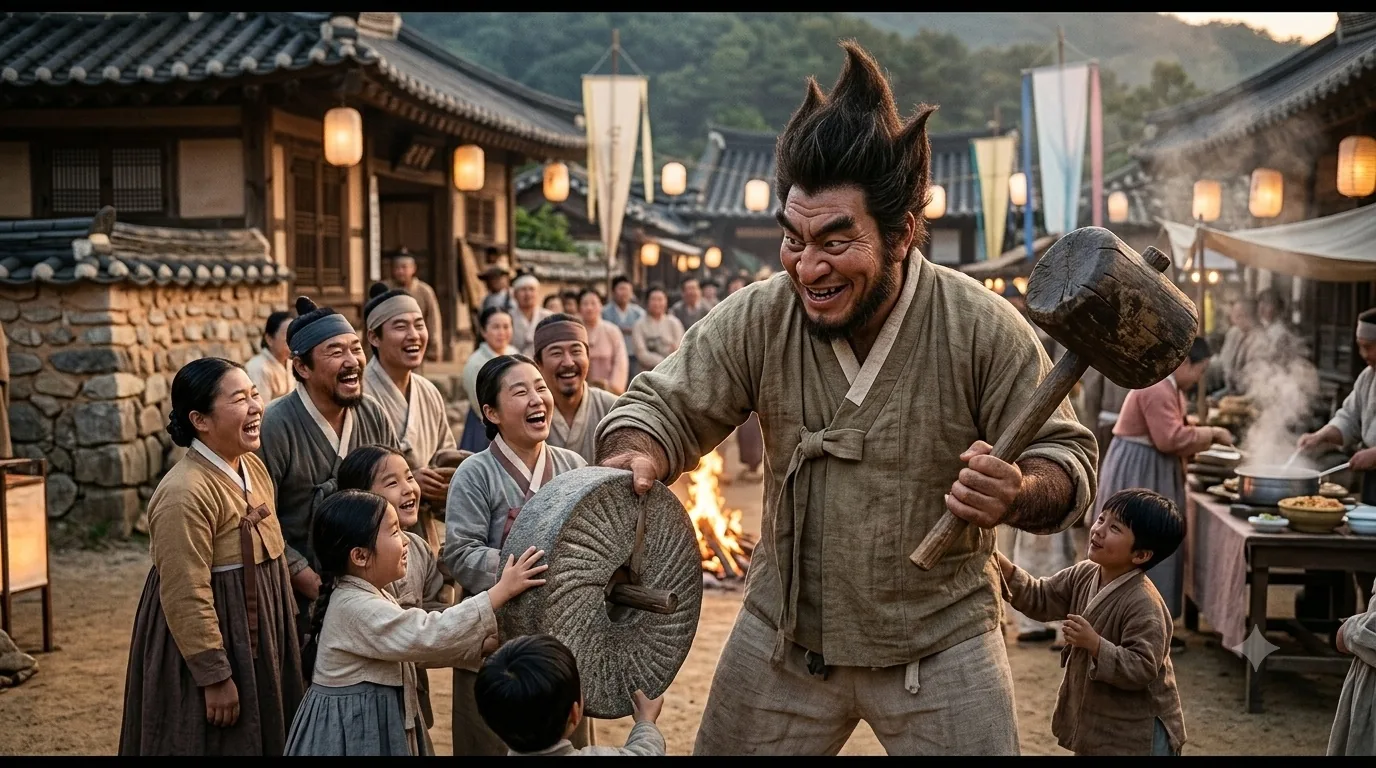 A dokkaebi as the folktales tend to describe him — powerful, unruly, close to the village, and still no match for human wit. (AI illustration)
Quick answer: A dokkaebi (도깨비) is not simply the Korean equivalent of a Western goblin. It is a shifting figure in Korean folklore that may appear as a trickster, a mysterious fire, a transformed object, a powerful human-like being, or a spirit addressed through communal rites. “Goblin” works as shorthand, but it carries modern fantasy associations that narrow the Korean idea. In the folktales dokkaebi love games and wrestling and can be outwitted; in other traditions they are blamed for fire, illness and possession.
So what is a dokkaebi?
Start by giving up on a one-line definition. The Encyclopedia of Korean Culture records dokkaebi turning up as transformed natural objects, as transformed everyday implements, as fire, in human-like form, and as figures addressed in worship (Encyclopedia of Korean Culture, 도깨비). That range is not sloppiness in the sources — it is what the tradition actually looks like.
What most people picture comes from the folktale strand. There, a dokkaebi is close to a trickster: fond of play, songs, riddles and Korean wrestling (씨름), strong but slow-witted, and — crucially — beatable. Ordinary villagers outwit dokkaebi and walk away better off. That is a very different emotional register from “monster.”
But the same tradition has a darker register that rarely survives translation. Dokkaebi were also held responsible for fires, for illness, for possession — and communities responded with ritual. The National Folk Museum’s Encyclopedia of Korean Folklore documents dokkaebi-je (도깨비제) and dokkaebi-gut (도깨비굿), rites performed to drive off sickness and to keep fire away. A being you hold a ritual for is not simply a comic figure.
The famous dokkaebi bangmangi (도깨비방망이) belongs to this same partial picture. It is not standard equipment for all dokkaebi. It is a marvellous club that appears in particular tales, producing treasure or goods on demand — “Gold, come out!” — and it stuck in the popular imagination precisely because those tales are the ones retold to children.
Why “Goblin” is an approximation, not a mistranslation
The problem is not that “goblin” is wholly wrong. It is that the English word arrives carrying cultural associations of its own.
When a modern English speaker meets the word goblin, a fairly specific image tends to load — small, ugly, furtive, malicious. That association is real, but it belongs largely to modern English-language popular culture and fantasy. Goblins in older European folklore were far more varied than the contemporary image suggests, and scholarship on the early modern British fairy tradition shows these categories shifting by period, region and text rather than sitting still.
So “Goblin” is not a blunder. It is a conventional approximation that fails to carry the cultural weight of the original — which is a different and more interesting problem.
The title situation reflects this. The official English title used by CJ ENM and the major streaming services is Guardian: The Lonely and Great God — yet internationally the drama is still widely known as Goblin. And while Guardian better fits Kim Shin’s role in the drama — he protects people — it would be a mistake to read that backwards into the folklore and conclude that dokkaebi in general were noble guardian spirits. The official title is a fact about the show. It is not a folkloric verdict.
Drama vs history
| In Guardian | In the folklore record |
|---|---|
| A single, consistent being: the dokkaebi, Kim Shin | A wide range of forms — transformed natural objects, transformed implements, fire, human-like figures, objects of ritual |
| Noble, melancholy, protective | Often playful and easily outwitted in tales; elsewhere blamed for fire, illness and possession |
| Human in appearance, romantic lead | No single established appearance; the familiar horned image is a modern publishing convention, and its origins are debated |
| Immortal Goryeo general with a cursed sword | An invented character; no documented folkloric antecedent for the sword |
| The club is barely present | The wish-granting club belongs to specific tales, not to dokkaebi as a class |
In short: the drama takes one strand of a much wider tradition and builds a romantic hero out of it — which is what good fantasy does, and which is exactly why the English label can narrow the figure before the story gets a chance to explain it.
Where do dokkaebi come from? One tradition among several
The idea that captured me when I first read about dokkaebi — and the one I have to state more carefully now — is that some of them used to be objects.
Korean folklore does record this. Worn-out brooms, pokers, straw shoes, pestles, sieves, cauldrons, broken dishes and cushions turn into dokkaebi in the tales. A local tradition collected in Gunpo features specifically a blood-stained broom that becomes one; implements marked by long human handling, or by a woman’s blood, recur in these accounts.
You can reasonably read this as animist — as the idea that ordinary, well-used things carry a latent spirit. But that is an interpretive frame that folklorists apply, not a category the tellers themselves used, and the object-origin tales do not all come from a single unified worldview.
It is tempting to go one step further and say that object-origin explains why dokkaebi feel domestic rather than wild, and tricksterish rather than predatory. Each of those observations holds up on its own. The causal link between them does not — that inference is mine, and the folklore does not make it.
The eerie lights called dokkaebi-bul (도깨비불) belong here too, with the same caution. Institutional dictionaries record strange lights appearing at night over graves, damp ground and fields, often bluish, and in some regions tied to agricultural divination. Colour and setting vary by region. They are frequently compared to the European will-o’-the-wisp — a useful translation, as long as “compared to” doesn’t quietly become “the same as,” since the two traditions differ in explanation and meaning.
The horns question: why so many dokkaebi looked Japanese
Here is the part the drama cannot show you, and the part where the history gets genuinely contested.
Through much of the twentieth century, Korean schoolbooks and children’s picture books drew the dokkaebi with horns and an iron studded club — an image visually close to the Japanese oni (鬼). That this oni-style image was reproduced over and over in Korean publishing is well documented.
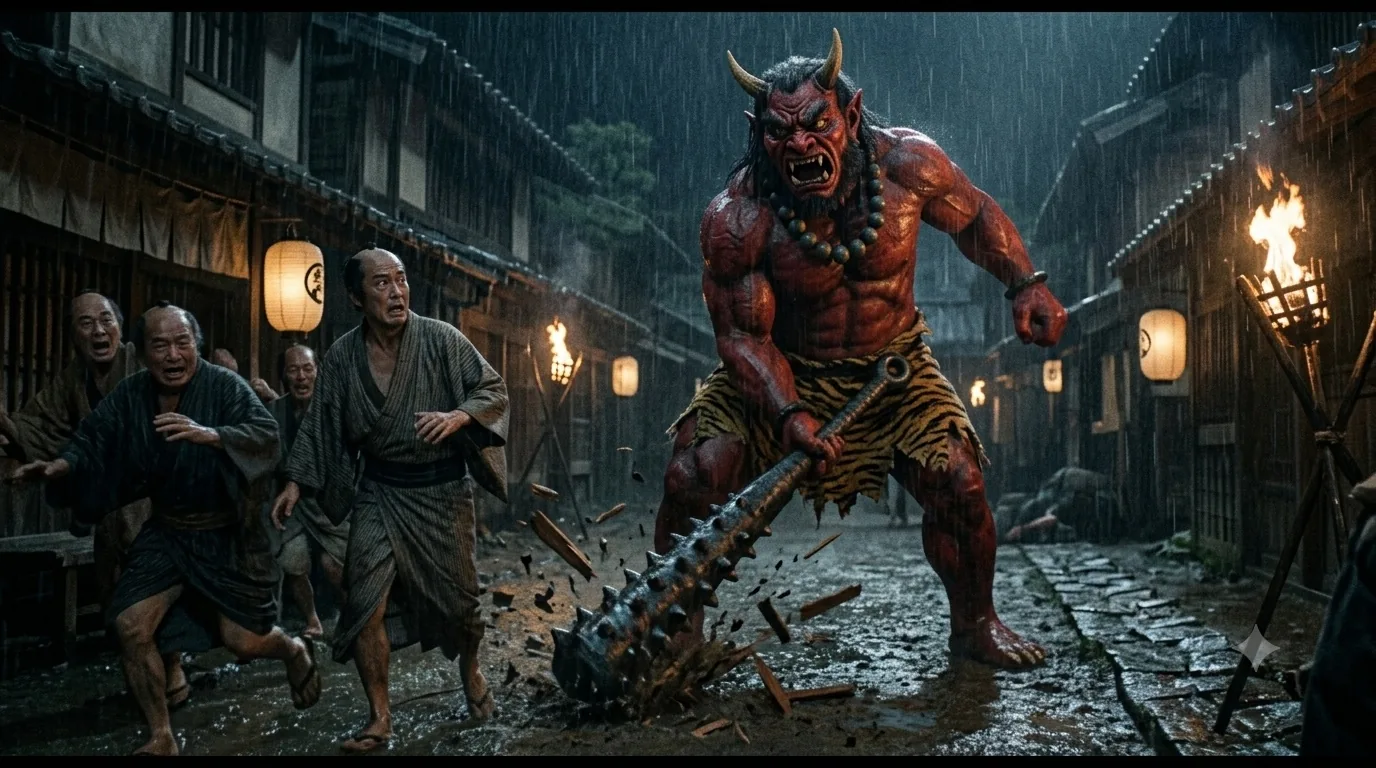 The Japanese oni: horns, fangs, tiger-skin, spiked iron club. For much of the twentieth century, Korean schoolbooks drew dokkaebi like this. (AI illustration)
Why is another matter, and this is where the popular version overreaches. It is often said flatly that the Japanese colonial authorities replaced Korea’s own dokkaebi with the oni. Research does connect colonial-period reader illustrations to oni iconography — so this is not invented — but it is not a single settled consensus. Park Mi-kyung (2020) argues that deliberate cultural imposition alone cannot account for it, and gives real weight to the post-liberation period: the informal inflow of Japanese visual culture, publishing, manga and animation, and the Korean publishing industry’s own repetition of the template. Lee Hyeok-jin (2023) goes further, critically re-examining the blanket “horned dokkaebi are all a Japanese fabrication” discourse.
The honest summary is a sequence, not a single act: colonial-era textbook illustration, then post-liberation influx of Japanese visual media, then decades of domestic reproduction. Whether the fangs, spiked club and tiger-skin loincloth were common across Korean publishing — as opposed to being the standard oni kit — would need actual editions and illustrations on the table to claim.
The Old Man with the Lump (혹부리 영감) is usually offered as the clinching evidence, and it doesn’t clinch. The Korean and Japanese versions do share the lump-removed / lump-added structure. But this tale type is distributed widely around the world, and Jang Jeong-hui’s comparative analysis identifies narrative elements distinct to each version. The Encyclopedia of Korean Culture itself sets out both the Japanese-transmission theory and the indigenous-Korean theory. A resemblance is not a direction of travel.
Since the 1990s, Korean children’s publishing has visibly moved away from the uniform oni template toward more varied folkloric forms. It is worth being precise about what that is: not the recovery of a lost true appearance — none was ever established — but a move away from a single dominant image toward the range the tales actually contain.
Spirits around the world — same impulse, different furniture
Once you see how unfixed the dokkaebi is, the comparisons get more interesting, provided we keep them as comparisons.
Japan — oni and tsukumogami. The oni (鬼) is the fierce one: horned, fanged, a demon-ogre much closer to what English-speaking audiences mean by “monster.” The more useful rhyme with the dokkaebi is the tsukumogami (付喪神), an old implement that stirs into a spirit. The tidy modern formula — a hundred years and any object wakes up — is a simplification; the historical sources are not uniform, as Lillehoj’s work on Japanese scrolls shows. Object-animation is a shared motif between the two traditions. It is not evidence of transmission or common origin, and I’m using “cousins” as a figure of speech rather than a claim of descent.
China — yaoguai. In a range of Chinese narrative and literary traditions — the zhiguai and chuanqi tales, the later gods-and-demons novels — animals, plants and objects transform after long cultivation or accumulated essence. That is a real and rich strand. It is not the whole of Chinese demonology: the terms 妖, 怪, 精, 鬼 and 魔 shift in meaning across periods and texts.
Europe — goblin, fairy and the rest. No single European figure maps onto the dokkaebi, and the categories themselves are less tidy than modern fantasy suggests. Goblin and fairy vary widely by period, region and author rather than sitting at fixed points on a good–evil scale, and while “demon” reads as straightforwardly evil in modern English and Christian usage, that does not extend back to the Greek daimōn. Enchanted, cursed and moving objects do appear in European folklore, and household spirits are well attested — so the sharpest version of the contrast, that Europe never imagines an object waking up, is simply not true.
What can be said is narrower and still worth saying: the systematic naming of aged implements as a category of spirit is far more developed in Japanese, and present in Korean, tradition than in European folklore. That is a difference of emphasis, which is what most honest cultural comparisons come down to.
So what is Kim Shin, then?
An invention — and a good one.
Kim Shin is a Goryeo general who becomes immortal, carrying the blade that killed him. There is no documented folkloric antecedent for that sword, and the production has not published a folkloric rationale for the character’s design.
He can be read as the last and most romantic descendant of a very old Korean idea — that the line between things, spirits and people was always thinner than the West assumed. I like that reading. But it is a reading of a fictional character, not a line of inheritance anyone has traced.
What is true is smaller and sturdier: a drama that could have reached for horns and a spiked club reached instead for something stranger and more human — and in doing so landed closer to the variety the folklore actually holds than the schoolbook picture ever did.
Coming up next
One approximate word — goblin — and we have travelled from a worn-out broom in Gunpo to a blue light over a field, to a colonial-era reader, to a Japanese scroll, to an argument Korean scholars are still having. That is the quiet gift of a good fantasy drama: even its monsters have a historiography. Next time, we’ll open another door.
Frequently asked questions
Is the “Goblin” in the K-drama really a goblin? Not in the sense most English speakers picture. The Korean word is dokkaebi (도깨비), a being of Korean folklore appearing across a wide range of forms and temperaments. “Goblin” is a conventional approximation carrying modern fantasy associations — small, ugly, sneaking — that do not match the figure in the drama. The official English title used by CJ ENM and the major streaming services is Guardian: The Lonely and Great God, although the drama remains widely known internationally as Goblin.
What exactly is a dokkaebi? There is no single definition. The Encyclopedia of Korean Culture describes dokkaebi appearing as transformed natural objects, transformed household implements, mysterious fires, human-like figures, and objects of worship. In many folktales they are playful and easily outwitted — fond of games, riddles, songs and Korean wrestling. In other traditions they are blamed for fires, illness and possession, and were addressed through ritual.
Do dokkaebi really come from old objects like brooms? That is one origin tradition among several, not the definition. Korean folklore does record everyday implements turning into dokkaebi — brooms, pokers, straw shoes, pestles, sieves, cauldrons, broken dishes — and a local tradition from Gunpo specifically features a blood-stained broom. But dokkaebi also appear as transformed natural objects, as fire, and in human form.
Why are dokkaebi so often drawn with horns and fangs? Because a horned, iron-club-wielding image close to the Japanese oni was reproduced repeatedly in Korean publishing through the twentieth century. How it got there is debated. Some research connects it to colonial-period reader illustrations; Park Mi-kyung argues deliberate cultural imposition alone cannot explain it and emphasises the post-liberation influx of Japanese visual culture, while Lee Hyeok-jin critically re-examines the blanket claim that horned dokkaebi are a Japanese colonial fabrication.
Is The Old Man with the Lump (혹부리 영감) a Japanese story? Its origin is not settled. The Korean and Japanese versions share the lump-removed / lump-added structure, but the tale type is distributed widely around the world, and Jang Jeong-hui’s comparative work identifies distinct narrative elements in each. The Encyclopedia of Korean Culture presents both the Japanese-transmission theory and the indigenous-Korean theory, so the resemblance is not proof of one-way colonial import.
What is dokkaebi-bul (도깨비불)? A strange light said to appear at night — over graves, damp ground and fields. Institutional folklore dictionaries record the nocturnal setting and a bluish glow, and in some regions connect the lights to agricultural divination. Colour and location are not uniform across regional traditions. It is often compared to the European will-o’-the-wisp, though the two differ in explanation and cultural meaning.
How does a dokkaebi compare to a Japanese oni or tsukumogami? The oni is the fierce horned ogre-demon. The tsukumogami is the closer comparison — an old implement that stirs into a spirit, commonly explained as happening after a hundred years, though historical sources are not uniform on that point. Object-animation is a shared motif in both traditions, but no direct transmission or common origin has been established.
Is Kim Shin a “more authentic” dokkaebi than the horned ones? That is a reading rather than a documented fact — and it is mine. Kim Shin is an invented character, a Goryeo general made immortal. Korean publishing has moved since the 1990s away from the uniform oni-style image toward more varied folkloric forms, but no single “true” historical appearance was ever established, and the production has not published a folkloric rationale for his design.
Sources & further reading
- Encyclopedia of Korean Culture (한국민족문화대백과사전) — 도깨비, 도깨비 설화, 혹부리 영감 설화
- Encyclopedia of Korean Folklore, National Folk Museum of Korea (한국민속대백과사전) — 도깨비불, 도깨비제, 도깨비굿
- 박미경, 『한국의 도깨비 — 도깨비를 통해 본 한국의 시각문화』, 고려대학교출판문화원, 2020
- 박미경, 「1990년대 이후 한국 아동 출판에 나타난 도깨비 시각 표상의 변화」, 『방정환연구』 5-2, 2023
- 이혁진, 「도깨비에게는 뿔이 없었을까: 도깨비 뿔 담론으로 본 한국학 방향에 대한 고찰」, 『한국학연구』 85, 2023
- 장정희, 「『혹부리 영감』譚의 한·일 간의 설화소 비교와 원형 분석」, 『한국학논집』 48, 2012
- 박준·김지인·남현우, 「한국 설화를 기반으로 한 사물형 도깨비 캐릭터 개발」, 『디지털디자인학연구』 15-2, 2015
- 군포문화관광 — 「피 묻은 빗자루가 변한 도깨비」 (원자료 『대야동마을지』, 2008)
- Elizabeth Lillehoj, “Man-Made Objects as Demons in Japanese Scrolls,” Asian Folklore Studies 54-1, 1995
- Ronald Hutton, “The Making of the Early Modern British Fairy Tradition,” The Historical Journal 57-4, 2014
- Matt King, A History of Goblins, Palgrave Macmillan, 2026
Thanks for reading — see you in the next one.
This article was researched and written by K-Drama History. Source: Guardian, Explained: What a Korean Dokkaebi Really Is — and Why 'Goblin' Doesn't Quite Fit — K-Drama History