Why Does Along with the Gods Have Seven Afterlife Trials? Korea's Ten Kings and 49-Day Judgment Tradition, Explained
Theme: Belief, Death & the Uncanny
From the research behind Pause the Drama.
In Along with the Gods: The Two Worlds (신과 함께 - 죄와 벌, 2017), the premise is clear before the opening credits settle. A man dies. He has forty-nine days. He must pass through seven courts of judgment — Murder, Indolence, Deceit, Injustice, Betrayal, Violence, Filial Impiety — one after another. If he clears all seven, he earns reincarnation. If he fails even one, he stays.
Released on December 20, 2017, the film crossed ten million admissions on January 4, 2018 — its 16th day in theaters — and went on to sell more than 14.4 million tickets, one of the highest totals in Korean box-office history (Korean Film Council). Part of its power was simply structural: seven sequential trials is a dramatically efficient machine, with a new accusation, a new defense, and a new verdict at regular intervals. But the deeper reason Korean audiences found the setup familiar is that it was not invented. The tradition of post-death judgment conducted by presiding kings, organized around specific categories of sin, and subject to the influence of living relatives — is a real feature of Korean and broader East Asian Buddhist belief, centuries old.
So where did it come from? And why seven?
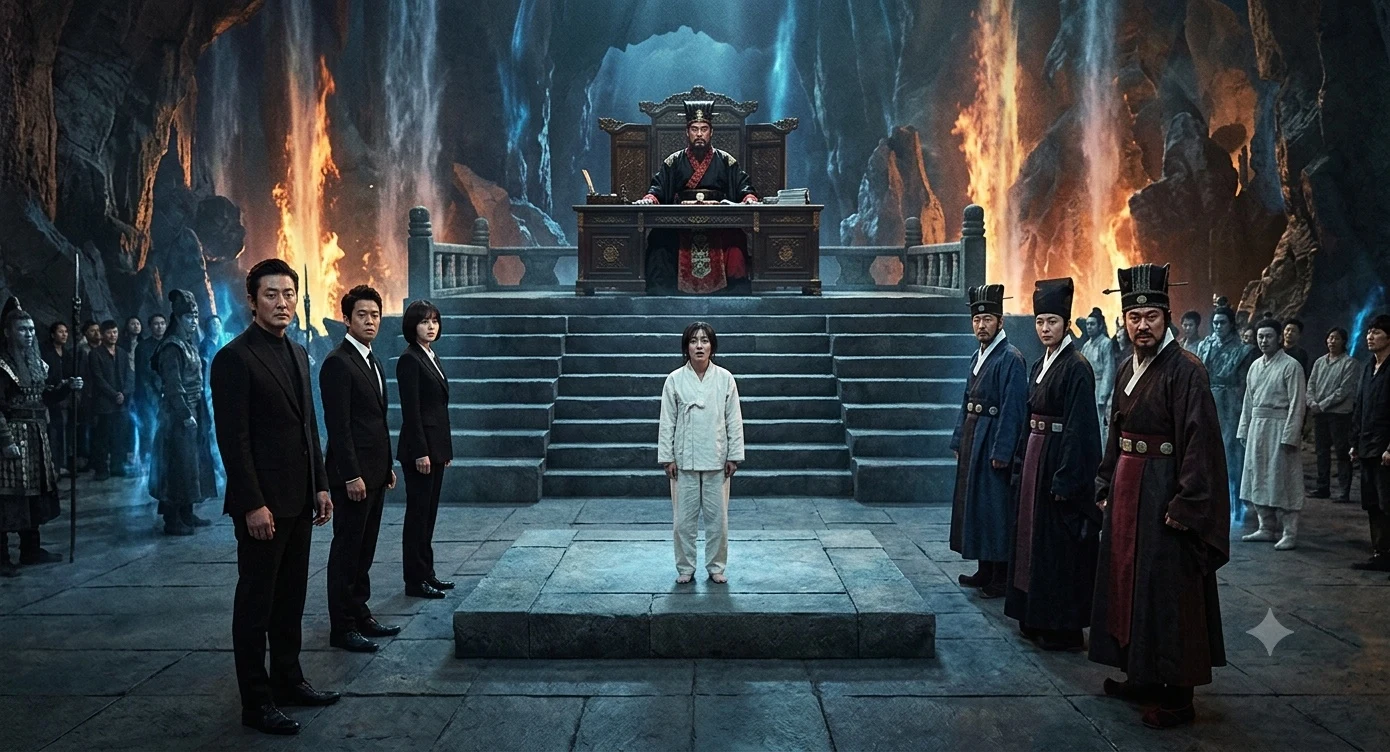
Quick answer: The seven-trial afterlife in Along with the Gods is a creative adaptation of the siwang sinang (十王信仰), the East Asian Buddhist “Ten Kings of Hell” tradition, filtered through the forty-nine-day mourning ritual (49-jae) central to Korean Buddhist practice after death. The Ten Kings tradition places the dead before ten successive courts over a period following death; the film’s webtoon author, Joo Ho-min, took seven of those courts and aligned them with the forty-nine-day calendar (seven days times seven courts equals forty-nine). The underlying belief system — that the dead face a legal-style judgment, that specific categories of wrongdoing are assessed separately, and that the living can help the dead through ritual — has roots in Tang and Song Dynasty China and entered Korea through centuries of Buddhist transmission. It is not merely a fantasy framework; it describes, in dramatized form, what many Korean families believed and practiced for generations.
Where does the forty-nine-day, seven-court structure come from?
The tradition at the center of Along with the Gods is called siwang sinang (十王信仰) — the “Ten Kings Belief.” It is a system of post-death judgment developed within East Asian Buddhism, elaborated primarily during the Tang and Song Dynasties in China, and transmitted to Korea and Japan through Buddhist monastic and textual networks. Strictly speaking, though, the Ten Kings system is not “early Buddhism” in a pure doctrinal sense: it is an East Asian religious formation shaped by Buddhism, Daoist underworld bureaucracy, and local folk belief — which is part of why it took such dramatic hold in the Korean imagination.
The Ten Kings (시왕, 十王) are ten rulers of the underworld, each presiding over a specific judgment court associated with a particular category of wrongdoing. It is tempting to build a neat table — this king judges murder, that one theft, another lying — but the primary sources resist it: the precise assignment of which king handles which category of sin varies across texts, Buddhist paintings, and regional ritual traditions, and even the tenth king’s name shifts between sources (도시왕, 오도전륜왕, 전륜왕). No single sin-to-king mapping should be treated as fixed. What is consistent is the structure: the deceased moves through each king’s court in sequence, facing a new moral reckoning at each stage. Surviving Goryeo-era Ten Kings paintings — examples are held at the Cleveland Museum of Art and Harvard Art Museums — show how elaborately the tradition was already being illustrated by the late 1300s. In the classic formulation, the full sequence unfolds over one hundred days following death.
The forty-nine-day framework in the film aligns specifically with 49-jae (사십구재) — the Buddhist ritual performed on the forty-ninth day after death. The logic of this ritual comes from the Mahayana Buddhist concept of the intermediate state (中有, jungyu, or 中陰身, jungeumshin): after death, a person does not immediately enter the next life. They occupy a suspended, “in-between” existence for up to forty-nine days while the karmic circumstances of the next birth are being resolved. The concept appears across several Mahayana texts in the Chinese Buddhist canon; scholars continue to examine which texts first made the forty-nine-day figure explicit.
This is not something the Buddha is recorded as having taught directly at the outset. Its clearest early articulation is traced to the Abhidharma Mahāvibhāṣā (아비달마대비바사론, vol. 70), a Sarvāstivāda scholastic treatise, which holds that the intermediate being lingers “at most seven times seven — forty-nine — days” before it must take a new birth; from there the figure fused with the East Asian 49-jae tradition. During this intermediate period, living relatives perform memorial rites every seven days — seven rites over seven weeks adds up to forty-nine days. The film’s webtoon source mapped seven of the traditional ten courts onto those seven memorial occasions. The result is creative adaptation rather than scriptural reproduction: the sin categories Joo Ho-min assigns to each court — Murder, Indolence, Deceit, and so on — do not map exactly onto the traditional siwang assignments. But the structural logic — sequential courts, categorical judgment, forty-nine days, the living’s rites affecting the outcome — is authentically rooted in Korean religious practice.
Who is Ksitigarbha, and why does he matter in the Korean afterlife?
The guardian figures who accompany the hero through the courts in Along with the Gods, acting as defense counsel, echo a real figure in the Korean Buddhist tradition: Jijang Bosal (지장보살), the Korean name for the bodhisattva Ksitigarbha (Sanskrit).
A bodhisattva in Mahayana Buddhism is an enlightened being who has chosen to remain within the cycle of death and rebirth, rather than passing into final nirvana, specifically in order to help other beings reach liberation. Ksitigarbha’s vow, as formalized in the Ksitigarbha Bodhisattva Fundamental Vow Sutra (지장보살본원경), is among the most extreme of all bodhisattva commitments: he pledged not to attain Buddhahood until every being in hell had been liberated. This makes him the patron bodhisattva of the dead, the underworld, and those who might otherwise be beyond saving.
The Ksitigarbha Fundamental Vow Sutra is traditionally said to have been translated in the 7th century by Śikṣānanda of Khotan, but the dominant scholarly view treats it as an apocryphal sutra (위경, 僞經) — most likely compiled in China between the Song and Ming periods rather than translated from an Indian original (Encyclopedia of Korean Culture). “Apocryphal” here is a text-historical term, not a verdict of fakery: it marks a scripture that took shape within the East Asian Buddhist world rather than descending directly from a Sanskrit source. What is not in question is that it was transmitted to Korea and Japan and became foundational to East Asian underworld iconography, where Ksitigarbha appears in hell paintings and temple sculpture as the intercessor who stands between the condemned and annihilation.
In Joseon Korea, this tradition ran up against the dynasty’s official policy of suppressing Buddhism (抑佛, eokbul) — and the real story is more precise than “it survived quietly.” The 49-day rite was never institutionalized as a state funeral in its own right. Instead, the royal Buddhist memorial rites — the chilchiljae (칠칠재, the “seven sevens,” i.e. 49-jae) among them — were absorbed into the state-sanctioned suryukjae (水陸齋, the Water-and-Land rite), which King Taejo systematized as a state ceremony held twice a year. When members of the deposed Goryeo royal Wang line were executed in 1394, suryukjae were performed the following year at temples including Samhwasa to guide their spirits. But this official standing did not hold: as the Neo-Confucian literati rose, the state Buddhist rites were rolled back — the last royal chilchiljae, held for Queen Dowager Insu, took place in 1504, and the royal memorial rite (gisinjae) was permanently abolished in 1516 (Encyclopedia of Korean Culture, Gukhaeng suryukjeon). After that, the 49-jae and related rites lived on in temples and among ordinary families rather than as state ceremony. That they persisted at all, through centuries of official hostility, testifies to how deeply the tradition had rooted itself in popular Korean consciousness about death, judgment, and what the living owed the dead.
Drama vs. traditional belief — what does Along with the Gods adapt?
| In Along with the Gods (2017 film) | In traditional Korean and Buddhist belief |
|---|---|
| Seven courts of judgment | Traditional siwang sinang has ten courts and ten kings |
| Forty-nine-day framework | Directly matches the 49-jae mourning calendar (7 × 7 days) |
| Guardian figures acting as defense lawyers | Echoes Ksitigarbha’s intercessory role; not a direct scriptural character |
| Each court specializes in a specific sin | Traditional: each king handles specific categories; exact assignments vary by source |
| Living family’s rites affect the outcome | Matches the core logic of 49-jae: living ritual helps the deceased |
Key terms. Siwang sinang (十王信仰) — the East Asian Buddhist “Ten Kings of Hell” tradition; each of the ten kings presides over a specific judgment court. 49-jae (사십구재) — the forty-ninth-day Buddhist memorial ritual; structured around the intermediate-state period of forty-nine days between death and the next rebirth. Jungyu / Jungeumshin (中有·中陰身) — the Buddhist “intermediate state” between death and rebirth; the theological basis for the forty-nine-day framework. Jijang Bosal (지장보살) — Ksitigarbha in Korean; the bodhisattva who vowed to remain in the underworld until all hell-beings are saved; the central intercessory figure in Korean afterlife belief. Eokbul (억불) — the Joseon Dynasty’s policy of suppressing Buddhism; the 49-jae ritual continued in popular practice despite it.
Death and judgment across cultures — how the Korean afterlife compares
The idea that death triggers a formal judgment — conducted before designated judges, with a record of deeds, specific categories of sin, and a verdict determining what follows — is one of humanity’s most persistent narrative frameworks. The details, as always, are the whole point.
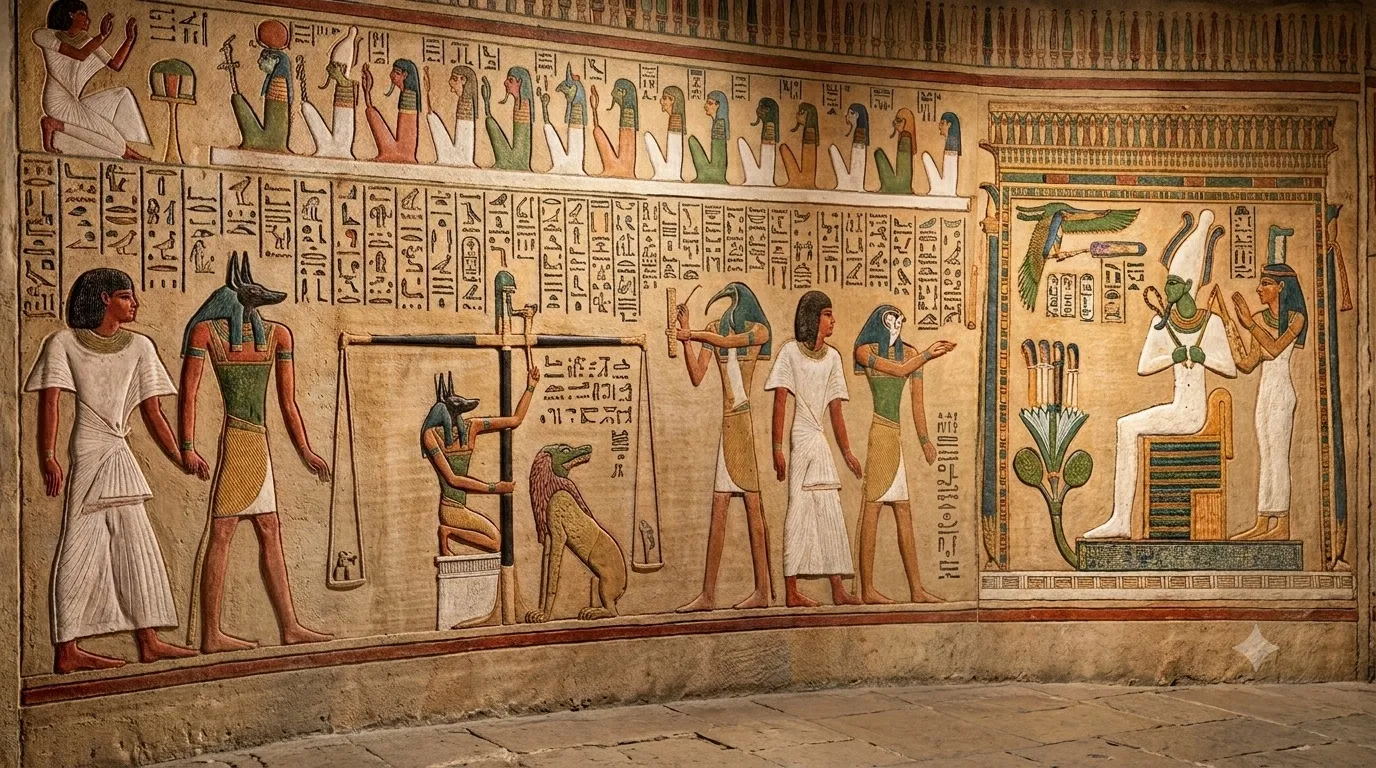
Ancient Egypt — the Weighing of the Heart. The Egyptian tradition, attested from the Old Kingdom through the New Kingdom in texts including the Book of the Dead, placed the deceased before the court of Osiris in the realm of Duat (the underworld). The deceased’s heart was weighed against the feather of Maat (divine truth). The god Anubis managed the scales; the ibis-headed Thoth recorded the result. If the heart proved heavier than the feather — burdened by wrongdoing — the monster Ammit consumed it and the soul was annihilated. If it balanced or weighed less, the deceased entered the Field of Reeds. The Egyptian system is a single judgment rather than a sequential series of courts, but it shares with the siwang tradition the logic of a formal weighing, a record-keeper, and a consequential verdict.
Catholicism — purgatory and the two judgments. Catholic teaching distinguishes between the Particular Judgment that occurs immediately after an individual’s death, and the Last Judgment that concludes history. Souls assessed as neither fully righteous nor fully damned enter purgatory, where they undergo purification before reaching heaven. The Council of Trent (1545–1563) affirmed that the prayers of the living, masses offered for the dead, and indulgences can help shorten a soul’s time in purgatory. This is structurally parallel to the 49-jae logic: the living can help the dead. Both traditions extend agency across the boundary of death — a feature neither the Egyptian judgment nor the Japanese Obon tradition provides in quite the same form.
Japan — Buddhism and Shinto in parallel. Japan received the siwang sinang tradition through the same Buddhist transmission channels as Korea, and Ten Kings iconography appears extensively in Japanese temple art. But Japan’s native tradition — Shinto’s concept of Yomi no Kuni (黄泉の国, the Land of the Dead) — runs alongside Buddhist afterlife belief rather than fully merging with it. A distinctive Japanese ritual tradition is Obon (お盆), the late-summer festival in which the spirits of ancestors are believed to return to the living world for three days before being guided back. This creates a fundamentally different relationship with the dead than the Korean 49-day linear judgment model: in Obon, the boundary between living and dead is permeable and cyclical, with the deceased returning periodically to visit rather than progressing irreversibly through a verdict system.
Coming up next
Seven courts, forty-nine days, a bodhisattva who refuses to give up on the damned, and a firefighter who turns out to deserve all seven chances. The tradition Along with the Gods draws on is not, in the end, a fantasy architecture — it is the map that Korean families have used for centuries to understand what to do, and what they can still do, in the forty-nine days after someone they love dies.
This series continues to explore Korean history through the dramas and films that bring it to life — from palace throne rooms to folk religion, from civil-service exams to ancient belief systems. See you in the next one.
Thanks for reading — see you in the next one.
Frequently asked questions
What is Along with the Gods: The Two Worlds about? Along with the Gods: The Two Worlds (2017) is a South Korean fantasy film based on Joo Ho-min’s webtoon. A recently deceased firefighter must pass through seven courts of the afterlife in forty-nine days, guided by three guardians who act as his defense lawyers. It became one of the highest-grossing Korean films of its era.
Are the seven hells in Along with the Gods based on real Korean tradition? The film draws on the real East Asian Buddhist tradition of the Ten Kings of Hell (siwang sinang), but the specific seven hells — murder, indolence, deceit, injustice, betrayal, violence, filial impiety — are a creative rearrangement by webtoon author Joo Ho-min. The traditional system has ten kings, not seven. The film adapts rather than directly reproduces the source tradition.
Is Along with the Gods religiously accurate? Not exactly. The film is not a direct reproduction of Buddhist scripture or temple ritual — it is a popular adaptation. It compresses the ten-king tradition into seven cinematic trials, aligns them with the forty-nine-day mourning calendar, and assigns its own set of sins to each court. The underlying framework — sequential judgment, the 49-day threshold, and the idea that the living can aid the dead — is authentic; the specific seven-court design is the webtoon author’s invention.
What is the 49-day ritual (사십구재) in Korean Buddhism? In Korean Buddhist belief, the forty-ninth day marks the end of the intermediate state (jungyu) between death and rebirth. Living relatives perform memorial rites every seven days for seven weeks to help guide the deceased toward a favorable next life. This forty-nine-day structure is the real calendar behind the film’s seven-court design.
What are the Ten Kings of Hell (시왕) in East Asian Buddhism? The Ten Kings are ten judges of the underworld, each presiding over a court associated with a specific category of sin. The system developed in Tang and Song Dynasty China and spread to Korea and Japan through Buddhist transmission. The assignment of specific sins to specific kings varies somewhat across sources and regional traditions.
Who is Ksitigarbha (지장보살, Jijang Bosal)? Ksitigarbha is a bodhisattva who vowed to remain in the underworld until every being in hell had been liberated. He is the primary intercessory figure of Korean and East Asian afterlife belief — a defender of the dead — whose role the film’s guardian characters echo. His tradition is formalized in the Ksitigarbha Bodhisattva Fundamental Vow Sutra, compiled in China, with scholarly debate continuing on whether it originated in India or China.
Is the 49-day ritual only for Buddhists in Korea? Formally it is a Buddhist practice, conducted at temples. In practice, the forty-ninth day as a significant mourning milestone has become culturally embedded in Korea beyond Buddhist affiliation. It survived even through Joseon’s official suppression of Buddhism — evidence of how deeply it had rooted itself in popular Korean conceptions of death and obligation to the dead.
How does the Korean forty-nine-day afterlife compare with Catholic purgatory? The most striking parallel is structural: both allow the living to help the dead. In the 49-jae tradition, living relatives’ rites can influence the deceased’s judgment. In Catholic teaching, prayers, masses, and indulgences can shorten purgatorial time. The theological frameworks are entirely different — Buddhist versus Christian — but the shared logic of extending living agency across the boundary of death is notable.
How many viewers did Along with the Gods attract in South Korea? Released on December 20, 2017, the first film crossed ten million admissions on January 4, 2018 — its 16th day in theaters — and finished with more than 14.4 million tickets sold, among the highest totals in Korean box-office history (Korean Film Council).
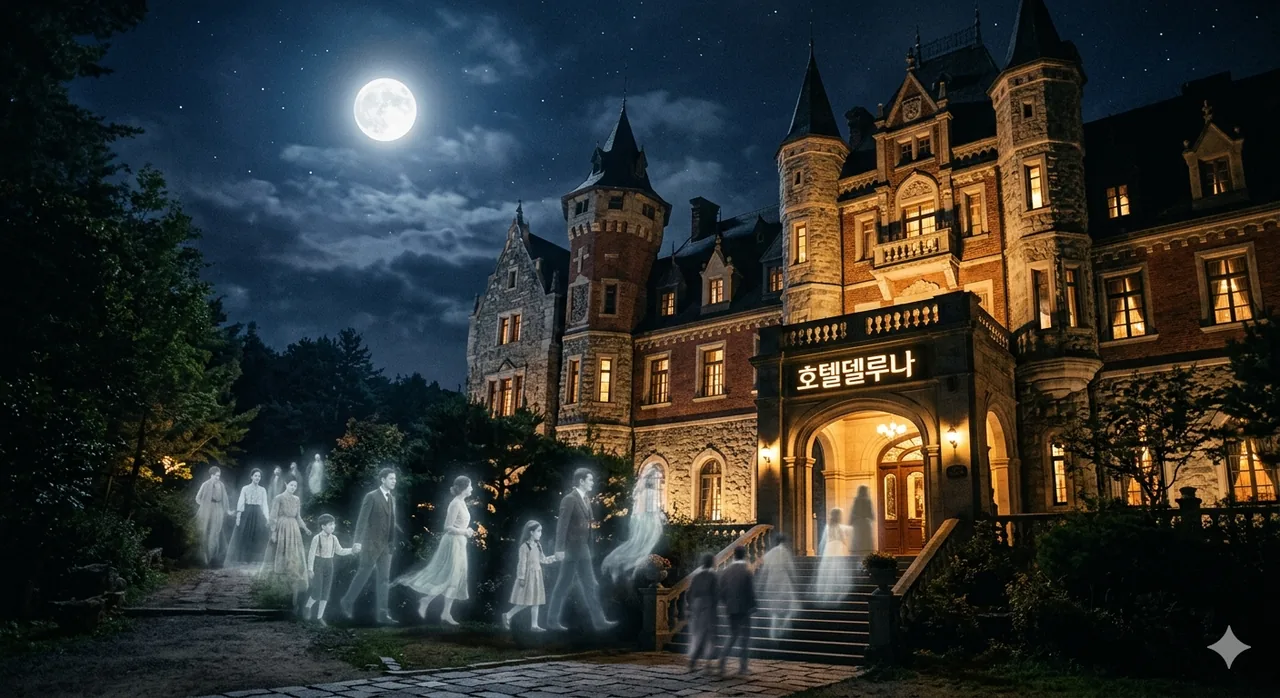
Why do Korean dramas show the grim reaper in a black hat? In modern Korean film and TV — Along with the Gods, Goblin, Hotel del Luna — the underworld envoy (저승차사, jeoseung chasa) appears in black robes and a black hat. But that look is largely a modern pop-culture convention. In older folklore, shamanic material, and Buddhist hell-paintings, the envoy was more often depicted as a soldier, a general, or a government official — a chasa (差使), an emissary dispatched to carry out the underworld’s orders, closer to a bailiff than a ghost. The black-hatted reaper is a 20th–21st-century visual crystallization, not an ancient fixed image.
Sources & further reading
This piece was written from the historical script and fact-check of 사뚱샘의 역사방 (SaDDungSam), drawing on Buddhist scholarship and official cultural-heritage databases:
- Siwang sinang (Ten Kings of Hell), 49-jae, Jijang Bosal (Ksitigarbha), and cheondobujae (memorial rites) — Encyclopedia of Korean Culture (Hanguk Minjok Munhwa Daebaekkwa, encykorea.aks.ac.kr): entries on siwang sinang (시왕신앙), sasisipgujae (사십구재), Jijang Bosal (지장보살), and cheondobujae (천도재).
- The Ksitigarbha Bodhisattva Fundamental Vow Sutra (지장보살본원경) — Encyclopedia of Korean Culture — pictorial entry (地藏菩薩本願經變相圖): traditionally ascribed to a 7th-century translation by Śikṣānanda, but the dominant scholarly view treats it as an apocryphal sutra (위경) compiled in China between the Song and Ming periods.
- The intermediate state (jungyu) and the forty-nine-day figure — its clearest early articulation is the Abhidharma Mahāvibhāṣā (아비달마대비바사론, vol. 70; Taishō 26, p. 530), a Sarvāstivāda treatise; see Dominic Rutana, “A Comparative Study of Death in Korean Buddhism and Daesoon Jinrihoe,” Daesoon Sasang Nonchong 40 (2022), pp. 155–185.
- Joseon Buddhism and the 49-jae absorbed into suryukjae — Encyclopedia of Korean Culture entry on Gukhaeng suryukjeon (국행수륙전): King Taejo systematized the Water-and-Land rite as a twice-yearly state ceremony; the last royal chilchiljae (for Queen Dowager Insu) was held in 1504 and the gisinjae abolished in 1516, after which 49-jae continued in temple and popular practice.
- Joo Ho-min, Along with the Gods (신과 함께) webtoon — author interviews have referenced the siwang sinang tradition as a source; the specific seven-hell structure is noted as his creative adaptation.
- Ancient Egyptian judgment of the dead (Weighing of the Heart) — Book of the Dead texts and Egyptological scholarship; used for structural comparison only.
- Catholic teaching on purgatory and intercession — Catechism of the Catholic Church, §1030–1041; Council of Trent, Session XXV (1563), decree on purgatory; used for structural comparison only.
- Japanese Obon tradition and its relationship to Buddhist afterlife belief — academic survey literature on Japanese religious studies; used for structural comparison only.
- Box office performance of Along with the Gods: The Two Worlds (2017) — Korean Film Council (KOFIC/KOBIS) — Integrated Cinema Ticket System, all-time box office: released December 20, 2017; crossed ten million on January 4, 2018; final total above 14.4 million admissions, among the highest in Korean box-office history.
Thanks for reading — see you in the next one.
This article was researched and written by K-Drama History. Source: Why Does Along with the Gods Have Seven Afterlife Trials? Korea's Ten Kings and 49-Day Judgment Tradition, Explained — K-Drama History