Jing-bi-rok, Explained: How Korea and Japan Went from Seven Years of War to Two Centuries of Tongsinsa Diplomacy
Theme: Power & Politics
From the research behind Pause the Drama.
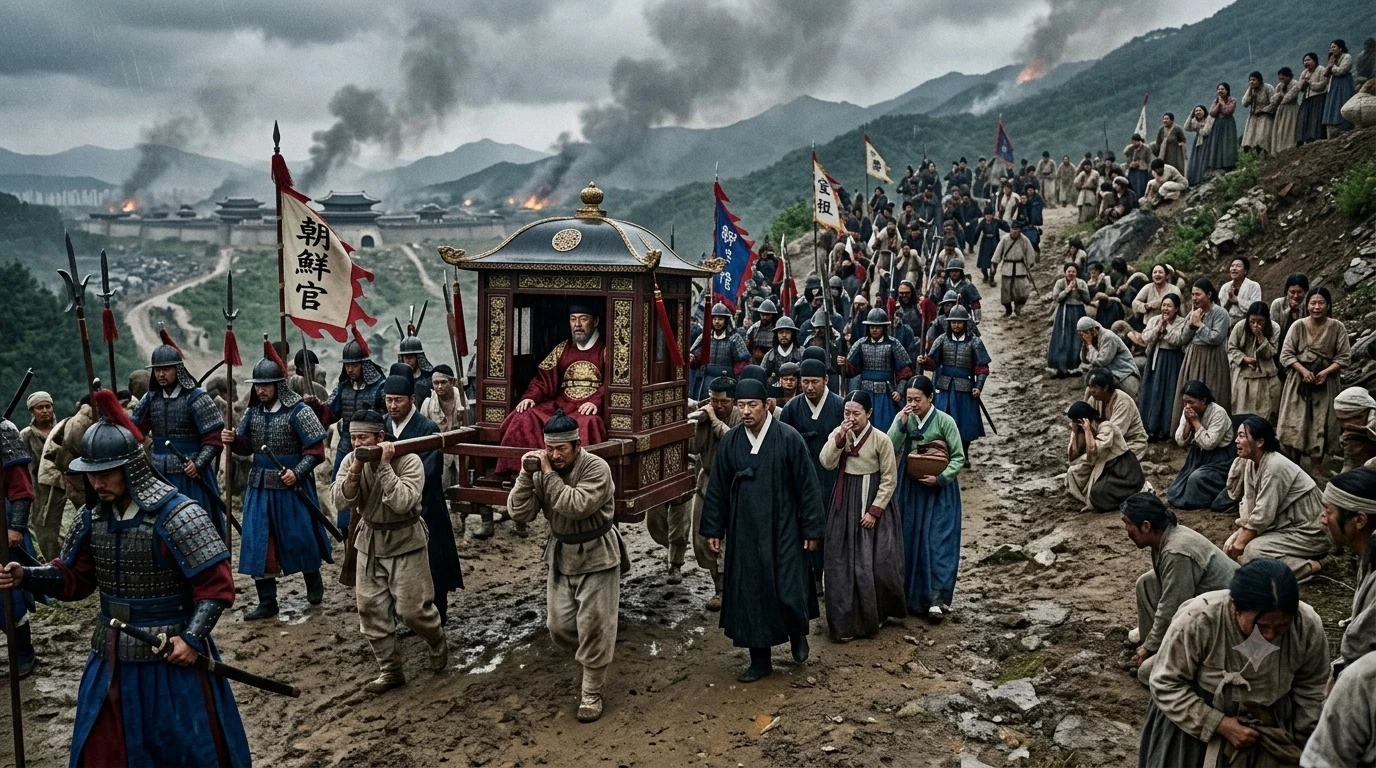
If you’ve watched KBS1’s sweeping 2015 epic Jing-bi-rok (징비록) — the story of the Imjin War told through the eyes of the statesman Yu Seong-ryong — you remember the dread that opens the whole thing. Before a single Japanese soldier crosses the strait, two Korean envoys come home from a fact-finding mission to Japan and stand before King Seonjo with completely opposite reports. One says war is certain. The other says there’s nothing to fear.
But here’s what the drama’s opening episodes don’t stop to spell out for international viewers. That mission was the last one Joseon sent to Japan before the invasion — and it was not the end of the story. Once the war finally burned itself out, Korea and Japan rebuilt formal diplomacy from nothing, and kept it running for two hundred years and twelve embassies.
Quick answer: In Jing-bi-rok, two Joseon envoys return from Japan in 1591 with opposite verdicts on whether Toyotomi Hideyoshi will invade — and the court sides with the reassuring one. The Imjin War (1592–98) followed. Afterward, Joseon and Japan’s new Tokugawa shogunate rebuilt relations from zero: Joseon sent twelve post-war embassies to Japan between 1607 and 1811 — conventionally grouped today under the history of the tongsinsa (通信使), though only the nine from 1636 onward officially carried that name. They carried royal letters, repatriated captives, and sustained one of pre-modern Asia’s longest diplomatic relationships.
Let’s unpack it.
Why did two envoys sent to the same country come home with opposite reports?
In 1590, King Seonjo dispatched a mission to Japan: Hwang Yun-gil (황윤길) as chief envoy, from the Western political faction, and Kim Seong-il (김성일) as vice-envoy, from the rival Eastern faction. Their job was simple in theory — assess whether Toyotomi Hideyoshi, who had just finished unifying a Japan torn apart by a century of civil war, intended to invade Korea.
The trip was tense before it even reached Japan. At Tsushima, the local lord breached protocol by riding his palanquin indoors during a banquet; Kim Seong-il stormed out in anger while Hwang Yun-gil stayed seated — a small moment that hints at how differently the two men were reading every signal. In Kyoto, they met Hideyoshi himself, received his reply letter, and sailed home.
When they returned to Hanyang in March 1591, the two men gave King Seonjo verdicts that could not have been further apart. Hwang Yun-gil warned that “there will certainly be military calamity,” describing Hideyoshi’s eyes as sparkling with courage and strategic wisdom. Kim Seong-il flatly disagreed: he said he “saw no such circumstances,” and dismissed Hideyoshi with a line that has echoed through Korean memory ever since — his eyes were like a rat’s, and he was not a man worth fearing (Seonjo Sujeong Sillok, Veritable Records of the Joseon Dynasty).
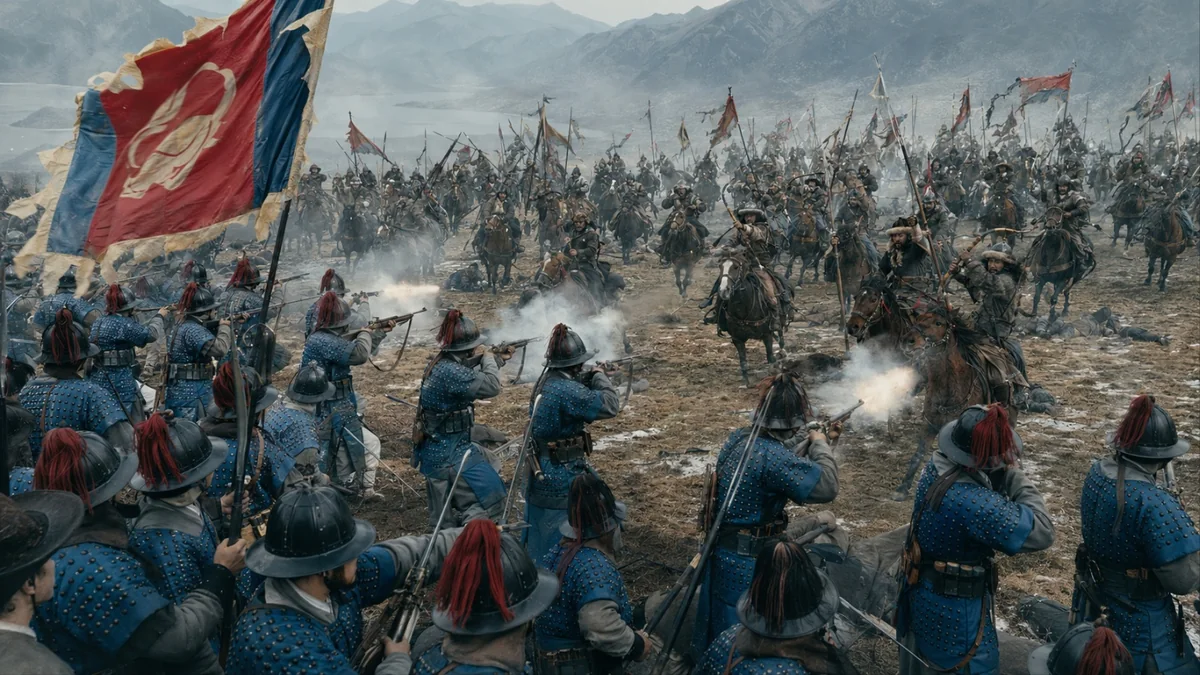
The court took the reassuring one. A year later, Hideyoshi’s armies landed at Busan and the Imjin War (1592–98) began.
It is tempting — and the drama invites you — to draw a straight line from Kim’s report to the catastrophe. The record resists that. Joseon did not simply down tools after the envoys spoke: fortification work, weapons inspections, and military preparation continued. What failed was broader and older than one report — the state of the fortifications, the burden the work placed on local populations, and the structural weakness of Joseon’s military system. Kim’s verdict is remembered as the emblem of that failure, not its sole cause.
The record adds a stranger, sadder wrinkle, too. Yu Seong-ryong — the real-life statesman Jing-bi-rok is centered on — recorded in his own memoir that Kim Seong-il later told him privately he had spoken with deliberate confidence to stop Hwang’s alarming report from disturbing the people’s minds, even though he personally thought an invasion was possible. He wasn’t only wrong. He was trying to manage a panic.
What happened to Korea and Japan’s relationship after seven years of war?
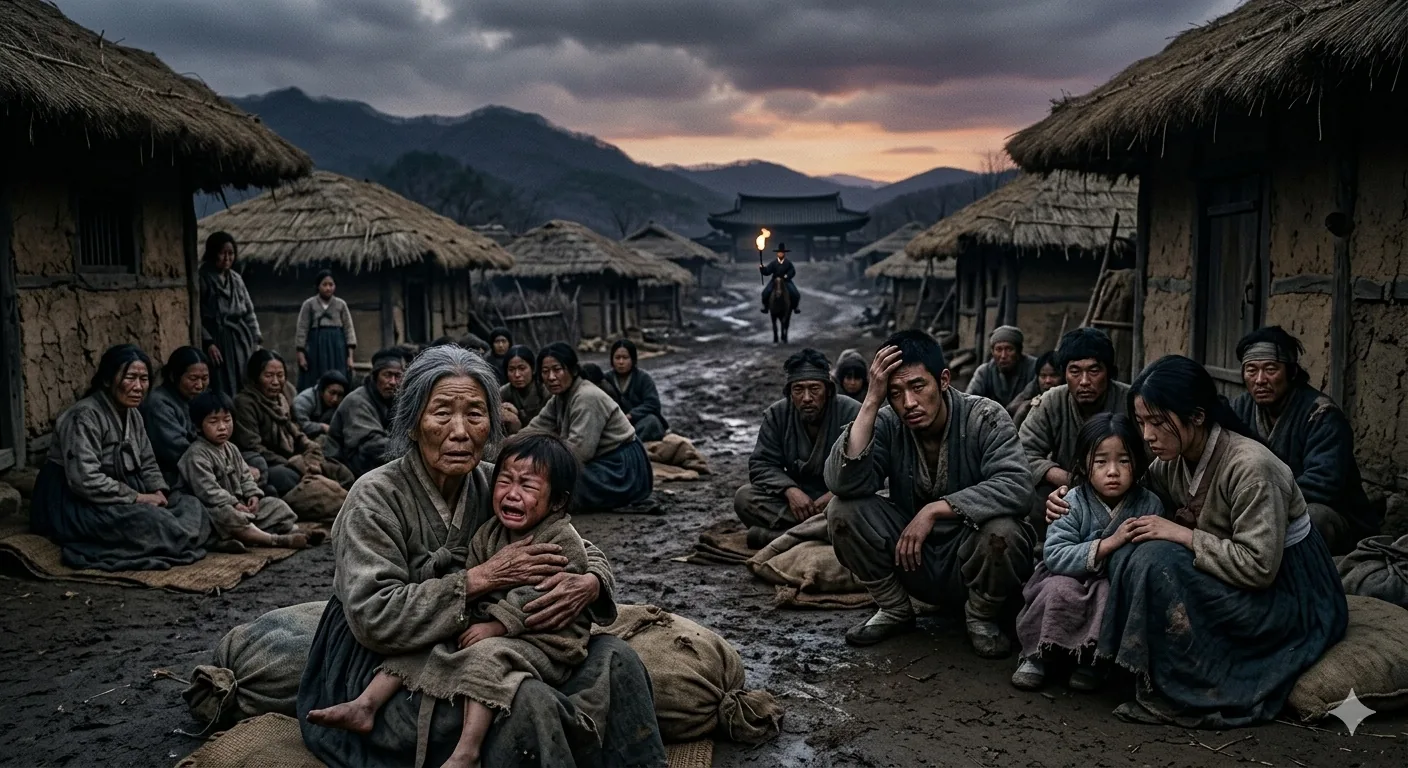
It collapsed completely. Hideyoshi’s armies devastated the Korean peninsula, and Koreans — potters, scholars, farmers, and ordinary civilians — were forcibly taken to Japan in large numbers. Any pretense of trust between the two courts was gone. Diplomatic relations simply stopped.
This is, not coincidentally, exactly the wound Yu Seong-ryong’s own memoir was written to examine. Jingbirok (懲毖錄) — the real 1604 book the drama takes its name and structure from — means roughly “a record written in self-reproach, to guard against the next calamity.” Yu wrote it precisely to dissect how a catastrophic misjudgment had been allowed to happen, so it wouldn’t happen again.
Why would Joseon ever send another embassy to Japan?
Because both sides, for very different reasons, needed a working relationship more than they needed to stay angry.
Tokugawa Ieyasu, who seized power in Japan after the decisive Battle of Sekigahara in 1600, needed international legitimacy for his brand-new shogunate — and he had not been the one who ordered the invasion. That was the Toyotomi regime he had just displaced. The small, resource-poor Tsushima domain, which sat physically between the two countries, was economically dependent on trade with Korea and had every incentive to broker a reconciliation.
On the Joseon side the priorities were just as concrete: recovering Korean captives still held in Japan, confirming that the new Tokugawa regime had no further designs on the peninsula, and freeing up attention for an unstable northern frontier, where Jurchen power was consolidating. (The state then forming would declare itself Later Jin in 1616 and invade Joseon in 1627; after renaming itself Qing in 1636, it invaded again that same winter. In 1607 it was a rising danger on the frontier, not yet a named one.)
So diplomacy resumed — carefully, and by name alone you can see how carefully. The first three post-war missions, in 1607, 1617, and 1624, were not called tongsinsa. They were named hoedap gyeom swaehwansa (回答兼刷還使) — literally “respond-and-repatriate envoys” — a title that pointedly avoided the word tongsin (通信), often interpreted as the two states “communicating trust.” Joseon was responding to Japan’s peace overture and retrieving its people; it was not yet ready to declare the relationship one of restored trust. Only from 1636 onward — the fourth post-war mission — did Korea formally reuse the name tongsinsa (통신사, Encyclopedia of Korean Culture; 우리역사넷). Counting from 1607 to the final mission in 1811, Joseon sent twelve post-war embassies over roughly two centuries. Strictly speaking, nine of them — those from 1636 on — were tongsinsa by name; the convention of calling all twelve “the tongsinsa” is a later, broader usage.
A word on the captives, because the numbers get flattened easily: the number of Koreans taken to Japan during the war and the number actually brought home by the repatriation missions are two different figures, and neither is settled. The repatriation embassies returned some of them. They did not return most of them.
What actually happened during a tongsinsa mission?
Picture something closer to a royal traveling pageant than a modern diplomatic trip. Before departure, the delegation gathered at Yeongga-dae (永嘉臺), a hilltop pavilion built overlooking Busan harbor, to perform the haesinje (해신제) — a formal sea-god ceremony asking for a safe crossing (영가대, 부산일보).
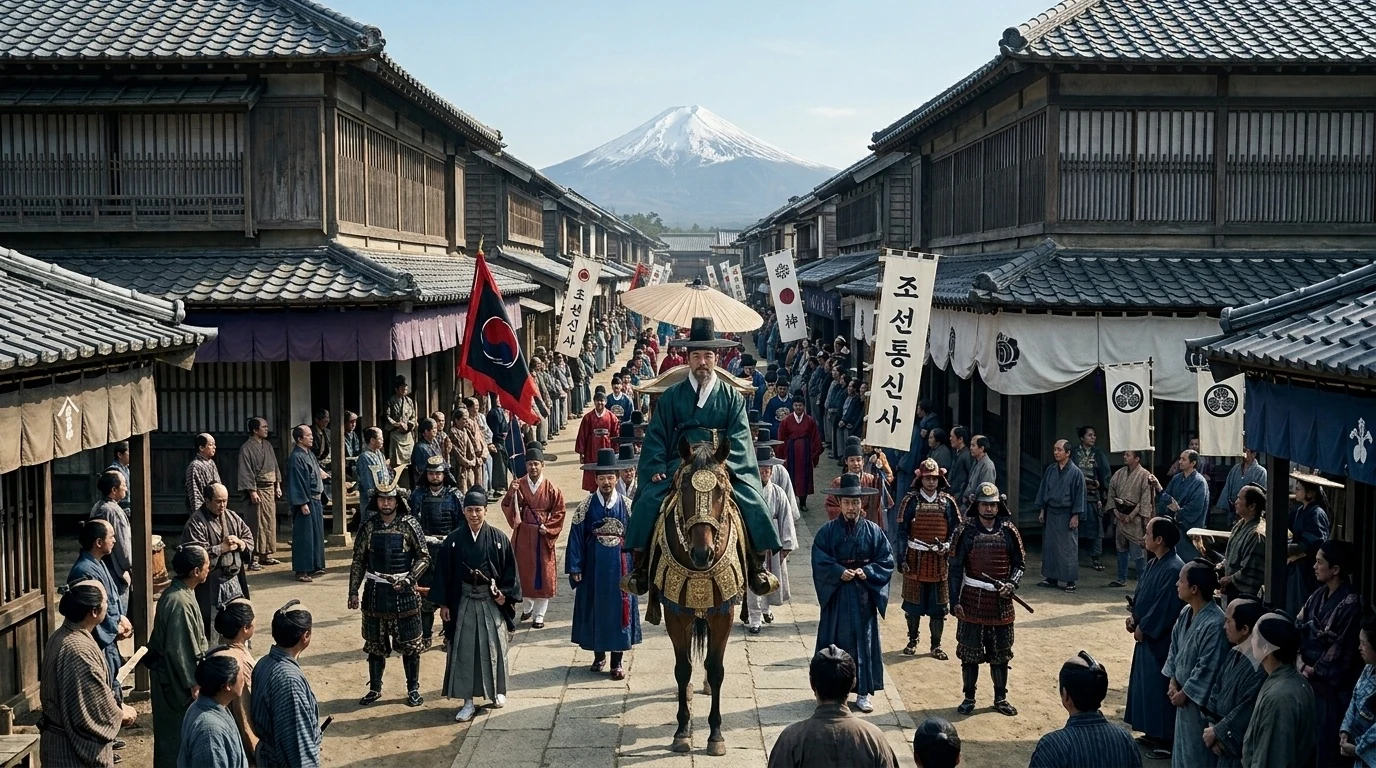
From there, a delegation of roughly 300 to 500 people — the 1682 mission numbered 473 — set out by ship and then overland, a round trip that could take five to eight months. They carried Joseon’s gukseo (國書, national letter) and an itemized gift list, the byeolpok (別幅), inside a ceremonial chest, bound for the bingnye (聘禮) — the formal audience at which the letter was presented to the shogun.
That audience usually took place at Edo Castle, but not always: the 1617 mission was received at Fushimi. And the last one never reached Edo at all — but that ending deserves its own section, further down.
The mission wasn’t only political theater. Wherever the procession stopped, Japanese Confucian scholars lined up for pildam-changhwa (筆談唱和) — “brush-talk and poetry exchange,” written conversations in classical Chinese covering everything from literature to medicine. The most famous exchange, in 1711, brought chief envoy Jo Tae-eok’s delegation into contact with Japan’s leading scholar-official of the day, Arai Hakuseki. Joseon horsemen performed equestrian tricks (마상재) that left Japanese audiences stunned, and the painter Kim Myeong-guk drew so many requests for his work from Japanese admirers that the demand became famous in its own right.
Was this really equal diplomacy — or was Japan using it to prop up the shogun at home?
Both. And you can see it in the bill.
On paper, tongsinsa diplomacy really was structurally different from Joseon’s relationship with China. Joseon treated Ming and later Qing China as its senior partner under the tributary framework known as sadae (事大) — but toward Japan it operated under gyorin (交隣), “neighborly relations.” The specific form was jeongnye gyorin (적례교린), “equal-protocol” relations: the Joseon king and the Japanese shogun exchanged royal letters directly, as nominal equals, and no kowtow was demanded of Joseon’s envoys — unlike the ritual expected of envoys before the Chinese emperor.
But the costs tell a different story about who needed the spectacle. Korean public history puts the price of hosting one tongsinsa mission at roughly a year of the shogunate’s entire budget (우리역사넷). Hold onto that number — it decides how this story ends. The shogunate required lavish hospitality from the daimyo along the route, which turned the embassy’s grandeur into a very public demonstration of the shogun’s command over Japan’s own feudal lords. You do not spend a year’s budget on a ceremony that is only about the guests.
The clearest evidence of this domestic angle came in 1711, when the powerful shogunal advisor Arai Hakuseki unilaterally changed the ceremony’s protocol — without first consulting Joseon — including elevating the shogun’s title from taikun (大君) to kokuo (国王), “King of Japan,” as part of an effort to build a more king-centered system of rule at home (1711년 신묘통신사 의례 변경, 우리역사넷; KCI). Tsushima’s own diplomat, Amenomori Hoshu, objected that “King of Japan” carried a different, riskier meaning than Hakuseki intended.
Joseon’s court pushed back. King Sukjong ultimately accepted the change — there was precedent for the title, and rupturing the relationship was the worse option — but disciplined his returning envoys afterward for allowing Korea’s standing to be diminished. The reversal came in 1719, under the eighth shogun, Tokugawa Yoshimune, when the ceremony was restored to its earlier form. (Not, as it’s often told, under the “next” shogun: Ienobu was followed by Ietsugu, and only then by Yoshimune.)
Key terms. Tongsinsa (통신사, 通信使) — Joseon’s formal missions to Japan’s shogunate. Nine were dispatched under that name between 1636 and 1811; twelve post-war embassies in total from 1607, counting the three that preceded the name’s restoration. Hoedap gyeom swaehwansa (회답겸쇄환사) — “respond-and-repatriate envoys,” the cautious name used for the first three post-war missions (1607, 1617, 1624), before the name tongsinsa was restored in 1636. Gyorin (교린, 交隣) — Joseon’s “neighborly relations” framework with Japan, distinct from the hierarchical tributary sadae relationship with China. Bingnye (빙례, 聘禮) — the formal audience ritual at which the tongsinsa presented Joseon’s national letter to the shogun.
Here’s the drama’s crisis translated into history at a glance:
| In Jing-bi-rok | In real history |
|---|---|
| Two envoys argue bitterly over what they saw in Japan | The Annals record both men gave King Seonjo genuinely opposite verdicts on Hideyoshi in March 1591 |
| Kim Seong-il simply seems to misjudge the danger | Yu Seong-ryong’s memoir records Kim privately admitting he softened his report on purpose, to avoid public panic |
| A failed Japanese envoy is executed on the spot | The envoy, Tachibana Yasuhiro, was really executed — but the Annals place it in Japan, on Hideyoshi’s order, after he returned home. The drama’s staging of when, where, and by whose hand is dramatic license |
| The story’s opening ends in catastrophe and war | Twelve embassies, 1607–1811, rebuilt a working relationship out of the wreckage |
Three neighbors, three ways of knowing each other
Here’s what makes this story land differently once you step back. Every pre-modern state faced the same problem Hwang and Kim were sent to solve: how do you find out what your neighbor actually intends? Set Joseon-Japan relations beside China’s system and Europe’s, and you can watch three civilizations answer that question in three completely different architectures — not better and worse ones, but genuinely different ones, each with its own strengths and its own blind spots.
Korea and Japan — a grand ceremony resting on a permanent everyday channel. Neither court ever stationed a resident ambassador in the other’s capital. The tongsinsa functioned instead as an occasional, spectacular event, dispatched for specific occasions — most often a new shogun’s installation — rather than on a fixed schedule. But the two countries were not out of contact between missions. The everyday relationship ran through the Waegwan (倭館) in Busan: a walled compound that Joseon built, controlled, and policed, regulating who could enter, reside, and trade there, and inside which officials and merchants of the Tsushima domain lived for long stretches, handling routine diplomacy and commerce. Korea also had envoys arriving from Japan, interpreters, Tsushima intermediaries, and reports from its own frontier officials. Information was not the scarce thing. What the architecture did not include was a Korean observer living in the shogun’s capital, revising his assessment as circumstances changed.
China — hierarchy instead of equality. Ming and Qing China ran something categorically different: the tributary system (朝貢), in which envoys from Joseon, Ryukyu, Vietnam and other states were formally ranked as junior partners inside a single Sinocentric order. The kowtow is its most famous image, though how the rituals were actually performed varied by dynasty, by period, and by who the envoy was. What makes Joseon’s position genuinely striking is that it ran both systems at once — hierarchical sadae toward Beijing, formally equal gyorin toward Edo — switching diplomatic grammar entirely depending on which neighbor it was managing.
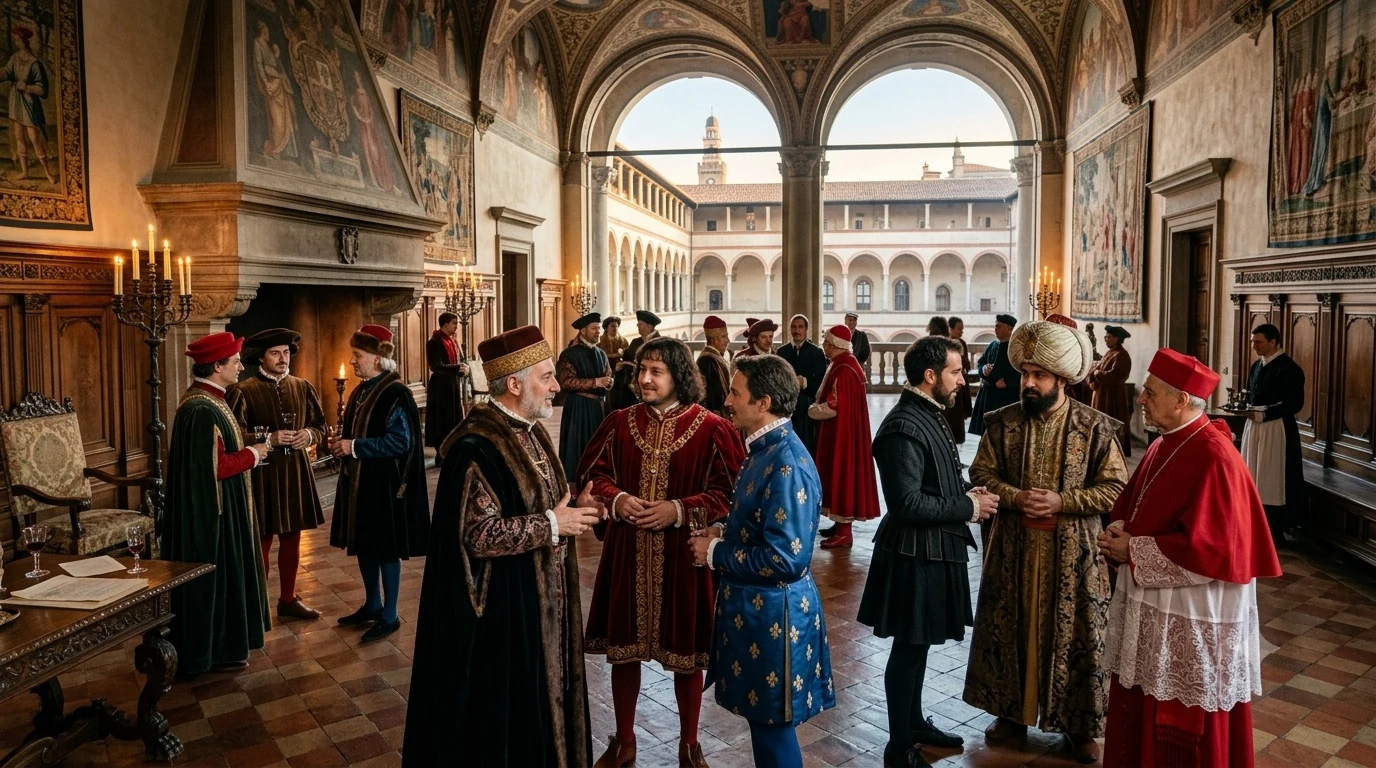
Europe — a different bet, made at almost the same moment. For most of European history before the mid-15th century, diplomacy looked structurally similar to Hwang and Kim’s mission: an envoy traveled, delivered a verdict, and came home. That began to shift in the 1450s, as several Italian city-states — with Milan under Francesco Sforza leading the way in institutionalizing and spreading the practice — developed the resident embassy: a diplomat who lived permanently in a foreign capital and kept sending updated reports (Britannica, Resident embassy). France took it up in the 1520s; it only became Europe’s default well into the 16th century. It is worth being precise about what that bought: continuous observation, not accuracy. Resident ambassadors misread their hosts constantly, and Europe’s permanent embassies did not spare it from centuries of miscalculation and war. It was a different trade-off, not a solution.
And Joseon’s own two-tier system. Korea’s gyorin was not one relationship but a graded set of them. At the top sat jeongnye gyorin — equal protocol, king to shogun, performed once every several years. Below it, Joseon managed the Sō of Tsushima and other Japanese groups seeking trade under gimi gyorin (기미교린), “loose-rein” relations: a deliberately unequal framework in which Joseon set the terms, ranked its counterparts, and controlled access. The grand equality on the surface rested on a hierarchy that Joseon itself administered underneath.
How it actually ended: the embassy that never reached Edo
Two hundred years of this, and then it just stopped. Not with a rupture. With an invoice.
Remember what a mission cost — about a year of the shogunate’s budget. By the late eighteenth century both governments were in serious fiscal trouble, and Korean public history is blunt about what that did: facing financial ruin, the two states came to regard the money for a tongsinsa mission as a burden (우리역사넷). Japan’s senior councillor Matsudaira Sadanobu, trying to repair shogunal finances, moved to postpone inviting one at all.
Then Japan asked for something unprecedented: move the ceremony out of Edo and hold it on Tsushima — the island in the strait, the doorstep. It broke every precedent of the relationship, and Joseon knew exactly what it meant. It took twenty years of pressure before Korea agreed.
In 1811, the mission sailed. It got as far as Tsushima, and there, under a protocol called yeokji bingnye (역지빙례) — “the ritual, relocated” — Joseon’s national letter was handed over on the border island.
That was the twelfth mission. There was never a thirteenth.
Read the two ends of this story next to each other. It opens with two men arguing in front of a king about a country they had crossed the sea to look at, because looking was the only way to know. It closes with the looking priced out — a ceremony that had cost a year’s revenue, negotiated down over two decades until it fit on an island, and then not held again. The tongsinsa didn’t die of hatred. It died of arithmetic.
Three architectures, three sets of blind spots. Look again at that one furious disagreement at the start of Jing-bi-rok, and it isn’t just two stubborn officials talking past each other. It’s a system meeting the limits of its own design, at the exact moment those limits mattered most.
Coming up next
One argument between two envoys — and we’ve traveled from a palanquin insult on Tsushima, to a war that emptied Korean villages of their potters, to a sea-god ceremony at a Busan pavilion, to a scholar trading poems with Arai Hakuseki, to Italian city-states working out the resident ambassador at almost the same moment, and back to Tsushima two centuries later, where the whole thing quietly ran out of money. That’s the gift of a good historical drama: even one scene has a two-hundred-year afterlife — and the afterlife has an ending the scene never hints at.
In the next essay, we’ll take another K-drama scene that looks like pure fiction — and trace the real Korean history hiding underneath it.
Frequently asked questions
Is Jing-bi-rok based on a true story? Yes, closely. It dramatizes the Imjin War through the eyes of the real minister Yu Seong-ryong, who wrote the 1604 memoir it takes its name from, and the opening crisis — two envoys returning from Japan in 1591 with opposite verdicts on Hideyoshi — is in the Annals. Some scenes are dramatized: the Annals place the Japanese envoy’s execution in Japan, on Hideyoshi’s order, after he went home.
What does the title Jing-bi-rok (징비록) mean? Roughly, “a record written in self-reproach, to guard against future calamity” (懲毖錄), echoing a line from the Book of Odes. Yu Seong-ryong wrote it after the war to examine how Joseon had misjudged the danger.
What was tongsinsa (통신사)? Joseon’s formal diplomatic missions to Japan’s shogunate. Historians commonly count twelve post-war embassies from 1607 to 1811 as the tongsinsa in the broad sense — but strictly, the first three were hoedap gyeom swaehwansa (“respond-and-repatriate envoys”), and only the nine from 1636 officially restored the name. They went for specific occasions, most often a new shogun’s installation, not on a fixed schedule.
Why did Kim Seong-il say there was nothing to fear from Japan? Two things at once. Factional rivalry shaped how each envoy framed his report. But Yu Seong-ryong’s memoir also records Kim telling him privately that he had spoken with deliberate confidence to stop Hwang’s alarming report from panicking the public — even though he thought an invasion was possible.
Was tongsinsa diplomacy really equal between Korea and Japan? Formally yes: king and shogun exchanged royal letters directly under jeongnye gyorin (적례교린), “equal-protocol” relations, with no kowtow — unlike Joseon’s tributary relationship with China. In practice the shogunate also staged the embassy’s passage as a display of its authority over Japan’s own lords, and in 1711 the advisor Arai Hakuseki unilaterally changed the shogun’s title. Research examines both dimensions.
Sources & further reading
This piece was written from the historical script and fact-check of 사뚱샘의 역사방 (SaDDungSam). Key facts are cited inline above. For broader reading:
- Seonjo Sujeong Sillok, 1591 — the primary Annals record of Hwang Yun-gil and Kim Seong-il’s contradictory reports. (National Institute of Korean History)
- Tongsinsa (통신사) — full overview of the Joseon-era missions to Japan, early and late period. (Encyclopedia of Korean Culture, Academy of Korean Studies)
- Documents on Joseon Tongsinsa/Chosen Tsushinshi — the 2017 joint Korea-Japan UNESCO Memory of the World inscription covering the 1607–1811 missions. (UNESCO)
- Arai Hakuseki and the 1711 title reform — the shogunal advisor’s attempt to elevate the shogun’s diplomatic title. (Encyclopædia Britannica; KCI)
- Resident embassy — the origins of Europe’s permanent-ambassador system in 15th-century Italy. (Encyclopædia Britannica)
Thanks for reading — see you in the next one.
This article was researched and written by K-Drama History. Source: Jing-bi-rok, Explained: How Korea and Japan Went from Seven Years of War to Two Centuries of Tongsinsa Diplomacy — K-Drama History