Jumong, Explained: Why the Records Tell Different Stories of Goguryeo's Founder
Theme: Power & Politics
From the research behind Pause the Drama.
The scene everyone remembers from Ju Mong, Prince of Legend is the one at the river. Jumong and a handful of companions are cornered by pursuers from Buyeo, the court he grew up in. He gets across. Later, in the south, he builds a kingdom of his own.
It is a good scene, and it rests on something real: the 『삼국사기』 does describe a man leaving Buyeo under threat and founding Goguryeo at Jolbon in 37 BCE. But if you go looking for the story behind the drama, you find something more interesting than a single story. You find several, and they disagree about the most basic question of all — whether this man lost a throne or was handed one.
Quick answer: Korean records agree that Jumong — or Chumo — was remembered as Goguryeo’s founder, traditionally dated to 37 BCE at Jolbon. They do not tell one identical biography. The Gwanggaeto Stele of 414 presents a sacred founder who crosses a river; the later 『삼국사기』 Goguryeo annals add persecution inside the Buyeo court; and a Baekje founding tradition says he married into the ruling house of Jolbon Buyeo and inherited its throne.
What the drama invented, and what it did not
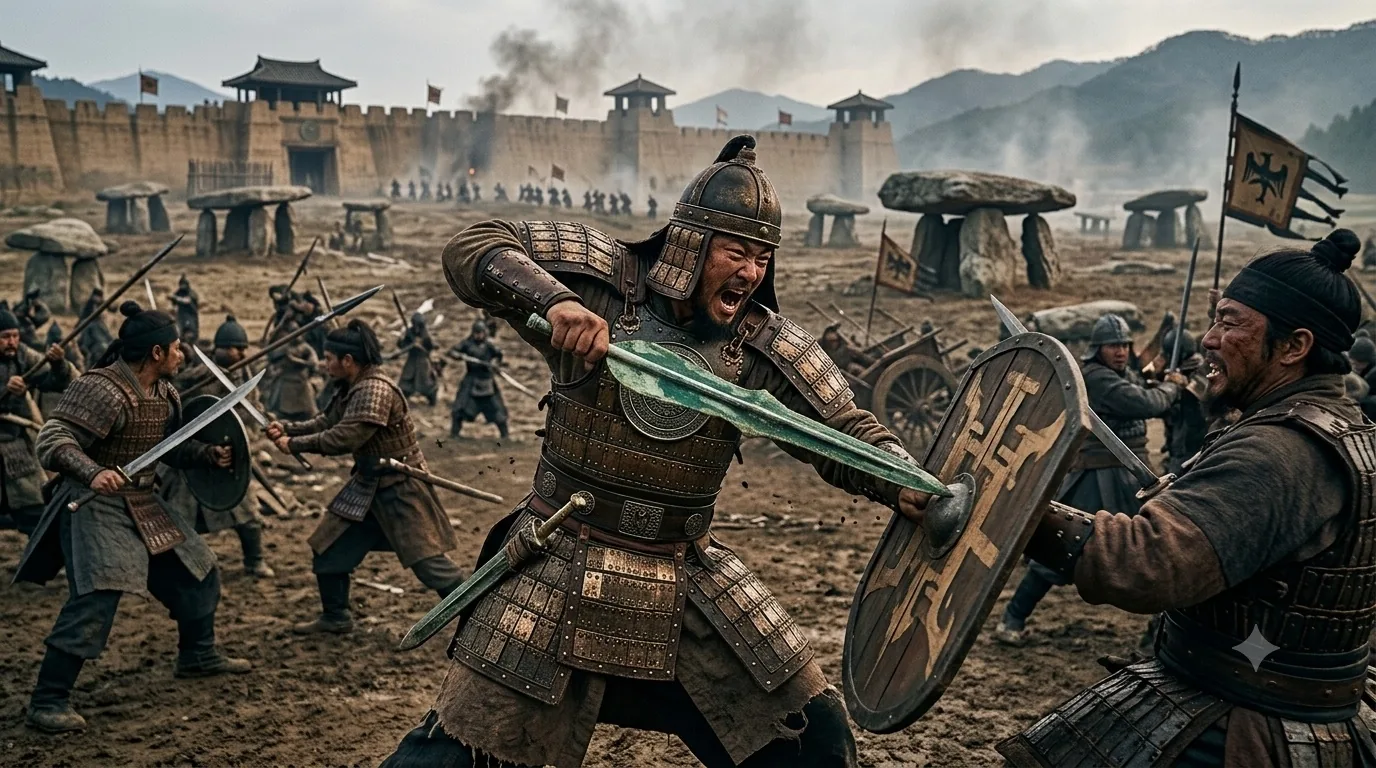
The war with Han armoured cavalry, Mopalmo’s breakthrough in ironworking, the friendship between Hae Mo-su and Geumwa, the romances — television. In the 『삼국사기』 Geumwa has seven sons; the drama keeps Daeso and Yeongpo and drops the rest, which tightens the palace conflict into something an audience can hold.
Two smaller things are worth straightening. MBC’s own material has the young Jumong as an unpromising prince, poor at martial arts, who becomes a great archer over the course of the story — so “he was always a brilliant shot but overshadowed” gets the arc backwards. And Daeso and Yeongpo are not his half-brothers by blood: he is Hae Mo-su’s son, raised in Geumwa’s household and treated as a prince alongside them.
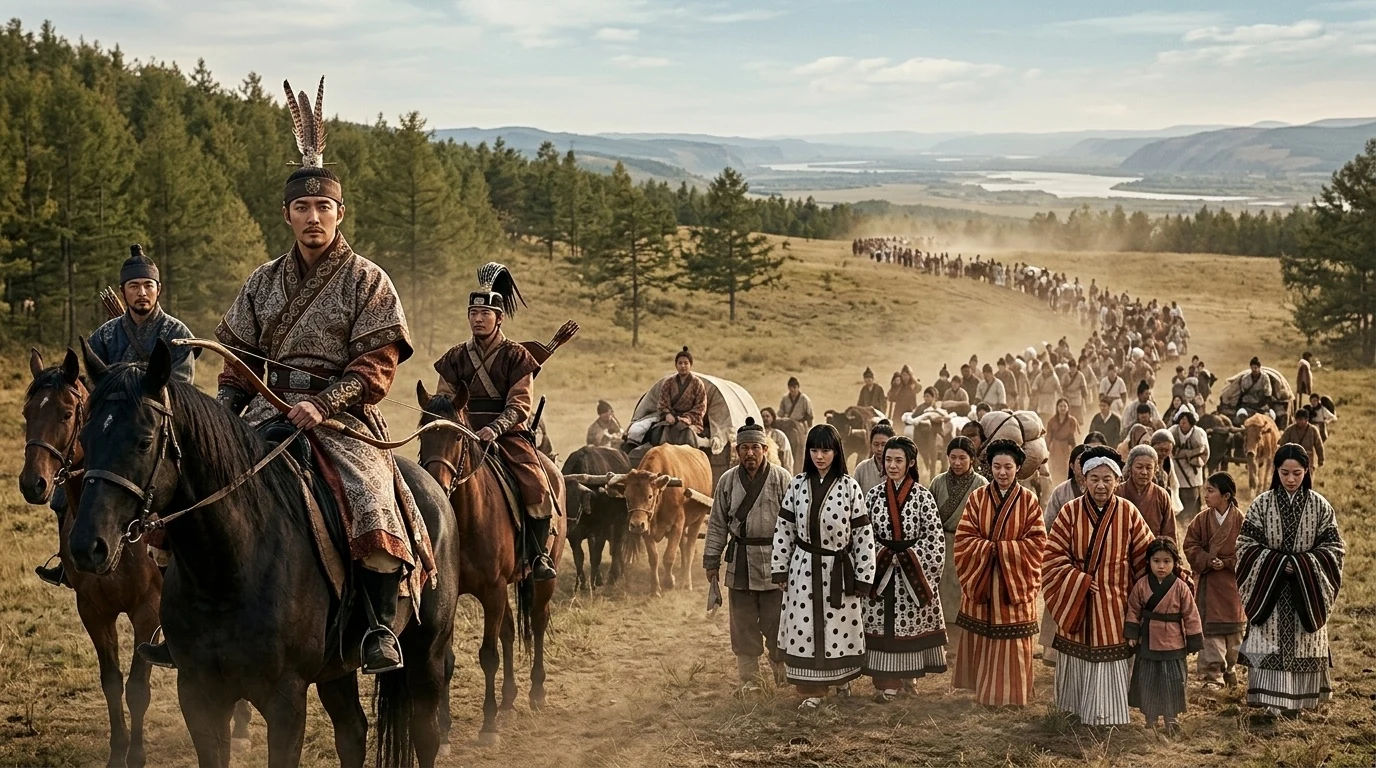
What survives from the record is the spine: a man of Buyeo stock who went south and became the founder of a new political community at Jolbon.
Three records, three shapes of the founder
Here is where the tidy summary breaks down.
The Gwanggaeto Stele (414) is the oldest surviving Goguryeo account of Goguryeo’s own founder, carved by his descendants. It calls him Chumo and gives him descent from the Heavenly Emperor and from Habaek, a miraculous birth, and a crossing of the river. What it does not give him is a persecution. Geumwa, Daeso, the plots inside the Buyeo palace — none of that is on the stone.
That absence matters, but it is not proof that no persecution tradition existed yet. The stele is a compressed royal monument, not a full biography; it carries what the fifth-century court needed carved. What we can say is narrower and still useful: persecution was not necessary to the official founder image of 414.
The 『삼국사기』 Goguryeo annals are where the palace story lives: threats from within the Buyeo royal house, the escape, the founding at Jolbon. This is the version the drama dramatises.
The 『삼국사기』 Baekje annals hand us a third shape — though this one is not an independent life of Jumong. It is the Baekje founding story, which calls him in to explain a lineage. In the Onjo tradition there, Jumong marries a daughter of the king of Jolbon Buyeo and, when that king dies, succeeds him. Read that again: in this version the man does not lose a throne. He inherits one.
So the honest formulation is narrower than the drama’s, and narrower than most retellings. In the tradition preserved in the Goguryeo annals, a man who was not accepted at the Buyeo court left it and became the founder of a new community at Jolbon. That is worth saying. What cannot be said is that failing to inherit caused Goguryeo — no source states it, and one source contradicts it.
It is also why “was Jumong real or mythical?” has no clean answer. The stele shows that by the early fifth century the Goguryeo royal house remembered Chumo as its founder. What it cannot show is how much of the surviving biography belongs to an actual life. The accurate thing to say is that Goguryeo remembered a founder, and that the account which reaches us combines historical memory with the myth that made him sacred. We cannot demonstrate that a plain biography came first and the miracles were painted on afterwards — the earliest record we have is already miraculous.
The egg
The drama has no egg. Its Jumong is born to Hae Mo-su and Yuhwa, grows up slighted inside the palace, and gets better at things. The records go the other way: Yuhwa, daughter of Habaek, is touched by sunlight, lays an egg, and Jumong is born from it.
Egg birth recurs in several Korean founding traditions; it is not unique to Goguryeo. Bak Hyeokgeose of Silla and Kim Suro of Gaya get one too. The point of an egg is that it puts a founder outside ordinary descent — the right to rule arrives with the birth rather than being acquired later. Note also what kind of story this is: not folklore that grew up outside the histories, but founding myth recorded in them.
The broken sword
Late in the drama, Lady Ye and her son Yuri arrive from Buyeo, and a long story ties itself off. That reunion has a famous token behind it.
In the 『삼국사기』 Yuri annals, Jumong leaves his pregnant wife in Buyeo with an instruction: when the child grows, let him find what his father has hidden. Yuri, in the house, catches what seems to be a sound from between the foundation stones. He looks, finds a seven-cornered stone, and beneath its pillar recovers a fragment of a broken sword. He carries it to Jolbon; Jumong produces the other half; the pieces join. Yuri is acknowledged and made heir.
The sword does not call to Yuri, whatever later retellings say. He hears what seems to be a sound from between the foundation stones, investigates, and finds the blade beneath the pillar. The device is documentary in shape: an object that proves a bloodline and a claim.
Greek tradition has a close cousin. Theseus lifts a rock to recover the sword and sandals his father hid, and carries them to Athens as proof of who he is. There is no evidence of contact between the two stories — but the shape recurs, and the difference is instructive. Theseus’s token admits him to an existing kingdom. Yuri’s admits him to one his father had just built.
Soseono, and the thing everyone gets wrong
In the drama Soseono is a merchant leader, Jumong’s partner, and a driving force behind the founding — supplying weapons and goods, gathering support, sometimes seeing further than he does. Then she goes south. Why?
The usual answer online is that she founded two kingdoms, Goguryeo and then Baekje. That flattens two traditions that do not fit together.
In the Biryu founding tradition, Soseono is a daughter of Yeontabal of Jolbon who married Utae and bore Biryu and Onjo, then later remarried Jumong. In the Onjo founding tradition, Biryu and Onjo are sons of Jumong and a daughter of the king of Jolbon Buyeo. These are not two slightly different copies of one settled biography. They are competing founding traditions that assign different parents and different roles.
The southward move belongs to the Biryu tradition, and even there the sequence is usually compressed. Yuri arrives from Buyeo and is made heir; Jumong dies; Yuri succeeds; and it is then that Biryu judges the kingdom has passed to Yuri and goes south with Onjo, taking Soseono with them. The text places the lost succession claim most explicitly with Biryu and Onjo. Soseono’s own political position is not separately explained — though she is described as a queen who put her wealth and base behind the founding, and she leaves with her sons.
Set the Biryu tradition beside the Goguryeo one and a similar narrative shape does appear: a group that has lost its place in an existing political order moves away and founds a new community. That is a resemblance between traditions. It is not evidence that the same political event happened twice.
Is Goguryeo Chinese history?
Foreign viewers ask this, and reasonably — the drama’s map is Manchuria and the river valleys north of the peninsula, and Goguryeo’s early centre lay in what is now Liaoning and Jilin.
Modern borders cannot by themselves assign an ancient state to a modern national history. Goguryeo developed across regions now divided between China and North Korea, maintained an independent monarchy and its own diplomatic system, and was remembered in Korean historical tradition as one of the Three Kingdoms alongside Baekje and Silla. Later, Goryeo claimed its succession, and the name Goryeo is the ancestor of the English word Korea.
Its history is therefore both transregional and central to Korean historical memory. The balanced answer weighs several things at once — political independence, state structure, external relations, population and culture, and how contemporaries and later dynasties understood the succession. The Goryeo–Korea line is one piece of that, not a trump card. What the evidence does not support is reducing Goguryeo to a local administration of any modern state.
Leaving home: Aeneas and Jumong
Founder stories about departure and building elsewhere are widespread, and the closest one to hand is Roman.
Aeneas is a member of the Trojan royal house who escapes the burning city with his aged father, his son and a small company, wanders, and eventually reaches Italy. The shape rhymes: a man of a ruling house leaves with a small following, crosses water, and becomes the origin of a political community somewhere else.
Two differences keep it honest. Troy had fallen; Buyeo had not. Aeneas leaves a destroyed homeland; Jumong leaves a political environment that will not have him. And Aeneas does not found Rome — he settles at Lavinium and becomes the root of the line and the community that later leads there.
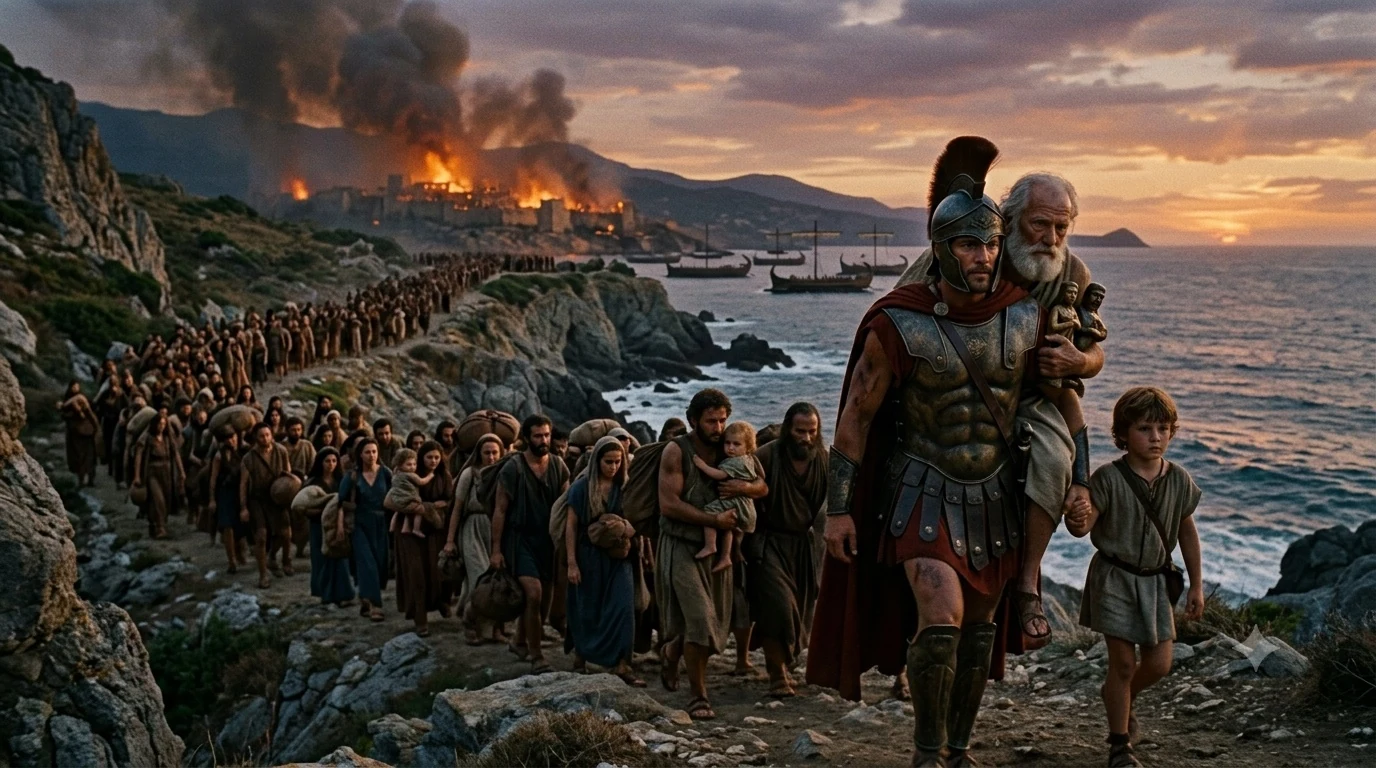
Against those, the shape of the Jumong tradition is its own. The strongest thing in it is not a throne recovered but a community founded somewhere the founder could not go home from.
Drama vs. the record
| What the modern frame assumes | What the record shows |
|---|---|
| Jumong founded Goguryeo because he was denied the Buyeo throne | No source states that causation, and the Onjo tradition has him succeed to the Jolbon Buyeo throne by marriage |
| The persecution at Buyeo is the core of the founding myth | It is central to the 『삼국사기』 tradition. The older Gwanggaeto Stele has no Geumwa, no Daeso and no persecution |
| Buyeo as a state decided to eliminate him | Daeso urged it; Geumwa refused. The threat comes from a hostile faction inside the royal house |
| He was born from an egg | Founding myth, recorded in the histories — the same device attaches to Bak Hyeokgeose and Kim Suro |
| The buried sword cried out and revealed itself | Yuri hears a sound from between the foundation stones, investigates, and finds the fragment beneath a pillar |
| Soseono founded both Goguryeo and Baekje | Later tradition celebrates her as a founding figure in both, but the surviving accounts do not add up to one seamless biography in which she straightforwardly founded either |
| Being pushed out repeated across two generations | A similar narrative shape appears if you read the Biryu tradition alongside the Goguryeo one. Not a demonstrated repetition of the same political event |
| Goguryeo was a war with Han cavalry over iron | Invented for television. The founding traditions are about leaving a court and building elsewhere |
In short: the 『삼국사기』 records Jumong founding Goguryeo at Jolbon in 37 BCE after leaving a Buyeo court that would not accept him, and the drama follows that tradition closely; but Goguryeo’s own oldest record, the Gwanggaeto Stele of 414, tells the founding without any persecution, and a second tradition has him inherit a throne rather than lose one — so the founder’s story survives in versions that disagree.
Key terms. Jumong (주몽) — the founder of Goguryeo; the 『삼국사기』 explains the name as the Buyeo word for a fine archer. Chumo (추모) — the founder’s name as carved on the Gwanggaeto Stele. Dongmyeongseongwang (동명성왕) — his royal title in the Korean histories. Buyeo (부여) — the northern state Jumong left. Jolbon (졸본) — where Goguryeo was founded. Habaek (하백) — the water deity whose daughter Yuhwa bore Jumong. Soseono (소서노) — the Jolbon figure central to the Biryu founding tradition of Baekje. Gwanggaeto Stele (광개토왕비) — the 414 monument carrying Goguryeo’s own earliest account of its founder.
Back to the drama
Return to the river. In that moment the drama’s Jumong is a fugitive from the court that raised him — and, to the people crossing with him, already something else: the man they are following.
The specific enemies on screen are invented, and the egg is myth, and the causation everyone repeats is not in the sources. What remains is the part that made the story worth carving on a stone in 414 and worth eighty-one episodes in 2006: a man of Buyeo stock went south, and the community that formed around him became a kingdom.
Which version you encounter depends on which record you are reading — and on what that record needed its founder to mean. The drama did not simply reproduce “the legend.” It chose one tradition from among several. It is worth knowing that a choice was made.
Frequently asked questions
Is the drama Jumong based on a true story? The frame comes from recorded tradition. The 『삼국사기』 and 『삼국유사』 both record Jumong as the founder of Goguryeo, and the 『삼국사기』 gives 37 BCE as the founding year at Jolbon. The war with Han armoured cavalry, Mopalmo’s ironworking and the romances are invented for television.
Did Jumong lose a throne, or inherit one? It depends which tradition you read. The 『삼국사기』 Goguryeo annals describe him fleeing threats inside the Buyeo court. But the Onjo founding tradition in the Baekje annals says he married a daughter of the king of Jolbon Buyeo and succeeded to that throne when the king died. The two do not agree, and neither should be presented as the single historical account.
What does the oldest Goguryeo record say? The Gwanggaeto Stele of 414 is the earliest surviving Goguryeo account of its own founder. It presents Chumo as descended from the Heavenly Emperor and from Habaek, with a miraculous birth and a river crossing — and it does not mention Geumwa, Daeso or persecution at the Buyeo court. The palace-intrigue version is a feature of the later 『삼국사기』 tradition.
Did Soseono found two kingdoms? That is a modern shorthand, and it flattens two separate traditions. In the Biryu founding tradition she is a daughter of Yeontabal of Jolbon who married Utae, bore Biryu and Onjo, and later remarried Jumong. In the Onjo founding tradition, Biryu and Onjo are sons of Jumong and a daughter of the king of Jolbon Buyeo. These are different founding traditions, not variant manuscripts, so “she founded Goguryeo and Baekje” cannot be stated as fact.
When was Goguryeo founded? 『삼국사기』 gives 37 BCE, and that is the traditional founding date. When state formation actually happened is discussed differently in textual and archaeological research, which tends to describe the merging of existing groups along the middle and upper Amnok river with southward-moving Buyeo groups rather than a single migration that simply became a state.
Sources & further reading
- 『삼국사기』 고구려본기 동명성왕조 — the Buyeo court, the flight, the founding at Jolbon.
- 『삼국사기』 고구려본기 유리왕조 — the sound between the foundation stones, the broken sword, Yuri made heir.
- 『삼국사기』 백제본기 온조왕조 — the Onjo founding tradition and the Biryu founding tradition, side by side and mutually inconsistent.
- Gwanggaeto Stele (광개토왕비, 414) — Goguryeo’s own earliest surviving account of Chumo.
- 『삼국유사』 — Goguryeo founding records.
- National Institute of Korean History, 우리역사넷 — 「고구려 건국」; 「고구려 주몽 신화의 전승 자료와 내용」, including the Gwanggaeto Stele section; the Jumong/Dongmyeong founder-name discussion; 「삼국사기 고구려본기 유리왕·대무신왕조」; 「백제 온조·비류 설화 전승 자료와 내용」.
- Encyclopedia of Korean Culture — 「동명성왕」, 「소서노」, 「백제」, 「온조왕」, 「난생신화」, 「국호」.
- Virgil, Aeneid; Encyclopaedia Britannica, 「Aeneas」 and 「Theseus」.
- UNESCO World Heritage Centre, “Capital Cities and Tombs of the Ancient Koguryo Kingdom” — for the location and heritage value of the Goguryeo capitals and tombs. Note that the listing is not a determination of historical attribution, and its pages give differing start dates for Goguryeo, so it should not be used on its own to verify the 37 BCE date.
This article was researched and written by K-Drama History. Source: Jumong, Explained: Why the Records Tell Different Stories of Goguryeo's Founder — K-Drama History