Warrior K (무신), Explained: Why an Army Kept Fighting After the King Surrendered
Theme: War & Resistance
From the research behind Pause the Drama.
If you’ve made it through all 56 episodes of MBC’s 2012 epic Musin (무신, “Warrior K”), you watched a slave named Kim Jun claw his way to the top of Goryeo’s military dictatorship, outlast the ruling Choe clan, and briefly become the most powerful man in the country. The final credits roll around 1268, with the century-old military regime cracking apart.
Here’s the part the drama doesn’t get to: the story wasn’t over. Two years after Musin’s last episode, a group of soldiers the drama had only begun to introduce — an elite unit called the Sambyeolcho — did something almost no other force in the Mongol Empire’s path ever managed. Their own king surrendered to the Mongols and went home. They didn’t. They kept fighting for three more years, on two different islands, until an empire that had already conquered half of Eurasia had to send an army just to finish them off.
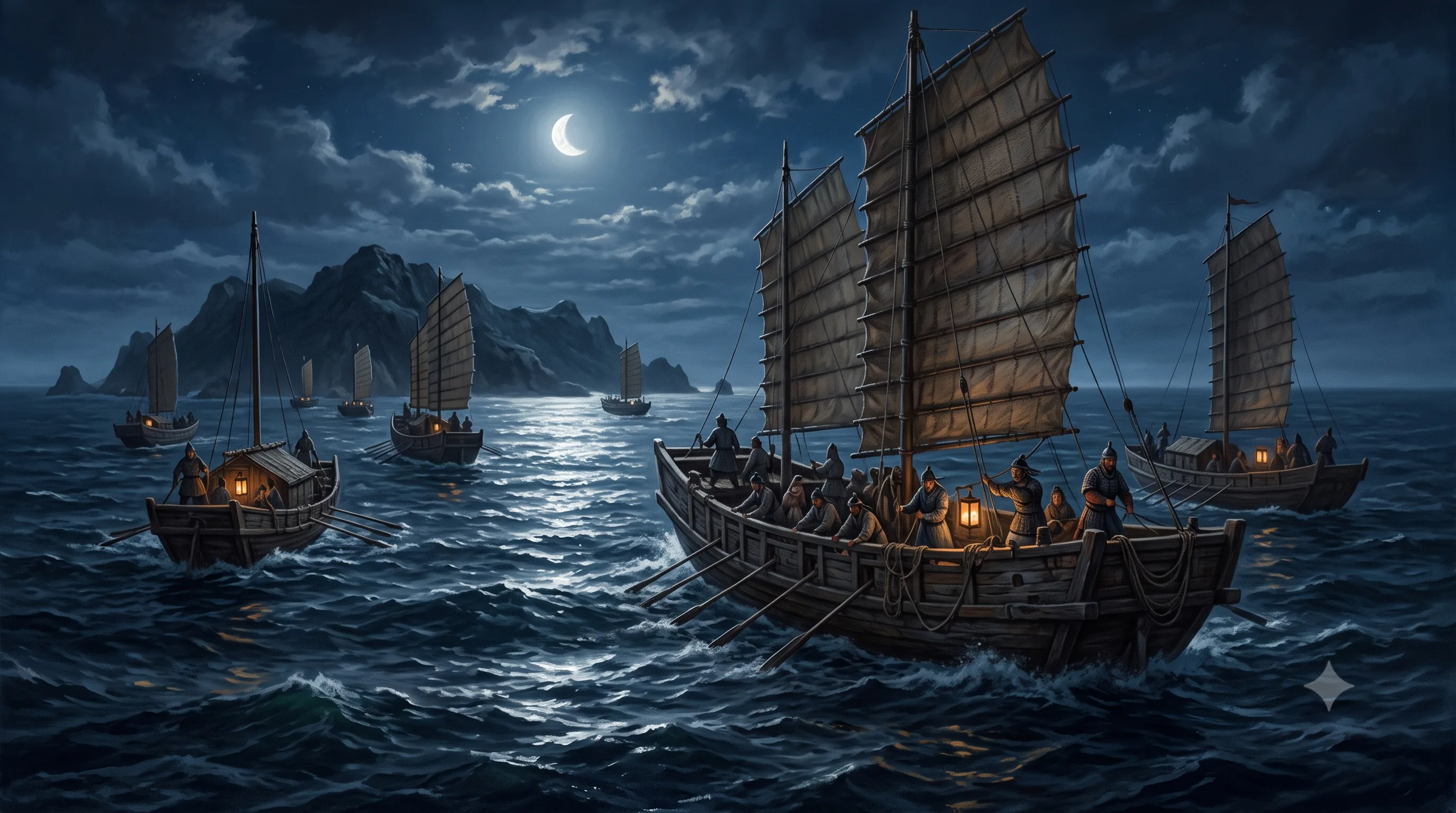
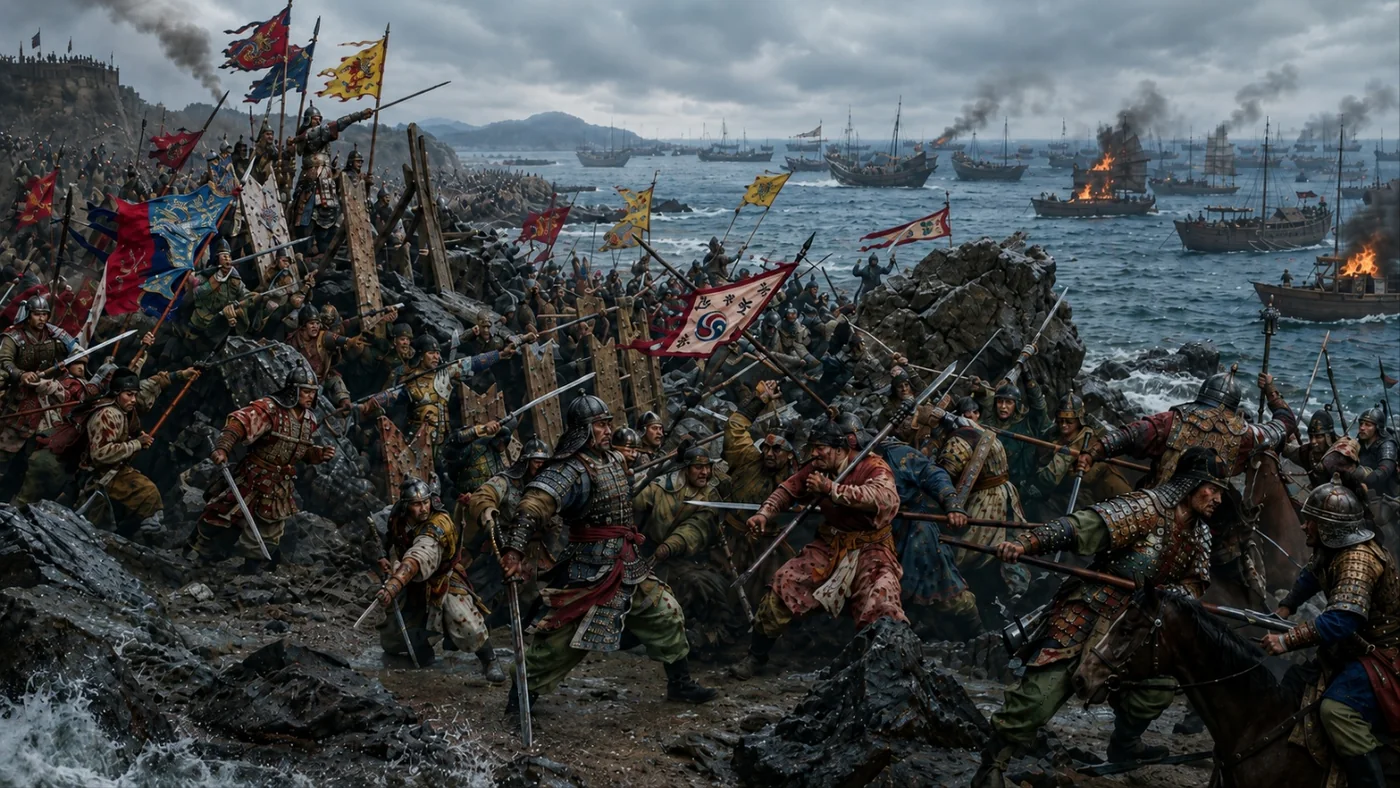
 The Sambyeolcho’s island war — from Jindo to Jeju, an elite unit fought on for three years after its own king had surrendered. (AI illustration)
Quick answer: The Sambyeolcho were Goryeo’s elite military units — born out of the same military-regime world MBC’s Musin depicts. In 1270, King Wonjong made peace with the Mongols and ordered the court back to the mainland capital and the Sambyeolcho disbanded. Instead of complying, the Sambyeolcho rebelled, crowned a rival king, and held out first on Jindo Island (1270–71) under general Bae Jung-son, then on Jeju Island (1271–73) under Kim Tong-jeong, until a joint Goryeo-Yuan force finally crushed them in 1273. It’s one of the rare cases in the Mongol century where resistance outlived a government’s surrender.
Let’s unpack it.
What was the Sambyeolcho, and why does Musin’s world matter here?
To understand why the Sambyeolcho revolted, you have to understand what kind of soldiers they were — and Musin spends 56 episodes building exactly that world.
The Sambyeolcho (“Three Elite Patrols”) started small: a night-patrol and anti-bandit force called the Yabyeolcho, organized under military strongman Choe U in the 1220s–30s to keep order in the capital. As it grew, it split into a Left Patrol and Right Patrol. A third unit, the Sinuigun, was added later, formed from Goryeo soldiers who had escaped Mongol captivity. Together, these three units made up the Sambyeolcho — troops who served the military regime as police, prison guards, and shock troops, and who over decades of Mongol invasions became Goryeo’s most experienced fighting force (한국민족문화대백과, “삼별초”).
That’s the world Musin dramatizes: Kim Jun’s rise through the ranks of a military dictatorship that had ruled Goryeo, in one strongman’s name after another, for roughly a century, while the country also absorbed repeated Mongol invasions from 1231 onward and the royal court sheltered on Ganghwa Island. Kim Jun himself toppled the last Choe ruler in 1258 and held power until his own assassination in 1268 (한국민족문화대백과, “무신정권”). The drama’s story effectively ends there. The Sambyeolcho’s most famous chapter was just about to begin.
What actually happened in 1270 — and why did the Sambyeolcho say no?
By 1270, the military regime that Musin chronicles had collapsed entirely, and the reigning king, Wonjong, made a decision that changed everything: he came to terms with the Mongols and ordered the court to leave its wartime refuge on Ganghwa Island and return to the mainland capital, Gaegyeong — a move remembered as 개경환도, the “Return to the Capital” (한국민족문화대백과, “원종”). As part of that peace, he ordered the Sambyeolcho disbanded.
For the Sambyeolcho, this order was not a relief — it was closer to a death sentence. These were the fighters who had spent decades resisting the Mongols from the safety of Ganghwa’s tidal straits; going home meant submitting to the very power they had been organized to fight, under a court now aligned with it. In June 1270, under general Bae Jung-son (배중손) and No Yeong-hui, the Sambyeolcho rebelled. They enthroned a Goryeo royal relative, Wang On (given the title Marquis Seunghwa, 승화후 온), as a rival king, loaded roughly a thousand ships with people and supplies, and sailed south rather than disband (우리역사넷, “삼별초 1232~1273”).
About two months later, they reached Jindo Island, off Korea’s southwest coast, and built Yongjangsan fortress. Jindo wasn’t a random hideout — it sat astride the sea routes that grain and tribute ships had to travel between the southwest and the capital, giving the Sambyeolcho real leverage over Gaegyeong’s supply lines. From this base they extended control to nearby coastal areas and, within months, to Jeju Island as well (한국민족문화대백과, “배중손”).
It didn’t last. In May 1271, a joint Goryeo-Mongol force led by Hong Da-gu and fellow commanders stormed Jindo. The rebel king Wang On was killed, and Bae Jung-son is believed to have died fighting at Nandoseong fortress — no further record of him appears after that battle.
The last stand: Kim Tong-jeong and Jeju
The Sambyeolcho’s survivors didn’t surrender. Under a new commander, Kim Tong-jeong (김통정), they evacuated to Jeju Island (then called Tamna) and built a new stronghold: Hangpaduri fortress (항파두성), with an inner wall roughly 750 meters around and an outer earthen rampart stretching several kilometers further (우리역사넷, “삼별초군의 제주도항전”). From Jeju, they kept raiding supply shipments along the coast — a resistance movement that had now survived the fall of its first island base and simply relocated to a second, further one.
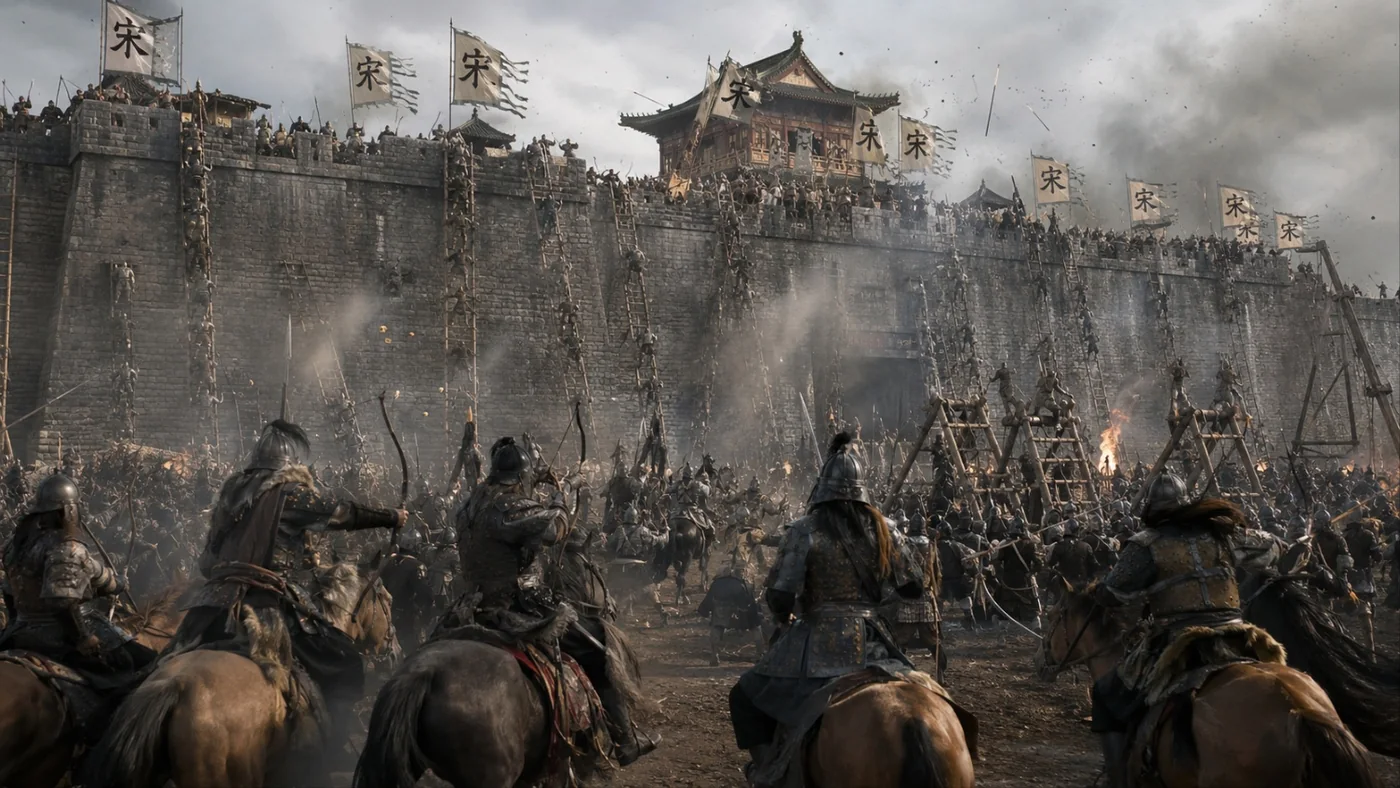
 Half a world away, the Southern Song fought the same empire after its own capital had surrendered — the closest parallel to the Sambyeolcho’s doomed holdout. (AI illustration)
The end came in spring 1273. A combined Goryeo-Yuan force — roughly 10,000 troops (a mix of Mongol, Han Chinese, and Goryeo soldiers) carried by about 160 warships — landed on Jeju and destroyed Hangpaduri (한국민족문화대백과, “김통정”). Kim Tong-jeong fled into the mountains with a small group of officers; most were hunted down and executed. Kim Tong-jeong himself was later found dead — Korean-side records describe death by hanging, without settling whether it was by his own hand or at someone else’s; Mongol-side records simply say he was captured and killed. Roughly 1,300 of his people were taken prisoner. It marked the end of some forty years of Goryeo resistance to the Mongols, dating back to the first invasions of the early 1230s (우리역사넷, “삼별초군의 제주도항전”).
Key terms. Sambyeolcho (삼별초) — the Left Patrol, Right Patrol, and Sinuigun units, Goryeo’s elite military force and later its last Mongol-resistance army. 개경환도 (Return to the Capital) — King Wonjong’s 1270 order ending the court’s decades-long refuge on Ganghwa Island and formally submitting to Mongol terms. Yongjangsan fortress — the Sambyeolcho’s fortified base on Jindo Island, 1270–71. Hangpaduri fortress (항파두성) — the Sambyeolcho’s final stronghold on Jeju Island, 1271–73, now a designated Historic Site. 여몽연합군 (Goryeo-Yuan allied army) — the joint Goryeo-Mongol force that suppressed the Sambyeolcho at both Jindo and Jeju.
Common misconception: wasn’t this simply “Korea vs. the Mongols”?
It’s tempting to read the Sambyeolcho’s story as a clean patriotic arc — loyal Koreans fighting a foreign empire while a weak king caved. The real record is messier, in two directions.
First, the force that finally crushed the Sambyeolcho on Jeju wasn’t a Mongol army with Korean prisoners in tow — it was a genuinely joint operation, with roughly 6,000 of the 10,000 attacking troops supplied by Goryeo itself, commanded by the Goryeo general Kim Bang-gyeong, fighting alongside Mongol commanders. (The National Institute of Korean History’s compilation breaks the force down as roughly 6,000 Goryeo, 2,000 Mongol, and 2,000 Han Chinese troops; the History of Yuan records a mobilization order of around 12,000. These are pre-modern record-based figures, not exact modern headcounts.) Once Wonjong’s government had submitted, it did not stand aside from the mop-up — its own soldiers helped carry it out.
Second, the Sambyeolcho were not simple outside rebels or peasant patriots. They were the elite enforcement arm of the same military dictatorship Musin portrays — troops who had spent a career serving whichever strongman controlled the throne behind the throne. Disbandment threatened their entire position, not only their pride. Their resistance blended real anti-Mongol conviction with the very concrete stakes of soldiers about to lose their livelihoods, their status, and quite possibly their lives under a newly submissive court. Neither side of this war was as simple as “us versus them.”
Why the Sambyeolcho’s last stand echoes far beyond Korea
Here’s what lifts this story out of one country’s history: it is not the only case of a people who kept fighting a Mongol-scale empire after their own government had already made peace.
The closest parallel sits in China, with the Southern Song dynasty — the very dynasty the Mongols were simultaneously grinding down while Goryeo’s own war played out. After decades of pressure, Mongol forces under Kublai Khan took the Song capital, Lin’an, in early 1276, and the boy-emperor there formally surrendered. But Song loyalist officials refused to accept that surrender as the end. They fled south by sea with two more child princes in tow, enthroned first one and then the other, and kept a rival Song court and army alive for three more years — until the war finally ended at the naval Battle of Yamen on 19 March 1279, when the loyalist minister Lu Xiufu drowned himself and the last child emperor rather than be captured (Song Dynasty falls as Mongols complete conquest of China, OUPblog).
| Goryeo (Sambyeolcho, 1270–1273) | Southern Song (loyalist court, 1276–1279) |
|---|---|
| King Wonjong makes peace with the Mongols and orders the return to the mainland capital in 1270 | The Song capital, Lin’an, falls and the child emperor formally surrenders to the Mongols in 1276 |
| The Sambyeolcho refuse to disband, enthrone a rival king (Wang On), and keep fighting | Song loyalists refuse to accept the surrender, enthrone two more child princes in succession, and keep fighting |
| Resistance relocates from Ganghwa to Jindo to Jeju as each base falls | The loyalist court retreats further south by sea as each position falls |
| Crushed by a joint Goryeo-Yuan force in 1273; leaders die rather than surrender | Crushed at the Battle of Yamen in 1279; the last emperor and his minister drown rather than surrender |
In short: in both Goryeo and Southern Song China, a government’s political decision to submit to the Mongols did not end the fighting — loyalist forces kept a rival state alive and fought on for roughly three more years, in both cases until their leadership chose death over capture.
That timing is almost eerie: two peoples, thousands of kilometers apart, both refusing to let their government’s surrender be the last word — and both losing, in the end, to the same empire.
Coming up next
A slave who became a strongman, a fortress on a tidal island, a rival king on Jindo, a last redoubt on Jeju, and — half a world away — a Song emperor drowning in the South China Sea rather than kneel. That’s the quiet gift of a serious historical drama: even after the credits roll on Kim Jun’s story, Goryeo’s hardest chapter was only just beginning.
In the next essay, we’ll take another K-drama scene that looks like pure fiction — and trace the real Korean history hiding underneath it.
Frequently asked questions
Is Musin (Warrior K) based on a true story? Largely, yes. Musin is built around real figures and real events from Goryeo’s military-regime period — Choe Chungheon, Choe U, and Kim Jun’s rise from slave to strongman — plus the Mongol invasions and the court’s flight to Ganghwa Island. Personal dialogue and some relationships are dramatized, but the political skeleton is documented history.
What was the Sambyeolcho? The Sambyeolcho (삼별초, “Three Elite Patrols”) began as Yabyeolcho, a night-patrol and anti-bandit unit organized under military strongman Choe U in the 1220s–30s. It split into a Left Patrol and Right Patrol, and a third unit, the Sinuigun, was formed from soldiers who had escaped Mongol captivity. Together these three units became the military regime’s enforcers and later Goryeo’s front line against the Mongols.
Why did the Sambyeolcho refuse to return to the capital in 1270? King Wonjong made peace with the Mongols and ordered the court to leave Ganghwa Island and return to the mainland capital (개경환도), while ordering the Sambyeolcho disbanded. The Sambyeolcho refused, rebelled under general Bae Jung-son, enthroned a royal relative, Wang On, as a rival king, and sailed south rather than submit.
Who was Bae Jung-son? Bae Jung-son (배중손) led the 1270 Sambyeolcho rebellion. He moved the resistance to Jindo Island, built Yongjangsan fortress, and held the southwestern coast for roughly nine months. He is believed to have died in battle in 1271, when a joint Goryeo-Mongol force under Hong Da-gu stormed Jindo.
Who was Kim Tong-jeong, and how did the resistance end? Kim Tong-jeong (김통정) led the Sambyeolcho survivors from Jindo to Jeju Island in 1271 and built Hangpaduri fortress as their last base. In spring 1273, a roughly 10,000-strong joint Goryeo-Yuan force landed with about 160 warships and destroyed the fortress. Kim Tong-jeong fled into the mountains and was found dead soon after; Korean and Mongol records disagree on whether it was suicide or execution.
Was the final battle really “Korea vs. the Mongols”? Not that simply. The force that crushed the Sambyeolcho on Jeju was a joint Goryeo-Yuan army, and Goryeo supplied roughly 6,000 of the 10,000 troops, under Goryeo general Kim Bang-gyeong, fighting alongside Mongol commanders. Once the Goryeo court had submitted, its own soldiers took part in suppressing fellow Koreans still resisting.
Did any other conquered people keep fighting a Mongol-scale empire after their government surrendered? The closest parallel is the Southern Song dynasty in China. Its capital fell and its child emperor surrendered to the Mongols in 1276 — but Song loyalist ministers refused to accept it, fled south with two more child princes, and kept fighting for three more years until the war ended at the naval Battle of Yamen in March 1279.
Where can you see Sambyeolcho history today? The clearest physical trace is the Hangpaduri Fortress site (제주 항파두리 항몽 유적) in Aewol-eup, Jeju City — the Sambyeolcho’s last stronghold, officially designated a Historic Site by Korea’s heritage authority in 1997 (on 18 April). Jindo’s Yongjangsan fortress ruins mark the earlier phase of the resistance.
Sources & further reading
This piece was written from the historical script and fact-check of 사뚱샘의 역사방 (SaDDungSam). The dates and figures above are sourced inline, cross-checked against primary and official Korean records — the Encyclopedia of Korean Culture (한국민족문화대백과, Academy of Korean Studies) and the National Institute of Korean History’s 우리역사넷. For broader reading:
- Sambyeolcho and the Goryeo-Mongol wars — encyclopedia overview. 한국민족문화대백과, “삼별초” (encykorea.aks.ac.kr) and “삼별초항쟁” (encykorea.aks.ac.kr)
- The Jindo and Jeju phases of the resistance, in detail. 우리역사넷 (국사편찬위원회), “삼별초의 진도 항전” (contents.history.go.kr) and “삼별초군의 제주도항전” (contents.history.go.kr)
- Hangpaduri Fortress, official heritage designation. 국가유산청 (Korea Heritage Service), 제주 항파두리 항몽 유적 (heritage.go.kr)
- The Southern Song dynasty’s fall and the Battle of Yamen. “Song Dynasty falls as Mongols complete conquest of China,” OUPblog, Oxford University Press (blog.oup.com)
- Musin (Warrior K), MBC (2012) — official program page. (content.mbc.co.kr)
Thanks for reading — see you in the next one.
This article was researched and written by K-Drama History. Source: Warrior K (무신), Explained: Why an Army Kept Fighting After the King Surrendered — K-Drama History