Under the Queen's Umbrella, Explained: Why Joseon Women Had Names — But History Often Erased Them
Theme: Women’s Lives
From the research behind Pause the Drama.
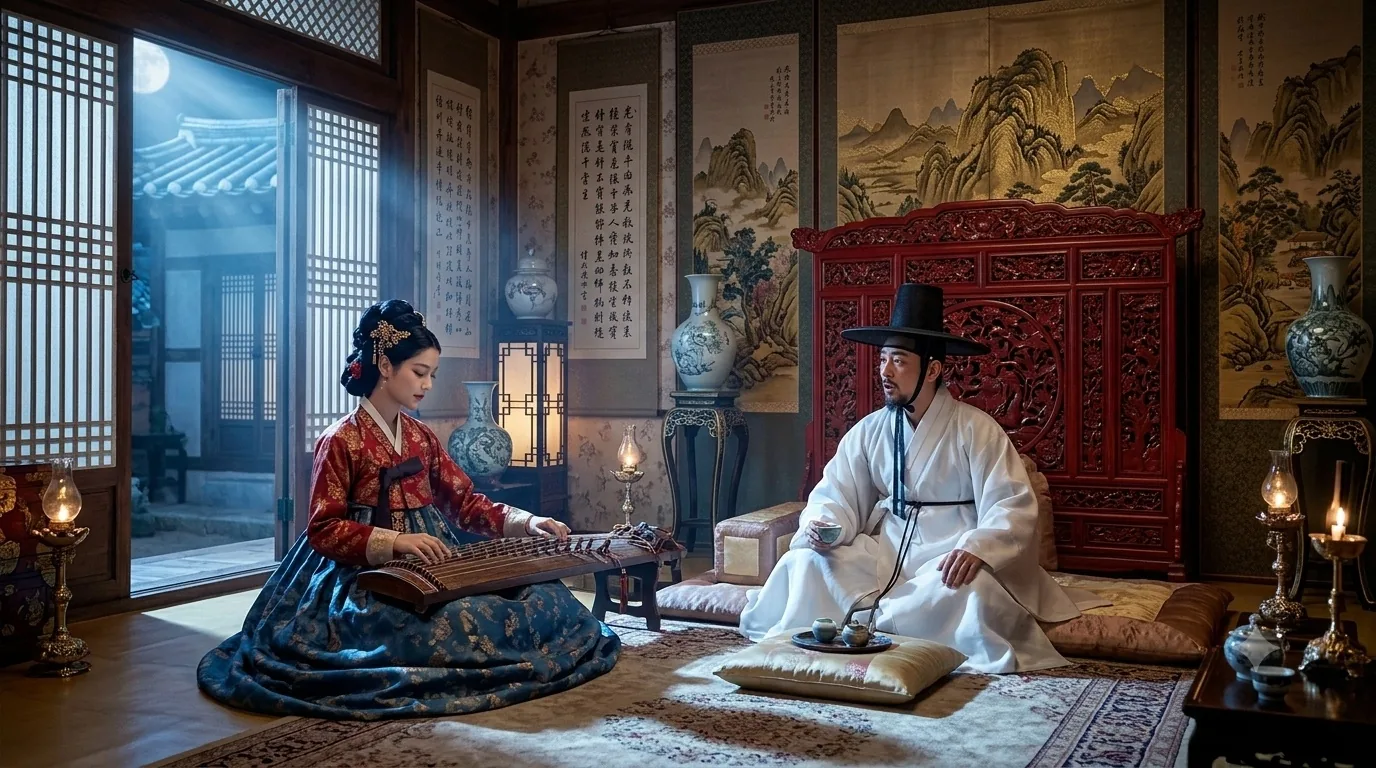
If you’ve watched Under the Queen’s Umbrella (슈룹, 2022, tvN), you’ve spent hours inside a palace where royal concubines are almost never called by a personal name. They’re 소용 this, 숙용 that — court rank standing in for identity, scene after scene. It’s easy to read as just the formal furniture of a sageuk, stiff palace etiquette dramas use to feel old and important.
It isn’t only that. Look past the fiction and something stranger sits underneath: the real, historical women those ranks describe — and even the most celebrated yangban women outside the palace walls — very often have no personal name recorded anywhere in official history at all.
This wasn’t a quirk of palace ceremony. It reflects a real, structural gap in the record: elite Joseon women, even famous ones, routinely have no birth name left in official history — only a title, an adopted name, or a clan label standing in for a self.
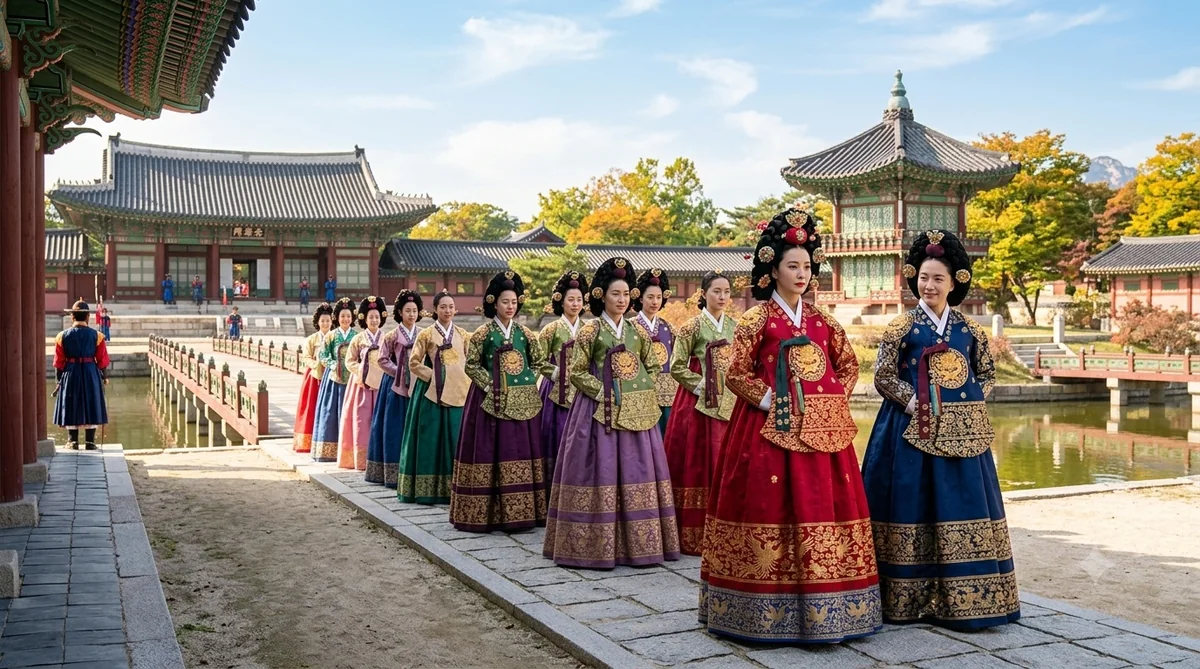 Joseon royal women in full court dress — remembered by rank and clan, rarely by a name of their own. (AI illustration)
Quick answer: Joseon yangban women were almost never recorded under their personal given names. Palace women were addressed by court rank (숙용, 소용, 숙원, 귀인 — the naemyeongbu system). Cultivated women who left writing, like Shin Saimdang, were remembered by an adopted studio name (당호, dangho) instead of a birth name — Saimdang’s own real name isn’t reliably documented. Married women in genealogies appear only as “Surname + 씨” (e.g., 안동 김씨). The root cause: Confucian gender norms defined a woman’s identity relationally — daughter, wife, mother, clan member — not as an individual with a name of her own in the public record. Let’s unpack it.
So why did women’s own names disappear from Joseon’s official record?
Joseon Korea ran on Neo-Confucian principles that assigned men and women sharply separated roles. A yangban woman’s recognized identity was almost never “herself” in the abstract — it was whose daughter, whose wife, whose mother she was, tracked through her clan’s bloodline rather than her own biography (Forgotten by Confucianism? The Fate of Women Under Joseon — Planète Corée). Family registers, or jokbo (족보), existed to preserve lineage, and lineage ran through men. The Encyclopedia of Korean Culture’s entry on Korean naming puts it bluntly: in genealogies that prized bloodline, “women’s names were not recorded — only the husband’s name appeared” (Encyclopedia of Korean Culture — Name (이름)). The same entry notes a name carried into adulthood was effectively “taboo” for women, who weren’t issued the formal registered name (관명) men received, until reforms after 1910.
This didn’t mean women had no names in life — more on that below. It meant the record simply stopped carrying that name forward. Privately named; publicly anonymous. That gap is this piece’s whole subject.
The three ways a name could exist without a name being written down
Three substitute systems filled the space where a personal name should have gone.
Rank titles, for palace women. Inside the royal household, women were identified through the naemyeongbu (내명부), a formal hierarchy of court ranks organized under King Sejong in 1428 and later codified in full in the Gyeongguk Daejeon (經國大典) statute code (Encyclopedia of Korean Culture — Naemyeongbu). Bin (빈) and gwiin (귀인) sat at first rank, down through soui/sugui, soyong/sukyong, and soweon/sukwon (see the FAQ below for the full ladder). These weren’t nicknames — they were official appointments with fixed grades and precedence, and a concubine’s rank could rise over her lifetime as her standing at court changed. This is exactly the system Under the Queen’s Umbrella dramatizes: its concubines address one another by this ladder of titles, not by given name.
Dangho — a chosen studio name — for cultivated women. Outside the palace, the rare educated yangban woman who left behind poetry, paintings, or letters good enough to be remembered by name at all was usually remembered not by her birth name but by a dangho (당호) — a name tied to a study, hall, or residence, adopted the way male scholars adopted a ho (호), a pen name earned through cultivated mastery. The single most famous case is Shin Saimdang (신사임당, 1504–1551): “Saimdang” is her dangho, chosen in homage to Tairen (太任), mother of King Wen of the ancient Zhou dynasty and Confucian literature’s ideal virtuous mother (Encyclopedia of Korean Culture — Shin Saimdang). She was also known as Siimdang (시임당) and Imsajae (임사재) — again, adopted names, not a birth name. The poet Heo Nanseolheon (허난설헌) is remembered the same way.
“○씨” (Surname + ssi), for everyone else. By far the most common outcome, covering the vast majority of yangban women who left no writing at all: a woman appears in genealogies, court documents, even her own gravestone, identified only by surname plus clan seat — for example, “안동 김씨” (“a Kim of the Andong clan”). The Encyclopedia of Korean Culture gives everyday versions directly: “윤씨할머니” (Grandmother Yun), “김씨부인” (Lady Kim), “연안김씨” (a Kim of the Yeonan clan) (Encyclopedia of Korean Culture — Name). The record usually preserved which bloodline she came from — but often failed to preserve who she, individually, was.
Wait — so is it true Shin Saimdang’s real name is just… unknown?
Here is the honest, slightly uncomfortable answer: yes, as far as reliable sources show. This is exactly the kind of claim worth double-checking rather than repeating, because a specific name for her circulates constantly in popular writing — and it doesn’t hold up.
You will often see her personal name given as “신인선” (Sin In-seon). The Encyclopedia of Korean Culture’s entry on her, however, records her birth and death years (1504–1551), her family background, her artistic accomplishments, and her three adopted names — Saimdang, Siimdang, Imsajae — but no personal birth name at all (Encyclopedia of Korean Culture — Shin Saimdang). That silence is telling — but the careful reading isn’t “the encyclopedia omits it, therefore no name existed,” since an entry could drop a name for editorial reasons. The stronger point is that across the major official and scholarly references — the Encyclopedia of Korean Culture, 우리역사넷 (the National Institute of Korean History), and the scholarship on the earliest record of her life, Yi I’s memorial essay for his mother — she is discussed through her dangho, and none presents a confirmed birth name. “신인선” circulates in popular writing but isn’t established in that record. Claiming it appears in no Joseon document at all would require surveying the annals, literary collections, genealogies, and epitaphs — so the honest line is simply that it is not reliably documented.
So the honest way to put it: historians do not have a verified personal name for Shin Saimdang. Her home in Gangneung, Ojukheon (오죽헌), survives as a state-designated Treasure, protected as her and her son Yi I’s birthplace (Korea Heritage Service — Treasure Gangneung Ojukheon). Her paintings are studied across Korea; her face appears on the 50,000-won note. Her given name is not reliably known. That isn’t a footnote here — it is the article, distilled into one fact. The point isn’t that Shin Saimdang had no name in life; it’s that the name her own family knew her by never survived as a verified name in the formal historical record.
Common misconception: doesn’t “no recorded name” just mean “no name”?
It’s tempting to conclude Joseon women simply weren’t named, full stop — as though naming a daughter was beneath consideration. That’s not what the record shows.
Girls were named the same way boys were: an informal childhood name (아명) at birth, spoken daily within the household, often deliberately humble — folk belief held that a lowly name protected a newborn’s fortune, tricking or turning away jealous spirits (Encyclopedia of Korean Culture — Name). What Joseon’s formal institutions withheld wasn’t the existence of a name — it was continuing that name into the public record of adulthood. A man’s name followed him through the exam system and his genealogy entry. A woman’s name mostly stopped traveling the moment she became someone’s wife. The erasure happened at the threshold between private life and public record — not at birth.
How does this compare to how Western noblewomen’s names worked?
It’s tempting to flatten this into “women’s names changed at marriage everywhere” — but that blurs something important.
Under English and broader European coverture, a married woman’s separate legal identity was considered absorbed into her husband’s, and as a visible symbol of that, she adopted his surname (National Women’s History Museum — Coverture). That’s a real erasure of legal personhood. But she kept her own given name for life throughout it. Consider Anne Boleyn: born a commoner’s daughter, she became Marchioness of Pembroke, then queen consort of England — and through every title, every document, every portrait, she is “Anne,” to the scaffold and beyond (Encyclopædia Britannica — Anne Boleyn).
| In Drama | In History |
|---|---|
| Concubines address each other only by rank (숙용, 소용, 귀인) | The naemyeongbu was a real, fixed rank system organized in 1428 and codified in the Gyeongguk Daejeon, used precisely this way at court |
| A woman’s identity feels beside the point next to her title | Married yangban women were commonly recorded only as “Surname + 씨” — bloodline, not biography |
| Shin Saimdang is simply “Saimdang” throughout | “Saimdang” is a dangho she adopted; her birth name is not reliably documented anywhere |
| A Western noblewoman like Anne Boleyn changes surname and title | Her given name, “Anne,” never disappears from the record for a single day |
| Looks like “women’s names changed” — a universal fact | Sharper: the personal name could vanish from the formal record entirely, not just get replaced |
In short: a Western noblewoman’s surname could change, but her given name anchored her identity across every title she held. In the Joseon yangban system, that anchor itself — the personal name — routinely went missing, replaced by a rank, a studio name, or a bare clan label. That is a different, more total kind of erasure.
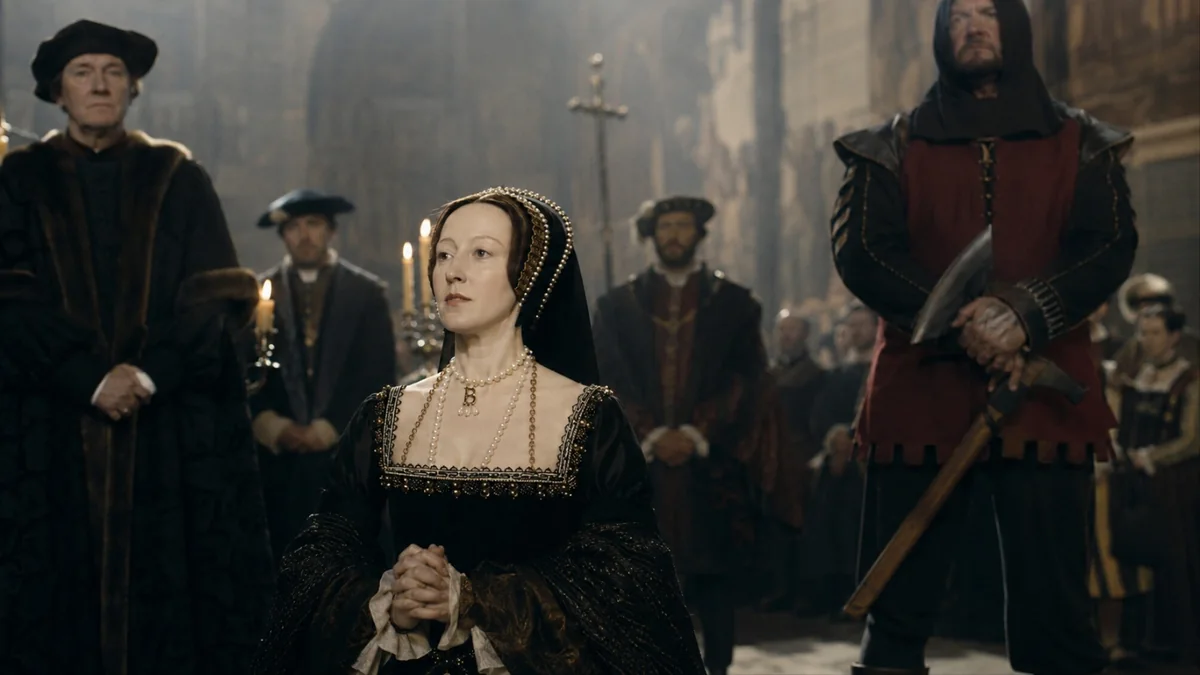 Anne Boleyn — commoner’s daughter, marchioness, queen, condemned prisoner — was “Anne” at every stage, even here. In the Joseon record, the given name itself often vanished. (AI illustration)
Coming up next
Watch Under the Queen’s Umbrella again with this in mind, and the palace’s parade of rank titles stops feeling like costume-drama formality. It becomes a precise window into how thoroughly a woman’s individual identity could be subsumed — by rank, by clan, by relationship to the men around her — even for the women closest to the throne. Shin Saimdang’s missing birth name isn’t a gap in our research. It’s the system working exactly as it was built to.
In the next essay, we’ll take another K-drama scene that looks like pure fiction — and trace the real Korean history hiding underneath it.
Frequently asked questions
Did Joseon women really have no personal names at all? No — that’s the misconception worth correcting. Girls were given informal childhood names within the family, just like boys. What disappeared was the formal, public record of that name. Once a yangban woman married, official documents — genealogies, court records, even her own gravestone — typically dropped her given name entirely and identified her only by clan and surname, such as “안동 김씨.” The name existed in her lifetime. It simply wasn’t the state’s or the clan record’s job to preserve it.
Was “Saimdang” Shin Saimdang’s real name? No. Saimdang (사임당) is a dangho — a self-adopted studio or hall name, not a birth name. According to the Encyclopedia of Korean Culture, she chose it in homage to Tairen (太任), the mother of King Wen of the Zhou dynasty, revered in Confucian tradition as the ideal virtuous mother. She was also known by two other adopted names, Siimdang (시임당) and Imsajae (임사재) — all titles she or her family chose, none of them her birth name.
What was Shin Saimdang’s actual birth name? Historians don’t reliably know. The Encyclopedia of Korean Culture’s entry on her records her dates (1504–1551), her dangho, and her achievements — but no personal birth name. The name “신인선” (Sin In-seon), though widespread in popular biographies and children’s books, is not presented as her confirmed birth name in any major official or scholarly reference — so historians treat it as popular tradition rather than established fact, not as a name provably invented. That one of Korea’s most celebrated women has no reliably documented birth name is itself the clearest illustration of this article’s point.
What is a dangho, and why did women in particular adopt one? A dangho (당호) is a name tied to one’s study, hall, or residence — a category of “ho” (호), the pen name earned through cultivated achievement in scholarship or art. Men used ho too, but for women a dangho carried extra weight: it was often the only name a cultivated woman would ever be known by outside her family, since her birth name was excluded from formal record. Shin Saimdang and the poet Heo Nanseolheon (허난설헌) are remembered today by dangho, not birth name.
What do titles like 숙용, 소용, 숙원, and 귀인 actually mean, and does Under the Queen’s Umbrella get them right? They’re ranks in the naemyeongbu (내명부), the Joseon court’s formal hierarchy for royal women, organized under King Sejong in 1428 and codified in full in the Gyeongguk Daejeon law code: bin (빈)/gwiin (귀인) at first rank, down through soui/sugui, soyong/sukyong, and soweon/sukwon at fourth. The drama’s concubines address one another by these exact titles rather than personal names — historically accurate to how the inner court actually referred to its women.
Why are married yangban women recorded in genealogies only as “○씨” — surname plus clan seat? Because Joseon family registers (족보) existed to trace bloodline, not biography. The Encyclopedia of Korean Culture notes that in genealogies prizing bloodline, only husbands’ names appeared — women were recorded by surname plus the suffix “씨” (ssi), like “윤씨할머니” or “연안김씨.” A woman’s clan origin mattered to the record; her given name did not.
Isn’t this the same as Western women taking their husband’s surname at marriage? It looks similar but isn’t. Under English and European coverture, a married woman took her husband’s surname; legally, her identity was considered absorbed into his. But she kept her given name for life — Anne Boleyn is always “Anne,” as a commoner’s daughter, as queen, on the scaffold. What’s different about the Joseon yangban pattern is that the personal name itself, not just the surname, routinely disappeared from the record — a deeper erasure, the vanishing of the name altogether.
Why does this gap in the historical record matter today? Because it shapes what we can and can’t know. When a Confucian gender system defines a woman’s identity relationally — as daughter, wife, or mother, tracked through clan rather than her own name — the record inherits that erasure permanently. We can reconstruct Shin Saimdang’s paintings, poems, and her dangho’s meaning in exhaustive detail. We still cannot tell you, with confidence, what her mother called her.
Sources & further reading
This piece was written from the historical script and fact-check of 사뚱샘의 역사방 (SaDDungSam), cross-checked against Korea’s standard reference encyclopedia and official heritage records:
- Shin Saimdang (신사임당) — dates, dangho origin (from Tairen 太任), alternate names, no documented personal name. Encyclopedia of Korean Culture
- Name (이름) — childhood names, the taboo on recording adult women’s names, and the “Surname + 씨” convention. Encyclopedia of Korean Culture
- Naemyeongbu (내명부) — the full royal-women rank hierarchy, established 1428. Encyclopedia of Korean Culture
- Treasure Gangneung Ojukheon — heritage designation of Shin Saimdang’s birthplace. Korea Heritage Service (국가유산청)
- Coverture — how English/European law absorbed a wife’s legal identity and the surname-change convention. National Women’s History Museum
- Anne Boleyn — a given name persisting across every title and life stage. Encyclopædia Britannica
- Forgotten by Confucianism? The Fate of Women Under Joseon — Confucian gender norms and women’s relational identity. Planète Corée
Thanks for reading — see you in the next one.
This article was researched and written by K-Drama History. Source: Under the Queen's Umbrella, Explained: Why Joseon Women Had Names — But History Often Erased Them — K-Drama History