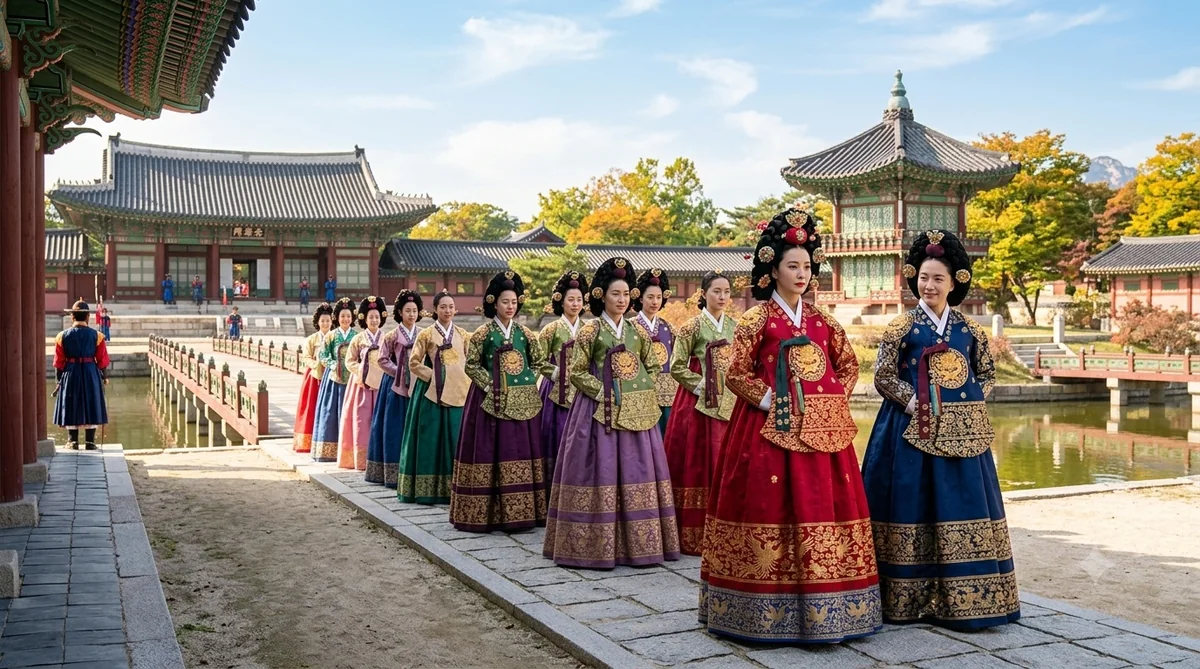
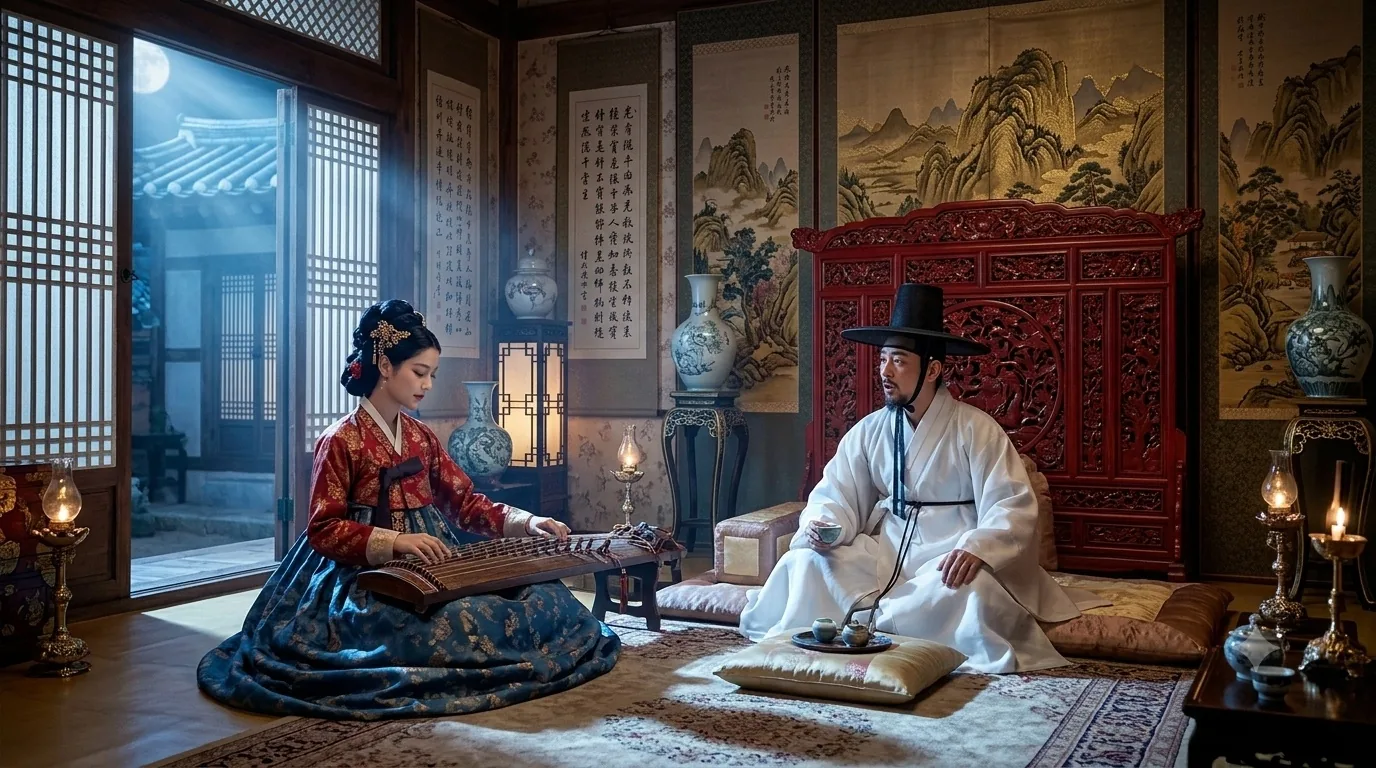
Knight Flower, Explained: Why a Chaste Widow Became One of Joseon's Highest Public Honors
Theme: Women’s Lives
From the research behind Pause the Drama.
In MBC’s 2024 hit Knight Flower (밤에 피는 꽃), Jo Yeo-hwa is, by daylight, the picture of a perfect Joseon widow. She has lived in seclusion for fifteen years, since her groom died the day of their wedding, and is quietly being considered for one of the highest honors a woman could receive — a chastity gate erected in her honor. By night, she puts on a mask, climbs over the estate wall, and becomes Midam, a masked vigilante who rights wrongs the law won’t touch.
The show plays her double life for thrills and romance. But the daytime half — the perfect, grieving, untouchable widow — isn’t an invented costume. It’s a role Joseon Korea built an entire legal and honor system to enforce, shaping real women’s lives for five centuries.
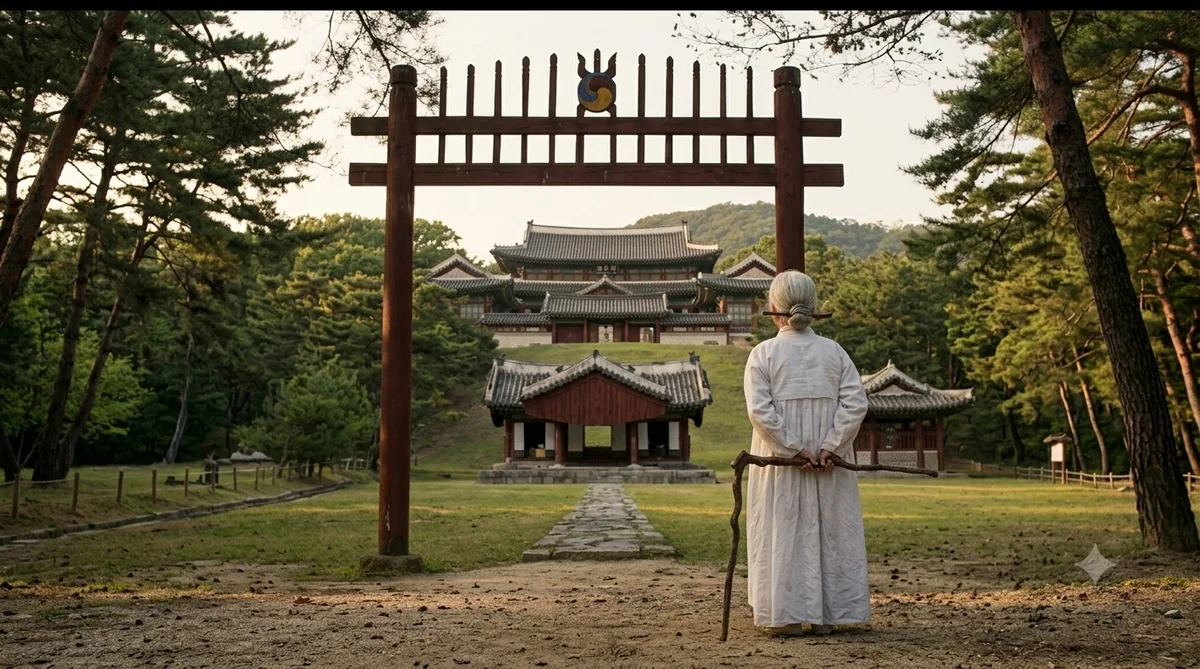 A widow before a red honor gate — the state’s public reward for a lifetime of chastity, and a role a real woman had to perform flawlessly. (AI illustration)
Quick answer: Knight Flower’s heroine is publicly a model chaste widow while secretly living as a masked vigilante — and the “model widow” role she performs was real. Joseon Korea discouraged widow remarriage through law starting in 1477, and rewarded women who stayed unmarried (or, later, who died to prove their fidelity) with public honor: a yeollyeo-mun, a state-built memorial gate. The ideal only hardened with time, turning a woman’s grief into a public resource for her family’s honor — and, at its harshest, into a trap.
Let’s unpack it.
Why is a “model widow” such a big deal in Knight Flower?
Because in Joseon Korea, a widow’s conduct wasn’t a private matter — it was public property, watched, reported, and graded by the state.
Jo Yeo-hwa isn’t simply grieving quietly out of personal preference. She’s performing a specific, recognizable social role: the yeollyeo (열녀), the “virtuous woman” who proves her devotion to a dead husband by refusing to remarry, sometimes for the rest of her life. That role came with real stakes attached — for her personally, and for the future careers and reputation of her descendants. Which is exactly why the show can plausibly put her up for a yeollyeo-mun honor while she’s secretly leaping across rooftops at night: the daytime performance had to be flawless, because an entire honor economy was watching.
What was Joseon’s yeollyeo system? It was a state-backed honor apparatus that rewarded women — especially widows — for lifelong fidelity to a single husband. It worked hand in hand with the widow-remarriage disqualification: remarriage was rarely punished as a crime, but it could bar a woman’s descendants from government office, while lifelong chastity could earn public honor in the form of a jeongnyeo memorial gate.
What actually happened? Joseon’s remarriage ban and the chastity-gate system
Here’s the real history sitting underneath the drama’s premise — and it runs deeper, and stranger, than “widows were expected to be sad.”
The remarriage ban wasn’t a criminal law — it was a career sentence handed to your children. In 1477 (King Seongjong’s eighth year), a widow named Cho arranged her own remarriage without her in-laws’ approval, forcing a court debate. At the time, the existing rule only barred descendants of women who had remarried three times from office. A minority of officials — including Im Won-jun, Heo Jong, and Yu Ja-gwang — pushed further: bar the descendants of any remarried woman. Seongjong sided with them (National Institute of Korean History). By 1485, this was written into the revised Gyeongguk daejeon (경국대전), Joseon’s foundational legal code, as the jaenyeo jason geumgo-beop — the law disqualifying the sons and descendants of remarried women from office (Encyclopedia of Korean Culture, Academy of Korean Studies).
Notice what this law does not do: it doesn’t jail a remarrying widow, and it doesn’t, technically, ban remarriage outright. It’s quietly worse in a different way — it makes remarriage a permanent professional liability for her sons and their descendants, locking them out of the small number of civil and military posts that meant anything in status-obsessed yangban society. It’s an indirect ban, enforced through your children’s future rather than your own body — and because Joseon’s aristocracy depended entirely on office-holding for status, it worked. The law stayed in force until the 1894 Gabo Reforms formally abolished it, and the social stigma behind it lingered for generations after.
Staying unmarried was rewarded — publicly, visibly, and for centuries. The flip side of the ban was a carrot: the jeongnyeo (旌閭) system. From the founding of the dynasty in 1392, provincial governors reported exemplary local figures to the capital every year, and the Ministry of Rites reviewed and forwarded strong cases to the throne. Recognized women could receive a jeongmun (memorial gate), a bokho (tax exemption for the household), material rewards, and — for commoners or the lowborn — elevation in social status (Encyclopedia of Korean Culture). This wasn’t only for women: the system honored three virtues together, the samgang — chungsin (충신, loyal subjects), hyoja (효자, filial sons), and yeollyeo (열녀, chaste women). A red-painted gate or a small standalone pavilion (jeongnyeogak) would go up at a village or family compound entrance, naming the honoree for anyone passing through to see.
Here’s what the drama shows beside what the historical record says:
| In Knight Flower | In real history |
|---|---|
| Jo Yeo-hwa is publicly considered for a chastity-gate honor | Provincial governors annually nominated women for the jeongnyeo honor system, running from 1392 onward |
| She has lived in strict seclusion for 15 years without remarrying | Widow remarriage carried no criminal penalty, but disqualified a woman’s descendants from office by law from 1485 |
| Her public reputation is treated as fragile and closely watched | A yangban family’s entire status could ride on a widow’s visible conduct, since sons paid the professional price |
| Her “perfect widow” role and her vigilante life must never overlap | The honor was for performance of chastity as much as private feeling — a public role with real, structural stakes |
In short: Knight Flower dramatizes a genuine Joseon institution — a legal disincentive against widow remarriage paired with a public honor system rewarding those who stayed unmarried — and uses its heroine’s double life to dramatize just how much pressure that public performance carried.
Key terms. Yeollyeo (열녀) — literally “ardent/virtuous woman,” the honorific term for a widow (or occasionally an unmarried woman) recognized by the state for lifelong fidelity to one husband, up to and including death. Jeongnyeo (旌閭) — the state commendation system itself, and also the general term for the resulting gate or marker. Yeollyeo-mun (열녀문) — the specific memorial gate erected for a woman honored as yeollyeo, one branch of the broader jeongnyeo system. Jaega-geumgo (재가금고) — the administrative “disqualification for remarriage,” barring a remarried woman’s descendants from office rather than punishing her directly. Gyeongguk daejeon (경국대전) — Joseon’s core legal code, finalized and repeatedly revised through the 15th century, which formally wrote the remarriage disqualification into law by 1485.
Did the pressure stay the same for all 500 years — or did it get worse?
It got worse — considerably.
Early Joseon already treated chastity as a Confucian virtue worth rewarding, but the intensity most people associate with “yeollyeo culture” is really a story about the 17th century onward. After the Japanese invasions of 1592–1598 and the Manchu invasions of 1636–1637, Joseon society was left shaken, and the state leaned harder on Confucian moral order to rebuild a sense of stability — including a much heavier emphasis on female chastity as a marker of social health. One figure captures the shift — though it has to be read narrowly. In the Dongguk Sinsok Samgang Haengsildo (동국신속삼강행실도), a state morality compendium compiled after the Imjin War, the women commended as yeollyeo outnumbered the hyoja and chungsin honorees combined by roughly three to one (Encyclopedia of Korean Culture). That ratio belongs specifically to that Imjin-War-era compilation — not to the whole of late Joseon. From the mid-17th century, moral instruction texts drawing on the Confucian primer Sohak (小學) proliferated household by household, giving families a script to drill into daughters and daughters-in-law.
Then the bar moved again. By the 18th and 19th centuries, the record suggests that simply staying unmarried for life — the original, “moderate” ask — had stopped being enough to draw recognition. The state increasingly reserved its highest honors for women who starved themselves to death, died by suicide, or died resisting an assault on their virtue, sometimes called sunjeol (순절, “dying for fidelity”). It’s a genuinely uncomfortable turn in the record, and it did not go unquestioned even at the time: the Confucian scholar Jeong Yak-yong (정약용), in the essay “Yeolbu-ron” (烈婦論), argued that when a husband died a natural death, a wife who killed herself to follow him was not performing righteousness — she was, in his framing, merely destroying her own life to no moral purpose (Encyclopedia of Korean Culture). The criticism came from inside the system, and the system kept running anyway.
Common misconception: “This was just a religious custom, not really enforced”
It’s tempting to imagine yeollyeo culture as purely cultural atmosphere — social expectation with no teeth. The law says otherwise: the remarriage disqualification was written into the Gyeongguk daejeon, Joseon’s actual legal code, and administered through real bureaucratic channels — governors’ annual reports, Ministry of Rites review, royal approval — with a real enforcement lever (a family’s access to office) and a real reward lever (tax exemption, status elevation, a physical gate). It’s also worth being honest about the limits of that enforcement: compliance was strongest among yangban families with careers to protect. Commoners and lower-status widows, who had comparatively little to lose and often a practical need for a second household, remarried far more freely — a reminder that even a five-century institution didn’t run the same way at every level of society.
Some concrete evidence of how deeply the honor mattered: commended jeongnyeo structures still stand in Korea today, such as the twelve-bay jeongnyeogak of the Hyeonpung Gwak clan in Daegu — housing 28 memorial tablets and designated a municipal cultural property in 1995. No jeongnyeomun currently holds top-tier national heritage status; by the Encyclopedia of Korean Culture’s count, about 15 jeongnyeogak carry cultural-property designations — a figure for designated heritage, not a full census of everything still standing (Encyclopedia of Korean Culture). Families kept these gates up for centuries. That’s not folklore — that’s architecture.
Beyond Korea: was controlling widows through enforced chastity a universal pattern?
Here’s where Knight Flower’s premise opens onto something bigger than one country: many societies reached for ways to control a widow’s future. But the mechanisms — and the stakes — were not remotely equivalent, and it’s worth being precise rather than collapsing them into one story.
India’s sati was a mortal, physical ritual — not the Korean model’s equivalent. Sati, in which a Hindu widow was burned on her husband’s funeral pyre, is real and documented, but historians are clear it was never a universal Indian practice: its incidence varied sharply by region, period, and social class — more visible in the early 19th century and in certain areas such as Bengal and Rajasthan — and it was condemned by many Indians at the time, including Mughal officials (World History Commons, Roy Rosenzweig Center for History and New Media). Reliable figures for how often it actually occurred are scarce, so it’s safer to describe the pattern than to pin a number to it. Governor-General Lord William Bentinck formally outlawed it through the Bengal Sati Regulation (Regulation XVII), promulgated 4 December 1829, declaring the practice illegal and punishable regardless of whether the widow had “consented” (George Mason University, Center for History and New Media). The distinction from Joseon is stark: sati was a single, mortal act; Joseon’s system was a decades-long legal apparatus that disqualified descendants from careers rather than mandating death — though its later, harsher phase did glorify women’s deaths as its highest honor, a dark convergence arrived at from a completely different legal starting point.
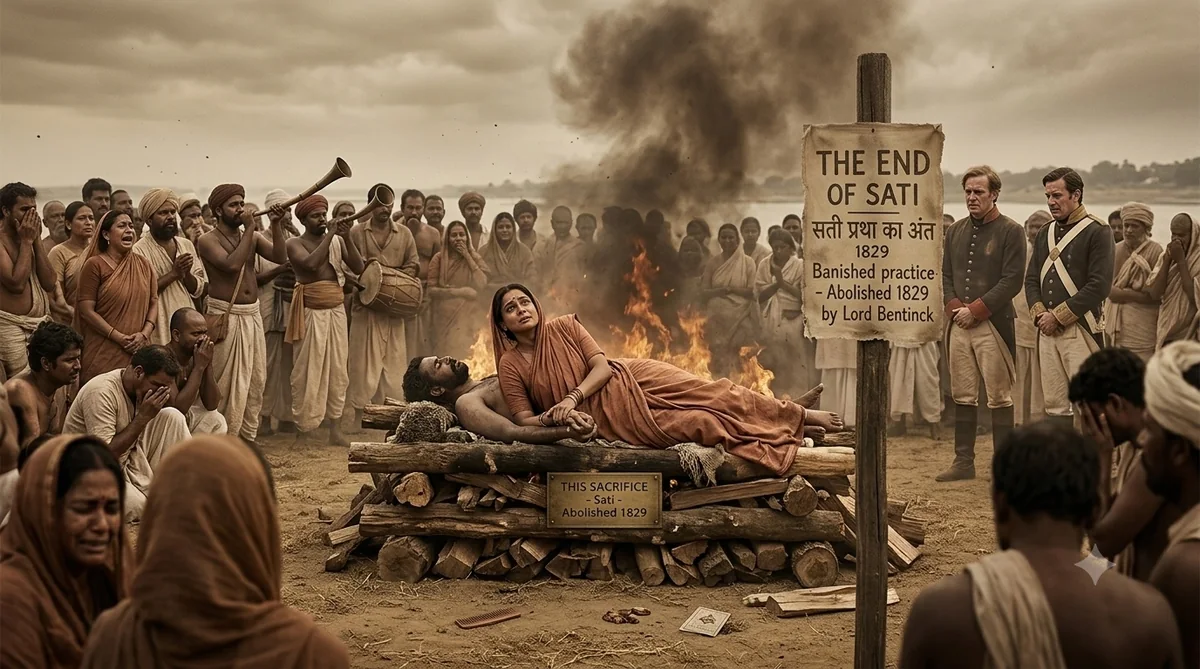 India’s sati was mortal and immediate; the British banned it in 1829. Joseon’s control was legal and slow — but both ended by treating a woman’s death as her highest honor. (AI illustration)
Europe generally built no legal remarriage ban — but social pressure still bit hard. In much of medieval and early modern Christian Europe, a widow’s remarriage wasn’t blocked by state law the way Joseon’s Gyeongguk daejeon blocked it; widowhood was handled mainly through property and dower-right law, which varied region by region (see the documented case of widow-right in medieval Durham, England, in Continuity and Change, Cambridge University Press). Social disapproval was a different matter: in parts of France and elsewhere, communities policed remarriages they found unseemly — an older widower marrying a much younger woman, or a widow remarrying “too soon” — through charivari, a noisy, mocking public ritual of processions and satirical songs, documented in the historical scholarship of Natalie Zemon Davis and E.P. Thompson (Oxford Academic, Past & Present). Real pressure, but community mockery — not a legal code disqualifying your children from office for five centuries.
Same underlying impulse, three very different machines. Joseon built a legal-and-honor apparatus that reached across generations. Sati, in its most extreme form, made the control mortal and immediate, though narrow in scale. Europe left it mostly to social mockery and property law. The impulse rhymes across all three; the machinery, and the human cost each demanded, did not.
Coming up next
A masked vigilante by night, a candidate for a chastity gate by day — one drama’s double life turned out to be a door into a legal code, a war-era honor spike, a scholar’s centuries-old dissent, and two very different systems half a world away that reached for the same control by very different means.
In the next essay, we’ll take another K-drama scene that looks like pure entertainment — and trace the real Korean history quietly running underneath it.
Frequently asked questions
Is Knight Flower based on a true story? No — Knight Flower is a genre drama adapted from a webtoon, and its central plot, a noblewoman moonlighting as a masked vigilante, is fiction. But the world around her is real: Joseon Korea did have a state honor system for chaste widows, a real administrative disincentive against widow remarriage, and real, documented social pressure on women to perform lifelong fidelity to a dead husband.
What was Joseon’s widow remarriage ban? It wasn’t a criminal ban on the act of remarrying itself — it was administrative. Starting with a 1477 edict under King Seongjong and formalized by 1485 in the revised Gyeongguk daejeon, the sons and descendants of a remarried yangban woman were barred from holding government office. Since office was the main ladder of status in Joseon, this made a widow’s remarriage a lifelong liability for her whole family line, not just for her.
What is a yeollyeo-mun (열녀문)? A yeollyeo-mun, or more formally a jeongnyeo (旌閭), was a red memorial gate or pavilion the Joseon state erected to publicly honor a recognized “chaste woman” — usually a widow who never remarried, or a woman who died defending her fidelity. It was one arm of a three-part honor system, alongside gates for loyal subjects (충신) and filial sons (효자).
Why did some women die to prove their chastity? Because the bar for the highest honor kept rising over time. Early on, lifelong celibacy after widowhood was enough to be recognized as yeollyeo. By the 18th and 19th centuries, records suggest plain celibacy had stopped being noteworthy, and the state increasingly reserved its highest honors for women who starved themselves, took their own lives, or died resisting assault — a pattern some Joseon scholars themselves criticized at the time.
Was this ideology present from the beginning of Joseon, or did it get worse over time? It intensified. Early Joseon already prized chastity as a Confucian virtue, but pressure escalated sharply after the Japanese invasions (1592–1598) and the Manchu invasions (1636–1637), when the state leaned on Confucian morality to restore order, and again in the 18th–19th centuries, when the honor system shifted from rewarding survival toward rewarding death.
Was Korea’s yeollyeo culture the same thing as sati in India? No, and the two shouldn’t be flattened together. Sati — a widow’s self-immolation on her husband’s funeral pyre — was a physical, mortal ritual that historians describe as never a universal Indian practice, varying by region, period, and class, and formally outlawed by the British colonial government in 1829. Joseon’s system was a legal and honor-based apparatus running across an entire dynasty for five centuries, disqualifying descendants from office rather than mandating death — though its harshest later phase did glorify women’s deaths as the highest honor.
Did European widows face the same kind of legal remarriage ban? Generally, no. In much of medieval and early modern Christian Europe, a widow’s remarriage wasn’t outlawed by the state the way it was administratively penalized in Joseon — it was handled mainly through property and dower law. Social disapproval existed, especially through charivari, a public shaming ritual sometimes aimed at widows or widowers who remarried “too soon,” but that was community mockery, not a legal disqualification written into a national code.
Did all Joseon widows actually comply with the chastity ideal? No. Compliance was strongest among yangban families, where the stakes for descendants’ careers were highest. Commoner and lower-status widows remarried far more often, since they had less to lose and often needed a second household’s labor to survive. Even among the aristocracy, the sheer volume of surviving texts that had to keep re-instilling the ideal is itself a sign it was never fully automatic.
Sources & further reading
This piece was written from the historical script and fact-check of 사뚱샘의 역사방 (SaDDungSam). The dates and figures above are sourced inline, cross-checked against the Encyclopedia of Korean Culture (Academy of Korean Studies), the National Institute of Korean History, George Mason University’s Center for History and New Media, and academic journals covering European widowhood and charivari. For broader reading:
- Joseon’s chastity-widow system in full. Encyclopedia of Korean Culture, “열녀 (Yeollyeo)” (encykorea.aks.ac.kr)
- The legal mechanics of the remarriage disqualification. Encyclopedia of Korean Culture, “과부재가금지법” (encykorea.aks.ac.kr)
- Sati in India — a teaching-oriented overview. World History Commons, “Long Teaching Module: Sati” (worldhistorycommons.org)
- Knight Flower (MBC, 2024) — drama database entry with cast and broadcast details. (HanCinema)
Thanks for reading — see you in the next one.
This article was researched and written by K-Drama History. Source: Knight Flower, Explained: Why a Chaste Widow Became One of Joseon's Highest Public Honors — K-Drama History