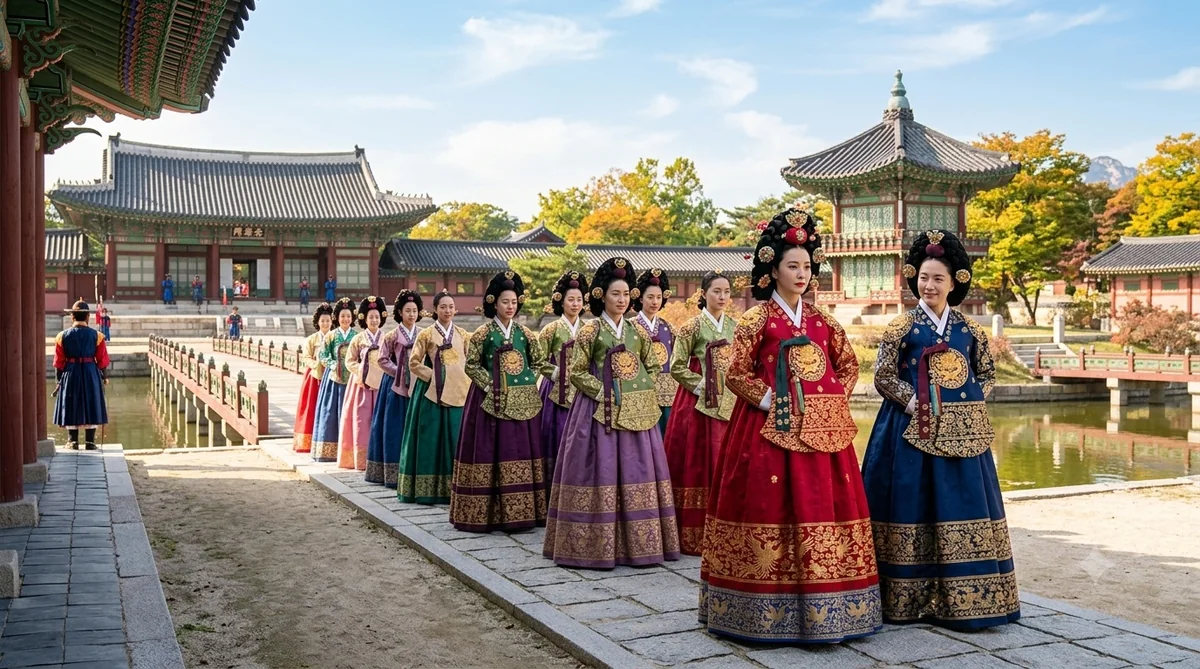
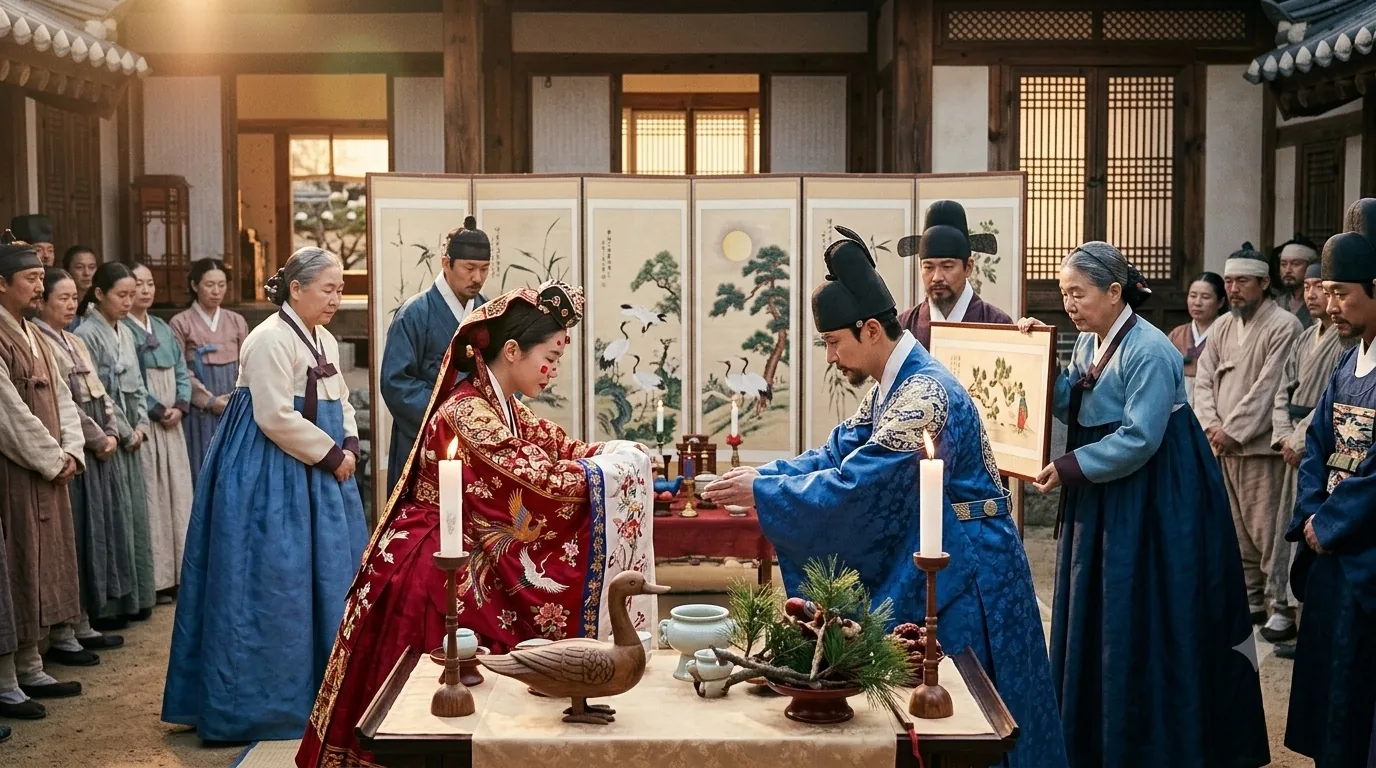
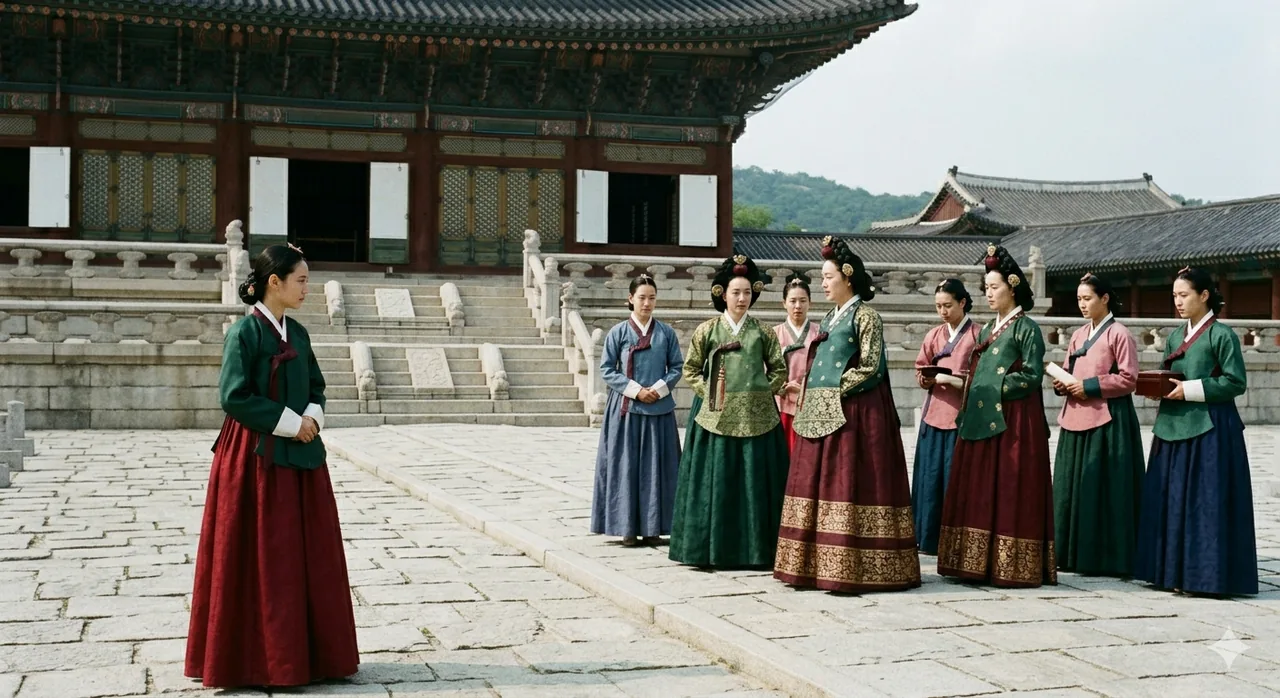
From the research behind Pause the Drama.
In Joseon, the wife of a daegun — a king’s son by the queen consort — was filed as a bubuin (부부인), senior first rank in the outer court. Not a gunbuin (군부인). That one word is the whole subject of this piece, because pulling on it opens the machinery Joseon built to sort its royal women: gongju and ongju, bin and gwiin, jeonggyeong-buin, and even the king’s wet nurse.
Somebody in this show is being filed in the wrong drawer, and it took Korean viewers about one episode to notice.
MBC’s Perfect Crown (21세기 대군부인) — twelve episodes, April to May 2026, with IU as Seong Hui-ju and Byeon Woo-seok as Grand Prince Ian — imagines a Korea where the monarchy never ended. Its heroine marries a daegun (대군), a grand prince. And the script keeps calling her gunbuin (군부인).
The usual complaint is that this demotes her a grade. That is not quite it, and the real version is more interesting. In the Gyeongguk Daejeon system the wife of a daegun was a bubuin (부부인) at senior first rank. Gunbuin was the title for the principal wife of a royal kinsman at senior or junior first rank — a concubine-born prince’s wife, the wife of a daegun’s eldest son. The two titles could carry the same number. What the drama gets wrong is not the height of the rung but which column the woman belongs in.
The show is set in an invented modern monarchy, so nothing obliges its palace to run on a fifteenth-century code. But measured against the historical system the usage does not fit, viewers said so publicly, and the production acknowledged the lapse in period detail.
Which is a strange thing to slip on in a drama whose Korean title is her status — and a good reason to ask what the ladder actually was. Because these were not honorifics. They worked as an administrative grading system, and where a woman sat on it shaped her stipend, her ceremonial access, and the scale of her funeral.
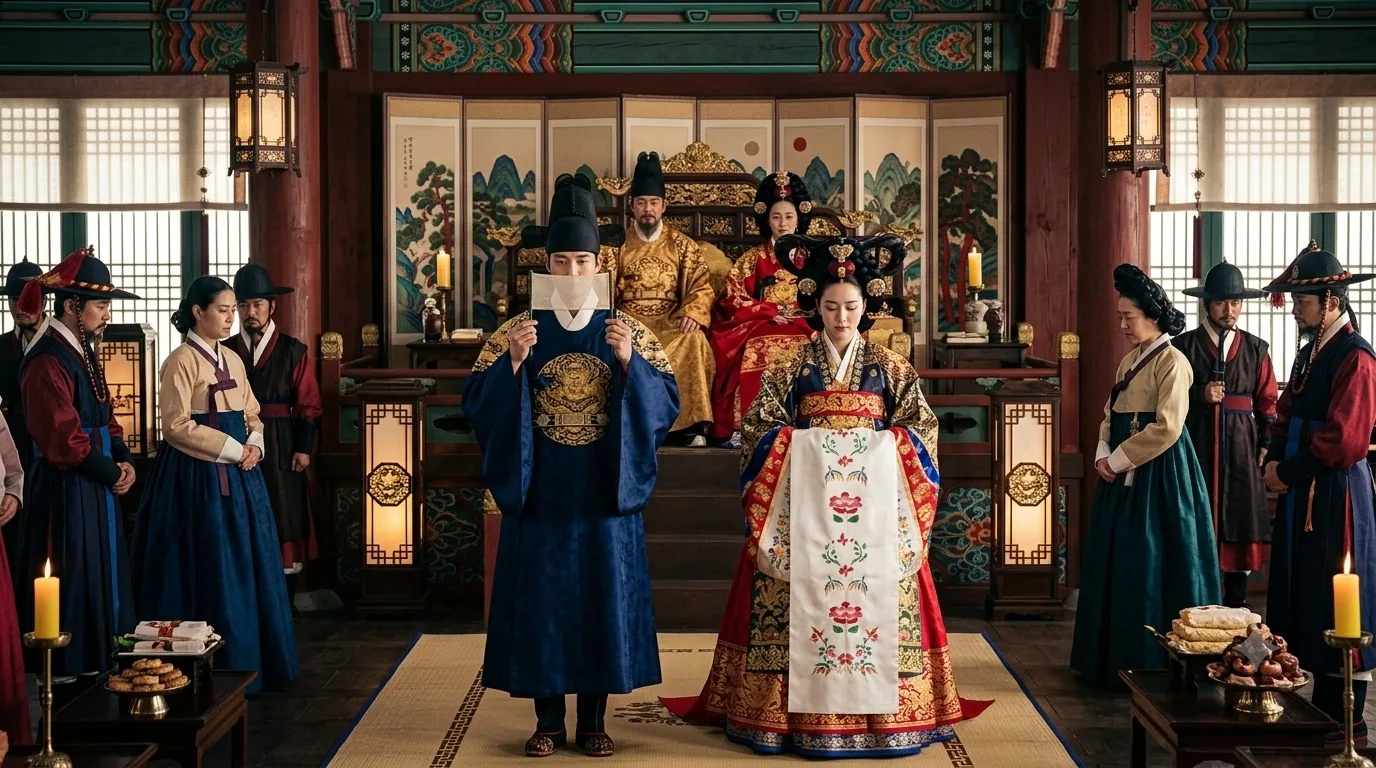 A title arrived as a document, read out and handed over. It could also be updated, upgraded, granted after death — or taken back. (AI illustration)
Quick answer: In Joseon, a king’s daughter by the queen consort was a gongju (공주); by a concubine, an ongju (옹주). A king’s son by the queen was a daegun (대군); by a concubine, a gun (군). A daegun’s wife was a bubuin (부부인) at senior first rank; gunbuin (군부인) went to the principal wives of first-rank royal kinsmen. Consorts inside the palace were graded on the naemyeongbu (내명부) — bin, gwiin, soui, sugui, soyong, sukyong, soweon, sukwon — while women outside it were graded on the oemyeongbu (외명부), whose top numbered title for an official’s wife was jeonggyeong-buin. Even the king’s wet nurse was enfeoffed: bongbo-buin. Every grade carried concrete entitlements, and every one could be raised, granted posthumously, or revoked. Let’s unpack it.
So what does the drama’s title actually refer to?
Start with the word. Daegun (대군, 大君) was the title for a king’s son born to the queen consort; a son born to a concubine became gun (군, 君) (Encyclopedia of Korean Culture — Daegun). From 1414 the court fixed that categories followed birth: whether the mother was the queen or a concubine decided which title a son would receive. Being born into the category was one thing; the formal enfeoffment was a separate procedure — the encyclopedia describes legitimate sons as designated from birth, while the National Institute of Korean History notes princes being enfeoffed on reaching a certain age.
Both sat outside the numbered bureaucracy. In early Joseon the grade was expressed as senior first rank without a numbered subdivision; the Gyeongguk Daejeon placed daegun and gun at mupum (무품), outside the numbered ladder altogether (우리역사넷 — Daegun and Gun). The point is not that they outranked the chief state councillor on a scale but that they stood outside the scale, as royal kin. After marriage they left the palace and lived among the population, supported by the state, with that support running four generations — after which their descendants entered office through the civil service examination like any other yangban family.
The wife, then. A daegun’s wife held bubuin (부부인, 府夫人) at senior first rank — the highest numbered title in the outer court (Encyclopedia of Korean Culture — Bubuin). Note the qualifier: gongju and ongju stood at mupum, above the numbers entirely, so bubuin was the top of the counted ladder rather than the top of everything.
The same entry records something that tells you how the state thought. The identical title, at the identical rank, also went to the mother of a reigning queen. Two different women — one married into the royal house, one having produced a queen — sorted under one grade. That is a statement about filing, not about equivalence: their ceremonial and political weight was not the same, but the ledger gave them the same row.
The title’s own history is almost comically bureaucratic. A daegun’s wife was styled ongju in the earliest period, then samhan-gukdaebuin (삼한국대부인), containing 國, “state.” Officials argued that attaching 國 to a subject’s wife was inappropriate, and the title was changed to bubuin. Someone, at some point, argued about which character was too large for a woman’s name.
The drama’s 대군부인 is the plain-language phrase — the daegun’s wife — where the clerk would have written bubuin.
Why is a king’s daughter sometimes a gongju and sometimes an ongju?
Same question, other gender: her mother.
A gongju (공주, 公主) was a king’s daughter by the queen consort (Gongju); an ongju (옹주, 翁主), by a concubine (Ongju).
This was not always tidy. In Goryeo, ongju covered a scatter of royal women — concubines themselves, princes’ wives — and King Gongyang widened it to include the king’s daughters and relatives’ wives. Into early Joseon it was still doing all that work at once. On the other side, gungju (궁주), ongju and wangnyeo (왕녀) were used more or less interchangeably.
The cleanup came in 1440, the twenty-second year of King Sejong, when the court fixed the meanings: the queen’s daughters were gongju, the king’s concubine-born daughters were ongju, and other royal daughters — a crown prince’s, for instance — took separate titles such as gunju (군주) and hyeonju (현주).
This is where popular retellings slip. The neat gongju/ongju split quoted as the Joseon rule is the rule of Joseon after 1440. Applied to the dynasty’s first half-century it is an anachronism: when you meet these titles in a source, the date matters as much as the word.
Both were classed as mupum — outside the numbered ladder. But “outside the ladder” did not mean “equal to each other.” An ongju’s treatment was set one grade below a gongju’s, and it followed her to the end: her funeral rites were conducted one grade down, and on her death the court suspended audiences for two or three days as formal mourning.
Then the sharpest detail — the husbands.
A gongju’s husband was appointed a royal son-in-law and given the title gwangdeok-daebu (光德大夫) or sungdeok-daebu (崇德大夫); an ongju’s husband, jaui-daebu (資義大夫) or sunui-daebu (順義大夫). Those titles were set in 1444, at junior first and junior second rank respectively (Veritable Records of King Sejong, 26th year 7th month 1st day). The office they entered was then called the bumabu; it was renamed uibinbu (의빈부) in 1466, and from 1484 and in the Gyeongguk Daejeon the two sons-in-law were appointed wi (위) at junior first and junior second rank.
Two men. Both married a daughter of the same king. Both entered the same office of royal in-laws. Different grades, different stipends — decided by which woman had borne their wives, decades before either man appeared.
Here is the ladder, side by side
| Title | Who she was | Standing |
|---|---|---|
| Gongju (공주) | King’s daughter by the queen consort | Mupum — outside the numbered ranks |
| Ongju (옹주) | King’s daughter by a concubine | Mupum, but treated one grade below a gongju |
| Bubuin (부부인) | Wife of a daegun; also a reigning queen’s mother | Senior 1st — the top numbered title of the outer court |
| Gunbuin (군부인) | Principal wife of a royal kinsman at senior or junior 1st rank | Senior or junior 1st |
| Bin / Gwiin (빈 / 귀인) | Royal consorts | Senior 1st / junior 1st, naemyeongbu |
| Soui / Sugui (소의 / 숙의) | Royal consorts | Senior 2nd / junior 2nd |
| Soyong / Sukyong (소용 / 숙용) | Royal consorts | Senior 3rd / junior 3rd |
| Soweon / Sukwon (소원 / 숙원) | Royal consorts | Senior 4th / junior 4th |
| Sanggung (상궁) and below | Palace officials, not consorts | 5th through 9th, naemyeongbu |
| Jeonggyeong-buin (정경부인) | Principal wife of a first-rank civil or military official | Highest numbered title among officials’ wives |
| Bongbo-buin (봉보부인) | The king’s wet nurse | Junior 1st, granted for her own service |
Read the middle column and the logic is hard to miss. Almost every entry defines a woman by a relation to a man — whose daughter, whose wife, whose mother. The last row is the exception, and we will come to her.
What was the naemyeongbu, and how did you move on it?
The court kept two parallel registers. Naemyeongbu (내명부) covered women who received formal rank inside the royal household — the consorts and the ranked palace officials. Oemyeongbu (외명부) covered women enfeoffed through their relation to the royal house, royal kin or officialdom, or through their own role: royal daughters, a crown princess’s household, a king’s mother, the royal wet nurse, royal kinsmen’s wives, officials’ wives (Myeongbu). Not every woman in the palace was in the naemyeongbu — unranked menial staff fell outside the table entirely.
The system was built in stages. Enfeoffment rules for the outer court date to 1396; a palace women’s rank structure to 1405; in 1428 King Sejong’s court separated the palace women into naegwan (내관, the ranked consorts) and gunggwan (궁관, the working women from sanggung down), specifying grades, titles, numbers and duties. The whole apparatus was then codified into eighteen graded positions in the Gyeongguk Daejeon under King Seongjong (Naemyeongbu).
Those grades were both precedence and job description. The National Institute of Korean History describes bin and gwiin at first rank assisting the queen in matters of ritual propriety, with lower grades handling sacrificial rites, receiving guests and textile work (우리역사넷 — The King’s Women). A rank told you where you stood and what you did — though actual activity was never strictly confined to the listed duty.
Could you move on it?
Yes — and how you entered shaped how far you could go. The formal route was gantaek (간택), state selection: a temporary office, the garyesaek, was set up for the occasion, unmarried women of good family were sought, and the chosen candidate went through betrothal rites conducted at the level used for a queen. That parity was procedural, about the wedding and entry, not a permanent equivalence of status. The informal route was seungeun (승은) — a palace woman received the king’s favour. That alone did not make her a concubine: she had to be enfeoffed at junior fourth rank sukwon or above to be formally counted as one, and women who were never enfeoffed remained palace women, sometimes as seungeun sanggung (우리역사넷 — How One Became a Royal Concubine).
So the ladder was climbable, and bearing a son could move a woman up it. But the rung she started on was set by the route and manner of her entry — which was not hers to choose.
Could a title be taken away?
Here the “administrative record” claim stops being an interpretation.
The entry on jeonggyeong-buin (정경부인) — the principal wife of a first-rank civil or military official — sets out the rules without ambiguity. The title was not granted to women of illegitimate birth or to women who had remarried. And once granted it could be taken back: if her husband was convicted and stripped of his credentials, or if she remarried after his death, the conferred title was revoked (Jeonggyeong-buin). The myeongbu entry generalises it — honoured women were barred from remarrying, and where the rule was broken the state took back the certificate of appointment. If a husband’s credentials were later restored, his wife’s could be returned as well.
Consider that mechanically. A woman’s standing was contingent on her husband’s record and her own later marital conduct. It could be cancelled by an event she took no part in. That is not how an honour behaves; it is how a licence behaves.
The title’s own name changes are a small archaeology of the same fact. In 1396 the principal wives of first-rank officials were styled gunbuin; in 1417 that became jeongsuk-buin (정숙부인); in 1430, when enfeoffment for the outer court was reset, gunbuin was reused for the principal wives of senior and junior first rank; and in 1439 the wives of first-rank civil and military officials became jeonggyeong-buin, with existing holders reissued accordingly (Veritable Records of King Sejong, 21st year intercalary 2nd month 2nd day). The trigger was a naming taboo: Jeongsuk clashed with the posthumous temple name of Queen Jeongsuk, consort of the posthumously honoured King Ikjo. By the Gyeongguk Daejeon the two words had separated for good — gunbuin for the principal wives of first-rank royal kinsmen, jeonggyeong-buin for those of first-rank officials.
A whole class of women had their formal titles reissued over a naming conflict. Honours are not reissued for clerical reasons. Records are.
Titles moved the other way too. Rank could be granted posthumously, and the bubuin entry notes honours extending to a woman’s relatives, including posthumous advancement for her father — status flowing backward up the family tree once a daughter reached the throne’s orbit.
Why did any of this matter in daily life?
Because the grade was the entitlement.
Money. A gongju’s husband drew the stipend of a junior first-rank appointment; an ongju’s, of a junior second. Rank set pay.
Ceremony. The bubuin entry records participation in court ceremonies as a specific privilege. When a queen visited her family home, banquets were held in honour of her mother, the bubuin, with court ladies in attendance, and further banquets followed inside the palace.
Funerals. Both the gongju and ongju entries treat funeral rites as a rank consequence: an ongju’s were conducted one grade below a gongju’s. The bubuin entry records the state supporting a funeral at the level used for a princess — that provision attaches to the queen’s mother; a daegun’s wife was buried according to the scale the state set for her. The difference between two of a king’s daughters was still being administered after both were dead.
Geography. Then there is eupho (읍호), the practice of prefixing a town’s name to a woman’s title (Eupho). The town was normally her own or her husband’s ancestral seat, or another place she was connected to. And a related practice ran alongside it: when a queen was invested, favour could be extended to the towns her father’s and mother’s families came from — Queen Jeonghui’s investiture is the case on record, with Wonpyeong-bu raised to Paju-mok and Incheon-gun to a dohobu. It was tied to a queen’s investiture rather than automatic for any enfeoffed woman, and it did not extend to royal consorts below her. By late Joseon the use of eupho itself was narrowed to the wives of daegun and royal princes — senior and junior first-rank royal kinsmen’s principal wives — and women of illegitimate birth or who had remarried were excluded.
Which brings us to the exception in the table.
Bongbo-buin (봉보부인) was the title for the king’s wet nurse (Bongbo-buin). A woman who had nursed a royal child was enfeoffed when that child became king. Enfeoffing or specially honouring a royal nurse was not new — there are precedents in Han and Song China and in Silla and Goryeo. What Joseon did was create this title: King Sejong granted it to a nurse surnamed Yi at junior second rank, and by the Gyeongguk Daejeon under King Seongjong it stood at junior first rank. Cases of the enfeoffment are attested as late as the Korean Empire period.
Two things make her notable. Most of these women came from the lowest social stratum — largely of base status, often drawn from the female servants attached to the royal house and its collateral lines, since yangban families did not supply daughters for the role. And her rank was granted for her own service rather than a husband’s office or a father’s blood. She was not the only woman ever enfeoffed on her own account — palace officials and court physicians were too — but the case is a rare one, and it sat at the very bottom of the social ladder looking up.
Benefits followed, though not as one automatic package: a junior first-rank stipend, and depending on the reign and the case, grants of land, servants, provisions, and manumission or office for her husband and sons.
 Europe’s answer to unequal blood was a contract drawn for the particular marriage — with the conditions negotiated before the vows. (AI illustration)
| What the modern frame assumes | What the Joseon record shows |
|---|---|
| A royal title is a social identity | It was a conferred grade with entitlements attached — stipend, ceremonial participation, funeral scale |
| Rank is something you are born into and keep | Ranks were raised, granted posthumously and revoked; the state took back the certificate |
| A wife’s standing is her own | It was computed from her husband’s grade, and could fall with his conviction |
| One stable Joseon rulebook | The rules moved: gongju/ongju fixed in 1440; officials’ wives renamed in 1396, 1417, 1430 and 1439 |
| “Gunbuin” simply means one grade down | It was a different category of woman — a first-rank royal kinsman’s principal wife — not a lower number |
In short: the drama treats a royal title as an identity; the Joseon state treated it as an entry in a register — assigned by parentage, priced in stipend and ceremony, and reversible by administrative action.
Key terms. Gongju (공주) — king’s daughter by the queen consort. Ongju (옹주) — king’s daughter by a concubine. Daegun (대군) — king’s son by the queen consort. Gun (군) — king’s son by a concubine. Bubuin (부부인) — senior first rank; a daegun’s wife, or a reigning queen’s mother. Gunbuin (군부인) — principal wife of a first-rank royal kinsman. Naemyeongbu (내명부) — the inner-court rank system, eighteen grades. Oemyeongbu (외명부) — enfeoffed women outside the palace establishment. Uibinbu (의빈부) — the office of royal sons-in-law, so named from 1466. Mupum (무품) — outside the numbered ladder. Eupho (읍호) — a town name prefixed to a woman’s title. Bongbo-buin (봉보부인) — the king’s wet nurse, junior first rank.
How does this compare with China and Europe?
China: the source of the template. Joseon did not invent this machinery. The gunbuin entry states that the title derived from Tang administrative practice and passed through several renamings in Korea before being fixed in the Gyeongguk Daejeon (Gunbuin). The jeonggyeong-buin entry traces its ancestry to Chinese precedent by way of Goryeo, which already honoured officials’ wives in a comparable way.
What Joseon did with the borrowed idea was write it into the dynasty’s basic law code — inner court, outer court, eighteen graded positions — and keep the framework for royal kin substantially stable through to the Daejeon Hoetong centuries later. A court custom became statute.
Europe: morganatic marriage. The closest Western analogue is not the princess-and-commoner fairy tale but morganatic marriage — a valid union between a man of a sovereign, princely or noble house and a woman of lesser birth, contracted on the express condition that she does not accede to his rank and that the children cannot inherit his hereditary dignities. Essentially a German institution, taken up by some houses outside Germany but not by those of France or England. (“Left-handed marriage” is the traditional explanation of the name rather than a documented universal rite.)
Both answer the same anxiety — what happens to rank when blood is unequal? — with different emphasis. Europe worked through house law and contracts drawn for the particular union, subject to family consent. Joseon worked through categories written into the code before the marriage existed, though it too required formal acts: investiture, promotion, revocation, restoration, each with its paperwork. Not more rigid, then, so much as more prospective.
Coming up next
The most quietly damning fact here is not any single rule. It is the 1439 renaming — a whole class of women having their formal titles reissued because the old wording collided with a royal temple name. Nobody’s honour changed that year. The paperwork did.
That is what these words were. Gongju and ongju, bubuin and gunbuin, bin and gwiin and sukwon — they look like poetry and behave like a register. Watch 21세기 대군부인 with that in mind and its conceit sharpens: a woman with unlimited money and no rank, meeting a system built to file her before she arrived.
In the next essay, we’ll take another K-drama premise that looks like invention — and trace the real Korean history sitting underneath it.
Frequently asked questions
What does 대군부인 in the drama’s Korean title actually mean? The wife of a daegun (대군) — a king’s son by the queen consort. It is a descriptive phrase, not a rank name. Her formal title in the Gyeongguk Daejeon system was bubuin (부부인), senior first rank.
Was a daegun’s wife called bubuin or gunbuin? Bubuin. In the Gyeongguk Daejeon system the principal wife of a daegun held bubuin (부부인) at senior first rank. Gunbuin (군부인) went to the principal wives of royal kinsmen at senior or junior first rank — a concubine-born prince’s wife, or a daegun’s eldest son’s wife.
So did the drama demote its heroine by one grade? Not by number. Gunbuin was the title for the principal wife of a royal kinsman at senior or junior first rank, so it could carry the same numbered rank as bubuin. The error is one of category — the wrong file for that woman. Viewers raised it and the production acknowledged the lapse.
What is the difference between a gongju and an ongju? Who her mother was. A gongju was a king’s daughter by the queen consort; an ongju, by a concubine. Both were mupum, outside the numbered ranks, but an ongju’s treatment ran one grade below, down to her funeral. The split was standardised in 1440.
Did the husband’s title change depending on which princess he married? Yes. From 1444, a gongju’s husband held gwangdeok-daebu or sungdeok-daebu at junior first rank; an ongju’s husband, jaui-daebu or sunui-daebu at junior second. The office was the bumabu, renamed uibinbu in 1466.
What was the naemyeongbu, and could a woman rise through it? The palace’s internal rank system — consorts in the upper four grades, ranked palace officials from the fifth down, eighteen positions in the Gyeongguk Daejeon. Rising was possible, but receiving the king’s favour did not by itself make a woman a concubine: she had to be enfeoffed at junior fourth rank sukwon or above.
Could a Joseon woman lose her title once she had it? Yes. If her husband was convicted and stripped of his credentials, or if she remarried after his death, the title was revoked and the certificate taken back. If his credentials were restored, hers could be returned.
Sources & further reading
This piece was written from the historical script and fact-check of 사뚱샘의 역사방 (SaDDungSam), cross-checked against Korea’s standard reference encyclopedia and the National Institute of Korean History:
- Gongju (공주) — the queen’s daughter, mupum standing, the 1440 standardisation. Encyclopedia of Korean Culture
- Ongju (옹주) — the Goryeo-to-Joseon drift in meaning, one-grade-lower treatment, mourning. Encyclopedia of Korean Culture
- Daegun (대군) — the 1414 rule separating queen-born from concubine-born sons. Encyclopedia of Korean Culture
- Daegun and Gun (대군, 군) — mupum standing, life outside the palace, four generations of support. 우리역사넷
- Bubuin (부부인) — senior first rank; the ongju → samhan-gukdaebuin → bubuin renaming; ceremonial privileges. Encyclopedia of Korean Culture
- Gunbuin (군부인) — principal wives of first-rank royal kinsmen, and the Tang origin of the title. Encyclopedia of Korean Culture
- Naemyeongbu (내명부) — the 1428 division into naegwan and gunggwan, eighteen grades in the Gyeongguk Daejeon. Encyclopedia of Korean Culture
- Myeongbu (명부) — inner and outer registers, the 1396/1405/1428 milestones, revocation of documents. Encyclopedia of Korean Culture
- Jeonggyeong-buin (정경부인) — the 1396/1417/1430/1439 sequence and the grounds for revoking a title. Encyclopedia of Korean Culture
- Bongbo-buin (봉보부인) — the royal wet nurse’s junior first rank, granted for her own service. Encyclopedia of Korean Culture
- Eupho (읍호) — town names attached to women’s titles, favour to a queen’s ancestral seats, late-Joseon restriction. Encyclopedia of Korean Culture
- The daebu titles of 1444 and the renaming to jeonggyeong-buin in 1439. Veritable Records of King Sejong, 26th year 7th month 1st day; 21st year intercalary 2nd month 2nd day
- The King’s Women: Royal Concubines (왕의 여인들, 후궁) — duties by rank. 우리역사넷
- How One Became a Royal Concubine (후궁이 되는 길) — gantaek versus seungeun, and enfeoffment as the threshold. 우리역사넷
- Morganatic marriage — Max Radin, “The Legal History of the Morganatic Marriage,” University of Chicago Law Review; Benoît Pelletier, “The Constitutional Requirements for the Royal Morganatic Marriage,” McGill Law Journal
- Perfect Crown (21세기 대군부인, MBC, 2026) — official programme materials; Yonhap News report on the title usage, 19 May 2026
Thanks for reading — see you in the next one.
This article was researched and written by K-Drama History. Source: What Was a Daegunbuin? Perfect Crown and How Joseon Filed Its Royal Women — K-Drama History