Six Flying Dragons and My Royal Nemesis, Explained: How Joseon Korea Actually Decided a Death Sentence
Theme: Power & Politics
From the research behind Pause the Drama.
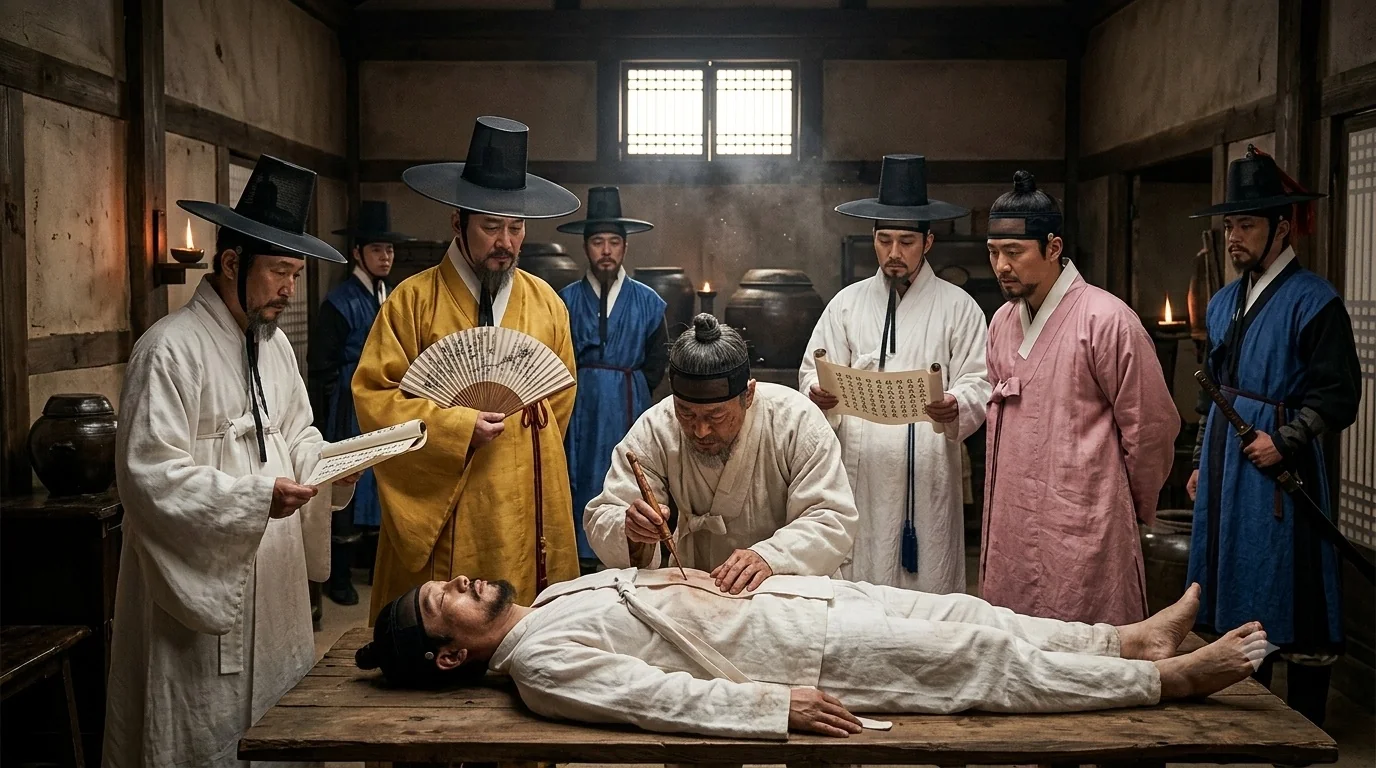
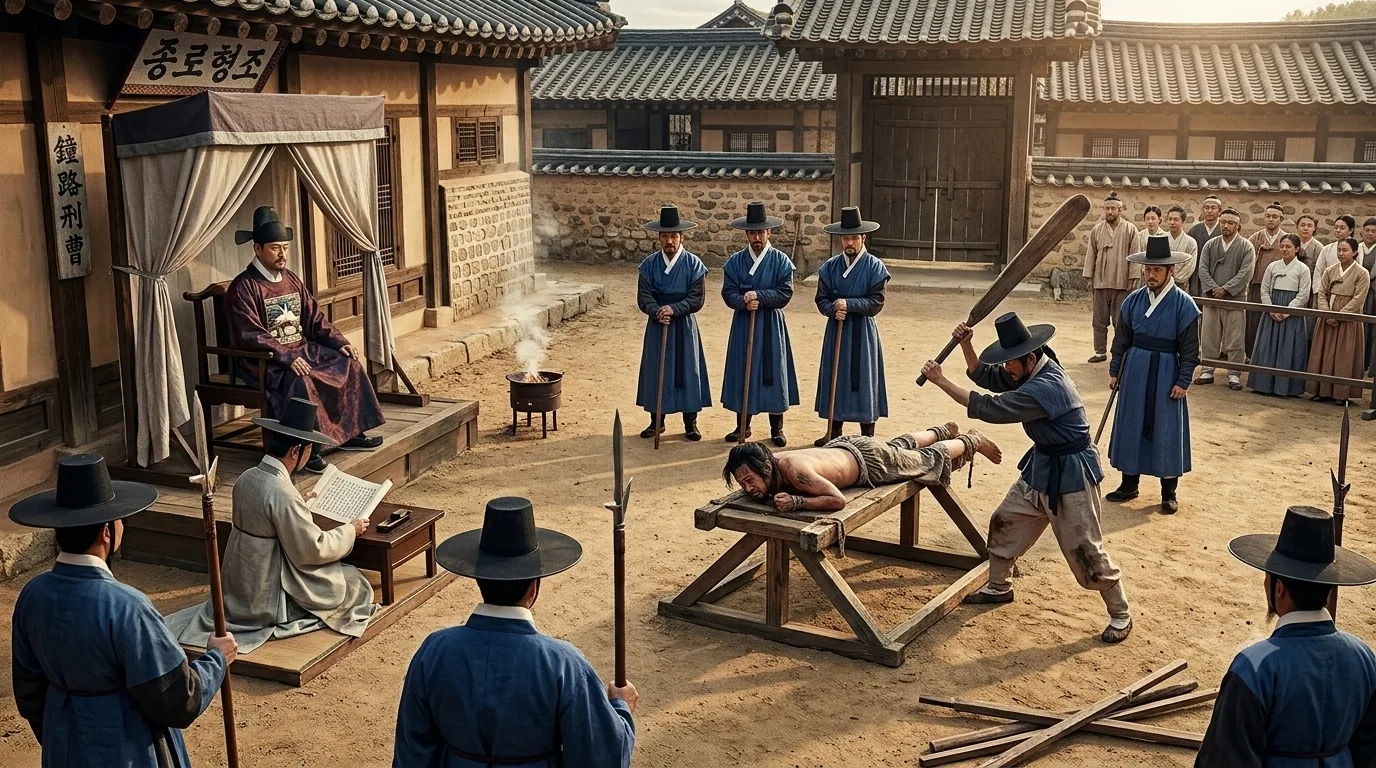 Punishment as public administration — recorded, supervised, and graded by statute. (AI illustration)
In episode 18 of SBS’s founding-of-Joseon epic Six Flying Dragons (육룡이 나르샤), broadcast on 1 December 2015, a sword takes the villainous swordsman Gil Tae-mi at the neck. On screen it reads like an execution: a hated man, a blade, a head. Legally it is nothing of the sort.
Gil Tae-mi dies at the end of a duel with Yi Bang-ji, on his feet. No arrest, no sentence, no officer acting for a state. (The character Park Hyuk-kwon plays in the finale is a different one — Gil Seon-mi, Gil Tae-mi’s twin brother.) He is an invented figure, and his death is set in the late Goryeo period, before Joseon exists.
A sword to the neck and a headsman’s block look like the same event on screen. In law, they are not remotely the same event. The distance between the two is more or less the whole subject of this article.
So let’s start from a scene that shows the other side of it.
SBS’s 2026 hit 멋진 신세계 — streaming internationally as My Royal Nemesis, though SBS’s own programme address still carries the earlier English handle Wicked World — opens at the end of a life. Kang Dan-sim is identified in SBS’s official material as a huibin (희빈), a high-ranking royal consort. She is handed a cup of poison, and wakes in 2026 Seoul in someone else’s body. The drama therefore offers a useful entry point into the royal practice of sasa: death ordered directly by the king.
A cup of poison, then. Not interchangeable with a blade — and the reasons why turn out to be less about a rank ladder than the familiar account claims.
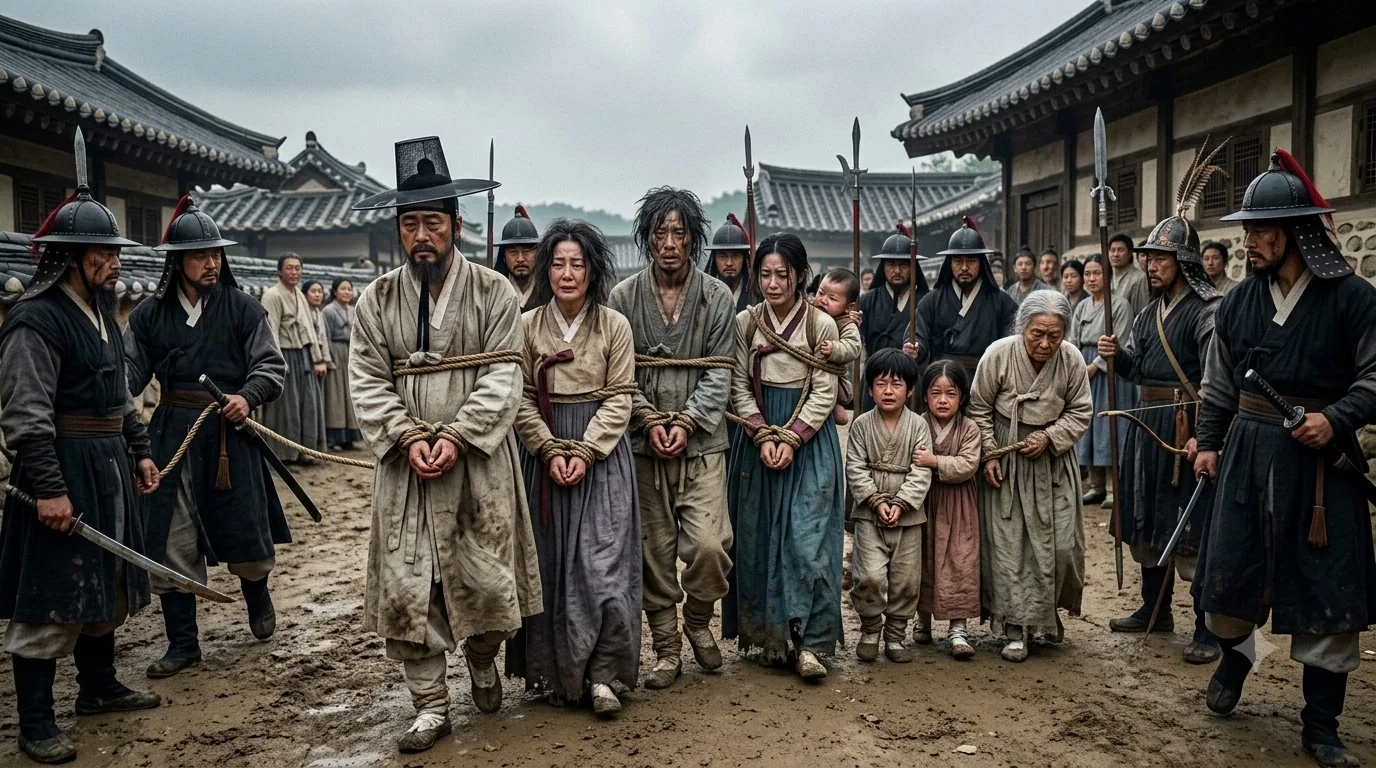
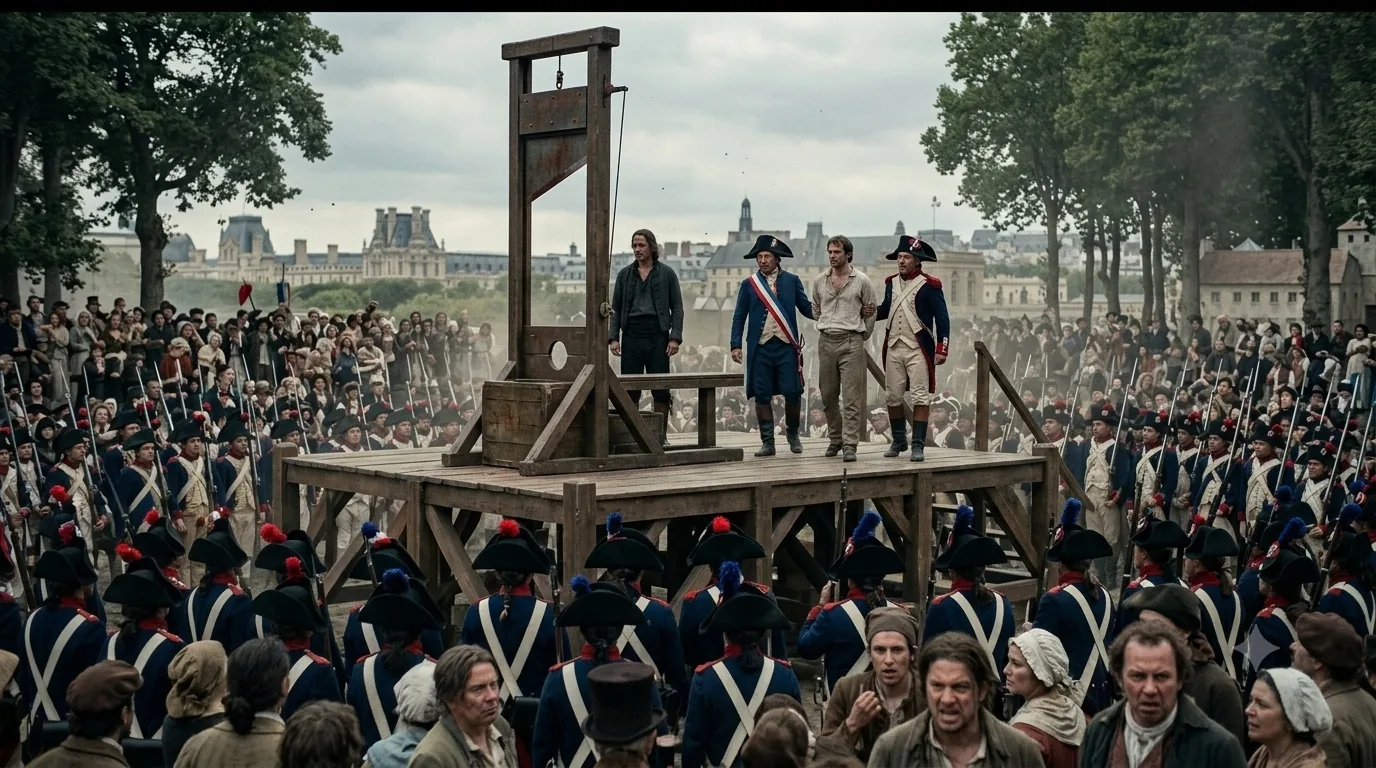 Revolutionary France made the machine the point: one method for everyone. Joseon did the opposite. (AI illustration)
Quick answer: Joseon did not assign execution methods through a simple rule of “poison for nobles, beheading for commoners.” The Ming-derived Daemyeongnyul (대명률) graded punishment mainly by offence: caning, heavy caning, penal servitude, exile and death. Rank mattered through royal kinship, official privilege and special deliberation. Sasa (사사) was a royal order to die, while sayak (사약) was its best-known instrument.
Let’s unpack it.
What was Joseon actually working from — a real rulebook?
Yes, and a foreign one. When Yi Seong-gye founded Joseon, he did not commission a criminal code from scratch. He adopted one.
King Taejo ordered that the Daemyeongnyul (大明律), the penal code of Ming China, serve as the basic criminal law of the new state. Because the code’s classical Chinese was hard for local officials to work with, a Korean working version was needed. At King Taejo’s command, Jo Jun supervised its preparation. Go Sa-gyeong and Kim Ji rendered the text into accessible Idu-based Korean, while Jeong Do-jeon — the reformist statesman Six Flying Dragons dramatises — and Tang Cheng revised the wording. The resulting text was printed in 1395 and is now known as the Daemyeongnyul-jikhae (대명률직해).
It is worth being precise about what that text was. Not a set of marginal notes on a foreign statute but a vernacular legal adaptation: an Idu-based translation reworked for Korean legal practice, with Chinese official titles and kinship terms replaced by Korean equivalents and provisions on redemption fines and exile fitted to Korean conditions. Korea went on adapting particulars over time — exile distances, official titles, provisions on slavery — but the Ming framework of offences and penalties remained Korea’s working criminal law for roughly the next five centuries.
The adoption was unusually extensive and long-lasting, although claims that it was uniquely so are difficult to substantiate.
What was the actual punishment ladder — the Five Punishments?
The Daemyeongnyul organised punishment into a five-tier scale inherited from a much older Chinese tradition reaching back to the Sui and Tang: the Five Punishments (오형, 五刑).
- Tae (笞) — light caning, five grades from 10 to 50 strokes.
- Jang (杖) — heavy caning, five grades from 60 to 100 strokes.
- Do (徒) — penal servitude, five grades of forced labour from one to three years.
- Yu (流) — exile, in three grades of 2,000, 2,500 and 3,000 li.
- Sa (死) — death, whose two basic methods were strangulation (gyohyeong, 絞刑) and beheading (chamhyeong, 斬刑).
Two things usually attached to this list deserve a lighter touch. The exile grades are often given as distances measured “from the capital”; the three-grade structure is solid, but the reckoning point is best left unstated. And penalties outside the Five Punishments were also carried out in Joseon — jaja (자자, penal tattooing or branding) among them — though how early and how widely is a question about frequency, which is harder to pin down than the structure itself.
Where the top of the ladder actually is
Here the architecture is easy to get wrong, in a way common enough in English writing on Joseon law to be worth spelling out.
Beheading and strangulation are often called the baseline death sentences, with Joseon law “having worse in reserve” — implying a rung above death. There is no rung above death. In the Five Punishments, death is the highest tier, and strangulation and beheading are its two basic methods. What sits at the extreme is not a higher category of punishment but a more severe way of carrying out the death penalty, imposed chiefly for treason and other offences treated as exceptionally destructive of the political or moral order.
The code’s own name for it is neungjicheosa (凌遲處死). The form most English-language writing uses — neungjicheocham (凌遲處斬) — genuinely appears in Korean sources: it turns up in the veritable records, including an entry in the Yeonsangun ilgi for the thirteenth day of the eighth lunar month of Yeonsangun’s tenth year, and in later Korean writing. But it is a Korean usage rather than the Ming code’s formal term.
What it meant in practice on Korean soil is a separate question, and a genuinely contested one. The characters point toward a slow, cutting death, and Chinese legal history documents that procedure at length. Sim Jae-woo’s 2011 study — 「조선시대 능지처사형 집행의 실상과 그 특징」, in 사회와 역사 volume 90 — works from the Korean case record and finds Joseon practice diverging from the fuller Chinese procedure. Executions recorded under the label more often took the form of geoyeol (車裂), tearing the body apart with carts or draft animals pulled in opposing directions, or beheading followed by dismemberment, with the head displayed for a set period and severed limbs circulated to the provinces. How consistently that substitution held across five centuries is a specialist question this piece does not try to settle.
Hyosu: what the state could do after the execution
Hyosu (효수, 梟首) is the display of an executed person’s severed head, mounted on a stand and left up as a visible warning; its best-known Joseon-era subject may be Kim Jong-seo, killed and displayed during the 1453 coup known as the Gyeyu Jeongnan. It is not a separate, status-linked method of execution sitting alongside beheading and poison, but an aggravating measure applied after death. The state retained a further entitlement over the body after death.
Sayak, sasa, and what rank actually changed
Now the poison, and the distinction the drama scene depends on.
Sasa (賜死) — literally “bestowed death” — is a disposition: the king orders a particular person to die. Sayak (사약) is the best-known means of carrying that order out: a poison sent by royal command, delivered by a court official. The two words are often used as if they were one thing. Sasa is the order; sayak is the instrument.
That matters for the detail everyone remembers — the body left whole. That feature belongs to sayak as a method of execution. It cannot be stretched into a definition of sasa in general, because sasa is a command, and a command can be executed in more than one way.
Who received it? The official reference explanation describes sayak as applied to royalty or to the sadaebu — the scholar-official class. There was no legal entitlement here, no rank threshold, no clause in the code granting poison to anyone above a given grade. Recorded recipients include Sim On, King Sejong’s father-in-law; the deposed Queen Yun, mother of the later King Yeonsangun; and the Noron leader Song Si-yeol in the late Joseon period.
Song Si-yeol is also the reason a second detail needs adjusting. The condemned is often said to have drunk the poison “at home,” as though the domestic setting were part of the definition. Song received sayak at Jeongeup, while being transferred to Jeju. What holds more generally is that sayak was generally administered away from the ordinary public execution ground — that is the feature doing the work, not the recipient’s house.
And the whole “rank decided how you died” frame? It needs downgrading.
What primarily determined a sentence in Joseon criminal law was the offence and its gravity. Status and office entered through a distinct set of mechanisms: the palui (팔의) categories, under which certain persons — royal kin, meritorious subjects, long-serving officials and others — had their cases subject to special deliberation; kinship to the throne; and procedural provisions governing how serving officials were investigated and punished. Those could reduce a sentence or change how a case moved. What they did not do is establish a fixed correspondence in which royalty and high officials receive poison and commoners receive a public beheading. That correspondence is a modern summary, not the code’s structure.
The same holds at the other end of the scale. Commoners and the low-born are said to have been publicly beheaded because the state needed the spectacle. Commoners could in fact be sentenced to strangulation depending on the offence — beheading was not the automatic commoner outcome. Public execution certainly did political work, and that is worth describing; it is not on its own the reason the system distributed methods the way it did.
Sayak’s preservation of the body invites comparison with the Confucian idea, from the Classic of Filial Piety, that one’s body is received from one’s parents and should not be needlessly damaged. The connection is plausible and the underlying idea is real, but it should be treated as an interpretation rather than a documented legal rationale. It is my reading, offered as a reading.
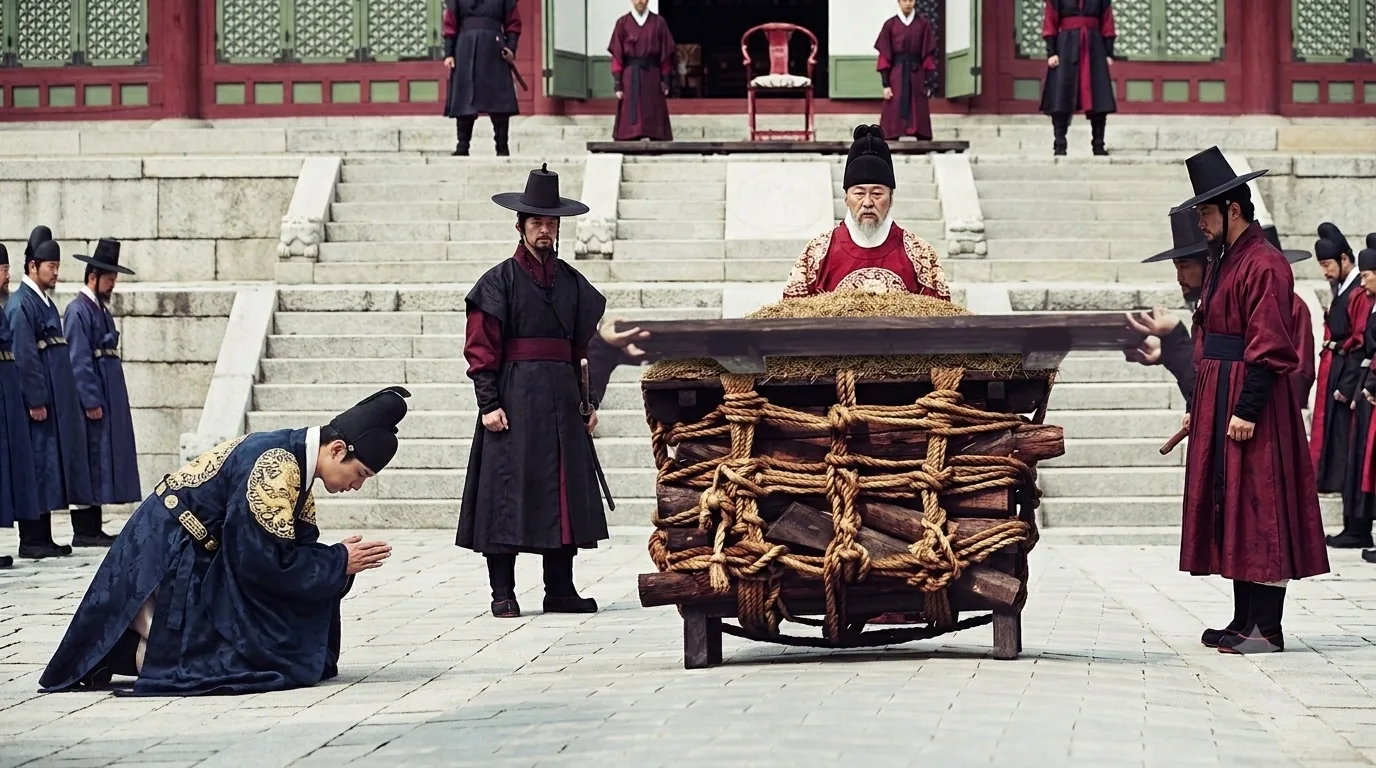
The system could also be sidestepped entirely when royal politics demanded it. Crown Prince Sado, sealed inside a wooden rice chest in 1762 rather than given any sentence in the code, remains the most famous case of the machinery being bypassed — a story told in full elsewhere on this site.
Key terms. Ohyeong (오형, 五刑) — the five-tier punishment scale: caning, heavy caning, penal servitude, exile, death. Daemyeongnyul (대명률, 大明律) — the Ming code adopted as Joseon’s basic criminal law. Neungjicheosa (능지처사, 凌遲處死) — the code’s aggravated method of capital punishment, imposed chiefly for treason and comparably grave offences against the political order. Hyosu (효수, 梟首) — public display of the severed head after execution. Sasa (사사, 賜死) — the king’s order that a person die. Sayak (사약) — the best-known instrument of that order. Palui (팔의, 八議) — the categories of persons whose cases received special deliberation.
Drama vs history
| In the dramas | In the Joseon record |
|---|---|
| A blade to the neck in Six Flying Dragons episode 18 reads as an execution | It is a duel, set in late Goryeo, with no arrest, no sentence and no officer of a state; the finale character is Gil Tae-mi’s twin brother Gil Seon-mi |
| Beheading reads as the harshest possible sentence | Death is the top tier of the Five Punishments, with strangulation and beheading as its basic methods; neungjicheosa is a more severe way of carrying out that same tier, not a tier above it |
| Poison for the highborn, the block for everyone else | Offence and statutory penalty set the sentence; rank operated through palui deliberation, royal kinship and official procedure. Commoners could receive strangulation; sayak was a royal order, not a status entitlement |
| Kang Dan-sim is condemned by “the court” | Sasa presupposes a royal order. SBS’s official material identifies her rank as a high-ranking royal consort |
| Execution is a single dramatic reckoning | It was administrative work under an imported code, with the state retaining a further entitlement over the body afterwards through hyosu |
| The system feels immovable, fixed for five centuries | Status and office shaped criminal procedure into the late dynasty, but the Gabo Reform of 1894 legally overhauled both the status order and the old penal system |
In short: the dramas get the atmosphere of Joseon punishment about right and the mechanism almost entirely wrong, and the mechanism is where the history lives.
The sharpest comparison is not the one about cruelty
Unlike Joseon, ancien-régime France openly attached execution methods to legal status: nobles were commonly beheaded, while commoners were more often hanged. The guillotine was promoted as an equalising machine — one method regardless of birth. The comparison clarifies the difference: status affected Joseon procedure and royal discretion, but the Ming-derived code did not establish the same simple class-to-method table. Korea had no equivalent moment of deliberate levelling, and yet the Gabo Reform of 1894 was itself a legal overhaul of the status order and the inherited penal system. The absence of a French-style revolutionary rupture is not evidence of five centuries of stasis; it is evidence that the change arrived by a different route.
How the system actually ended
This is the part usually compressed into a single sentence, and it takes three.
First, a royal decree on the twenty-seventh day of the twelfth lunar month of 1894 — the thirty-first year of Gojong, and 22 January 1895 by the Gregorian calendar — abolished neungjicheosa and hyosu, and made hanging the standard method for ordinary death sentences.
Second, beheading did not simply linger on as a habit the law had already disowned. It was legally restored in the revised Hyeongnyul Myeongnye (형률명례) of 1900, in limited form. That is a legislative act, not the residue of one.
Third, the Hyeongbeop Daejeon (형법대전) of 1905 abolished beheading again and took effect as the Korean Empire’s basic penal code, formally displacing the Daemyeongnyul-based system. “Formally” is doing real work in that sentence: a substantial amount of Daemyeongnyul and existing Korean penal content carried straight through into its provisions. The break was in the code’s status, not in the whole content of the law.
Coming up next
A duel that looks like an execution, a code borrowed from a neighbouring empire, a five-tier ladder whose top rung is easy to misplace, a royal order and the poison that carried it out, a French machine sold as equality, and a law abolished, restored and abolished again in eleven years. That is the quiet gift of a historical epic: even the scenes it gets wrong have paperwork behind them.
In the next essay, we’ll take another K-drama scene that looks like pure fiction — and trace the real Korean history hiding underneath it.
Frequently asked questions
What were Joseon’s Five Punishments (오형)? Tae (笞, light caning, 10–50 strokes), jang (杖, heavy caning, 60–100 strokes), do (徒, penal servitude of one to three years), yu (流, exile, in three grades of 2,000, 2,500 and 3,000 li), and sa (死, death, whose two basic methods were strangulation and beheading). It is a Chinese framework reaching back to the Sui and Tang, inherited by Joseon through the Ming code.
Did rank decide how you were executed in Joseon? Not by itself. What primarily set the statutory penalty was the offence and its gravity. Status and office mattered through a different door: the palui (팔의) deliberation categories, kinship to the throne, and the procedural handling of serving officials could reduce a sentence or change how a case was processed. There was no clause in the code assigning poison to the highborn and the public block to everyone else.
What was sayak — and is it the same as sasa? No, and they are worth keeping apart. Sasa (賜死) is the disposition: the king orders a person to die. Sayak (사약) is the best-known means of carrying that order out — a poison sent by royal command and generally administered away from the ordinary public execution ground. The “body left intact” feature belongs to sayak specifically; it cannot be extended to every form of sasa.
What was neungjicheosa — was it really “death by a thousand cuts” in Korea? The formal name in the Daemyeongnyul is neungjicheosa (凌遲處死); neungjicheocham (凌遲處斬) is an expression that appears in the Joseon veritable records and later Korean writing rather than the code’s own term. It was not a rung above the death penalty — it was an aggravated way of carrying out the death penalty, imposed chiefly for treason and other offences treated as exceptionally destructive of the political or moral order. Sim Jae-woo’s 2011 study of the Korean case record finds Joseon practice diverging from the fuller Chinese procedure, more often taking the form of geoyeol (車裂) or beheading followed by dismemberment and display.
When did Joseon abolish these punishments? In three moves, not one. A royal decree of the twenty-seventh day of the twelfth lunar month of 1894 — 22 January 1895 by the Gregorian calendar — abolished neungjicheosa and hyosu and made hanging the standard method for ordinary death sentences. Beheading was then legally restored in the revised Hyeongnyul Myeongnye of 1900, and abolished again by the Hyeongbeop Daejeon of 1905, which replaced the Daemyeongnyul-based system as the state’s basic penal code while carrying a good deal of its content forward.
Sources & further reading
This piece was written from the historical script and fact-check of 사뚱샘의 역사방 (SaDDungSam). Where a source could not be verified to a specific stable address, it is cited by name only.
- Encyclopedia of Korean Culture (한국민족문화대백과사전) — 오형, 대명률, 대명률직해, 효수, 사약, 팔의, 송시열
- 한국학중앙연구원 한국학자료센터 — 대명률직해 편찬 경위 (조준·고사경·김지·정도전·당성)
- 심재우, 「조선시대 능지처사형 집행의 실상과 그 특징」, 『사회와 역사』 90집, 2011 (KCI ART001570026)
- 『연산군일기』 연산군 10년 8월 13일 기사 — the expression 능지처참 in Korean use
- 『고종실록』 고종 31년 12월 27일 기사 — abolition of 능지처사 and 효수
- 국사편찬위원회 한국근대사자료집성; 전병무, 「한말~일제 초기 형사법의 추이와 사형제의 변화」, 2024
- 「형률명례」 (1900 revision) · 《형법대전》 (1905)
- SBS official programme material — 육룡이 나르샤 episode 18 (broadcast 1 December 2015), official clip 「길태미 최후」, finale material on 길선미; 멋진 신세계 programme and episode-one material
- Netflix official title page and press material — My Royal Nemesis
- Encyclopaedia Britannica — Guillotine
Thanks for reading — see you in the next one.
This article was researched and written by K-Drama History. Source: Six Flying Dragons and My Royal Nemesis, Explained: How Joseon Korea Actually Decided a Death Sentence — K-Drama History