From the research behind Pause the Drama.
In The Throne (사도, 2015), the scene audiences cannot shake is the rice chest. King Yeongjo orders his son, Crown Prince Sado, to climb inside a wooden grain chest in the summer heat. He has the lid sealed. The chest sits in the courtyard of Changgyeong Palace. Eight days pass. The crown prince of Joseon dies inside a box.
The historical event — the Imo Incident of 1762 — is real. What the film forces viewers to sit with is the question it refuses to answer cleanly: why? Was Yeongjo a father at the end of his rope with a violent, unraveling son? Or was he a politician making a cold calculation? The answer, as Korean historians have spent two and a half centuries working out, is both — and neither alone.
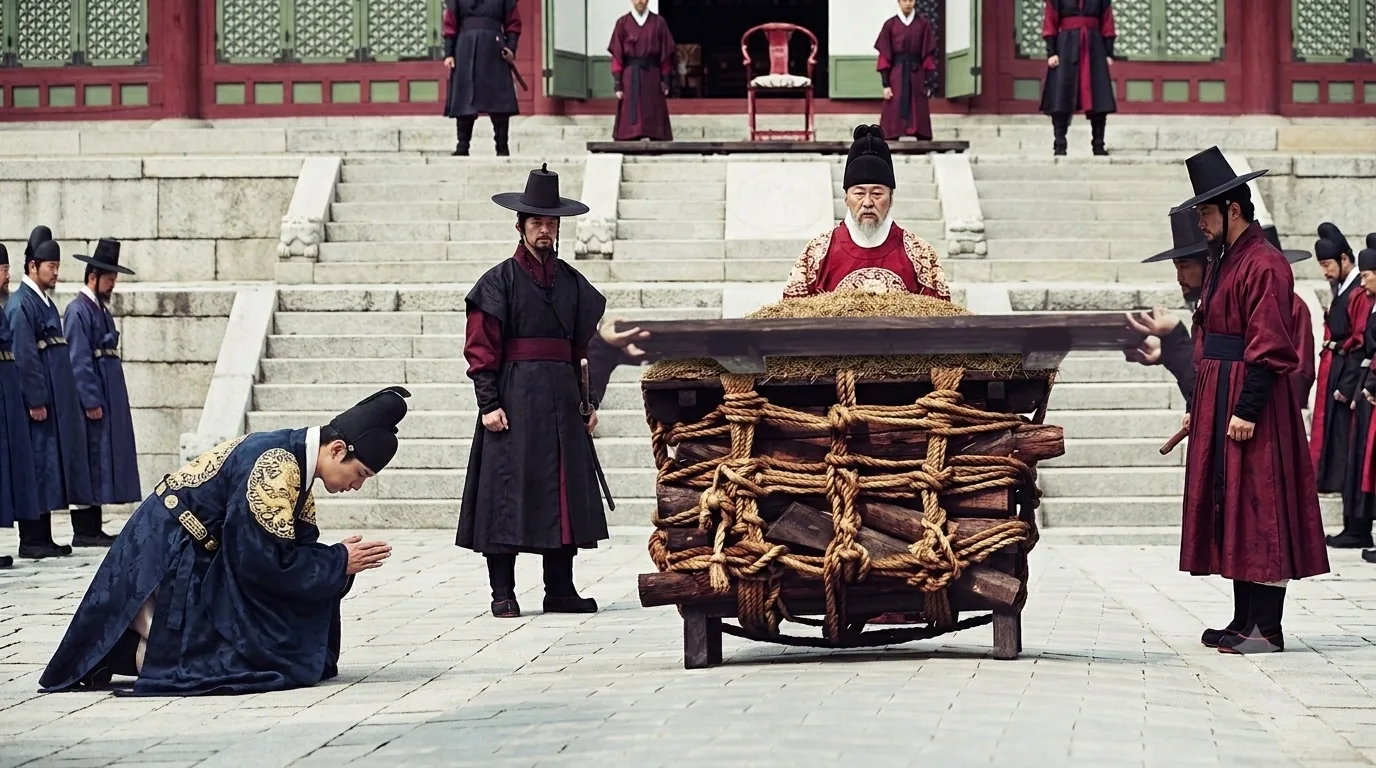
Quick answer: The Imo Incident (임오화변, 1762) was the act by which King Yeongjo of Joseon sealed Crown Prince Sado in a wooden rice chest, where the prince died after eight days. Yeongjo chose this method deliberately: a formal treason execution would have branded Sado’s son (the future King Jeongjo) a traitor’s child, threatening the succession. The rice chest was not a formal treason execution but a royal order of confinement that produced death — politically useful precisely because it avoided branding Sado a traitor and disqualifying his son. Behind that calculation lay two decades of factional warfare between the Noron and Soron camps, with Sado positioned, wittingly or not, at the center of a struggle for dynastic control. The Hanjungnok, the memoir of Sado’s wife, is our richest source for these events — and one of our most politically compromised.
What actually happened in the summer of 1762?
Crown Prince Sado (1735–1762) was Yeongjo’s second son, elevated to crown prince after the early death of his elder half-brother Prince Hyojang. As a child he was considered exceptionally gifted. By adulthood, the relationship between father and son had fractured severely.
The Veritable Records of Yeongjo (Yeongjo Sillok) and the Hanjungnok (閑中錄) — “Memoirs Written in Silence,” composed by Sado’s wife, Lady Hyegyeong of the Hong clan — describe a prince who in adulthood exhibited extreme behavioral episodes: a phobia of dressing so severe it could consume an entire day (uidae-jeung), and violent fits during which palace servants were killed. The Yeongjo Sillok itself records that during his fits Sado killed palace maids and eunuchs (gungbi and hwansi), often stricken with remorse afterward — but it gives no exact count. The figure of “dozens” comes from the Hanjungnok, and the precise number deserves careful cross-checking against the memoir’s own wording. Modern scholars discuss these episodes in terms of psychotic disorder or severe trauma — while also noting that the Hanjungnok was composed years later, under Jeongjo’s reign, by a woman whose family had politically aligned with Yeongjo’s decision. It is not a neutral clinical record.
On the thirteenth day of the intercalary fifth month of 1762 (by the lunar calendar), Yeongjo acted. The Veritable Records entry for that day preserves the sequence: the king first pressed Sado to take his own life, then issued the order stripping him of rank and reducing him to commoner status (pye-wi-seoin, 廢爲庶人), and finally commanded that he be confined (yupye, 幽囚). One detail matters for accuracy: the sillok entry does not name the rice chest. It records the demotion and says Sado was “sternly confined” (自內嚴囚) — the vivid image of the wooden grain chest (nuju) comes from the Hanjungnok and later court memoirs, which must be read alongside the official record rather than treated as identical to it. What is established across the sources: Sado was confined, sealed away, and died after eight days. He was twenty-seven years old.
Was it factional politics that killed Crown Prince Sado?
Reading the Imo Incident as only a personal family tragedy misses half the history.
Yeongjo’s court was dominated by the Noron (老論, “Old Doctrine”) faction, which had backed Yeongjo’s succession in circumstances that were themselves historically fraught. Yeongjo’s path to the throne had involved accusations — unresolved to this day — that he was complicit in the death of his predecessor; he owed his position, in significant part, to Noron support.
Crown Prince Sado, as he grew older, drifted toward — or was perceived by the establishment as sympathetic to — the rival Soron (少論, “Young Doctrine”) and Namin circles. For Noron politicians, a Sado succession would mean a loss of the factional dominance they had held for decades. The Hanjungnok and later records from Jeongjo’s reign carry repeated indications that some Noron members reported — and may have embellished or fabricated — accounts of Sado’s violent behavior to Yeongjo, converting a deteriorating father-son relationship into a political weapon.
Yeongjo’s method — the rice chest rather than a treason charge — was itself a form of factional management. A formal treason execution would have made Sado’s son, the future Jeongjo, legally a traitor’s child. The succession would collapse — and with it the political settlement that had secured Yeongjo’s own throne. The rice chest death was, by comparison, a quiet erasure that preserved the succession while eliminating the problematic heir without formally condemning him.
Jeongjo understood the calculation when he came to the throne in 1776. On the very day of his enthronement he declared, “Alas, I am the son of Crown Prince Sado” (Jeongjo Sillok, accession year, third month, tenth day). Contrary to a common assumption, the line did not appear in the formal enthronement edict but in an address (yun’eum) delivered to his assembled ministers that same day — and its framing was deliberately balanced. In the same breath Jeongjo affirmed that he would uphold the succession line Yeongjo had fixed (which had made him heir to Prince Hyojang, not to Sado directly), and warned that anyone who exploited the statement to agitate for Sado’s posthumous elevation would be punished. It was defiance and restraint at once. What is beyond dispute is that Jeongjo spent his reign carefully checking the political forces tied to the 1762 crisis, while stopping short of a direct reversal of Yeongjo’s decision.
Here a common misconception is worth correcting: the name Sado (思悼), “mourned in reflection,” was not Jeongjo’s doing. It was Yeongjo who, right after confirming his son’s death, restored the prince’s rank and gave him that posthumous name — a father’s flash of remorse. Jeongjo’s rehabilitation went further and more carefully: he honored his father with the higher posthumous title Jangheon (莊獻), and his construction of Hwaseong Fortress in Suwon and the relocation of his father’s tomb there (culminating in the Hyeollyung-won) were as much acts of symbolic political rehabilitation as urban planning — all without formally reversing the verdict of 1762 or putting the Noron establishment on trial.
Drama vs. real history — how much does The Throne compress?
| In The Throne (사도, 2015) | In real Joseon history |
|---|---|
| The rice chest as the film’s central image | The chest (nuju) appears in memoir accounts (Hanjungnok); the sillok records the demotion and confinement but does not name the chest itself |
| Yeongjo portrayed as cold, calculating | Historical accounts show both cold calculation and documented anguish |
| Sado’s violent mental episodes | Detailed in Hanjungnok; psychiatric interpretation is retrospective and contested |
| Factional court politics as an undercurrent | Well-documented; Noron members appear to have actively reported against Sado |
| Jeongjo watching the events as a child | Historically attested; the young Jeongjo was present at the palace |
Key terms. Imo Incident (임오화변) — the 1762 event in which Sado was sealed in a rice chest; Imo (壬午) = the year 1762 in the sexagenary cycle, hwa = calamity, byeon = incident. Nuju (뒤주) — the wooden grain chest used as the instrument of Sado’s death. Hanjungnok (閑中錄) — “Memoirs Written in Silence,” Lady Hyegyeong’s account of Sado’s life and death; the richest source on the events, but politically compromised by context. Noron / Soron (노론·소론) — the “Old Doctrine” and “Young Doctrine” factions whose rivalry dominated late-Joseon politics. Sado (思悼) — the posthumous name given by Yeongjo right after the prince’s death (“the Mourned Prince”); Jeongjo later added the higher title Jangheon (莊獻).
A father kills a son: Joseon, Russia, the Ottomans, and Shakespeare
The Imo Incident belongs to a grim international catalog of rulers who chose an heir’s death over the risk of an unstable succession.
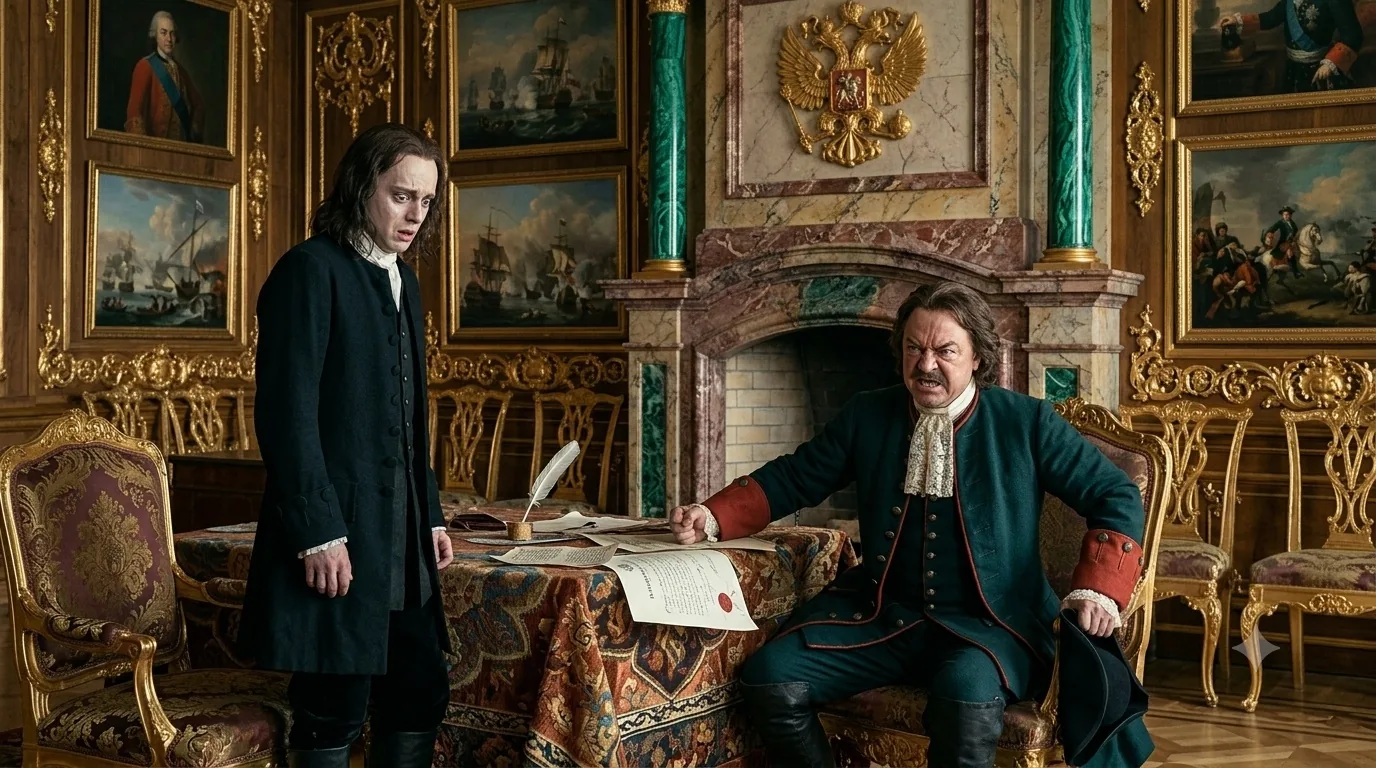
Russia — Peter the Great and Alexei (1718). Peter I had his son and heir Tsarevich Alexei arrested after Alexei fled to the Habsburg court in apparent protest against his father’s reforms. Returned to Russia, Alexei was subjected to interrogation and, by most accounts, severe physical treatment in custody. He died in the Peter and Paul Fortress in 1718. The exact cause of death — whether directly from torture, the accumulated physical ordeal of his treatment, or some other factor — remains a matter of historical debate. The structural parallel with the Imo Incident is precise: a reforming monarch who saw his conservative heir as a threat to everything he had built, and who eliminated him without the formality of a public execution.
The Ottomans — Suleiman the Magnificent and Mustafa (1553). The Ottoman sultan Suleiman I ordered the execution of his eldest son Şehzade Mustafa in 1553. Mustafa was widely regarded as the most capable candidate for succession, and his elimination is attributed by most accounts to the political influence of Suleiman’s wife Hürrem Sultan (Roxelana) and the grand vizier Rüstem Pasha, who had Mustafa accused of conspiracy. The Ottoman context adds a further dimension: the dynastic practice of fratricidal succession — by which a new sultan was expected to eliminate brothers who might become rallying points for rebellion — had developed across the dynasty’s history. Its best-known codification is the fratricide clause attributed to Mehmed II’s Kanunname, which invoked niẓām-ı ʿālem (“the order of the world”) to sanction it — though the clause survives through later manuscript copies rather than a verified original, and Suleiman, for all his fame as “the Lawgiver” (Kanuni), did not create it. By 1553, the logic of eliminating potential rivals was long embedded in Ottoman dynastic culture, even if the circumstances of Mustafa’s specific death were politically orchestrated rather than procedurally automatic.
England — history and Shakespeare. English royal history offers fewer direct parallels of a king killing his own son than might be expected; the more common English pattern involves barons killing kings (Edward II, Richard II) or wars between rival claimants. The imaginative tradition of the father-son power tragedy belongs in England decisively to Shakespeare: King Lear’s destruction of paternal authority, Hamlet’s prince trapped between a murdered father and a usurping uncle. English-speaking readers approaching the Imo Incident often find the emotional framework of “Joseon’s King Lear” the most accessible entry point — though of course in the historical event, it is the father who destroys rather than the children.
Coming up next
A wooden box in a summer courtyard. A king who chose a legal gray zone over his son’s life because the alternative threatened the dynasty. A political machine that fed reports upward to shape a father’s worst fears. And a grandson who spent an entire reign quietly trying to undo what had been done.
In the next essay, we leave the throne room and cross to the other side — asking what awaits after death in Korean tradition, and why the answer involves seven trials, forty-nine days, and a bodhisattva who refuses to abandon the damned.
Thanks for reading — see you in the next one.
Frequently asked questions
What is the film The Throne (사도) about? The Throne (사도, 2015) is a South Korean historical film that dramatizes the Imo Incident of 1762 — the day King Yeongjo sealed Crown Prince Sado inside a wooden rice chest. The prince died after eight days. The film presents both perspectives, using the tragedy as a lens on royal authority, mental crisis, and court factional warfare.
What was the Imo Incident (임오화변)? The Imo Incident (壬午禍變) was the 1762 event in which King Yeongjo stripped Crown Prince Sado of his rank, sealed him inside a wooden grain chest, and left him to die. The prince was twenty-seven. The name combines the year (壬午, 1762) in the sexagenary cycle with the words for calamity (禍) and incident (變).
Why did Yeongjo choose a rice chest instead of a formal execution? Executing Sado on a treason charge would have branded his son — the future King Jeongjo — a traitor’s child, potentially destroying the succession. The rice chest created a legal gray zone: a death that was not technically a formal execution, which kept Jeongjo’s path to the throne intact. Historians read this as a calculated political maneuver alongside whatever personal anguish Yeongjo experienced.
Did Crown Prince Sado have a mental illness? The Hanjungnok, a memoir by Sado’s wife, describes extreme phobias and violent episodes. Modern scholars have retrospectively discussed schizophrenia and severe PTSD as analytical frameworks. The Hanjungnok, however, was written under Jeongjo’s reign by a family politically aligned with Yeongjo’s decision, making it an imperfect clinical source.
What role did Noron factional politics play in Sado’s death? The Noron faction dominated Yeongjo’s court and had reason to fear a Sado succession that might empower rival factions. Evidence in the Hanjungnok and Jeongjo-era records suggests some Noron members amplified or fabricated reports of Sado’s misconduct, turning a family crisis into a political weapon.
What did Jeongjo do about his father’s death? Jeongjo worked carefully throughout his reign to rehabilitate Sado’s memory. On his enthronement day he declared he was Sado’s son — in an address (yun’eum) to his ministers rather than the formal edict, while simultaneously pledging to uphold Yeongjo’s succession order. He built Hwaseong Fortress in Suwon and relocated his father’s tomb there as acts of symbolic restoration. (The name Sado (思悼) itself had been conferred by Yeongjo at the prince’s death; Jeongjo went further, honoring him with the grander title Jangheon, 莊獻.)
What does “Sado” (사도) mean? Sado (思悼) combines the characters for “to mourn or reflect” (思) and “to grieve” (悼). It is conventionally translated as “the Mourned Prince.” It was conferred by Yeongjo right after the prince’s death — a father’s remorse — not by Jeongjo, who later added the grander posthumous title Jangheon (莊獻).
How does the Imo Incident compare with other royal father-son tragedies? Peter the Great had son Alexei die in custody in 1718 after interrogation and probable physical abuse; the exact cause remains historically debated. Suleiman the Magnificent ordered his son Mustafa’s execution in 1553, driven by succession politics and court intrigue. English royal history offers fewer father-kills-son parallels, but Shakespeare’s tragedies give English-speaking readers the closest emotional framework. All share the same core dynamic: a ruler who eliminates an heir seen as a political threat to dynastic stability.
Sources & further reading
This piece was written from the historical script and fact-check of 사뚱샘의 역사방 (SaDDungSam), drawing on primary records and official cultural-heritage databases:
- The Imo Incident and its political context — Encyclopedia of Korean Culture (Hanguk Minjok Munhwa Daebaekkwa, encykorea.aks.ac.kr): entries on imohwaban (임오화변), Sado Seja (사도세자), Yeongjo (영조), and Jeongjo (정조). National Institute of Korean History (국사편찬위원회) database.
- Yeongjo Sillok (영조실록) — the Veritable Records of King Yeongjo, the primary dynastic chronicle for the period; archived in the National Institute of Korean History database.
- Lady Hyegyeong, Hanjungnok (閑中錄, “Memoirs Written in Silence”) — the primary memoir source on Sado’s psychology and behavior; used with awareness of its political composition context.
- Hwaseong Fortress and Sado’s tomb relocation — UNESCO World Heritage designation records and National Institute of Korean History documentation of Jeongjo’s restoration program.
- Sado’s posthumous names — the name Sado (思悼) was conferred by King Yeongjo immediately after the prince’s death (National Institute of Korean History, 우리역사넷; Korea Heritage Service, Yungneung tomb records); Jeongjo later honored him as Jangheon (莊獻), and in 1899 King Gojong elevated him to emperor-equivalent status as Jangjo (莊祖).
- Peter the Great and Tsarevich Alexei (1718) — academic histories of Petrine Russia; cause of Alexei’s death noted as historically debated in the scholarship.
- Suleiman the Magnificent and Şehzade Mustafa (1553) — Ottoman dynastic history scholarship; the codification timeline of fratricidal succession noted as a matter of ongoing scholarly discussion in the field.
Thanks for reading — see you in the next one.
This article was researched and written by K-Drama History. Source: Why Prince Sado Died in a Rice Chest: Joseon's Most Shocking Royal Tragedy — K-Drama History