Curse, Ritual, or Contagion? How Joseon Explained and Responded to Illness
Theme: Belief, Death & the Uncanny
From the research behind Pause the Drama.
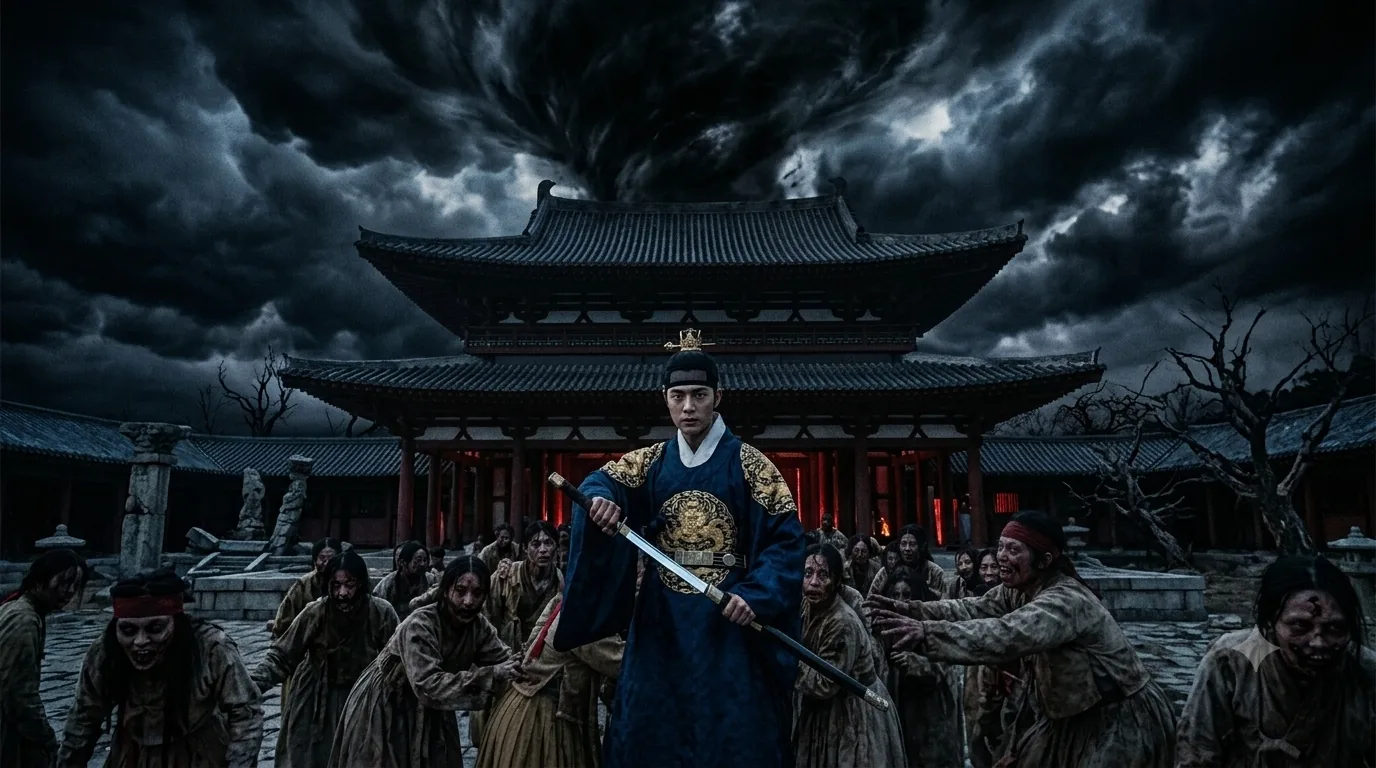
The East Palace opens with a crown prince dead in a palace pond and a king who keeps what lies behind it to himself. Word spreads that a vengeful ghost has sworn to end the royal line, and to protect the one small son he has left the king quietly summons two people from outside the court: Gu-cheon, an exorcist who can cut ghosts, and Saeng-gang, a palace woman who hears the dead.
Now lay another screen over that one. In Jejungwon, a butcher’s son, a nobleman’s son and an interpreter’s daughter sit in the same classroom and learn Western medicine at the hospital Joseon opened in 1885.
The question between those two scenes is where this article starts. What did the Joseon state actually do when people fell ill in numbers — and what do its records let us say about how illness was explained?
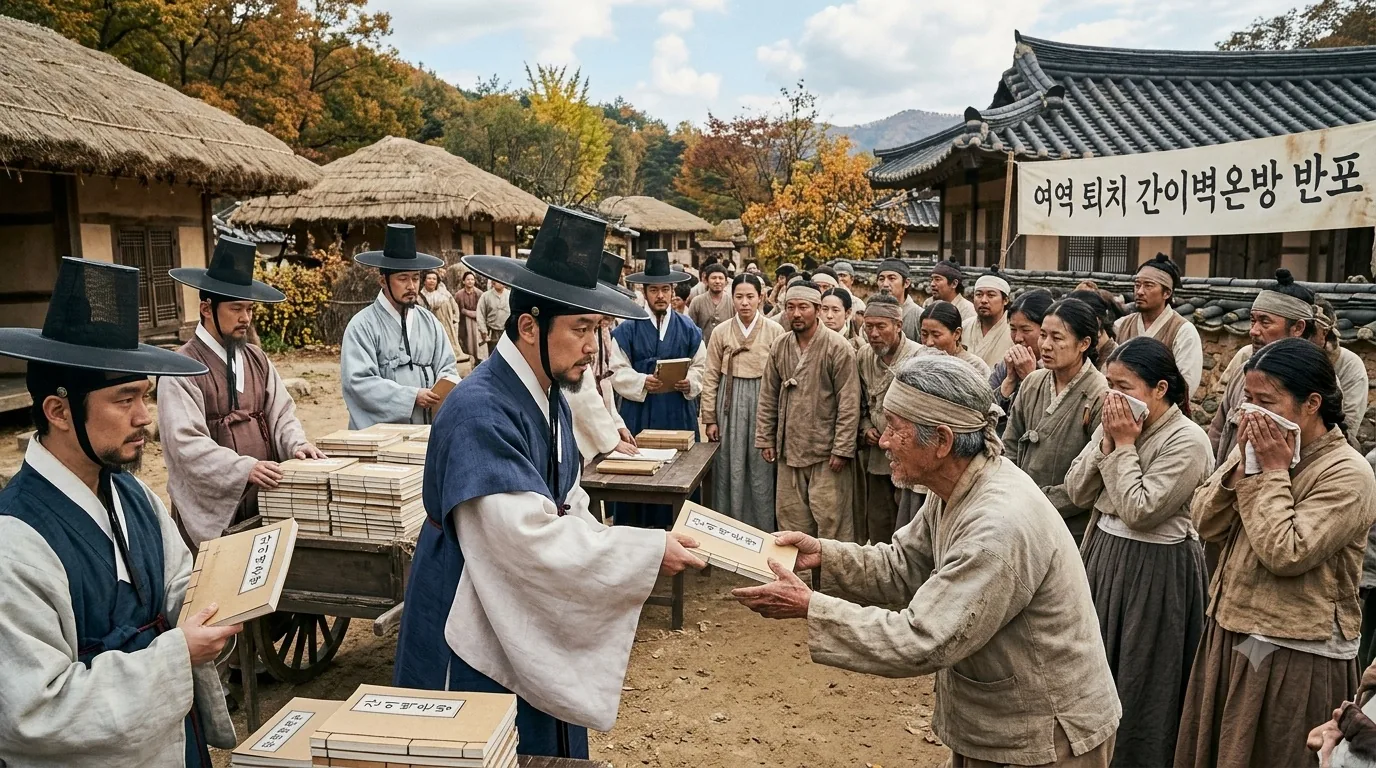 Compiling and distributing a medical book was one of the state’s responses to an epidemic — here, the plague manual of 1525. (AI illustration)
Quick answer: The Joseon state’s documented responses to epidemics were of several kinds at once, inside its own institutions. In 1401 it instituted an official, regular rite — the yeoje — for the dead who received no sacrifice and were thought to bring pestilence, and kept it on the state calendar until 1908. In 1429 it ordered magistrates to have physicians and shamans treat fever patients together. In 1525 it compiled a plague manual through its physicians and printed it with a Korean-alphabet translation. Those are responses, and the records show them side by side. What people believed caused a given illness — a curse, an unsacrificed spirit, the Guest, foetal poison, contagion — is a separate question, and the sources describe those ideas circulating together without telling us how any one household weighed them. Smallpox is the disease for which the most kinds of response are recorded. The arrival of Western medicine in the 1880s added another; the state rite it did not immediately replace.
Let’s take it in order.
What did the state do? The plague manual of 1525
Behind the scene in which The East Palace’s king sends for an exorcist stands another action, one the real kings are recorded taking: the compilation and distribution of medical books.
From the autumn of 1524 a fever epidemic spread through Pyeongan province in the north-west. In 1525 King Jungjong had his physicians — Kim Sun-mong, Yu Yeong-jeong and Pak Se-geo — gather prescriptions for the treatment of onyeok, epidemic fever, and the result was the Gani byeogonbang, “Simple Prescriptions for Warding Off Plague”. It was printed not only in Chinese but with a Korean-alphabet translation; the preface by the chief royal secretary Kim Hui-su, dated to the first month of 1525, says the aim was that even people in remote villages should know how to treat the disease.
Overseas readers tend to miss what that means. The Korean alphabet, promulgated in 1446, was actually used for this: an epidemic manual, printed in the letters ordinary people could read, distributed across the country. That does not tell us what share of the state’s effort went into books rather than rites or relief — this article has not compared them — and it does not prove that spirit-explanations of illness were absent. What it shows is that medical compilation and distribution was one documented state response. (The book’s own contents, and whether they mixed charms with prescriptions, we have not examined; the original edition is lost, and what survives are reprints of 1578 and 1613, the latter made when the fever returned.)
What did the state do? A rite for the dead who received no sacrifice
The same state, facing the same kind of disaster, also did something entirely different.
On the 14th day of the first month of 1401, Gwon Geun — then holding the post of Chamchan munha busa — submitted a memorial to King Taejong after a palace fire. Its sixth recommendation was to institute the yeoje, the rite for the yeo — the dead who receive no sacrifice — which, he noted, was not yet being performed, and to do so on the Ming model, at an altar in the northern suburb of the capital.
A yeo is a spirit with no one to sacrifice to it: someone with no descendants to feed them, or someone who died before their time or by violence. Joseon held that such spirits, resentful, brought calamity and pestilence, and set up the yeoje as the answer to that danger. The institution was built out over four decades, and the Encyclopedia of the Veritable Records traces the steps with the Annals entries for each: the Ministry of Rites drew up the ritual procedure in 1404; the altar was standing by 1413; a full ritual text was submitted in 1440; and in 1444 women who died in childbirth were added to the categories honoured.
The ritual text of 1440 fixes the calendar. Sejong’s Annals for the 29th day of the 6th month of that year set the rite three times a year: on the Qingming day in spring, on the 15th of the 7th month, and on the 1st of the 10th month. Three days before each, a notice-rite was made to the City God, whose spirit presided at the altar. Provinces and counties were ordered to build altars of their own. It was, in every formal sense, a state sacrifice: a procedure from the Ministry of Rites, designated officiants and attendants, a calendar, a place.
Who was honoured is the striking part. The altar held one seat for the City God and fifteen for the unsacrificed dead — and those fifteen were not names. They were categories of death, as the ritual text lists them: on one side, those killed by weapons, those who died by flood or at the hands of bandits, those worked or oppressed to death, those whose spouses were taken from them, those who died under unjust punishment, and those who died of natural disaster or epidemic; on the other, those killed by beasts or poison, those who froze or starved, those who fell in battle, those who hanged themselves in despair, those crushed by collapsing walls, those who died in childbirth, those struck by lightning, those who fell to their deaths, and those who died leaving no descendants.
Put plainly: inside the state ritual calendar of a Confucian kingdom there was an official place for people who had died badly and had no one to feed them. Overseas readers usually do not expect this. “Confucian state” tends to summon only ancestor worship. How the yeoje related to shamanic practice is a question for other evidence; the rite itself was an officials’ sacrifice, and no shaman appears in its procedure.
What did the state do? Physicians and shamans, by order
In The East Palace, the palace woman Saeng-gang hears the dead. The gift is invented. That the state put shamans to work alongside physicians in epidemics is not.
On the 18th day of the fourth month of 1429, the Ministry of Rites proposed, and King Sejong approved, that local magistrates have “physicians and shamans” (uisaeng and mugyeok) examine and treat fever patients; that shamans who saved many lives be relieved of the shaman tax or of corvée; and that the sick be fed a measure of rice a day from the state granary “on the model of the Hwarinwon in the capital”.
This is the clearest single document in the article, and it is worth reading precisely. It is an order: the Ministry proposes, the king approves, and the mechanism — tax relief for shamans who succeed — is spelled out. It is not a report of results, and the entry does not tell us how many magistrates carried it out or how many shamans were relieved. The order’s existence is certain; its implementation across the provinces is not measured here.
The office the order names had a long institutional life of its own: founded in 1392 as the East and West Daebiwon on the Goryeo model, renamed the East and West Hwarinwon in 1414 when the Buddhist name was dropped, reorganized as the Hwarinseo in 1466, and — by the encyclopaedia’s account — abolished in 1882. Its two branches stood outside the city walls; in epidemics it set up sick-sheds, took in patients, distributed food, medicine and clothing, and buried the dead. (How shamans entered the palace itself, through the Seongsucheong, is the subject of another article here and is not repeated.)
So the same state that classed shamanism as a false way, taxed its practitioners and restricted them, also ordered them into epidemic service and adjusted their taxes for it. Repression and employment, in the same body of law.
One disease, several kinds of response: smallpox
Three responses, described separately. There is one disease for which all three kinds are recorded.
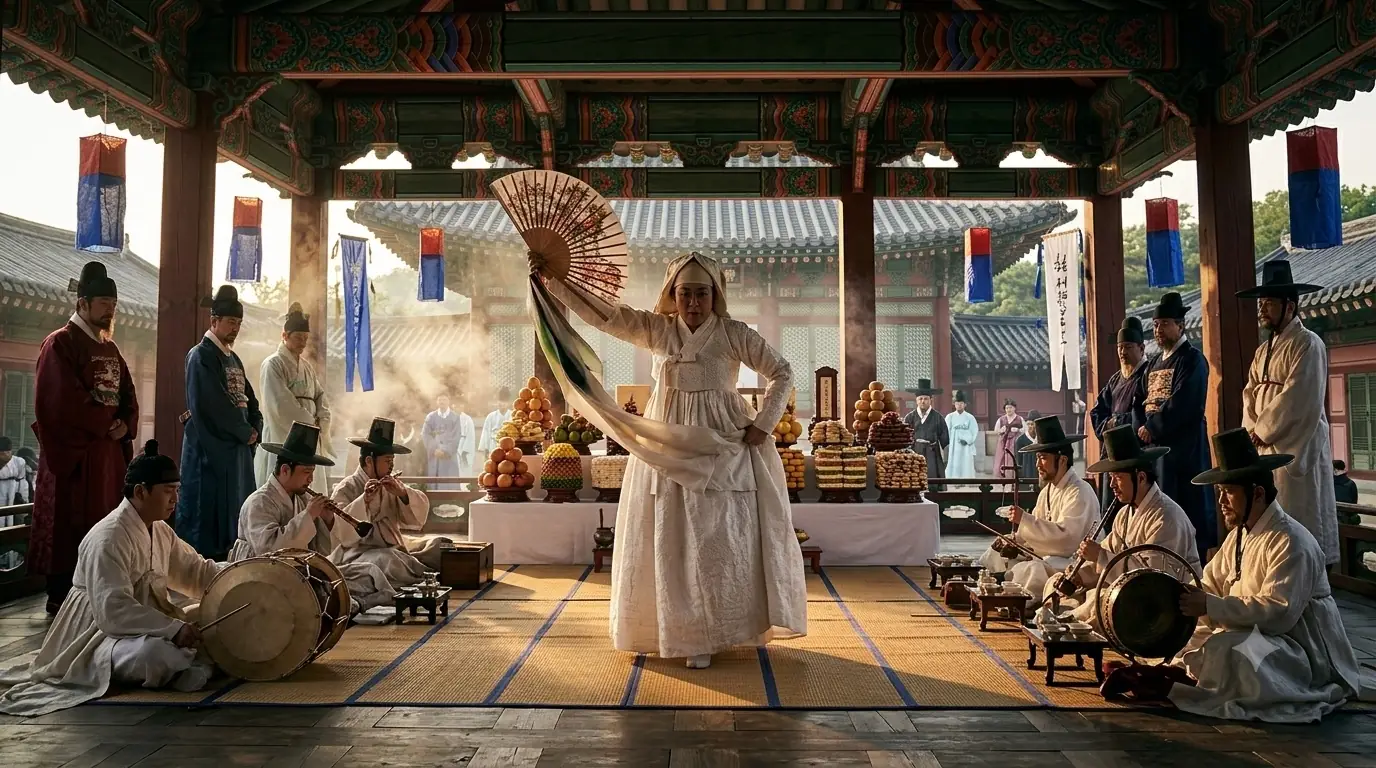
In the villages, smallpox was addressed as a visitor. People spoke of the smallpox spirit as hogwi mama or sonnim — “the Guest” — an honorific for an illness. Shamanic tradition pictured the Guest as a spirit come from outside; the hope folded into the name was that, like a guest, it would not stay. Villages set up smallpox jangseung, carved posts, at their entrances to ask the Guest not to come in. Shamans performed the sonnimgut, the rite for the Guest — known regionally as byeolsang-geori, hogu-geori, sonnimpuri or manura baesong, the “seeing-off of the lady”.
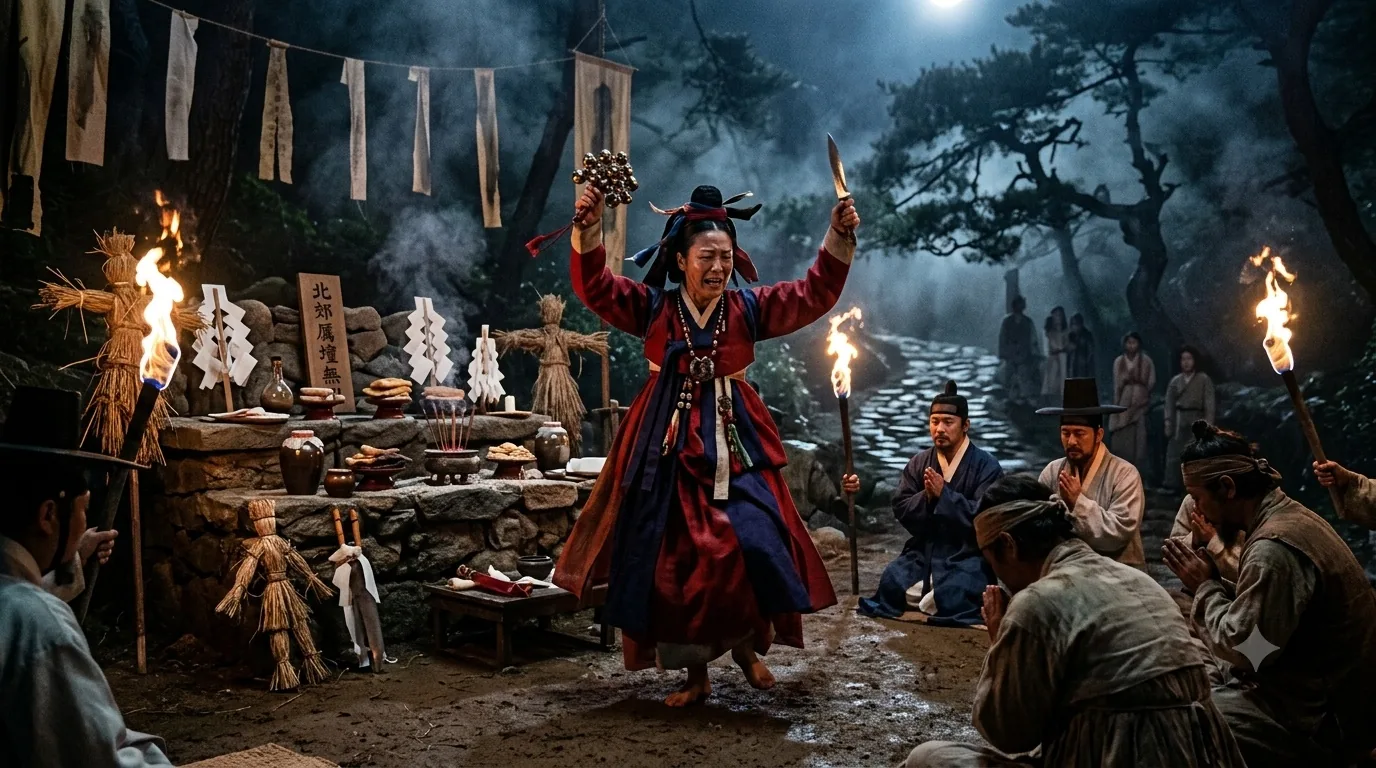 An AI illustration of a shamanic rite of the kind performed for the Guest. It is not a depiction of the state yeoje, which was an officials’ sacrifice without a shaman.
At court, the encyclopaedia says, “the countermeasure was mainly to hold the yeoje” — the state rite of the previous section, put to work on this disease. (Cases of the rite being ordered during smallpox and measles epidemics are documented; we do not claim it was automatic every time.)
In the medical books, smallpox had causes of a third kind. The foetal-poison doctrine held that a child fell ill with smallpox because, in the womb, it had received foul qi from its mother; the cyclical-qi doctrine made the sky’s qi in a given year the external trigger that let the internal poison break out. Both were inherited from Chinese medical literature.
A rite to see off a visitor; a state sacrifice; a theory of qi in the womb. Three kinds of response are recorded for one disease. That is what the sources show. They do not show how the three combined in a given village or household, or whether one ever displaced another in a particular place — and a rite is not the same thing as an explanation, since the same family could hold a gut and send for prescriptions.
There is a household-level record, at second hand. Cho Geuk-seon (1595–1658), a scholar, kept a diary for twenty-seven years, and Kim Dong-geon’s 2021 study of it — we cite the study’s abstract, not the diaries — describes how his household met an epidemic: moving out of the way of it (pijeop), other villages detouring around the infected one, anxious deliberation over whether ancestral rites could be held while the plague spirit was abroad, a shaman’s performance to see the spirit off once the danger had passed — and Cho blaming the spread of illness through his family on his own lack of virtue. In one household, then, avoidance, ritual and moral self-reproach appear together.
So what were the curse cases?
Back, briefly, to the world of The East Palace.
Burying bones, dead animals or written curses to harm someone — maehyung — appears in the Annals, and the reign of Gwanghaegun saw a run of curse trials; our article on the drama treats those as political history, and we will not repeat it. The question for this article is different. Did maehyung function as an explanation of illness, or as a political weapon?
The honest answer is that the archive itself leans political. A curse case gets into the record when an interrogation was opened, and the interrogations that reached the Annals tend to cluster around the throne and the factions. Cases that passed quietly were not written down. So the number of curse entries cannot be read as the frequency of curse belief in Joseon society; that would mistake the shape of the archive for the shape of the world. We have not counted the entries and make no claim about how often curses were blamed for illness.
What can be said is narrower. Among the ideas about illness in circulation, the curse was the one that could be turned into an investigation. Disordered qi cannot be denounced, and an unsacrificed spirit cannot be interrogated. The person who buried the bones can be arrested. That is a fact about what the state could act on, not about what people most often believed.
Drama vs. real history
| In The East Palace and Jejungwon | In the records |
|---|---|
| A vengeful ghost is said to have killed the crown prince | The dead who received no sacrifice were a category the state appeased by an official rite, three times a year, from 1401 to 1908 |
| The king sends for an exorcist | Kings are also recorded printing medical books (1525) and ordering physicians and shamans to treat the sick together (1429) |
| A curse is named as the cause of the trouble | Curse cases survive mainly as interrogation records; the archive tilts toward the political, and their frequency in belief cannot be read from it |
| Three students learn Western medicine at Jejungwon | Joseon already had a medical system — court physicians, the Hwarinseo, vernacular medical books. Jejungwon added a new one alongside |
The dramas’ details are not listed as errors. The East Palace announces that its dynasty is invented, and Jejungwon’s students are fictional; neither is a target for fact-checking.
Key terms. Yeoje (여제, 厲祭) — the state rite for the dead who received no sacrifice. Yeodan (여단) — its altar in the northern suburb of Seoul, and the provincial altars modelled on it. Yeo (여, 厲) — a spirit with no one to sacrifice to it; also musa gwisin, “spirits without sacrifice”. Hwarinseo (활인서) — the state office treating the sick in the capital. Uisaeng / mugyeok (의생·무격) — physicians and shamans, as paired in the 1429 order. Sonnim (손님) — “the Guest”, the honorific for the smallpox spirit. Maehyung (매흉) — burying objects to curse someone. Pijeop (피접) — moving away to avoid an epidemic.
Four misconceptions, corrected
“A Confucian state denied ghosts.” It classified them. Ancestors were fed in the family shrine; the unsacrificed were fed at the yeodan, by officials, on fixed days.
“Shamans were only persecuted.” Persecution and employment coexisted in law. The 1429 order put shamans beside physicians at the sickbed and rewarded those who saved lives.
“Western medicine erased the traditional responses.” The Hwarinseo was abolished, by the encyclopaedia’s date, in 1882; Jejungwon opened in 1885; the yeoje was formally abolished only in 1908. The state rite outlasted the Western hospital’s opening by more than twenty years.
“The Korean alphabet was for poems and letters.” In 1525 it was for a plague manual.
The rat-ghost of 1821
In the seventh month of 1821 an unidentified disease broke out in Pyeongan province and moved south. The Annals call it a “strange sickness”; it is now generally taken to have been cholera. The entry of the 22nd day of the eighth month describes it: violent diarrhoea, then cramping that rose from the feet to the belly, spreading from house to house, “scarcely one or two in ten surviving”; more than ten senior ministers dead; and the total in the capital and provinces put at 累十萬餘 — “several hundred thousand”, in the official translation. That is the Annals’ figure, not a modern count, and we give it as such. The king’s order that day was for rites at the mountains and rivers to avert the disaster. Note what the same entry does: it records contagion — the disease passing from house to house — and orders a rite in the same breath.
What ordinary people made of it is preserved at second hand. A 2014 master’s thesis on the 1821 outbreak by Kim Sin-hoe, which we have not read, is reported to describe the folk name jwitong, “rat-ache”: a rat-shaped spirit was thought to enter through the feet and gnaw its way upward through the legs to the organs — a picture that fitted, rather well, what onlookers saw of cholera’s cramps. We flag this as a later scholarly reconstruction of a folk belief, cited at second hand. From the end of the century the disease would be called hoyeolja.
When the state handled epidemics elsewhere
China — where the form came from. Joseon’s altar was built on the Ming model; Gwon Geun’s memorial says so. The Ming, too, had rites for the unsacrificed dead at provincial and county level, so the provincial altars were not a Joseon innovation. If Joseon’s practice was distinctive, it would have to be shown in how the rite was run and whom it named — a comparison this article has not done.
Japan — one type, for contrast. Japan had its own belief that resentful deaths caused pestilence, and its own ritual answers. One well-known type of goryō belief enshrines a named individual’s angry spirit — most famously political figures — as a god. That is one type among several in Japan, and the comparison here is with that type only.
Korea — categories rather than names. Joseon’s yeoje, by contrast with that Japanese type, named no one. Its fifteen seats were organized by cause and circumstance of death and by whether the dead had anyone to sacrifice to them. Where one tradition raised particular wronged persons to godhood, the Joseon state took the anonymous, unfed dead as a class and made feeding them a duty of government.
Back to the classroom — and what changed in 1886 and 1895
The three students in Jejungwon are learning, along with new treatments, a different framework for understanding disease and the body — though what, exactly, they were taught about the causes of illness in the hospital’s earliest years is not something the sources we have settle.
The year after Jejungwon opened, in 1886, cholera swept the country. Park Han-min’s 2020 study shows that Joseon had not yet established quarantine regulations of its own, and that prevention at the three treaty ports ran differently in each — cooperation among Korean, Chinese and Japanese officials at Wonsan, friction over the rules at Busan. Formal Cholera Prevention Rules followed: the Annals record their promulgation on the 14th day of the intercalary fifth month of 1895. The entry confirms that the rules were issued; it does not, by itself, tell us what theory of disease they rested on, and we do not read one into it.
Set the port beside Cho Geuk-seon’s household. Pijeop and quarantine both separate people from people. The difference the sources let us name is one of organization: a family deciding for itself to move out of the way, against a port authority applying written rules to the movement of ships and travellers. Whether the family thought in terms of spirits and the port in terms of germs is not something either record states — and the 1821 entry above is a reminder that observing contagion and ordering a rite could sit in the same document.
Which is why it would be too much to call this a replacement. Jejungwon was an important stage in the state’s institutionalization of Western medicine — not the first Western-style medical practice in Korea, and not the end of the older kind. The concrete evidence for continuity is the state’s own calendar: the yeoje was formally abolished in 1908, twenty-three years after the hospital opened. Whether the Guest rite and the rat-ghost persisted in the villages through those years is a separate question that these sources do not answer. A new system of explanation was institutionalized, and for a generation at least it stood alongside the ones already there.
Watch The East Palace’s king summon an exorcist over his son’s body once more. What the drama shows is one action: a king reaching for a specialist in ghosts. What the records show is that the real Joseon state, over its history, reached for several kinds of specialist — physicians, officiating officials, and, by the order of 1429, shamans — and kept the institutions for all of them.
Coming up next
Our article on The East Palace covers the buried curse objects, the crown prince’s quarters and the politics of the Gwanghaegun-era trials. Donggung follows the shamans the court kept on its own payroll. And the 1886 Jejungwon report asks what actually changed when the new hospital started counting the sick.
Frequently asked questions
Did Joseon explain illness by ghosts? That was one idea in circulation, and the state acted on it with an official rite — alongside plague manuals from its physicians and, from 1429, shamans and physicians treating the sick together. The records show several responses; they do not say how any one person explained a given illness.
Was the yeoje a real state rite? Yes: proposed in 1401 on the Ming model, given a procedure in 1404, an altar by 1413 and a ritual text in 1440; held three times a year at the northern altar with a notice-rite to the City God; replicated in the provinces; formally abolished in 1908.
Why would a Confucian state sacrifice to ghosts? It classified rather than denied them. Ancestors in family shrines; the unsacrificed and the violently dead at the state altar, by category, by officials.
Was smallpox really called “the Guest”? Yes — sonnim or hogwi mama, with village posts to keep it out and a shaman’s rite to see it off, while the court held the yeoje and physicians wrote of foetal poison. Three kinds of response for one disease; how they combined in a household the records do not say.
Were shamans only persecuted? No. They were condemned and taxed, and by the 1429 order also placed at the sickbed beside physicians, with tax relief for those who saved lives. The order is documented; its implementation is not measured here.
How common were curse cases? Unknown, and not counted here. Curse cases reach the Annals through investigations, which cluster around the throne; their number measures the archive, not belief.
Did Western medicine end the older explanations? Not at once. Jejungwon opened in 1885; the yeoje was abolished in 1908. Whether folk rites continued alongside is a separate question these sources do not settle.
Is the curse in The East Palace real history? The ghost, exorcist and medium are fiction. Burying objects to curse someone is documented in the Annals; the state rite for the unsacrificed dead is documented too, and the dramas do not show it.
Sources & further reading
- The founding memorial — Veritable Records of Taejong, 1401/1/14, entry 3: Gwon Geun, Chamchan munha busa, recommends instituting the yeoje on the Ming model as the sixth of his proposals. Consulted directly.
- The institution, the calendar and the fifteen categories — Encyclopedia of the Veritable Records, ‘Yeoje’, which gives the sequence 1401 → 1404 → 1413 → 1440 → 1444 with its Annals citations, the fifteen categories, the three annual dates, the City God notice-rite and the 1908 abolition; Veritable Records of Sejong, 1440/6/29, entry 4, the ritual text, consulted directly for the three dates. Some general reference works give the rite as twice yearly; we follow the ritual text.
- Physicians and shamans together — Veritable Records of Sejong, 1429/4/18, entry 3, consulted directly: magistrates to use uisaeng and mugyeok; tax and corvée relief for shamans who save many; rice “on the model of the Hwarinwon”.
- The infirmary — Encyclopedia of Korean Culture, ‘Hwarinseo’ (E0065037), consulted directly: 1392 Daebiwon → 1414 Hwarinwon → 1466 Hwarinseo → abolished 1882. The 1882 date rests on this entry; the administrative order was not checked.
- The plague manual — Encyclopedia of Korean Culture, ‘Gani byeogonbang’ (E0000573), consulted directly. The preface date is given there in the first month of 1525; we have not converted it and make no claim about the Western calendar date.
- Smallpox — Encyclopedia of Korean Culture, ‘Smallpox’ (E0017038) and ‘Sonnimgut’ (E0030480), consulted directly. Foetal poison, cyclical qi, the Guest, the jangseung, and the court’s use of the yeoje all come from these entries; no medical text was opened.
- A household’s diary — Kim Dong-geon (2021), abstract consulted; the Injae illok and Yagok illok themselves were not read.
- 1821 — Veritable Records of Sunjo, 1821/8/22, entry 1, consulted directly: 累十萬餘, rendered “several hundred thousand” in the official translation; some accounts give “over 100,000”. The rat-ghost belief is from Kim Sin-hoe’s 2014 MA thesis, cited at second hand; the thesis and the 1821 sources behind it were not read.
- 1886 and 1895 — Park Han-min (2020), abstract consulted; Veritable Records of Gojong, 1895/int.5/14, entry 3, consulted directly for the fact of promulgation only.
- Comparisons — The Ming provincial rites are noted from general scholarship; the Da Ming huidian itself was not opened. The Japanese comparison is confined to the named-individual type of goryō enshrinement. Both are used only for the narrow contrasts drawn.
- Limits of this article — The three KCI/library items (Kim 2021, Park 2020, Kim 2014) were read in abstract or record only. The Gukjo orye ui was not opened; the fifteen categories are taken from the Sillok Dictionary’s summary of the ritual text. The Yeoje deungnok and the contents of the Gani byeogonbang were not read. No count of curse cases, and no comparison of the relative frequency of state responses, was made; the article accordingly makes no claim about which response was most common, or about how explanations of illness combined in any one household.
This article was researched and written by K-Drama History. Source: Curse, Ritual, or Contagion? How Joseon Explained and Responded to Illness — K-Drama History