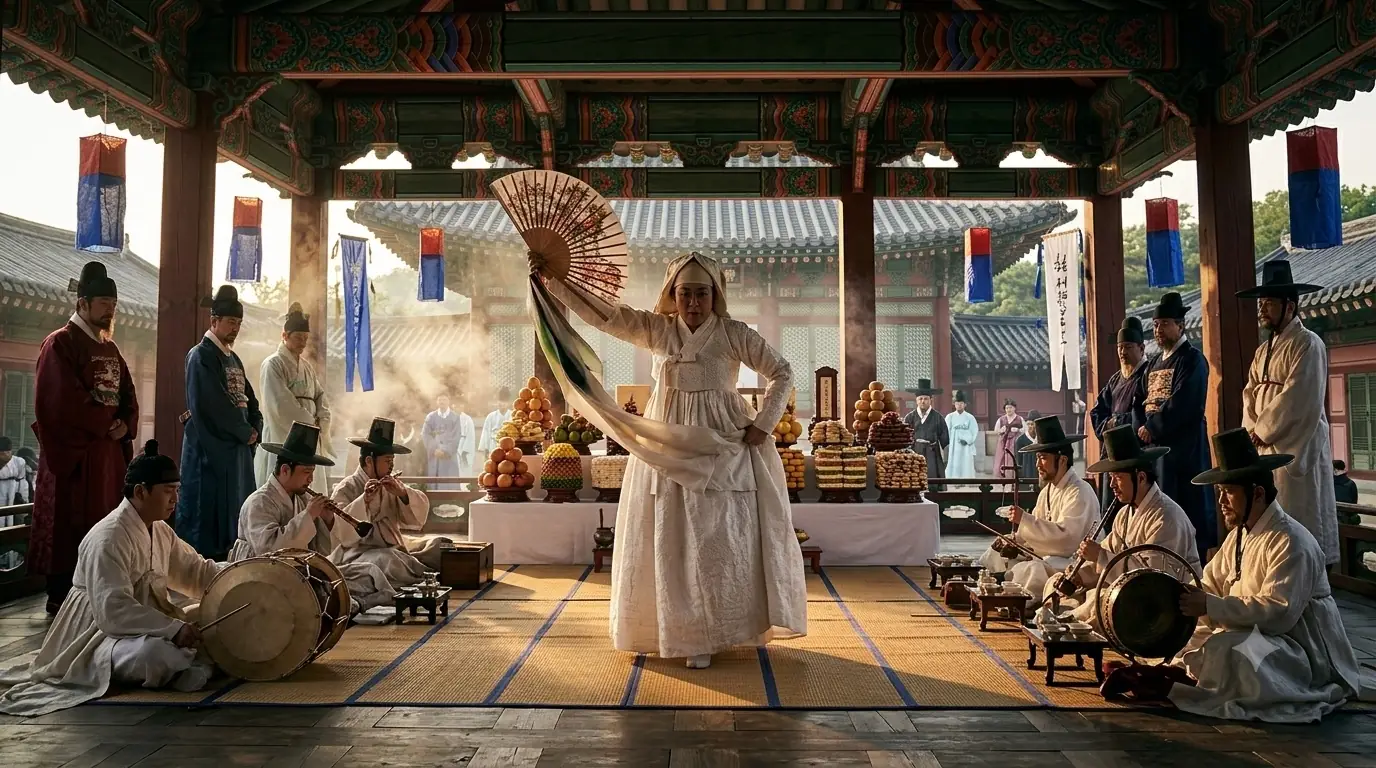
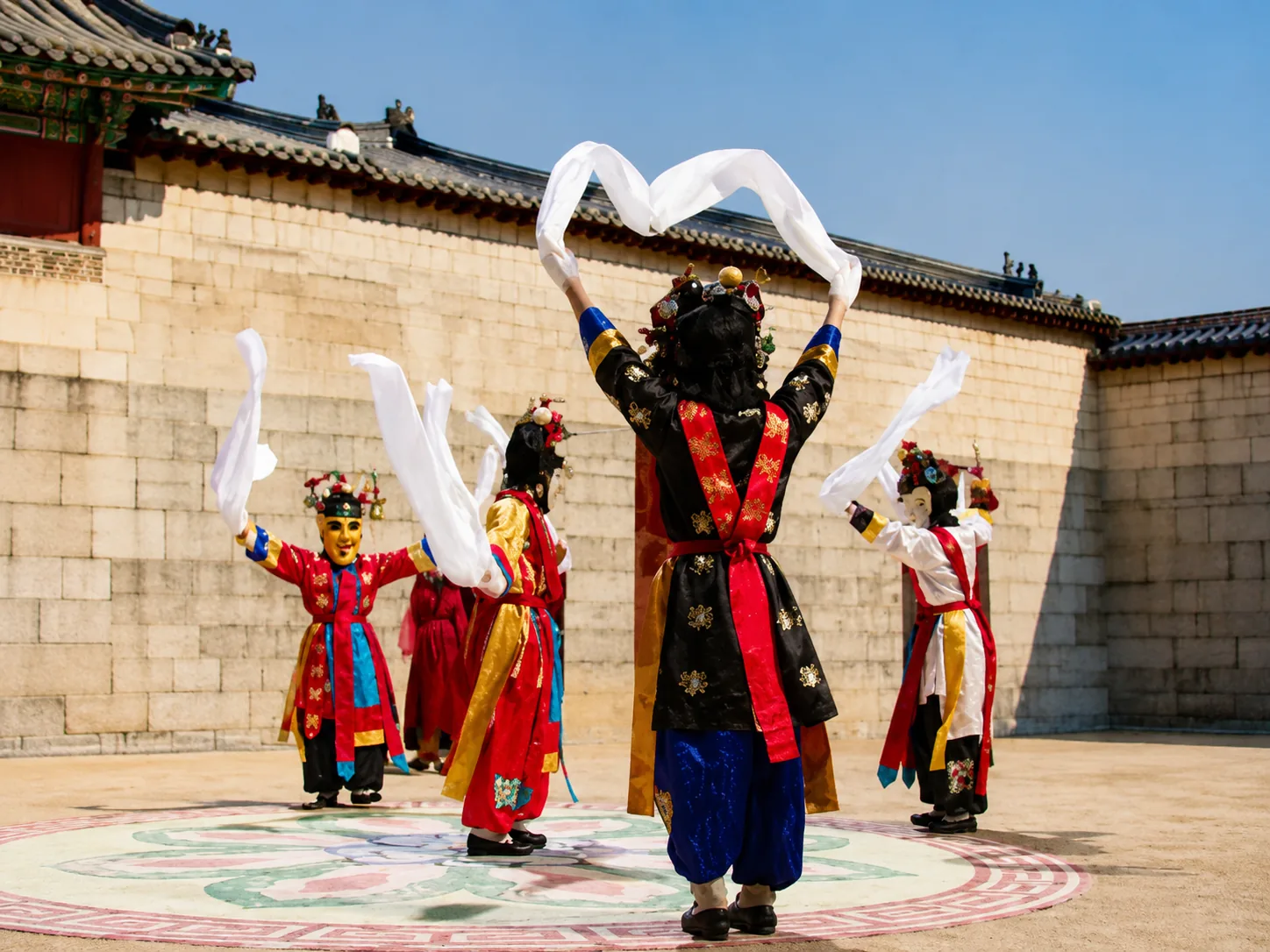
The East Palace, Explained: Why the Joseon Crown Prince's Home Was the Most Sacred — and Most Cursed — Place in the Palace
Theme: Belief, Death & the Uncanny
From the research behind Pause the Drama.
A crown prince is found dead in a palace pond, and the king cannot tell anyone.
That is the opening of The East Palace (동궁), Netflix’s eight-part occult sageuk released on July 17, 2026. A vengeful spirit is blamed, and the ghost is said to have sworn to end the royal line. The king (Cho Seung-woo) has one young son left. And still he does not bring it to his ministers — because the rumor that a demon walks the palace would go straight at the thing a Korean king could least afford to lose.
So he sends, in secret, for two people who belong nowhere near a throne room: Gu Cheon (Nam Joo-hyuk), an exorcist who can cut a spirit, and Saeng-gang (Roh Yoon-seo), a palace maid who can hear the dead.
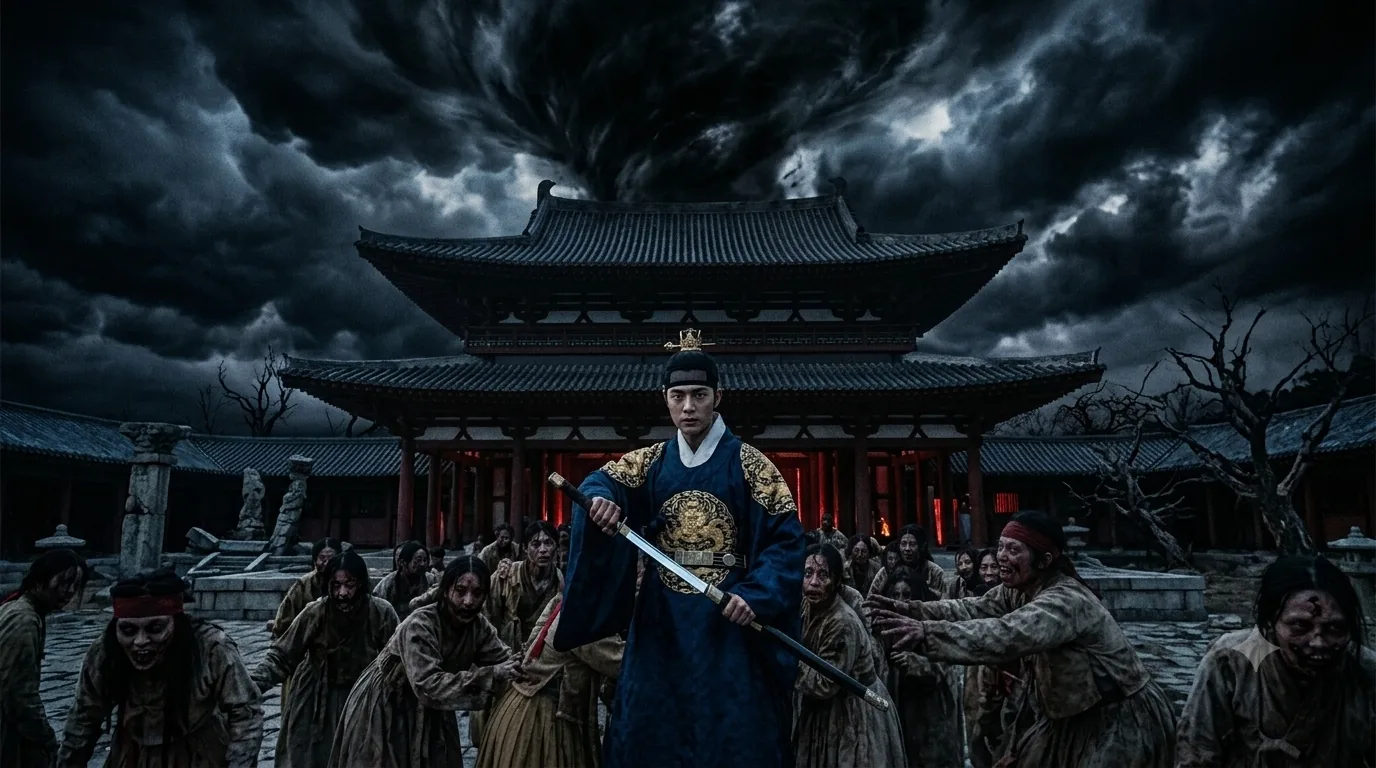 The Donggung took its name from the east — the direction associated with sunrise and the future ruler. In the surviving records it is a place of buried bones, fire, and political ruin. (AI illustration)
The kingdom is invented and the ghosts are fiction. The question underneath is not.
Why would a storyteller choose the crown prince’s home as the place where the darkness lives? Of all the rooms in a palace, why that one?
Quick answer: Because the choice is not arbitrary. Joseon’s crown prince quarters carried the brightest name in the palace — Donggung (동궁, 東宮), the eastern palace, the direction of the rising sun and therefore of the future king. In the historical record that brightest-named building is where you find buried curse objects, fire, and ruined lives. Court curse cases were real, and so were the prosecutions around them: curse accusations did not need to be true to destroy queens, dowagers, palace women, and princes. And the drama’s instinct that a king would hush it up has a recognizable political logic behind it. The spirits belong to fiction. The fear does not.
Let’s open the gate.
The Donggung was a building — and also a person
The place the king sends them into needs unpacking. Donggung (동궁, 東宮) meant both the quarters where the crown prince lived and, by extension, the crown prince himself. Joseon court language did this routinely — a residence became a title for the person who occupied it. Junggung (중궁) or Junggungjeon (중궁전) worked the same way for the queen, denoting both her residential sphere and the queen herself.
Why east? Across East Asian courts, the east was the direction of sunrise and therefore of the heir who would one day rise to rule. The same logic gave the crown prince a second nickname, Chungung (춘궁, 春宮) — the spring palace, spring being the season of beginnings. The crown prince’s quarters in Joseon sat on the eastern side of the palace’s main hall, and the vocabulary followed the geography.
Being invested as crown prince meant moving into that separate world. He lived under the tutors of the Sejasigangwon (세자시강원), the office responsible for his education, and the guards of the Sejaiksisa (세자익위사). It would overstate the case to say he could never leave except for official ritual — in the early dynasty the crown prince quarters were at times located outside the palace walls entirely, and princes did travel beyond them. But the shape of the life is clear enough: a child moved into a compound where instruction, protection, and ceremony were all organized around watching him.
A brilliant name, and a closed room. The drama’s instinct to make it claustrophobic has something behind it.
The hall whose name sounded like “the afterlife”
Here is the detail that stops English-speaking readers cold.
One of the halls used as crown prince quarters, in the Changdeokgung–Changgyeonggung area, was called Jeoseungjeon (저승전, 儲承殿). The characters are auspicious. Jeo (儲) appears in jeogun (儲君), a term for the heir apparent; seung (承) carries the sense of receiving or continuing. Written 儲承殿, the name draws on characters associated with the heir and the continuation of succession. Nothing in the written name refers to death.
But jeoseung (저승) is also an ordinary Korean word. It means the afterlife. The world of the dead.
The two are etymologically unrelated; one is Sino-Korean, the other native Korean vocabulary, and nobody named the hall to make that joke. Two cautions are worth stating plainly. The name was not chosen for the effect, and we should not assume the two words were pronounced identically in the fifteenth century when the hall was built — what we can say is that in modern Korean they sound the same. A Korean viewer today hears a crown prince living in “Afterlife Hall.”
And then there is what the records say happened there.
In the eighth lunar month of 1647, foul objects — human bone, hair — were reported buried around Jeoseungjeon. A repair directorate was established, and over roughly the following year the hall was rebuilt. During that construction more turned up: rotted bone, a dead magpie, ash from burned clothing. The hall later served as the childhood residence of Prince Sado, the crown prince who in 1762 was shut inside a rice chest by his own father and died there. Jeoseungjeon itself burned down in 1764.
Keep those separate, because it is easy to smear them into one story. Prince Sado did not die at Jeoseungjeon. What is true is narrower and still striking: a hall where curse objects were dug up and which later burned is also the hall where a boy grew up before his own catastrophe — and later memory laid those things on top of each other.
Curse objects were not a metaphor. People dug them out of the ground.
The buried evil that Gu Cheon and Saeng-gang go hunting is fantasy. The practice is not.
Concealing foul objects — bones, dead animals, written curses — in the ground or inside someone’s quarters in order to harm them was called maehyung (매흉, 埋凶), literally “burying the foul.” It appears in the Veritable Records, and under Gwanghaegun (r. 1608–1623) accusations of court cursing became a recurring feature of political life.
The sequence there is worth getting right, because it is usually compressed into a single dramatic stroke and it was not one. In 1613 the Gyechuk Purge (계축옥사) swept up the family of Queen Dowager Inmok; her son, the young Grand Prince Yeongchang, was stripped of rank and confined on Ganghwa Island, and he was killed there on the tenth day of the second lunar month of 1614, by the Ganghwa magistrate Jeong Hang. Queen Dowager Inmok herself was confined to the Western Palace in 1618. Curse allegations ran through this period as a political instrument — but they did not detonate all of it at once, and stringing the events together as a single chain of cause and effect flattens five years of maneuvering into a story that is tidier than the record.
Whether any curse ever worked is not a question the archive can answer. The question the archive answers is different, and colder.
A curse did not kill anyone. A politics that took curses seriously did. When a foul object surfaced, palace women and shamans were dragged in and tortured, and the fates of queens and dowagers turned on what they said under it.
Why the king hushes it up
The drama has the king suppress the incident and handle it privately. That is not merely a plot convenience — it follows a recognizable Joseon political logic. No documented case matches this exact scenario, but the motive is entirely at home in Joseon political culture.
In Confucian statecraft, calamity and the uncanny (괴이, 怪異) were read as Heaven’s commentary on the ruler. If something ominous happened inside the palace, it could be argued — by anyone with a reason to — that the king’s virtue was insufficient. That made every discovery a potential weapon aimed at the legitimacy of the throne itself.
So two forces pulled against each other whenever something was found: the impulse to bury it, and the impulse of somebody else to make it public and useful.
The most dangerous thing in the palace was never the ghost. It was the rumor that there had been one.
The maid who hears the dead, and the exorcist
Saeng-gang’s ability is invented, and so is Gu Cheon’s. But the world they move through — a palace entangled with shamanic practice — is close to the record.
Joseon proclaimed itself a Confucian state and classed shamanism as vulgar superstition. Shamans and ritual specialists nonetheless entered the orbit of the royal household — in illness, in childbirth, in calamity, and in curse cases. In those cases they appear on both sides of the ledger: as the people accused of performing the curse, and as the people summoned to undo it. Officially despised, practically indispensable. (We have written separately about the office Joseon actually kept for this, the Seongsucheong — see our piece on why a Confucian kingdom kept a shaman on the government payroll.)
Palace women stood at the center of these cases too. Curses were worked in the private depths of a residence, which is where the accounts place the hands that carried them out: the close attendants of a queen or a royal concubine. In many transmitted accounts, palace women appear among the first questioned, punished, or tortured once a case surfaced. The surviving evidence is uneven, so this is better treated as a recurring pattern in the accounts than as a universal rule.
The shape of it, though, is hard to miss. The women with the least standing in the palace carried its most dangerous secrets. Making Saeng-gang a maid nobody looks at, and therefore the one who gets closest to the truth, lands on that irony precisely.
Drama vs. history
| In The East Palace | In the Joseon record |
|---|---|
| A prince’s death is attributed to a vengeful spirit | In the documented curse cases the objects and the accusations were made by people; the lethal force came from the investigation, the torture, and the politics that followed |
| A ghost swears to end the royal line | Curse objects were buried by people, and the harm came from the prosecutions that followed |
| The king hides the incident from his ministers | Historically plausible: uncanny events in the palace could be read as evidence against the king’s virtue |
| An exorcist and a spirit-hearing maid are summoned in secret | Shamans really were called into the palace quietly — and were tortured when a case broke |
| The kingdom is unnamed and invented | The institutions borrowed — Donggung, Jeoseungjeon, maehyung — are documented Joseon ones |
In short: The ghosts are invented; the politics of the curse is not. In the real cases the terrifying agent was never the spirit — it was the person who buried the object, and the faction that knew what to do with it once it was found.
Key terms. Donggung (동궁, 東宮) — the crown prince’s quarters on the palace’s eastern side, and by extension the crown prince himself. Chungung (춘궁, 春宮) — “spring palace,” a second epithet built on the same symbolism of beginnings. Jeoseungjeon (저승전, 儲承殿) — a hall used as crown prince quarters; in modern Korean its name is a homophone of jeoseung, the afterlife. Maehyung (매흉, 埋凶) — burying or hiding foul objects to curse someone. Gyechuk Purge (계축옥사, 1613) — the political purge that swept up Queen Dowager Inmok’s family under Gwanghaegun.
Later memory: how a hall became an unlucky place
The stories that gathered around Jeoseungjeon grew darker with time, and it is worth being careful about which layer we are standing on.
Later transmission places Lady Jang Hui-bin’s residence near the hall, and the tale that she cursed Queen Inhyeon circulated for centuries. Prince Sado spent his childhood there before his death in the rice chest. In the Hanjungnok — the memoir of Sado’s wife, Lady Hyegyeong — and in later readings of it, Jeoseungjeon is remembered as a place that carried a sense of foreboding and of Sado’s tragedy.
What we should not do is upgrade that into a claim that Joseon society at large designated the hall an unlucky ground, or assert that contemporary shock at the events caused a folk tradition to form. Neither is documented. The honest version is smaller and more interesting: in one family’s memoir, and in the readings that followed it, this particular hall became the place where a tragedy is felt to have begun.
Two other courts: China’s eastern palace, Europe’s poisoned one
Crown prince quarters and court cursing were not Korean peculiarities. Setting two other cases beside Joseon’s sharpens what was distinct about it.
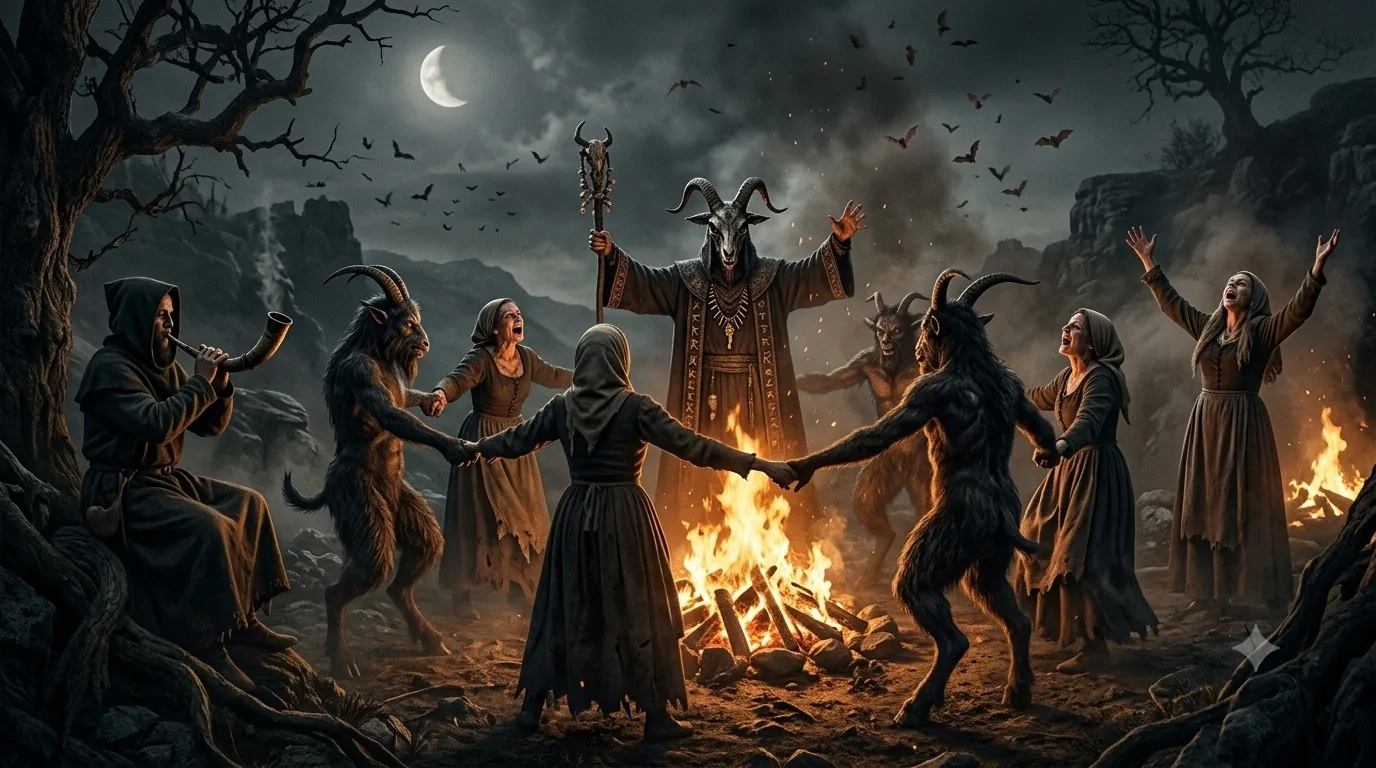 Europe’s version of a court curse ran toward the devil and the heretic. Joseon’s ran toward the succession. (AI illustration)
China — the closest parallel. The term donggung and the association of the east with the successor were widely used in Chinese imperial practice, where the heir’s residence, his household offices, and the heir himself could all be denoted by it, and succession intrigue recurred dynasty after dynasty. But the inheritance is not a clean line: not every Chinese dynasty placed the heir’s residence due east of the throne hall, and Joseon did not import a finished institution. It took the name and the symbolism and ran them through its own palace layout and its own Confucian program for raising a future king.
Europe — the instructive contrast. European courts also saw poison and black magic marshalled against rivals; in Louis XIV’s France the Affaire des poisons entangled aristocrats in accusations of poisoning, sorcery, and sacrilege. The tempting summary — “Europe had witch trials, Joseon had politics” — does not survive the detail. The French case was investigated not by an ecclesiastical court but by a special tribunal the crown itself established, and Joseon’s curse cases were likewise never filed under a single charge, combining harm to the royal house, false accusation, murder, and factional conflict case by case.
What survives the caveats is a difference in gravitational pull. In France the accusations pulled toward poison, sacrilege, and the machinery of the court; in Joseon they pulled toward the succession and the safety of the royal house. Both were about power. They reached for different vocabulary to talk about it.
Watch it again
Gu Cheon’s blade and Saeng-gang’s ear are inventions. But the floor being dug up, the foul thing being lifted out, and a queen’s or a prince’s fate turning on what it was taken to mean — that happened. So did a king’s instinct to keep it quiet. So did the fact that the lowest-ranking women in the palace ended up holding the most dangerous knowledge in it.
The East Palace is an occult sageuk. The deepest fear it touches is a historical one. The room named for the sunrise is where the record is darkest. The buried object was powerless. The court that believed in it was not.
Coming up next
One pond, one dead prince, one king who cannot speak — and we have travelled from a hall whose name sounds like the afterlife, to bones dug out of a palace foundation in 1647, to a purge that ran five years and killed a child prince, to a tribunal in Louis XIV’s France. That is what a good historical drama leaves behind: even its ghost story has a paper trail.
In the next essay, we’ll take another K-drama scene that looks like pure fiction — and trace the real Korean history hiding underneath it.
Frequently asked questions
Is The East Palace based on a true story? No. The spirit world, the sword that cuts ghosts, and the characters are all invented, and the show is set in a deliberately unnamed kingdom rather than historical Joseon. What is real is the setting it borrows from: the Donggung as the crown prince’s quarters, and the court curse cases recorded in Joseon’s own annals.
Was the Donggung a real place? Yes. Donggung (동궁, 東宮) means “eastern palace” and referred both to the physical quarters where the crown prince lived, on the eastern side of the palace complex, and to the crown prince himself. Joseon court language did this routinely: Junggung (중궁) or Junggungjeon (중궁전) likewise denoted both the queen’s residential sphere and the queen herself.
Did a Joseon crown prince really live in a hall that sounds like “the afterlife”? In modern Korean, yes — by coincidence. One hall used as crown prince quarters at Changdeokgung and Changgyeonggung was called Jeoseungjeon (저승전, 儲承殿), written with characters meaning the heir and succession. The native Korean word jeoseung, meaning the afterlife, is etymologically unrelated. Today the two sound identical, but the name was not chosen for that effect, and we should not assume the pronunciation was identical in the fifteenth century either.
Did curse rituals actually happen in the Joseon palace? Yes. Burying or hiding foul objects — bones, dead animals, written curses — to harm someone was called maehyung (매흉, 埋凶), literally “burying the foul.” Cases appear in the Veritable Records, and under Gwanghaegun accusations of court cursing became a recurring political instrument.
Was a king’s instinct to cover up a curse case historically real? Yes. In Confucian statecraft, disasters and uncanny events were read as Heaven’s warning about the ruler’s virtue. An ominous discovery inside the palace could be turned into an argument against the king’s legitimacy, so there was a genuine political motive to suppress such cases rather than publicize them.
Sources & further reading
This piece is an English adaptation of an original Korean essay by 사뚱샘의 역사방 (SaDDungSam), revised against his own fact-check notes. Key dates and figures are sourced inline above. For broader reading:
- 세자궁 (the crown prince’s quarters), with 세자시강원 and 세자익위사 on his tutors and guards. (Encyclopedia of Korean Culture)
- 저승전 (Jeoseungjeon) — the hall, the 1647 discoveries and rebuilding, and the 1764 fire. (Encyclopedia of Korean Culture)
- 저승 (jeoseung) — the native Korean word for the afterlife, on its separate etymology. (Encyclopedia of Korean Culture)
- 계축옥사 (1613) and 영창대군 — for the sequence the curse allegations ran through. (Encyclopedia of Korean Culture)
- Gwanghaegun Ilgi, year 5 / 8th month / 2nd day and year 6 / 2nd month / 10th day. (Veritable Records of the Joseon Dynasty)
- 김선현, 「〈한중록〉에 나타난 궁궐 공간 인식과 장소감」, 『한국고전여성문학연구』 49 (2024) — on how Jeoseungjeon is remembered in the Hanjungnok.
- L’affaire des poisons — Ministère de la Justice, and Lynn Wood Mollenauer, Strange Revelations: Magic, Poison, and Sacrilege in Louis XIV’s France (Penn State University Press, 2006).
Thanks for reading — see you in the next one.
This article was researched and written by K-Drama History. Source: The East Palace, Explained: Why the Joseon Crown Prince's Home Was the Most Sacred — and Most Cursed — Place in the Palace — K-Drama History