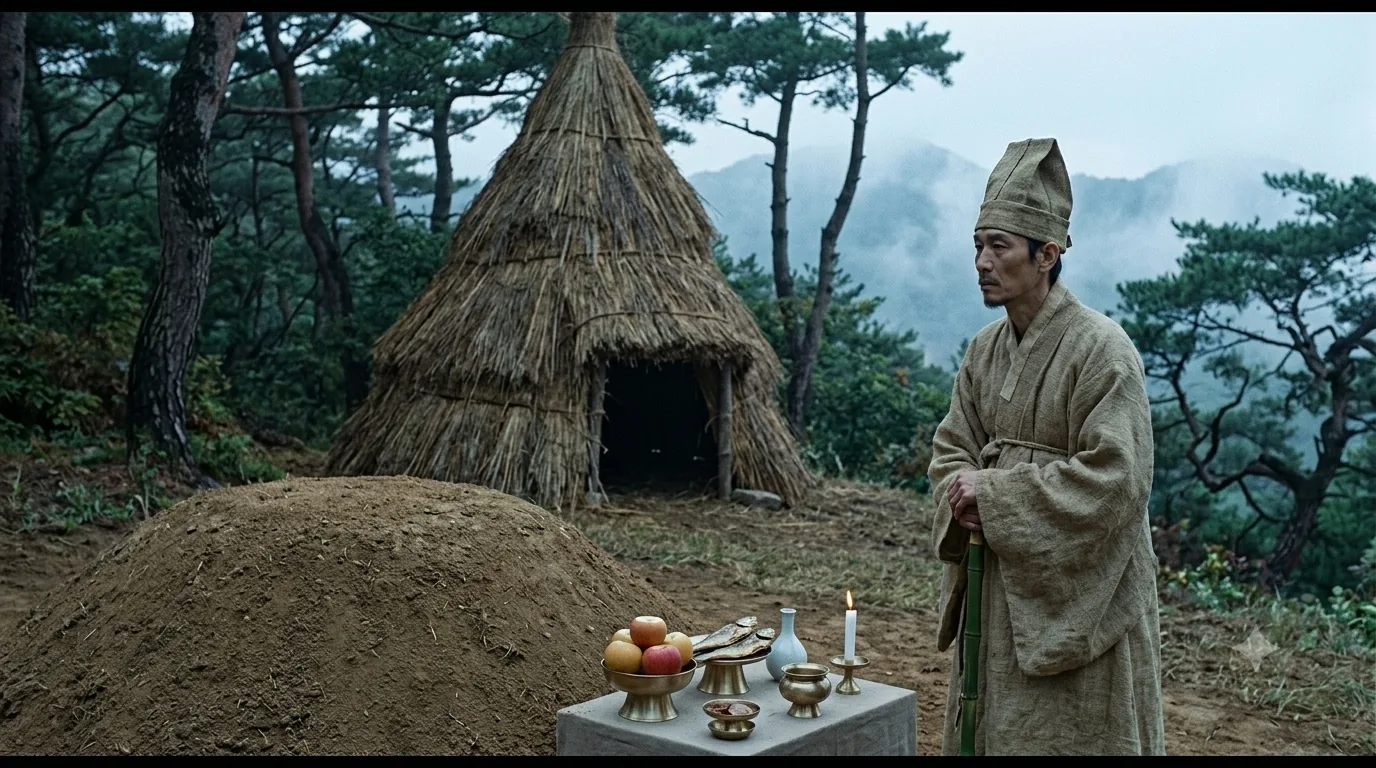
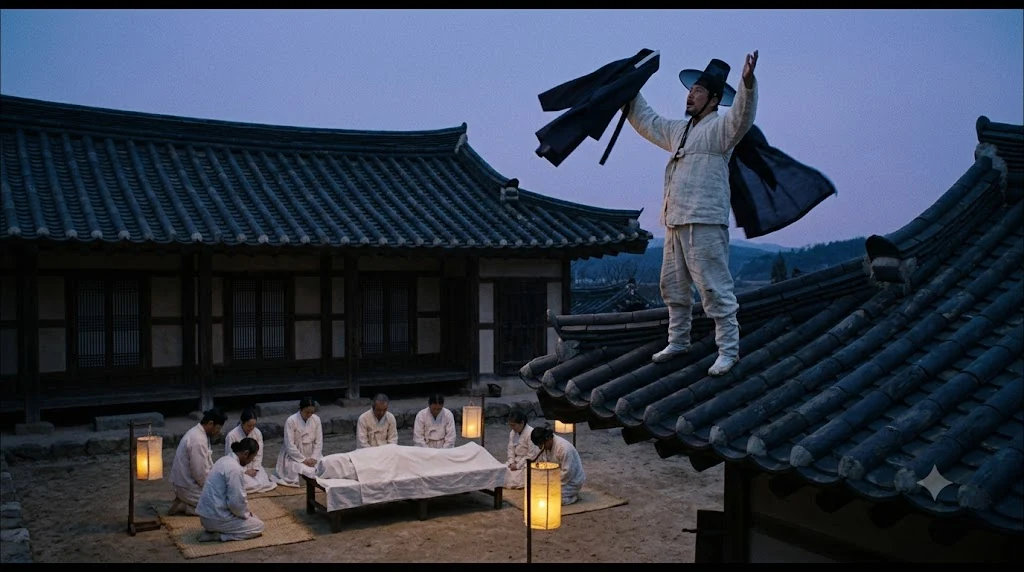
Because This Is My First Life, Explained: Why Ji-ho Is Sent to the Kitchen During Jesa
Theme: Confucian Life & Ritual
From the research behind Pause the Drama.
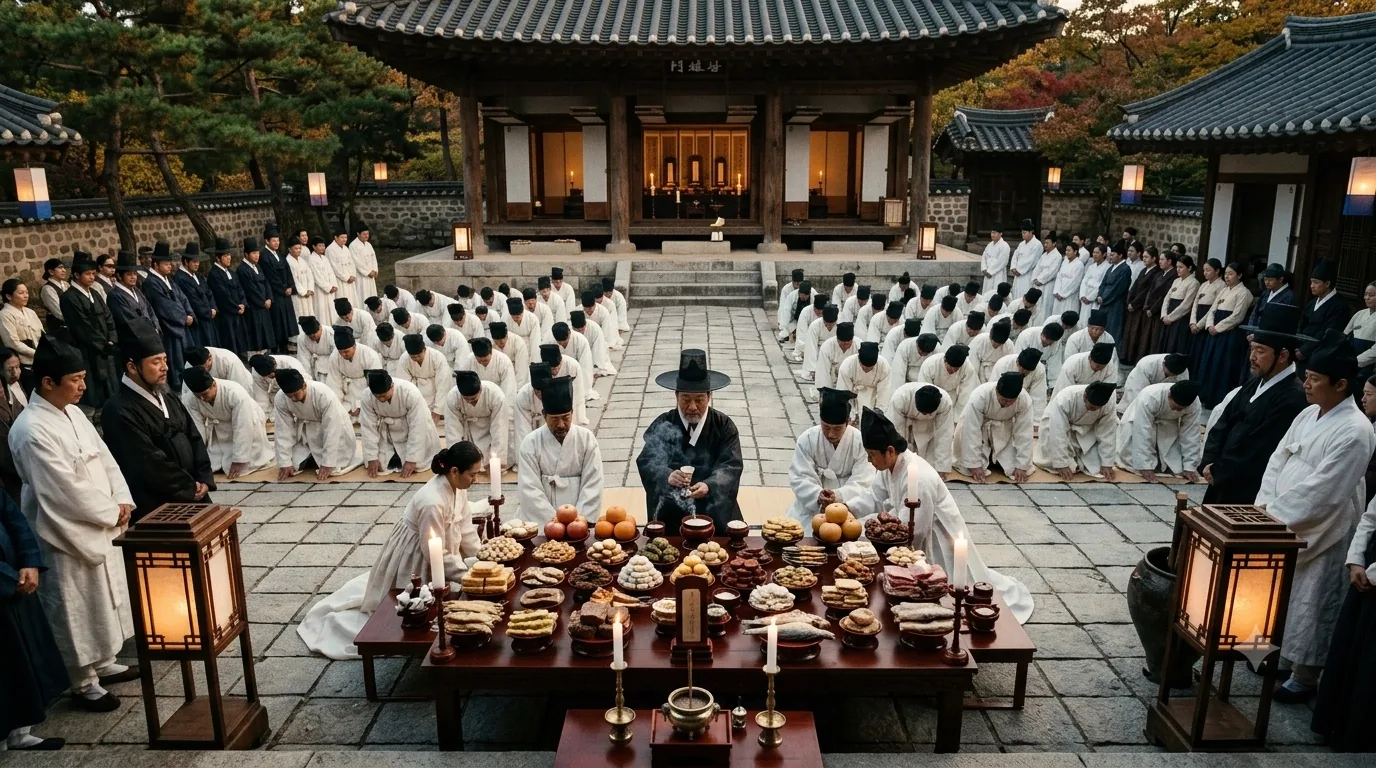 The ancestral rite in its formal lineage-shrine setting — an ideal that many ordinary households adapted to their own means. (AI illustration)
Here is the scene that lands hardest in Because This Is My First Life (이번 생은 처음이라, 2017): Yoon Ji-ho, freshly and only nominally married, walks into her in-laws’ ancestral rite already knowing she does not want to be there — and is handed an apron before she has sat down. Her husband, Nam Se-hee, had told her flatly not to come. She goes anyway, out of a half-obligation that is not even written into their arrangement. Once she is inside, the aunts hand her task after task while the men wait to eat. The marriage was a contract. The unpaid kitchen shift was not.
It is a quiet scene, no raised voices, which is exactly why international viewers tend to miss what Korean audiences catch instantly. That division of labour is not the in-laws being unusually demanding. It is the working end of a very old institution — and, as I want to be careful about in this piece, of several overlapping institutions that are often collapsed into one.
Quick answer: Ji-ho is sent to the kitchen not because jongbeop (宗法) — the patrilineal succession framework — assigned cooking to daughters-in-law, but because several traditions overlapped. Jongbeop placed ritual authority in a male line; patrilocal marriage, service to parents-in-law and gendered domestic labour placed the food on married women. The eldest-son-centred form most people picture is younger than the dynasty usually blamed for it — researchers date its hardening to roughly the mid-17th through mid-18th century, not to 1392. Under Korean law today, co-heirs of the same rank inherit equally.
Let’s unpack it.
What exactly is jesa — and how is it different from charye?
Jesa (祭祀) is a broad Korean word for ritual offerings — it is not reserved for ancestors, and not only for Confucian rites; state rites, mountain-spirit rites and village rites all carry it. In the family context this article is about, it is the everyday term for the ancestor rites: the food offerings, the incense, the bows. Several of its forms have their own names, and they are worth keeping apart, because Korean everyday speech does not.
Gijesa (忌祭祀), usually shortened to gije, falls on the anniversary of a particular ancestor’s death, historically timed to begin just after midnight. Under the norms of Zhu Xi’s Garye (家禮, Family Rituals), it covered four generations: parents, grandparents, great-grandparents and great-great-grandparents.
Sasije (사시제, 四時祭) is the seasonal rite of that same Garye tradition, and it is routinely confused with something else. The sasije was held in the second, fifth, eighth and eleventh lunar months, and it was addressed to the same four generations of ancestors, from parents up to great-great-grandparents. Its procedure functioned as the basic working form that other rites, the death-anniversary gije included, were built from.
What a great many Korean families today call “시제” is a different rite. It is held at the graves, most commonly around the third and tenth lunar months, and it is addressed to ancestors beyond the four-generation limit — the ones whose tablets have already been retired. That is properly myoje (묘제), a grave rite. Calling it sije is an entrenched colloquial habit, not a technical description, and merging the two flattens the part of the system that actually explains why some ancestors stay on the household calendar and others move out to the hillside.
Charye (茶禮) — literally “tea rite” — is, in contemporary practice, the comparatively simplified holiday rite performed at Seollal and Chuseok, and the one most people outside Korea have actually seen on screen. In casual conversation, Koreans say “jesa” for all of it, which is part of why the terms arrive in translation already blurred.
So who is a jesa performed for — a photo, a name, or something else?
The object at the centre of the rite is the sinju (神主): a wooden tablet inscribed with the deceased’s name and titles, understood not merely as a symbol, but as a ritual body in which the ancestor’s spirit was enshrined.
The making of it happened in stages, and the stages matter. At the uje (虞祭), the rite performed shortly after burial, the tablet was made of mulberry and was called the uju (虞主). The following year, at the yeonje (練祭), a chestnut tablet — the yeonju (練主) — was made in its place. Mulberry was not a cheap stand-in for chestnut while the family waited to afford better; it belonged to a specific ritual moment, and the change of wood tracked the family’s movement through the stages of mourning.
The white in the descriptions is also not what a casual reading suggests. It is not white lettering. The face of the tablet was coated with white powder, and the name and offices were inscribed on that prepared surface. The distinction sounds trivial until you notice that the tablet is being treated the way a body is treated — dressed, prepared, given a surface fit to receive a name.
That physical reverence is well attested in other ways too: accounts describe households prioritising the rescue of their sinju tablets over almost anything else during a fire or a wartime evacuation.
A related term is wipae (位牌), and the two are often distinguished along the wrong line. It is not the case that sinju live in houses and wipae live in shrines and temples. Sinju were enshrined in the gamyo (家廟) and sadang (祠堂) — the household and lineage shrines — as a matter of course. The two objects do differ in construction, but by later periods the two names were used interchangeably in many contexts. The honest formulation is: a structural difference, with the vocabulary blurring over time. Not a rule about location.
Where did this come from — was it always this rigid?
Not remotely, and not from China alone.
Korea had its own ritual traditions long before the Garye arrived: funerary and mourning practices, sky rites and ancestor observances, with Buyeo’s Yeonggo, Goguryeo’s Dongmaeng and Ye’s Mucheon among the earliest recorded ceremonies of that kind. So the frequently repeated line that Korean jesa is the direct lineal descendant of Chinese ancestor worship is too clean. The accurate version is that Joseon’s Confucian ritual system was a reorganisation carried out on top of existing Korean ritual traditions, under the decisive influence of Chinese ritual codes and above all of Zhu Xi’s Garye. Influence, not descent.
That reorganisation has dates attached. In 1390, the second year of King Gongyang at the very end of Goryeo, a set of ritual regulations for the scholar-official class was promulgated, prescribing rites centred on the primary heir and death-anniversary observances on the Garye model. In June 1391, an order was issued to institute the household shrine, the gamyo. What did not happen was rapid compliance. Actual construction of household shrines and genuine settling-in of Garye-style ritual took a long time — this is a case of the state issuing instructions to the elite and then waiting, in some regions for generations.
The legal machinery kept accumulating through early Joseon. Adoption for the purpose of continuing a line — ipu (입후) — was already regulated from King Sejong’s reign; it is not a late-16th-century invention. What happened on the sixteenth day of the tenth lunar month of 1580, the thirteenth year of King Seonjo, was narrower and more interesting than the popular version. The court dealt with the awkward case of a family that had already adopted an heir and then had a biological son. The ruling recognised the adopted heir’s already-vested right to succeed to the rites. That principle was reaffirmed under King Hyojong and eventually written into the Sokdaejeon. So 1580 is not the year adoption gained legal priority in general; it is the year the court protected an adopted heir against a later-born natural son.
What is jongbeop, exactly — and how much does it actually decide?
Jongbeop (宗法) is the framework that determines, within a patrilineal kin group, who carries ritual authority. It distinguishes a daejong (大宗) — the central lineage descending from a founding ancestor through the line of primary heirs, which in principle continues indefinitely — from sojong (小宗), the branch lines founded by younger sons, whose obligation to a shared ancestor lapses after a set number of generations.
That word daejong is where a lot of casual writing about Korean families goes wrong. A daejong is not simply “the eldest son’s house.” It is a specific structural position at the head of a lineage traced from its founding ancestor. Three things get run together in popular usage and should not be: (1) an ordinary household that happens to host the rites because its head is the eldest son, (2) a jongga (종가), the head house of a lineage, and (3) the classical daejong of the ritual codes. Ji-ho’s in-laws are, as far as the drama tells us, the first of those. Nothing in the show establishes them as a jongga or a daejong line.
The other correction is about the mechanics of authority. It is often written that a younger son needed the jongja’s (宗子, lineage heir) permission even to hold a rite. The classical basis for this is the Book of Rites — the “Quli” chapter — and what it prescribes is that a branch son does not independently preside over rites to the shared ancestors, and that he must inform the lineage heir. “Must inform” is not “must obtain consent,” and hardening it into a permission system makes the arrangement sound more like a licensing regime than it was.
Nor did all the cost and labour sit on one household. Other descendants came to the head house to contribute work and goods; lineage property and dedicated ritual land could carry the expense. And ritual duty tracked the shrine as a physical thing: a Sejong sillok entry for the tenth day of the second lunar month of 1427 records succession to the office of rite-holder attaching to the household that has the shrine. The picture is closer to a lineage-wide operation with a designated host than to a single house pinned under a permanent, unshared bill.
What jongbeop does not do is design the kitchen. It is a framework for succession to rites and lineage authority. The concentration of food preparation on daughters-in-law comes from a different and overlapping set of norms: patrilocal residence after marriage, the obligation to serve parents-in-law, the expectation encoded in the phrase 봉제사 접빈객 — that a wife’s work is to serve the ancestral rites and receive guests — and the broader gendered division of domestic labour. Those norms travelled alongside jongbeop and reinforced it. They are not the same instrument, and collapsing them into one makes the history less useful, not more damning.
Property: what actually changed, and what modern law says
Korean sources are explicit that before the 17th century, Joseon inheritance — like Goryeo’s before it — was broadly gyunbun sangsok (균분상속): property divided roughly equally among children, daughters included. From the mid-17th to the mid-18th century, unequal, eldest-son-favouring division begins to dominate the surviving family partition records, the bunjaegi (분재기), and by the mid-1700s it is the prevailing pattern.
Two qualifications belong here that the summary usually leaves out. First, the partition records are not a single rule applied uniformly: they show adjustments for supporting parents, for taking on the rites, for property already transferred at a child’s marriage, and considerable variation by region and by family. Inheritance by non-eldest sons and by daughters did not vanish outright after the eighteenth century; it narrowed. Second, the turning point is a historian’s judgement, not a claim the documents make about themselves: it is modern researchers who identify the mid-17th century as decisive in the surviving partition records.
And the present tense needs separating from all of it. Under the Korean Civil Act, co-heirs of the same rank take equal statutory shares. There is one narrow exception, and it is genuinely relevant to this drama: ritual property — grave land, the protected woodland around a grave, genealogical records, ritual implements — passes to the person who presides over the rites, under a separate provision of the Civil Act. And who that person is has itself changed. Since a 2023 Supreme Court decision, the presider is determined first by agreement among the co-heirs; where they cannot agree, priority no longer runs automatically to the eldest son but generally to the nearest and eldest direct descendant regardless of sex. So four things are running at once and should never be described as one: late-Joseon inheritance practice, modern equal inheritance, the special succession of ritual property, and family pressure. Ji-ho is standing inside the fourth. The first is history, the second and third are law, and only the fourth is holding the apron.
Not every ancestor gets bumped off the table — what is bulcheonwi?
Ordinarily, once four generations have passed, an ancestor’s sinju is ritually retired and leaves the death-anniversary rotation. Bulcheonwi (不遷位, “the tablet that is not moved”) is the explicit exception: a tablet belonging to someone judged to have rendered extraordinary service — to the state, or to Confucian scholarship — is kept permanently in the shrine and honoured indefinitely.
There are two tiers. A guk-bulcheonwi (國不遷位) is designated by the state and carries the greatest prestige. A yurim-bulcheonwi (儒林不遷位) is proposed and recognised by regional Confucian scholars; these are far more numerous and generally treated as less authoritative. A bulcheonwi ancestor effectively never leaves the family calendar — a permanent line item in a household’s ritual year, and one of the more concrete ways a lineage’s historical standing keeps costing it money and labour centuries later.
Drama vs history
| In Because This Is My First Life | In the historical record |
|---|---|
| Ji-ho is put to work the moment she arrives at the rite | Rite food preparation has fallen heavily on daughters-in-law — but through gendered household norms (patrilocal residence, service to parents-in-law, 봉제사 접빈객), not through jongbeop alone |
| The rite happens at Se-hee’s family home | Jongbeop assigns ritual authority down a line of primary heirs; the drama does not establish this household as a jongga or a classical daejong line |
| The obligation feels ancient and unquestionable | The eldest-son-centred version hardened between roughly the mid-17th and mid-18th century — late Joseon, not 1392 |
| The men wait while the women cook | Only the designated heir presided; but other descendants contributed labour and goods, and lineage land could carry the cost |
| Everything seems to funnel to one son by law | Modern Korean law gives co-heirs of the same rank equal shares; only ritual property follows the rite-presider |
| Se-hee tries to opt his household out | Contemporary Korea argues about exactly this, loudly, twice a year |
In short: the drama is accurate about the pressure and imprecise about the mechanism, and the mechanism is the part worth knowing, because it is the part that has already changed.
Key terms. Jesa (제사, 祭祀) — the umbrella term for Confucian ancestor-memorial rites in Korea. Gije (기제, 忌祭) — the death-anniversary rite. Sasije (사시제, 四時祭) — the four-season Garye rite, held in the 2nd, 5th, 8th and 11th lunar months for four generations. Myoje (묘제, 墓祭) — the grave rite for ancestors past the four-generation limit, colloquially called sije. Charye (차례, 茶禮) — the shorter Seollal and Chuseok rite. Jongbeop (종법, 宗法) — the patrilineal succession framework. Sinju (신주, 神主) — the spirit tablet. Bulcheonwi (불천위, 不遷位) — the never-retired tablet.
How other traditions settled the same question
Nearly every society has had to answer what the living owe the dead, and who pays it. Set side by side, the answers make Ji-ho’s apron look less like a Korean peculiarity and more like one settlement among several.
China built the apparatus first and scaled it furthest, with lineage temples and tablets maintained across generations. Japan moved the duty into the butsudan (仏壇), a household Buddhist altar in the main room — a shift encouraged by the Edo-era temple registration system, though affiliation with a temple and keeping an altar were never the same requirement. Vietnam runs on shared Confucian vocabulary — filial piety expressed through a family altar and periodic offerings — on its own political timetable. The Christian West has no institution matching the Korean arrangement, where a patrilineal kin group inherits the obligation to feed a named ancestor on a fixed date; it remembers the dead through Masses and commemoration rather than through a household rite with an heir attached.
What distinguishes the Korean version is not the sentiment but how thoroughly the succession was specified: which line holds the rites, which tablets stay and which retire, what happens when there is no son. That specification is the thing Ji-ho walked into.
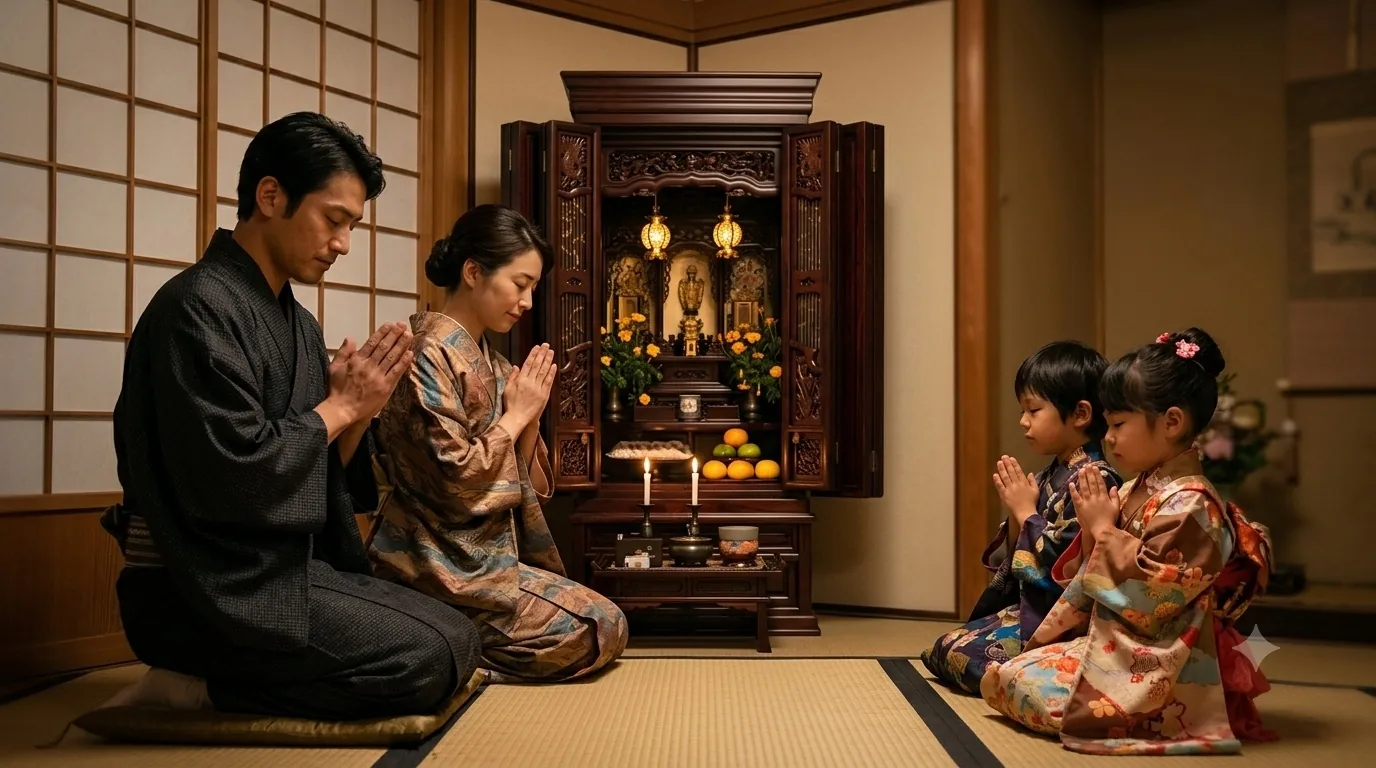 Japan folded the same duty into a household Buddhist altar — the butsudan. (AI illustration)
So what is Ji-ho actually standing in?
Not a five-hundred-year-old legal chain of custody with her name at the end of it. That is the most tempting sentence to write about this scene, and it is the one to give up, because it is doing three separate things at once and getting all three slightly wrong.
Here is the sturdier version. Jongbeop settled succession, and it did so unevenly and later than the folk chronology suggests. Inheritance law tilted toward the eldest son over about a century, then was replaced in the twentieth century by equal shares with one narrow ritual-property exception. The kitchen was assigned by gender norms that ran alongside the lineage rules rather than being generated by them. What Ji-ho meets at the door is the residue of all three, held in place now by nothing more legally binding — and nothing less socially effective — than a room full of relatives who expect it.
Which is, in the end, what the drama is actually about. Se-hee’s attempt to opt his household out is not a legal question. It never was.
Coming up next
One apron, handed over before the front door closed — and behind it a mulberry tablet replaced by a chestnut one, a Song-dynasty rulebook arriving in 1390, a court in 1580 protecting an adopted heir, a lineage’s grave land quietly paying for a rite, and four other traditions answering the same question differently. That is what a good domestic drama scene can carry, if you know which parts of it are institutions and which are habits.
In the next essay, we’ll take another K-drama scene that looks like pure fiction — and trace the real Korean history hiding underneath it.
Frequently asked questions
What is jesa, and how is it different from charye? Jesa (祭祀) is a broad Korean word for ritual offerings — not reserved for ancestors, and not only Confucian. In family life it refers to the ancestor rites: food offerings, incense, bows. Gijesa falls on the anniversary of a death; charye (茶禮) is, in contemporary practice, the comparatively simplified holiday rite performed at Seollal and Chuseok. In casual speech Koreans say “jesa” for all of it.
Why does the eldest son’s household usually host jesa? Because of jongbeop (宗法), the patrilineal succession framework organised around Zhu Xi’s Family Rituals, which specified which line holds the rites and passes them on. It is worth being precise about the date: researchers place the hardening of the eldest-son-centred pattern in roughly the mid-17th through mid-18th century — later than the founding of Joseon in 1392, which usually takes the blame.
Why do daughters-in-law end up doing the cooking? Not because jongbeop assigned it. Jongbeop settled ritual authority — who presides, whose line continues — and said nothing about the kitchen. The cooking came from a different stack: patrilocal marriage that moved a wife into her husband’s household, the expectation of service to parents-in-law, and a gendered division of domestic labour. The rite supplied the occasion; those three supplied the apron.
Does Korean law today still hand the estate to the eldest son? No. Under the Korean Civil Act, co-heirs of the same rank take equal statutory shares. The one narrow exception is ritual property — grave land, protected woodland around a grave, genealogical records and ritual implements — which passes to the person who presides over the rites. Since a 2023 Supreme Court decision, that person is determined first by agreement among the co-heirs, and where they cannot agree, priority runs to the nearest and eldest direct descendant regardless of sex, not automatically to the eldest son.
Is the daughter-in-law’s ancestral-rite labour shown in the drama still common in Korea? The drama is dramatising a real friction rather than inventing one, and the load has historically fallen on married women. But practice varies widely by household today — many families have simplified the rites, shortened the menu, moved them, shared the work, or stopped holding them. What the drama captures is the pressure, which is family expectation rather than legal obligation.
Sources & further reading
This piece was written from the historical script and fact-check of 사뚱샘의 역사방 (SaDDungSam). Where a source could not be verified to a specific stable address, it is cited by name only.
- Encyclopedia of Korean Culture (한국민족문화대백과사전) — 제사, 기제, 시제, 제례, 신주, 종법, 불천위, 상속
- National Institute of Korean History, 우리역사넷 — 「신주, 가상의 몸체」, 「종법이란 무엇인가」, 「조선시대의 종법」, 「가묘의 설치」, 「『가례』의 전래」, 「조선 초기의 상속제」
- 『선조실록』 선조 13년(1580) 10월 16일 기사 — the adopted heir’s vested ritual succession
- 『세종실록』 세종 9년(1427) 2월 10일 기사 — succession attaching to the household holding the shrine
- 《예기》 「곡례」 하 — the branch son informs the lineage heir
- 《속대전》 — later codification of adoption (입후) rules
- 대한민국 《민법》 제1008조의3 (ritual property) · 제1009조 (statutory shares)
- 국가기록원 (National Archives of Korea) — 「제사」
- Mark Edward Lewis, The Early Chinese Empires: Qin and Han, Harvard University Press, 2007
- Tian Tian, “Rethinking the Ancestral Shrines in the Early Empires,” Early China 45, 2022
- Helen Hardacre, on Japanese Buddhism and the household altar (Columbia University, Asia for Educators)
- Nanzan Institute for Religion and Culture, “The Development of the Temple-Parishioner System,” Japanese Journal of Religious Studies
- The Cambridge History of China — “The Emergence of the State of Vietnam”; Cambridge University Press, “Naming the Red River: Becoming a Vietnamese River”
- UNESCO World Heritage — Jongmyo Shrine; Korea Heritage Service (국가유산청) — 종묘·종묘제례
- Catechism of the Catholic Church — “The Communion of Saints”; Congregation for Divine Worship, Directory on Popular Piety and the Liturgy
Thanks for reading — see you in the next one.
This article was researched and written by K-Drama History. Source: Because This Is My First Life, Explained: Why Ji-ho Is Sent to the Kitchen During Jesa — K-Drama History