Brothers in 1627, Sovereign and Subject Demanded in 1636 — The War Before The Fortress, Explained
From the research behind Pause the Drama.
In The Fortress (남한산성), the camera does not leave the 47 days. The Qing army crosses the Amnok, the king and his court take shelter in a snowbound mountain fortress, and two men argue there through the winter: Choi Myung-gil (최명길), who wants the country kept alive at the price of humiliation, and Kim Sang-heon (김상헌), who wants the fight carried to the end.
Outside the wall there is a Qing commander who comes and goes with the demand for surrender — Yonggoldae (용골대). To the audience he is the face of an army that has just arrived. He was not new to the country. In the second lunar month of that same year he had been in Hanyang with Mabudae as a condolence envoy, and the Annals of King Injo record the court arguing with him over the letters he carried.
And nine years before the film’s winter, Joseon and the Later Jin had already fought a war and already sworn a peace.
The reckoning of 1636 was not the first time the court had to decide what to call these people. It was the second.
A note on what has and has not been checked. The sources behind this article come in grades. (1) Four entries of the Annals of King Injo were opened and collated directly for this English version: Injo 5/3/3, 14/2/24, 14/2/26 and 14/4/26. (2) Other entries of the Annals, and the passages cited from 『속잡록』 and the Veritable Records of Qing Taizong, are carried here as the Korean-language collation behind this article reports them; where only the presence of an entry was confirmed and not its wording, this article says so and does not quote. (3) The narrative frame comes from institutional reference works — the Encyclopedia of Korean Culture, published by the Academy of Korean Studies, and Urihistorynet, published by the National Institute of Korean History — and where those two disagree, the disagreement is left standing rather than merged. (4) Three Korean journal articles are cited from their KCI abstracts only; none of the full texts was read, and no argument here is attributed to them beyond what an abstract states. (5) For the film, this article works from publicly available title information, casting and synopsis. It does not collate the film scene by scene, and the film’s dramatic construction is not treated as a fact-checking target. (6) There is no filmed scene of the 1627 war to show. The illustrations below are AI images made for this article, not reproductions of any historical painting.
All right. Let’s unpack it.
The war the film starts nine years after
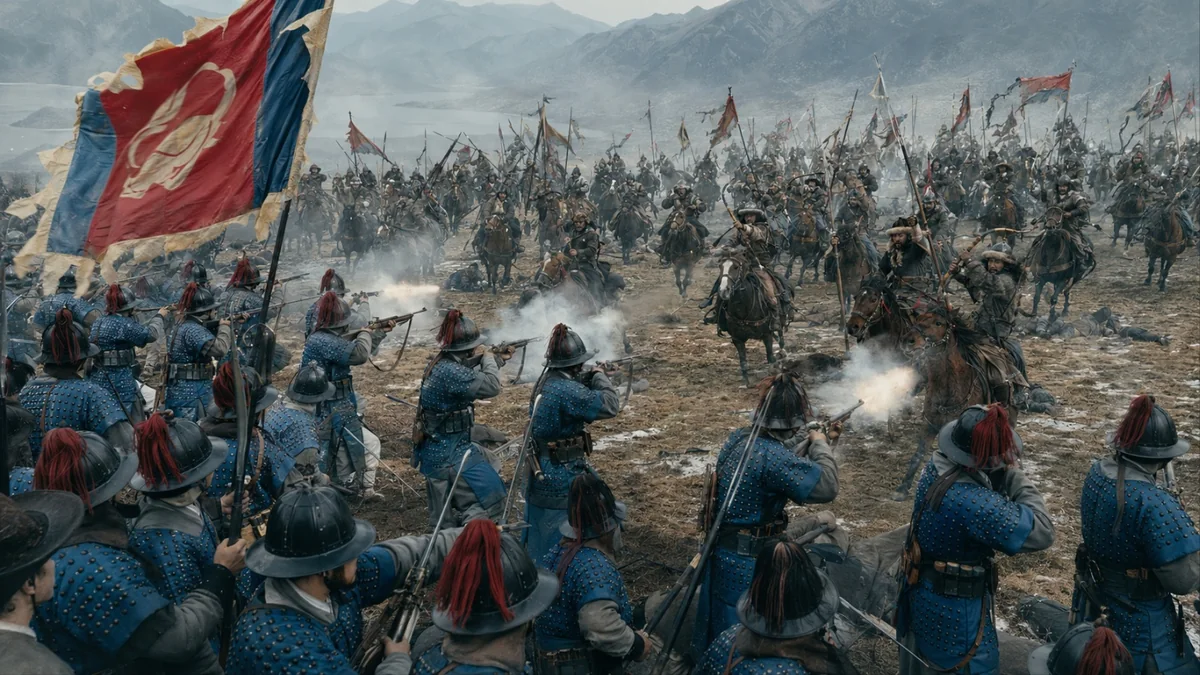
In the first lunar month of 1627, the Later Jin commander Amin (아민, 阿敏) crossed the Amnok at the head of a force put at around 30,000. The invaders set out seven charges against Joseon as their reason for coming. (These are charges framed against Joseon; they are not the Seven Grievances Nurhaci had earlier proclaimed against the Ming, and should not be read as that document.)
The demands were three: that land be ceded (割地); that the Ming commander Mao Wenlong (모문룡), garrisoned on the island of Ka-do, be seized and handed over; and that Joseon send 10,000 soldiers for the campaign against the Ming. The three appear together in 『속잡록』 under the second month of the jeongmyo year — 「一曰割地, 二曰捉給文龍, 三曰借兵一萬」 — which is a Korean record of the period reporting what was demanded, not the Later Jin’s own document.
The king went into Ganghwa Island. The crown prince Sohyeon went south to Jeonju. King and heir were put in two different places. The Later Jin force was built around cavalry, and the court appears to have judged that an island would buy time.
Nine years later that road is closed, and the film begins.
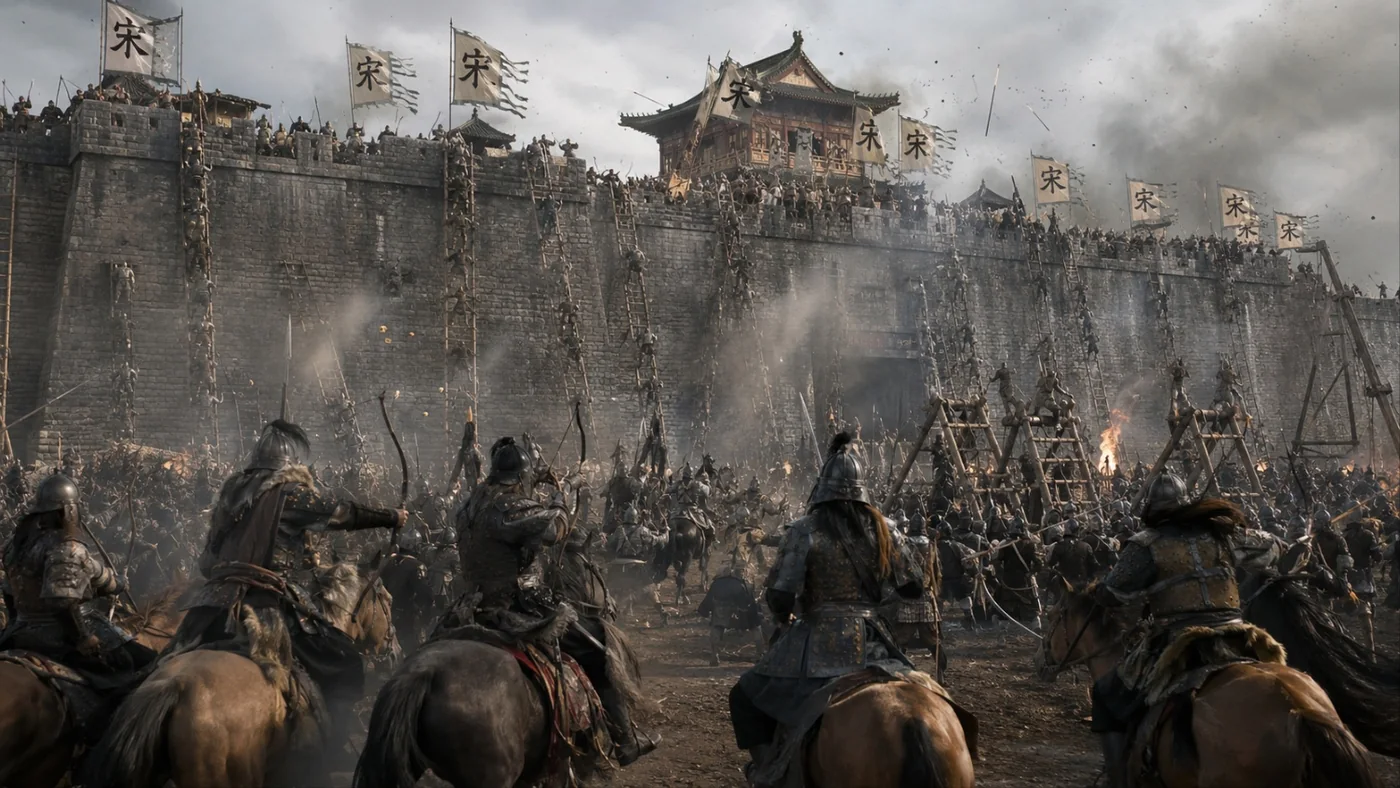
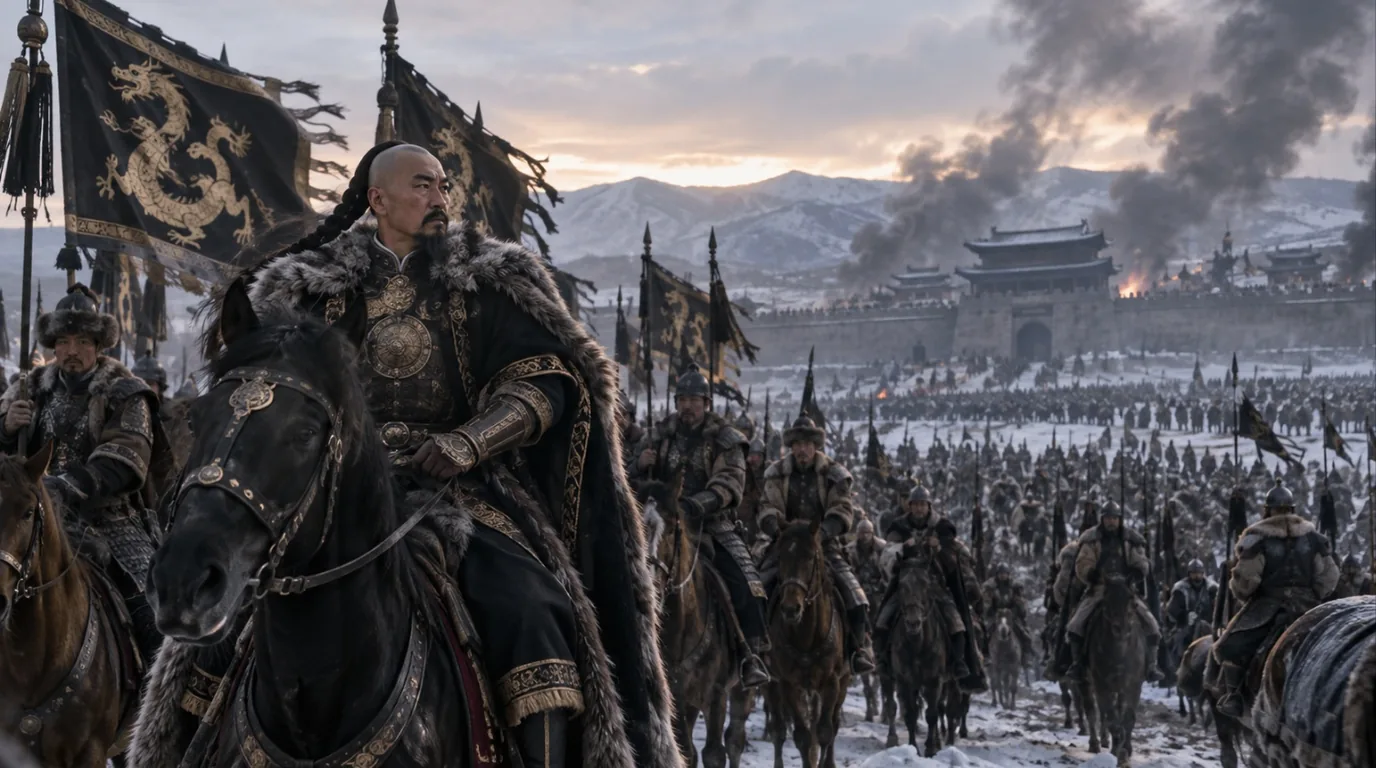 The war that ends two months later in an oath, and is almost never filmed. (AI illustration)
What the word “brothers” was made to carry
In the film, ministers fight through the night over a phrase in a document. The negotiation of 1627 was of that kind too.
The terms of the settlement are set out as four items in some sources and five in others. Urihistorynet’s account lists four; the Encyclopedia of Korean Culture’s entry on the 1627 accord (정묘약조) gives five, including an undertaking that the Later Jin army would not cross south of Pyongsan. The items common to both are these: that the two states swear a covenant of brothers; that the troops withdraw once peace was made; that neither state’s army cross the Amnok; and that Joseon, having made peace, would not act as an enemy to the Ming.
That last clause is the strange one. Joseon made peace with the Later Jin and kept its Ming relationship where it was.
Brothers, but with an order of precedence: in the documents the Later Jin sent, the Later Jin was the elder and Joseon the younger. That hierarchy is not only a later gloss. In the fourth lunar month of 1636, when the tone of the Qing letters had changed, Joseon officials complained in the Annals that the language now used had abandoned 「兄弟相敬之道」 — the way in which brothers show each other respect — and treated Joseon like slaves. The frame they were saying had been broken is the frame of 1627.
What the two sides actually pushed against each other over was not only the wording of clauses. Territory, the surrender of Mao Wenlong, the loan of troops, tribute goods, trade and the handling of people who crossed the border were all real issues in the exchanges — the Joseon state letter of the fifteenth day of the second lunar month takes up withdrawal, the river line and gifts in concrete terms. What was distinctively hard to settle, and what kept coming back, sat on top of those clauses: the rank of the relationship, what to do about the Ming, whose reign era a document would be dated by, and what the king’s own body would be made to do at the ceremony.
They could agree to stop the war. What they never fully settled was what that relationship entitled each side to demand from the other.
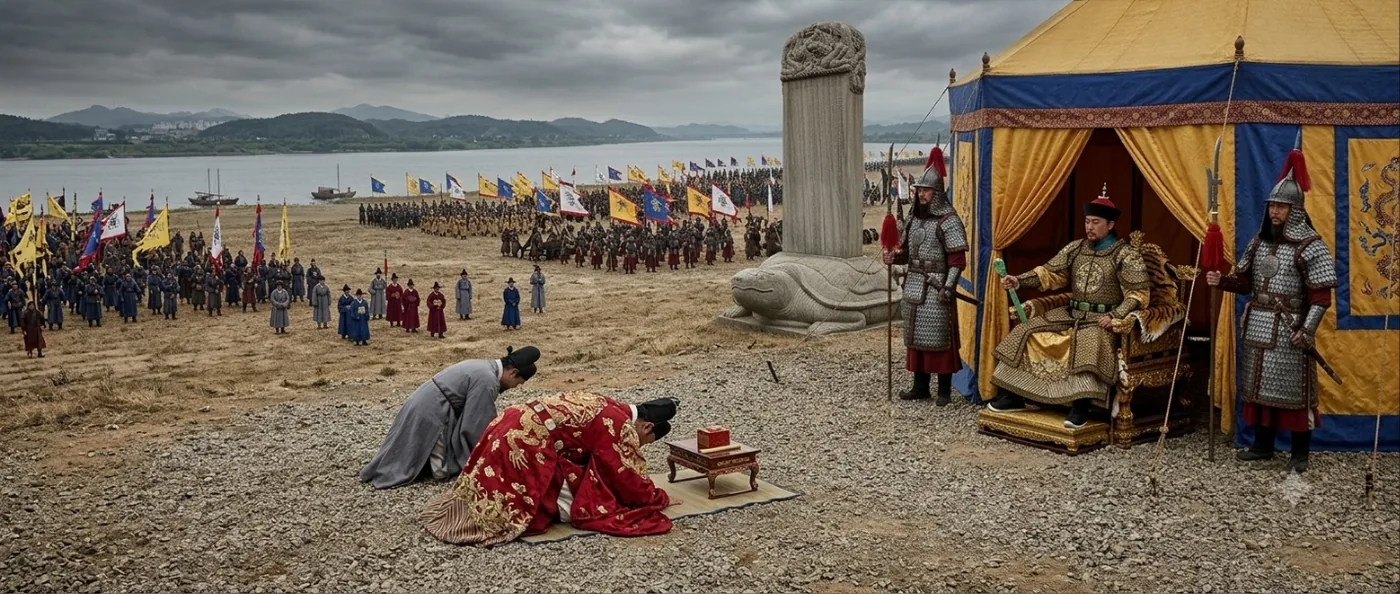
The night of the oath: what the king did, and what he did not do
Here a common shorthand needs pulling apart, because two ceremonies took place and they were not the same ceremony.
Under the third day of the third lunar month of Injo’s fifth year, the Annals record that that night the king went out into the great hall (대청) of the temporary palace, burned incense, and performed the rite of announcing to Heaven in person. Separately, the ministers — O Yun-gyeom, Kim Ryu, Yi Gwi, Yi Jeong-gu, Sin Gyeong-jin and others — went with the Later Jin envoy Yuhae to the oath altar (서단, 誓壇), where the Jurchens slaughtered an ox and a horse and took the blood and bone into vessels.
So the king did announce to Heaven, with his own hands, and he did it indoors. The slaughter and the blood covenant were carried out by ministers at a separate altar. Collapsing the two into a single picture of the king standing at a sacrificial altar outside the walls gets the location and the actor of the rite wrong.
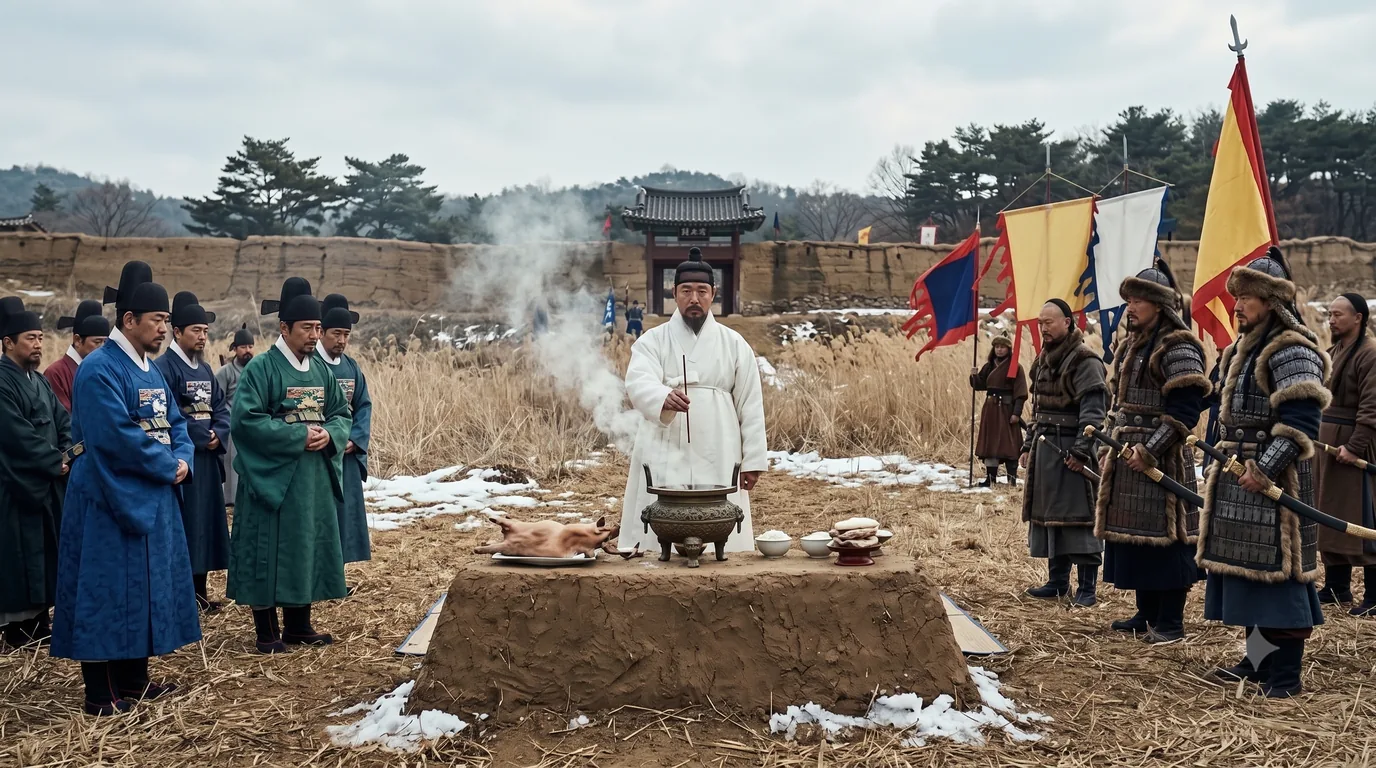 Two rites on one night, in two places, performed by two different sets of people. (AI illustration)
Urihistorynet’s entry on the war explains that the Later Jin wanted the king himself at the ceremony, and that the compromise reached was that Injo, being in mourning, went no further than burning incense. The burning of incense by the king is confirmed in the entry itself. The exact shape of the bargaining behind it — a demand that he bow, a refusal, incense accepted instead — is an institutional explanation that this article has not matched against the original negotiation record, and it is repeated here at that strength and no higher. Read against what Injo would be made to do at Samjeondo nine years later, it is suggestive. It is not a collated quotation.
Two more things about that document and that day. The oath text drawn up at Ganghwa dated itself by the cyclical year — this jeongmyo year, such a month, such a day — and used neither the Ming reign era nor the Later Jin’s. And the word “brothers” being attested in the negotiation documents and in both sides’ later understanding of the relationship is not the same as the claim that the final Ganghwa oath text itself contains the word; this article makes the first claim, not the second.
The Later Jin had demanded a prince as hostage. Joseon raised the royal kinsman Gu (구, 玖) from Wonchang-burye to Wonchang-gun and sent him in the character of the king’s younger brother. He was not the king’s brother. Urihistorynet records that Yi Hong-mang was sent with him, styled as a high minister.
In the fourth month the court returned to Hanyang.
Choi Myung-gil, standing in the same place for the second time
The film puts two men at its centre, and the audience meets Choi Myung-gil at the cliff edge, choosing reality over righteousness.
He had stood there before.
At Ganghwa in 1627, with no one at court willing to be the first to say the word, it was Choi Myung-gil, then a second minister, who argued for terms and turned the court’s direction — this is the Encyclopedia of Korean Culture’s account in its entry on the 1627 accord, and the Annals for the second lunar month of that year record him active in the negotiations.
The Choi Myung-gil of the fortress was not arguing for accommodation for the first time. He was standing in the same place for the second time.
What that fact will carry, and what it will not: it establishes that 1636 was not his first argument for peace. It does not establish that his thinking stood still for nine years, and no evidence for that was established here. Nine years later he again argued for terms, and the demand facing him had become far more steeply hierarchical than the one he had answered at Ganghwa.
When did that war actually end?
Peace was formally concluded on the third day of the third lunar month. The withdrawal of the troops took months longer, and the official accounts do not put the same date on it.
Urihistorynet’s detailed survey account (the page titled 「3) 의병의 활약」) has the Later Jin troops who stayed behind at Uiju withdrawing in the eighth month. Urihistorynet’s own entry on the war states that the remaining units did not pull out until the ninth month. And the Annals, under the twelfth day of the ninth lunar month of Injo’s fifth year, carry a report of the withdrawal of Takdori’s party from Uiju.
These are not two competing dates for the end of a war. They are one agreement made in the third month and a withdrawal that ran on for months after it, described differently by different official accounts. This article leaves the difference standing.
The things the covenant had not written down — how much would be sent in goods, where a market would be opened, what would be done about people who fled across the border — went on being negotiated afterward. Chae Hong-byeong’s 2021 study takes up the problem that the 1627 covenant is divided between a Ganghwa oath and a Pyongyang oath and that what those two documents actually were has not been established. This article has read that far in the abstract and no further; whether the contents of the two documents differed is not something it can say.
What moved between brothers
Once the fighting stopped, goods began to move. Joseon sent tribute goods (세폐, 歲幣), and a market was opened at Junggang (중강) on the Amnok, across from Uiju — not at the river’s mouth. The Encyclopedia of Korean Culture records the tribute goods and the opening of the Junggang market as the economic gains the Later Jin took from this war, and institutional accounts describe trade with the Later Jin being carried on at Junggang and at Hoeryong from 1628.
For the Later Jin this was a channel for grain and supplies. For Joseon it was the price of postponing the next invasion. But the amounts and the items were not nailed down in the covenant. The Later Jin asked for more; Joseon tried to reduce or delay. Friction over tribute, over trade, and over how far the covenant reached grew especially sharp in the 1630s, according to Chae’s abstract.
Joseon, for its part, appears to have taken the relationship inside an older frame — reading it in the manner of gimi (기미), the loose rein held over a neighbouring power, while holding to the principle that its relations with the Ming stayed in place. That reading is an interpretation carried here from the Korean-language collation behind this article, not a phrase quoted from any entry collated directly for this version. The Later Jin, looking at the same arrangement, saw a country already inside its own order.
And the north had never been fully settled. After the Later Jin column moved south, Jeong Bong-su (정봉수) and Yi Rip (이립) led righteous armies in resistance in the northern provinces. One line of explanation counts that unsettled north among the reasons the Later Jin was in a hurry to conclude terms.
How brother became sovereign and subject
Queen Inyeol died in the twelfth lunar month of 1635. In the second lunar month of 1636 the condolence envoys arrived: Yonggoldae and Mabudae.
What they brought needs to be kept separate, because the film’s audience — and a good deal of summary writing — folds it into one document.
Under the twenty-fourth day of the second lunar month, the Annals record three letters from the khan: a spring greeting, condolences for Queen Inyeol, and a list of ritual offerings. With them came separate sealed letters — one from the eight banner lords (팔고산), one from the Mongol princes of the outer domains — both marked as respectfully presented to the king of Joseon. What those separate letters asked was that Joseon take part in elevating the khan to emperor. Joseon officials refused to receive them, on the ground that there is no rule by which subjects send letters to the ruler of another state; the envoys protested that the khan had named Joseon a brother state and that a brother state should therefore take part, and threatened to leave the next day with horses or without them.
Two days later, under the twenty-sixth, Choi Myung-gil reports on the same business and says of the khan’s own letter: 「汗書亦無別語」 — the khan’s letter contains nothing out of the ordinary. The offence lay in the other letters.
Then the accident. A secret instruction from Injo to the governor of Pyongan Province, ordering a hard line against the Later Jin, fell into the hands of the departing envoys. What Joseon was preparing inwardly went straight across the table.
That year Hong Taiji took the imperial title and changed the name of the state to Great Qing. The two dates that circulate for this are not two rival accounts: the eleventh day of the fourth lunar month of 1636 is the fifteenth of May in the Western calendar, one event in two calendars. (For the same reason the year appears as Tiancong 10 in records made before the change and Chongde 1 after it. That is a change of reign era, not a contradiction.)
The Joseon envoys sent to the ceremony, Na Deok-heon and Yi Gwak, refused to perform the rite of a subject state.
And under the twenty-sixth day of the fourth lunar month, the Annals record what the letters coming from the other side now said: the sender styled himself 「大淸皇帝」, the Great Qing Emperor, and called Joseon 「爾國」 — your country. The report entered there states that the letter’s reproving language had given up 「兄弟相敬之道」, the way in which brothers show respect, and looked on Joseon as one looks on slaves.
The change was a change of nouns, and the nouns were the relationship.
On the first day of the twelfth lunar month a force of 120,000 — Urihistorynet’s entry on Injo breaks it down as 70,000 Qing, 30,000 Mongol and 20,000 Chinese troops — was assembled at Shenyang. The Veritable Records of Qing Taizong place Hong Taiji’s own departure on the second day. Assembly and departure are better kept on their two days than merged into one.
Where the film and the record part
The film keeps the nine years off screen in order to hold the 47 days. That is a choice, not an error, and this article has no production statement explaining why it was made.
What the choice costs the audience is the staircase. In 1627 the relationship was brothers; in 1636 the demand was sovereign and subject. The demand did not arrive all at once. It climbed.
And the man outside the wall was a known quantity. Yonggoldae had been in the capital that spring arguing with the court over a sealed letter.
On screen, 1627 is thin. A search of Korean film and drama material turned up no work treating the Jeongmyo horan head-on — but that search was not exhaustive, and MBC’s 500 Years of Joseon: Namhansanseong (조선왕조 500년 남한산성, 1986–87) exists and takes Injo’s reign as its subject. How much of the 1627 war that series actually depicts was not verified here, and this article therefore does not claim that nothing covers it.
Kang Hong-rip, and the story people told afterwards
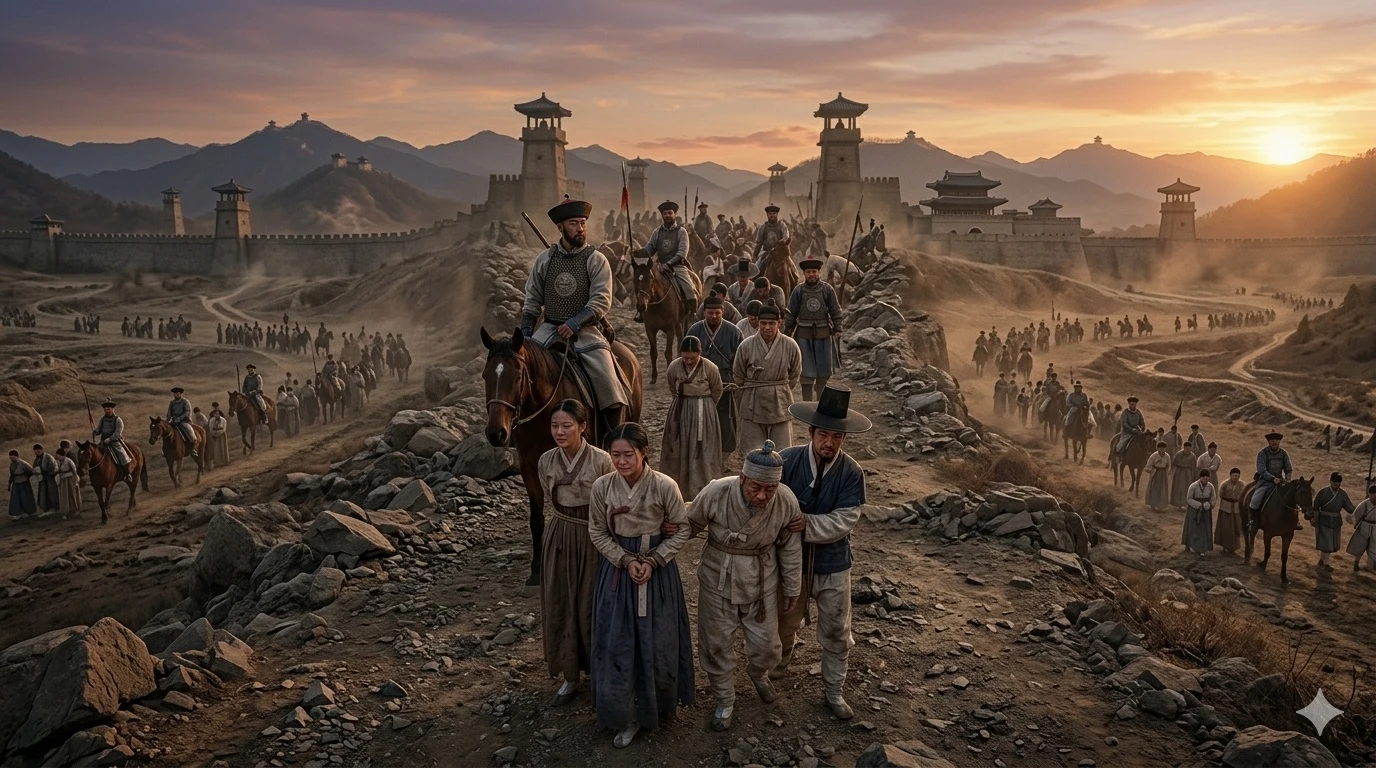
There is one more strange figure in this war. Kang Hong-rip (강홍립) had gone out in 1619 to help the Ming and had surrendered to the Later Jin. The Encyclopedia of Korean Culture states that he did so under a secret instruction from Gwanghaegun to watch the situation and decide his allegiance accordingly — an attribution worth keeping as an attribution, since recent work reconsiders how simply that “secret order” can be read as an order to surrender. His rank was stripped at court; the Annals of Gwanghaegun show Ming suspicion, the statements of returnees, repeated demands from the Border Defence Council and the king’s withholding of punishment all in play, so the stripping cannot be laid to one cause.
Held in the north, he came back into Joseon in 1627 with the Later Jin army and was involved in the peace negotiations at Ganghwa. The Encyclopedia of Korean Culture describes him as having guided the invading force; the Annals have him giving his own account of how he came to be travelling with it, and recent scholarship examines separately how the charge of having led the enemy in was formed at the time. Calling it an established military act of guidance goes further than the records support.
He died that year. On whether his rank was restored before or after his death the institutional accounts differ: the Annals under the twenty-fifth day of the third lunar month of Injo’s fifth year record Injo ordering that his rank and title be restored while he was alive, while the Encyclopedia of Korean Culture’s entry on him sets the restoration after his death. Until the actual execution of that order is traced through the subsequent record, neither version should be picked.
Three years later, in 1630, Gwon Chik (권칙, 1599–1667) wrote the classical Chinese-language novel Kangnojeon (강로전, 姜虜傳) — “The Tale of the Kang Barbarian.” Its Kang Hong-rip urges Nurhaci to attack Liaodong, forgets his country for love of a Han Chinese woman, and in the end presses Hong Taiji to threaten Joseon. The Encyclopedia of Korean Culture’s entry states that most of what the work depicts diverges widely from the facts, and locates the reason for so hostile a portrait in the ideology of revering the Ming and rejecting the Qing. Five variant texts survive.
Two wars in nine years were probably a shock that demanded an explanation, and when an explanation does not come, people look for a traitor. That last sentence is a reading, not a finding.
Has this happened elsewhere?
One peace failing to prevent the next war is not a Korean peculiarity. Two comparisons, kept at the strength the sources allow.
Goryeo and the Mongols. In 1219, after putting down a Khitan force together, Goryeo and the Mongols swore what the records call a covenant of brothers. It is the same word. Mongol demands for tribute grew, the relationship broke down, and war began in 1231, with the killing of the envoy Jeogoyeo taken as the pretext. Attaching a justification to an invasion is a procedure the Later Jin’s seven charges share. When Kaegyeong was besieged in the twelfth month of that year, Choe U pursued terms, and the Mongol army withdrew in the first month of the following year. The price included the stationing of 72 darughachi in the northwest — the number 72 appears in the records and institutional accounts, but the number of walled towns they were placed in varies between sources, and Yi Ik-ju’s 2018 study (abstract only) distinguishes the initial agreement from the installation of darughachi and the levies demanded after the withdrawal. So it is safer not to fix all of it to the moment of the first agreement. In any case the demands did not stop: troop levies were added, then a demand that the king come in person and that the population be counted. Goryeo broke off negotiating and moved to Ganghwa Island. Urihistorynet’s account states that Choe U already had resistance in view at the time he was pursuing terms.
Demands climbing by stages, a court withdrawing to an island, war returning. Four centuries later the shape recurs. That is as far as it can be taken: the same phrase was used and the same choice appears twice. Whether the 1219 covenant of brothers and the 1627 covenant of brothers were the same institutional concept has not been established here, and it should not be read as a law of repetition.
The Qing and Britain. The first Opium War, begun in 1839, ended with the Treaty of Nanjing in 1842. Friction over the treaty’s working followed, and in the mid-1850s Britain, seeking wider commercial rights, found a pretext and reopened the war; the second war’s terms were heavier than the first’s. The structure rhymes, but the object of the fight does not. There the disputed thing was the clauses of a treaty.
Joseon’s fight was not only over clauses. Elder or younger, emperor or khan, the king bowing or the king burning incense — the name of the relationship came before the contents of the document. So when the Qing changed the names — Later Jin to Qing, brothers to sovereign and subject — there was nothing in the earlier agreement that could absorb it.
Back to the fortress
At the end of The Fortress, Injo walks out through the gate, and the audience watches the formal submission the film has been moving toward.
But that king had already stood once before at a rite of announcing to Heaven, nine years earlier, on an island. That night he burned incense in a hall, and his ministers went out to the altar in his place.
They agreed on the words. They did not agree on what those words would mean.
Two states put two different meanings inside one word, and the gap did not narrow in nine years. The question deferred in 1627 came back in 1636. By the time the film begins, a good deal of the answer had already been written.
This article was researched and written by K-Drama History. Source: Brothers in 1627, Sovereign and Subject Demanded in 1636 — The War Before The Fortress, Explained — K-Drama History