Why Did Silla Turn on Jang Bogo? Cheonghaejin and What the Records Actually Say
Theme: Power & Politics
From the research behind Pause the Drama.
Emperor of the Sea runs for 51 episodes on KBS2, from November 2004 to May 2005. It begins with a boy on an island in Cheonghae — present-day Wando, off Korea’s south-western coast — and the official episode listing describes him being caught trying to escape by ship to Tang China and bargaining for his life.
The records tell you where that boy ends up before the drama does. He becomes the man who holds Silla’s sea lanes. He helps replace a king. And then he is killed by a man the court sent.
That man’s name was Yeomjang. The drama builds a character around him. The sources do not: he appears near the end, with no explanation of who he was before, volunteers for the job, and does it.
Which leaves a question the drama’s 51 episodes are really about. Why did Silla kill the man it had appointed?
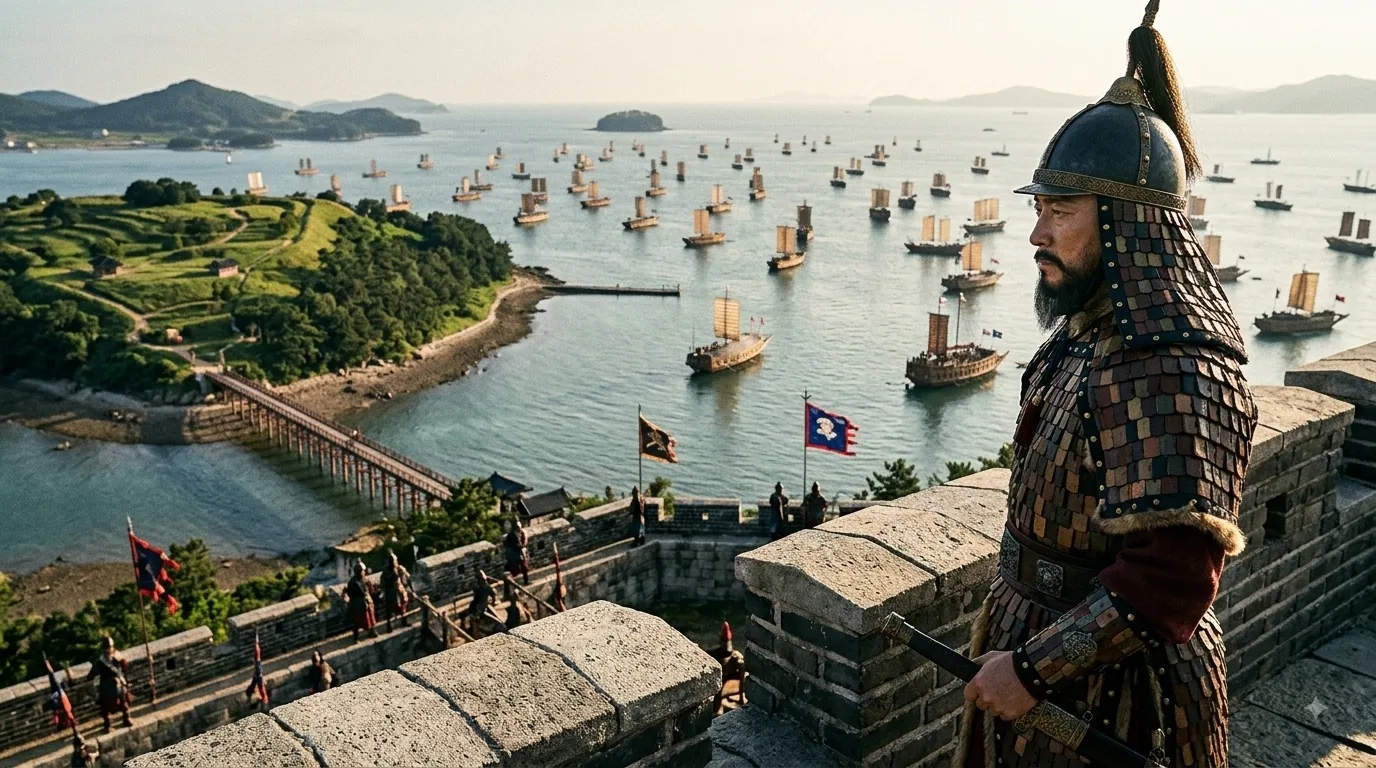
Cheonghaejin stood on Jangdo, a small island off Wando. Excavations between 1991 and 2001 found an earthen rampart, a timber palisade along the shore, and building platforms on the summit. This is an illustration, not a reconstruction drawing. (AI illustration)
Quick answer: In 828 a man returning from a military career in Tang China petitioned King Heungdeok for a garrison at Cheonghae (Silla Annals, original text) — today’s Wando — so that raiders could not seize Silla people and sell them westward as slaves. The king agreed and made him commissioner (daesa), a title that did not exist in Silla’s regular system. Silla did not conjure him out of nothing. He arrived with a Tang military record and connections among Silla communities in China; the court then gave that experience an institutional base at Cheonghaejin, with the authority and the men to hold it. In 839 he helped put King Sinmu on the throne. Then the court blocked his daughter’s marriage to the next king on the grounds that his birth was too low, and a man named Yeomjang went to Cheonghaejin under a false defection and killed him. The Samguk Sagi dates that to 846; a Japanese chronicle dates it to November 841. Modern annotation in the Korean History Database judges the Japanese chronology the more likely of the two, and this article keeps both. Separately — and this is a different disagreement, not the same one — the twelfth-century compiler explicitly preserved two conflicting accounts of Jang Bogo’s part in the events of 839 rather than choosing between them. In 851 the garrison itself was abolished and its people moved inland. And there is a consequence the popular retelling never mentions: if the 841 date is right, the Samguk Sagi’s placement of the refused marriage in 845 (original text) and the killing in 846 (original text) cannot both stand. The database annotation therefore raises the possibility that the whole sequence was entered under the wrong years. The sequence may well be old; its dates are not secure.
Let’s unpack it.
The raiding in this story included slave-taking
Start with the word, because it misleads.
“Pirate” in English carries chests of coin and boarding actions over treasure. That is not what the ninth-century Yellow Sea was about. The raiders in these waters dealt in people.
The Samguk Sagi’s biography of Jang Bogo records his petition to the king in direct speech. In the National Institute of Korean History’s translation, he tells King Heungdeok that having travelled throughout China he found the people of his own country being held as slaves, and asks for a garrison at Cheonghae so that raiders could not seize people and carry them off to the west.
West means Tang China. People were among the cargo.
Urihistorynet, the National Institute of Korean History’s public reference service, describes the same period from the Silla side: raiders in the early ninth century cut the sea routes, plundered trading ships bound for Tang, paralysed the grain shipments that fed the capital, and struck the south-western coast to seize Silla people and sell them as slaves across Tang territory. The state, it adds, looked for ways to suppress them and could not — because central control over the provinces had weakened and the military had become an institution in name.
So the problem was real and the state had already failed at it. That matters for everything that follows.
One caution belongs here, and it is not a small one. The slave-raiding rationale reaches us through a particular channel. It is in the biography in volume 44 — and the Korean History DB’s annotation states plainly that this biography is taken almost verbatim from the account by the Tang poet and official Du Mu, in his collected works, and that its contents are sparse and contain errors, so that its value as a historical source is hard to call high. The same annotation goes further: the compiler of the Samguk Sagi, it says, consulted no domestic transmitted material at all when writing this biography.
The Silla Annals entry for 828 records the founding of the garrison and the command granted. It does not record the petition about slaves.
This is not a reason to throw the rationale out — the National Institute of Korean History adopts it, and cites Du Mu by name for the outcome, quoting the report that after the Taehe era (828–835) the seizing and selling of Silla people at sea vanished entirely. It is a reason to be honest about the shape of the evidence. The most quoted sentence about why Cheonghaejin existed comes from a Chinese man of letters, not from Silla’s own chronicle.
What the king actually granted
The Silla Annals put it in the fourth month of 828. The court approved the garrison, appointed Gungbok — Jang Bogo’s Korean name — as daesa (大使), commissioner, and gave him command of ten thousand troops.
Two things about that sentence deserve slowing down for.
First, the title. The Korean History DB’s annotation notes that daesa was not part of Silla’s regular official system. The comparable garrison at Paegang had a commander with an ordinary Silla title. Urihistorynet suggests the borrowing was from Tang, where regional military governors were sometimes addressed as daesa — which is to say the court reached outside its own vocabulary to name what it was doing.
Second, the ten thousand. This is the number that turns into “Jang Bogo’s private army” in popular accounts, and it is exactly where a modern reader should stop. Urihistorynet is openly sceptical that ten thousand soldiers were ever actually handed over, on the grounds that Silla at that moment had no capacity to detach such a force. Its reading is that some provincial troops were transferred and the rest had to be raised and trained by Jang Bogo himself, and that the figure of ten thousand should be understood as the ceiling on the force the commissioner of Cheonghaejin was entitled to command — an authorisation, not a delivery.
The same article suggests that in the early period he may have put his own money into running the garrison, since state finances could not have covered it.
Put those together and the shape of the arrangement appears. Silla did not build this. Silla permitted it.
He already had an organisation, and it was not in Silla
What he brought to that meeting was not only ships.
Jang Bogo and his contemporary Jeong Nyeon had gone to Tang and risen to junior general in the Wuning Army — a command in a Tang regional force. The Korean History DB gives that as Muryeonggun sojang (武寧軍小將); Urihistorynet renders the rank as gunjung sojang. Either way: he had held a commission in the army of the empire next door.
Around the Shandong peninsula there were Silla wards (Sillabang) — settled communities of Silla people in Tang territory, with their own temples. The best known of those temples is the Chishan cloister at Chishan village, a foundation associated with Jang Bogo.
What survives about that place comes from a third country. The Japanese monk Ennin (圓仁), travelling in China between 839 and 847 on a pilgrimage in search of the Dharma, wintered at a monastery in Shandong run by Korean monks, and his diary is one of the principal sources for Jang Bogo’s world; the Korean History DB lists its volume 2, for the sixth month of 839 and the second month of 840, among the key records on him. Silla people in Tang helped Ennin arrange his travels.
Read together, the holding was this: a Tang military record, a diaspora society inside Tang, and the religious institution that society used. None of it was granted by Silla.
Urihistorynet describes the commercial network that grew on top: trading bases running from Chishan harbour on the Shandong peninsula through Chuzhou and Lianshui on the Huai to Yangzhou, linked back to Cheonghaejin. Trade missions to Japan were called hoeyeoksa and operated with the acknowledgement of the Dazaifu and the Japanese court. Demand there ran hot enough that in 831 the Japanese court issued instructions restricting the trading activity of Silla merchants — and, Urihistorynet notes, local officials nevertheless broke the rules to pay Jang Bogo’s fleet in advance for goods.
What Silla added was an official base and a mandate inside its own waters. How much of the organisation he brought with him, and how much the state supplied, the sources do not let us divide cleanly.
One thing we could not confirm. Founding dates for the Chishan cloister circulate — 823 in some accounts, 824 in others — along with figures for the estate that supported it. We could not verify any of them against a documentary source, so this article does not claim the temple predates the garrison, and gives no figure for its lands.
The garrison that is still in the ground
There is a third kind of evidence in this story, and it is the only kind that cannot contradict itself.
Cheonghaejin stood on Jangdo, a small island in front of the village of Jangjwa-ri, about six kilometres north of Wando town. The National Research Institute of Cultural Heritage excavated it for the county between 1991 and 2001, and Urihistorynet summarises what came out:
- an earthen rampart running roughly 890 metres, rammed-earth construction in as many as eighteen compacted layers, doubled at the south-western entrance;
- a timber palisade along the shore — a trench eighty centimetres deep with pine and oak posts about forty centimetres thick set close together, running 331 metres. Radiocarbon dating of sampled posts returned a central date in the early to middle ninth century;
- building platforms on the summit, some post-built, some on stone footings;
- a ritual deposit: a pit with a large jar at the centre, surrounded by flask-shaped vessels, iron cauldrons, iron trays and a bronze bottle, mostly ritual ware, undisturbed.
That last one closes a small loop. The Samguk Sagi records a state sacrifice being performed at Joeumdo in Cheonghaejin. The deposit is consistent with that record.
The island is now Historic Site No. 308.
839: he makes a king
Here the story stops being about trade.
Silla in the 830s was in a succession war. Kim U-jing, pushed out of the contest, came to Cheonghaejin. What happened next is told two ways, and the difference is not decorative.
The Silla Annals version. Kim U-jing, with Jang Bogo’s help, entered the capital, killed King Minae, and took the throne as King Sinmu in 839. Sinmu died within months, and his son succeeded as King Munseong. In the Silla Annals, Sinmu enfeoffs Jang Bogo as gamuigunsa with a fief of two thousand households.
The biography version. Jang Bogo detached five thousand of his soldiers and gave them to Jeong Nyeon, took his hand and wept, and said: if not you, no one can put down this disaster. Jeong Nyeon went into the capital, killed the rebel, and set up the king. Then the king summoned Jang Bogo and made him chief minister, with Jeong Nyeon sent to hold Cheonghae in his place.
Same year, same event — and a different man goes in, and Jang Bogo receives a different office.
The Korean History DB does not leave this implicit. Its annotation states directly that the Silla Annals contain no account of Jang Bogo being summoned to the capital and made chief minister, and that according to the Silla Annals what he received was the gamuigunsa title and the fief. It concludes from this that Jang Bogo stayed at Cheonghaejin.
And here is the part that makes this article’s argument. Kim Bu-sik, compiling in the twelfth century, saw the contradiction and wrote it down. His note begins: this differs considerably from the traditions of Silla — and he keeps both accounts rather than deleting one.
Why he was working from Du Mu at all, the database also explains. Its annotation reasons that the compiler passed over the Silla Annals and domestic transmitted material and built the biography from Du Mu and the New Book of Tang because those Chinese texts recorded that Jang Bogo’s courage and generosity had been widely praised in China — and it points to a line in the Kim Yu-sin biography where the compiler says that but for the records of China, such things would all have vanished and gone unknown.
Sit with that. A man Silla treated as a traitor, and whom Goryeo had largely forgotten, survives in the Korean record because a Chinese poet wrote about him.
The marriage, and the killing
King Sinmu had promised a marriage. His son was to take Jang Bogo’s daughter.
It did not happen, and the sources say why. The Samguk Yusa records the courtiers’ objection in direct speech: Gungpa is of low origin, so it is not permissible for the king to make his daughter a royal consort.
Be exact about the position. The Korean History DB describes what was intended as second consort, not principal queen — and the same annotation notes that in the third month of 842 the king took the daughter of Kim Yang as a queen instead.
Silla’s ranked-birth system is the background here, and it is a subject in its own right: how bone rank set the ceiling on office, marriage and even dress is the frame within which “low origin” was a sufficient argument in a royal council. No surviving code lists permitted spouses grade by grade, but the objection recorded here is exactly the kind of thing that system produced.
Then the Silla Annals, under the spring of Munseong 8:
Gungbok of Cheonghaejin, resenting that the king had not taken his daughter, based himself on the garrison and rebelled. The court, fearing an unforeseeable calamity if it moved against him and unable to pardon the offence if it did not, did not know what to do.
A man of Muju — the province centred on present-day Gwangju — stepped forward. His name was Yeomjang, and he was known for boldness. He told the king: I will not trouble a single soldier; with my bare hands I will cut off Gungbok’s head and present it.
He went to Cheonghaejin pretending to have turned against the state. In the record’s own words, Gungbok valued strong warriors, and so received him without suspicion or reserve as an honoured guest, and drank with him with great pleasure. When Jang Bogo was drunk, Yeomjang took his sword, cut off his head, and then gathered his followers and talked them into submission.
There is a detail worth keeping. In the Japanese chronicle Shoku Nihon Koki, the same man’s name is written with a homophonous character — Yeomjang (閻丈) rather than 閻長 — and he appears there as the governor of Mujinju who put down a subsequent revolt at Cheonghaejin.
Notice what the Korean record does and does not supply. It gives the sequence: the marriage blocked, the resentment, the volunteer, the killing. It does not give the court’s internal deliberation. This article does not convert that sequence into a motive.
The year of his death is two years
And now the flat contradiction the manuscript behind this article refused to smooth over.
The Samguk Sagi’s Silla Annals date the killing to 846. The Korean History DB titles the entry accordingly.
The Japanese Shoku Nihon Koki, volume 11, under the first month of Jowa 9 (842), records that Silla envoys including Yi So-jeong came to Japan and reported that Jang Bogo had died in the eleventh month of the previous year — 841.
Five years apart, for the same man.
The Korean History DB’s annotation lays the gap out and then does something worth reporting precisely, because it changes the balance: it judges the Japanese record to be the accurate one. Its reasoning is a third document — Ennin’s diary, volume 4, which places a former Cheonghaejin officer, Choe Hun, in exile at Lianshui in China in the seventh month of 845, having fled a national calamity. On the Silla Annals’ dating, Jang Bogo would still have been alive then.
The annotation also points to the marriage: the king took Kim Yang’s daughter as queen in 842, which fits an 841 death better than an 846 one.
So where does that leave a reader?
The state institutions are not saying one thing. Urihistorynet’s Cheonghaejin article writes flatly that the garrison’s standing collapsed when Jang Bogo was assassinated in 841. The Korean History DB’s annotation reaches the same conclusion. The Encyclopedia of Korean Culture still heads its entry on him with 846, and school materials have generally followed the Samguk Sagi.
This article therefore does two things at once, and they are not in tension. It reports both dates, because both are in the sources. And it tells you where the weight sits, because pretending the question is evenly balanced would be its own distortion.
851: the post is abolished rather than filled
In the second month of 851, the Silla Annals record five words of consequence: the court abolished Cheonghaejin and moved its people to Byeokgol-gun — present-day Gimje in North Jeolla, called by an older name than the one it had carried since the eighth century.
Twenty-three years from foundation to abolition.
No number of people is given. Figures in the range of a hundred thousand circulate in popular accounts; we found no documentary basis for any of them, and give none.
It is tempting to read this as the state deciding that no one should hold that position again. That reading is available, but it is a reading, and there is a competing one in the record’s own apparatus. The Korean History DB’s annotation observes that on either dating the garrison outlived Jang Bogo by years — five on the Japanese chronology, ten on the Silla one — and notes a proposal that Yeomjang’s faction took control of Cheonghaejin after the killing, which would make the 851 abolition an action against that faction rather than a delayed verdict on Jang Bogo.
What can be said without choosing: the seat on the sea was not passed to a successor. It was closed, and the people who had manned it were moved a hundred kilometres inland, away from the water.
Drama vs. real history — how much does Emperor of the Sea embellish?
A note on the limits of this table. We were able to check the drama’s premise, cast, run and source novel, but not its scene-by-scene content or how it handles its ending. Where we could not check, we say so rather than guessing.
| Emperor of the Sea | The record |
|---|---|
| Gungbok begins as a slave in Cheonghae | The biography says only that his home district and his father and grandfather are not known. The later objection to the marriage is that his birth was low, not that he had been a slave. The slave origin is the novel’s and the drama’s |
| Yeomjang is a major antagonist with his own arc | In the sources he arrives at the end, with no background: a man of Muju known for boldness who volunteered. How the drama fills that silence, we could not verify |
| Jami-buin, Jeonghwa and the other principal women | Inventions of the drama and Choi In-ho’s novel. Not subject to fact-checking |
| The king appoints him to take command of the sea | Closer to the reverse. He petitioned, and the court ratified an organisation he had built outside Silla |
| A private army of ten thousand | The number is in the record; Urihistorynet reads it as the ceiling on what the post could command, not a force delivered |
Key terms. Cheonghaejin (청해진, 淸海鎭) — the maritime garrison on Jangdo off Wando, 828–851. Daesa (대사, 大使) — “commissioner”, the title given to Jang Bogo; the Korean History DB notes it was not part of Silla’s regular official system. Gungbok (궁복) / Gungpa (궁파) — his Korean name; “Jang Bogo” appears to be the name he used in China, and Japanese records write it 張寶高. Gamuigunsa (감의군사) — the title the Silla Annals say King Sinmu gave him, with a fief of two thousand households. Jinhae janggun (진해장군) — “General Who Pacifies the Sea”, the title the Korean History DB says King Munseong gave him along with ceremonial robes; the database interprets this as conferring authority to conduct foreign dealings without the king’s prior approval — an interpretation, not a sentence in the source. Hoeyeoksa (회역사) — the trade missions his fleet sent to Japan.
Three ways maritime power could relate to political authority
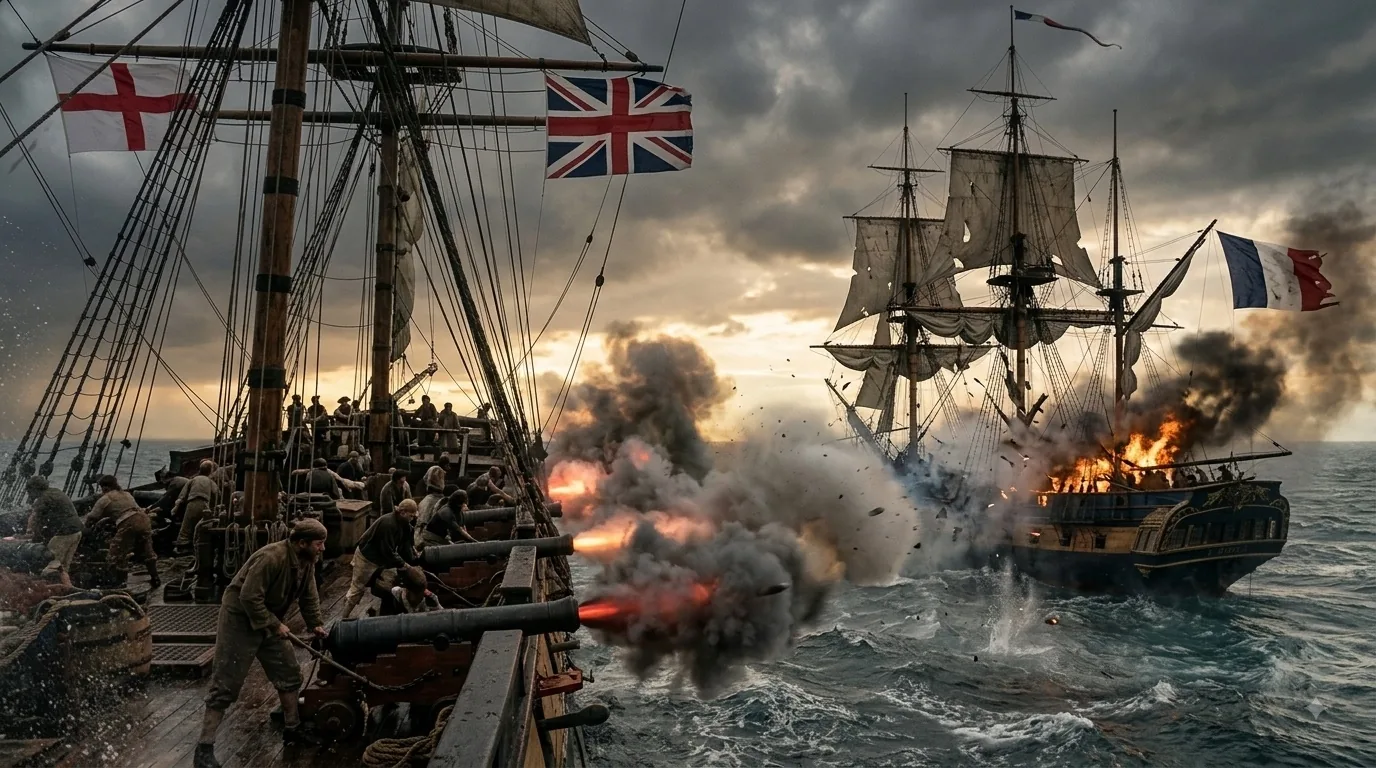
Europe’s answer to private violence at sea was paperwork — a state licence that made it lawful. Silla never wrote one. (AI illustration)
Silla was not the only state facing the question of what to do with private power on water. Comparing the answers is useful, provided the comparison stays modest — these are institutional sketches across very different centuries, not matched cases.
England: license it. A letter of marque was a commission granted by a belligerent state to a private shipowner, authorising him to use his own vessel as a warship against enemy shipping. Privateers were not paid; they took their profit from what they seized. Under the Tudors, men operating on such commissions were encouraged or restrained as the political weather changed. The practice was formally ended among the signatory powers by the Declaration of Paris in 1856, which stated that privateering “is and remains abolished.”
The key difference: England turned private violence at sea into a document a state could issue. A licensed man was inside the system by definition, because the licence was the system.
The Hanseatic League: skip the state. Here the order came from merchants and cities directly rather than from a crown. The League fought a long war with Denmark that ran through the 1360s; in 1368 its forces inflicted a heavy defeat, and by the Treaty of Stralsund in 1370 Denmark conceded trading rights and control that gave the League a dominant position in Baltic commerce.
The key difference: the Hanseatic case was organised by collective urban institutions rather than by one monarch and one commander — there was no single appointment to revoke.
Silla: neither. It took the third path and got the worst of both. It recognised a private man’s power, used it to make a king, and then removed him. It built an institution to manage the sea — and never found a way to fit the man who built that institution into its order of birth.
That is where the two halves of this story finally meet. The court could give him a garrison, a title outside its own system, ten thousand men on paper, a fief of two thousand households and a general’s robes. It could not give him a rank his daughter could marry from.
The phrase this article does not use
One last discipline, and it is the one this subject most needs.
You will see Jang Bogo called the “maritime king” or the man who “dominated East Asian sea trade.” The temptation to write that sentence is strong, and the Korean History DB’s own annotation is the reason not to.
That annotation records something genuinely surprising about how this reputation was built. Pre-modern writers — Du Mu, the Samguk Sagi, the Samguk Yusa, and Joseon scholars after them — praised Jang Bogo for courage and magnanimity. But, the annotation states, there was no conception of him as a maritime power who had grown through control of sea routes and international trade. Understanding him as an independent sea power is, in its words, a product of modern historical research — beginning in the 1920s, when Japanese scholars analysing Ennin’s diary noticed how much help the pilgrim had received from Jang Bogo’s people, and continuing through later work that read him as a “merchant prince” at the head of a maritime commercial empire.
That is not a debunking. The trade was real, the network was real, and the archaeology at Jangdo is real. It is a caution about vocabulary. “Emperor of the sea” is a twentieth-century sentence about a ninth-century man, and this article reports it as such rather than adopting it.
Back to the drama
Emperor of the Sea opens with a boy of unfree status trying to get off an island, and runs 51 episodes to the death of a man who had made a king.
The records get there faster and stranger. They give a man whose origins nobody wrote down; a title that sat outside Silla’s regular official system and may reflect Tang institutional vocabulary; ten thousand soldiers that may only ever have been a number on an authorisation; a king he helped enthrone; a marriage refused on the grounds of birth; and a killer who arrives with no past at all.
Then they give the thing the drama cannot: a compiler four centuries later, reading two accounts that contradicted each other, writing that they differ considerably — and keeping both.
Jang Bogo disappeared first. Cheonghaejin did not. It outlived him by years, under arrangements the record does not let us reconstruct securely — one reading has Yeomjang’s faction holding it — before the court abolished it in 851 and moved its people inland.
The year he died is still two years.
Coming up next
If the evidentiary problem here interests you more than the legend, two companion pieces follow the same thread from different directions. Bone rank in Silla is the system that made “low origin” a winning argument in a royal council — the wall Jang Bogo’s daughter ran into. And two centuries later, the three entries in the History of Goryeo recording visitors from the Arab world show the same discipline applied to a much smaller documentary base: what the record says, and what the popular telling adds to it.
Frequently asked questions
Is Emperor of the Sea based on a true story? The skeleton is documented: Jang Bogo, Cheonghaejin in 828, the enthronement of King Sinmu in 839, the killing by Yeomjang, and the abolition of the garrison in the second month of 851 are all in the Samguk Sagi. The principal women — Jami-buin, Jeonghwa — are inventions of the drama and its source novel. Yeomjang is the interesting case: the records give him no backstory at all, so whatever the drama supplies is filling a silence rather than contradicting a source.
Was Jang Bogo really a slave? We could not find a source that says so. The biography says only that his home district and his father and grandfather are not known. The later objection to his daughter’s marriage is low birth, not slave status. “Origins unknown” and “was a slave” are different statements, and the second one comes from the novel and the drama.
What were ninth-century pirates in these waters after? People were one of the documented targets — raiders also took goods and attacked trading and grain ships. The petition in the biography has Jang Bogo telling the king he had found Silla people held as slaves throughout China, and asking for a garrison so raiders could not seize people and carry them west.
Did the king really give him ten thousand soldiers? The record says so. Urihistorynet is openly sceptical that ten thousand men were actually transferred and reads the figure as the ceiling on what the commissioner of Cheonghaejin was entitled to command. It should not be converted into a modern order of battle.
When did Jang Bogo die? Two answers, five years apart. The Samguk Sagi says spring 846. Shoku Nihon Koki records Silla envoys reporting in Japan in 842 that he died in the eleventh month of 841. The Korean History DB’s annotation judges the Japanese record accurate, and Urihistorynet writes 841; the Encyclopedia of Korean Culture still heads its entry 846. This article keeps both and says where the weight sits.
Why was the marriage blocked? Because of his birth. The Samguk Yusa gives the objection in direct speech: Gungpa is of low origin, so his daughter cannot be made the king’s consort. The position at stake was second consort, not principal queen.
Was Cheonghaejin abolished because Jang Bogo died? Not immediately. On either dating the garrison outlasted him by five to ten years before being abolished in the second month of 851 (original text). The Korean History DB notes a reading in which Yeomjang’s faction had taken it over, making the abolition an action against that faction — one scholar’s reading, not a fact in the text.
Was he the “maritime king” who dominated East Asian trade? That framing is modern, and the Korean History DB says so: pre-modern writers praised his courage and generosity but had no conception of him as a maritime power built on international trade. Reading him as an independent sea power is, in the database’s words, a product of modern research beginning in the 1920s. The trade was real; the title is a later sentence, and this article does not adopt it.
What this article could not confirm
- The drama’s scene-by-scene content, and how it handles its ending. We worked from the official episode listing, cast and broadcast data, and did not invent scenes to fill the gap.
- A founding date for the Chishan cloister — popular accounts give 823 and 824 — and any figure for the estate that supported it. We therefore do not claim the temple predates Cheonghaejin.
- The exact original characters of Kim Bu-sik’s closing note on keeping both versions. We verified the National Institute of Korean History’s translation of its opening clause and quote from that, rather than reproducing a Chinese text we could not collate.
- The volume number of Du Mu’s collected works containing the Jang Bogo and Jeong Nyeon account. Two National Institute of Korean History services give it differently, so we cite the work without a volume number.
- Any documentary basis for population figures for the 851 removal to Byeokgol-gun.
- Any source describing Jang Bogo as a slave. We looked and did not find one; we report that as not found, not as proof that none exists.
- The Britannica entries used by the underlying manuscript for the privateering and Hanseatic comparisons. Britannica blocked automated access for this article, so those claims were re-sourced from independently checkable references and the comparison is stated more narrowly than it was drafted.
Sources & further reading
- The founding of Cheonghaejin — Samguk Sagi, Silla Annals vol. 10, Heungdeok 3 (828), fourth lunar month, via the National Institute of Korean History’s Korean History Database (
sg_010r_0060_0130). The database’s annotation notes that daesa was not a title in Silla’s regular system. - The killing — Samguk Sagi, Silla Annals vol. 11, Munseong 8 (846), spring (
sg_011r_0020_0210). Quotations of Yeomjang’s offer and of Jang Bogo receiving him as an honoured guest follow the database’s Korean translation. - The abolition — Samguk Sagi, Silla Annals vol. 11, Munseong 13 (851), second lunar month (
sg_011r_0020_0340). The annotation records the reading that Cheonghaejin had passed to Yeomjang’s faction, citing Choe Geun-yeong, A Study of Provincial Powers in Unified Silla (1990), 145. - The biography — Samguk Sagi vol. 44, Biographies 4, “Jang Bogo and Jeong Nyeon” (
sg_044r_0110_0010through0090). Source of the petition about slavery, “his home district and forebears are not known”, Jeong Nyeon’s reply about dying in his own country, the five thousand soldiers, and Kim Bu-sik’s note that the account differs considerably from Silla’s own traditions. The database’s annotations supply: that the biography is taken almost verbatim from Du Mu and is of limited source value; that no domestic transmitted material was consulted; that the Silla Annals contain no account of Jang Bogo being made chief minister; that the Japanese dating of his death is judged accurate; and that reading him as an independent maritime power is a product of modern research from the 1920s onward. - Cheonghaejin, the ten-thousand figure, the trade network and the excavation — National Institute of Korean History, Urihistorynet, “Cheonghaejin” (
kc_r101460). Source of the reading of ten thousand as a ceiling; the Du Mu quotation on slave-taking ceasing after the Taehe era; the hoeyeoksa missions and the Japanese court’s 831 restrictions; and the 1991–2001 Jangdo excavation results, including the 890-metre rampart, the 331-metre palisade with ninth-century radiocarbon dates, and the ritual deposit. - The objection to the marriage — Samguk Yusa vol. 2, Gii, “King Sinmu, Yeomjang and Gungpa”. We verified the translated objection; we did not collate the original characters.
- The 841 dating — Shoku Nihon Koki vol. 11, Jowa 9 (842), first month, and Ennin’s Nitto guho junrei koki vol. 4 on the exiled Cheonghaejin officer at Lianshui in 845. Both are cited here from the Korean History Database’s annotations, not collated against their originals.
- Du Mu’s account — Fanchuan ji. Two National Institute of Korean History services give different volume numbers for the Jang Bogo and Jeong Nyeon piece, so no volume is cited here.
- The privateering comparison — standard legal references on the letter of marque as a commission granted by a belligerent state to private shipowners, and the Paris Declaration Respecting Maritime Law (1856), which provides that privateering “is and remains abolished.”
- The Hanseatic comparison — the Danish–Hanseatic war of 1361–1370, the League’s decisive victory in 1368, and the Treaty of Stralsund of 1370.
- The drama — Emperor of the Sea (해신), KBS2, 24 November 2004 to 25 May 2005, 51 episodes; based on Choi In-ho’s 2003 novel Haesin; starring Choi Soo-jong, Chae Shi-ra, Song Il-kook and Soo Ae. Availability on streaming services differs by country and was not verified region by region.
A note on the illustrations
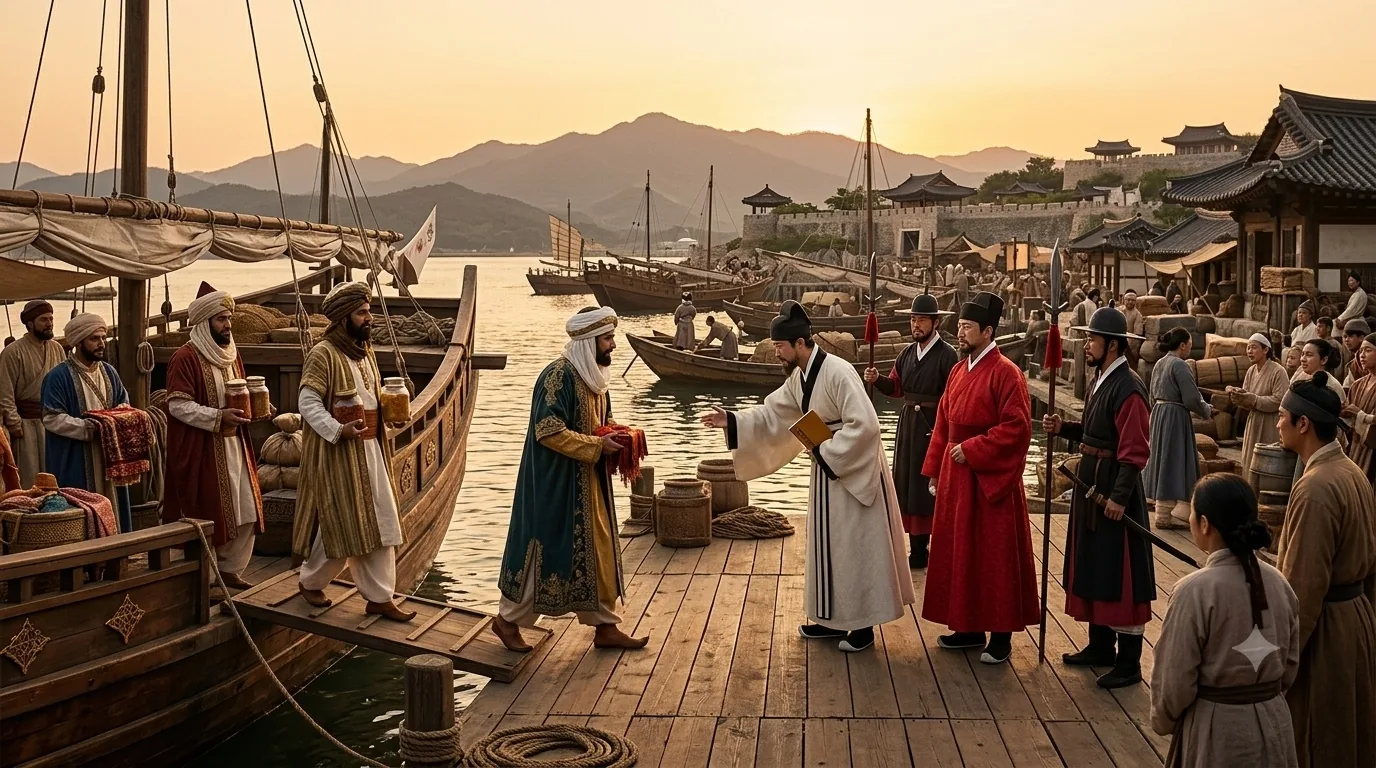
The images with this article are AI illustrations made for it. No contemporary depiction of Jang Bogo, Cheonghaejin or its ships is known, and the harbour image should not be read as a reconstruction drawing of the excavated site.
This article was researched and written by K-Drama History. Source: Why Did Silla Turn on Jang Bogo? Cheonghaejin and What the Records Actually Say — K-Drama History