Hwarang, Explained: How Silla's Bone-Rank System Shaped Whom You Could Marry, What You Could Wear and Who You Could Become
Theme: Status & Class
From the research behind Pause the Drama.
If you’ve watched KBS’s Hwarang (화랑) — the 2016–17 youth sageuk that put half of future K-drama stardom in one training hall — you know the setup. Seon-u, Sammaekjong, Su-ho, Ban-ryu and Han-seong train in the same courtyard and wear the same uniform. And the strongest wall between them isn’t swordsmanship or temperament. It’s what they were born as.
Seon-u comes from outside the capital’s aristocratic society; A-ro is born to an aristocratic father and a low-status mother; Su-ho and Ban-ryu are sons of powerful noble houses; Sammaekjong is a king hiding his face. The drama’s romance insists that people can choose who they become. The world it is set in was built on the opposite premise.
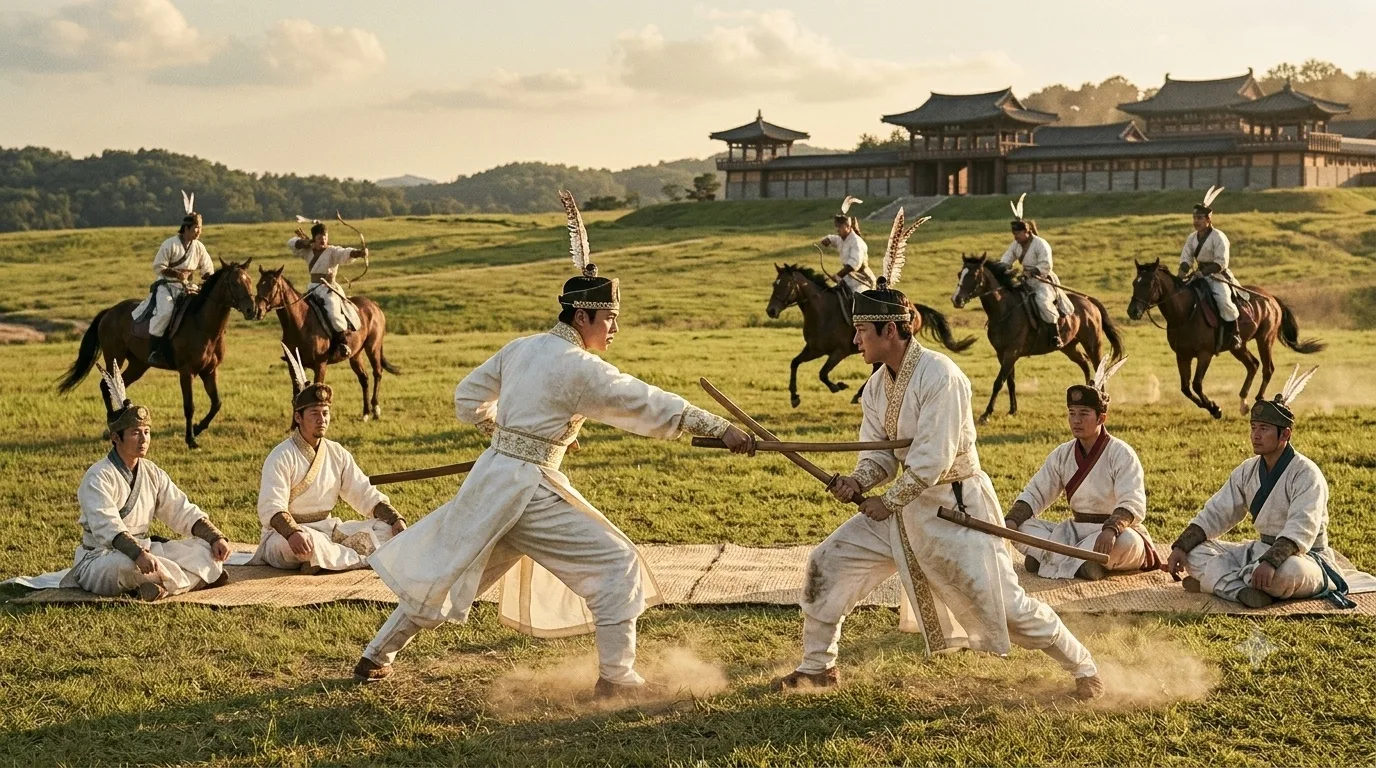 Same uniform, same training ground — different ceilings, fixed at birth. (AI illustration)
Quick answer: In real Silla, a hereditary grade called golpum (골품) — “bone rank” — shaped an aristocrat’s entire life trajectory: whom they could realistically marry, how high they could rise through the seventeen office ranks, what court robes their position allowed, and, by the ninth century, even the size and decoration of their house and carriage. “Hallowed bone” (seonggol) and “true bone” (jingol) royalty stood above head ranks six, five and four. The top five office ranks were reserved for true-bone aristocrats, so talent below that line hit a ceiling no ability could break. The hwarang — real aristocratic youth bands with followers called nangdo — trained, roamed and were observed for talent inside this order, not outside it. Ability could change your speed; bone rank set your finish line.
What was the bone-rank system?
Golpum means, literally, “bone grade” — the height of the lineage you were born into. Silla’s ruling stratum was divided into seonggol (성골, “hallowed bone”), jingol (진골, “true bone”), and the head ranks — yukdupum (6두품), five and four — below them (Encyclopedia of Korean Culture, 골품제도). Queen Jindeok was remembered as the last seonggol ruler; from King Muyeol onward, the throne passed through the jingol royal line.
One clarification that saves a lot of confusion: the bone-rank system was not a complete nationwide census assigning every commoner a named grade. Its clearest documented function was to rank royal and aristocratic lineages — especially those participating in the politics of the capital, Wanggyeong (modern Gyeongju) — while the status of broader provincial populations is much less neatly recorded. But for anyone who wanted a life in capital politics, bone rank was the master variable — the thing that decided what office, what marriage and what display were even possible.
Did bone rank shape whom you could marry?
Strongly — though not by a surviving statute book. Because bone rank passed through blood and kinship, marriage was never only a love match; it was the act that fixed the next generation’s rank (Encyclopedia of Korean Culture, 골품제도). Royal and upper-aristocratic houses commonly married within closely matched status groups — a practice that helped preserve lineage claims and the political position of their descendants — and cases of marriage between close kin are attested within the royal house and true-bone aristocracy. A union across ranks was not merely a romance problem — it could touch the children’s status and the house’s political future.
Be precise about the limits of the record, though: no law code survives that spells out permitted spouses grade by grade. The honest formulation is that Silla’s elite practiced strong status-preserving marriage customs — not that “a true bone could only ever marry a true bone” as a mechanical rule. The drama’s cross-status love stories are fiction, but the wall they run into is the real one.
Did bone rank decide what you could become?
Here the record is at its clearest, and it is stark. Silla had seventeen office ranks, from ibeolchan at the top down to jowi. The top five ranks — down through daeachan — were reserved for true-bone aristocrats. A head-rank-six man could rise to rank six, achan, and no further; head ranks five and four are understood to have been capped at rank ten (daenama) and rank twelve (daesa) respectively — the latter two ceilings being scholarly reconstructions from the way ranks, grades and robe colours align in the sources (Samguk Sagi, Offices treatise; 우리역사넷).
Since the great offices of state required the top ranks, a head-rank-six man of superb learning could serve, advise, and distinguish himself — and still never become one of the state’s highest officials. There was even a system of sub-grades (jungwi) that let a man blocked at his bone-rank ceiling keep being promoted inside that ceiling rank, which is somehow the most eloquent detail of all: the state acknowledged talent enough to invent extra rungs, without ever raising the roof.
Bone rank gave a mediocre true-bone aristocrat a high ceiling he hadn’t earned, and put an invisible roof over a brilliant man born one grade down.
Could people see your rank? Robes, houses and carriages
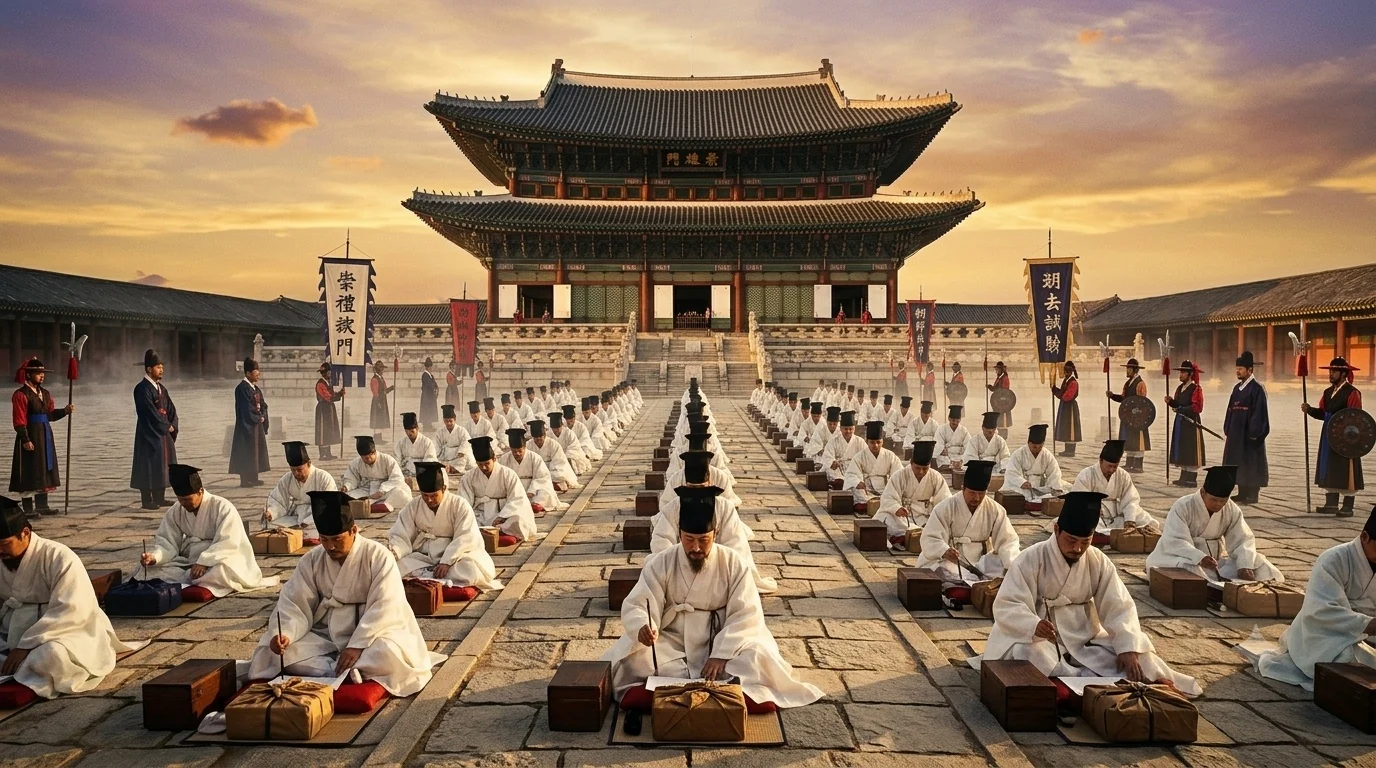
Yes — in official settings, at a glance. Silla’s court dress was colour-coded by rank group: purple for the highest officials, then crimson, blue and yellow below (Samguk Sagi, dress treatise). Since bone rank capped your office rank, and office rank set your robe colour, the colour of a man’s court robes told you roughly which band of the hierarchy he belonged to. (The careful version: this applied to official dress at court, not to every garment worn in daily life.)
And the reach of the system kept growing. In 834, under King Heungdeok — well after the drama’s era — Silla issued regulations restricting house dimensions, roof and wall ornament, carriages, horse trappings and household goods by status grade. That is later evidence, but it shows the reach: by the ninth century, the same status logic that constrained office and marriage was also expressed through detailed rules governing houses, carriages and household display. In Silla, the colour of your robes and the size of your roof were not taste. They were status, made visible.
So what were the hwarang — and did they beat the system?
The hwarangdo is often described as Silla’s special forces or its officer academy. The reality was stranger and more interesting. A hwarang was a leader chosen mainly from among aristocratic youth; his followers, the nangdo (낭도), are understood to have included capital youths of more varied station — though no roster survives to tell us exactly how varied. Together they roamed mountains and rivers, trained body and mind, sang and made music — and, as the Samguk Sagi describes it, their conduct and character were observed, so that worthy men could be recommended to court (Encyclopedia of Korean Culture, 화랑도). Figures who rose from the hwarang to distinguish themselves in war and office are attested — Sadaham, celebrated at the conquest of Daegaya in 562, is the classic case.
But be clear about what the hwarangdo was not. It did not abolish bone rank, and it did not hand a low-born nangdo a true bone’s career. It was not an egalitarian order outside the system; it was a channel inside the system — a place where young men of different stations could train together and be seen, within walls that never moved. That is, in fact, exactly the tension the drama runs on.
One more wrinkle the drama skips, and it’s a good one: in the Samguk Sagi’s origin story, the hwarang had female predecessors. Two women, Nammo and Junjeong, were chosen as wonhwa (원화), each leading a following of some three hundred — until, the story goes, Junjeong murdered Nammo out of jealousy, was executed, and the organization was disbanded; handsome young men were then selected instead, and so the hwarang began. Note the careful framing: that is the order of events inside the origin story (told under the year 576), while Sadaham already appears as a hwarang in 562 — so the tale is best read as a later origin tradition rather than a dated founding event. What it clearly shows is how later Silla tradition, as preserved in the Samguk Sagi, explained talent-selection: beauty, followings, and observed character, braided together.
Was Sammaekjong really King Jinheung?
The name is real. The Samguk Sagi records King Jinheung’s personal name as Sammaekjong — also written Simmaekbu, a form echoed in inscriptions of the period — and the drama picked the former. The real Jinheung came to the throne as a child, and his mother, Lady Jiso, governed on his behalf during the early part of his reign; the hwarang are understood to have been organized as a channel for finding and training talent during his rule.
What no record contains is a grown Sammaekjong hiding his identity to train, brawl and bond among the hwarang. Seon-u, A-ro, Su-ho, Ban-ryu, Han-seong and their entanglements are the drama’s invention — a modern coming-of-age story wearing a sixth-century institution.
Were the hwarang Korea’s samurai or knights?
The comparison is irresistible and mostly wrong, in instructive ways.
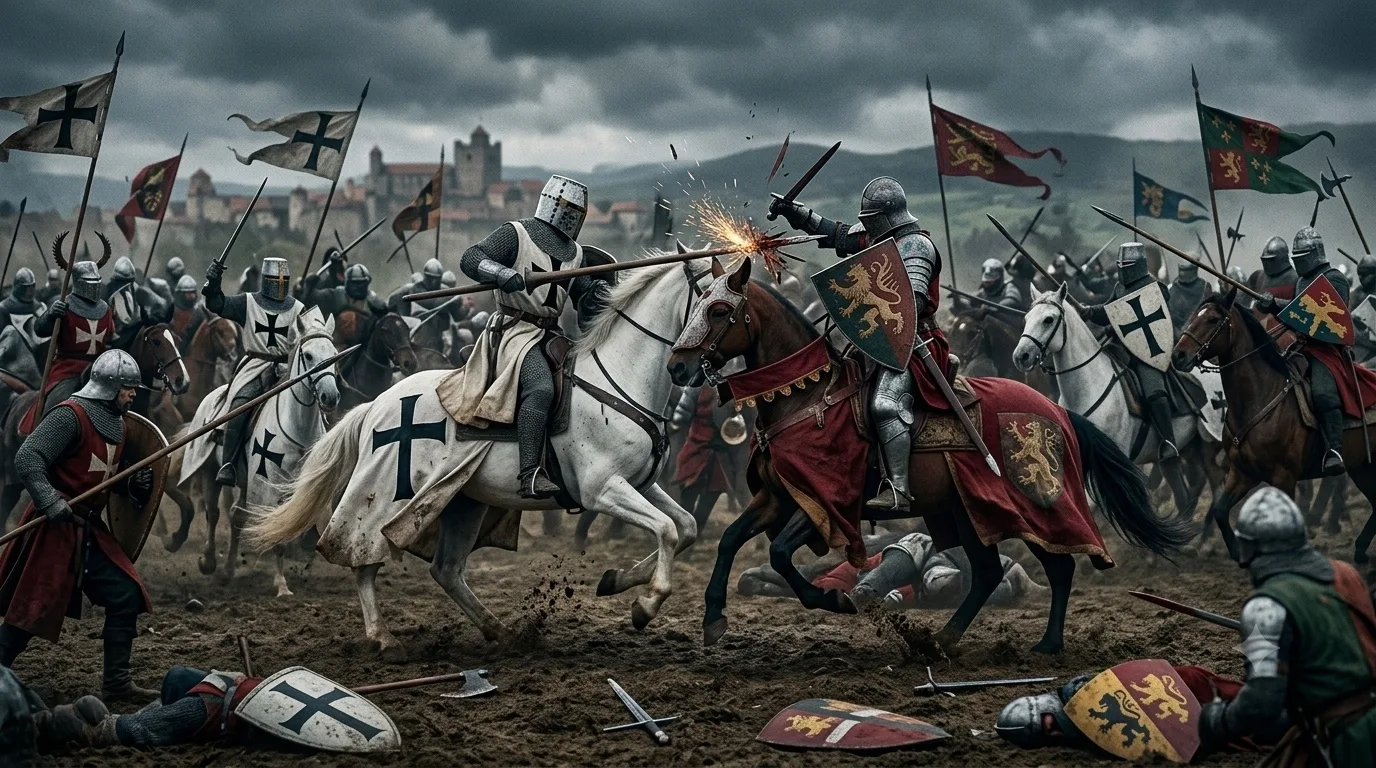 The comparison everyone reaches for — and the structures don’t match. (AI illustration)
All three groups involved martial skill and stood close to the ruling order of their societies — that much the comparison gets right. The structures beneath differed fundamentally. Samurai developed into a hereditary warrior class that from the twelfth century came to dominate Japanese politics and society; in the long peace of the Edo period, idealized discourses of warrior ethics flourished — though it is safer to speak of various idealized codes than of one universal bushido that bound every samurai (The Met; British Museum). Medieval knighthood was tied far more directly to mounted warfare, lordship and military service than the hwarang organization ever was. The hwarang, by contrast, formed no hereditary warrior class and no military government: theirs was a youth organization braiding martial training with song, landscape pilgrimage, moral cultivation and talent-spotting, inside a status system that predated and outlasted them.
The hwarang were not Korea’s samurai, and not Korea’s knights. They were Silla’s answer to a different question — not “who fights for the lord?” but “how does a bloodline state find talent without disturbing the bloodlines?”
Watch it again
Watch the training-yard scenes again and the uniform reads differently. The drama’s young men wear the same clothes, but Silla had already assigned each of them a different ceiling before any of them picked up a sword. A king is a king even with his face hidden; noble sons stand near power by default; the ones with clouded lineage must prove, endlessly, that they deserve to be in the yard at all.
Real hwarang were not a band of equals. Yet the organization appears to have brought youths of differing station into the same followings — training side by side, having their conduct weighed — without erasing the ceilings attached to birth: a small meeting-space built inside one of history’s hardest status walls. Hwarang is a drama about friendship and love across rank. What gives it its charge is that the world it depicts ran on the opposite rule: in Silla, ability changed how fast you ran, and the grade of your bones decided where the track ended.
In the next essay, we’ll take another K-drama scene that looks like pure fiction — and trace the real Korean history hiding underneath it.
Frequently asked questions
Is Hwarang based on a true story? Its institutions are real; its story is not. Sammaekjong is a recorded name of the real King Jinheung (the Samguk Sagi gives his name as Sammaekjong or Simmaekbu), and the hwarang were a real Silla youth organization. But Seon-u, A-ro and the drama’s friendships and romances are invention, and there is no record of a king concealing his identity to live among the hwarang.
What was Silla’s bone-rank system? Golpum (골품) — literally “bone grade” — was Silla’s hereditary ranking of its capital elite: the “hallowed bone” (seonggol) and “true bone” (jingol) at the top, then head ranks six, five and four below them. It was less a nationwide registry of every inhabitant than a grading of the royal and aristocratic lineages of the capital — but for anyone in capital politics, it set the ceiling on office, marriage prospects and display.
Could a talented person of low bone rank reach the top in Silla? It was very hard. Silla had seventeen office ranks, and the top five were reserved for true-bone aristocrats; head-rank-six men could rise to rank six (achan), and head ranks five and four are understood to have been capped at ranks ten and twelve. Since the great offices of state required the top ranks, even a brilliant head-rank-six man could not normally become one of the state’s highest officials.
Did King Jinheung really disguise himself as a hwarang? No such record exists. The real Jinheung came to the throne young, with his mother Lady Jiso acting as regent for a time, and the hwarang were organized during his reign — but the undercover-king premise is the drama’s modern invention.
Were the hwarang Silla’s special forces? Not exactly. The hwarang were leaders chosen mainly from aristocratic youth, each followed by bands of nangdo companions; they roamed mountains and rivers, trained body and mind, enjoyed song and music, and — as the Samguk Sagi puts it — their conduct was observed so that the worthy could be recommended to court. Figures who distinguished themselves in war are attested, but the organization was as much about cultivation and talent-spotting as combat.
Were the hwarang Korea’s samurai or medieval knights? No. All three involved martial skill and ties to the ruling order, but the structures differed fundamentally: samurai became a hereditary warrior class that eventually ruled Japan, medieval knighthood was tied far more directly to mounted warfare and military service to lords, and the hwarang were a youth training and talent-cultivation organization inside Silla’s bone-rank order — not a hereditary warrior class at all.
Could people change their bone rank in Silla? Bone rank was fundamentally hereditary, so individual achievement did not normally move a person from a lower head rank into the true-bone aristocracy. Scholarship discusses status decline and limited movement within parts of the head-rank order, but the system did not work as an open merit ladder: talent could improve your position within the limits of birth, not erase those limits.
Did bone rank control whom people could marry? It strongly shaped elite marriage, but no surviving law code lists permitted spouses grade by grade. Royal and aristocratic houses commonly married within closely matched status groups, because marriage fixed the rank of descendants and carried political weight. It is safer to speak of powerful status-preserving marriage customs than of an absolute statutory ban on every cross-rank union.
Sources & further reading
This piece was written from the historical script and fact-check of 사뚱샘의 역사방 (SaDDungSam). Where the record supports influence but not statute — bone rank and marriage, the head-rank-five and -four ceilings, the composition of the nangdo — this article says “understood to” rather than pretending to a law code that doesn’t survive.
- The bone-rank system — structure, ranks and ceilings. (Encyclopedia of Korean Culture, 골품제도 · 우리역사넷)
- The hwarangdo — organization, nangdo, functions. (Encyclopedia of Korean Culture, 화랑도)
- The primary source — Samguk Sagi: Annals of Silla, Jinheung years 23 (Sadaham, 562) and 37 (the wonhwa origin story and hwarang, 576); the treatises on dress, carriages, utensils and housing (the 834 Heungdeok regulations); the treatise on offices; the biography of Sadaham. (Korean History Database)
- The comparisons — samurai and knights, and why the analogy breaks. (The Met, Heilbrunn Timeline · British Museum)
- The drama. (Hwarang: The Poet Warrior Youth — Rakuten Viki)
Thanks for reading — see you in the next one.
This article was researched and written by K-Drama History. Source: Hwarang, Explained: How Silla's Bone-Rank System Shaped Whom You Could Marry, What You Could Wear and Who You Could Become — K-Drama History