Goryeo-Khitan War, Explained: What the Records Actually Say About Arab Traders in Goryeo — and What They Don't
Theme: Power & Politics
From the research behind Pause the Drama.
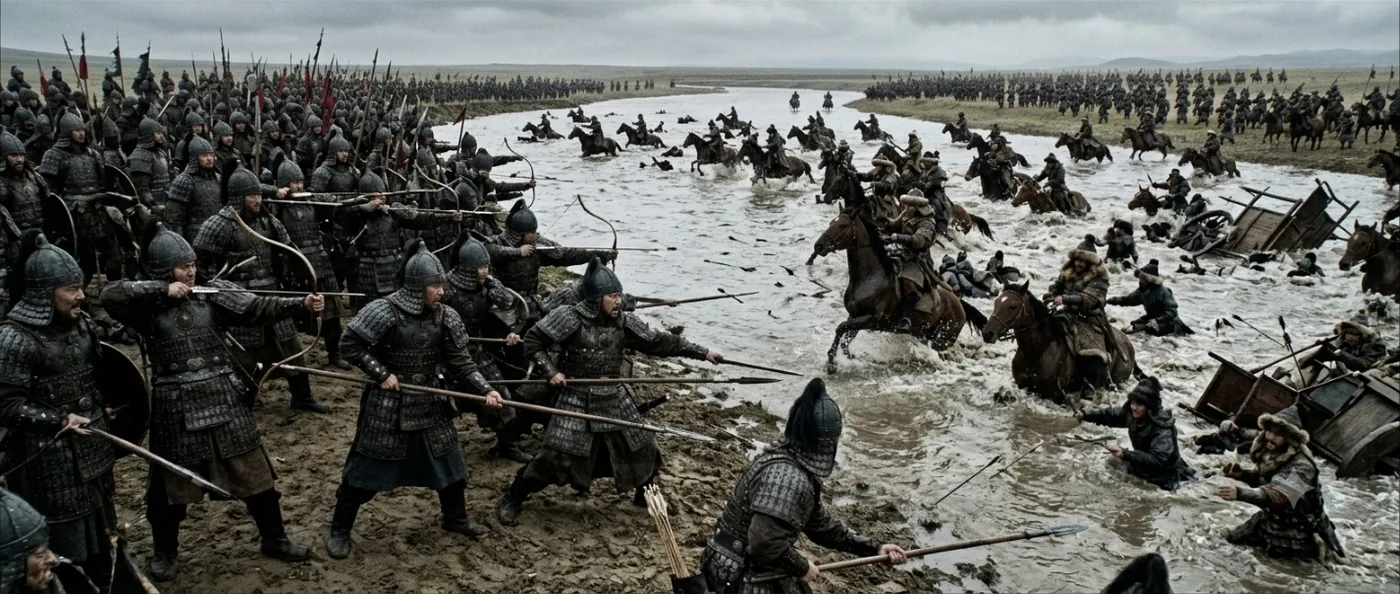
Goryeo-Khitan War builds for thirty-two episodes toward a frozen plain in 1019. A Liao army withdrawing north is caught at Gwiju. The Khitan force is broken, and the empire that had invaded three times does not come again.
The drama’s climax is that battle. History, of course, keeps going.
Five years later, in the ninth lunar month of 1024, a clerk in the Goryeo court wrote three lines about a hundred visitors. The record does not describe their ships, their route, or where they landed. It gives their origin as Dashi (大食) — the East Asian term for the Arab world — and adds a note explaining, for readers who would not have known, where that was.
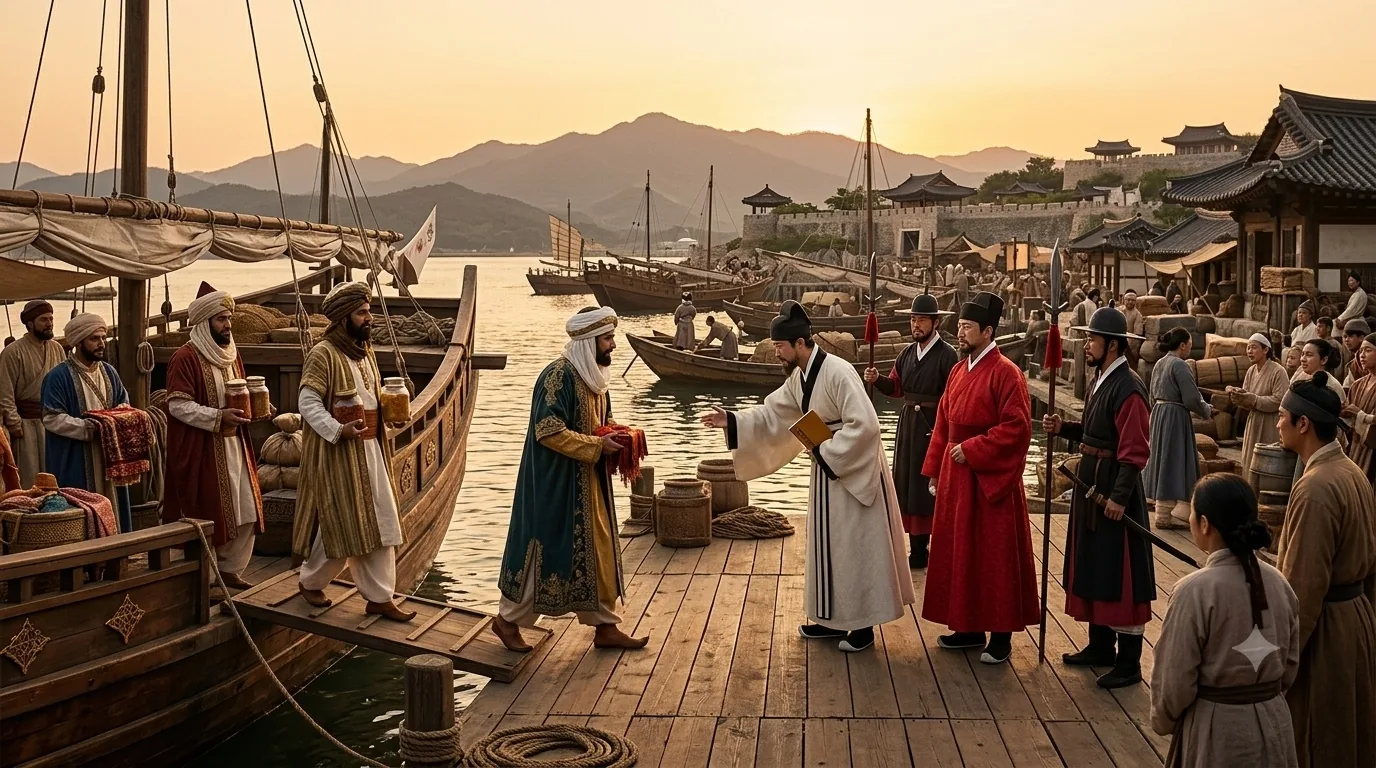
Byeongnando, Goryeo’s principal international port, lay on the Yeseong estuary about thirty ri from the capital. No record says where the Dashi visitors landed — this is an illustration of the port, not of that arrival. (AI illustration)
The three entries, in full
Everything reliable in this story rests on three short passages. Here they are.
1024 (Hyeonjong 15, ninth lunar month)
是月大食國悅羅慈等一百人來獻土産。【大食國在西域。】
In this month, Yeollaja and others of the country of Dashi, one hundred men, came and presented local products. [The country of Dashi lies in the Western Regions.]
1025 (Hyeonjong 16, ninth lunar month, second day — 26 September in the Julian reckoning given by the archive)
九月 辛巳 大食國遣蠻夏·詵羅慈等百人來獻土產
Ninth month, sinsa day. The country of Dashi sent Manha and Seonnaja and others, one hundred men, who came and presented local products.
1040 (Jeongjong 6, eleventh lunar month, fifteenth day)
十一月丙寅, 大食國客商保那盍等來, 獻水銀·龍齒·占城香·沒藥·大蘇木等物
Eleventh month, byeongin day. Bonahap and others, merchants of the country of Dashi, came and presented mercury, dragon’s teeth, Champa aromatic, myrrh, sappanwood and other goods.
The court’s response is recorded for the last of these: the king ordered the responsible officials to entertain the visitors generously at the guest house, and on their departure to grant them gold and silk in ample measure.
That is the whole documentary basis. Three entries. Roughly sixty characters.
What the entries do not say
A note on wording before the table. This article calls these men traders for convenience, and the headline does too — but the records apply that word to only one of the three visits. In 1024 and 1025 they are simply men of Dashi; the term 客商, travelling merchants, appears in 1040. The distinction is part of the point, so it is worth holding onto while reading.
The popular version of this story is more cinematic than the record, and the gap is instructive.
| The familiar telling | What the entries actually contain |
|---|---|
| A hundred Arab merchants stood in the palace courtyard at Kaesong with chests of myrrh | The hundred men are in the 1024 entry, which lists no goods. The myrrh is in the 1040 entry, which gives no number of men. Sixteen years apart |
| They were merchants | The 1024 and 1025 entries call them simply men of Dashi. Only the 1040 entry uses 客商, travelling merchants |
| They arrived at Byeongnando | No entry names a port |
| They were received by the king in his palace | The 1040 entry has the king order his officials to host them at the guest house. There is no record of a personal audience, and no entry mentions the palace at all |
| They came in autumn because of the monsoon, and stayed three or four months | Nothing in the entries supports this. The months are lunar, and no departure port, route or return date is recorded |
None of this makes the visits less interesting. It makes them more precisely interesting. In the eleventh century, a Korean court wrote down myrrh and Champa aromatic by name — commodities of the Indian Ocean and Southeast Asian networks — and recorded what it gave in return.
That is a fact about connection. It does not need the courtyard scene.
The port, and the building that may have named it
Byeongnando (碧瀾渡) stood at the mouth of the Yeseong River. The do (渡) of its name means a crossing or landing, not an island.
Our most vivid description of the place was not written by a Korean. In 1123 a Song embassy arrived, and one of its members — Xu Jing (徐兢) — wrote up what he saw in forty volumes, the Xuanhe fengshi Gaoli tujing. He is often called a painter, and he was indeed skilled in calligraphy and painting; but the sources describe him as an official attached to the embassy rather than a painter by trade. He produced illustrations too, which have not survived. The text has.
His chapter on official buildings describes the reception pavilion:
碧瀾亭, 在禮成港岸次, 距王城三十里 … 亭有二位, 西曰右碧瀾亭, 以奉詔書, 東曰左碧瀾亭, 以待使副 … 往來各一宿而去
The Byeongnan Pavilion stands on the bank of Yeseong harbour, thirty ri from the royal capital … The pavilion has two positions: the western one, the Right Byeongnan Pavilion, is for enshrining the imperial edict; the eastern one, the Left Byeongnan Pavilion, is for receiving the envoy and his deputy … Coming and going, they stayed one night at each.
Three things are worth pulling out of that. The pavilion had two wings with divided functions — the emperor’s document was housed apart from the men who carried it. The distance to the capital is given precisely. And the embassy stayed there on the way in and again on the way out, which is why it is inaccurate to describe Xu Jing as a man who passed the port once.
Byeongnando is traditionally explained as taking its name from this pavilion — the building first, the landing named after it. That explanation appears in official reference material, and it may well be right.
But the surviving chronology does not settle it, and the National Institute of Korean History’s fuller commentary says so directly. The pavilion appears in Xu Jing’s account of 1123; the place name Byeongnando is attested in the sources somewhat later than that. Which is why the same commentary allows the reverse: “어쩌면 벽란도라는 명칭이 먼저 쓰였고 이를 따서 벽란정이라는 이름을 붙였을 수도 있다” — perhaps the name Byeongnando was in use first, and the pavilion was named after it.
So the honest position is that we have a pavilion and a port sharing a name, and no document that fixes the order.
The calendar coincidence, and the claim it cannot carry
Here is a detail that rewards attention.
The 1040 visit is dated to the fifteenth day of the eleventh lunar month. According to the Encyclopedia of Korean Culture, the Palgwanhoe — described there as the foremost state rite of Goryeo — was held in the capital on exactly that date: the fifteenth day of the eleventh month.
It gets better. The same reference states that trade was conducted on the occasion of the eleventh-month Palgwanhoe, and that Song merchants, the eastern and western Jurchen, and Tamna presented local products at it. So there was a real institution here: foreign traders bringing goods to the court on that very day.
And yet — Dashi is not in that list, and the 1040 entry says nothing about the festival. It records the arrival and the goods, and stops.
So we have a visit landing on the exact date of a ceremony at which foreign merchants are known to have presented goods, and two sources that never touch each other. It is easy to see why accounts leap the gap and put Arab traders in the festival crowd. But a shared date is not a shared event. The honest sentence is that the visit fell on the day of the Palgwanhoe and the record does not connect the two — which is more interesting than the version usually written, because it leaves the reader with a real question instead of a decoration.
What Goryeo sent out
Trade ran both ways. Korean exports of the period are described as including metals, ginseng, pine nuts, fans, ramie cloth and paper, against books, silk and porcelain coming in from Song China.
There is one export that surprises modern readers: Goryeo celadon.
A regional gazetteer compiled in the Ningbo area in the early thirteenth century lists Korean goods traded into China, sorted into a fine-goods category and a coarser one. Silver, ginseng, musk and beeswax sit among the fine goods. Green ceramics appear in the cheaper category, alongside silk floss, chestnuts, jujubes, tiger skins, copper vessels and mats.
It is tempting to run that into a paradox — the treasure of Korean museums, filed by Song clerks as a bargain item — and the temptation should be resisted. The category covers Korean green wares broadly, and there is no basis for treating what it lists as the same objects as the finest inlaid celadon now held as national treasures. Nor does the classification itself prove either high quality or large volume. What it reasonably supports is this: Goryeo ceramics were not only art objects but ordinary trade goods, and a substantial quantity reached China.
Three ways to handle a foreign merchant
Goryeo was not the only place answering this question in the eleventh century, and comparing the answers is useful — as long as the comparison stays modest, since these are institutional sketches rather than matched cases.
Guangzhou. Major Chinese ports under the Tang and Song are described as having fanfang (蕃坊), designated quarters where foreign merchants lived, with their own appointed head handling internal affairs. Foreigners settled, and the arrangement was institutionalised.
Venice. The direction reversed. Venice’s business was not hosting foreign merchants but sending its own out across the Mediterranean. Maritime commerce sat at the centre of how the state operated.
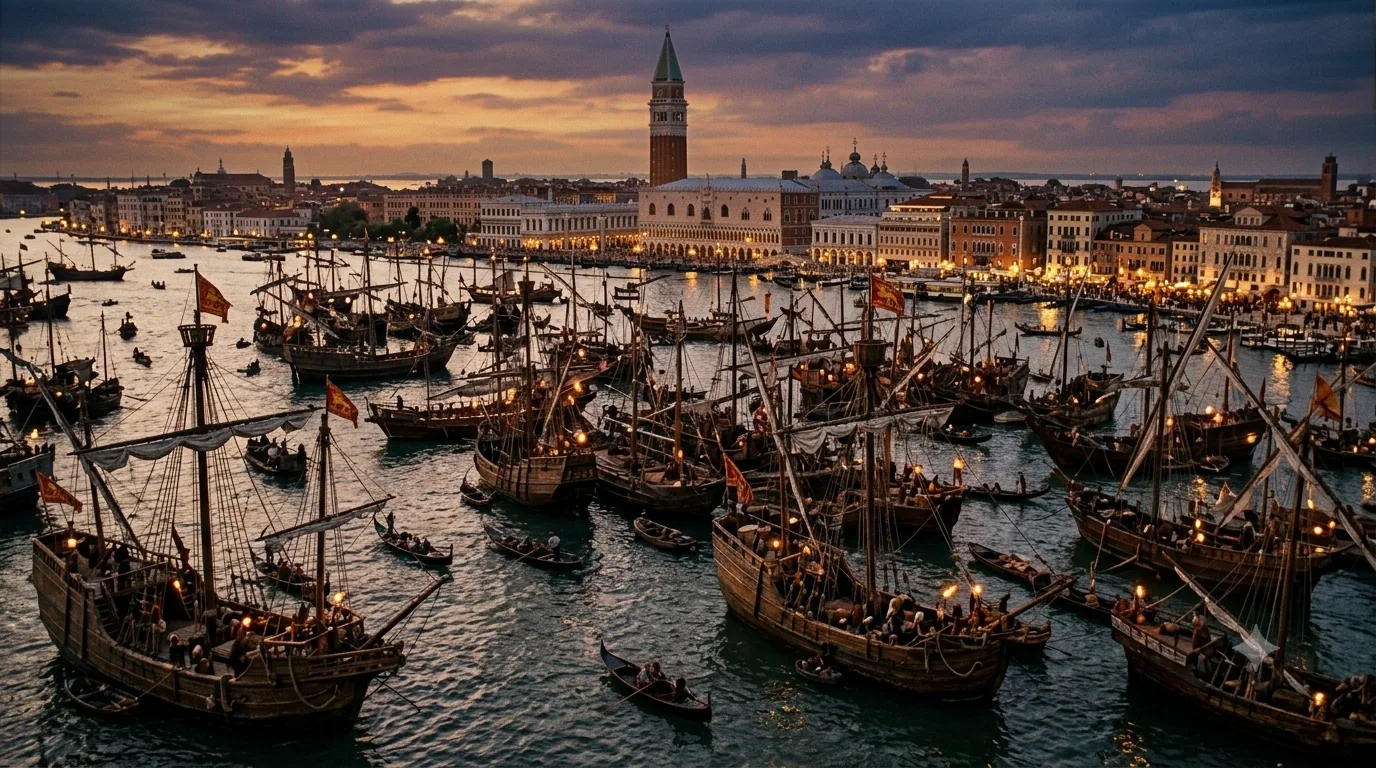
Venice answered the same question from the other end: rather than housing foreign traders, it sent its own merchants out. (AI illustration)
Goryeo. Neither. There is no evidence of a permanent foreign quarter on the Guangzhou model, and merchants did not run the state. What the record shows is a court-administered reception: visitors present goods, officials host them at the guest house, and the king’s order sends them home with gold and silk.
That exchange is written in the language of tribute. Some scholars read it as functioning as trade regardless of the form it takes in the annals. That reading is reasonable — but it is a reading, and calling the transaction a straightforwardly equal commercial deal imports a modern category the text does not use. The safer formulation: it wore the clothing of tribute and did the work of commerce.
The name the world uses
So did the name Korea leave through this port?
Two accounts circulate, and it is important to say plainly that they do not rest on the same kind of evidence.
The Korean textbook account, from the National Institute of Korean History, holds that Arab traders carrying mercury and aromatics to Byeongnando made the name of Goryeo known in the West, which is why the country is called Korea today. Eleventh century, sea route, Arabic intermediary.
The European documentary trail is different. Forms such as Caule and Cauli appear in thirteenth-century accounts connected with travel through the Mongol empire, understood to render the East Asian name 高麗. Thirteenth century, overland route, Chinese intermediary.
Presenting these as two rival theories of equal standing would flatter the first. Transmission into the Islamic world is plausible — the visits happened — but no continuous chain of Arabic and then European texts has been shown. What can be pointed to in European sources is the Caule/Cauli line. That asymmetry is the accurate picture.
Two smaller corrections belong here, both of which overturned our own earlier draft.
The spelling Korea is often credited to Hendrick Hamel’s account of his captivity, published in Dutch in 1668. But Hamel’s title and text spell the country Coeree. And English etymological references record the form Core in English as early as 1598 — seventy years before Hamel. So Hamel is neither the first attestation nor the source of the modern spelling.
And the exact date at which English settled on Korea over Corea is not something we could establish from primary material, so we do not give one.
‘Hermit Kingdom’ — a phrase with a birthday, and a wrong title
In English, Korea spent a long time as the Hermit Kingdom, and readers routinely apply the label backward across the whole of Korean history.
The label has an origin. In 1882 the American writer William Elliot Griffis published a book that shaped the English-speaking image of a closed Korea for generations. Its title, however, is Corea: The Hermit Nation — Nation, not Kingdom. The famous phrase is not actually his title, and we found no support for the further claim, often repeated, that Korea was the first country ever called a hermit kingdom.
What is well attested is this: Griffis had not been to Korea when he wrote it. He worked from printed sources and second-hand information.
The book appeared in 1882. That is 144 years ago — not the round 150 that gets quoted. And the country it described was Joseon, which is roughly three and a half centuries later than the Goryeo court that wrote down myrrh.
Back to the drama
Goryeo-Khitan War ends where a war drama should end. It is not obliged to show a port.
But it is worth knowing what the same reign contained. Hyeonjong is the king in that drama — the ruler who flees, endures, and holds. And in the fifteenth and sixteenth years of that same reign, the court recorded a hundred men from Dashi, twice, in consecutive autumns.
The National Institute of Korean History observes that Goryeo’s standing rose after 1018 and that regions trading with Song took an interest in it. That is a reading worth knowing. It is not the same as saying the victory caused the visits, and the records do not establish that chain.
What they establish is smaller and firmer. Five years after the fighting stopped, the court was writing down the names of visitors from the far side of the known world, and what those visitors carried.
What this article could not confirm
- Whether the Dashi visitors came directly from the Arabian Peninsula, or were traders within a longer network. The entries do not settle it.
- Whether these three entries are the only relevant records in the History of Goryeo. We follow the National Institute of Korean History’s description of three visits; we did not run an exhaustive search of the annals ourselves.
- Any primary evidence for a Muslim settlement near the port, or for Arab attendance at the Palgwanhoe.
- The exact Chinese characters of the 1040 passage recording the grant of gold and silk. We confirmed the translated text; the original characters of that clause were not verified.
- The precise date at which English adopted the spelling Korea.
- The compilation year of the Ningbo gazetteer, which is given variously; we describe it as early thirteenth century rather than fixing a year.
Primary records used
Every claim about the Dashi visits in this article rests on these. Readers can check them directly.
| Source | What it supplies | Link |
|---|---|---|
| Goryeosa, Hyeonjong 15 (1024), 9th lunar month | 是月大食國悅羅慈等一百人來獻土産 — the hundred men; no goods listed | Korean History DB |
| Goryeosa, Hyeonjong 16 (1025), 9th month, 2nd day | 九月 辛巳 大食國遣蠻夏·詵羅慈等百人來獻土產 — the second consecutive autumn | Korean History DB |
| Goryeosa, Jeongjong 6 (1040), 11th month, 15th day | 十一月丙寅, 大食國客商保那盍等來, 獻水銀·龍齒·占城香·沒藥·大蘇木等物 — the goods, and the order to officials | Korean History DB |
| Xu Jing, Gaoli tujing, ch. 27 “Guansa” | 碧瀾亭…亭有二位…往來各一宿而去 — the pavilion’s two wings and the two overnight stays | Korean History DB |
| Encyclopedia of Korean Culture, “Palgwanhoe” | The 11th month, 15th day date in the capital; trade at the festival | AKS |
| National Institute of Korean History, “The location of Byeongnando” | The naming problem, in both directions | Urihistorynet |
| W. E. Griffis, Corea: The Hermit Nation (1882) | The actual title | Project Gutenberg |
A note on the illustrations
The images accompanying this article are AI illustrations made for it, not depictions of documented scenes. No record describes the arrival of the Dashi visitors, and none says which port they used.
This article was researched and written by K-Drama History. Source: Goryeo-Khitan War, Explained: What the Records Actually Say About Arab Traders in Goryeo — and What They Don't — K-Drama History