Before Passports: How Joseon Korea, Ming China and Tokugawa Japan Proved Who You Were
Theme: Status & Class
From the research behind Pause the Drama.
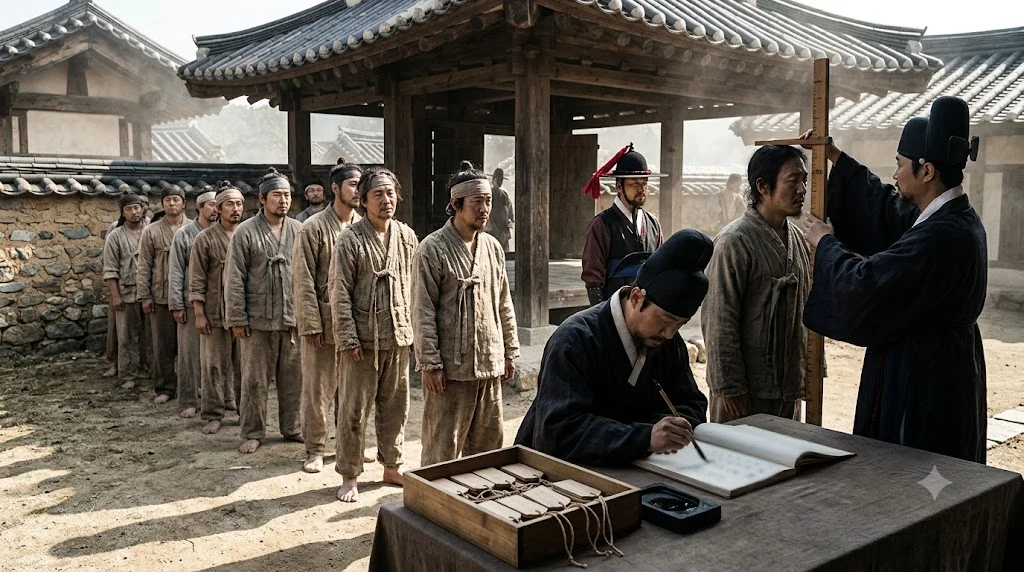
If you read the piece on the hopae, you have met Joseon’s answer to a problem every early modern state had: how do you attach a real body to a name on a list, and keep it attached?
Korea’s answer was a tag you carried. It was not the only answer available, and comparing it with the neighbours makes clear what the tag was actually for.
Quick answer: Ming China worked through household registers — the huangce, or “yellow registers,” compiled for tax and corvée — layered with collective-responsibility groupings (lijia, then baojia), and controlled movement with a travel permit, the luyin. Tokugawa Japan routed registration through Buddhist temples: households were certified by a temple and those certifications were bound into population registers. Joseon Korea combined a body-carried tag with a household register organised by lineage. All three were built by governments that needed soldiers and grain. None was built to help a person prove she was herself.
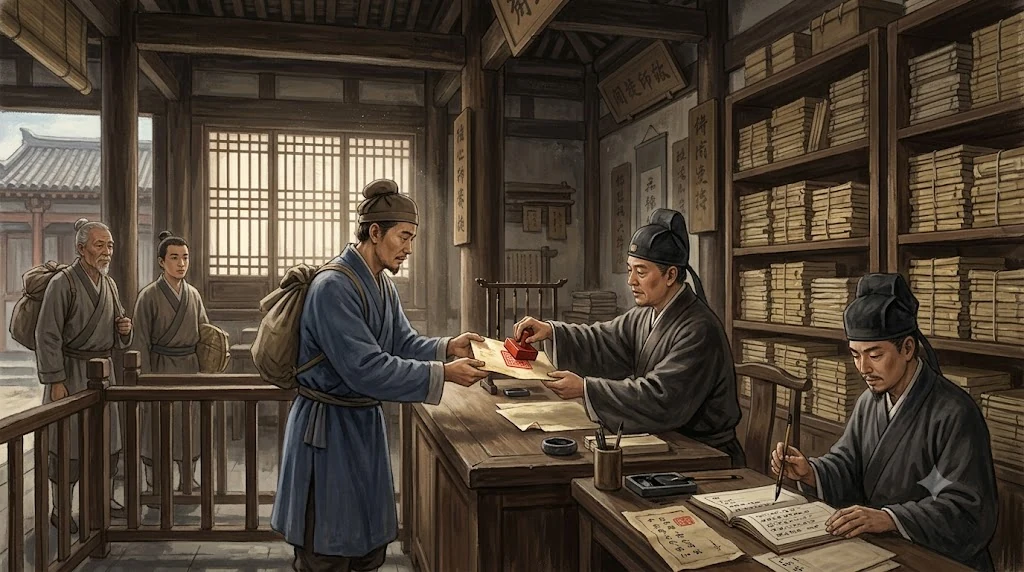 A traveller receives his luyin — the permit certifying he left home lawfully. Behind him, the registers the permit is checked against. (AI illustration)
China — the register as the foundation of the state
Chinese household registration long predates Joseon and set the template Korea inherited.
Under the Ming, the population was organised through the lijia (里甲) system: 110 households formed a li, the ten wealthiest furnishing the headmen, with the remaining hundred divided into ten jia and service rotating on a fixed decennial cycle. Layered over it from the mid-Ming came baojia (保甲), in which ten households formed a jia and ten jia a bao, with heads responsible for local order. The registers themselves — the huangce (黃冊), the “yellow registers” — supplied the base data for taxation and corvée recruitment, and were sometimes called the fuyi huangce, the yellow registers for tax and labour service.
Movement was controlled directly too: a traveller going beyond a set distance from his home district was required to carry a luyin (路引), a permit certifying he had left home lawfully.
The difference from the hopae is instructive, though it is a difference of emphasis rather than of kind. China’s instrument authorised movement; Korea’s tag certified belonging. Both answer the same anxiety — a subject in the wrong place is a subject who has fallen off a tax roll. And Joseon’s ogajaktong, households bound into units of five with shared liability, is visibly a cousin of baojia: same collective liability, same use of neighbours as the enforcement layer of last resort, same admission that central records go stale the moment they are written.
Japan — identity delegated to the temple
Tokugawa Japan, ruled by the shogunate from 1603 to 1867, arrived at a genuinely different arrangement, and its origin was religious rather than fiscal.
Suppressing Christianity, the shogunate required households to be certified by a Buddhist temple; officials collected these certifications and bound them into ledgers known as shūmon-ninbetsu-aratamechō (宗門人別改帳), the registers of religious inquisition and population inspection. These recorded the household head, the names, ages, sexes and relationships of members, animals owned, and tax notations. Alongside them ran the goningumi registers of five-household units — Japan’s own version of the same collective-responsibility instinct — and a system of travel permits (tegata) enforced at road checkpoints.
Note the drift, because it is the interesting part. What began as religious surveillance became general administration: a document created to prove you were not Christian ended up doing the work of population registration. In Japan the paper that functioned as proof of identity for marriage, travel and official business was issued by a temple, and the register was formally a record of religious affiliation.
 A household is certified by its parish temple. The document is religious in form and administrative in function — and the registers beside the desk are where it ends up. (AI illustration)
Korea never routed identity through a religious institution. It routed identity through lineage — a person placed in the record by the sajo, the four-ancestor formula. Which is why a Joseon forger’s real target was a genealogy and a Tokugawa subject’s problem was his temple.
And Europe, briefly
Premodern European states also issued documents letting a named person pass safely through territory — the safe-conduct, ancestor of the passport. But these were largely grants for particular journeys across jurisdictions, not entries in a standing national roll of subjects.
The expectation that every ordinary inhabitant should hold a document establishing identity, backed by a continuously updated register of the whole population, arrived in most of Europe considerably later — alongside conscription and mass taxation. Which is the giveaway, and it applies to all four cases here. Wherever a state decides it needs every adult body on a list, look for what it is planning to ask of those bodies.
Compared
| Joseon Korea | Ming China | Tokugawa Japan | |
|---|---|---|---|
| Carried on the person | Hopae tag, material graded by standing | Luyin travel permit, for journeys | Tegata travel permit, checked at barriers |
| The standing record | Hojeok household register, recompiled every three years | Huangce yellow registers, for tax and corvée | Shūmon-ninbetsu-aratamechō, temple-certified |
| Who vouches for you | Your household and your four ancestors | Your neighbours, through lijia / baojia | Your parish temple |
| Collective liability | Ogajaktong, units of five | Baojia, tens within tens | Goningumi, units of five |
| Original driver | Labour and military service | Tax and corvée | Religious suppression, becoming administration |
In short: all three states were solving the same problem — keeping a population legible for taxation and service — and all three used collective liability to do it; what differed was the anchor. Korea anchored identity in lineage and put a tag on the body, China anchored it in the neighbourhood and licensed movement, and Japan anchored it in the temple.
Key terms. Hopae (호패 號牌) — the Joseon carried tag. Hojeok (호적) — the Joseon household register. Sajo (사조 四祖) — the four-ancestor formula placing a person in that register. Ogajaktong (오가작통) — Joseon five-household liability units. Lijia (里甲) / baojia (保甲) — Ming household groupings. Huangce (황책 黃冊) — the Ming “yellow registers” for tax and corvée. Luyin (노인 路引) — the Ming travel permit. Shūmon-ninbetsu-aratamechō (종문인별개장) — the Tokugawa temple-certified population register. Goningumi (오인조) — Tokugawa five-household units. Tegata (수형) — Tokugawa travel permits.
Back to the drama
Hong Geum-bo walks into a brokerage with a new name and a new age, and the paperwork holds long enough for a plot to happen.
In any of the three systems above, the paperwork would have been the easy part to fake and the hard part to survive — because in none of them was the document the point. The point was the register behind it, and the neighbours, or the temple, or the ancestors who were expected to answer for you.
For Joseon’s system in full — the 1413 regulations, the penalties, and the eighteen years of actual operation in two hundred and sixty — see the main post.
Frequently asked questions
Did China have something like the Korean hopae? Not as a universal carried tag in the same way. Ming China worked primarily through household registers — the huangce or “yellow registers” used for tax and corvée — combined with collective-responsibility groupings, lijia and later baojia. For movement it used the luyin, a travel permit certifying that a traveller had lawfully left his home district.
How did Tokugawa Japan register its population? Through Buddhist temples. Suppressing Christianity, the shogunate required households to be certified by a temple, and officials bound those certifications into registers known as shūmon-ninbetsu-aratamechō, recording household heads, members’ names, ages, sexes and relationships. Alongside them ran goningumi five-household groups and tegata travel permits checked at road barriers.
What made Joseon’s system different? The combination rather than any single element. Joseon paired a tag carried on the body with a household register organised by lineage, in which a person was placed through the sajo — the four-ancestor formula. Korea had collective liability too, in the ogajaktong, so the contrast is a matter of emphasis, not of one country having an idea the others lacked.
When did Europe get identity documents? Premodern European states issued safe-conducts letting a named person pass through territory, but those were grants for particular journeys rather than entries in a standing national roll. The expectation that every ordinary inhabitant holds a document backed by a continuously updated register of the whole population arrived in most of Europe considerably later, alongside conscription and mass taxation.
Sources & further reading
- Encyclopædia Britannica — 「Lijia」, 「Baojia」, 「Tokugawa period」.
- ChinaKnowledge.de — 「huangce 黃冊」, the yellow registers for tax and labour service.
- Encyclopedia of Korean Culture — 호패, 호적, 오가작통.
- 『태종실록』 26권, 태종 13년 9월 1일 4번째 기사 — the 1413 hopae regulations.
This article was researched and written by K-Drama History. Source: Before Passports: How Joseon Korea, Ming China and Tokugawa Japan Proved Who You Were — K-Drama History