Three Hun, Seven Po, and Four Mitama: How East Asia Divided the Soul
Theme: Belief, Death & the Uncanny
From the research behind Pause the Drama.
If you read the piece on honbaek, you have met the Korean arrangement: a person comes apart at death into hon and baek, and each half gets its own address and its own upkeep.
That model was not invented in Korea, and it was not the only thing done with it. The same East Asian inheritance was counted, subdivided and re-sorted differently by the neighbours — and setting the versions side by side is the fastest way to see what is actually distinctive about the Korean one.
Quick answer: Chinese tradition counts the components — standardly three hun and seven po. Korean Confucian ritual generally used honbaek as a two-part compound rather than an enumeration, though some Jeju traditions spoke of three souls with three destinations. Shintō analysed a single tama into functional aspects — ruling, harmonising, transforming, blessing — rather than pieces going to separate places. The Greek and Christian inheritance runs the other way entirely: one soul, one journey. What is distinctive about Korea is less the splitting than the addressing.
China — the origin, and a different arithmetic
The vocabulary is Chinese, and the basic split is the same: hun are the heavenly, more spiritual souls that leave the body at death; po the earthly and material ones, sorted along yin and yang lines.
The difference is that the Chinese tradition counts them. A person is standardly said to have three hun and seven po, with health depending on their harmonious union and sickness and death following from their separation. The ritual bargain is stated plainly too: if the prescribed burial rites and sacrifices are properly observed, the hun send blessings to the bereaved family from their dwelling in heaven.
Korea absorbed the framework and generally did not enumerate — honbaek works as a two-part compound. But the counting instinct survived in places. Jeju folk belief held that a person had three souls: one departing for the King of the Underworld, one guarding the bones in the grave, and one attaching to the spirit table in the house until the three-year mourning ended, then rising into the sky.
Two remarks so this is not read as a tidy family tree. “China” here means a long, internally varied tradition, not a single doctrine held everywhere at once; and the Jeju material comes from folklore collection, which is a different kind of evidence from a court ritual manual.
Japan — the same furniture, a different theory
Japanese religion has tama, a soul or divine and semi-divine spirit, analysed into distinguishable aspects: the ara-mitama with the power to rule, the nigi-mitama to harmonise, the kushi-mitama to transform, the saki-mitama to bless.
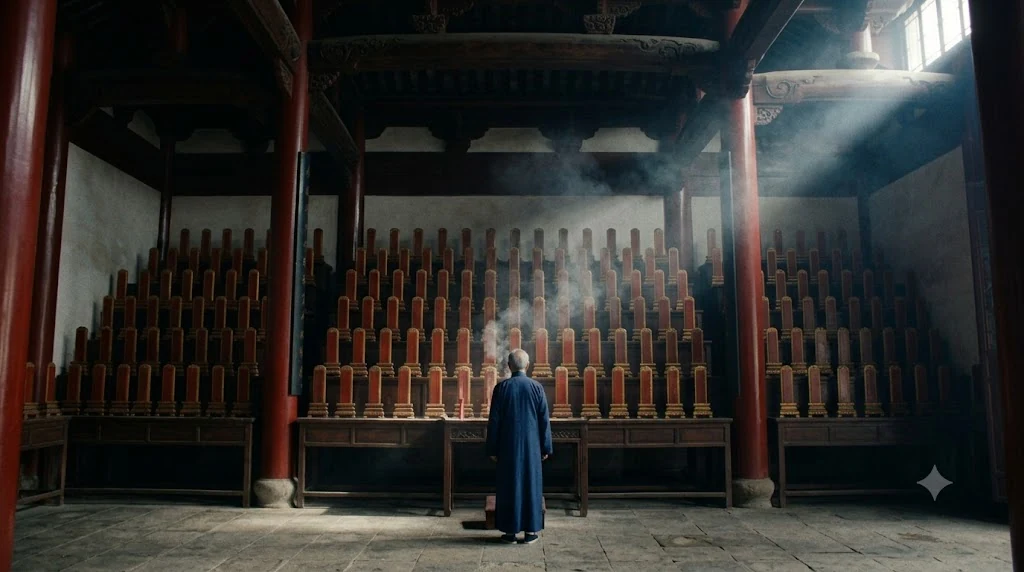
In Shintō households the physical apparatus is startlingly close to Korea’s. The tamaya is a household altar for the spirits of deceased ancestors, holding a tamashiro — a mirror or tablet listing the names of the family dead — with offerings made daily for the first fifty days after death, after which the tablet joins the other ancestors for regular worship. A named tablet, a domestic shrine, an intensive initial period, then absorption into the collective ancestry: the hardware is nearly interchangeable with the Korean sinju and sadang.
One scope limit matters, because it is the kind of thing a comparison quietly inflates. The tamaya is not in every Shintō-observing home: Buddhist practice dominates Japanese funerary rites, and the tamaya belongs to priestly or strict Shintō households. So this is a Shintō parallel to the Korean arrangement, not the Japanese norm set beside the Korean one.
And the theory underneath differs even where the furniture matches. The mitama are aspects of one spirit — facets, modes, powers — not pieces going to two different physical destinations. Japan divides the spirit’s functions. Korea divided its addresses.
Greece — the single traveller
The Homeric poems use “soul” in two related ways, per the Stanford Encyclopedia of Philosophy: it is something risked in battle and lost in death, and it is what at the moment of death departs from a person’s limbs and travels to the underworld, where it has a more or less pitiful afterlife as a shade or image of the deceased.
Note the shape. The psyche is one thing, and it goes. In this register nothing important is left behind requiring separate accommodation — which is the exact hinge the Korean scheme turns on.
That is a statement about the Homeric material specifically, and it should stay one. Greek thought about the soul is not a single position: later philosophy argues about it at length, and Greek practice included tomb cult and offerings to the dead that assume some ongoing relationship. The contrast worth drawing is with the Homeric picture, not with “the Greeks.”
Why the Korean version needed a bureaucracy
If a person is one soul with one destination, the interesting question about death is judicial — where does it go, on what verdict? Korea has stories in that register too, and this site has told them: the seven courts of the Buddhist afterlife, the black-hatted jeoseung-saja who comes to collect you.
But those sit alongside a Confucian arrangement whose question isn’t judicial at all. It is architectural: two things have separated, both are still here in some sense, and someone must decide where each lives and who feeds them.
That is why the Joseon state kept a soul hall — the honjeon — with a cabinet minister at its head, and an altar in the northern suburbs for the dead who had nobody. Not because it was unusually superstitious, but because the model it had adopted leaves two objects to house rather than one soul to see off, and it followed that model down into its budget and its bureaucracy.
Compared
| Korea (honbaek) | China (hun/po) | Shintō Japan (tama) | Homeric Greece (psyche) | |
|---|---|---|---|---|
| How many? | Two, as a compound — not usually counted (some Jeju traditions: three) | Counted: three hun, seven po | One spirit, several aspects | One |
| What separates? | Hon ascends, baek stays with body and grave | Hun leave at death, po are earthly | Nothing goes to separate places — aspects of one spirit | The psyche departs entire |
| Physical seat | Silk honbaek, then chestnut sinju tablet in the sadang | Ancestral tablets in the lineage hall | Tamashiro in the household tamaya (Shintō households) | — |
| Intensive early period | Daily meals at the spirit table; three-year sequence | Prescribed burial rites and sacrifices | Daily offerings for the first fifty days | — |
| The state’s role | Royal soul hall under a chief councillor; biannual rite for the unattended dead | — | — | — |
In short: the hon/po framework is a shared East Asian inheritance that each tradition handled differently — China by enumerating it, Shintō by dividing a single spirit into functions, Korea by sending two halves to two physical addresses and then building institutions to maintain both, while the Homeric picture keeps one soul making one journey.
Key terms. Hon / hun (혼, 魂) — the light, ascending, more spiritual component. Baek / po (백, 魄) — the heavy, earthly component that stays with the body. Honbaek (혼백, 魂魄) — the Korean two-part compound. Tama (魂) — the Japanese soul or spirit. Mitama — its aspects: ara- (rule), nigi- (harmonise), kushi- (transform), saki- (bless). Tamaya (霊屋) — Shintō household ancestral altar. Tamashiro (霊代) — the mirror or tablet in it. Psyche (ψυχή) — the Homeric soul that departs to the underworld.
Back to the drama
Wicked World moves one whole person from Joseon into a 2026 body. Every tradition above would have found something odd in that — but for different reasons, and the differences are the point.
For the Korean system in full — the roof-calling, the silk figure served three meals a day, the state altar for the dead nobody was feeding, and the 1438 court prayer that named hon and baek separately — see the main post.
Frequently asked questions
How many souls did East Asian traditions believe a person had? It depends which tradition and which register. Chinese tradition standardly enumerates three hun and seven po. Korean Confucian ritual generally used honbaek as a two-part compound rather than a count, though some Jeju traditions described three souls with three destinations. Shintō analysed a single tama into distinguishable aspects rather than counting separate souls.
What is the difference between hun and po? In the Chinese scheme the hun are the heavenly, more spiritual components that leave the body at death, and the po are the earthly and material ones, sorted along yin and yang lines. Health was held to depend on their harmonious union, sickness and death on their separation.
What are the four mitama? Japanese religion analyses tama — a soul or divine spirit — into aspects: the ara-mitama with the power to rule, the nigi-mitama to harmonise, the kushi-mitama to transform, and the saki-mitama to bless. These are aspects of one spirit, not separate souls headed to separate places.
Did Japan have something like the Korean ancestral tablet? In Shintō households, yes. The tamaya is a household altar for deceased ancestors holding a tamashiro — a mirror or tablet listing the family dead — with offerings made daily for the first fifty days after death, after which the tablet joins the other ancestors. But the tamaya is not in every Shintō-observing home, since Buddhist practice dominates Japanese funerary rites.
How is the Korean model different? Less in the splitting than in the addressing. China counted the components; Shintō divided a spirit’s functions. Korea sent its two halves to two different physical places — the baek to the grave, the hon to a silk figure and then a wooden tablet — and built institutions to maintain both.
Sources & further reading
- Encyclopaedia Britannica — 「Hun」 and 「Po」, on the heavenly and earthly components and the three-hun/seven-po enumeration.
- Encyclopaedia Britannica — 「Tama」 and 「Tamaya」, on the mitama aspects, the Shintō household altar and the fifty-day period.
- Stanford Encyclopedia of Philosophy — Ancient Theories of Soul, on the Homeric psyche.
- Encyclopedia of Korean Culture — 넋, 영혼관, 혼백상 (the last carrying the Jeju three-soul tradition).
This article was researched and written by K-Drama History. Source: Three Hun, Seven Po, and Four Mitama: How East Asia Divided the Soul — K-Drama History