The King and the Clown, Explained: Why a Court Clown Could Mock a Tyrant and Live
Theme: Status & Class
From the research behind Pause the Drama.
If you’ve watched The King and the Clown (왕의 남자, 2005) — the film that became the first historical drama in Korean cinema to cross 10 million admissions — you remember the danger in it. Two itinerant performers, Jang-saeng and Gong-gil, are dragged off the street and into the palace of King Yeonsangun. There, in front of the throne, they do the one thing that should get them killed: perform a mask play that mocks the king himself.
The film plays this as a high-wire act of nerve. But it is also, quietly, a documentary about a real institution. Joseon Korea had a recognized theatrical space in which performers — drawn largely from its most marginalized hereditary communities — could stage satire in front of the king, more openly than ordinary court speech ever allowed. It had rules, risks, and a name.
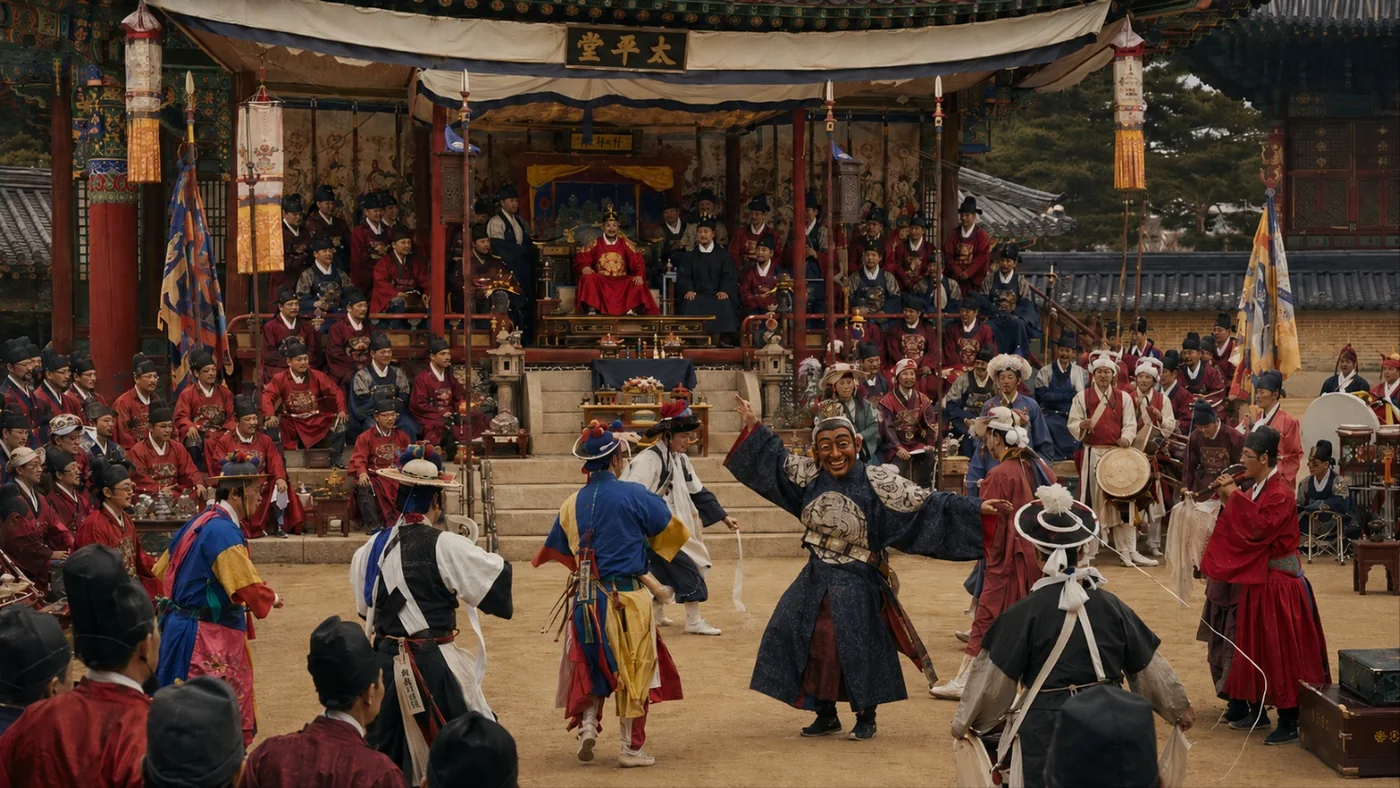 A masked court performance before the throne — the licensed, occasion-bound space in which a lowborn gwangdae could mock power to the king’s face. (AI illustration)
Quick answer: The King and the Clown draws on a real Joseon tradition — but Korea had no permanent royal jester like the European court fool. During narye and other court entertainments, professional performers (jaein and changu, drawn from marginalized hereditary communities) could use comic skits to expose corrupt officials and voice indirect criticism before the king. This was a temporary, revocable theatrical latitude, not legal immunity: the historical performer Gong-gil was flogged and exiled in 1505 after King Yeonsangun judged his classical quotation disrespectful.
Let’s unpack it.
Why does a masked comedy routine terrify a king in this film?
Because in the world the film reconstructs, the mask was not a legal shield — but it opened a temporary theatrical space where criticism could sometimes be voiced more openly than ordinary court speech allowed.
Confucian Joseon ran on a rigid, sincere hierarchy: king above official, official above commoner, commoner above outcaste. Almost nowhere in that stack was a person of low rank allowed to say an uncomfortable truth to a person of high rank, let alone the king. And yet the film shows exactly that happening, staged as art, tolerated (barely) as performance. Jang-saeng and Gong-gil are not soldiers or officials with standing to challenge Yeonsangun. They are the opposite: outcastes with nothing to lose and, for the length of a performance, a temporary latitude that ordinary petitioners and courtiers rarely had — one that could vanish the instant the king judged the joke disrespectful.
That protection was not fictional set dressing. It came from a real, centuries-old court tradition.
What actually happened: narye, sandaehui, and the performers who staged them
The ritual: narye. Long before it was entertainment, narye (나례, also written 나희) was religion — a year-end exorcism performed to drive out the old year’s evil spirits and purify the palace for the New Year. According to the Encyclopedia of Korean Culture, the custom was transmitted to Korea’s royal court from China as far back as the Goryeo dynasty, and in its earliest recorded form involved masked youths, a four-eyed exorcist figure called bangsangsi, and a five-person masked dance called cheoyongmu. Over time the line between “sacred rite” and “show” blurred: the same encyclopedia notes that as narye’s religious character thinned out, it absorbed acrobatics, music, and comic routines, becoming as much spectacle as ritual. The palace kept a dedicated office to run it — first a narye bureau, later the royal Bureau of Astronomy. Rather than a single clean abolition, the court’s grand sandae version was wound down in stages: the one staged for a king’s return was ended by 1744, and after 1784 the envoy-reception sandae narye was no longer held — a discontinuation that settled in over the following reigns. As the palace tradition faded, the performers who once served the court scattered into private, itinerant troupes.
The spectacle: sandaehui. For the biggest state occasions — receiving Chinese envoys, welcoming a king home from a procession, royal agricultural rites — Joseon built something more theatrical still: the sandae (산대), a towering stage shaped like the mythical Bongnaesan (Penglai) mountain, decorated with rock, tree, and figurine ornamentation. The largest documented installation (1620) used main structural poles up to 90 cheok long and secondary poles around 80 (a cheok is a traditional Korean foot-measure), supporting a decorated structure whose main level stood roughly 60 cheok above the ground — big enough that a visiting Ming envoy likened it to a city gate. Not every sandae was this size, and later versions were often smaller and mobile. On and around this structure, professional entertainers staged sandaehui (산대희) — mask dances, tightrope walking, acrobatics, mechanical puppet displays. A record from 1626 (King Injo’s fourth year), during a Ming envoy reception, gives a sense of scale: the Naryecheong deungnok lists 286 performers under the “left bureau” alone, and factoring in the two-bureau (left/right) structure, the full mobilization is estimated at 500 or more — perhaps around 600 — though that total is an inference from the left-bureau record, not a precise headcount.
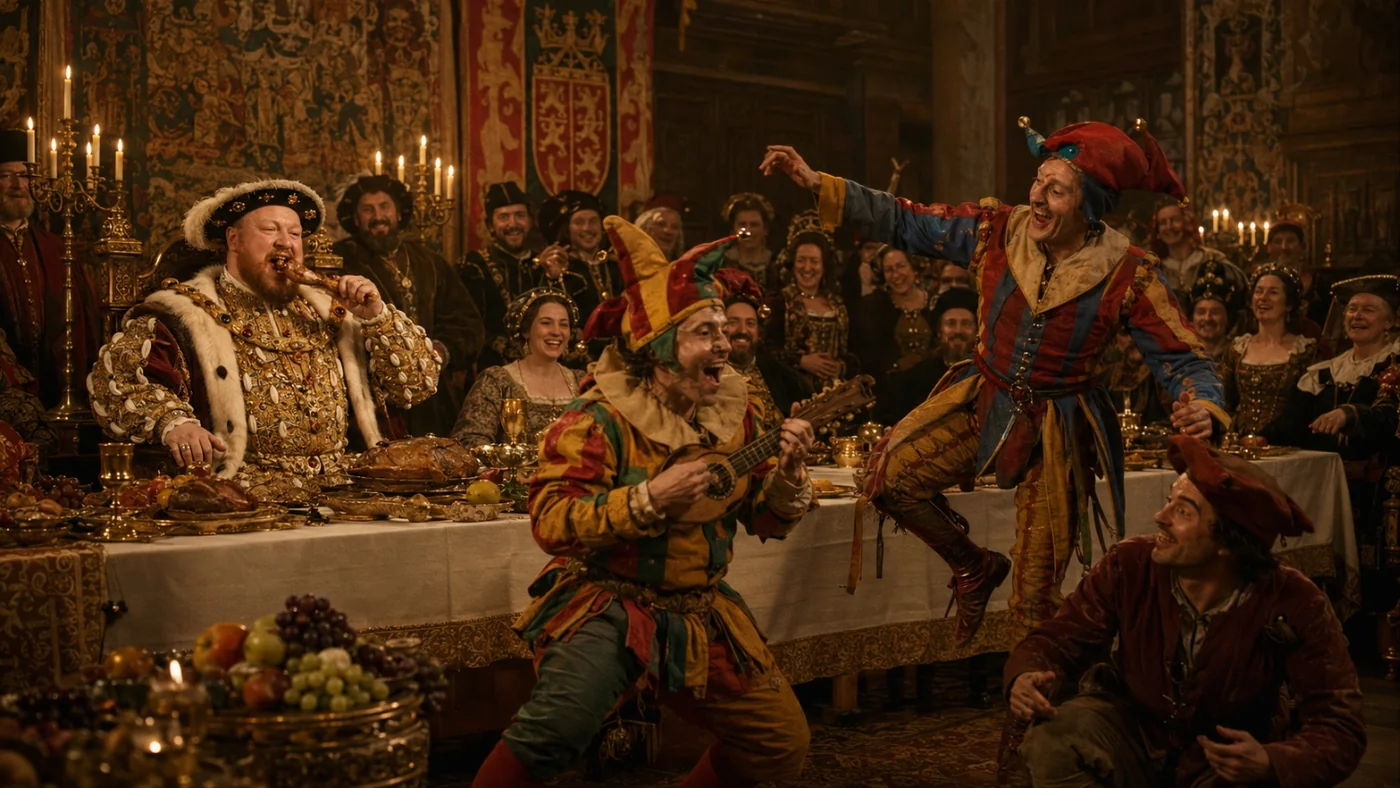 Europe’s court fool — like Henry VIII’s Will Somer — held a standing household position near the monarch, where Joseon’s jaein had, at most, a stage and a night. (AI illustration)
The performers: jaein and changu. Who actually put on these masks? Men and women classified as jaein (재인) and changu (창우, 倡優) — professional entertainers who specialized in acrobatics, music, mask dance, and comic patter (재담), and who, in many households, doubled in trades like leatherwork and butchering. Crucially, their status is more tangled than a single label. Entertainers like jaein were socially despised, and by later Joseon they are described in the encyclopedic record alongside butchers (백정) as lowborn. But the legal picture initially cut the other way: in 1423, King Sejong’s court — treating jaein and the hwacheok as commoners by origin who were nonetheless shunned in marriage — relabeled them baekjeong and actively encouraged them to live among, and marry, ordinary commoners. The reform didn’t dissolve the stigma: people kept calling them jaebaekjeong, and the sources describe jaein status as caught between this push toward commoner assimilation and a persistent slide toward outcaste standing. By the late Joseon period, once the palace’s own narye tradition ended, these performers organized into itinerant troupes — the elite sandaepae, the nationwide changupae, the temple-linked sadangpae — carrying the mask-dance tradition out of the palace and into village and market squares, part of why Korean mask dance (탈춤) survives today in regional forms like Bongsan talchum.
Fact and fiction: King Yeonsangun. The King and the Clown sets its story in the court of King Yeonsangun (연산군, r. 1494–1506), and here the film’s foundation is solidly historical, even where its plot invents freely. Yeonsangun’s reign is remembered for two brutal political purges and a documented, dramatic expansion of the palace’s entertainment establishment: records describe him dispatching officials (chaehongsa, 採紅使) to the provinces to recruit courtesans, and expanding court women and performers into the hundreds under categories like heungcheong, at a scale historians call unprecedented for the era. This indulgence, alongside his purges of the scholar-official class, fed directly into the coup that ended his reign: in September 1506, officials led by Seong Hui-an, Park Won-jong, and Yu Sun-jeong deposed him in the Jungjong banjeong (중종반정), exiling him to Gyodong Island (in present-day Ganghwa, Incheon) and placing his half-brother on the throne as King Jungjong.
Here is the part that should genuinely surprise you: one of the film’s two central performers is not fully invented. Jang-saeng, the bold, scarred lead played by Gam Woo-seong, was created for the stage play 이 (爾) by playwright Kim Tae-woong. But Gong-gil (공길), played by Lee Jun-ki, appears in the actual Annals of King Yeonsangun. The entry, dated to the 12th lunar month of the king’s 11th year (1505), records that a performer named Gong-gil staged a mock-elderly-scholar routine, telling the king, in effect, “Your Majesty is like the sage-kings Yao and Shun, and I am like their minister Gao Yao — but sage-kings aren’t always around, while a Gao Yao always is,” before reciting a line from the Analects: “A ruler must be a ruler, a subject a subject, a father a father, a son a son… if these are not so, how can I eat, even with grain before me?” Yeonsangun judged the remark “close to disrespect” and had Gong-gil flogged and exiled. The record ends there — Gong-gil disappears from history after that single entry. Whether it was deliberate satire or an unintended slip, the Annals do not say. But the shape of it — a low-status entertainer, a performance, a barbed classical quotation aimed at the throne, and a punishment — is the seed the entire film grew from.
Here is what the drama shows beside what the historical record supports:
| In the drama | In history |
|---|---|
| Jang-saeng and Gong-gil are recruited from the street into the palace | Court entertainers were routinely mobilized from provincial troupes for major state ceremonies (narye, sandaehui) |
| The two perform an elaborate satirical mask play mocking the king and his officials | A performer named Gong-gil is recorded once, in 1505, performing a satirical routine quoting the Analects at Yeonsangun |
| Their performance provokes fury and violent royal reprisal | Gong-gil was flogged and exiled for words judged disrespectful; the record does not confirm the film’s larger plot |
| Jang-saeng is a fully realized, named historical-feeling character | Jang-saeng does not appear in the historical record; he was invented for the 2000 play 이(爾) |
| Yeonsangun is shown as erratic, entertainment-obsessed, and doomed | Yeonsangun’s real reign (1494–1506) did feature a documented expansion of palace entertainers and ended in the 1506 Jungjong coup |
In short: The King and the Clown takes a single annal entry — a court performer punished for a pointed classical quotation — and builds an entire fictional relationship, plot, and tragedy around it, while keeping its surrounding world, Yeonsangun’s excesses and downfall, close to the documented history.
Key terms. Narye (나례) — a year-end court exorcism ritual that gradually absorbed mask dance and comic performance. Sandaehui (산대희) — mask-dance and acrobatic spectacles staged on the towering sandae stage for state occasions. Jaein (재인) / changu (창우) — professional entertainers, socially despised and, by late Joseon, associated with cheonmin standing, though their legal status shifted over time. Cheonmin (천민) — a broad, unevenly applied label for socially and legally degraded groups; enslaved people, butchers, and hereditary entertainers did not all share an identical legal position, and jaein status shifted across periods and regions.
A licensed fool is not a uniquely Korean idea — but the license worked differently
Nearly every hierarchical court in history seems to invent the same pressure valve: a performer allowed, within limits, to say the thing no one else can. Confucian Joseon is one version. Renaissance Europe is another.
In Tudor England, Henry VIII kept a court fool named Will Somer, first recorded in the royal accounts in 1535, who stayed close to the king for the rest of his reign. Historians distinguish “artificial” fools — professional wits who performed folly as a craft — from “natural” fools, historically people with disabilities kept at court partly for amusement; some sources read Somer as the latter, though this is debated rather than settled — a useful complication of any tidy story about jesters as calculating satirists. In France, the name Triboulet attached to a court fool — really a blend of several, linked to the courts of Louis XII and Francis I — whose reputation for surviving his own insolence was later fictionalized by Victor Hugo and, in turn, Verdi’s Rigoletto (which censors relocated from the French court to a Mantuan one). A little further south, 16th-century Italy produced commedia dell’arte: masked stock characters — the boastful soldier Capitano, the pedantic Dottore, the grasping Pantalone — whose improvised scenes, per Britannica, turned into pointed mockery of recognizable social types.
The pattern that connects all of this to The King and the Clown is simple: power tends to carve out a small, licensed space for its own mockery. A ruler who can laugh at a joke about himself looks secure; a ruler who cannot look tyrannical. Satire staged as festival or ritual theater lets a court release pressure — and exposes corrupt officials by proxy — without anyone having to be formally, dangerously blamed.
But the difference in status is real, and it matters. European court fools, whether “natural” or “artificial,” typically held a recognized, standing position inside the royal household — a job, however strange, with continuity and a place near the monarch’s person. Joseon had no clearly comparable office — no permanent personal jester on the royal payroll. Its satirical performers came from the lower rungs of Joseon’s hereditary and occupational status order, and reached the king not through a standing household post but through ritual, ceremony, and organized court entertainment — mobilized for a specific occasion and sent home, or, as Gong-gil’s case shows, punished the moment the performance stopped reading as entertainment and started reading as insult. Europe’s court fool could hold a continuing seat in the royal household. Joseon’s jaein had no such office — at most a stage, an occasion, and a night.
Coming up next
One court, one mask, one recorded sentence in an ancient chronicle — and from it, a global comparison stretching from a Tudor throne room to an Italian street stage. That’s the pattern worth remembering: even the strictest hierarchies build themselves a pressure valve, and the people staffing that valve are rarely the ones anyone expects to protect.
In the next essay, we’ll take another K-drama scene that looks like pure invention — and trace the real Korean history hiding underneath it.
Frequently asked questions
Is The King and the Clown based on a true story? Partly. The film is adapted from the play 이(爾) (Yi) by Kim Tae-woong, and its two leads are not equally real. Jang-saeng was invented for the play. Gong-gil, however, appears once in the actual Annals of King Yeonsangun, performing a satirical skit for which he was flogged and exiled. The surrounding world — Yeonsangun’s real entertainment excess and his 1506 deposition — is genuine history.
What was narye (나례), the ritual behind the film’s court performances? Narye was a year-end exorcism ritual, transmitted to Korea’s court from China as far back as the Goryeo dynasty, meant to purify the palace and drive out evil spirits before the new year. Over centuries it absorbed acrobatics, mask dance, and comic skits alongside its ritual core, before the court’s grand sandae version was wound down in the late 18th century — the envoy-reception form no longer held after 1784, a change that settled in over the following reigns.
What was sandaehui (산대희)? Sandaehui were large mask-dance and acrobatic spectacles staged on and around the sandae, an elaborate mountain-shaped stage structure — the largest documented version (1620) raised on structural poles up to 80–90 cheok long, likened by a Ming envoy to a city gate — built for occasions like the arrival of Chinese envoys and royal celebratory processions.
Were jaein and changu really the lowest social class in Joseon? It’s more tangled than a flat yes. These performers were socially despised and, by later Joseon, grouped with the lowborn alongside butchers (baekjeong). But in 1423, King Sejong’s court treated jaein as commoners by origin, relabeled them baekjeong, and actually encouraged them to marry ordinary commoners — the opposite of a legal marriage ban. The stigma persisted anyway (people kept calling them jaebaekjeong), so their status is best read as caught between a legal push toward commoner assimilation and enduring social contempt.
Was Gong-gil, the character played by Lee Jun-ki, a real person? There really was a court performer named Gong-gil (孔吉). The Annals record that in the 12th lunar month of 1505, he performed a mock scholar routine quoting Confucius directly at King Yeonsangun, was judged disrespectful, and was beaten and exiled — after which he vanishes entirely from the historical record.
What happened to King Yeonsangun? Yeonsangun ruled from 1494 to 1506. His reign is remembered for two bloody purges of officials and a dramatic expansion of palace entertainment troupes and courtesans. In September 1506 he was deposed in a coup known as the Jungjong banjeong and exiled to Gyodong Island (in present-day Ganghwa, Incheon); his half-brother took the throne as King Jungjong.
How does the Korean court jester compare to Europe’s court fool? Both traditions gave performers a narrow license to mock the powerful — England’s Will Somer for Henry VIII, France’s Triboulet (a figure blending several French court fools). The key difference is status: European fools held a recognized household position near the monarch, while Joseon’s jaein and changu came from the lower rungs of its hereditary status order and reached the throne only through ritual and organized court entertainment — an occasion-bound latitude, not a standing household post.
Why would a king allow lowborn performers to mock him at all? Because satire performed as ritual or festival theater let a court blow off steam, expose corrupt officials by proxy, and let a king appear magnanimous — without any single person having to be formally blamed. But the license was narrow and revocable, and it could fail badly, as Gong-gil’s flogging and exile show.
Sources & further reading
This piece was written from the historical script and fact-check of 사뚱샘의 역사방 (SaDDungSam). The specific dates, figures, and quotations above are sourced inline, cross-checked against the Encyclopedia of Korean Culture (Academy of Korean Studies), the National Institute of Korean History’s Veritable Records database, and Encyclopaedia Britannica. For broader reading:
- The court exorcism-turned-entertainment tradition, and its staged wind-down. Encyclopedia of Korean Culture, “나례 (Narye)” and “예인집단 (Performer Groups)”; and Oh Jin-hee, “The Operation and Transformation of Naryecheong in Late Joseon,” The Study of Korean Culture 47 (2024). (Narye, Performer Groups, Oh 2024)
- The mask-dance stage and its performers. Encyclopedia of Korean Culture, “산대 (Sandae)” and “산대극 (Sandaehui mask drama).” (Sandae, Sandaehui)
- The 1505 record of Gong-gil’s satire. Veritable Records of the Joseon Dynasty, Annals of King Yeonsangun. (National Institute of Korean History)
- European court fools as a comparative tradition. Encyclopaedia Britannica, “Fool: Court Jester, Clown & Trickster,” and Historic England, “The King’s Fools: Disability in the Tudor Court.” (Britannica, Historic England)
Thanks for reading — see you in the next one.
This article was researched and written by K-Drama History. Source: The King and the Clown, Explained: Why a Court Clown Could Mock a Tyrant and Live — K-Drama History