From the research behind Pause the Drama.
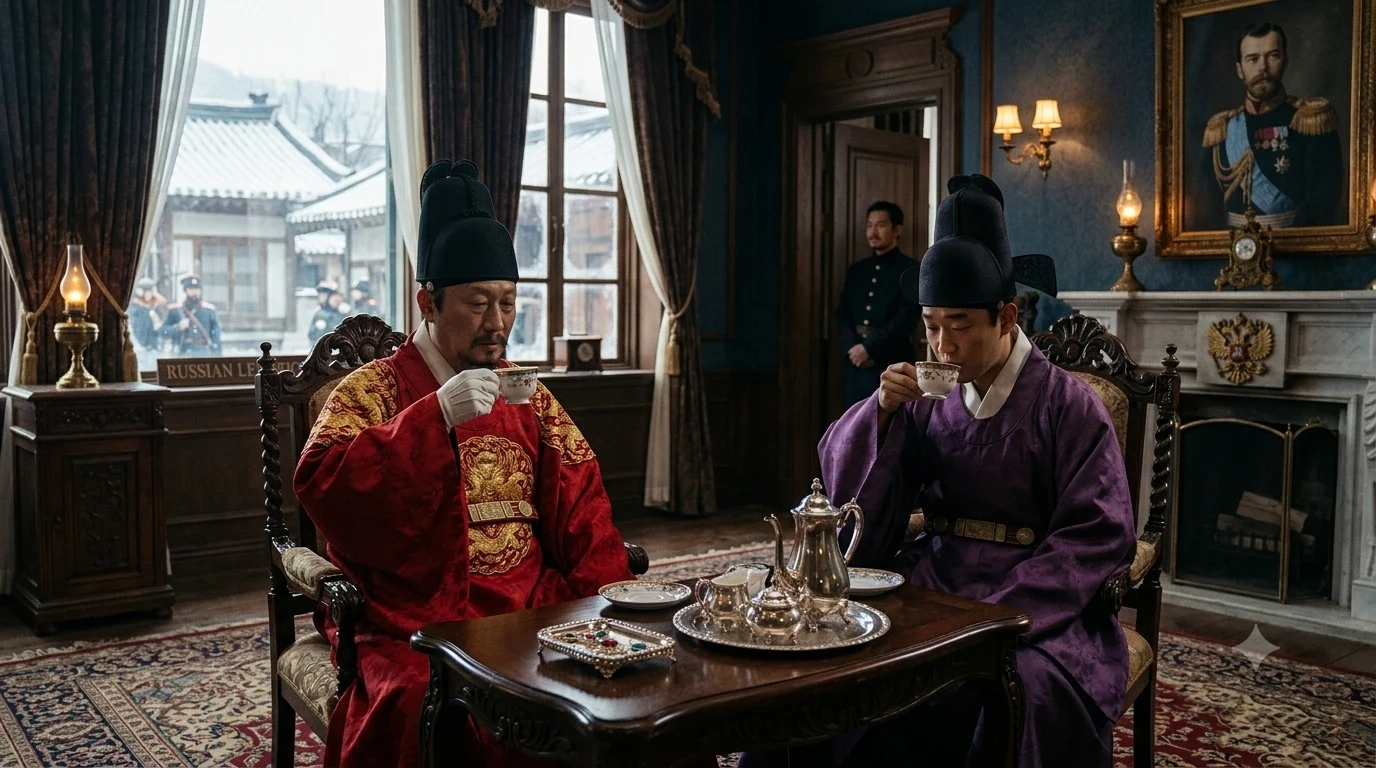
Mr. Sunshine keeps returning to a room where the new century seems to have arrived early: a hotel lounge lit by gaslight, porcelain cups, upholstered chairs, people learning new ways to sit and speak and bargain. The drama is set in the years when the Korean Empire was trying to build a modern state under pressure from every direction, and that room is where the pressure becomes furniture.
One of the things poured in it was coffee.
At the Korean court coffee was a pleasure, a diplomatic prop, and — for one night in the autumn of 1898 — a weapon. That last part is not a legend. It is in the Veritable Records, down to the quantity of the drug and the price the man was promised.
Quick answer: In September 1898, opium was put into coffee served to Emperor Gojong and the crown prince, the future Sunjong. The Veritable Records of Gojong name the vessel — the coffee pot, 珈琲茶罐 — and set out the chain: Kim Hong-yuk, an interpreter sentenced to exile, passed the drug to Gong Hong-sik, who paid a dismissed royal-kitchen storekeeper, Kim Jong-hwa, to put it in. Both men drank and both survived. The case then became an argument about whether to bring back the old punishments.
How coffee actually got here
The tidy version says coffee came with the treaty ports. The tidier version says it came to Gojong at the Russian legation. Neither is quite the shape of the evidence.
Coffee was here first. The letters of Bishop Siméon-François Berneux, the French missionary executed in the persecution of 1866, record coffee ordered in 1860 and brought into the country in 1861 — fifteen years before the Ganghwa Treaty. What the ports and legations did after 1876 was not introduce the bean but spread it: through the settlements, the missions and the hotels, and into the palace whenever Westerners were received. Not the door, in other words. The rooms where a foreign drink became a familiar one.
The names it collected measure how foreign it was. Gabae (가배, 珈琲) is a phonetic borrowing, the same characters that appear in the Veritable Records. A second name, yangtangguk (양탕국) — roughly “Western broth” — turns up constantly in modern popular accounts, glossed as a joke about a bitter black liquid that looked like herbal medicine. The early attestation is thin: it is not clear when or how widely the word was used in 1890s Korea, and the “it looked like hanyak” gloss unpacks the characters rather than records a contemporary reaction. A later nickname, then — not a term to build a title on.
Did the emperor really love coffee?
Yes, as far as the evidence goes — and the best evidence is the dullest. A Japanese diplomatic despatch of September 1898 notes that at Western-style meals Gojong reached for coffee first. That is someone with no stake in a charming anecdote describing a habit.
Two popular claims do not survive. He was not the first Korean coffee drinker: Berneux had it in 1861, and the treaty ports and legations were full of it by the 1880s. Nor did he necessarily discover it during the Agwan Pacheon of 1896, when he took refuge in the Russian legation after his queen was killed — that is the most repeated story about him and coffee, and even official heritage material narrates it with “is said to.” Same for Antoinette Sontag, the Alsatian woman of the Russian legation said to have served him coffee: memoirs and later writing, not contemporary record. Good stories, later stories.
The pavilion follows the same pattern. Jeonggwanheon (정관헌) in Deoksugung is routinely called the Western-style pavilion Gojong built for drinking coffee. Architectural study of the building finds no direct record that it was built for tea or coffee at all, and it is not purely Western — it combines Western structure and ornament with Korean traditional elements. That he enjoyed coffee there is an old and broad tradition. That the building was made for it is not established.
The night of the eleventh
The emperor’s birthday celebration, the Mansuseongjeol, fell in the ninth month of 1898. Contemporary reporting places the drinking of the coffee on the night of 11 September; the official court record is dated 12 September. Many later accounts, including the standard encyclopaedia entry and recent scholarship on the case, therefore give the twelfth as the date of the incident. This accounts for the two dates found in later histories, and neither is careless — one is when it happened, the other is when the state wrote it down.
The entry itself is short. The Minister of the Royal Household, Yi Jae-sun, reports that the emperor and the crown prince have been taken ill at the same time, that due care was not taken when the food was presented, and asks that everyone involved be thoroughly investigated. The reply is one line: let the Police Bureau investigate the root cause severely.
What makes the entry extraordinary is the note attached to it, which lays out what the investigation found:
On the tenth day of the seventh lunar month of this year, Kim Hong-yuk received the edict of exile and set out for his place of banishment that same day, stopping briefly at the house of Kim Gwang-sik. From the hand-bag he was carrying he took out one yang of opium, and suddenly revealing a treasonous heart, gave it to his close acquaintance Gong Hong-sik, secretly instructing him to have it mixed into the royal table. On the twenty-sixth day of the seventh lunar month, Gong Hong-sik met Kim Jong-hwa, told him in full what he had been instructed to do by Kim Hong-yuk, and said that if he mixed this drug into the tea served to the throne he would be rewarded with a thousand won in silver. Kim Jong-hwa had formerly been a storekeeper of Bohyeondang who handled the Western cooking served to the throne, and had been dismissed for performing his duties poorly. He immediately put the drug in his sleeve, entered the kitchen, put it into the coffee pot, and in the end it was served.
— Veritable Records of Gojong, vol. 38, Gojong 35th year, ninth month twelfth day, second article
Three things in that passage are worth slowing down for.
The drink is named. 珈琲茶罐 — the coffee pot. No later tradition attached coffee to a vaguer record about “food.” The state’s own account of its own investigation says coffee.
The chain has three links, not one. Popular retellings compress it to “Kim Hong-yuk bribed a palace cook.” He handed the drug to a friend on his way into exile; the friend found the man with kitchen access; the man with kitchen access was bought. Three people, three different motives.
The man who did it had been fired from that kitchen. Kim Jong-hwa handled Western food for the royal table and lost the post for doing it badly. That gives him both the route in and a grievance — but the record does not credit him with a grievance. It credits him with a price.
One caution about the drug. The inquiry was conducted under torture and closed questioning, and disputes were raised at the time about the substance itself. The record identifies the poison as opium; that is not the same as opium having been demonstrated.
What actually happened to the two men
The familiar telling is a parable: the emperor, a connoisseur, catches the strange smell after a sip and sets the cup down untouched, while his son drinks it down and collapses. A refined palate saves a life.
The primary entry does not support the first half. It says 玉度、睿候同時愆和 — the emperor’s health and the crown prince’s health were impaired at the same time. Contemporary reporting in The Independent on 13 September and a Japanese despatch later that month describe Gojong drinking a small amount and vomiting; the crown prince drank considerably more, vomited and lost consciousness. Others at court who tasted the coffee were affected too, so the harm did not stop at two people.
The difference between the two men is a difference of dose. Nothing establishes that the crown prince was unfamiliar with coffee, so the trained-palate line has to go.
What survives is smaller and better. Gojong noticed the coffee was not as it usually was — which is what happens when a person has had the same drink often enough to know it, and is the most concrete evidence in the whole affair that he really did drink a lot of it.
The part that outlived the poisoning
The assassination attempt failed. The political aftermath did not.
Kim Hong-yuk, Gong Hong-sik and Kim Jong-hwa were executed. Afterwards Kim Hong-yuk’s body was left exposed and was abused by a crowd — often told as folklore, but it appears in contemporary records of how the case was handled, where the question of who was responsible for allowing it was raised. What exactly was done to the body, those records do not detail.
Then, on 23 September 1898, officials at the Privy Council proposed reviving the noryuk provisions — the severe penal treatment applied to grave offenders — and the yeonjwa principle, under which liability extended to a criminal’s family. A number of councillors supported it. Whether any of them had been waiting for an opportunity is not something the sources can tell us; what they show is that the case became the occasion for the demand.
This is where the incident stops being a palace scandal. The Korean Empire was at that moment trying to build modern legal institutions — public trial, punishment by statute — and the poisoning handed the other side an argument. The conflict was not, as it is sometimes put, a clash over a cup of coffee. It was a concrete fight over how this case would be investigated, tried and punished, and whether older collective-liability ideas would come back with it.
Gojong’s own conduct here is more interesting than the drama’s usual portrait of him. Scholarship on the case — Yi Gil-sang’s study of its historical significance — finds him irresolute during the handling, which is the familiar picture. But it also finds that in the end he did not choose the return to the old penal order. Both halves belong in the sentence. Quoting only the second turns a qualified assessment into a defence.
Coffee and power, elsewhere
Korea was not the only place where what people drank became a political question. In the sixteenth and seventeenth centuries Ottoman authorities at various times regulated or closed coffeehouses. Popular accounts put this down to politics — men gathering to talk about the state — but the scholarship is broader: religious controversy over the drink itself, public order and the assembly of social groups all figure, and the response varied by period and by ruler. The accurate statement is narrow: in some periods, Ottoman authorities treated coffeehouses as something to be controlled.
Set beside that, the Korean case inverts the relationship. In the Ottoman lands the drink was what authority watched. In the Korean Empire the sovereign’s familiar drink became the vehicle for an attempt on his life. Gojong noticed something was wrong and drank relatively little; the crown prince drank far more. Both survived — not because coffee offered any protection.
Drama vs. the record
| What the modern frame assumes | What the record shows |
|---|---|
| Gojong was Korea’s first coffee drinker | Coffee was in Korea by 1861, via Bishop Berneux; the ports and legations spread it. He liked it — “first” is a later flourish |
| He discovered coffee at the Russian legation in 1896 | Even official heritage material says this “is said to” have happened. No contemporary record establishes it |
| Jeonggwanheon was the Western pavilion he built for coffee | No direct record that it was built for tea or coffee; its use is contested, and it mixes Western and Korean architectural elements |
| Kim Hong-yuk bribed palace staff to poison the coffee | Three links: Kim Hong-yuk → Gong Hong-sik → Kim Jong-hwa, a dismissed royal-kitchen storekeeper promised a thousand won in silver |
| The emperor detected the poison and was unharmed | The record says both men’s health was impaired at the same time. He drank a little and vomited; his son drank more and collapsed |
| A connoisseur’s palate saved his life | The difference was dose. Nothing establishes the crown prince was unused to coffee |
| The incident was a court scandal | It became the occasion for petitions to revive collective-liability punishment, against a state trying to build modern legal procedure |
In short: the Veritable Records of Gojong document the 1898 poisoning in detail — the opium, the three-man chain, the thousand won in silver, the coffee pot itself. Both the emperor and the crown prince drank, and both survived. What made the case matter was the argument it started about reviving the old punishments.
Key terms. Gabae (가배 珈琲) — the phonetic transcription of “coffee” used in the period and in the Veritable Records. Yangtangguk (양탕국) — “Western broth,” a nickname widely repeated in modern accounts, with unclear early attestation. Mansuseongjeol (만수성절) — the emperor’s birthday celebration. Agwan Pacheon (아관파천) — Gojong’s 1896 removal to the Russian legation. Jeonggwanheon (정관헌) — the hybrid Western–Korean building in Deoksugung associated with his coffee drinking. Hanseong Panyun (한성부 판윤) — the official responsible for the administration of the capital, often compared today to the mayor of Seoul. Yeonjwa (연좌) — the principle extending liability to a criminal’s family. Noryuk (노륙) — severe penal provisions applied to grave offenders.
Back to the drama
Mr. Sunshine is a work of fiction, and its characters, dialogue and particular scenes are invented. What it gets right is the texture: a court and a capital in which foreign objects were arriving faster than anyone could decide what they meant.
A cup of coffee at that court was three things at once. It was a taste the sovereign had acquired and kept. It was part of how a state under pressure presented itself to foreigners it needed. And on one night in September 1898 it was the most intimate weapon available to a man who had lost everything and knew the way to the royal kitchen.
He knew the pot would reach the imperial table. What he could not control was how much each man would drink.
Frequently asked questions
Was there really poison in the Korean emperor’s coffee? Yes. The Veritable Records of Gojong for the twelfth day of the ninth month of 1898 record the palace minister reporting that the emperor and the crown prince had both fallen ill, and the interlinear account attached to that entry states that a man carried opium into the kitchen and put it into the coffee pot. It was an assassination attempt, and it failed.
Did Gojong drink it? He did. A widespread retelling has him detecting the smell and escaping unharmed, but the primary entry says the emperor’s health and the crown prince’s health were impaired at the same time. Contemporary reporting and diplomatic despatches indicate Gojong drank only a small amount and vomited, while the crown prince drank more and was far more seriously affected. Both survived.
Who was Kim Hong-yuk? An interpreter of Russian who rose through the negotiations around Gojong’s move to the Russian legation, eventually reaching the post of Hanseong Panyun — the official responsible for the administration of the capital, often compared today to the mayor of Seoul. He was accused of taking private profit in dealings with Russia and sentenced to exile on Heuksando. According to the official investigation recorded in the Veritable Records, he then arranged the poisoning out of resentment.
How was the poison actually delivered? Through two other men, not by Kim Hong-yuk himself. The record states that on his way into exile he took a yang of opium from his hand-bag and passed it to an acquaintance, Gong Hong-sik, instructing him to have it mixed into the royal table. Gong then approached Kim Jong-hwa, promising him a thousand won in silver. Kim Jong-hwa had been a storekeeper at Bohyeondang who handled Western-style food for the royal table and had been dismissed for poor service. He put the drug in the coffee pot.
Was the poison definitely opium? The official investigation recorded in the Veritable Records says opium — “one yang of opium” in the original. That is what the state’s inquiry concluded and wrote down. It is not a chemical finding, and there were disputes at the time about the nature of the substance and about the conduct of the investigation, so it is safer to say the record identifies it as opium than to say opium was proven.
Was Gojong the first Korean to drink coffee? There is no evidence for that. Coffee was in Korea before the ports opened in 1876 — Bishop Berneux ordered coffee in 1860 and it was brought in the following year — and foreigners at the treaty ports, the legations and the hotels were drinking it well before any account of the emperor doing so. He is widely described as a coffee lover, and contemporary reporting supports that he liked it, but “first” is a later flourish rather than a documented fact.
Did Gojong discover coffee at the Russian legation? That is the best-known version of the story, but even official heritage material presents it as something that “is said to” have happened rather than as a documented event. It is safer to treat it as a later narrative than as a first-hand record of 1896.
What happened to Kim Hong-yuk? He was executed, along with the two men who handled and delivered the drug. Afterwards his body was left exposed and abused by a crowd — this appears in contemporary records of the political handling of the case, not only in later tradition, and responsibility for allowing it was raised at the time. What the case is better remembered for is what followed: petitions in the ninth month of 1898 to revive the yeonjwa principle, which extended liability to a criminal’s family, and the noryuk provisions applied to grave offenders.
Sources & further reading
- Veritable Records of Gojong (『고종실록』) vol. 38, Gojong 35th year (Gwangmu 2, 1898), ninth month twelfth day, second article — the report of the illness, the order to investigate, and the interlinear account of the opium, the chain of three men, the thousand won in silver and the coffee pot.
- Veritable Records of Gojong, same date, third to fifth articles — the petitions of Yun Yong-seon, Sim Sun-taek and Kim Chun-su for the punishment of the offenders.
- 『독립신문』 (The Independent), 13 September 1898 — contemporary reporting on the condition of the emperor and the crown prince.
- Report of the Japanese Minister to Korea, Katō, 25 September 1898 — on the incident and on Gojong’s habits at Western-style meals.
- 이길상, 「고종 커피독살 기도사건의 역사적 의미」, 『한국커피문화연구』 8권 1호 (2022), 29–50쪽.
- National Institute of Korean History, 『한국사』 — 「독립협회의 활동」; and 한국사 총설 DB — 「의회개설문제와 헌의 6조」.
- Encyclopedia of Korean Culture — 「김홍륙 독차 사건」, 「김홍륙」.
- 허유진·전봉희·장필구, 「덕수궁 정관헌의 원형, 용도, 양식 재고찰」.
- Korea Heritage Service — 「고종황제가 마시던 가배차를 아시나요?」, 「고종황제·정관헌·커피에 관한 소고」.
- Letters of Bishop Siméon-François Berneux — on coffee ordered in 1860 and brought into Korea in 1861.
This article was researched and written by K-Drama History. Source: The Emperor's Poisoned Coffee: Gojong and the 1898 Assassination Attempt — K-Drama History