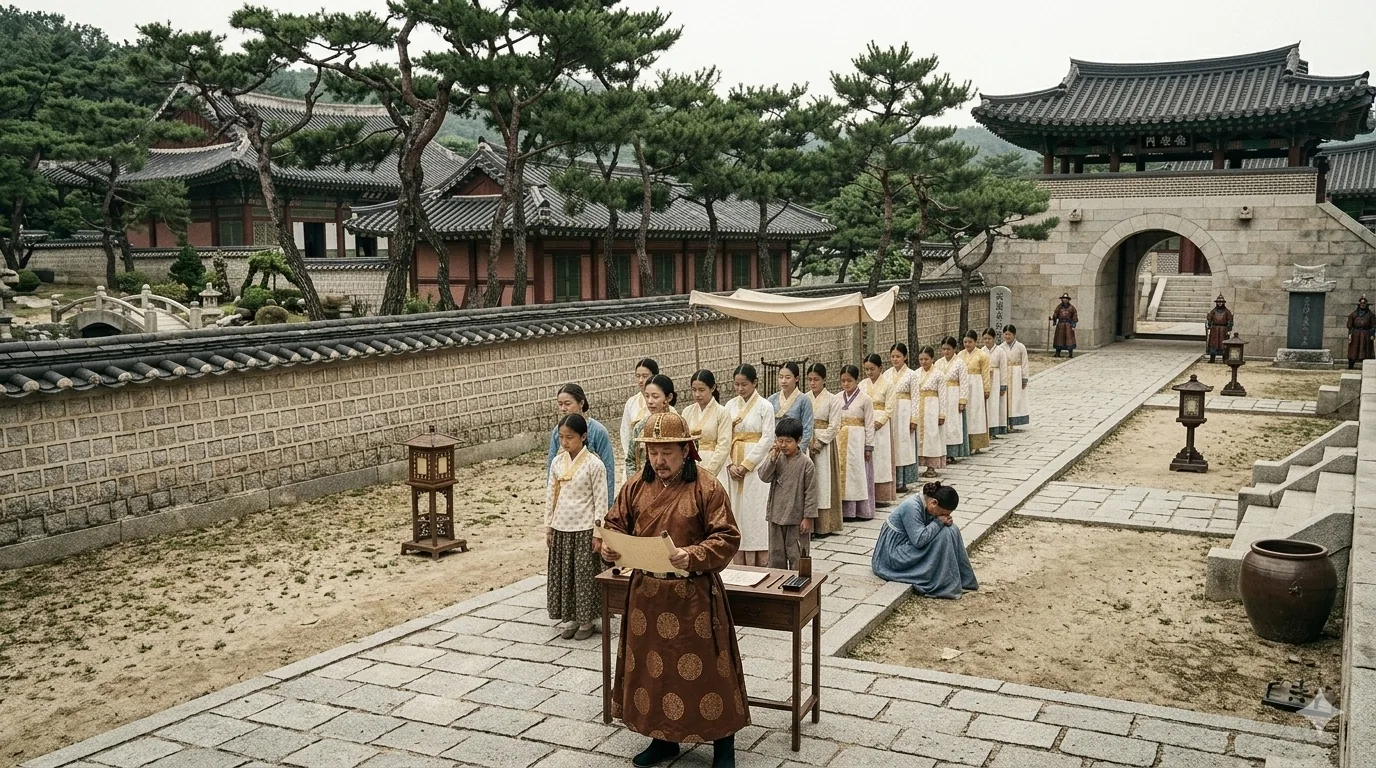
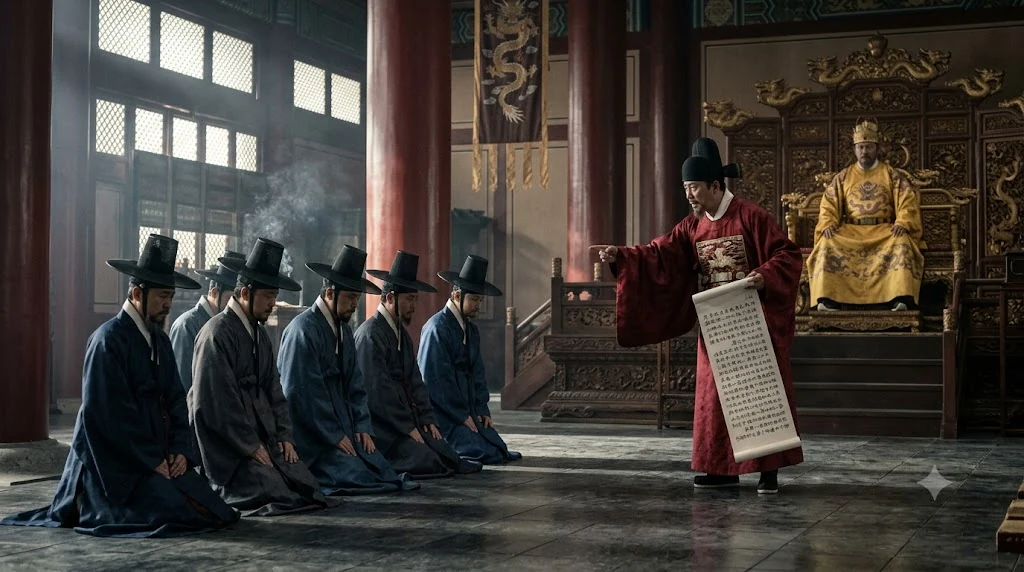
From the research behind Pause the Drama.
In Empress Ki, Seung-nyang walks into the consort selection at the Yuan palace. The other candidates are dressed to dazzle. She stands among them in plain white.
Korean press at the time read the scene as a statement: white for the “white-clad people”, a Goryeo woman marked out by her dress. A report that March described her wardrobe more generally as neither Goryeo nor Yuan in style — a look of her own. Those are reporters’ descriptions; the production’s intentions are not on record in them.
The costumes are a good place to start, because the fourteenth-century sources have something to say about Goryeo dress at that court. Not about Seung-nyang’s white — about a fashion the Yuan palace itself called “Goryeo style”.
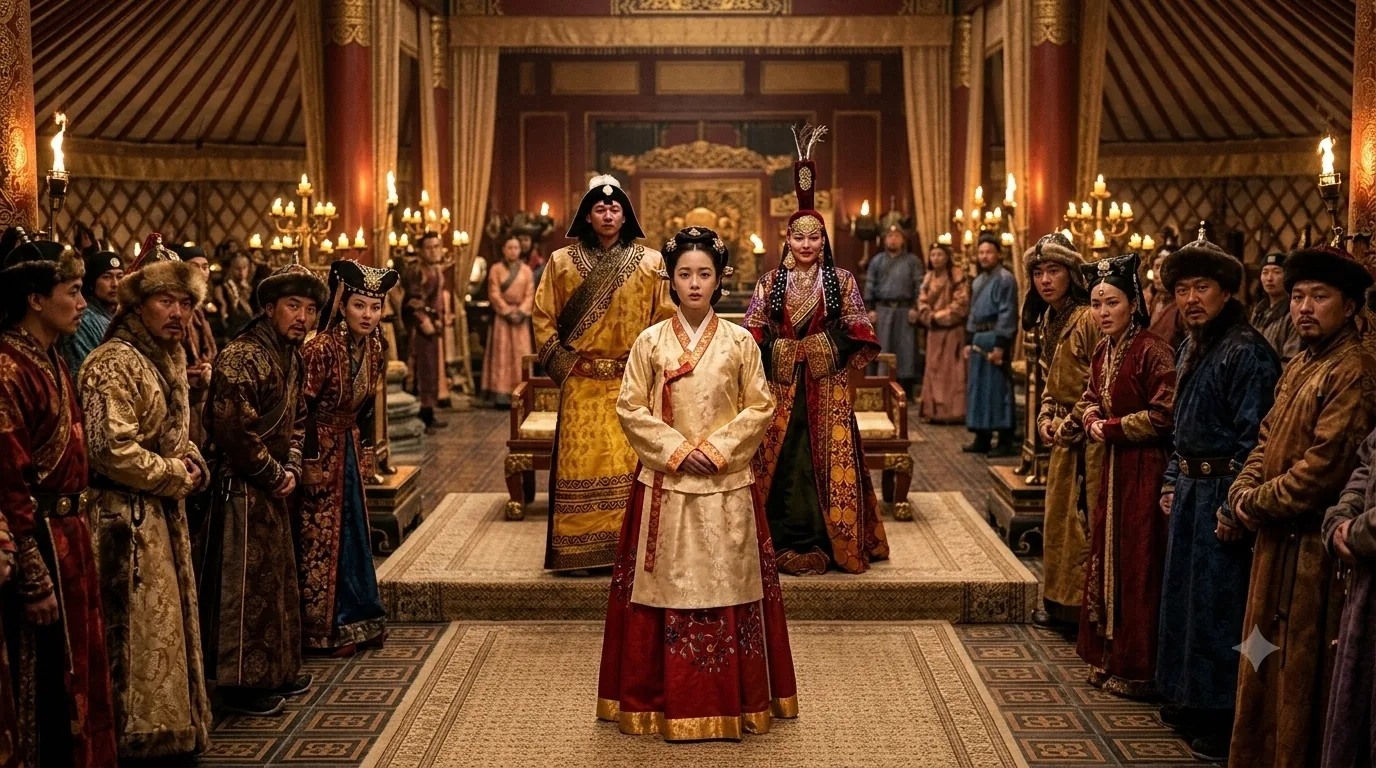 The drama dresses her to stand apart. The sources describe a court in which Goryeo dress was itself in fashion. (AI illustration)
Quick answer: In the mid-fourteenth century, sources describe a Goryeo style — goryeoyang (高麗樣) — at the Mongol court in Dadu. A quatrain by the late-Yuan poet Zhang Yu says palace dress “newly favoured the Goryeo style”; the Gengshen waishi, a private history of Toghon Temür’s reign, attributes the spread of Goryeo clothes, shoes, hats and utensils to the many Goryeo women serving in the palace; a miscellany records Goryeo-style boots in vogue among scholars at Hangzhou; and the Yuan History’s record of official dress names a fabric with “Goryeo” in it. Each source supports a different thing, and together they describe the court and some elite circles, not an empire. Empress Ki appears in one of them — the hostile Gengshen waishi — which connects the Goryeo women of her circle to the fashion’s spread. No source consulted here says the court copied her own clothes.
Let’s take the sources one at a time.
What was the goryeoyang?
The Encyclopedia of Korean Culture defines the goryeoyang as “Goryeo customs that were in fashion in Yuan China in the late Goryeo period”, and lists what was fashionable: clothing, shoes and hats; foods such as dumplings and rice cakes; and utensils. The period the sources cluster in is the Zhizheng reign era of the emperor Toghon Temür, which began in 1341. The Ming took Dadu in 1368 and the Yuan court withdrew north; Toghon Temür died in 1370 and was succeeded by his son — Empress Ki’s son. The era’s end is the end of one reign era, not of the Yuan line.
The same decades saw the reverse current in Goryeo: braided hair, Mongol dress, Mongol names — the mongolpung, “Mongol style”, adopted under the pressure of a dominant neighbour, with a heavy element of compulsion. The goryeoyang runs the other way: the customs of a politically subordinate kingdom taken up in the palace of the power that dominated it. The sources do not describe a decree behind it. They also do not describe simple taste. What they describe, as the next sections show, is a palace full of Goryeo women, and a court in which imperial favour and the standing of great houses were bound up with them.
Which poem names the Goryeo style?
The phrase appears in a poem. Among the “Palace Verses” (宮中詞) of Zhang Yu (張昱, courtesy name Guangbi) — a poet and official of the late Yuan whose career, as the Siku quanshu catalogue summarizes it, ran through posts in the Jiang-Zhe region and a judgeship in the Branch Bureau of Military Affairs — is this quatrain, as transmitted in the Yuan gongci anthology:
宮衣新尙高麗樣,方領過腰半臂裁。 連夜內家爭借看,爲曾著過御前來。
Palace dress newly favours the Goryeo style — a square collar, a banbi cut to fall past the waist. Night after night the people of the palace compete to borrow it and look, because it was once worn before the emperor.
That is the scene the poem describes: a garment worn before the emperor, and afterwards passed around the palace to be looked at. Seong Beom-jung’s Korean translation (2012) and the Northeast Asian History Foundation’s 2022 article both read it this way. It is a poem, and we treat it as a poem: a poetic description of a court’s taste, not a record of an event on a given night.
What the poem does not say is also worth listing. It does not say who wore the garment. It does not mention Empress Ki. It does not claim that the square collar (bangnyeong) or the banbi — a sleeveless or very short-sleeved over-garment; the sources define it slightly differently — were invented in Goryeo. What it says is that at that moment, in that court, this cut and this way of wearing it were understood as Goryeo, and it says so using the phrase 高麗樣. The name is not a modern coinage.
Which history explains its spread?
The second source is blunter, and needs more handling.
The Gengshen waishi (庚申外史) is a private history of the reign of Toghon Temür, written by a scholar named Quan Heng. It is not an official history. In its second book, in a passage about the empress, it says — in transcription:
祁后亦多蓄高麗美人,大臣有權者輒以此女送之。京師達官貴人,必得高麗女然后為名家。高麗婉媚,善事人,至則多奪寵。自至正以來,宮中給事使令,大半為高麗女。以故四方衣服鞋帽器物,皆依高麗樣子。
Empress Ki, too, kept many Goryeo beauties, and would send such women to ministers who held power. Among the high officials and notables of the capital, one had to obtain a Goryeo woman to count as a great house. Goryeo women were graceful and good at serving people, and once they arrived they often took the favour of the household. Since the Zhizheng era, the greater part of those who attend and run errands in the palace have been Goryeo women. For this reason, clothes, shoes, hats and utensils everywhere have all followed the Goryeo pattern.
Three things about this passage.
First, it is the text that connects the empress to the fashion, and it does so through people, not through her wardrobe: Goryeo women in her keeping, sent to the houses of the powerful; Goryeo women attending and running errands in the palace. The Goryeo pattern spreads, in this account, because the hands that served the court were Goryeo hands. That is the author’s claim about a mechanism.
Second, it is not a neutral text. The passage is part of a hostile portrait of the empress and her circle, and the Goryeo women in it are an item in a bill of indictment. We read the Gengshen waishi as a claim, not a finding.
Third — and this matters for the drama — it does not say the court imitated her. It says that because there were so many Goryeo women in the palace, the pattern spread. The fair sentence is this: the sources connect the Goryeo women of the Yuan palace, the empress’s circle among them, to the spread of the Goryeo style. None consulted here makes Empress Ki its author or its model.
Not only dress: boots, a fabric, lettuce, a cake
If the goryeoyang had stopped at palace women’s clothing, the story would be short. The sources are more scattered than that — and they do not all support the same kind of thing.
Boots, at Hangzhou. The Nancun chuogeng lu of Tao Zongyi, a late-Yuan miscellany, tells of the scholar Du Ben staying at Qiantang — Hangzhou — with Confucian scholars crowding to him, dressed in purple rattan hats and Goryeo-style boots; someone mocked them in verse, and the text notes that boots made in the Goryeo manner were then in vogue. This is the one source that places the fashion outside the palace and on men, in the south.
A fabric, in the dress system. The Yuan History’s treatise on carriages and dress lists, among the fabrics of officials’ summer jisün robes — the colour-matched robes worn at imperial banquets — one called “Goryeo crow-blue cloud-sleeve gauze” (高麗鴉青雲袖羅). “Crow-blue” is a dark blue-black. What this shows is a Goryeo name attached to a textile in the official record of court dress. It does not by itself show how widely the fabric was worn, or where it was made.
Lettuce, noticed. The eighteenth-century Korean scholar Yi Ik gave an entry of his Seongho saseol to “raw greens and gwaebae” and quoted a line of the Yuan poet Yang Yunfu — “Again they say Goryeo’s raw greens are fine” — together with a note, transmitted with the poem, that “Goryeo people wrap rice in raw greens and eat it”. Yi added that the custom continued in his own day. What this shows is a Goryeo habit being observed and written down by a Yuan poet. It does not show that the lettuce wrap travelled from Goryeo to China.
A cake, in the cookbooks. Yuan-period household compendia — the Shilin guangji, a work of Southern Song origin re-edited under the Yuan, and the Jujia biyong — are reported in the Foundation article to carry a recipe called “Goryeo chestnut cake” (高麗栗糕): dried chestnut flour, glutinous rice flour and honey water, steamed. What it shows is a dish carrying the Goryeo name in a Chinese kitchen manual.
Put in one place, with what each supports:
| Source | What it directly supports |
|---|---|
| Zhang Yu’s quatrain | A poetic description of the palace’s preference for a Goryeo-style garment |
| Gengshen waishi | The author’s claim that Goryeo women in the palace caused clothes, shoes, hats and utensils to follow the Goryeo pattern |
| Nancun chuogeng lu | An explicit statement that Goryeo-style boots were then in vogue among scholars at Hangzhou |
| Yuan History, dress treatise | A fabric name with “Goryeo” in it in the official list of banquet-robe fabrics |
| Yang Yunfu’s line, via Yi Ik | A Yuan poet’s note on how Goryeo people ate |
| Shilin guangji / Jujia biyong | A dish with a Goryeo name in Yuan-period compendia |
The geography is specific — Dadu, Hangzhou — rather than “China”, and the population is the palace and the literate elite. That is the scope the evidence carries.
Why were there Goryeo women in the palace?
Clothes do not cross borders by themselves. People crossed first.
From the late thirteenth century, Goryeo people entered Yuan territory by several routes, and by the fourteenth century a varied Goryeo presence in and around Dadu is documented — merchants, officials, eunuchs, and the women the drama is about. The route that led into the palace itself was the tribute women. The Yuan demand for Goryeo women is documented from 1274, when a bureau was set up in Goryeo to supply them; those first women were destined for Chinese soldiers, not the palace, and Goryeo women in the imperial household are a later thread. The system, its human cost, and the empress’s own path through it are the subject of our article on the tribute women.
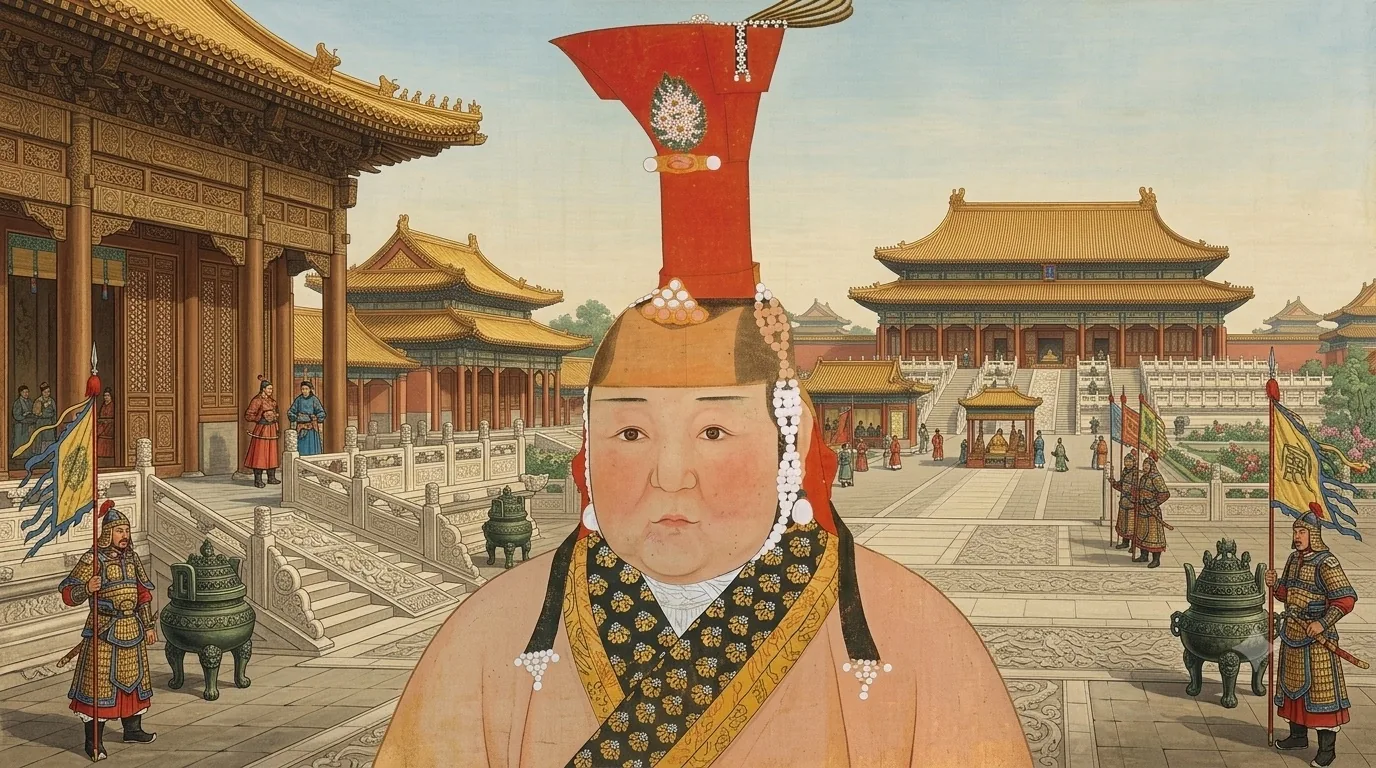 An AI illustration in the manner of the Yuan album portraits. It depicts no historical person. The real album leaf discussed below is linked in the text.
Two things follow for the goryeoyang. The first is that the Gengshen waishi’s mechanism — Goryeo women in the palace, Goryeo women in great houses — is not an abstraction: it describes the outcome of a system that had been moving women from Goryeo to Yuan for decades. The second is that “fashion” is the wrong word if it suggests only preference. The passage ties the Goryeo pattern to imperial favour (奪寵, “took the favour”), to the status of a “great house”, and to the competition of powerful ministers for the women the empress sent them. Goryeo style spread inside a structure of power, and some of the women at the centre of it had not chosen to be there.
Is that portrait Empress Ki?
Search for “Empress Ki” in Korean or Chinese and one painting comes up again and again: a round-faced woman in the tall red boqta headdress of a Mongol empress. It is in the National Palace Museum in Taipei, an album leaf on silk, and it is inscribed “Empress Taji of Emperor Shunzong” — Dagi, the mother of the emperors Wuzong and Renzong, a woman of an earlier generation. The Foundation article makes the same correction.
No contemporary likeness that can be securely identified as Empress Ki is known to us. That is a statement about identification, not about survival: we do not know whether one was ever painted. Either way, what she herself wore cannot be shown.
Did the Ming ban the Goryeo style?
It would make a neat ending to say that when the Ming founder banned Mongol dress in 1368 he banned the Goryeo style with it. The Ming founder’s order of that year prohibits Mongol dress, speech, surnames and hairstyles and restores Tang-style dress. We found no source that extends it to Goryeo customs, and we make no claim that it did.
Drama vs. real history
| What the drama shows | What the sources support |
|---|---|
| Seung-nyang’s wardrobe, as described by a 2014 report, is neither Goryeo nor Yuan in style | Fourteenth-century sources describe a Goryeo style in palace dress — a square collar and banbi — that the Yuan palace itself favoured |
| Her white dress at the consort selection, read by the press as a sign that she was Goryeo | Goryeo dress could mark origin and be in fashion at the same time; the sources do not treat the two as opposites, and the drama’s white dress is not the garment the poem describes |
| Empress Ki as the centre of change at the Yuan court | The one source connecting her to the Goryeo style, a hostile private history, links the Goryeo women of her circle to its spread; none consulted here names her as its origin or model |
| The familiar “Empress Ki” portrait | Is the Taipei museum’s Empress Taji of Shunzong — Dagi, a different woman. No securely identified likeness of Ki is known to us |
Key terms. Goryeoyang (고려양, 高麗樣) — “Goryeo style”: Goryeo dress, food and objects in fashion in Yuan China. Mongolpung (몽골풍) — its mirror image: Mongol customs adopted in Goryeo. Banbi (반비, 半臂) — a sleeveless or short-sleeved over-garment; the sources define it variously. Bangnyeong (방령, 方領) — a square collar. Zhizheng (至正) — the reign era of Toghon Temür, 1341–1370; Dadu fell in 1368 and the emperor died in 1370. Jisün (질손) — the colour-matched robes of Yuan court banquets. Gengshen waishi (庚申外史) — a private history of Toghon Temür’s reign by Quan Heng.
Back to the consort selection
Watch Seung-nyang in white once more. The drama uses the dress to say: this one is Goryeo.
The sources say that in the same court, Goryeo dress was something the palace favoured, borrowed and looked at — and that the reason, in the one account that gives one, was the Goryeo women who filled the palace and the great houses. The strongest thing in the record is not that an empress set a fashion. It is that the women of a politically subordinate country left a mark on the daily life of the imperial court that its own writers noticed, named, and in one case resented.
Coming up next
Our article on the tribute women covers the system that moved Goryeo women to Yuan and the empress’s own rise through it. The Yeoncheon tomb site asks whether she came home. And tribute, investiture and sadae explains the diplomatic frame in which a Goryeo woman could become a Yuan empress at all.
Frequently asked questions
Was the goryeoyang real? Yes, within a defined scope: a Yuan poem that uses the phrase, a private history that explains its spread, a miscellany on Goryeo-style boots at Hangzhou, and a fabric name in the official dress record. The court and some elite circles, not an empire.
Did Empress Ki create it? None of the sources consulted here says so. The Gengshen waishi connects the Goryeo women of the palace — her circle among them — to the fashion’s spread; nothing names her as its origin or model.
Does the drama show it? We did not survey all fifty-one episodes and make no claim either way. A 2014 report described the costumes as neither Goryeo nor Yuan; the white dress was read by the press as a sign of Goryeo identity.
What was fashionable? Palace dress (square collar and banbi), Goryeo-style boots at Hangzhou, a “Goryeo crow-blue” fabric in the dress record; and, as things noticed rather than fashions shown, lettuce wraps and a chestnut cake.
Did lettuce wraps go from Goryeo to China? The sources do not say so; they record a Goryeo habit being observed by a Yuan poet.
How is it different from the Mongol style in Goryeo? Direction and setting: Mongol custom in Goryeo under compulsion; Goryeo custom in the Yuan palace, spread through Goryeo women within a structure of favour and status.
Is there a portrait of her? No securely identified one is known to us. The famous image is the Taipei museum’s portrait of Empress Dagi.
When did the Yuan lose Dadu, and when did the era end? Dadu fell in 1368; Toghon Temür died in 1370 and his son succeeded him. The Zhizheng era ended with the emperor, not the dynasty.
Sources & further reading
- The definition — Encyclopedia of Korean Culture, ‘Goryeoyang’ (E0003477); ‘Empress Ki’ (E0008496) for the 1370 succession. Both consulted directly.
- The main secondary account — Kim Yun-jeong, Northeast Asian History Foundation newsletter, January 2022, consulted directly. The chestnut cake, the definition of banbi as sleeveless and the correction of the portrait are taken from it.
- The poem — Zhang Yu, ‘Palace Verses’, in the Yuan gongci anthology; Seong Beom-jung, Gyeongsang Ilbo, 4 December 2012, with translation; Siku quanshu zongmu tiyao, book 168, on Zhang’s career. Zhang Yu and “Zhang Guangbi” are one person — name and courtesy name.
- The history — Quan Heng, Gengshen waishi, book 2, transcription; the passage is quoted above in full. Some Korean summaries give the wording as 皆爭效高麗樣 (“all competed to imitate the Goryeo style”); the transcriptions consulted read 皆依高麗樣子, and we follow them.
- Boots — Tao Zongyi, Nancun chuogeng lu, transcription.
- The fabric — Yuan History, book 78, treatise on carriages and dress, transcription: 高麗鴉青雲袖羅 among the summer jisün fabrics.
- Lettuce — Yi Ik, Seongho saseol, book 5, ‘Saengchae gwaebae’, quoting Yang Yunfu; consulted through a transcription. The link given is the encyclopaedia’s entry on the Seongho saseol, not the text.
- The portrait — National Palace Museum, Taipei, ‘The Century of the Khans’, Portrait of the Empress of Yuan Shunzong, inscribed 順宗皇帝后塔濟, album leaf on silk, 61.5 × 48 cm. Consulted directly.
- The drama’s costumes — Aju Business Daily, 25 March 2014; Mediaus, 28 January 2014. Both consulted directly; both are reporters’ descriptions and readings, not production statements.
- Limits of this article — No printed or woodblock edition of any Chinese text was opened; the Gengshen waishi, the poem, the Nancun chuogeng lu and the Yuan History were read in online transcriptions, and the base edition of Zhang Yu’s collected poems was not consulted (lines 3–4 of the quatrain are transmitted in more than one form). The chestnut-cake recipes are cited through the Foundation article, not from the compendia. The Seongho saseol entry was read in a transcription. The Yuan History’s biography of the empress and the Ming founder’s 1368 order were not read for this article, and no claim above depends on them. The drama was not surveyed across its fifty-one episodes. The sources consulted here are limited, and the scope of every claim above has been kept to them.
This article was researched and written by K-Drama History. Source: Empress Ki and Goryeoyang: Goryeo Fashion at the Yuan Court — K-Drama History