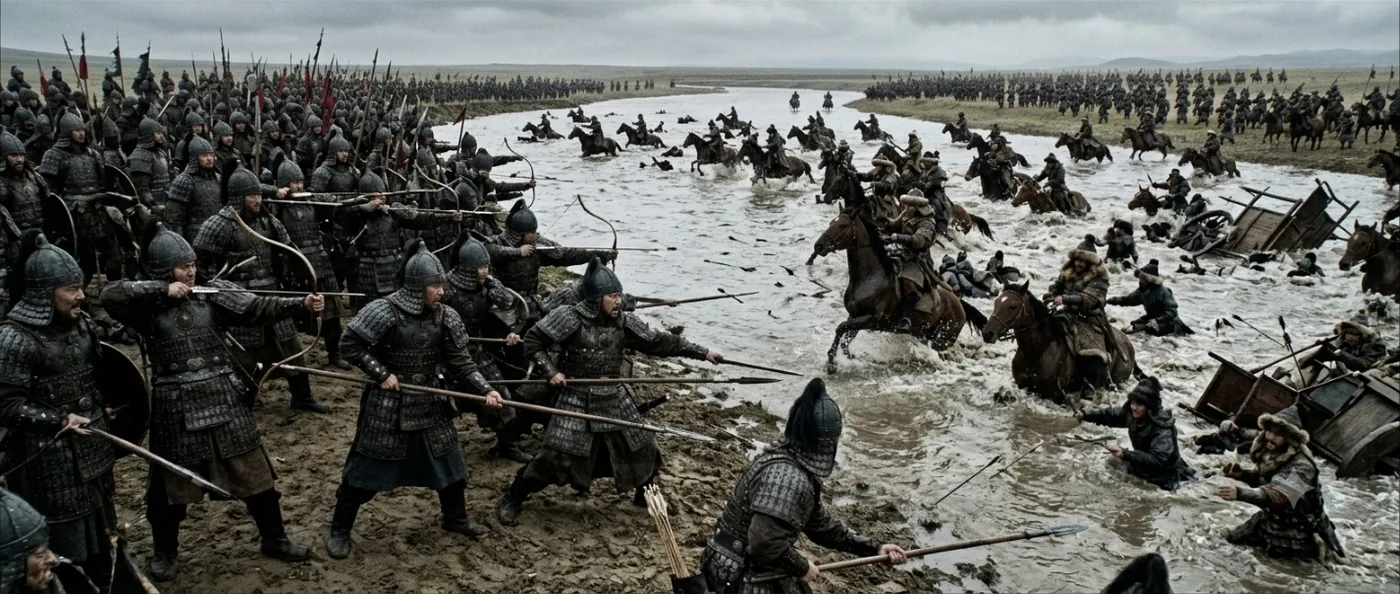
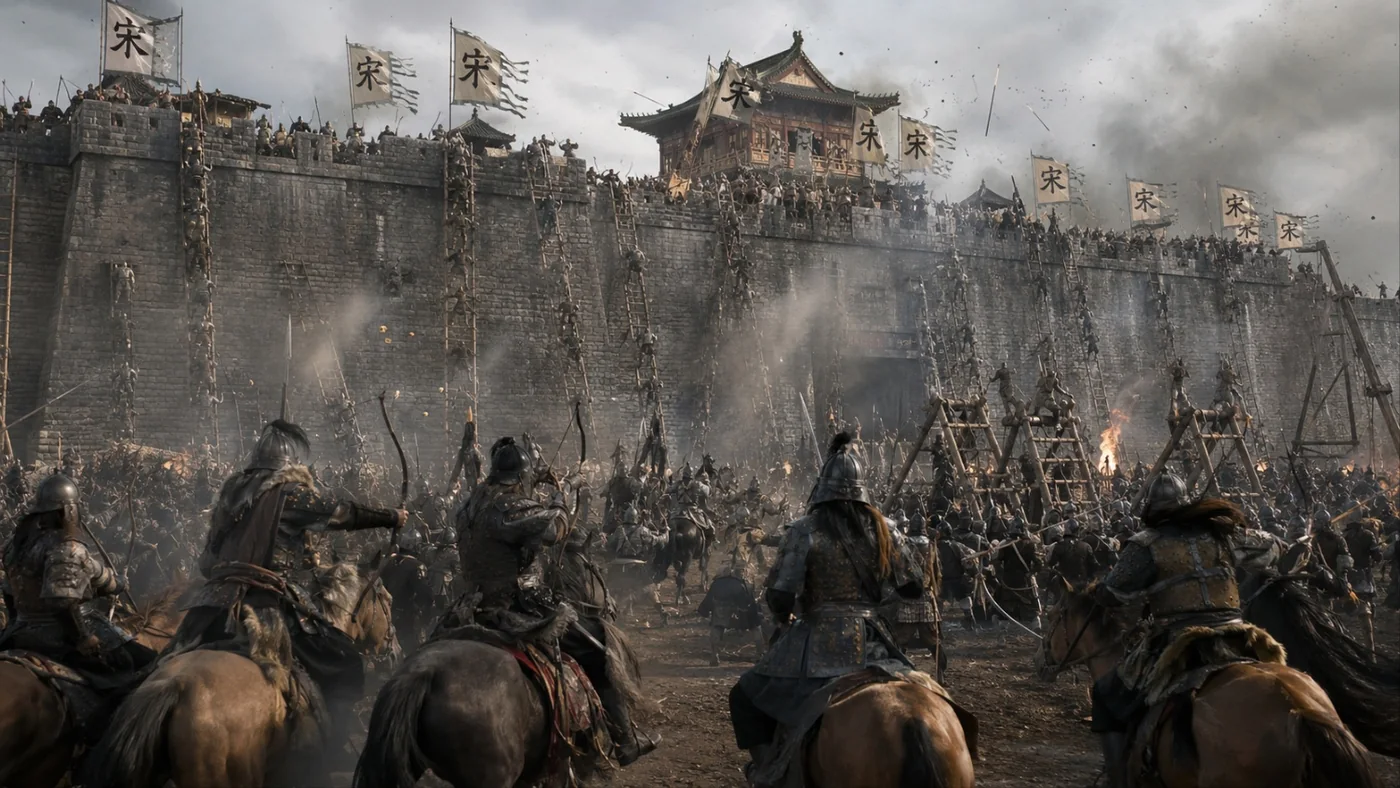
Goryeo-Khitan War, Explained: How Song and Goryeo Both Made Peace with the Liao
Theme: War & Resistance
From the research behind Pause the Drama.
If you’ve watched the 2023–2024 KBS epic Goryeo-Khitan War (고려거란전쟁), the most thrilling moment is unmistakable: General Gang Gam-chan shattering the Khitan army at Guiju. (For the battle and the war itself in full, see our companion piece on Goryeo’s war with the Khitan.) But to really understand what that victory meant, you have to look beyond Korea — at the other giant wrestling with the very same enemy, the Liao (Khitan) empire. That giant was Song China.
And here’s the twist that reframes the whole war: both Song and Goryeo fought the Liao for years — and both, in the end, turned military pressure into a negotiated peace. What really differed was the kind of settlement each could reach.
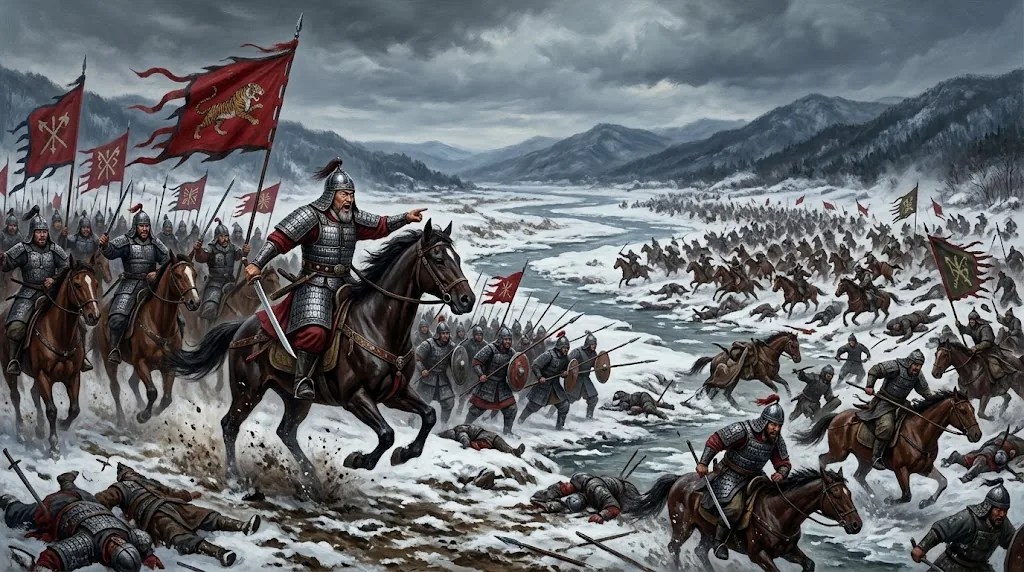 Goryeo won its peace at Guiju in 1019 — while Song China had already paid for its own. (AI illustration)
Quick answer: Song and Goryeo did not choose opposite responses to the Liao (Khitan) empire — both fought major wars, then used diplomacy to turn military pressure into a durable peace. After the 1004 campaign, Song concluded the Chanyuan Treaty in early 1005, recognizing Liao as a dynastic peer and sending annual silver and silk (the sepye) in return for a stable frontier. Goryeo first negotiated under Seo Hui, fortified the territory that became the Six Garrisons, and later smashed a major Liao invasion at the Battle of Guiju (1019). That victory strengthened Goryeo’s hand, but lasting peace still came through renewed diplomatic relations in 1020. The difference wasn’t “money versus courage” — it was the particular settlement each state could secure.
Let’s unpack it.
How Song China bought its peace
Song was no weakling. In economy, population, and culture it was one of the most advanced states on earth. But against the Liao — a cavalry empire ruling Manchuria, Mongolia, and part of north China — it carried a heavy military burden.
Song had already fought the Liao for decades — including failed northern campaigns in 979 and 986 to recover the lost Sixteen Prefectures. When a large Liao army drove south in 1004, the Song emperor Zhenzong went in person to the front at Chanyuan, and Song troops killed a senior Liao commander before the two exhausted sides came to terms. The resulting Chanyuan Treaty, negotiated during the 1004 campaign and concluded in early 1005, had Song send Liao an annual payment: 100,000 taels of silver and 200,000 bolts of silk (Britannica — Treaty of Chanyuan). The figure later grew — a renegotiation in 1042 raised it to 200,000 taels of silver and 300,000 bolts of silk (keep the 1005 base and the post-1042 increase distinct). But the payments were only one part of the deal. The treaty also had the two empires recognize one another as dynastic peers, their emperors set in a “brotherly” relationship — Song ceded no further territory, and Liao won no real subordination. So the sepye (세폐) was a diplomatic cost for a stable frontier, not simply protection money handed to a raider.
This was shaped by Song’s governing approach, often labeled civilian rule (문치주의) — though “centralized military power” is more accurate than “unmilitary.” Wary of the warlord chaos that had ended the Tang, Song’s founders concentrated military authority under central control and a scholar-official bureaucracy. This did not make Song a weak-armed state — it maintained enormous armies and spent heavily on defense. But a combination of factors — a vulnerable northern capital, a chronic shortage of cavalry and warhorses, the lost Sixteen Prefectures, and a long, cumbersome command and supply structure — made prolonged war with a northern cavalry empire exceptionally costly.
Was it humiliation — or realism?
On the surface, a mighty empire sending silver and silk to “barbarians” looks like pure humiliation. Look again, though, and it reads as a very cold calculation.
Holding a northern front indefinitely meant staggering costs — soldiers, horses, weapons, grain, fortress repairs, supply lines. Against that, a fixed annual shipment of silver and silk was a bruise to the pride but potentially far cheaper than endless war. Song couldn’t fully break Liao by force, so it dealt with Liao by arithmetic. The sepye was at once a humiliation and a kind of insurance premium for peace: Song paid for a stable border, and in return kept its economy, culture, and administration intact. So the Chanyuan Treaty isn’t just a story of “weak Song paying tribute.” It was a realist’s trade of war costs against peace costs.
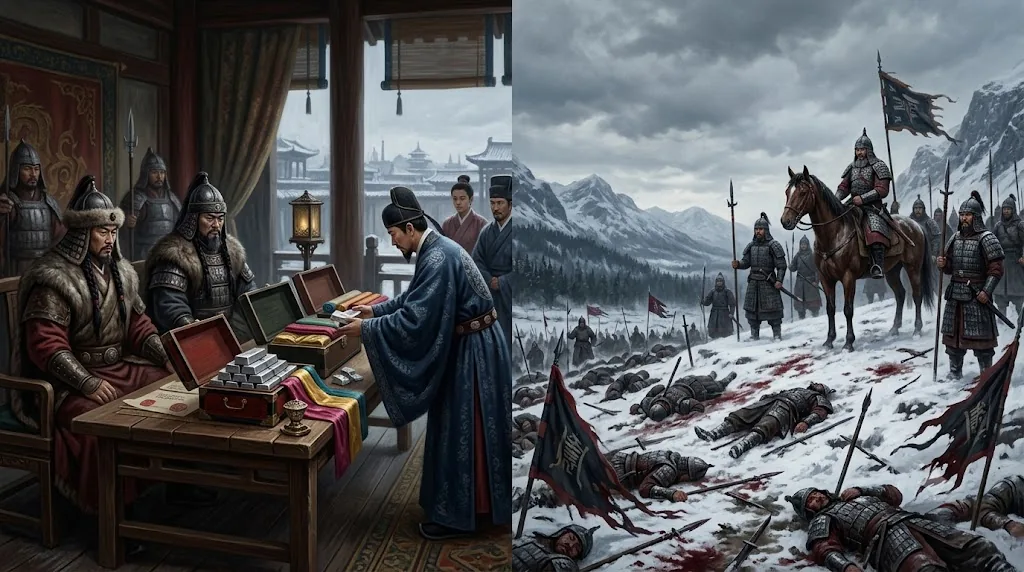 Two paths to peace with one empire: Song settled by treaty and payment (left), Goryeo by victory at Guiju (right) — but both fought, and both negotiated. (AI illustration)
How Goryeo won its peace instead
Goryeo didn’t simply fight from the start, either. In the first Khitan invasion (993), the diplomat Seo Hui halted the war through negotiation — winning Liao’s acceptance of Goryeo’s expansion into the Jurchen-held land east of the Amnok (Yalu) River. Goryeo then occupied and fortified that region over the following years, building the strongpoints that became the Six Garrisons (강동 6주) (Encyclopedia of Korean Culture — Seo Hui). Goryeo, in other words, knew how to turn diplomacy into secured ground.
But when Liao invaded again and a great army under Xiao Baiya poured south in 1018, Goryeo did not yield. In 1019, at Guiju, Gang Gam-chan’s forces crushed the Liao army (Encyclopedia of Korean Culture — Battle of Guiju (구주대첩) · Gang Gam-chan). Sources describe the Liao host as “said to be 100,000,” with only a few thousand making it home — figures best understood as pre-modern expressions of scale and defeat, not exact modern statistics. But Guiju did not, by itself, end the conflict. It was the climax of a long process — Seo Hui’s 993 talks, the fortifying of the northern garrisons, the resistance to the 1010 invasion, the defensive war of 1018–19 — and its real payoff was leverage. The victory let Goryeo conclude a more secure peace: the two states restored normal diplomatic relations in 1020, and Goryeo kept the Six Garrisons while blunting Liao’s demands (a royal visit of homage, the return of the garrisons) — all while still taking part in the era’s tributary-and-investiture order. It’s hard to call either state simply more correct; each secured the best settlement its conditions allowed.
Key terms. Chanyuan Treaty (전연의 맹약, 1004) — the Song–Liao peace deal under which Song paid annual silver and silk. Sepye (세폐) — those annual payments; a diplomatic cost for peace, not a simple tax. Battle of Guiju (귀주대첩, 1019) — Gang Gam-chan’s decisive Goryeo victory over Liao. Six Garrison Settlements (강동 6주) — the strategic districts Seo Hui secured by negotiation.
Here’s the drama decoded:
| In Goryeo-Khitan War | In real history |
|---|---|
| Guiju as a glorious triumph | A real, decisive victory over a major Liao invasion (1019) |
| Diplomacy before battle (Seo Hui) | Real — negotiation won the Six Garrison Settlements |
| Goryeo standing alone against Liao | Song faced the same Liao — and also fought, then settled by treaty |
| A small country beating a giant | Survival by combining diplomacy, terrain, and force |
| Liao’s “100,000” army | A pre-modern expression of scale, not an exact headcount |
The Western echo: England’s Danegeld
If “buying peace” from a fearsome northern power sounds uniquely East Asian, it wasn’t. Early medieval England offers a loose parallel — with a different enemy.
To stop devastating Viking raids, Anglo-Saxon rulers repeatedly paid out silver known as Danegeld (“Dane-payment”) (Britannica — Danegeld). It rhymes with Song’s sepye in one narrow sense: rulers sometimes judged silver cheaper than renewed war. But it was not a close institutional match — Danegeld often bought only a temporary withdrawal, and the Vikings frequently returned, whereas the Chanyuan settlement built a durable diplomatic order between two territorial empires. The shared thread is just the underlying dilemma — that open war could be ruinously expensive — not an identical solution.
Which is exactly what makes Goryeo-Khitan War’s Guiju so striking. In a regional order where Song, Liao, and Goryeo were all constantly calculating one another, Goryeo held its own place not by blind courage alone, but by using diplomacy and military force together — bargaining, fortifying, defending, and, at the decisive moment, winning the battle that bought it a stronger peace.
Coming up next
One battle — and we’ve traveled from Guiju’s river valley to a Song treaty table, the Six Garrison Settlements, and Viking longships off the English coast. That’s the quiet gift of a good historical drama: a single victory is a doorway.
In the next essay, we’ll take another K-drama scene that looks like pure fiction — and trace the real Korean history hiding underneath it.
Frequently asked questions
What was the Battle of Guiju? The Battle of Guiju (귀주대첩, 1019) was a major Goryeo victory in which General Gang Gam-chan crushed a large invading Liao (Khitan) army. Korean tradition ranks it with the Battle of Salsu and the Battle of Hansan Island as one of the great triumphs in the country’s history. Sources describe the Liao force as “said to be 100,000” and say only a few thousand returned — figures best read as pre-modern expressions of scale and shock, not exact statistics.
Did Song China really pay the Khitan Liao for peace? Yes. Under the Chanyuan Treaty of 1004, Song agreed to send the Liao annual payments of silver and silk. The base amount was 100,000 taels of silver and 200,000 bolts of silk; after renegotiation in 1042 it rose to 200,000 taels of silver and 300,000 bolts of silk. It looks like humiliation, but it was also a hard-nosed calculation: paying was far cheaper than endless war on the northern frontier.
Did Goryeo remain an enemy of Liao after the Battle of Guiju? No. Guiju ended Liao’s ability to force its major territorial and ceremonial demands on Goryeo, but the two states restored peaceful diplomatic relations in 1020. Goryeo kept the Six Garrisons while still taking part in a Liao-centered tributary-and-investiture relationship.
Did Song avoid fighting Liao by simply paying money? No. Song and Liao fought repeated wars before the Chanyuan settlement, including a Liao drive south in 1004 that Song met at the front. The annual silver and silk formed part of a treaty concluded after military confrontation — and after mutual recognition as dynastic peers — not a substitute for having fought at all.
Did Goryeo troops hold a victory parade in the Song capital after Guiju? There’s no reliable record of that. No confirmed source shows Goryeo soldiers marching in triumph through a Song city. What’s clearer is that Song officials increasingly viewed Goryeo as a useful counterweight to Liao.
What’s the Western equivalent of Song’s payments? England’s Danegeld — the silver Anglo-Saxon rulers paid to keep Viking raiders away — is the closest parallel. Like Song’s sepye, it bought peace at the cost of pride, and sparked the same lasting debate about whether it was appeasement or hard realism.
Sources & further reading
This piece was written from the historical script and fact-check of 사뚱샘의 역사방 (SaDDungSam). Key sources are cited inline above. For broader reading:
- The Battle of Guiju (구주대첩 / 귀주대첩, 1019) — Gang Gam-chan’s decisive victory over Liao. (Encyclopedia of Korean Culture / 한국민족문화대백과)
- Gang Gam-chan (강감찬) — the commander at Guiju. (Encyclopedia of Korean Culture)
- Seo Hui (서희) & the Six Garrison Settlements (강동 6주) — the 993 negotiation that won strategic ground without war. (Encyclopedia of Korean Culture)
- The Treaty of Chanyuan (澶淵之盟, 1004) — the Song–Liao peace and the annual silver-and-silk payments. (Encyclopaedia Britannica)
- Danegeld — the silver Anglo-Saxon England paid to keep Viking raiders away, the Western parallel. (Encyclopaedia Britannica)
Thanks for reading — see you in the next one.
This article was researched and written by K-Drama History. Source: Goryeo-Khitan War, Explained: How Song and Goryeo Both Made Peace with the Liao — K-Drama History