How Did Goryeo Survive the Liao Empire Three Times? Seo Hui, Kang Gam-chan, and the Battle of Gwiju, Explained
Theme: War & Resistance
From the research behind Pause the Drama.
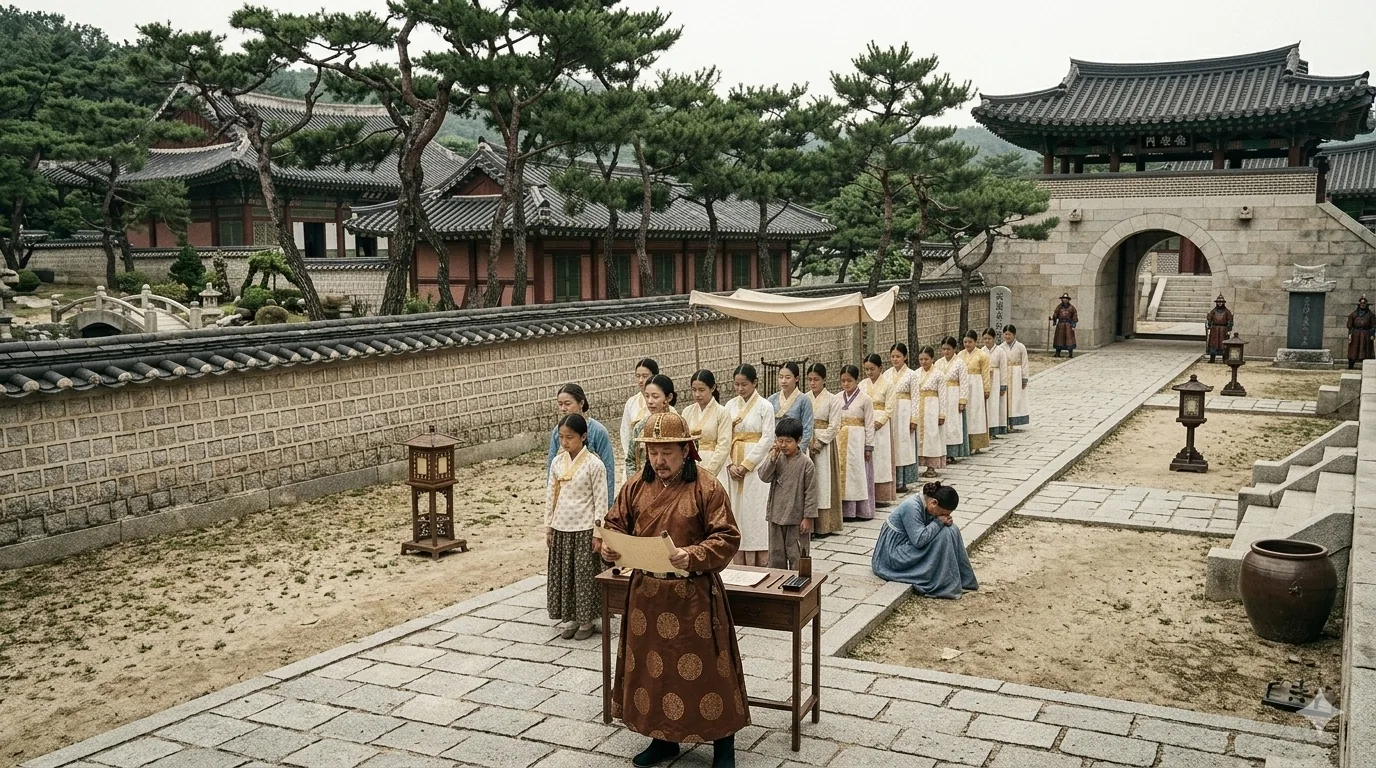
In the opening episodes of Goryeo-Khitan War (고려거란전쟁, KBS2, 2023–2024), a diplomat named Seo Hui walks, unarmed, into a meeting with a Liao general — and walks out having gained territory. Later in the series, a general in his seventies releases a dammed river onto a Liao cavalry column crossing below. Both scenes are grounded in historical record. They prompt a question the drama doesn’t have time to answer fully: how did a kingdom the size of Goryeo defeat the dominant military empire of 11th-century East Asia — not once, but three times in a generation?
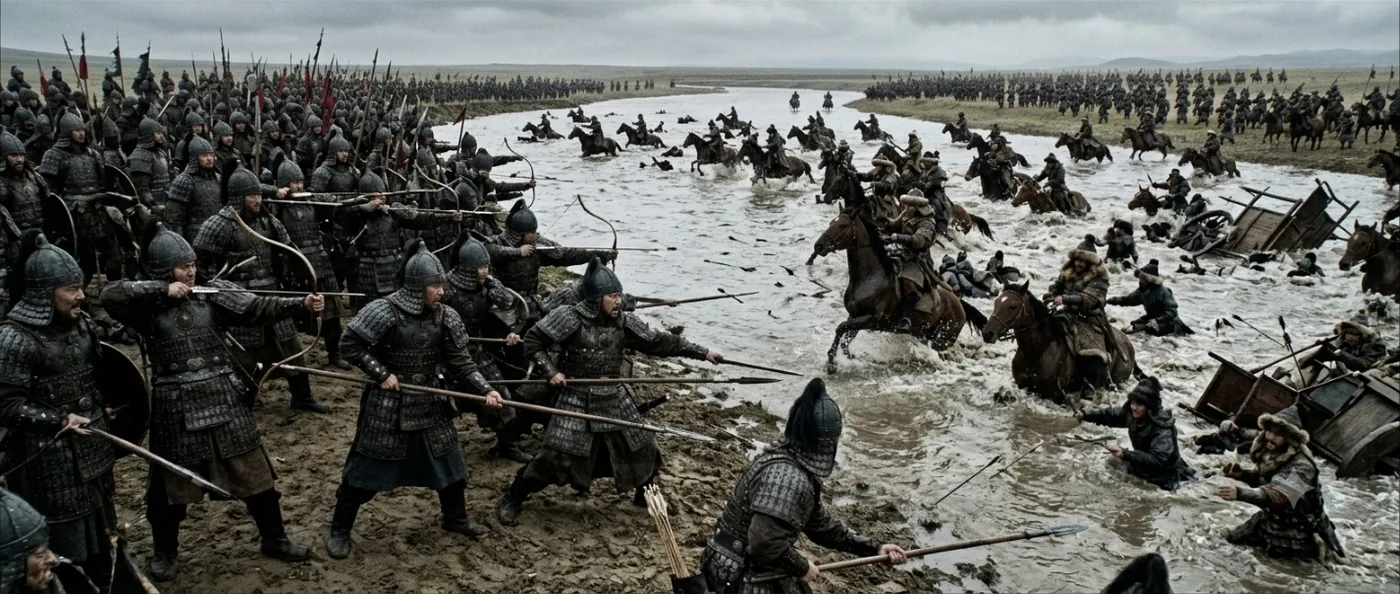 Kang Gam-chan’s forces broke a dammed river onto the Liao vanguard at Heunghwajin — one of the strokes that set up the decisive victory at Gwiju. (AI illustration)
Quick answer: The Goryeo-Khitan Wars (993–1019) were three distinct confrontations between Goryeo and the Liao (Khitan) Empire — the same empire that extracted annual tribute payments from Song China. Goryeo survived the first war through brilliant diplomacy (Seo Hui’s negotiations, which yielded a net territorial gain), weathered the second through strategic withdrawal, and destroyed the Liao expeditionary force at the Battle of Gwiju (귀주대첩) in 1019. The Goryeosa records that only a few thousand Liao soldiers survived to return home. The victory established Goryeo as a genuine independent power within the East Asian order and triggered construction of the Cheonnijangsong — a fortified line from the Amnok River to the eastern coast — that anchored the kingdom’s northern border for the next two centuries.
What was the Liao Empire, and why does its power matter for understanding these wars?
To grasp what Goryeo was up against, the Liao Empire needs to be placed in the right frame. The Liao (遼, 907–1125), founded by the Khitan people, was at its peak one of the two dominant powers in East Asia — the other being Song China. It controlled Manchuria, Mongolia, and parts of northern China including the strategically vital Sixteen Prefectures in the modern Beijing region, which it had wrested from a predecessor state in 936.
Song China, for all its wealth and cultural prestige, could not dislodge Liao from those territories by force. After decades of costly border warfare, Song signed the Treaty of Chanyuan (澶淵之盟, 1004), agreeing to pay Liao an annual tribute of 100,000 taels of silver and 200,000 bolts of silk. Those figures were not fixed forever: in 1042 a renegotiation — the Qingli tribute increase (경력증폐) in Song reckoning, the Chongxi increase (중희증폐) in Liao reckoning — raised the annual payment to 200,000 taels of silver and 300,000 bolts of silk. (Often loosely called tribute, the payment was diplomatically framed within the Chanyuan settlement as annual “gifts” — a peace price more than an act of submission.) Song essentially bought peace. That is the empire Goryeo was dealing with when Liao’s cavalry rode south across the Amnok River.
How did Goryeo turn the first invasion into a territorial gain?
The first Liao invasion (993) was not primarily about conquest. Liao’s objective was strategic: sever Goryeo’s alliance with Song, secure the eastern flank, and stabilize the rear for potential campaigns westward. Liao commander Xiao Sunning presented Goryeo with a demand to submit and cut Song ties.
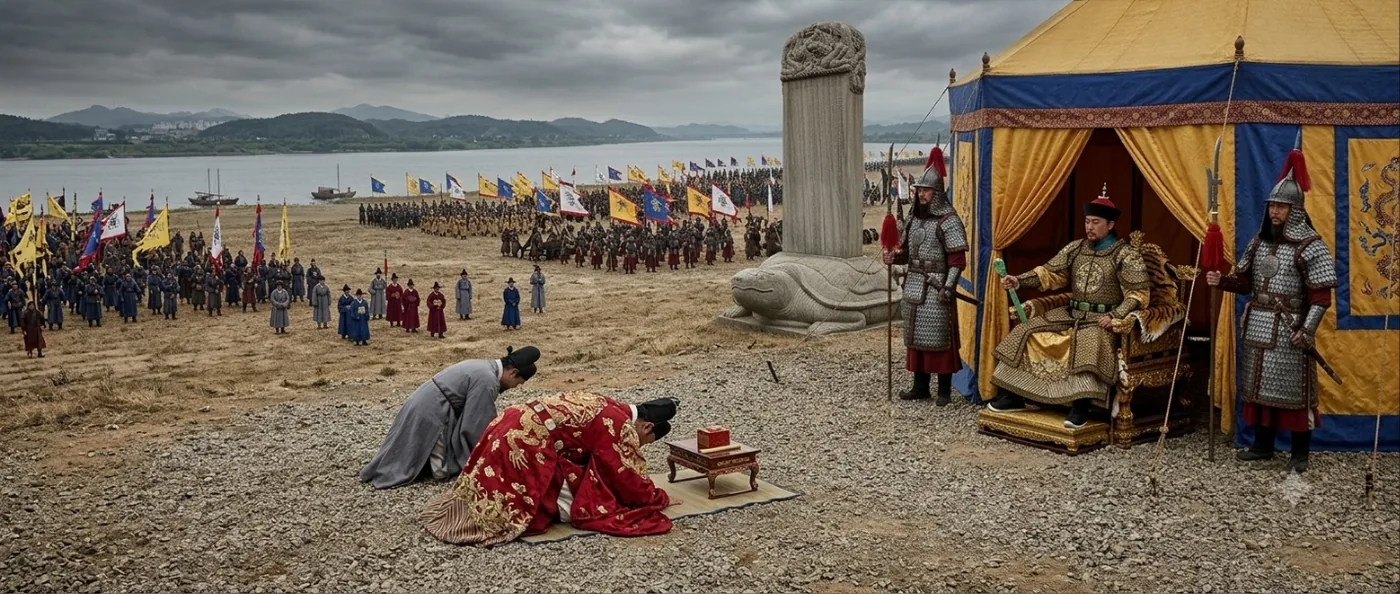
Instead of surrendering or simply fighting, the Goryeo court sent Seo Hui (徐熙) to negotiate directly with Xiao. Seo’s argument was audacious: Goryeo was the legitimate successor of Goguryeo, whose territory extended to the Amnok River. The land between that river and Goryeo’s actual northern boundary was occupied by Jurchen tribes — not Liao settlers. Therefore, Goryeo claimed, that territory should belong to Goryeo.
Liao’s calculation aligned with this framing. Permanent conquest of Goryeo was never the goal; a compliant eastern neighbor was. Liao accepted Goryeo’s break with Song, and Goryeo received the Six Garrison Territories (Gangdong yukju), territory it then garrisoned and developed. A diplomatic performance converted a military invasion into a net territorial gain — one of the more remarkable outcomes in medieval Korean history (National Institute of Korean History, The Khitan Invasions of Goryeo).
What happened in the second invasion, and how did Goryeo survive it?
The second Liao invasion (1010) was grimmer. Following a domestic political crisis in Goryeo in which a pro-Liao king was killed, Liao Emperor Shengzong led a large force personally and drove south. King Hyeonjong fled the capital Gaeseong, which Liao forces entered and damaged. On the surface, a catastrophe.
But Liao’s strategic weakness was the same as in 993: full occupation of a mountainous peninsula defended by fortified positions was beyond its logistical reach. And the sack of the capital masked what actually kept Goryeo alive. Survival hinged on commanders such as Yang Gyu (양규), whose fortress defense and relentless strikes on the retreating Khitan columns — recapturing towns and freeing thousands of captives — turned the occupation into a logistical nightmare. Goryeo’s commanders held fortress after fortress while Hyeonjong’s court sued for peace. Liao withdrew after extracting a nominal submission — but without enforcing it. Goryeo retained its political structure, its territory, and its king. The second invasion, despite the sack of Gaeseong, ended in another Liao failure to achieve its core objectives.
What made the Battle of Gwiju decisive?
By 1018, the relationship between Goryeo and Liao had deteriorated through years of Goryeo’s non-compliance with post-invasion agreements. Liao dispatched a third army under the command of Xiao Baiya (소배압 — not to be confused with Xiao Sunning, who had led the first invasion and faced Seo Hui across the negotiating table). The chronicles describe it as an army styled 100,000 strong — the Goryeosa phrase 兵號十萬 literally means “an army called 100,000,” a conventional figure for a great host rather than a precise headcount; the actual combat strength may have been lower.
Kang Gam-chan (姜邯贊, conventionally dated 948–1031) was the civil official appointed Supreme Commander (Sang Wonsu) (Encyclopedia of Korean Culture, Kang Gam-chan). His first move was at Heunghwajin: Goryeo forces had dammed a tributary, and when Liao cavalry attempted to cross, the dam was released. The water attack disrupted the Liao vanguard and established momentum.
The Liao army pressed southward but failed to capture the critical fortresses in its path. Running low on supplies and facing a hostile winter, Xiao Baiya ordered retreat northward. Kang Gam-chan’s forces moved to Gwiju (present-day Kusŏng, North Pyongan Province) and blocked the route. The resulting battle was a rout. The Goryeosa (高麗史, Book 94, Biography of Kang Gam-chan) records that only a few thousand of the Liao force were said to have made it home — the language of a premodern chronicle emphasizing the totality of the defeat rather than a precise casualty count (Encyclopedia of Korean Culture, Battle of Gwiju).
Liao never invaded Goryeo again. The peace that followed lasted until Liao’s own collapse at the hands of the Jurchen Jin dynasty in 1125.
Drama vs. real history — how much does the show exaggerate?
| In Goryeo-Khitan War (KBS2) | In real history |
|---|---|
| Seo Hui wins territory through a single audacious negotiation | The diplomacy is well-documented; the Gangdong yukju acquisition is historical fact |
| Kang Gam-chan is depicted as a commanding battlefield presence in old age | He was the Supreme Commander; his advanced age at the time is historically attested |
| The dam-burst water attack at Heunghwajin is a turning-point scene | The water attack is recorded; its precise scale and sequence are harder to verify |
| 100,000 Liao soldiers face destruction at Gwiju | The chronicles say the army was styled 100,000 (兵號十萬); actual combat strength may have been lower |
| Goryeo is framed as the underdog against an overwhelming empire | Accurate — Liao had extracted tribute from Song China, a far larger and wealthier state |
In short: the drama compresses personality and timing but stays faithful to the fundamental outcomes — a smaller kingdom halting the dominant empire of its era through a mix of diplomacy, terrain, and one decisive field battle.
Key terms. Liao (遼) — the Khitan-founded empire (907–1125), East Asia’s dominant military power at the time of the invasions. Seo Hui (서희) — Goryeo diplomat who turned the first invasion into a territorial gain through negotiation. Gangdong yukju (강동 6주) — the Six Garrison Territories acquired as a result of Seo Hui’s negotiations with Liao. Kang Gam-chan (강감찬) — Goryeo Supreme Commander at Gwiju; a civil official turned battlefield commander. Gwiju Daecheop (귀주대첩) — the Battle of Gwiju (1019), the decisive Goryeo victory. Cheonnijangsong (천리장성) — the Thousand-Li Wall built after the victory, from the Amnok River to the eastern coast; begun in 1033 (King Deokjong) and completed in 1044 (King Jeongjong).
How does Gwiju compare with the world’s great defensive battles?
Korea (Goryeo) — the triple-strategy victory. What makes the Goryeo-Khitan Wars remarkable as a historical case is the combination of tools deployed across three confrontations over 26 years: pure diplomacy (Seo Hui, 993), strategic withdrawal and attrition (second invasion, 1010), and mobile field battle at the point of maximum Liao vulnerability (Gwiju, 1019). No single approach defines Goryeo’s success. That versatility against one powerful adversary across a generation is the story the KBS drama is telling.
China (Song) — the tribute path. Song China faced the same Liao Empire and made the opposite strategic choice: the Treaty of Chanyuan purchased peace through annual payments — 100,000 taels of silver and 200,000 bolts of silk a year, raised to 200,000 and 300,000 in the 1042 renegotiation. This wasn’t simply weakness. Song had deliberately built a state around civilian rule (문치주의, munchi-jui): wary of the warlord chaos that had ended the Tang, it subordinated its generals to civil officials — superb for internal stability, but a structural handicap against a cavalry empire on the northern steppe. Seen that way, the tribute reads less as humiliation than as a peace-insurance premium — cheaper than endless frontier war, and it let Song protect the economy and administration that were its real strengths. But the contrast with Goryeo is still sharp. Song paid to keep the war away; Goryeo used diplomacy to buy time, fortified in depth, and then won the peace outright at Gwiju. One bought peace with silver; the other earned it with a river and a wall.
The Islamic world and the West — Tours-Poitiers (732). The Western historical episode most structurally similar to Gwiju is the Battle of Tours-Poitiers, where Charles Martel halted the Umayyad advance from Iberia into Frankish territory. It is celebrated in European historiography as the battle that preserved Christian Europe — a framing historians have complicated considerably, noting that the Umayyad expansion may already have overextended for logistical reasons before the battle. Gwiju’s outcome is less contested: Liao’s withdrawal was definitive, and the peace lasted until the empire collapsed.
Byzantium — the long defense. The Byzantine Empire offers the most structurally parallel case across multiple generations: centuries of defending northern and eastern frontiers against Arab, Bulgar, and Pecheneg incursions through a layered combination of fortified positions (the thema provincial-army system), specialized weapons (Greek fire), and diplomatic division of enemies. Goryeo’s fortress-chain strategy in the second invasion, and its construction of the Cheonnijangsong afterward (Encyclopedia of Korean Culture, Cheonnijangsong), reflects a similar institutional logic — defend in depth, exhaust the attacker, negotiate from surviving strength.
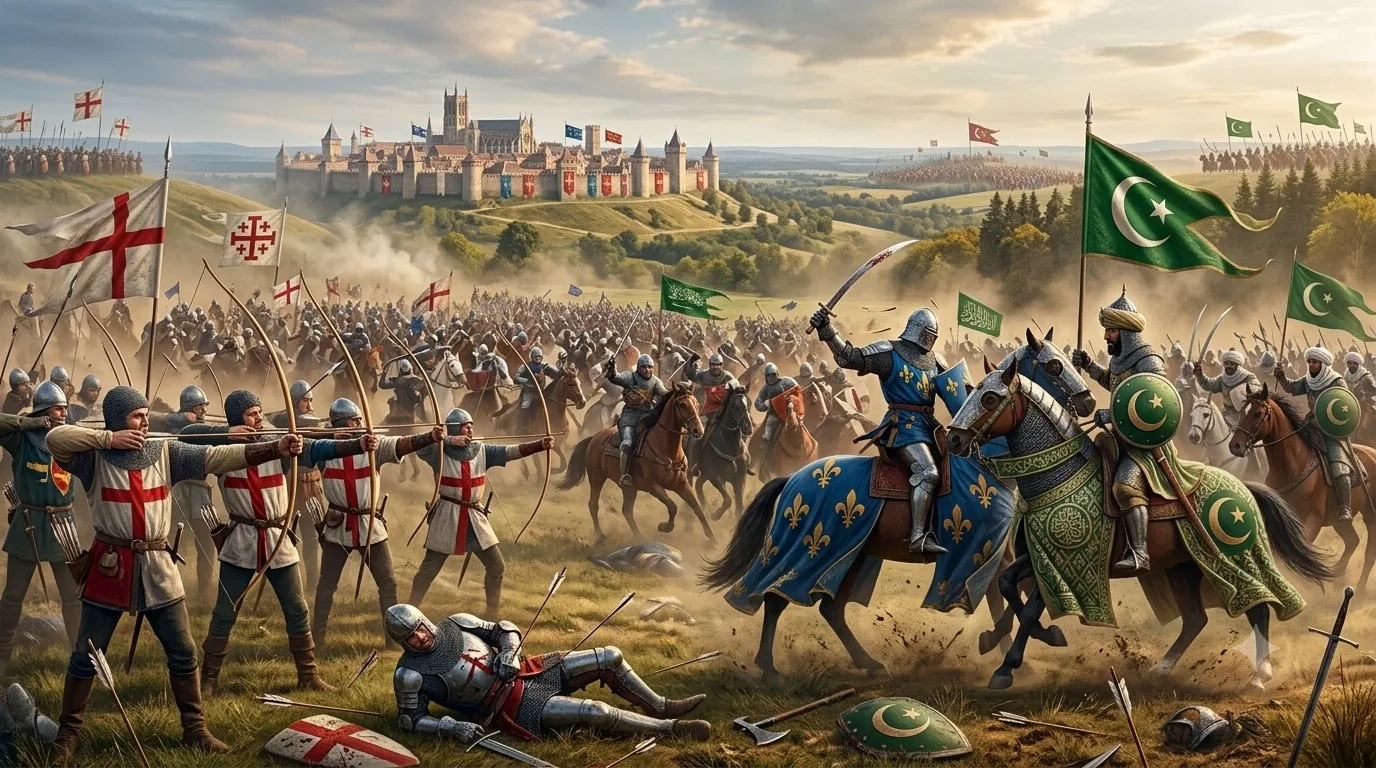 From Tours-Poitiers to Byzantium’s long frontier, the West asked the same question Gwiju answers: how does a defending power stop an expansionist empire? (AI illustration)
Coming up next
A kingdom that won three wars against the dominant empire of its era — through diplomacy, water, and a general in his seventies blocking a retreat route. The drama makes it feel personal. The history shows it actually was.
Next, we move forward two centuries and turn south, to a mountain fortress in winter. Forty-seven days of siege, a court split between fighting and surrendering, and a king who eventually had to choose.
Thanks for reading — see you in the next one.
Frequently asked questions
What is the drama Goryeo-Khitan War about? Goryeo-Khitan War (2023–2024, KBS2) is a large-scale Korean historical drama depicting Goryeo’s three wars against the Liao (Khitan) Empire between 993 and 1019. It centers on Seo Hui, the diplomat who won territory without a battle in 993, and Kang Gam-chan, the general who destroyed the Liao expeditionary force at Gwiju in 1019.
Who was Kang Gam-chan, and why is he famous? Kang Gam-chan (conventionally dated 948–1031) was a Goryeo civil official appointed Supreme Commander during Liao’s third invasion. He is remembered for breaching a dam to flood the Liao vanguard at Heunghwajin and blocking the Liao retreat at Gwiju. The Goryeosa records that only a few thousand of the Liao force were said to have survived. His advanced age — he was about seventy-one — has made him an iconic figure in Korean military history.
How did Seo Hui gain territory through diplomacy during an invasion? In 993, Liao’s goal was to break Goryeo’s Song alliance, not to conquer Goryeo outright. Seo Hui argued that Goryeo was Goguryeo’s successor with historic claim to the Amnok River border. Liao, preferring a stable eastern neighbor over prolonged conquest, accepted the framing. Goryeo cut Song ties and received the Six Garrison Territories in return.
Why did the Liao Empire invade Goryeo three times? Each invasion had a distinct trigger: the first aimed to break Goryeo’s Song alliance; the second followed a domestic Goryeo political crisis; the third was intended to enforce submission after years of non-compliance. All three ended with Liao failing to achieve its stated core objectives.
What happened at the Battle of Gwiju? In 1019, Kang Gam-chan’s forces trapped the retreating Liao army at Gwiju. The Goryeosa records that only a few thousand were said to have survived. The sources describe the Liao force as one “styled 100,000 strong” (兵號十萬) — a conventional figure rather than a precise count — but the scale of the defeat is consistent across historical accounts. Liao never invaded Goryeo again.
Why is the Battle of Gwiju barely known outside Korea? European and Chinese frameworks dominate global history curricula; the Goryeosa has limited English translation; and victors often receive less historiographical attention than victims. The KBS drama is arguably the first mass-audience vehicle to bring this conflict to significant international attention.
Was the Battle of Gwiju Korea’s greatest medieval victory? It is traditionally counted among Korea’s three great victories, alongside the Salsu Battle (612, against Sui China) and the Battle of Hansan Island (1592, against Japan). What makes Gwiju distinctive is that it ended a generation-long confrontation with one of East Asia’s strongest military empires — after 1019, Liao never invaded Goryeo again.
What is the Cheonnijangsong, and when was it built? The Cheonnijangsong (Thousand-Li Wall) was Goryeo’s northern fortification line, running from the mouth of the Amnok River to the eastern coast. Construction began in 1033 (King Deokjong’s 2nd year) and was completed in 1044 (King Jeongjong’s 10th year) — roughly twelve years of work. It served as the primary defense line against subsequent Jurchen and Mongol threats.
How does the Battle of Gwiju compare with Tours-Poitiers? Both involved a defending kingdom stopping an expansionist empire at a decisive field battle. Historians debate how decisive Tours-Poitiers (732) really was — the Umayyad advance may have already stalled logistically. Gwiju’s outcome is less contested: the peace with Liao lasted until the empire’s own collapse in 1125, without any further large-scale Liao invasion of Goryeo.
Sources & further reading
This piece was written from the historical script and fact-check of 사뚱샘의 역사방 (SaDDungSam), drawing on primary chronicles and established scholarship:
- Goryeo-Khitan Wars (993–1019) — primary chronicles — Goryeosa (高麗史) and Goryeo Sacheolyo (高麗史節要); National History Compilation Committee (Guksa pyeonchan wiwonhoe) Korean History Database.
- Seo Hui’s diplomacy and the Six Garrison Territories — Encyclopedia of Korean Culture (Hanguk minjok munhwa daebaekkwa sajeon) entries on Seo Hui, the Gangdong yukju, and the first Goryeo-Liao War.
- Kang Gam-chan and the Battle of Gwiju — Encyclopedia of Korean Culture entries on Kang Gam-chan and gwiju daecheop; Goryeosa biographical section (Yeoljeon).
- The Cheonnijangsong — Encyclopedia of Korean Culture entry on cheonnijangsong; National History Compilation Committee sources on Goryeo’s northern defense construction.
- The Liao (Khitan) Empire and the Treaty of Chanyuan — Encyclopaedia Britannica entry on the Liao Dynasty; standard scholarship on Song-Liao diplomatic relations.
- Battle of Tours-Poitiers in comparative context — Standard Western medieval history sources; ongoing historiographical debate on the battle’s actual strategic decisiveness.
- Byzantine frontier defense (thema system, Greek fire) — Encyclopaedia Britannica entries on the Byzantine Empire and its military institutions; standard Byzantine history scholarship.
- Edward J. Shultz, Generals and Scholars: Military Rule in Medieval Korea (University of Hawaii Press) — background on Goryeo military structure and civil-military relations.
Thanks for reading — see you in the next one.
This article was researched and written by K-Drama History. Source: How Did Goryeo Survive the Liao Empire Three Times? Seo Hui, Kang Gam-chan, and the Battle of Gwiju, Explained — K-Drama History