The Tiger, Explained: Joseon Korea Codified a Military Corps for Hunting Tigers
Theme: Power & Politics
From the research behind Pause the Drama.
In The Tiger: An Old Hunter’s Tale (대호, 2015), an ageing marksman on Jirisan refuses to hunt any more, and the animal he refuses to hunt is not simply an animal. The villagers speak of it as the lord of the mountain. The film builds to a single man facing a single tiger, alone.
Four centuries earlier, the Korean state had faced the same animal — and its answer looked nothing like that.
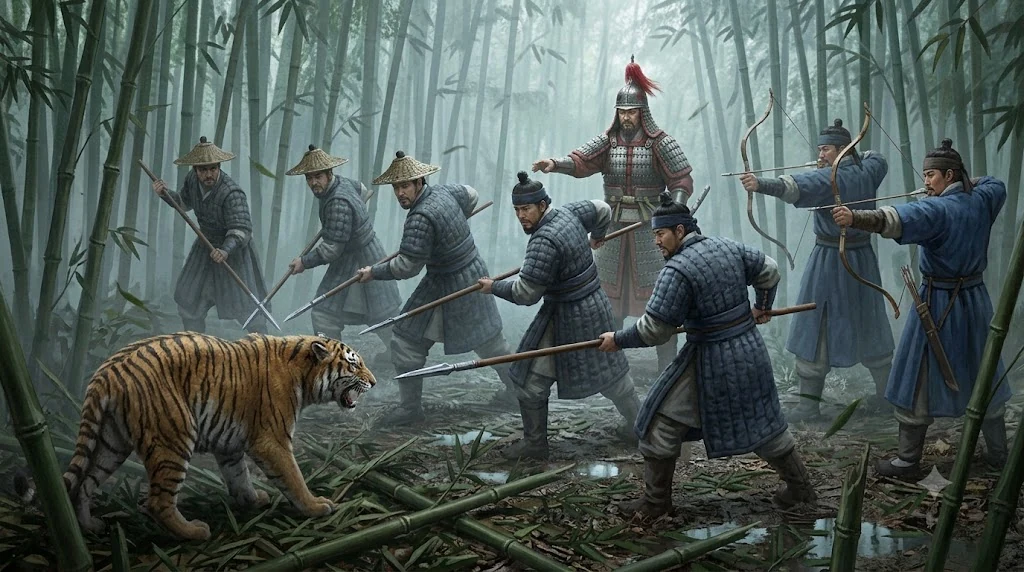 A tiger taken by a party, not a duel — a spear line from one side, bows from the other, an officer directing from behind. (AI illustration; a reconstruction of the method, not a specific recorded hunt)
Quick answer: Joseon fielded the chakho gapsa (착호갑사, “armoured soldiers who catch tigers”), a military speciality with quotas, entrance examinations and a graded reward scale written into the national law code. Tigers were the focus, though leopards were covered too. The term first appears in 1416; formal organisation followed under King Sejong from 1421, and the roster grew to 440 in the Gyeongguk daejeon — five rotating shifts of 88, not a standing hunting party. And the part that surprises modern readers: the state made heavy use of traps, and a tiger taken in a state-managed trap earned the same service credit as one taken with arrow or spear.
A predator the state had to answer
It is easy to read the tiger of Korean art — the comic one in folk paintings, the mascot of the 1988 Olympics — back into the Joseon period and assume the animal was mostly a symbol. It was not. Tigers came into the capital.
In 1405 a tiger entered the courtyard of the main hall of Gyeongbokgung Palace. In a separate incident in 1626, a tiger that had killed a woodcutter outside the Inwangsan fortress wall went on into the rear garden of Ingyeonggung. These are two different events, two centuries apart, and they are worth keeping apart rather than blurring into one image of tigers prowling the throne room. But together they make the point: a kingdom whose palace grounds were not reliably tiger-free had a security problem, not a folklore motif.
Removing that threat was also a demonstration. A state that cannot keep large predators out of its own capital has trouble claiming it governs the countryside.
The corps, and the dates people get wrong
The chakho gapsa were not improvised. They emerged as a specialised branch of the gapsa, the elite armoured soldiers who served in the royal guard and in other military duties including frontier defence, and they became a recognised speciality with its own rules.
Here the sources demand care, because two different moments regularly get merged into a single “founding.”
The term first appears in the records in the tenth month of 1416, under King Taejong. That body is understood as a temporary arrangement rather than a standing corps — men dispatched to a province when tigers became a problem, and dispersed afterwards.
Formal organisation came under King Sejong. In 1421 the structure was set out with rotating on-duty and off-duty shifts. It is tempting to reduce this to “founded in 1421 with 20 men,” and that reading circulates, but the National Folk Museum of Korea describes the 1421 arrangement in terms of shifts of twenty on and twenty off, and the underlying entry does not read cleanly as a single total headcount. The safe statement is that 1421 is when the corps acquired a formal shift structure — not that its entire strength was fixed at twenty.
After that the roster grew, and here the numbers are firm:
| Roster | |
|---|---|
| 1425 (Sejong 7) | 80 |
| 1428 (Sejong 10) | 90 |
| 1468 (Sejo 14) | 200 |
| Gyeongguk daejeon (Seongjong era) | 440 |
One caution about the last figure. The National Folk Museum explains the 440 as five rotating shifts of 88, which means it describes the size of the roll, not a force that took the field together. The corps expanded across the fifteenth century; it never became a 440-man tiger hunt.
Getting in
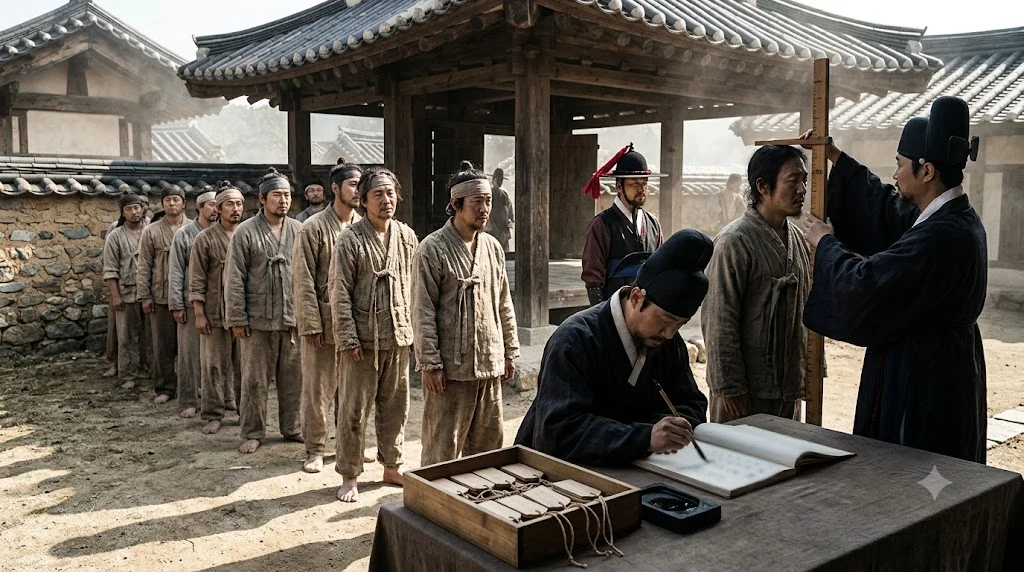
Entry ran through an examination, and the Gyeongguk daejeon lists the subjects in its military section: shooting on foot, shooting from horseback, spear work from horseback, running, and strength. Under that structure a candidate could qualify by passing in a single skill — you did not need to be excellent at everything.
An earlier rule from 1425 had similarly allowed men to be assigned who passed in either archery or the spear. The two are related in spirit but belong to different periods and different codes, and merging them into one “the Gyeongguk daejeon said you only needed a bow or a spear” is the kind of tidy sentence that quietly misstates the record.
There was also a results-based route. Men credited with spearing tigers — recorded by whether they struck first or second — could be exempted from the entrance test. This was credit for demonstrated performance in a group hunt, not a claim that one man had personally taken down two tigers alone.
How a tiger was actually taken
A tiger was not ordinarily brought down by a single arrow. At least three arrow strikes or three spear thrusts were normally needed, and the reward system was built around that reality: the man who struck first was recorded as seonjungjeonja (先中箭者), the second as chajungja, the third as ucha-jungja. Rewards followed the order of the strikes.
Which weapon actually did most of the work is less certain than it might seem. Surviving hunting paintings show spear hunts far more often than archery, which suggests the spear was the more common instrument — but that is an inference from pictorial evidence, not a count, and it should be held as a probability rather than a fact.
Then there is the part that tends to surprise readers raised on heroic hunting stories.
The state was fine with traps
Joseon made extensive use of the hamgi (함기), a trap sometimes described in Korean as a “thunderbolt frame.” A pit was dug and covered with a raft of logs or a heavy lid, propped at an angle and held on a bow-stave trigger, with a dog tethered inside as bait. When the tiger came in after the dog, the trigger released, the cover dropped, and the animal could not get out.
Note what that means: the hamgi was used to take tigers and leopards alive, or to obtain the pelt undamaged. It was not simply a heavier way of killing — it was a way of ending the hunt without anyone standing in front of the animal, and without ruining what the state wanted from it.
The revealing detail is not the mechanism but the accounting. A regulation of 1471 put arrow, spear and trap on the same footing: for a large tiger, the credit ran 50 days of service for the first strike, 45 for the second, 40 for the third — and a tiger taken with a state-managed trap was credited on the same scale. Joseon did not treat a trapped tiger as a lesser trophy, and it did not reserve reward for the man who faced the animal down.
It is worth being precise about how far this goes, because it is easy to overstate into a neat reversal. This is not evidence that the kingdom formally ranked traps above weapons as a matter of doctrine. What it shows is a state that encouraged safe, effective methods alongside direct hunting and declined to discount them.
The strongest pro-trap statement in the record belongs to one person. In his Mongmin simseo, the scholar Jeong Yak-yong ranked trap-based methods above the matchlock, and argued that hunters conscripted for tiger duty imposed a heavier burden on villagers than the tigers did. That is a formidable administrator’s judgement about local government — and it is his argument, not an official Joseon ordering of weapons.
Note also what a specific reward figure is attached to. The equal-credit principle of 1471, carried into the Gyeongguk daejeon in 1485, is one thing; the Daejeon songnok of 1492 is another, and it did something more specific — it separated state-managed traps from privately set ones and offered alternatives to service credit, such as three bolts of cotton cloth or twenty days’ credit for a large or medium tiger taken in a state trap. Same story, different provisions.
Dates and institutions not to confuse 1416 — the term first appears; a temporary arrangement, not a standing corps. 1421 — formal shift structure under Sejong (not a fixed total of twenty men). 1471 — arrow, spear and trap given equal service credit. 1485 — roster and rules carried into the Gyeongguk daejeon (440 across five shifts). 1492 — Daejeon songnok separates state from private traps and adds alternative rewards. 1785 — Daejeon tongpyeon marks the provincial tiger-catcher provision as superseded; not an abolition of the whole institution. Later provincial tiger units performed a related function — they were not simply the central corps renamed.
Why the state cared: two motives, not one
It is tempting to draw a clean line — Joseon hunted tigers to protect its people, and later hunters killed them for trophies. The record does not sort that neatly.
Protection was real. So was economics. Tiger and leopard pelts were valuable, both for domestic use and as tribute, and the state’s interest in the animal included that value. Curiously, the more prized skin was not the tiger’s but the leopard’s: fine-furred and well-marked, it stood high among the goods China sought from Korea. Skins destined for tribute were held to demanding standards, though those standards varied over time rather than holding fixed across five centuries.
So the corps sat at the meeting point of two needs — keeping subjects alive, and supplying a valuable commodity. Both were operating at once.
The mountain lord
Alongside all this administration ran a completely different way of regarding the same animal.
In popular belief the tiger was the sangun (山君), the lord of the mountain; the scholar Yi Gyu-gyeong records the usage, along with epithets like sallyeong (mountain spirit) and “hero of the mountains.” The tiger appears as the mountain spirit’s messenger, sometimes as the spirit itself, and offerings to the mountain spirit before a dangerous spear hunt are recorded — though how widespread that practice was, and in which periods and regions, is not established.
The stories give the animal several faces. In the Samguk yusa tale of Kim Hyeon, a tiger-woman gives her life for the man she loves, and a temple is founded in her memory — a Silla-period tale, not a Joseon fact. In Park Ji-won’s satire Hojil, a tiger delivers a moral rebuke to a hypocritical scholar. In village folktales, a tiger is frightened off by a dried persimmon.
This reverence belongs to folk belief and literary imagination. It was not state doctrine, and it should not be read as “Joseon worshipped the tiger.” The same kingdom that called the animal a lord also set a bounty scale on its hide. Both are true, and the tension between them is the interesting part — much as the same court could keep an official shaman inside a Confucian capital.
Compared: three states, three ways of handling a predator
States elsewhere also organised against dangerous animals, and the comparison sharpens what Joseon did.
Carolingian Francia. Article 69 of the Capitulare de villis, the late eighth- or early ninth-century instruction for managing royal estates, directs stewards to keep the king informed at all times about wolves — how many each has taken — and to send the skins in. That is a standing administrative expectation about a specific predator, backed by reporting. Historians caution that the Capitulare was substantially aspirational and did not always match what estates actually did, so it is better read as a statement of intent than as a description of practice.
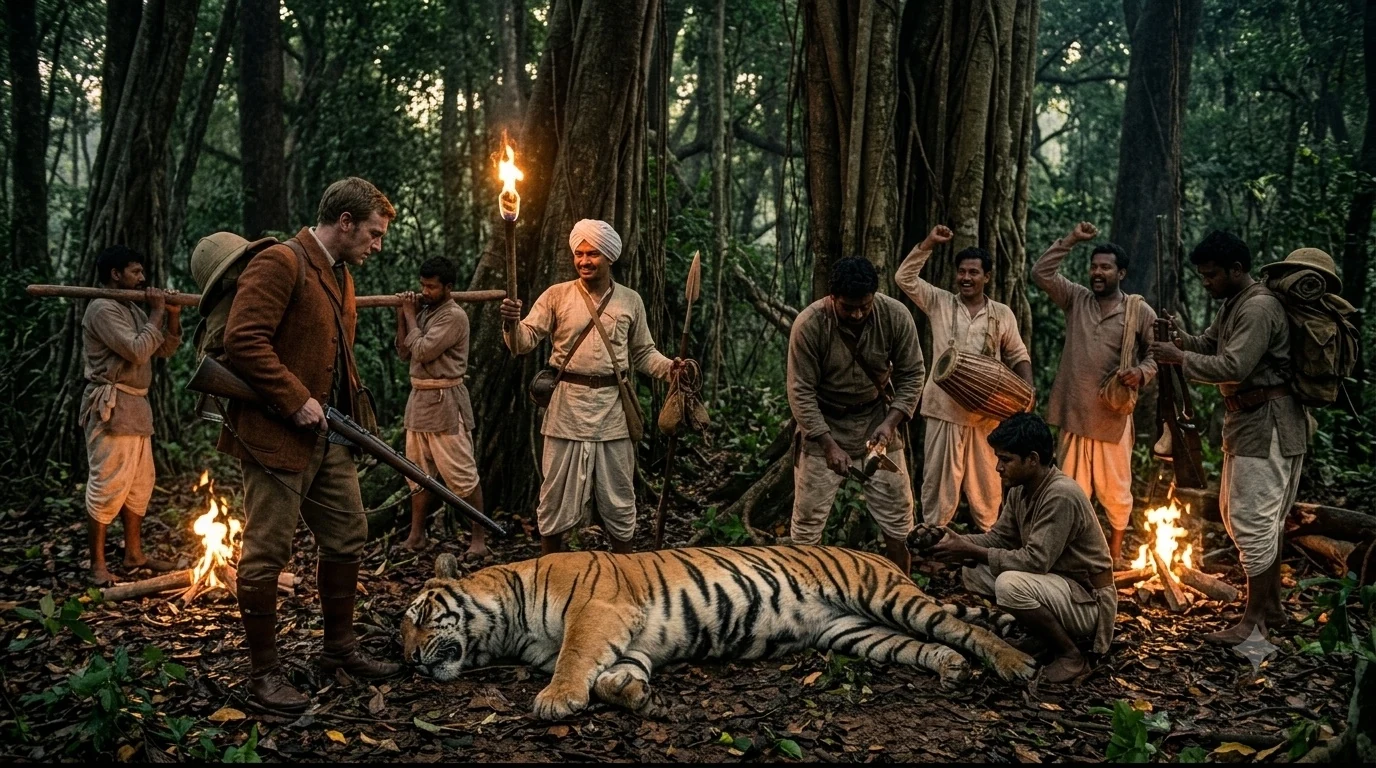 A colonial-era shikar hunt: the kill displayed, the labour of the hunt supplied by local men. (AI illustration)
British India. Tiger hunting, shikar, is often summarised as pure imperial sport, and the display element was real. But the picture was mixed: removing man-eaters and protecting settlements served as a stated justification for colonial authority, and bounty payments drove killing well beyond sport. Estimates of roughly 80,000 tigers killed between 1875 and 1925 rest largely on bounty records and describe large-scale destruction under colonial rule rather than a tally of sporting kills.
Joseon Korea. What distinguishes Joseon is codification. Not stewards reporting pelts, not a bounty layered onto sport, but a military speciality with quotas, examination subjects and a reward scale set out in the national law code — and an accounting that credited a trapped tiger the same as a speared one.
What happened to the corps
The ending is usually told too tidily. It is often said that the Daejeon tongpyeon of 1785 records the abolition of the tiger-hunting corps, but that reads the code too broadly. The notation geumpye (今廢, “now abolished”) there attaches to the immediately preceding provision on selecting provincial tiger-catchers, and the code’s own editorial convention was to mark superseded provisions this way. It is not a declaration that the whole institution had been dissolved.
The later picture is also less unified than a single name suggests. In 1814 the Sunjo sillok refers to a force of some five thousand “tiger-catching soldiers” formerly under the Pyongan provincial command, redesignated in 1696 — a provincial military arrangement, not a continuation of the central corps under a new name. Central chakho gapsa, provincial tiger-catchers, and later regional units should not be strung together as one organisation renamed over time.
What can be said is this: as firearms spread through the later Joseon period, professional gunners and the standing garrisons absorbed much of the work, and the central corps declined in importance.
Back to the film
Which returns us to that lone hunter on Jirisan, and to the four centuries between him and the corps.
The Tiger is set in 1925, under Japanese colonial rule. Its hunter carries a rifle. He is not a chakho gapsa and the film does not depict them — nor do Mr. Sunshine or Kundo, which belong to the same later gunner era. What the film captures accurately is the older sensibility: an animal addressed as a lord of the mountain, feared and honoured at once.
What it cannot show, because it is a different story, is the other Korean answer to the tiger — unheroic, procedural, and startlingly modern in temper. Quotas. Entrance examinations. Graded rewards by order of strike. And a state that, faced with a choice between glory and a pit with a heavy lid and a dog inside, was perfectly willing to sign off on the pit.
Sources
- National Institute of Korean History, 우리역사넷 — Sim Seung-gu, “착호갑사,” “착호의 사냥법,” “호랑이 사냥의 포상,” “호환과 사냥” (Korean Cultural History vol. 40).
- Gyeongguk daejeon, Military Section (examination subjects for the chakho gapsa); Seongjong sillok kwon 9, Seongjong 2 (1471), first month (equal service credit for arrow, spear and trap; 50/45/40 days for a large tiger); Daejeon songnok (1492, state versus private traps and alternative rewards); Daejeon tongpyeon (1785, provincial tiger-catcher provision and its geumpye notation).
- Veritable Records of the Joseon Dynasty — Taejong sillok (1405 Gyeongbokgung incident; 1416 first appearance of the term), Sejong sillok (1421 shift organisation; 1425 and 1428 rosters), Injo sillok (1626 Ingyeonggung incident), Sunjo sillok (1814, Pyongan tiger-catching soldiers).
- National Folk Museum of Korea, Encyclopedia of Korean Folk Symbols — 寅 (shift structure; the 440 figure as five shifts of 88).
- Jeong Yak-yong, Mongmin simseo — ranking of hunting methods and criticism of the burden imposed by conscripted hunters.
- Yi Gyu-gyeong, Oju yeonmun jangjeon sango — the tiger as sangun; Samguk yusa — the Kim Hyeon tale; Park Ji-won, Hojil.
- Capitulare de villis, art. 69 (Carolingian royal estates, wolf reporting); on the document’s aspirational character, J. Campbell, “The Capitulare de Villis, the Brevium exempla, and the Carolingian court at Aachen,” Early Medieval Europe (2010).
- Shafqat Hussain, “Forms of Predation: Tiger and Markhor Hunting in Colonial Governance,” Modern Asian Studies 46:5 (2012); Joseph Seeley and Aaron Skabelund, “Tigers—Real and Imagined—in Korea’s Physical and Cultural Landscape,” Environmental History 20:3 (2015).
Reign dates and Korean-era years follow the sources cited. Individual Veritable Records article identifiers have not been checked against the original entries; where a fact rests on the National Institute of Korean History’s account rather than on our own reading of the primary text, it is presented as that account reports it.
This article was researched and written by K-Drama History. Source: The Tiger, Explained: Joseon Korea Codified a Military Corps for Hunting Tigers — K-Drama History