Were Gisaeng Like Geisha? Hwang Jini and the Real History Behind Joseon's Female Entertainers
Theme: Women’s Lives
From the research behind Pause the Drama.
In Hwang Jini (KBS2, 2006), a single line of verse is enough to unravel a man’s composure. In the best-known anecdote, a royal-clan aristocrat who went by the pen name Byeokgyesu (a great-grandson of King Sejong, famed as a geomungo master) boasted that no woman could shake him. Hwang Jini let him ride past her by moonlight, then recited — “Blue mountain stream, don’t boast that you flow so freely” — and his composure was gone. (A separate legend has her break the long ascetic discipline of a revered monk, Jijok Seonsa — the two men are different figures, though retellings often blur them.)
She was, by Joseon law, the lowest thing a person could be: a gisaeng, a registered entertainer classified in the same legal tier as government slaves. And yet the greatest scholars of her age sat with her as equals, traded poems with her, and lost. How does a system that calls a woman “lowborn” simultaneously give her an education that surpasses its highest-born men?
That question is the whole point of Hwang Jini — and it turns out, the answer lies not in Hwang Jini’s personal genius but in how Joseon’s state built its caste system.
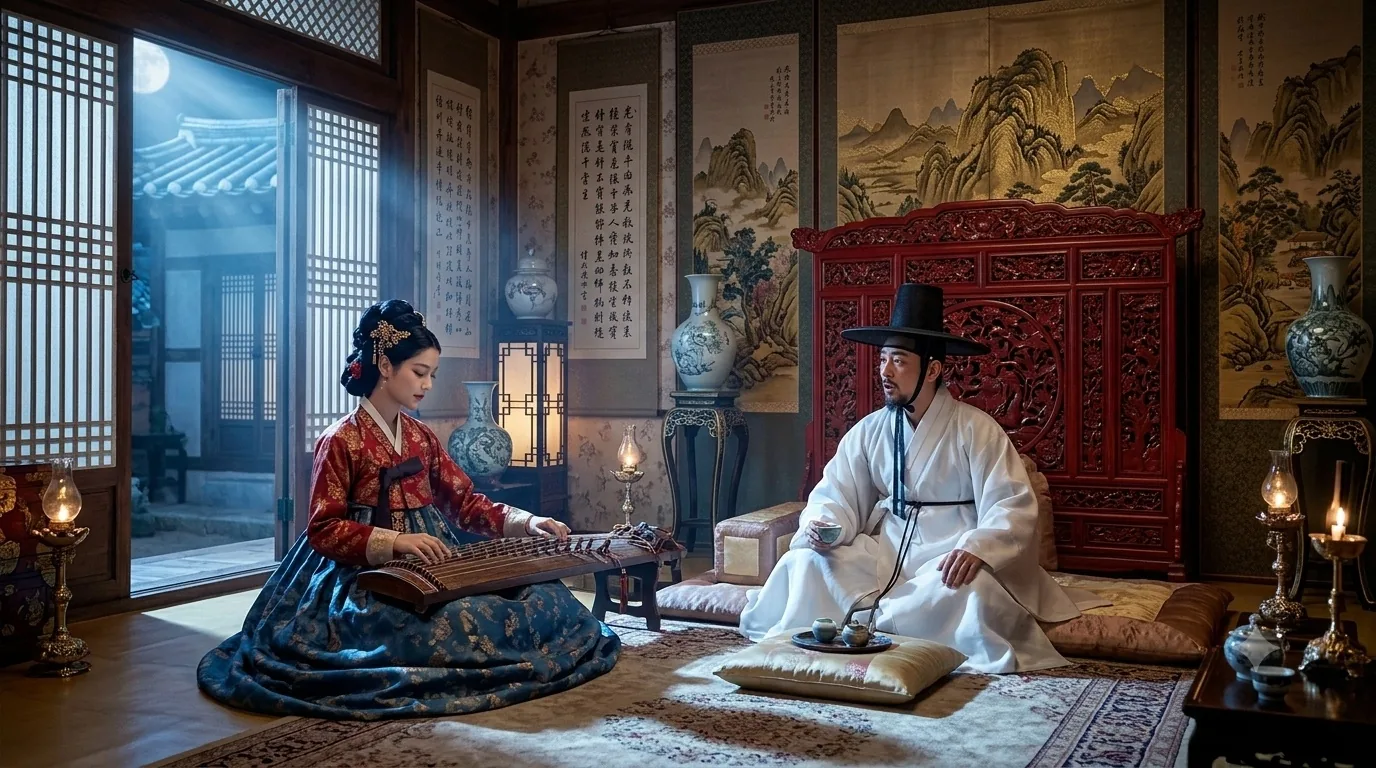
Quick answer: A Joseon gisaeng was not simply a prostitute or a Korean version of a geisha. She was a government-registered female entertainer, legally placed among the lowest social groups yet trained through the gyobang (state academy) in music, dance, song, and court performance. Literary fame, in the case of figures like Hwang Jini, came less from a formal state poetry curriculum than from private study and exchange with the literati. Hwang Jini became a legend because she exposed the contradiction at the system’s heart: a woman treated as lowborn by law could become culturally equal to the men who ruled her world.
Why did Korea’s state put its lowest-caste women through a rigorous literary education?
Joseon’s social order rested on the yangcheon system: a binary division between yangmin (commoners and above) and cheonmin (the unfree). In practice this resolved into a familiar Confucian hierarchy — scholars, farmers, artisans, merchants — above a fifth category of the “lowborn.” Gisaeng sat firmly in that fifth tier, grouped legally with government slaves (gwannobi).
Yet the same state that classified them as lowborn funded their education. The reason was functional: the state needed skilled performers for official banquets, diplomatic receptions, and court ceremonies, and it needed them reliably, on official rosters. The solution was the gyobang (교방), a government training institute attached to regional offices across the country. The gyobang taught gayageum (Korean zither), geomungo (six-string zither), piri (bamboo flute), song, and jeongjae (정재, formal court dance). Its core function was performance training in music and dance — not literary instruction. Classical Chinese poetry composition was not a formal part of the curriculum; the Encyclopedia of Korean Culture describes the gyobang as an institution where entertainers learned and performed court and ceremonial music. The literary brilliance of a gisaeng like Hwang Jini came instead from individual study and from her exchanges with the male literati of her day — not from a state poetry class.
That distinction matters. It is tempting to call the gyobang a “gisaeng school” that manufactured poet-entertainers on demand, but the truth is more interesting. The state trained these women as musicians and dancers; the ones who became literary legends did so by building a private education on top of that foundation. Hwang Jini, a gisaeng from Gaeseong (Songdo) — the old Goryeo capital, whose gyobang culture was particularly developed — became the example history remembered. In later tradition she is grouped alongside the scholar Seo Gyeong-deok (Hwadam) and the Bak-yeon Waterfall as one of the “Three Marvels of Songdo” (Songdo Samjeol, 松都三絕); the Encyclopedia of Korean Culture’s entry on Hwang Jini records this grouping. It should be read not as an official Joseon-era title but as a popular tradition that crystallized around her fame and the cultural prestige of the Gaeseong region — direct biographical sources on her are scarce, and much of what survives comes through later anecdotal writing (yasa). What is beyond dispute is that multiple yangban writers of the period referenced her by name as an intellectual peer.
A correction worth making early: Western accounts of gisaeng often default to “Korean prostitutes” or “just like geisha.” Both framings flatten what was actually a diverse institution. The primary legal duty of a gwangi (official gisaeng) was artistic performance at official functions — not sexual service, which had no formal standing in the job description. Real-world practice varied enormously by era, region, and individual, but treating sexual service as the defining feature misreads the institution entirely.
Were all gisaeng the same? The three tiers of the system
The gisaeng world was not monolithic. It divided, roughly, into three layers.
Gwangi (官妓) — Official gisaeng attached to government offices. These were the most prestigious, subject to official rosters and mobilized for state events. Hwang Jini was a gwangi, based in Gaeseong.
Sagi (私妓) — Private gisaeng working outside the government system, typically in taverns or private households. Their status was lower than gwangi and their work less protected by official affiliation.
Toegi (退妓) — Retired gisaeng. The retirement threshold was codified: the Gyeongguk Daejeon (the foundational Joseon legal code) stipulated that a Seoul-registered gisaeng (gyeonggi) be struck from the performers’ register and released from service duty at age fifty (京妓 年滿五十 除樂籍 免貢役). Two cautions, though. “Toegi” itself was a colloquial term, not the legal language — the code speaks of removal from the roster, not of “retired courtesans.” And the age was not uniform: the fifty-year rule applied mainly to gisaeng conscripted to the capital, while those attached to provincial offices could remain bound until sixty-one, like other unfree laborers. What is clear is that social stigma did not retire along with the woman — the label followed her.
One detail from Hwang Jini’s biography illuminates a gisaeng’s sense of self within this system. According to one tradition, she chose her own gisaeng name — Myeongwol (明月, “Bright Moon”) — herself. The Encyclopedia of Korean Culture records her birth name as Hwang Jin (黃眞) and her gisaeng name as Myeongwol; that she chose it herself, however, has an uncertain documentary basis and continues to be debated, since direct sources on her life are scarce and much rests on later tradition. The story is still telling: whether or not it is verified, it circulated as plausible precisely because the idea of a gisaeng asserting her own artistic identity was not seen as impossible.
Drama vs. real history — what does Hwang Jini get right?
| In Hwang Jini (KBS2, 2006) | In real Joseon history |
|---|---|
| Hwang Jini sparring intellectually with top scholars | Corroborated in contemporaneous yangban writings |
| She is a gwangi from Gaeseong / Songdo | Consistent with historical accounts |
| Her artistry spans poetry, music, and dance | Matches the gyobang curriculum |
| She has a name she claims as her own (Myeongwol) | Attested as tradition; exact documentary source debated |
| She is treated as a social inferior yet cultural equal | The central structural paradox of the actual institution |
Key terms. Gisaeng (기생) — a government-registered female entertainer in Joseon; lowest legal caste, highest cultural training. Gwangi (官妓) — official gisaeng attached to a state office. Gyobang (교방) — the state training academy where gisaeng learned music, dance, song, and court performance; literary composition was not a formal part of its curriculum. Cheonmin (賤民) — the “lowborn” caste at the base of Joseon’s yangcheon system, which included government slaves and gisaeng. Sijo (시조) — the vernacular Korean poetic form; at least several sijo attributed to Hwang Jini survive in literary collections, though the exact count varies by scholar. Songdo Samjeol (松都三絕) — the “Three Marvels of Songdo”: Hwang Jini, the scholar Seo Gyeong-deok, and the Bak-yeon Waterfall.
The educated entertainer across cultures — gisaeng, geisha, courtesan, tawaif
Korea’s gisaeng was not unique in producing a class of women who were socially stigmatized and culturally elite simultaneously. But the details of how each society produced that result differ sharply.
| Tradition | Shared trait | Key structural difference |
|---|---|---|
| Joseon gisaeng | trained female entertainer, artistically elite yet low-status | registered and trained by the state |
| Japanese geisha | music, dance, refined conversation | private guild (okiya), never state-run |
| European courtesan | literary and musical cultivation | individual patronage, salon culture |
| Indian tawaif | dance, music, poetry | court/private patronage (kotha household) |
In short: all four societies gave stigmatized women extraordinary artistic educations — but only Joseon ran the system through a government office.
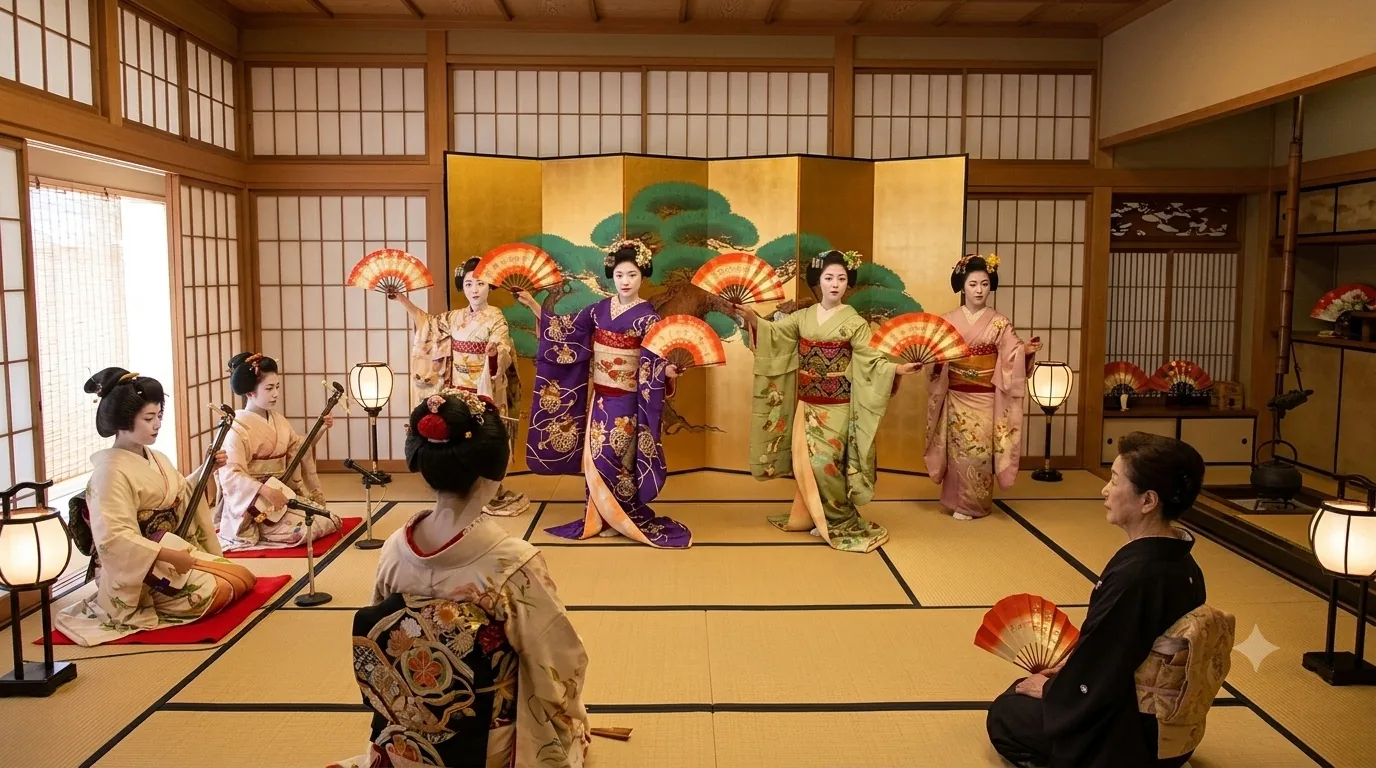
Japan — the geisha. Japan’s geisha emerged in the Edo period (1603–1868) as a distinct class of professional entertainers within a private guild system called the okiya. Their training — shamisen, classical dance, the art of refined conversation — parallels the gyobang curriculum closely. The key structural difference is that Japanese geisha were products of a private market, not a state apparatus. No government office enrolled them or set their duties by statute; their relationship was with the okiya and its proprietress, not with the state.
France and Italy — the courtesan. The Renaissance and Baroque courtesan (French courtisane, Italian cortigiana) was a figure of urban elite culture, educated in literature, music, and classical languages under the patronage of wealthy noblemen. The Italian cortigiana onesta (“honest courtesan”) in particular could anchor a salon, correspond with humanist scholars, and publish poetry. The structural contrast with the gisaeng is decisive: her position rested on individual patronage relationships, not state-mandated training and employment. There was no gyobang counterpart.
India — the tawaif. Among the four comparisons, India’s tawaif of the Mughal and post-Mughal courts comes closest in structural terms to the Joseon gisaeng. Tawaif were professional performers specializing in classical dance (kathak), music, and Urdu poetry, patronized by nobles and nawabs, and recognized as repositories of high culture — the primary vehicle, in some regions, for the transmission of Urdu literary tradition. Like the gisaeng, they held low formal social status and high cultural authority simultaneously. The difference is again institutional: the tawaif operated within a semi-formal private patronage system (the kotha household), not a government office with official rosters.
The pattern across all four is consistent: societies that needed skilled female entertainers for elite male culture found a way to give those women extraordinary educations — and then made sure they could not keep the social status that education implied.
Coming up next
A poem that undoes thirty years of meditation. A woman who names herself. A state that trains its servants to out-argue its masters and then makes sure they stay servants. The gisaeng institution is one of history’s most efficient paradox machines — and Hwang Jini is history’s most famous product of it.
In the next essay, we move from the poetry hall to the throne room — and ask why a Joseon king locked his son in a wooden chest and left him there for eight days.
Thanks for reading — see you in the next one.
Frequently asked questions
What is the KBS drama Hwang Jini about? Hwang Jini (KBS2, 2006) dramatizes the life of the legendary sixteenth-century gisaeng of the same name, tracing her artistry, her love affairs, and her rivalry with the Confucian scholarly world. The drama uses her story to explore the central paradox of Joseon’s caste system: a woman classified as the lowest caste yet recognized as the finest poet and musician of her age.
What was a gisaeng in Joseon Korea? A gisaeng was a government-registered female entertainer who served at official banquets, diplomatic receptions, and state ceremonies. Her primary duties were musical performance, dance, and classical Chinese poetry. Officially she belonged to the cheonmin (lowest) caste — the same legal tier as government slaves — yet the state funded her education through a training institute called the gyobang.
Was Hwang Jini a real historical person? Yes. Hwang Jini is considered a real historical figure. Several of her sijo — about five or six are commonly cited, though the exact count varies by scholar because of transmission and attribution problems — survive in Joseon literary collections, and she is mentioned in the writings of contemporaneous yangban scholars.
Did a gisaeng’s daughter automatically become a gisaeng? In principle, yes. A gisaeng’s daughter inherited her mother’s cheonmin status and was typically enrolled in the gyobang system. In practice there were exceptions, but the rule of hereditary status meant the gisaeng class reproduced itself across generations.
When did the gisaeng system end? The official system of government-registered gisaeng was abolished along with the Joseon caste structure in the Gabo Reforms of 1894. Cultural practices associated with gisaeng continued in altered forms into the Japanese colonial period (1910–1945).
How does a gisaeng compare to a Japanese geisha? Both were trained female entertainers who performed music, dance, and literary arts for elite male audiences, and both occupied a paradoxical social position — admired for cultural refinement yet stigmatized by occupation. The key structural difference is institutional: Joseon’s gisaeng were government employees trained by the state. Japan’s geisha emerged from private guild structures and were never state-sponsored in the same way.
What was the gyobang (교방)? The gyobang was the government training academy attached to regional offices where official gisaeng received their education. Its curriculum centered on performance — gayageum, geomungo, flute, song, and court dance. Classical Chinese poetry was not a formal subject: the gyobang was a music-and-dance institution, not a literary academy. Gisaeng who became poets, like Hwang Jini, built that skill through private study and exchange with the literati, on top of the state’s artistic training.
Why could a low-caste gisaeng compete intellectually with top scholars? Because the state gave her a rigorous artistic education — music, dance, and song — at its own expense, and the most gifted gisaeng built a private literary education on top of it. Hwang Jini, remembered in later tradition as one of the “Three Marvels of Songdo” alongside a great scholar and a famous waterfall, had mastered classical Chinese poetry to a level that matched the most educated men of her era. Her caste was the lowest; her cultivation was among the highest — a contradiction built into the system.
Sources & further reading
This piece was written from the historical script and fact-check of 사뚱샘의 역사방 (SaDDungSam), drawing on primary records and official cultural-heritage databases:
- The gisaeng institution, gyobang curriculum, and caste classification — Encyclopedia of Korean Culture (Hanguk Minjok Munhwa Daebaekkwa, encykorea.aks.ac.kr): entries on gisaeng (기생), gwangi (관기), gyobang (교방), and Hwang Jini (황진이).
- Hwang Jini’s sijo and her literary reputation — Joseon-era literary anthologies and biographical records preserved in the National Institute of Korean History (국사편찬위원회) database.
- Songdo Samjeol (Three Marvels of Songdo) — referenced in Joseon literary collections; the precise source text varies, and scholars note that attribution accounts differ across manuscripts.
- Joseon legal codes and caste structure — Gyeongguk Daejeon (경국대전), the foundational Joseon legal code, as archived and annotated by the National Institute of Korean History. On the gisaeng retirement rule specifically, the Punishments code’s public-slave section stipulates that a capital gisaeng was struck from the roster and freed of service duty at fifty (京妓 年滿五十 除樂籍 免貢役).
- Capital vs. provincial gisaeng and the female-court-musician (yeoak) system — Seo Ji-yeong, “Layers of Representation of Yeoak: Female Entertainers of the Joseon Period” (Han’guk Gojeon Yeon’gu 54, 2021); Park Yeong-min, “The Gyobang Policy of 19th-Century Provincial Offices and the Economic Reality of Gwangi” (Minjok Munhwa Yeon’gu 50, 2009).
- The tawaif in Mughal court culture — academic literature on North Indian performing arts and the kotha system; used for structural comparison only.
- Gabo Reforms of 1894 and caste abolition — National Institute of Korean History documentation of the late-Joseon reform period.
Thanks for reading — see you in the next one.
This article was researched and written by K-Drama History. Source: Were Gisaeng Like Geisha? Hwang Jini and the Real History Behind Joseon's Female Entertainers — K-Drama History