Netflix's Teach You a Lesson, Explained: Where Did the Korean Teacher's Rod Get Its Authority?
Theme: Knowledge & Science
From the research behind Pause the Drama.
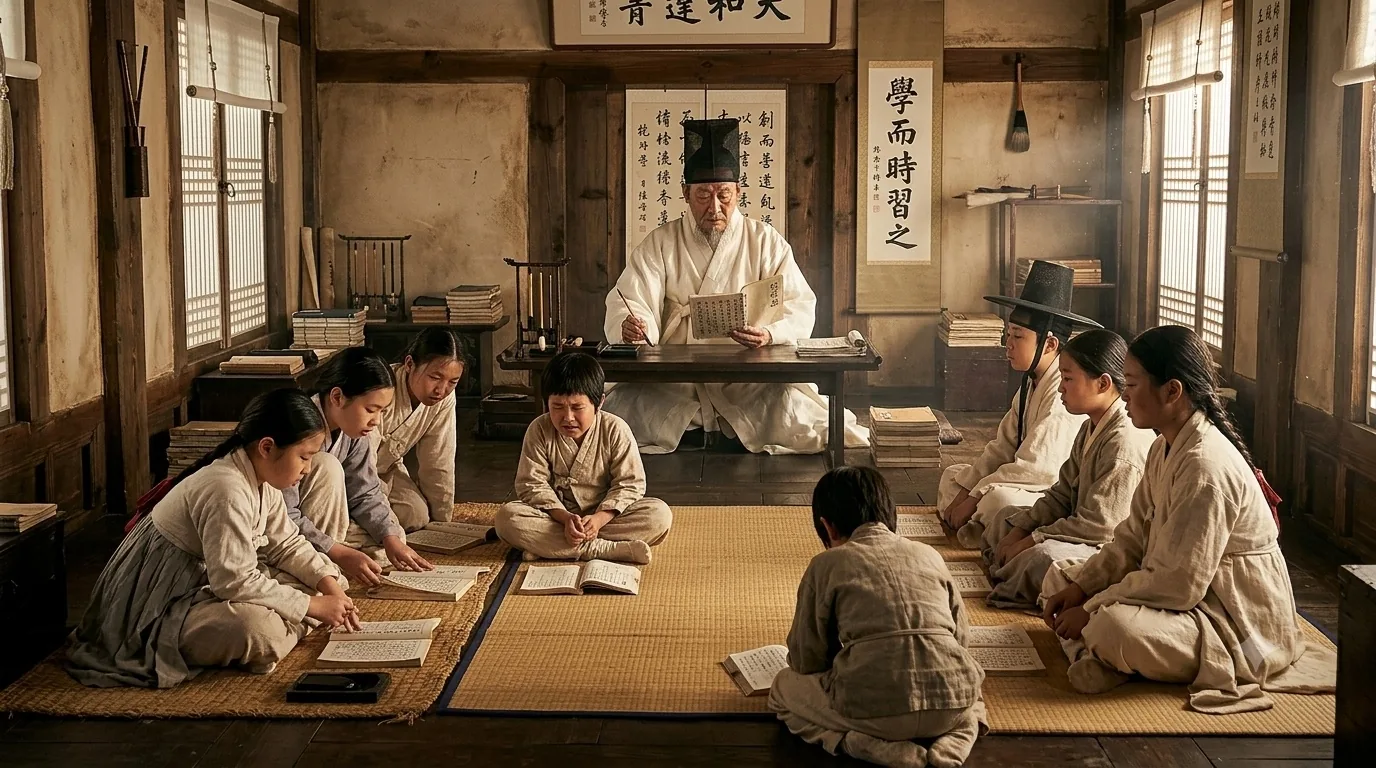 The seodang: privately founded, locally supported, and outside the state’s own school system. (AI illustration)
Before the series was released, teachers’ and parents’ organisations held a press conference outside Netflix Korea to object to Teach You a Lesson (참교육). Yonhap News reported the event on 23 July 2025; the participants included the Korean Teachers and Education Workers’ Union (전교조) and the National Parents’ Association for True Education (참교육을위한전국학부모회). Reports differ on how many organisations signed on.
The 2026 Netflix series casts Kim Moo-yeol as Na Hwa-jin, who works for a newly created fictional Educational Rights Protection Bureau (교권보호국); Lee Sung-min plays the education minister who founds it. The premise is built for catharsis: an agency that walks into schools where students, parents and teachers have all stopped respecting one another, and restores order — physically, if it comes to that. A column in the Kyunghyang Shinmun on 13 June 2026 criticised the production to the effect that it exists to justify hitting children.
Notice the assumption underneath the argument, shared by both sides: that a teacher’s authority is something that can be granted, revoked and — if lost — legislated back into existence.
For many boys who received basic literary education in Joseon, the relevant institution was the privately run seodang. Its master’s standing was real, strong enough to be spoken of alongside the king and the father, and it did not rest on a commission from the state. But Joseon also ran schools of its own, and there the authority of a teacher was written down and enforced.
That double structure is what the modern word cannot hold. Gyogwon now carries two meanings: moral authority and legal protection. One is accorded by families and neighbours; the other is guaranteed by statute. Joseon kept them in separate institutions; modern Korea has folded them into one word.
Quick answer: Most seodang schoolmasters were not state-appointed officials. Their standing depended mainly on the families, lineages or villages that invited and supported them. No single Joseon statute gave them a general right to strike pupils; corporal discipline rested on a mixture of parental consent, teaching custom, Confucian moral training and local rules. State schools were different: their codes formally protected the authority of appointed instructors.
Let’s unpack it.
What gunsabuilche actually says
Gunsabuilche (군사부일체, 君師父一體) — “ruler, teacher and father are one body” — is the phrase Koreans reach for most readily when the old standing of teachers comes up.
The idea behind it is genuinely ancient. The Guoyu (국어, 國語), a Warring States era compilation, carries a passage in its Jin yu 1 (진어 1, 晉語一) chapter: 民生於三 事之如一 — people live by three and serve them as one; the father begets them, the teacher teaches them, the ruler feeds them.
The four characters gun-sa-bu-il-che do not appear in that sentence. The phrase is a later formulation for which the passage is one classical warrant, and when those characters settled into the form Koreans now use is a question the standard reference works do not answer.
Joseon children could meet the idea through the Sohak (소학, 小學), the Neo-Confucian primer compiled in 1187 by Yu Ja-jing (유자징, 劉子澄) under Zhu Xi’s direction, whose Myeongnyun (명륜) chapter lays out the Five Relationships. The Encyclopedia of Korean Culture describes it as widely diffused among Neo-Confucian scholars and in teaching — a leading primer, not the only one.
Now read the Guoyu line again. It is organised around what has been given: life, understanding, food. Reading it as a list of three debts rather than a ranking is my interpretation, not a finding — the passage sits inside a Confucian order that also assumed hierarchy. What can be said without interpretation is narrower: the sentence describes what is owed to a teacher, not an office, a power, or a mechanism of enforcement.
So when a modern commentator quotes gunsabuilche to argue that teachers have lost standing they once held by right, the quotation is being asked to do something the sentence does not do: convert a debt into a right. Gunsabuilche described an obligation to the teacher; it did not grant the teacher a licence.
Who actually stood behind the village schoolmaster
A village schoolmaster’s position was not ordinarily created by state appointment. His livelihood and everyday standing depended chiefly on the household, lineage or village that invited and supported him, although state norms and local officials were not wholly absent.
Seodang were run in several different ways, and no single arrangement stands for all of them: a master teaching for his own living, a wealthy family engaging a tutor inside the household, a lineage funding a clan school from shared land and grain, several lineages or a whole village sharing the cost — and, from the seventeenth century onward, schools that local magistrates founded, supported or in some cases ran directly. Reference works group these forms differently, so the list is a range, not an official taxonomy.
The Encyclopedia of Korean Culture is direct about the legal position: establishing a seodang required neither capital investment nor legal authorisation, so anyone with the intention could found one, sustained by 민간자산, private community resources. But private is not the same as beyond the state. State norms about instruction and about how children should be disciplined reached into village schools as well; Song Su-jin’s 2024 study of the use of the switch by Joseon Confucian intellectuals works through exactly this material.
The hunjang (훈장, 訓長) who taught in a seodang was 초빙 — invited. Woori History Net, the National Institute of Korean History’s reference service, records that hunjang were mostly men who had studied at a hyanggyo, a seowon or a seodang, and that among them were men who had failed the civil examinations. A professional hunjang, it notes, typically stayed 길어야 1∼2년, 일반적으로 6개월 내지 1년 — a year or two at the outside, usually six months to a year — before moving on in search of better treatment. His compensation was not a salary but grain and firewood for his household, clothing for himself, feasts when a student finished a text, and extra fees during the intensive summer sessions.
On his standing the reference works are unsentimental and uneven, and both halves belong in the picture. Men genuinely versed in the classics were rare; some rural instructors could not properly handle literary Chinese; in remote villages there are accounts of men whose origins nobody could establish — fugitives — taking the role. Some hunjang were poorly paid and treated with contempt; others were respected for their learning; many wrote documents for illiterate neighbours to supplement their income.
Hold that against the slogan. Ruler, teacher and father as one body — and the teacher in question might be an itinerant examination failure, paid in firewood, gone within the year. The contradiction is only apparent, and resolving it gives the mechanism. Reverence attached to the role. Employment attached to the man. A village that invited a schoolmaster chose him, fed him, housed him and could decline to continue, though the short tenures are at least as much a story of teachers moving on for better terms as of villages letting them go.
Where did the rod come from, then?
No statute granted a seodang master the right to strike a student, and there is no act of state delegation anywhere in the chain. Whether the rod was therefore a power handed over by parents alone is a separate question, and the answer is no.
The ritual usually offered as proof is soksu (속수, 束脩): the classical bundle of dried meat a family brought when entrusting a child to a teacher, named in the Analects, where Confucius says he never denied instruction to anyone who came bearing so much as a bundle of dried meat. In Joseon it functioned as gift, fee and entry rite at once, marking that a teaching relationship now existed between a family and a master.
It is often described as something more: a transfer of parental authority into the teacher’s keeping, with in loco parentis as the literal content of the ceremony. There is no direct evidence for that reading. The Analects passage is about a teacher who does not refuse a student, not about a father delegating a power, and nothing in the Korean reference material makes soksu a handover of authority in the legal sense the English phrase carries.
Parents did ask masters to discipline their children; requests for 달초 and 초달, the switch applied to a pupil’s calves, are attested. But the authority behind that switch does not reduce to a single origin. Parental consent, teaching practice of the period, Confucian theories of moral training, written school rules and community norms all bore on it, and Song Su-jin’s study treats it as exactly that kind of composite.
Kim Hong-do’s celebrated genre painting of a seodang — the weeping boy, the switch, the classmates suppressing their laughter — is usually read as a pupil struck for failing to recite the previous day’s lesson, and institutional commentary hedges even that with probably. It establishes that corporal punishment happened in village schools. What Joseon viewers took it to mean is inference.
The state’s own schools were a different world
Where the Joseon state ran schools, it did legislate the authority of teachers.
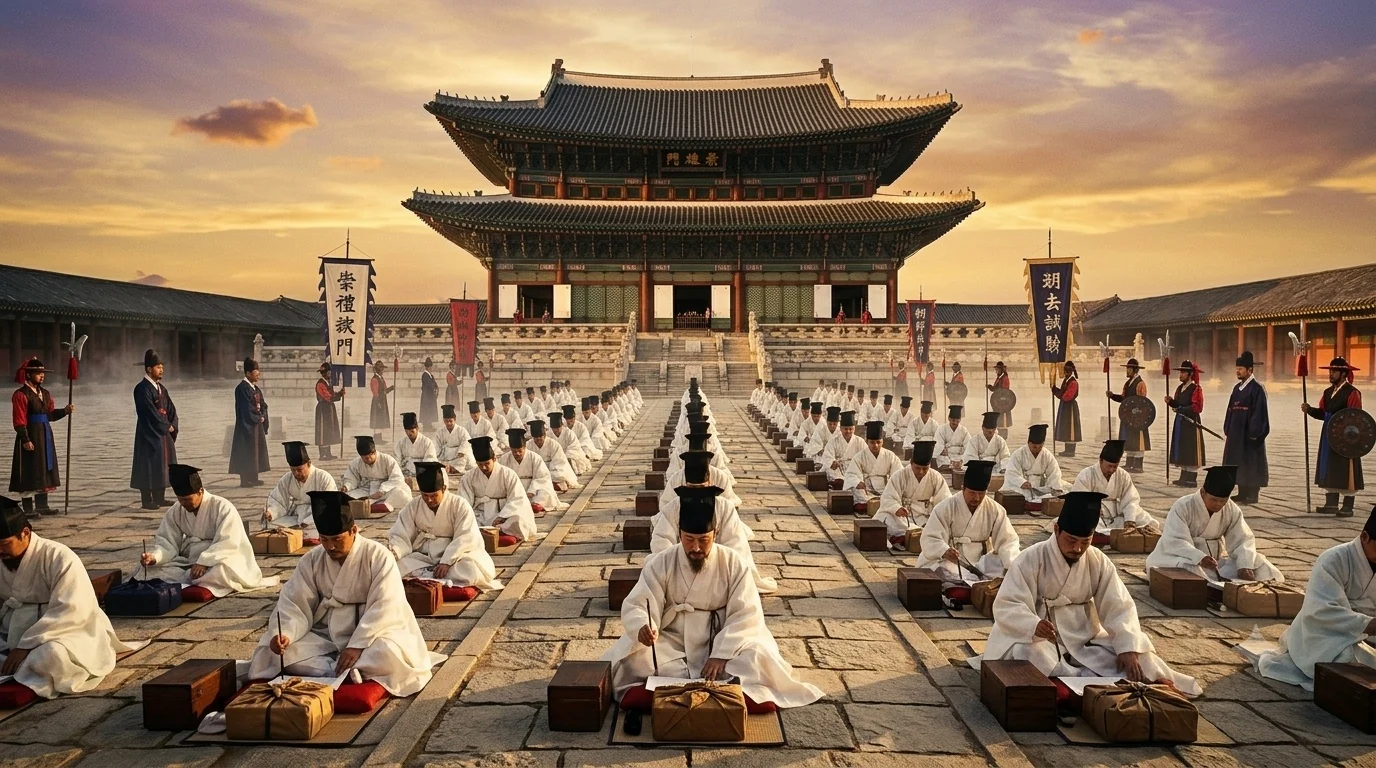
Sungkyunkwan (성균관), the national academy, admitted about 150 students in the early Joseon period and was expanded to 200 in 1429. It housed them in the east and west halls (동재/서재) under a sign-in register, 도기 (到記), whose 원점 tally tied attendance to eligibility for certain civil examinations.
Governing conduct and instruction was the 학령 (學令), the school code — and not only at Sungkyunkwan. It set norms for the state’s educational institutions generally, reaching the Four Schools of the capital (사학), the royal clan school (종학) and the county hyanggyo. It punished students who insulted their teachers, alongside those who read heterodox texts, criticised the court, flattered the powerful or violated the Five Relationships. Among its sanctions was 출재 (出齋), removal from the residence halls rather than permanent expulsion.
So inside a state institution, the standing of a teacher was written into a formal code and enforced by that institution, which looks far closer to the world the drama imagines than the village seodang does. It is not evidence of a general Joseon doctrine that the state stood behind teachers everywhere; it is a state disciplining its own students inside its own schools.
And those students were not silent. Late-Joseon Sungkyunkwan students had a standing repertoire of collective action: 유소 (儒疏), collective memorials to the throne; 소행 (掃行), leaving the academy in a body; 권당 (捲堂), boycotting classes; and 공관 (空館), vacating the academy entirely. Their collective action shows that formal discipline did not make students politically or institutionally voiceless — though calling it a negotiation between equals would flatten a structure that also contained the bureaucracy, the academy’s officers and the throne.
The hyanggyo, and a long thinning-out
The hyanggyo (향교), the county schools, tell a third story: institutional decay spread across centuries.
Reference works describe roughly 330 hyanggyo installed across most counties in the later Joseon period — a figure for a period, not a constant maintained for five hundred years. They were supported by school land (학전) and school slaves (학노비), an endowment whose scale varied by region and shrank over time, and their staff held office by commission: a 교수 (gyosu) at senior grade six and a 훈도 (hundo) at junior grade nine. Whether a county had one, both or neither depended on its grade and on the period.
Here is the state-appointed teacher — and the appointment thinned out. The Encyclopedia of Korean Culture is plain about why: 문과에 합격한 자가 지방의 교관직에 부임하기를 원하지 않았기 때문이다 — men who had passed the higher civil examination did not want provincial teaching posts — so local scholars and degree-holders filled in instead.
Exactly when those offices lapsed is unsettled: the entry on the hyanggyo describes abolition at the Sokdaejeon stage, while the entries on the teaching ranks have the hundo abolished after Myeongjong’s reign and the gyosu continuing afterwards. The direction of travel is not in doubt. Through the later Joseon period the state’s teaching appointments were reduced and the educational function of the hyanggyo weakened, while private seowon and seodang came to carry much of the basic education — not everywhere, and not all at once.
1895: the state starts training teachers
In 1895 the state began building a modern system for training, certifying and appointing teachers. King Gojong’s Royal Edict on Education declared education the foundation of preserving the state, and the ordinances that followed in the same year established the Hanseong Normal School and a national elementary school system. (The lunar and solar dates are set out in the FAQ below.)
Under the old arrangement, a teacher was a person a village decided to trust; under the new one, a teacher is a person the state certifies — trained, credentialed, assigned.
But 1895 is a beginning, not a switch being thrown. Seodang persisted through the Korean Empire and into the colonial period, some reorganising into 개량서당, reformed village schools. The direction was still a real gain: state-organised schooling built the basis for standardisation, expanded access and eventually mass literacy.
The structural cost is a different matter, and here I am reading rather than reporting. A teacher whose standing is conferred by the state holds it on terms the state sets, and legal status and social trust come to rest on different foundations.
What the law says now
As of July 2026, modern Korean teachers do receive statutory protection, but no law creates a bureau like the drama’s or grants a general right to use corporal punishment. Since the 2023 reforms, legitimate educational activity has received stronger protection, while student guidance remains governed by ministry rules, school regulations and child-protection law.
One of the 2023 amendments obliges guardians to respect and cooperate with legitimate educational activity — writing into statute the thing gunsabuilche assumed was simply owed.
Japan’s terakoya, for comparison
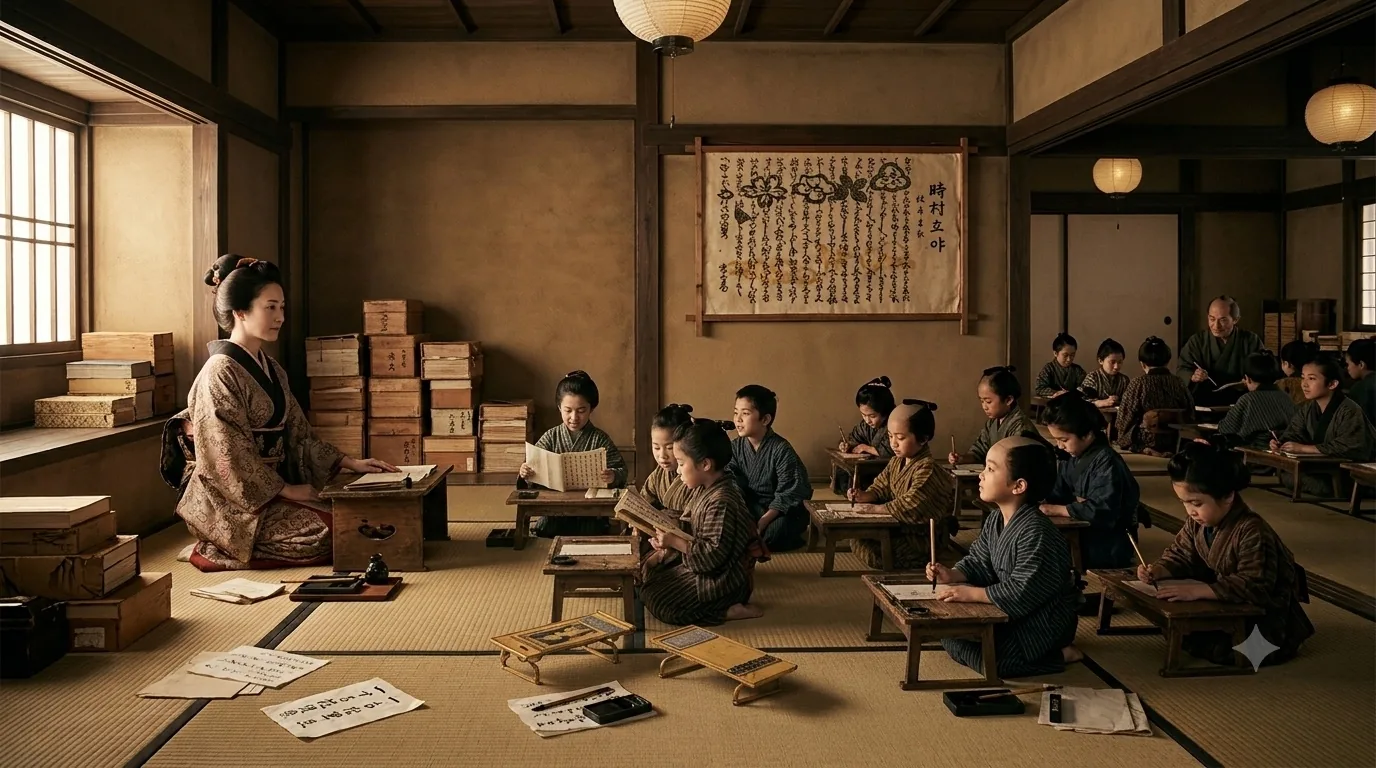 Japan’s terakoya ran on local demand rather than state appointment. (AI illustration)
Tokugawa terakoya (寺子屋) are the closest comparison for the seodang. Britannica describes them as numerous private schools, mostly in towns, teaching reading, writing and arithmetic, staffed by monks, unemployed warriors and others, alongside the hankō domain schools that served samurai. Like the seodang, they answered to local demand rather than to a state appointment system. That is the point of the comparison and also its limit: standing, curriculum and livelihood differed enough that the resemblance should not be pushed into identity.
The sequels differ most. Terakoya buildings, teachers and habits of schooling formed part of the base on which Meiji primary education spread, while Korea’s transition arrived in 1895 amid a collapsing sovereignty and soon under colonial rule, and its village layer neither vanished nor converted cleanly. What eventually dissolved that layer was not one force but many — the Gabo reforms, the Korean Empire’s school system, colonial education policy, war, urbanisation and the expansion of compulsory schooling.
Drama vs history
| In Teach You a Lesson | In the historical and legal record |
|---|---|
| The Bureau enforces teacher authority from outside the school | Fictional. Joseon had no such body; the 2023–24 reforms created regional teacher-rights committees at district education offices, not an enforcement bureau |
| Teacher authority is something the state confers and defends | In the seodang it rested chiefly on the families, lineages and villages that invited and supported the schoolmaster; in state schools it was written into the 學令 code |
| The state is the natural guarantor of education | State teaching posts at the county hyanggyo were unattractive and were progressively reduced; private seowon and seodang took on more of the teaching |
| Authority must be enforced from outside the school | Sungkyunkwan’s 學令 punished insults to teachers — and students answered with memorials (유소), walkouts (소행, 공관) and class boycotts (권당) |
| A collapse of respect is the problem | The source of a teacher’s official standing moved from community to state, changing what respect was owed to, and by whom |
Why the drama needs a bureau
Now the series becomes legible. It invents an enforcement body because, within its premise, there is nothing else left to invent. Netflix Korea’s own framing — an office created to defend a collapsed school from students, teachers and parents who cross the line — names teachers among the offenders, not only students and parents. The Bureau is not a fantasy about restoring the schoolmaster’s switch. It is a fantasy about an external authority adjudicating a relationship that no longer has an internal one.
In the village, many conflicts between master, child and family were likely worked out inside the web of relationships all three belonged to — likely, not certainly, since villagers could also take grievances to the magistrate, replace a schoolmaster or move away. What has changed is the balance: committees, district education offices and courts now carry a far larger share of the load. That is why teachers say the protection written into law is not matched by support in practice, why parents describe institutions that are not answerable to them, and why students sit inside a structure being renegotiated over their heads. All three accounts can be accurate at once, because all three follow from the same structural change rather than from anybody’s bad faith.
The teacher’s authority in Joseon did not come from a single source. In the village seodang it rested on learning, moral expectation, accepted discipline and the support of the families or community that sustained the school. In state institutions, written codes and official appointment added a formal layer.
Modern Korea has reversed the balance. Teachers now receive their official standing from certification, employment law and public institutions, while social trust can no longer be assumed. That is why the word gyogwon is so difficult: it asks the law to protect a profession and, at the same time, asks society to restore a relationship.
Teach You a Lesson invents a bureau because it turns that unresolved gap into action drama. The bureau is fictional. The gap is not.
Frequently asked questions
Is Teach You a Lesson based on a real government agency? No. The Educational Rights Protection Bureau (교권보호국) is invented for the drama, and so is its power to walk into a school and impose order. Korea does have real teacher-protection law, but it operates through committees, ministry rules and the courts rather than through an enforcement agency. Joseon had no equivalent body either.
What did the 2023–24 teacher-protection reforms actually change? In September 2023 the National Assembly passed what is commonly called the four teacher-protection laws — amendments to the Teacher Status Act, the Elementary and Secondary Education Act, the Early Childhood Education Act and the Framework Act on Education. An amendment to the Act on Special Cases concerning the Punishment of Child Abuse followed on 26 December 2023 as Act No. 19832. Teacher-rights committees moved from individual schools to regional committees at district education offices on 28 March 2024.
What does gunsabuilche (군사부일체) actually mean? It is the idea that ruler, teacher and father are to be served as one. Its classical warrant is a passage in the Jin yu 1 chapter of the Guoyu: people live by three and serve them as one — the father begets them, the teacher teaches them, the ruler feeds them. The four-character phrase itself does not appear there; it is a later formulation, and the reference works do not fix when it settled into Korean usage.
Did Joseon law give a village schoolmaster the right to beat a student? No statute granted it, and the seodang was in principle a privately established school whose master was not a state-appointed official. That does not mean the state was absent: from the seventeenth century onward local magistrates founded, supported and sometimes ran seodang, and state norms about instruction and discipline reached village schools too. The state’s own schools were different again — the 學令 school code formally punished students who insulted their teachers.
What was soksu (속수), and did it transfer parental authority? Soksu was the bundle of dried meat a family brought when asking a teacher to take a child, named in the Analects, where Confucius says he never turned away anyone bearing so much as a bundle of dried meat. In Joseon it worked as gift, fee and entry rite, marking that a teaching relationship now existed between family and master. It is often called a handover of parental authority, equivalent to in loco parentis. There is no direct evidence for that.
Is corporal punishment legal in Korean schools today? There is no general legal authority for a teacher to strike a student. The clause usually cited — Article 31(8) of the Enforcement Decree of the Elementary and Secondary Education Act, amended in 2011 — was deleted on 28 June 2023 by Presidential Decree No. 33566, so it should not be quoted in the present tense. The current framework is the Ministry of Education’s Notification on Student Guidance by Teachers, together with school regulations and child-protection law.
Did the Joseon state ever appoint teachers? Yes. County hyanggyo were staffed by commissioned officials — a gyosu at senior grade six and a hundo at junior grade nine — though whether a given county had one, both or neither depended on its grade and on the period. Sungkyunkwan and the Four Schools of the capital were state institutions with their own officials and a written code. Over the later Joseon period those teaching appointments were reduced.
What did the 1895 education reforms do? On the second day of the second lunar month of 1895 — 26 February by the solar calendar — King Gojong issued the Royal Edict on Education under three headings: 덕양, 체양 and 지양, the cultivation of virtue, of the body and of knowledge. The Hanseong Normal School regulations followed on the sixteenth day of the fourth lunar month (10 May), and the Elementary School Ordinance on the nineteenth day of the seventh lunar month (7 September).
What does gyogwon (교권) mean, and why is the word a problem? It is the modern term for teacher authority, and it carries two senses that are rarely distinguished in argument: the moral standing a community accords a teacher, and the legal protection a state affords an employee. The two are not incompatible — a teacher can hold both — but they rest on different foundations, and Korean debate slides between them mid-sentence, which is one reason the argument is so hard to finish.
Sources & further reading
Written from the historical script and fact-check of 사뚱샘의 역사방 (SaDDungSam). Documents are cited by name; where a link could not be verified against the document itself, no link is given.
- Encyclopedia of Korean Culture (한국민족문화대백과사전) — 서당: no capital or authorisation required, organisational forms, and the 회초리 in Kim Hong-do’s painting
- Encyclopedia of Korean Culture — 훈장: uneven qualifications, pay in grain, firewood and clothing, and the range of standing
- Encyclopedia of Korean Culture — 성균관 (E0029204): student numbers, 동재/서재, 도기 and 원점, and 유소 · 소행 · 권당 · 공관
- Encyclopedia of Korean Culture — 학령 (E0060806): the school code, its scope, its punishment of disrespect toward teachers, and 출재
- Encyclopedia of Korean Culture — 향교: roughly 330 county schools, 학전 and 학노비, recruitment difficulty, and the reduction of teaching posts
- Encyclopedia of Korean Culture — 교수 · 훈도: senior grade six and junior grade nine, and when each post lapsed
- Encyclopedia of Korean Culture — 소학: compiled in 1187 by Yu Ja-jing (劉子澄) under Zhu Xi; the 명륜 chapter
- Encyclopedia of Korean Culture — 교육입국조서: the 1895 edict and its 덕양·체양·지양 headings
- 우리역사넷 (Woori History Net, National Institute of Korean History) — 훈장: 초빙, backgrounds, tenure and compensation
- 우리역사넷 — 서당의 종류 · 서당에서의 교육과 체벌 · 서당 교육의 변화 · 개량 서당의 등장
- 우리역사넷 — 교육입국조서: the edict and the ordinances that followed
- 송수진, 「조선 시대 유교 지식인들의 회초리(체벌) 사용과 그 의미」, 『민족문화』 66, 2024, 75–106쪽
- 『고종실록』 고종 32년 2월 2일 · 4월 16일 · 7월 19일 기사 — the edict and the two 1895 ordinances, by lunar date
- 국가법령정보센터 (Korean Law Information Center) — 『초·중등교육법 시행령』 연혁: Article 31(8), deleted by Presidential Decree No. 33566 on 28 June 2023
- 국가법령정보센터 — 교육부 고시 「교원의 학생생활지도에 관한 고시」
- 교육부 — 「교권 보호 4법, 국회 본회의 통과」 (September 2023)
- 법률 제19832호 『아동학대범죄의 처벌 등에 관한 특례법』 (26 December 2023)
- 교육부 — 「교원의 지위 향상 및 교육활동 보호를 위한 특별법 시행령」 개정 안내 (2024년 3월 28일 시행)
- 넷플릭스코리아 — 「넷플릭스 시리즈 『참교육』 제작 확정」
- Netflix official title page — Teach You a Lesson (참교육)
- 『연합뉴스』, 23 July 2025 — the press conference outside Netflix Korea
- 『경향신문』, 13 June 2026 — the column criticising the production
- Encyclopædia Britannica — “Education in the Tokugawa era”: terakoya and hankō
Classical texts cited by name: the Guoyu (국어, 國語), Jin yu 1 chapter, for 民生於三 事之如一; the Sohak (소학, 小學), Myeongnyun chapter; and the Analects (논어, 論語), Shu er chapter, for the 束脩 passage.
Thanks for reading — see you in the next one.
This article was researched and written by K-Drama History. Source: Netflix's Teach You a Lesson, Explained: Where Did the Korean Teacher's Rod Get Its Authority? — K-Drama History