Road to Boston, Explained: They Erased the Flag from the Photograph. Ninety Years Later, the Official Result Still Says Japan.
Theme: Modern Korea
From the research behind Pause the Drama.
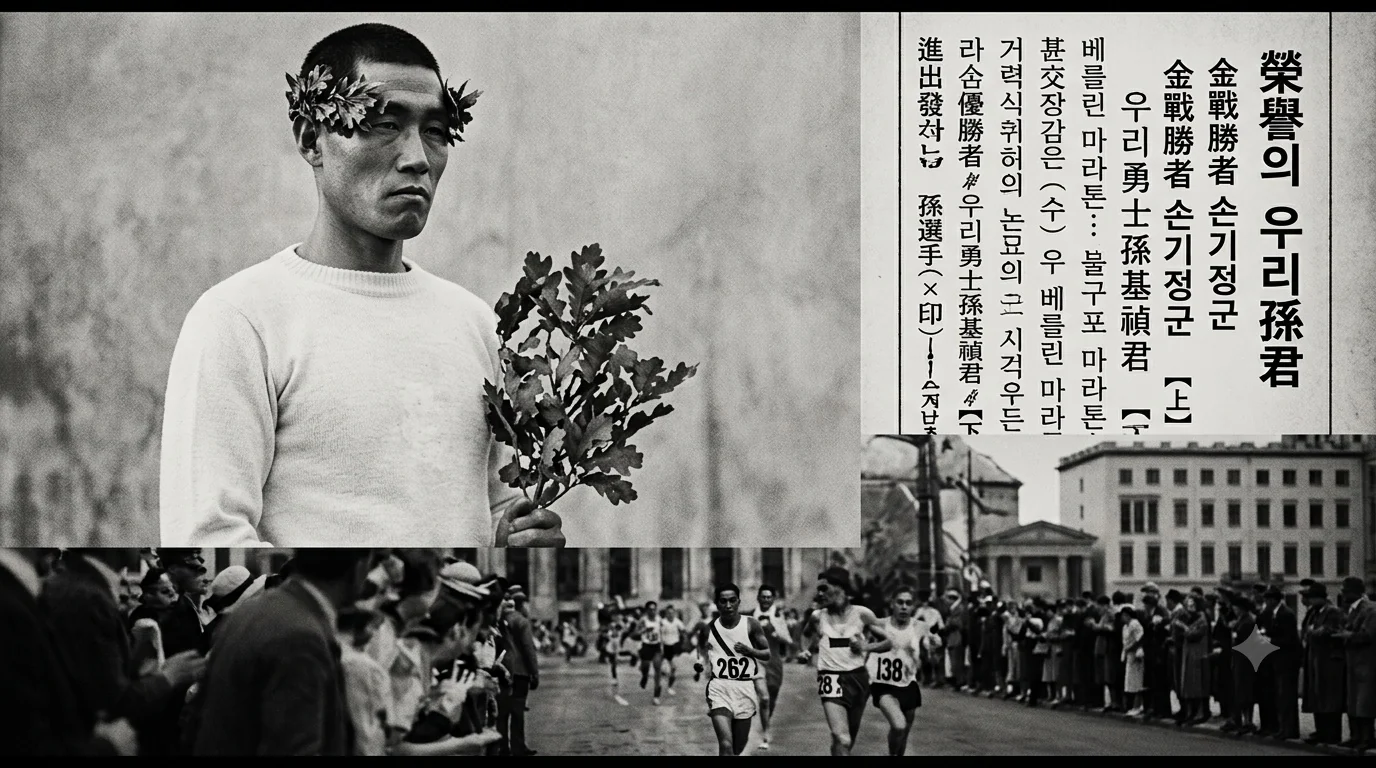
Road to Boston does not open with a finish line. It opens on a podium.
Berlin, 1936. The Japanese anthem is playing. The man who has just won the Olympic marathon is Korean, and on his chest is the flag of the empire that governs his country. He lifts the oak seedling he has been given and holds it in front of him.
The film’s own tagline sits on top of that image: if the country became independent, our records should be independent too.
So it is fair to ask whether they did.
The short answer: what was erased in 1936 was a flag in a photograph. What has not been erased, ninety years on, is the nationality in the record.
What he actually ran
The film is not interested in the times, which is a pity, because the popular version of them is wrong in a specific and fixable way.
Sohn won in Berlin in 2:29:19.2. That was an Olympic record. It is frequently described as the moment humanity broke the 2:30 barrier, and that is not what happened — by August 1936 several men had already run inside 2:30, Sohn among them, more than once. The accurate claim is narrower: it was the first time an Olympic marathon had been run inside 2:30.
The world record at that moment was his own. On 3 November 1935 in Tokyo he had run 2:26:42, taking the record from Yasuo Ikenaka’s 2:26:44 set that April. Earlier still there is a 2:26:14, and here the record books themselves disagree. The Association of Road Racing Statisticians places that run on 21 March 1935, with Fusashige Suzuki second in the same race in 2:27:49. The IAAF/World Athletics tradition instead dates Suzuki’s 2:27:49 to 31 March. What both agree on is that Sohn’s 2:26:14 was never the ratified world record; his memorial museum classifies it as an unratified world best.
One comparison that circulates with these figures should be dropped. The claim that 2:26:14 beat “the world record of 2:31:37” does not hold: 2:31:36 was the winning time of the 1932 Los Angeles Olympic marathon, run by Juan Carlos Zabala of Argentina. It was an Olympic record, not a world record, and the figure has drifted a second in the retelling.
Behind him in Berlin: Ernest Harper of Great Britain, 2:31:23.2. And in third, another Korean — Nam Sung-yong, listed as Shoryu Nan of Japan, 2:31:42.0.
What the newspapers did
Here is where the film stops and the history starts.
On 13 August 1936, the Chosun Jungang Ilbo ran the medal-ceremony photograph on page 4 with the Japanese flag removed from Sohn’s vest. The same day, the regional morning edition of the Dong-A Ilbo ran the photograph on page 2 in a form where the flag on Sohn’s vest appeared faint or obscured. On 25 August the Dong-A Ilbo published an image with the flag removed again.
Whether that 13 August Dong-A Ilbo image was deliberately retouched is not settled. The Encyclopedia of Korean Culture treats both papers as having run flag-removed photographs that day; records from the veterans’ affairs archive describe the rectangular outline of the flag as still present with the centre gone faint, which they read as too ambiguous to call a deliberate erasure.
The Encyclopedia of Korean Culture declines to call this a conspiracy. Its word is closer to tacit agreement: retouching photographs was ordinary technical work, and the people producing both papers found that their feelings about the flag in the frame ran the same way.
Either way, the August 13 printings were not caught at the time — the flag had not vanished so much as gone faint, and the censors did not register it. In the Dong-A Ilbo of that date, the flag on Nam Sung-yong’s vest, standing beside Sohn, was left untouched.
The 25 August edition was caught.
One correction to how this is usually summarised: it is not that the 13 August images were permanently overlooked. The Chosun Jungang Ilbo photograph surfaced later, during the investigation into the Dong-A Ilbo, and that paper was pulled into the case from there.
The price
The Dong-A Ilbo was suspended indefinitely on 29 August 1936. It was the paper’s fourth indefinite suspension since founding, and the first caused by a photograph.
The publisher Song Jin-woo, chief editorial writer Kim Jun-yeon and managing editor Seol Ui-sik all resigned. Eight staff were arrested — from the social affairs desk, department head Hyun Jin-geon with Lee Gil-yong and Jang Yong-seo; from research, the painter Lee Sang-beom; from photography, Shin Nak-gyun, Baek Un-seon and Seo Yeong-ho; and Choi Seung-man of the magazine division, for the reprint in the affiliated monthly Shin Dong-A. They were held around forty days and released after signing undertakings never to work in journalism again.
The paper resumed on 3 June 1937. From 29 August to 3 June is 278 days — a little over nine months. Some accounts say 279 days, which is the same span counted inclusively; some say ten months, which does not match the two dates.
The Chosun Jungang Ilbo suspended publication voluntarily on 5 September 1936 and never resumed. Its publishing licence lapsed on 5 November 1937. Whether to call that a principled closure or the end of a paper already in financial trouble depends on which account you read, and both readings are in circulation.
Who was first — and why the usual citation is wrong
The most contested question in this affair is which paper did it first, and this article does not settle it.
The long-standing position credits the Chosun Jungang Ilbo, whose publisher was Lyuh Woon-hyung, later a central figure in the independence movement. The counter-argument arrived with the Dong-A Ilbo’s regional morning edition of the same date: Seoul editions were printed in the early hours of the publication day, while regional morning editions were customarily printed the day before — so by the moment ink met paper, the Dong-A Ilbo may have been ahead.
The Encyclopedia of Korean Culture makes no ruling. It records only that both papers carried it “in their editions of 13 August.”
One thing does need correcting, because it is repeated often. The scholar Chae Baek is usually cited as the authority for the Chosun Jungang Ilbo claim. His work runs the other way: it brought forward the Dong-A Ilbo’s regional edition and raised the printing-practice argument. What he did not do was document when the presses actually ran, so his case is a reconstruction, not a proven priority. It should not be erased, and it should not be promoted into a settled fact either.
There is a further limit worth stating plainly. The encyclopedia entry on the incident lists a single reference — the Dong-A Ilbo company history of 1975. An account of a priority dispute resting on the in-house history of one of the parties is a thin base, and this article leans on it while saying so.
The record that was never erased
The film’s slogan asks whether the records became independent. They did not.
In the IOC’s official results for the 1936 Berlin marathon, the champion is registered as Kitei SON, competing for Japan. Nam Sung-yong appears as Shoryu Nan.
Attempts to change this are not new. The IOC took up the question in the 1980s and declined, citing the principle that results follow the organising committee’s records at the time, and noting that an exception would invite others.
On 9 December 2011 it did move partway. The biography on his profile now identifies him as Korean and explains that under colonial occupation he had no choice but to compete under Japanese nationality. A similar note was added for Nam Sung-yong.
This distinction matters, and getting it wrong would be unfair to the IOC in one direction and misleading in the other. The IOC does not deny that he was Korean — its own biography says so. What has not changed is the registered name and the national affiliation in the results table itself.
For the ninetieth anniversary of the Berlin victory, the Sohn Kee-chung Memorial Foundation has restarted a campaign to correct the nationality, with a petition drive.
The newspapers could erase a flag with ink. Nobody has been able to erase the nationality in the record.
Why an image, of all things
What makes this episode strange in press history is that the offence was not an article. Not an editorial, not a leader column — a photograph. A small circle removed from a vest closed one paper for 278 days, and helped set in motion the chain of events after which another never published again.
The colonial administration’s sensitivity had a logic to it. Sohn’s victory was not something the Government-General could prevent. If it could not be prevented, then what it belonged to had to be managed. The flag on his chest was the mark of ownership, and removing it was a denial of the ownership itself.
What the colonial state was defending was not the victory. It was the question of whose victory it was.
Elsewhere: two teams that existed, and one record that got fixed
Finland, 1912. At the Stockholm Games Finland was an autonomous grand duchy of the Russian Empire, and its Olympic symbolism was constrained accordingly. According to Finland’s official centenary history, the team entered the stadium behind the blue-and-white flag of the Helsinki Women’s Gymnastic Club — and that flag was removed before they passed the box of honour, at the request of Finland’s own IOC member, R. F. von Willebrand, because carrying it breached the agreement covering the opening ceremony. When the Finns left the stadium they had no flag at all. Their competition outfits carried the lion coat of arms of the Grand Duchy.
The distance runner Hannes Kolehmainen won three golds. What was raised afterwards is disputed — many English-language accounts say the Russian flag went up and quote Kolehmainen saying he almost wished he had not won, while the same Finnish source describes both the Russian tricolour and a blue-and-white banner being raised. This article leaves that part on the table.
Bohemia competed separately under Austria-Hungary in the same period. In June 1914, at Russian and Austro-Hungarian insistence, the special status of both Finland and Bohemia was revoked. The window in which a nation inside an empire could compete under its own name opened briefly and shut.
The difference from Korea is not subtle. Finland and Bohemia had teams. Korea in 1936 had no team to be denied.
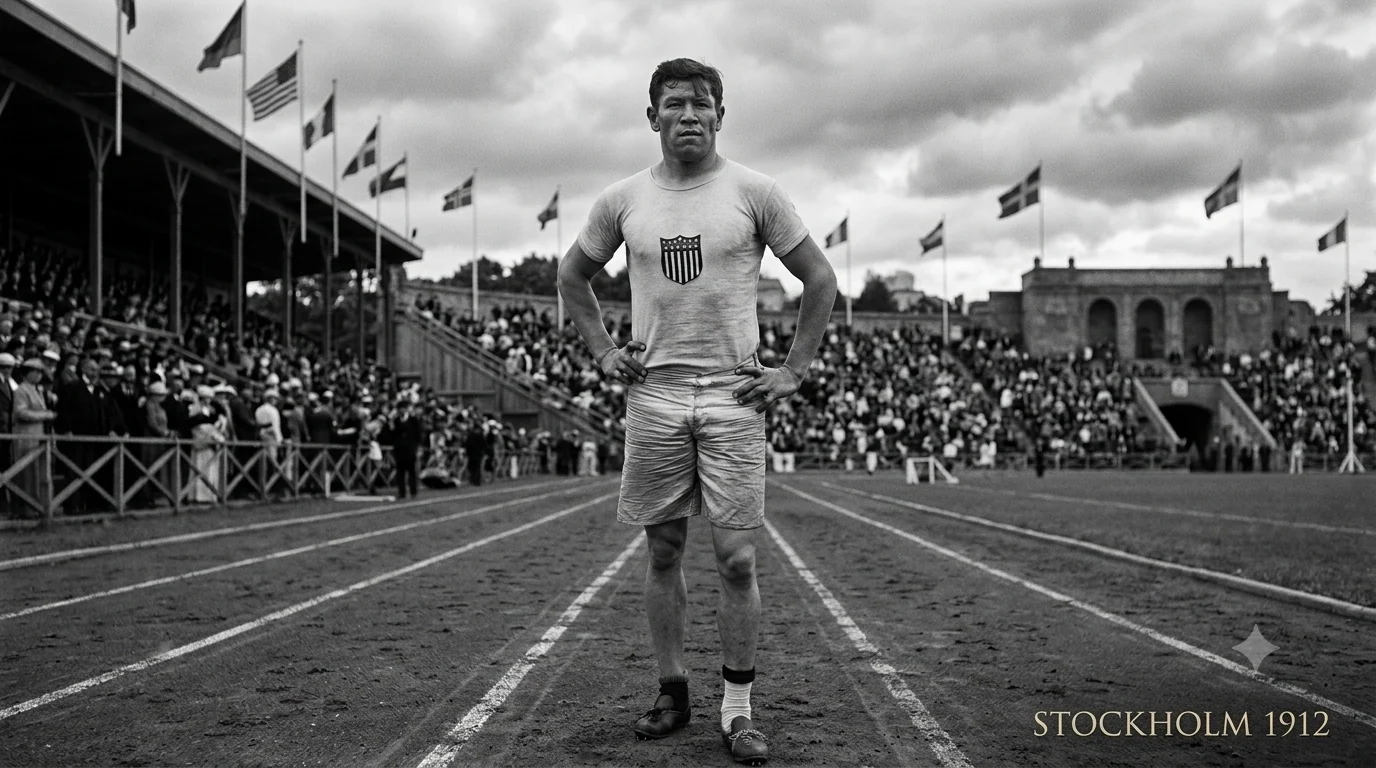
Jim Thorpe, 1912 and 2022. At those same Stockholm Games the Native American athlete Jim Thorpe won the pentathlon and decathlon. He was stripped of both in 1913 for violating the amateurism rules — he had been paid to play minor league baseball. In 1982 the IOC accepted the decision had been improper and gave replica medals to his family, but listed him as co-champion. Then on 15 July 2022, 110 years after the fact, the IOC reinstated him as sole winner of both events, and World Athletics amended its records with it.
That is the point of the comparison. It is not true that records this old cannot be changed. The IOC called Thorpe’s case exceptional and unique, which is a caution as well as a precedent.
The two cases are not the same kind of thing, and it would be sloppy to treat them as one. Thorpe’s was the restoration of a victory that had been improperly taken away from him at those Games. Sohn’s is a request to change, after the fact, the national affiliation under which he actually competed — an affiliation created by colonial occupation. So Thorpe is evidence that historical Olympic results can be amended; he is not a legal precedent requiring that Sohn’s NOC affiliation be amended. But Finland solved its problem by becoming independent and competing as Finland in 1920. Thorpe’s record was fixed after 110 years. Sohn’s nationality is in its ninetieth year.
Back to the film
Road to Boston ends with Suh Yun-bok winning under the Korean flag. What the film wants to say is clear enough: what was taken in 1936 was taken back in 1947.
Half of that is right. Suh really did run under his own flag, and really did win in a world best.
The other half has not happened. The man who crossed the line in Berlin on 9 August 1936 in 2:29:19.2 is still, in the IOC’s official results, Kitei Son of Japan.
In the film Sohn covers his chest with a seedling. The newspapers covered the same spot with ink. Both changed the photograph. Neither changed the record.
On sources and open questions
- The film’s central conflict is invented. There was no dispute over Stars-and-Stripes vests in Boston. Suh Yun-bok ran in a vest carrying both flags and wore a Korean-flag-only vest at the ceremony; costs were helped by fundraising among US soldiers stationed in Korea, referenced in a May 1947 cable from General Hodge to IOC figure Avery Brundage. The invention borrows its shape from the 1936 incident — which is why it lands.
- The potted-plant gesture is treated here as a widely transmitted scene, not a documented act of defiance. The autograph-book signature — 손긔졍 with KOREAN written beside it — is the better-attested gesture.
- The priority dispute is presented unresolved on purpose. The main encyclopedia entry lists a single reference, the 1975 company history of one of the two papers involved.
- Where numbers disagree, both are shown: 278 days versus 279 counted inclusively; the Finnish flag question; the character of the Chosun Jungang Ilbo’s closure.
- Corrected in this article against versions in circulation: the “first human under 2:30” claim, the “world record 2:31:37” comparison, and the attribution of the Chosun Jungang Ilbo priority argument to Chae Baek.
This article was researched and written by K-Drama History. Source: Road to Boston, Explained: They Erased the Flag from the Photograph. Ninety Years Later, the Official Result Still Says Japan. — K-Drama History