Did the Sambyeolcho Escape to Okinawa? The Mystery of a Goryeo-Inscribed Roof Tile
Theme: War & Resistance
From the research behind Pause the Drama.
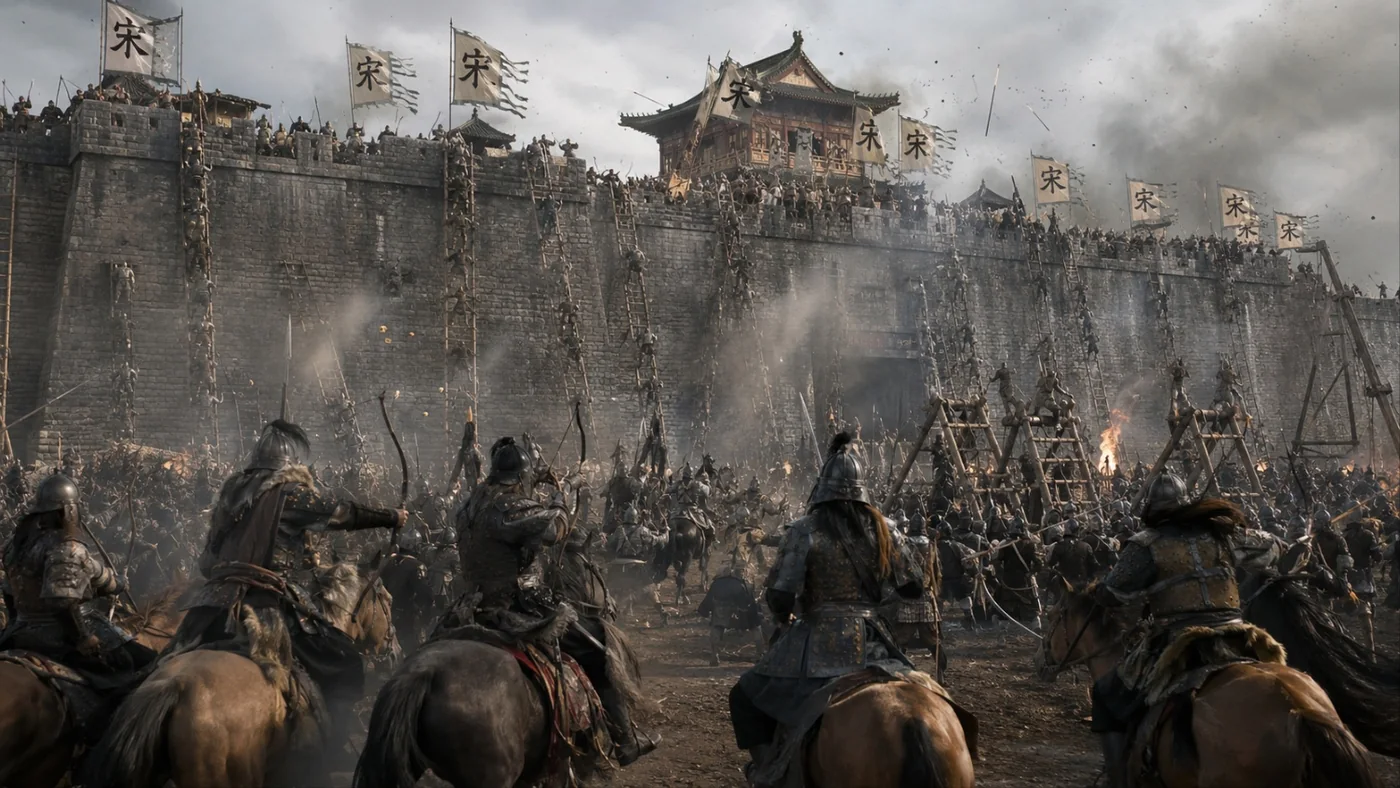
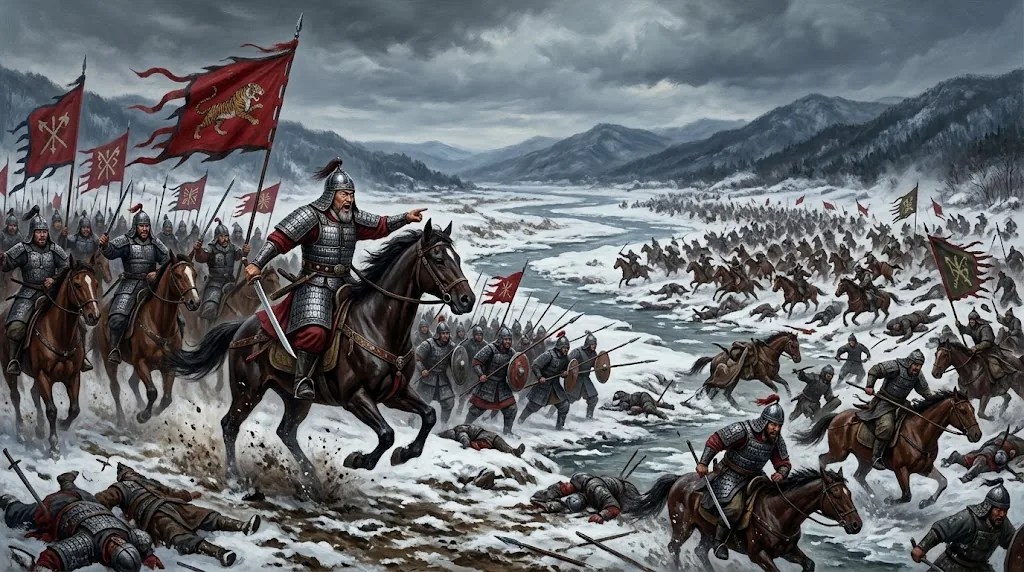
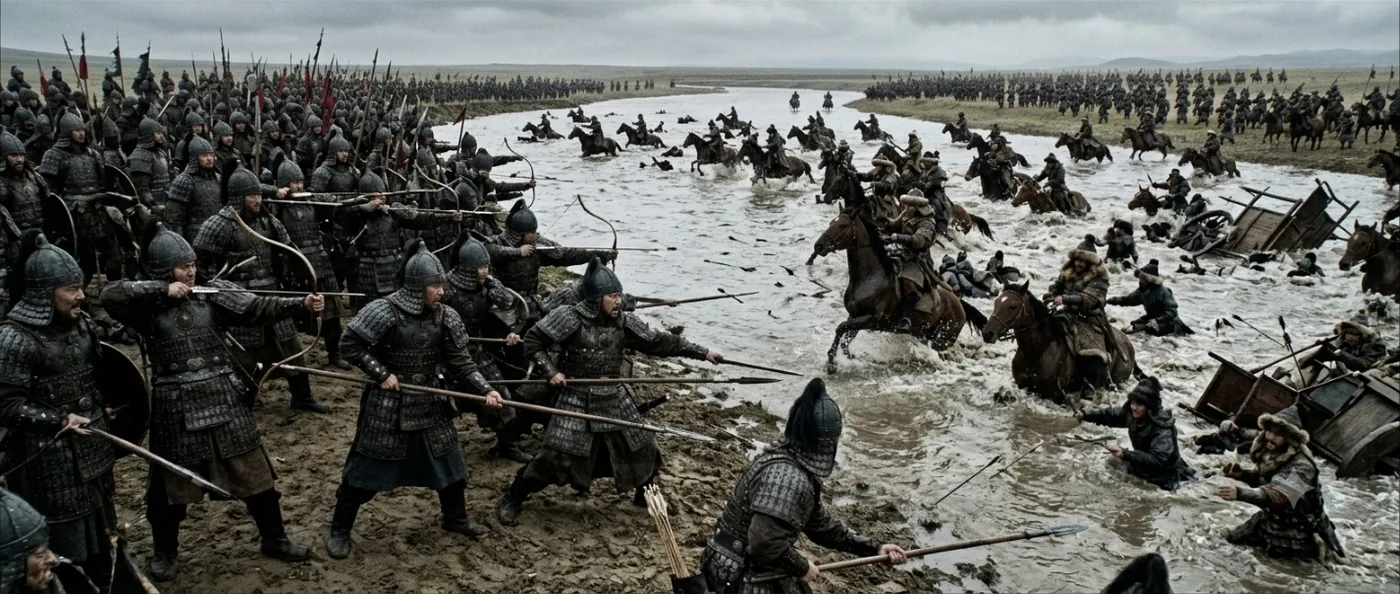
If you’ve watched the 2012 MBC epic Warrior K (무신) — a sweeping drama of Goryeo’s military rulers and the long war against the Mongols — you’ve seen the political world that produced the Sambyeolcho: military strongmen, Mongol invasions, and a bitter fight over whether to make peace with the empire. The drama’s story ends before the rebellion’s last stand, but the resistance itself held on until 1273, when a combined Mongol–Goryeo army stormed the rebels’ final fortress on Jeju Island and it vanished into history.
But here’s a question that refuses to stay buried: did the Sambyeolcho really disappear on Jeju — or did some of them sail farther south, into the open sea? Nearly a thousand kilometers away, on the island of Okinawa, a group of inscribed roof-tile fragments has kept that question alive.
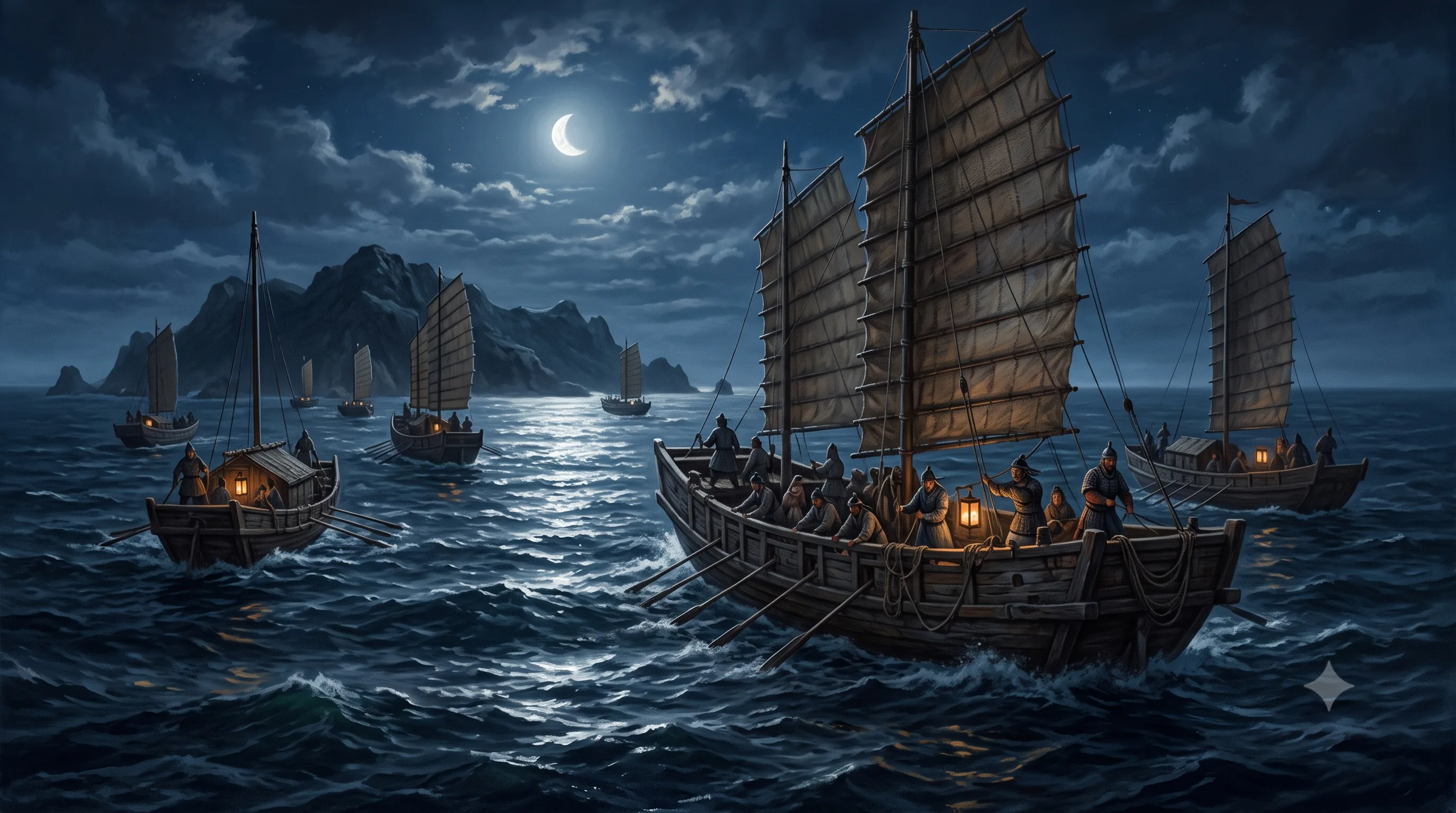 Did part of the Sambyeolcho escape Jeju by sea? A roof tile in Okinawa keeps the question open. (AI illustration)
Quick answer: The Sambyeolcho rebellion is usually said to end in 1273 on Jeju. But at Urasoe in Okinawa, archaeologists found roof tiles stamped “made by a Goryeo tile-maker” (癸酉年高麗瓦匠造). Some scholars link them to Goryeo craftsmen — possibly connected to Sambyeolcho survivors — moving south after Jeju fell. It’s a genuine archaeological puzzle, but an unproven hypothesis, not settled history: the tile’s date isn’t fixed, and the unified Ryukyu Kingdom came 150 years later.
Let’s unpack it.
The Goryeo roof tile in Okinawa
The whole mystery rests on a few pieces of fired clay. At the Urasoe Castle site and the nearby royal mausoleum of Urasoe Yōdore in Okinawa, excavators recovered roof tiles carrying an inscription read as 癸酉年高麗瓦匠造 — roughly, “made by a Goryeo tile-maker in the year of gyeyu” (Uehara Shizuka, “Koryŏ-Style Roof-tiles Excavated on the Okinawa Islands,” Seoul National University repository).
Two words on that tile set imaginations racing. First, it literally says “Goryeo.” Second, the year-name “gyeyu” (계유年) has been linked to 1273 — the very year the Sambyeolcho fell on Jeju.
But this is exactly where caution is essential. Gyeyu is a sexagenary year-name that comes around every sixty years — so the tile cannot simply be dated to 1273. Scholars have proposed several candidate years for the inscription, including 1153, 1273, 1333, and 1393, with 1273 and 1333 among the main competing interpretations (Urasoe City cultural materials). To write “the Goryeo tile-maker tile was definitely made by the Sambyeolcho in 1273” would be to overreach badly. The safe version: a Goryeo-inscribed tile really was found at Urasoe, and some scholars connect it to Goryeo craftsmen — possibly Sambyeolcho-linked — arriving after the Jeju defeat, while the exact date and makers remain unconfirmed.
Why Okinawa? A crossroads of the sea
To modern eyes Okinawa is a resort island, so the idea of 13th-century Korean rebels landing there sounds far-fetched. It isn’t — because medieval Okinawa was anything but remote.
In this period the islands were a maritime crossroads linking Korea, China, Japan, and Southeast Asia, and home to a distinct civilization: the world that would become the Ryukyu Kingdom. Its landscape is dotted with gusuku (グスク) — fortified sites that were part castle, part seat of power, part sacred space, unique to the Ryukyu world. UNESCO recognizes the Gusuku Sites and Related Properties of the Kingdom of Ryukyu as a World Heritage site precisely because Okinawa was a major stage of East Asian maritime exchange (UNESCO World Heritage Centre).
That is what makes the island plausible as a place where the tracks of Goryeo craftsmen — or a seaborne group — might survive. But plausibility is not proof. A Goryeo-inscribed tile does not, by itself, mean “the Sambyeolcho settled here.” Several explanations compete: Goryeo craftsmen may have migrated, Goryeo-linked techniques may have been transmitted, or Sambyeolcho remnants may have been involved. The honest position holds all three open.
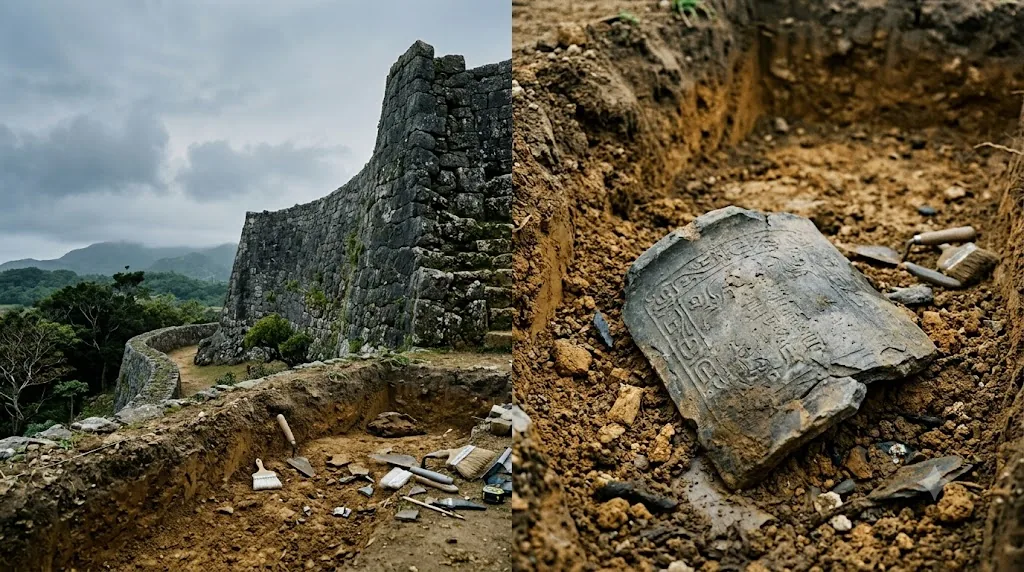 An Okinawan gusuku wall and a Goryeo-inscribed roof tile unearthed nearby — resemblance that raises questions, not answers. (AI illustration)
Do Okinawan castles really resemble Goryeo ones?
This is where the hypothesis gets its strongest support — and also where it needs its firmest guardrails.
A study by the archaeologist Im Young-jin, “The Construction Background of Okinawan Gusuku: On the Possible Migration of Sambyeolcho Forces,” examines structural similarities between Okinawan gusuku and Goryeo fortresses (Im Young-jin, Honam Studies 52, 2012). It describes some gusuku as having a “bent-central-axis, stepped-terrace” layout — the fortress’s central axis bends along a sloping ridge, and the interior is divided into stepped, level terraces.
The paper notes that this pattern can be compared to Goryeo fortifications such as Kaegyeong’s walls, Ganghwa’s walls, and Yongjangseong on Jindo — the Sambyeolcho’s own mountain fortress (Encyclopedia of Korean Culture — Yongjangseong, Jindo). Tile patterns add a second thread: the lotus-petal design on a roof-end tile from Yongjangseong on Jindo is noted as resembling those found in Okinawa. Crucially, though — they are not identical. The careful phrasing is “a resemblance is noted,” not “they are the same.”
For an international reader, the image is almost cinematic: the memory of the Sambyeolcho, broken on Jeju, seems to flicker faintly in the walls and tiles of Okinawa. But that flicker is a question posed by archaeology, not a settled conclusion.
Key terms. Sambyeolcho (삼별초) — military units tied to Goryeo’s military regime (the Left and Right Byeolcho and the Sinuigun) that rebelled in 1270 after the court made peace with the Mongols, holding out on Jindo and then Jeju until 1273. Gusuku (グスク) — Okinawa’s distinctive fortified sites, blending castle, court, and sacred space. Gyeyu (계유년) — a sexagenary year-name recurring every 60 years, which is why the tile’s date (1153? 1273?) can’t be pinned down. Yongjangseong (용장성) — the Sambyeolcho’s fortress on Jindo, cited for structural comparison.
Here’s the mystery, laid out plainly:
| The claim | What the evidence actually supports |
|---|---|
| “The Sambyeolcho fled to Okinawa” | A Goryeo-inscribed tile exists at Urasoe; a migration is hypothesized, not proven |
| “The tile dates to 1273” | Gyeyu recurs every 60 years — proposed dates include 1153, 1273, 1333, 1393; unconfirmed |
| “Okinawan castles are Goryeo castles” | A structural resemblance is noted between some gusuku and Goryeo forts |
| “The Sambyeolcho founded the Ryukyu Kingdom” | Impossible on the dates — the kingdom came in 1429, 150+ years later |
Wait — did the Sambyeolcho found the Ryukyu Kingdom?
No. This is the one line that has to be drawn firmly, because it’s where the story most often runs off the rails.
Saying “the Sambyeolcho founded the Ryukyu Kingdom” fails on two counts. First, the dates don’t work. The possible southward move is discussed for the late 13th century, around 1273. But the unified Ryukyu Kingdom wasn’t established until 1429 — a gap of more than 150 years. Second, Urasoe Yōdore, where the inscribed tiles were found, belongs to an earlier phase of royal tomb and castle culture, not to the unified kingdom. So the only thing open to scholarly examination is whether Goryeo craftsmen or Sambyeolcho-linked groups influenced the early castle-and-tile culture of the gusuku period — not the founding of a state.
There is, however, one genuinely striking piece of context for the idea that the Sambyeolcho looked beyond Korea’s shores at all. In 1271, the Sambyeolcho government on Jindo sent a diplomatic letter to Japan; the Kamakura shogunate reviewed it and recorded its doubts point by point in a document known as the Goryeo Cheopjang Bulsim Jojo (高麗牒狀不審條條) (Encyclopedia of Korean Culture). It isn’t proof of any voyage to Okinawa. But it shows the Sambyeolcho were not sealed inside Jindo and Jeju — they were actively reaching across the sea, seeking allies against the Mongols. That single fact is what keeps the Okinawa hypothesis from sounding absurd.
How other cultures tell the same kind of story
The Sambyeolcho–Okinawa puzzle belongs to a very human genre: the defeated who supposedly escaped across the water.
Japan — the fallen Heike. After the Taira (Heike) clan was destroyed in the Genpei War of 1185, legends sprang up across Japan of Heike no ochūdo — surviving warriors who fled into remote mountains and islands to live in hiding. Villages from the Japanese Alps to the southern islands still claim descent from them. Like the Sambyeolcho story, it braids real defeat with local memory and later storytelling.
The West — Troy’s scattered survivors. European traditions did the same with the fall of Troy: refugees under Aeneas were said to have sailed to Italy and seeded Rome, and medieval British chroniclers even traced Britain’s founding to a Trojan named Brutus. Defeat, in the retelling, becomes an origin.
What makes the Sambyeolcho case unusual is that it isn’t only legend — there’s a physical object, a Goryeo-stamped tile in Okinawan soil, doing the talking. That’s also exactly why the discipline matters: a tile can anchor a hypothesis, but it can’t, on its own, carry a whole migration across the sea. The most honest ending is the most interesting one — we don’t yet know, and the clay is still speaking.
Coming up next
One roof tile — and we’ve traveled from a Goryeo rebellion’s last stand on Jeju to the ramparts of Okinawa, a 1271 letter to the Kamakura shogunate, and legends of the Heike and Troy. That’s the quiet gift of a good historical drama: a single unanswered question is a doorway.
In the next essay, we’ll take another K-drama scene that looks like pure fiction — and trace the real Korean history hiding underneath it.
Frequently asked questions
Did the Sambyeolcho really flee to Okinawa? It’s an unproven hypothesis, not a settled fact. A roof tile stamped “made by a Goryeo tile-maker” was found at Urasoe in Okinawa, and some scholars connect it to Goryeo craftsmen — possibly linked to Sambyeolcho survivors — moving south after 1273. But the tile’s exact date and makers aren’t confirmed, so it’s best treated as a fascinating archaeological question, not proven history.
Did the Sambyeolcho found the Ryukyu Kingdom? No — that claim doesn’t hold up. The Sambyeolcho’s possible move south is discussed around the late 13th century (circa 1273), but the unified Ryukyu Kingdom wasn’t established until 1429, more than 150 years later. At most, scholars discuss whether Goryeo craftsmen or Sambyeolcho-linked groups influenced the early castle-and-tile culture of Okinawa’s gusuku period.
What is the Sambyeolcho? The Sambyeolcho (三別抄) were military units tied to Goryeo’s military regime — the Left and Right Byeolcho and the Sinuigun — that rebelled in 1270 when the Goryeo court made peace with the Mongols. They resisted from Jindo and then Jeju Island, until a combined Mongol-Goryeo force destroyed their last stronghold at Hangpaduseong on Jeju in 1273. (For that resistance in full, see our companion piece on the Sambyeolcho’s war against the Mongols.)
Sources & further reading
This piece was written from the historical script and fact-check of 사뚱샘의 역사방 (SaDDungSam). Key sources are cited inline above. For broader reading:
- The Sambyeolcho (삼별초) — the elite units and their resistance. (Encyclopedia of Korean Culture / 한국민족문화대백과)
- Yongjangseong on Jindo (진도 용장성) — the Sambyeolcho fortress cited for structural comparison. (Encyclopedia of Korean Culture)
- Goryeo-style roof tiles in Okinawa — the archaeological study of the “Goryeo tile-maker” inscription. (Uehara Shizuka, “Koryŏ-Style Roof-tiles Excavated on the Okinawa Islands,” SNU repository)
- Im Young-jin, “The Construction Background of Okinawan Gusuku” — the gusuku–Goryeo fortress comparison (Honam Studies 52, 2012). (KCI)
- Goryeo Cheopjang Bulsim Jojo (고려첩장불심조조) — the 1271 Sambyeolcho letter to Japan, reviewed by the Kamakura shogunate. (Encyclopedia of Korean Culture)
- Gusuku Sites and Related Properties of the Kingdom of Ryukyu — UNESCO World Heritage. (UNESCO World Heritage Centre)
- Urasoe City cultural materials — official local documentation of the inscribed tiles and their debated dating (1153 / 1273 / 1333 / 1393). (Urasoe City)
- Ryukyu roof-tile materials analysis (2022) — finds mixed Korean/Japanese/Chinese influence in Ryukyu tiles and cautions that technical influence does not, by itself, prove a population migration. (PLOS ONE)
- Urasoe Castle & Urasoe Yōdore — the Okinawan sites where the tiles were found. (浦添城跡 — Japan Heritage Portal, Agency for Cultural Affairs · 浦添城跡散策マップ — Urasoe City)
Thanks for reading — see you in the next one.
This article was researched and written by K-Drama History. Source: Did the Sambyeolcho Escape to Okinawa? The Mystery of a Goryeo-Inscribed Roof Tile — K-Drama History