Queen Dowager Cheonchu and the 1009 Coup: Why Her Nephew Became King and Her Son Died
From the research behind Pause the Drama.
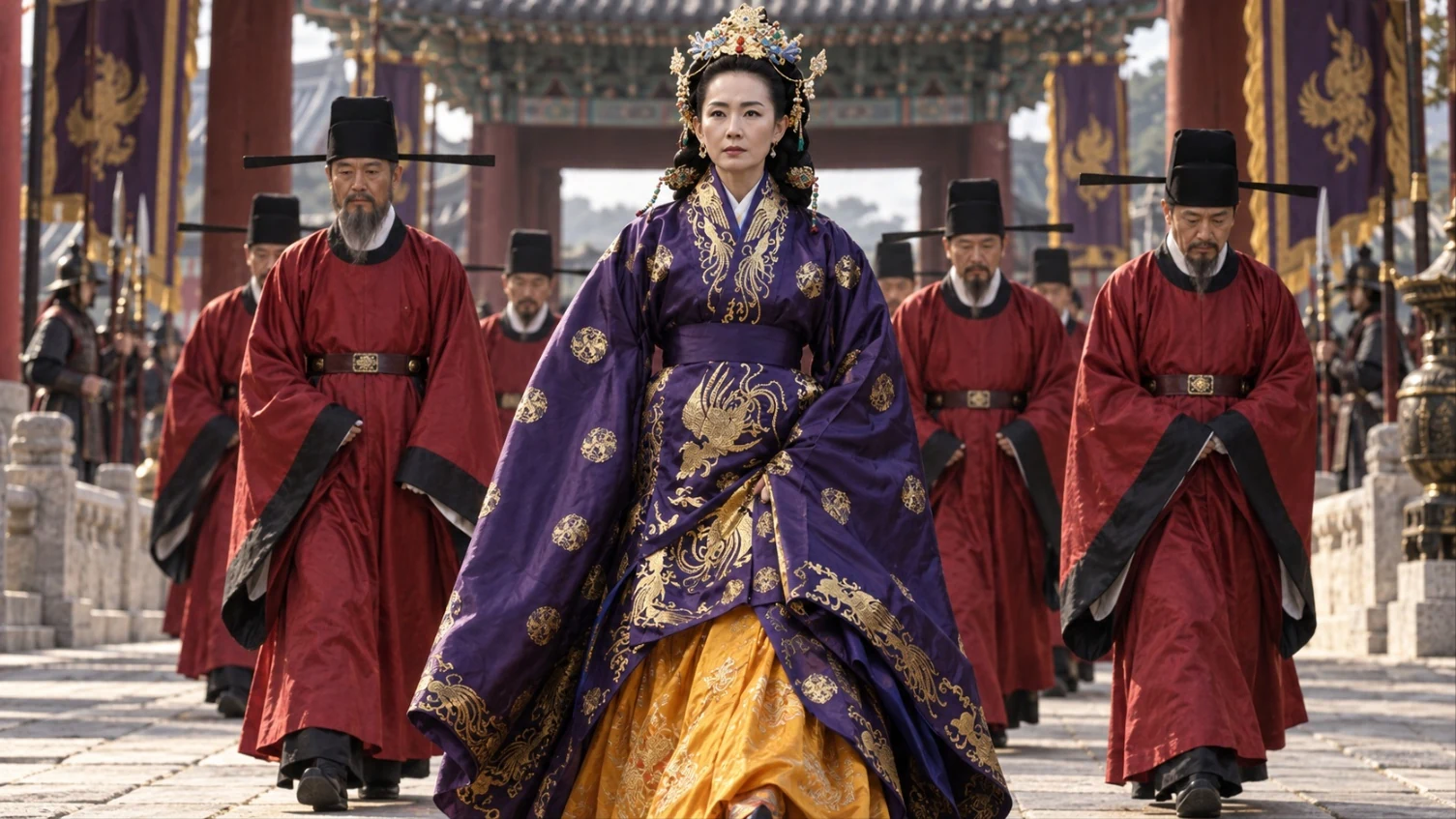 A queen dowager’s procession in the Goryeo court. In 1006 the same court produced a gold-ink sutra naming her and Kim Chi-yang as joint sponsors. (AI illustration)
1. How does the drama show her?
In episode 2 of Korea-Khitan War, a young man named Wang Sun, Prince Daeryangwon (大良院君), lives shut away in a mountain temple. He refuses to eat food said to have been sent by Queen Dowager Cheonchu and runs barefoot into the forest. Arrows from hidden soldiers follow him, and he throws himself down before a stone Buddha inside a turtle-shaped rock and begs for his life.
In episode 3, the palace catches fire. Gang Jo, a general of the northwestern frontier, leads troops into the capital, Gaegyeong, and cuts down Kim Chi-yang and his son. Standing before King Mokjong and Queen Dowager Cheonchu as they cling to each other, Gang Jo tells them that if they had set the country right a little sooner, he would not have had to become a traitor. Then he sends them out of the capital. On that road, the one who falls to the sword is not the Queen Dowager but her son, Mokjong.
The drama makes Cheonchu the starting point of the chaos. Press coverage at the time of broadcast described the drama’s turmoil as beginning with her desire to become “mother of two emperors.”
(These scenes are described from press reports and KBS’s official synopses published at the time. The episodes themselves were not watched and checked against the descriptions here.)
So who, according to the records, did Cheonchu’s side try to harm? And why was the person who finally lost his life her son and not her nephew?
2. The short answer: the target was her nephew, not her son
The records do not name her son as the target. According to the Goryeosa, Biographies of Consorts, the Queen Dowager wanted the son she had with Kim Chi-yang to be heir. To that end, she had her nephew Prince Daeryangwon, a candidate for the throne, forced into monastic life and tried several times to have him harmed. However, there is little contemporary material that could confirm this independently. The Encyclopedia of Korean Culture’s entry on Kim Chi-yang names Kim Chi-yang, not the Queen Dowager, as the one who drove this.
The outcome of the 1009 coup was the reverse of that plan. The nephew survived and became Hyeonjong, the eighth king of Goryeo. Her son Mokjong was deposed and killed on the road into exile. The men who killed him were sent not by his mother but by Gang Jo, the leader of the coup.
The nephew Cheonchu’s side is said to have tried to kill became king. The one who finally lost his life was her son.
No record in which Cheonchu’s side explains its own political position on the succession dispute, the alleged attempts on Daeryangwon, or the 1009 coup has been identified. (A 1006 sutra colophon does carry her official title and her name as a sponsor. It is discussed below, but it is not a political defense of her actions.)
The surviving accusatory narrative of Cheonchu’s succession dispute and the coup is found in later dynastic histories and in the records of a family that served on Hyeonjong’s side.
3. How did Taejo’s granddaughter become “Cheonchu”?
The Queen Dowager holding Mokjong in episode 3 was born at the very center of the royal house. Born in 964, she was a granddaughter of Wang Geon, King Taejo, and both of her parents were children of Taejo by different mothers. She married her cousin, the fifth king Gyeongjong. To avoid the form of a marriage within the same surname, she took her grandmother’s surname and was styled Lady Hwangbo (皇甫氏). Marriage between members of the royal family was common in the early Goryeo court.
Gyeongjong died young, and she was widowed at 18 by traditional Korean age reckoning. In 997 her son Mokjong came to the throne, also aged 18 by traditional Korean age reckoning. She received the honorific title Eungcheon Gyeseong Jeongdeok Wangtaehu and acted as regent. Because she lived in the Cheonchujeon (千秋殿) hall of the palace, people called her Queen Dowager Cheonchu. “Cheonchu” is neither her name nor her posthumous title. It is the name of the hall where she lived. The posthumous title she received was Heonae Wangtaehu (獻哀王太后). The Encyclopedia of Korean Culture describes her case as a rare one in which a mother acted as regent even though the king was an adult. (For how regency worked as an institution, see our regency article.)
4. Lover or political partner? A gold sutra in Kyoto
(This section opens with an object, not a drama scene.)
The Kyoto National Museum in Japan holds a Buddhist sutra scroll written in gold powder on deep indigo paper. It is chapter 32 of the Mahāratnakūṭa Sūtra (大寶積經), 29.2 cm high and about 8.4 m long. It is part of a gold-lettered canon commissioned jointly by Queen Dowager Cheonchu and Kim Chi-yang in 1006, the ninth year of Mokjong’s reign.
Kim Chi-yang was a relative on her mother’s side (the histories call him one of her 外族, her maternal kin). The histories say he posed as a monk, came and went from the Queen Dowager’s quarters, and caused a scandal. He was exiled under King Seongjong. When Mokjong came to the throne he was recalled and rose to high posts, including Right Executive (우복야) concurrently heading the Three Finance Offices (삼사사), and he controlled appointments to office (Encyclopedia of Korean Culture, “Kim Chi-yang”). (The 1006 sutra colophon discussed below styles him Left Executive of the Department of State Affairs and Supervisor of the Three Finance Offices, 尙書左僕射判三司事. The two titles are not necessarily in conflict; they may reflect different dates.) There is also a view that he may actually have been a monk of the Hwaeom school.
What stands out is that the sutra does not hide that the two sponsored it together. The colophon records that in the seventh month of the 24th year of Tonghe (統和), that is 1006, the two of them “with one mind vowed” (同心發願) to have a gold-lettered canon copied. It gives the Queen Dowager’s full official title and names Kim Chi-yang. It also names the scribe, Choe Seong-sak. The two people the histories describe in terms of scandal appear in a contemporary object as joint sponsors under official titles.
The Encyclopedia notes that red writing beside the frontispiece records that the scroll was donated in 1388 to Kongōrin-ji (金剛輪寺) in Ōmi, Japan. It suggests the scroll left Korea around that time, when Japanese pirate raids were frequent. It also describes the scroll as the earliest-dated surviving Korean hand-copied sutra that exists as a single standalone unit.
A note on terms: sutra copying (寫經) was a Buddhist practice of copying scripture by hand to earn merit. The vow (發願) states what that merit is being dedicated to.
What this sutra directly shows goes no further than the joint vow. Kim Agnes, in her 2008 study, characterizes the relationship between Cheonchu and Kim Chi-yang as a political partnership. That is her interpretation, based on reading the records together. It is separate from the documentary fact that the two jointly commissioned a gold-lettered canon in 1006.
5. 1009: what burned, and who killed whom?
In episode 3, the drama opens the coup with Kim Chi-yang’s side setting the palace on fire. The Goryeosa Jeolyo records that in 1009, the twelfth year of Mokjong, a fire broke out in the oil storehouse of the Daebu (大府) and spread as far as the Cheonchujeon. It says that Mokjong fell ill after seeing it and could no longer attend to government. Some researchers have suggested that this record of illness may be a way of covering what was in effect a confinement. The Encyclopedia of Korean Culture’s entry on the 1009 coup says Kim Chi-yang’s faction started the fire. Its entry on Kim Chi-yang gives that account but also presents the view that the opposing faction started the fire in order to remove Kim Chi-yang.
According to the Goryeosa Jeolyo, Mokjong acted after Yu Chung-jeong reported that Kim Chi-yang was aiming for the throne. Believing that trouble came from the lack of a settled heir, he sent officials to Sinhyeolsa temple to bring Prince Daeryangwon to the palace. He ordered Gang Jo, the general of the northwestern frontier, to come up with troops as an escort. The Goryeosa Jeolyo also records that Mokjong said, while still alive, that he wished to abdicate in person and hand over the affairs of the army and the state (予欲親禪, 付之軍國). In a message sent to Daeryangwon, he said he wanted to meet him face to face before his own appointed end and entrust him with the ancestral shrines, and that if he himself had years left, he would place Daeryangwon in the Eastern Palace, the heir’s residence (寡人未至大期, 面囑宗社……若有餘齡, 使處東宮). The person who summoned as heir the nephew his mother’s side is said to have pushed aside was her son, Mokjong.
Gang Jo turned back once because of a false rumor. Then he received a letter from his father hidden inside a bamboo walking stick, came to believe the king was dead, and marched south with 5,000 soldiers. On the way he heard that the king was alive, but he did not stop. The Encyclopedia explains that Gang Jo judged that, as long as Mokjong lived, Kim Chi-yang’s faction could not be removed because of its ties to the Queen Dowager, and so he decided to replace the king.
Seven people, including Kim Chi-yang, his son and Yu Haeng-gan, were killed. Some thirty others, including members of Kim Chi-yang’s faction and the Queen Dowager’s relatives, were exiled to islands. Prince Daeryangwon came to the throne as Hyeonjong.
The deposed Mokjong left for Chungju with his mother. The Goryeosa Jeolyo records that as he left he said to his official Choe Hang: “That the storehouses (府庫) recently burned and an unforeseen upheaval arose is all because I lack virtue” (頃, 府庫災而變起所忽, 皆由予不德). The same record describes the journey. When the Queen Dowager wished to eat, Mokjong held the bowl for her himself. When she wished to ride, he held the reins himself. When the party reached Jeokseong county, Kim Gwang-bo, an officer of the royal pharmacy sent by Gang Jo, offered him poison. When Mokjong refused to drink it, Gang Jo’s order was passed on: if the poison could not be administered, the escort soldiers were to finish the task and then report that the king had taken his own life. That is how Mokjong was killed.
The Goryeosa says the Queen Dowager repeatedly sent people to harm her nephew, and that on one occasion poisoned wine and rice cakes were sent. But the king who actually received the poison was her son.
There is one more twist. The Goryeosa Jeolyo writes that although officials and commoners all grieved at the injustice, the new king did not know what had happened. Only when the Khitan raised an army to punish the crime did he learn that Mokjong had been murdered, and he then revised Mokjong’s posthumous and temple names. In 1010, Emperor Shengzong of the Liao put forward Gang Jo’s killing of Mokjong as one of his justifications for invading. The drama’s episode 4 also opens the war with the Khitan emperor declaring that someone had harmed the Goryeo king the Khitan had invested. (For the war itself, see our Battle of Gwiju article.)
Queen Dowager Cheonchu was not executed. The Goryeosa records that after the coup she returned to live in Hwangju, her grandmother’s home region (歸居黃州), and gives the length of that period as 21 years. This appears to be an inclusive count, counting both the first and the last year. She died in 1029 at Sungdeokgung, aged 66 by traditional Korean age reckoning.
The Encyclopedia of Korean Culture’s entry on Queen Dowager Heonae reads this as her returning to Gaegyeong after falling ill. The same encyclopedia’s entry on the 1009 coup says briefly that she ended her days in Hwangju. The two entries are inconsistent in wording, but this has not been confirmed as a separate version based on a different source.
6. Who called her “Empress Lü”?
(This section also opens with an inscription, not a drama scene.)
The National Museum of Korea holds the epitaph of Choe Sa-wi (961–1041), a meritorious subject of King Hyeonjong. The stone was made and buried in 1075, after his death, when his youngest son moved his grave. It contains this line:
“Executive Kim Chi-yang plotted together with Empress Lü to harm the heir of Han” (僕射金致陽同謀呂后將害漢儲).
This is a literal rendering. “The heir of Han” (漢儲) is not a real title. It is a figure of speech that likens Daeryangwon to the rightful successor of the Han dynasty. Daeryangwon was not an invested crown prince at the time. Kim Yong-seon’s translation renders the word simply as “heir apparent.”
Empress Lü was the empress of Liu Bang, the founder of the Han dynasty, who held real power in Han after her husband’s death. The epitaph of Choe Sa-wi likens Cheonchu to Empress Lü and Daeryangwon to the rightful heir of the Han line.
Forty-two years later, the epitaph of Choe Sa-wi’s great-grandson Choe Gye-bang (1117) repeats the same story. Without naming the Queen Dowager, it writes that “in the old days, under Mokjong, a treacherous minister seized power, and the altars of the state were about to pass to another surname” (姦臣擅權將以社稷歸于異姓). It says that Hyeonjong was able to inherit Taejo’s throne and carry on the legitimate line because Choe Sa-wi protected him. This story of merit was repeated in the great-grandson’s epitaph 42 years later.
The Goryeosa was compiled by Joseon in 1451, about 440 years after these events. It is based on Goryeo-period records that are now lost, so it cannot be treated as a Joseon invention. But long before Joseon’s historians, the family of one of the coup’s winners was already likening her to Empress Lü. Whether that family’s version passed directly into the later Goryeosa has not been established.
Some 380 years before Joseon compiled the Goryeosa, an epitaph from a family on the coup’s winning side was already calling her “Empress Lü.”
Kim Chang-hyun questions the traditional account of a “Kim Chi-yang rebellion”; Kim Agnes, separately, describes Cheonchu and Kim Chi-yang as political partners rather than re-examining the rebellion itself. The Encyclopedia of Korean Culture’s entry on Queen Dowager Heonae, written by Kim Chang-hyun, says that the Goryeosa and Goryeosa Jeolyo describe Kim Chi-yang as if he started a rebellion. It argues that in fact the faction around Daeryangwon, centered on Choe Sa-wi, appears to have launched the coup. The same encyclopedia’s entry on the 1009 coup presents two views. One doubts that the rebellion happened at all, on the grounds that Kim Chi-yang lacked the capacity to start an uprising, did not mobilize armed force, and that there are signs the records were manipulated. The other treats the event as a coup carried out by Hyeonjong and his supporters. Urihistorynet also points out that very few records survive from Mokjong’s reign and that those that do focus on the affair and the coup. This cannot be called a scholarly consensus. Because the Heonae entry was written by Kim Chang-hyun, it is not independent of his own research.
One more feature of how the records are arranged is worth noticing. According to the Encyclopedia, Hyeonjong himself was the son of Queen Heonjeong, Cheonchu’s sister, who was also widowed by Gyeongjong’s death, and Wang Uk, a son of Taejo. The histories record both sisters’ relationships outside marriage. One is placed as the story of Hyeonjong’s birth. The other is placed in a negative narrative tied to the succession dispute. It may be worth asking whether political legitimacy shaped that difference. (This is the script’s own interpretation.) On wording: the Goryeosa text says she “had relations with Kim Chi-yang and bore a son” (與金致陽通而生子). The official Korean translation renders this as an illicit liaison (사통), but the two characters 私通 do not appear in the classical Chinese original.
None of this means every record is false. Several records agree that she had a son with Kim Chi-yang and that there was a conflict over the succession. Whether her side actually tried to kill her nephew cannot be decided. No self-account from her side survives, and there is too little contemporary material to confirm it independently. This article can say that much and no more.
7. Where does the drama differ from the record?
- The fire: The drama shows it as arson by Kim Chi-yang’s side. The records report the fire, and views differ on who started it.
- Mokjong’s death: In the drama he falls to a sword while leaving the capital. In the record he is first offered poison at Jeokseong county and is killed when he refuses it.
- The food and the arrows: Episode 2’s refused food and pursuit by archers dramatize the Goryeosa’s account that the Queen Dowager repeatedly sent people to harm Daeryangwon, and that poisoned wine and rice cakes were sent on one occasion. The specific staging is the drama’s own.
- The Queen Dowager’s ambition: The idea that she wanted to be “mother of two emperors” is the drama’s interpretation. The records say only that she sought to make her son by Kim Chi-yang heir. They say nothing about what she privately felt.
8. A legend-like story inside an official history
Sinhyeolsa on Samgaksan, where Daeryangwon stayed, is described by the Encyclopedia of Korean Culture as the temple that stood on the site of today’s Jingwansa in Eunpyeong-gu, Seoul. The Goryeosa, in its biography of Queen Dowager Heonae in volume 88, tells how he survived there in the manner of a legend. A palace woman sent by the Queen Dowager brought wine and rice cakes laced with poison. A monk of the temple hid him in an underground chamber. The wine and cakes were thrown into the courtyard, and crows and sparrows that ate them died. The Goryeosa Jeolyo also contains a passage in which Daeryangwon, in a letter to Mokjong, complains that when he gave the wine and food he had been sent to birds, the birds died.
This is not folk rumor. It is recorded in an official history. But the existence of the record is not independent proof of a poisoning attempt. What the Goryeosa Jeolyo presents as Daeryangwon’s letter takes the form of a personal plea. The Goryeosa biography transmits the story, but when it took shape and which Goryeo-period material it passed through before reaching the Goryeosa has not been determined. The structure, in which a persecuted rightful heir survives as if by a miracle, also resembles the kind of story that strengthens the legitimacy of an accession.
Perhaps the event was such a shock to people at the time that stories like this one were left behind. (This is the script’s own interpretation.)
9. How does she compare with other “dangerous mothers” in world history?
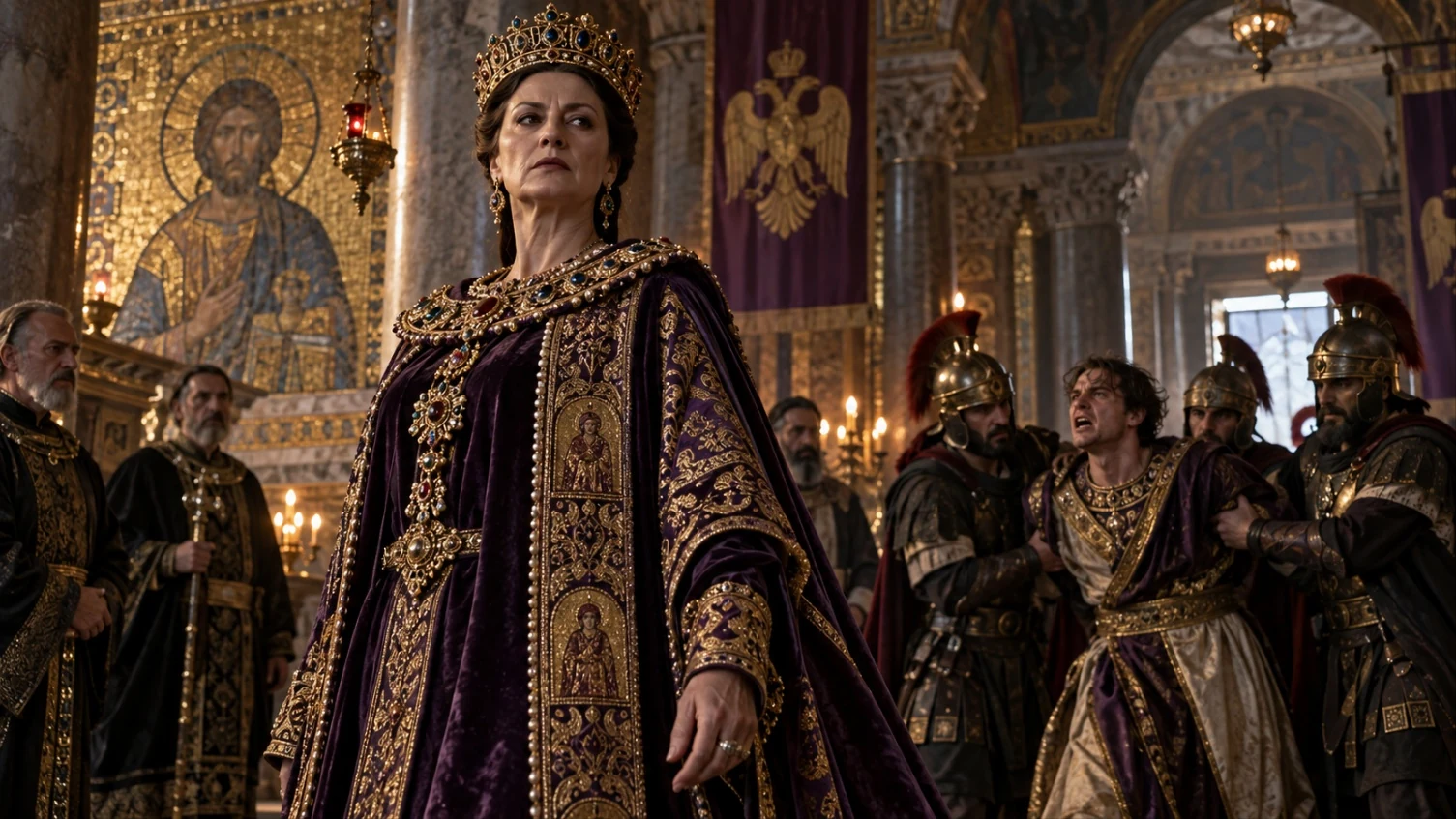 Empress Zoe of Byzantium, one of the three comparisons below. Only the structure of the stories is compared, not their political weight. (AI illustration)
The mother of the First Emperor of Qin (later called Zhao Ji, 趙姬): the closest structural parallel. According to the biography of Lü Buwei in Sima Qian’s Shiji, the First Emperor’s mother secretly bore two sons by Lao Ai, a false eunuch. An accusation was lodged that the two had plotted, “when the king dies, let us make this son the successor” (王即薨, 以子為後). The king of Qin exterminated Lao Ai’s kin to three degrees, killed the two sons the queen dowager had borne, and moved her to Yong (雍). A lover, a son by that lover, and the charge of scheming to make that son heir: the structure is almost the same. But in Qin, the sons were killed on the orders of the regime of the king of Qin, her own son. This comparison is about the similarity in how the histories tell the two women’s stories. It does not mean their actual political careers were the same.
Irene of Byzantium: a clearly different case. If you are looking for “a mother who harmed her reigning son,” you will find one in Byzantium, not Goryeo. According to Britannica, Irene took power as guardian of her young son Constantine VI. In 797 she plotted against him, had him arrested and blinded, and then ruled alone as emperor for five years. The passages of the Goryeosa and Goryeosa Jeolyo examined here contain nothing saying that Cheonchu tried to harm Mokjong, and the person recorded as ordering Mokjong’s killing is Gang Jo.
Empress Lü of Han: the case that shows this article’s theme most clearly. Empress Lü held real power in Han after Liu Bang’s death. According to Britannica, when she died, a coalition of court officials and members of the imperial family massacred her entire clan and enthroned Liu Heng, the son of another of Liu Bang’s consorts, as Emperor Wen. The epitaph of Choe Sa-wi itself directly likens Cheonchu to Empress Lü (呂后) and Daeryangwon to the heir of Han (漢儲). Reading that comparison as the family laying the 1009 coup as a whole over the Han story of removing the Lü clan and installing the legitimate emperor goes beyond what the epitaph itself says. That reading is a researchers’ interpretation associated with Kim Chang-hyun. The view that Choe Sa-wi and Daeryangwon’s faction were the ones who carried out the coup is also a scholarly reconstruction, not something the source states.
Cheonchu of Goryeo. She overlaps with all three but matches none of them. Like the First Emperor’s mother, she had a son by a lover, but that son was killed not by her own son but by a general on the opposing side. Like Irene, she held power beside a son, in Cheonchu’s case an adult one, but there is no record that she harmed him. And the comparison of her to “Empress Lü” was not a title she held. It is a figure of speech used in the epitaph of Choe Sa-wi, one of Hyeonjong’s meritorious subjects.
10. Conclusion: two people on the road into exile
In episode 3 of Korea-Khitan War, the two people standing before Gang Jo are holding each other. In the record, Mokjong, on the road into exile, held his mother’s bowl and her horse’s reins. And he died on that road. Queen Dowager Cheonchu lived until 1029, twenty years later.
The nephew Cheonchu’s side is said to have tried to kill became king. The one who finally lost his life was her son.
The surviving accusatory narrative of Cheonchu’s succession dispute and the coup is found in later dynastic histories and in the records of a family that served on Hyeonjong’s side.
This article was researched and written by K-Drama History. Source: Queen Dowager Cheonchu and the 1009 Coup: Why Her Nephew Became King and Her Son Died — K-Drama History