Pachinko, Explained: The Korean Women Who Crossed the Pacific With Only a Photograph
Theme: Modern Korea
From the research behind Pause the Drama.
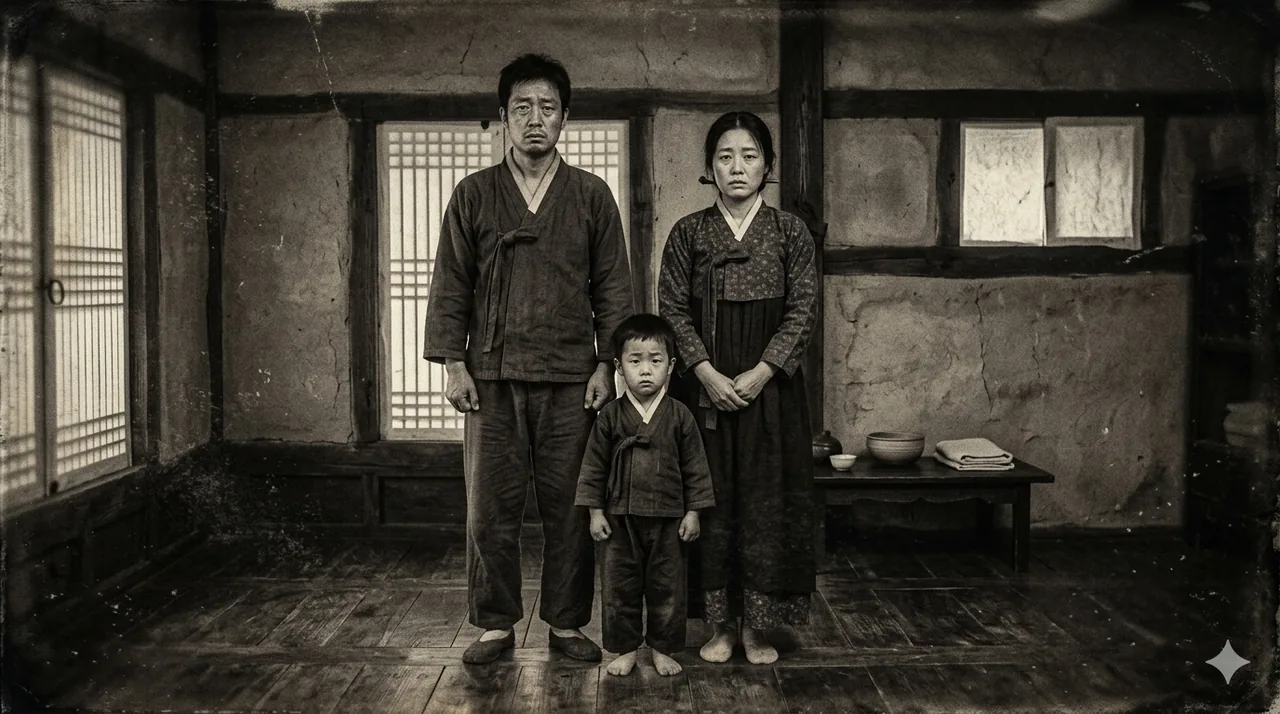
In Pachinko, Sunja marries Pastor Isak after he has lodged in her mother’s boarding house for a few weeks. Then she boards a ferry at Busan for Osaka. She is not yet twenty, and she is crossing a sea with a man she barely knows.
Viewers read the scene as Sunja’s particular misfortune.
But when Sunja was still a child on Yeongdo, women were leaving from that same coastline on a much longer voyage — and they had never seen their husbands at all. A photograph was the entire courtship.
This is not a coincidence of geography. Picture brides came disproportionately from Gyeongsang province, close to the port of Busan. Sunja’s home was their port of departure.
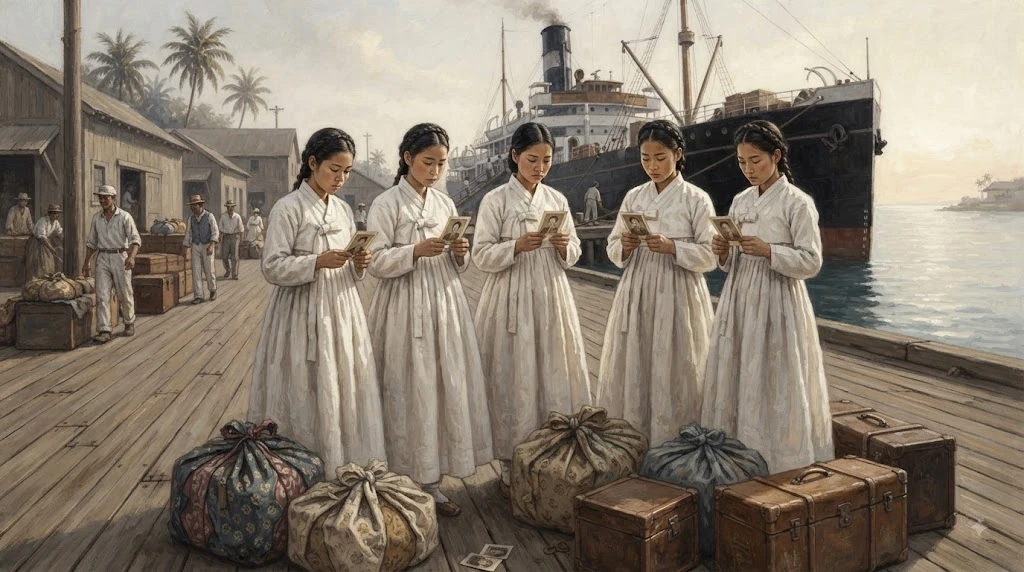
Arrivals at Honolulu carried the photograph with them — not as a memento, but because it was the document the marriage rested on. (AI illustration)
The photograph was not a keepsake. It was paperwork.
Between 1910 and 1924, Korean women married men in Hawaii and on the American mainland on the strength of an exchanged photograph. In Korean they are called sajin sinbu (寫眞新婦) — picture brides.
The system is usually told as a love story gone wrong. It is better understood as immigration law.
The United States had closed its doors to Asian labour migration. Labourers could not enter; families could. So marriage became very nearly the only lawful channel through which an Asian woman could set foot on American soil.
That is the first half. The second half is the part that makes this a Korean story rather than a general one.
These women could cross the Pacific not because a country protected them, but because their country had ceased to exist.
How a photograph became an entry document
In Pachinko, when Sunja travels to Osaka, the authority that permits and records her movement is the Japanese colonial administration. The picture brides stood on exactly the same ground.
Korean emigration to Hawaii’s sugar plantations had begun in 1903 and was halted in August 1905 under Japanese pressure. (Korea’s own government had issued an emigration ban that April.) Either way, it was not a decision Koreans made for themselves. That November, the Protectorate Treaty stripped Korea of its diplomatic voice altogether — which is why some accounts date the closure to the end of 1905 rather than the summer.
By then more than seven thousand Koreans had reached Hawaii. The overwhelming majority were men in their twenties; women were under a tenth of the total. It was, in effect, a society of men. And when their contracts ended, those men could not go home to fetch a bride, because the migration channel had been shut behind them.
Meanwhile, anti-Japanese sentiment was hardening in the United States. In 1907–1908 Washington and Tokyo reached the so-called Gentlemen’s Agreement, which effectively stopped Japanese labour migration — but left a door open for the wives and children of men already resident. Japanese men used that exception to bring brides from home by photograph. Korean men in Hawaii followed the same route.
The question is how Koreans got onto a Japanese route at all. The answer is August 1910: Korea was annexed, Koreans were reclassified as subjects of the Japanese empire, and they began receiving travel documents issued by that empire.
The first Korean picture bride landed in Honolulu on 28 November 1910 — three months after the country vanished. Her name was Choi Sara, she was twenty-three, and she came from Mokpo. She was married inside the immigration station itself, officiated by the Reverend Min Chan-ho, to Yi Nae-su, a man of thirty-eight who led the Korean National Association in Hawaii.
The wedding took place at the border, not at an altar.
A note on a much-repeated citation. Korean accounts of this first wedding routinely cite a report in Gungminbo dated 6 December 1910 — the reference appears in the Encyclopedia of Korean Culture's own entry on picture brides. That date cannot be right as written. The Honolulu Korean National Association's paper was founded in February 1909 as Sinhan Gukbo and did not carry the title Gungminbo until August 1913. Either the report ran in Sinhan Gukbo under its actual name, or the date belongs to something else. We could not examine the December 1910 issue ourselves, so we have left the newspaper out of the account above and kept only what the records agree on: the date, the place, the officiant and the two names.
A gentlemen’s agreement is not a treaty. It was an informal understanding between two governments, not a law — which is precisely why it was full of exceptions and gaps. Picture marriage grew in one of those gaps.
The dock
In Pachinko, Sunja arrives in Osaka and finds a reality that has nothing to do with what she imagined. The arrival scenes in Honolulu were not different.
The Encyclopedia of Korean Culture records the mechanics without sentiment: grooms lied about their ages, or sent photographs retouched to look younger. Matchmakers sold Hawaii as an earthly paradise.
Researchers describe the grooms as commonly fifteen to twenty years older than the brides. Sources differ on the exact gap, and we have not found a single figure that all of them accept.
The plantations did not match the advertisement either. Roughly ten hours a day; about 65 cents for men, 50 cents for women and children; something near sixteen dollars a month, before food and laundry were taken out. Overseers — known on Hawaii’s plantations as luna — rode the fields on horseback.
So why not turn around and go home?
There was no money for the passage. There was no country to go home to. And a daughter who had left to be married and returned unmarried was a disgrace to her household. The disappointment on the dock was not a choice. It was a notification.
What the drama shares with the history
One thing should be said plainly: there are no picture brides in Pachinko. Sunja went to Japan, not Hawaii, and she had met her husband’s face.
And yet the two stories rest on the same machinery. A people who could not issue their own passports. Women with no livelihood at home. A male-heavy labour society formed across the water.
Sunja crossed the Korea Strait and the picture brides crossed the Pacific. Both were holding paper issued by an empire that was not their own.
The drama’s broker, Koh Hansu, is invented — but middlemen who moved people and goods across water were not. Picture marriage had its own brokers, walking village to village selling the story of a golden country.
Six things that surprise readers abroad
One: the plantation owners were in favour of these marriages. The Encyclopedia of Korean Culture records that Korean labourers moved between plantations at a high rate, and that owners promoted the marriage of single men to make them stay. A man with a family does not leave. Picture marriage was labour retention policy before it was romance.
Two: the brides were generally better educated than the grooms. The men had left as labourers; a good number of the women had received a modern education. That gap is credited with changing Hawaii’s Korean community.
Three: a striking number of them divorced. Divorce was extremely rare in Korea at the time. In Hawaii, separations over a husband’s drinking, gambling or failure to provide were not unusual, and households run by mothers emerged as a result.
Four: their kitchens funded a resistance movement. When news of the March First Movement reached Hawaii in March 1919, women delegates from across the islands gathered in Honolulu and founded the Korean Women’s Relief Society. Lee Hee-kyung, a picture bride from Daegu who had arrived in October 1912 at the age of nineteen, made and sold rice cakes, japchae and skewers every week to fund the independence movement, and later organised a separate association of women from Gyeongsang province.
Food made in a plantation kitchen crossed the Pacific as independence funding.
Five: they built the institutions. As the sex ratio evened out, households formed; once households existed, churches, schools and associations could be sustained. A camp of temporary workers who intended to earn and leave became a community that taught the next generation to read Korean, collected dues and elected representatives. That Hawaii could serve as a financial artery of the overseas independence movement after 1919 is inseparable from the fact that people had stopped planning to leave.
Six: their success closed the door. As the children born to these women became American citizens and the Asian American population grew, opposition to picture marriage mounted. The Immigration Act of 1924, signed on 26 May, effectively barred Asian immigration and ended the picture bride route. A door opened so that families could be formed was shut once families actually were.
What one of them wrote down
This subject has almost no folklore attached to it. What it has instead is testimony.
Chun Yeon-hui was born in Jinju, South Gyeongsang province, in 1896, and sailed to Hawaii as a picture bride in 1915, at nineteen. Her husband, Kil Chan-rok, was a labourer on the Paia plantation on Maui and twenty-seven years her senior. She recalled trying to refuse the marriage after seeing him in person on the dock, and marrying him because there was no way back. She later divorced, worked as a laundress and a seamstress, ran a boarding house, and went on to operate a hotel and a carnation farm.
Her notebooks and recorded tapes have been edited by researchers into a published volume — a rare case of a picture bride leaving a long first-person record.
We should be exact about what kind of record this is. Chun's notebooks and tapes were made when she was past seventy, looking back across sixty years. They are testimony and recollection at once, and memory shifts. That the scene on the dock — the photograph against the man — is the part that recurs across so many accounts probably says something about how large that moment loomed for the people who lived it.
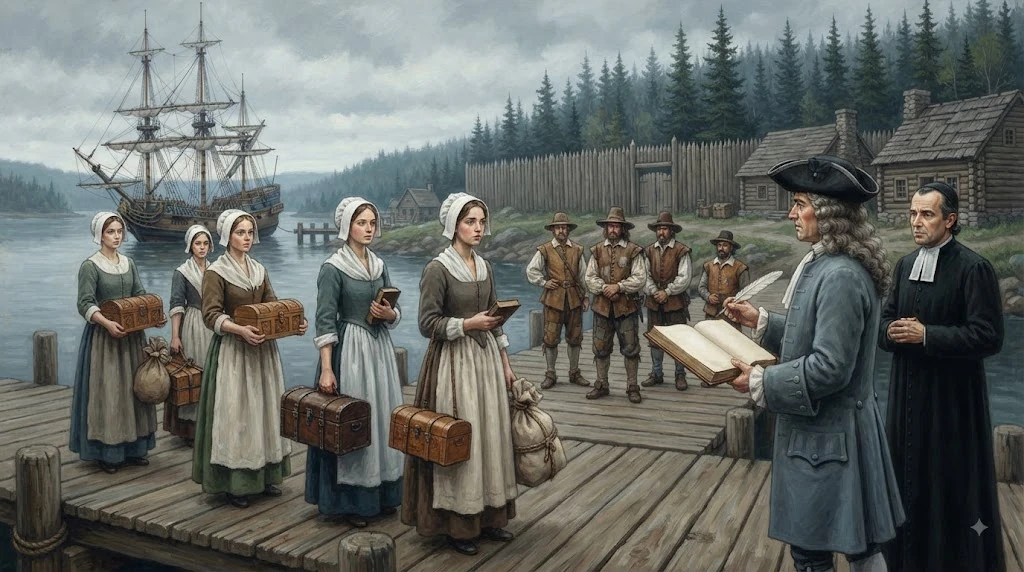
The filles du roi sailed to New France a quarter of a millennium earlier, and they too arrived into a register. (AI illustration)
Elsewhere: women who crossed borders on paper
Korea was not the only place that sent women across an ocean to fix a shortage of them. What differs is who paid, and who was responsible.
Japan — the same ships, the same ports. Picture marriage began with Japan. After the Gentlemen’s Agreement the numbers rose sharply, and more than twenty thousand Japanese and Okinawan women are estimated to have reached Hawaii this way between 1908 and 1920. When American opinion turned, the Japanese government stopped issuing passports to picture brides itself, on 1 March 1920.
France — brides sent by a king. Seventeenth-century New France, now Quebec, was also a society of men. Between 1663 and 1673 Louis XIV sent roughly 800 young women at state expense; they are known as the filles du roi, the King’s Daughters. The crown paid their passage and some received a dowry. A state budgeted for the migration of women.
Italy — proxy marriage into the twentieth century. Italy had a practice of matrimonio per procura, marriage concluded with one party absent. After the Second World War, Italian men in Australia married women from home this way, often after an exchange of photographs. Around twelve thousand women are estimated to have travelled to Australia under it between 1945 and 1976.
| Who arranged it | Who paid | Who was responsible on arrival | |
|---|---|---|---|
| Japan | The state issued and withdrew passports | Families | Japanese consulates |
| France | The crown | The crown | The colonial administration |
| Italy | Community and church | Families | Consulates and parishes |
| Korea | Brokers and Hawaii’s Korean associations | Families | No one |
Korea’s picture brides had none of it. No country to send them, none to protect them, and no consulate to appeal to when something went wrong. They sailed on another country’s papers, and once ashore they raised, themselves, the funds to get their own country back.
Of the four, Korea is the only case where women filled the space a state had vacated.
Back to Pachinko
Pachinko is, in the end, a story about people who survive. Sunja survives, and hands a life to her sons and grandsons.
A generation earlier, across a wider ocean, something similar happened. Women who boarded ships holding a single photograph were disappointed at the dock, worked the cane fields, opened boarding houses, sent daughters to university, and sold rice cakes to raise money for an independence movement.
What they crossed was not a sea. It was a set of documents.
And what was built at the end of those documents was not a marriage. It was a society.
This article was researched and written by K-Drama History. Source: Pachinko, Explained: The Korean Women Who Crossed the Pacific With Only a Photograph — K-Drama History