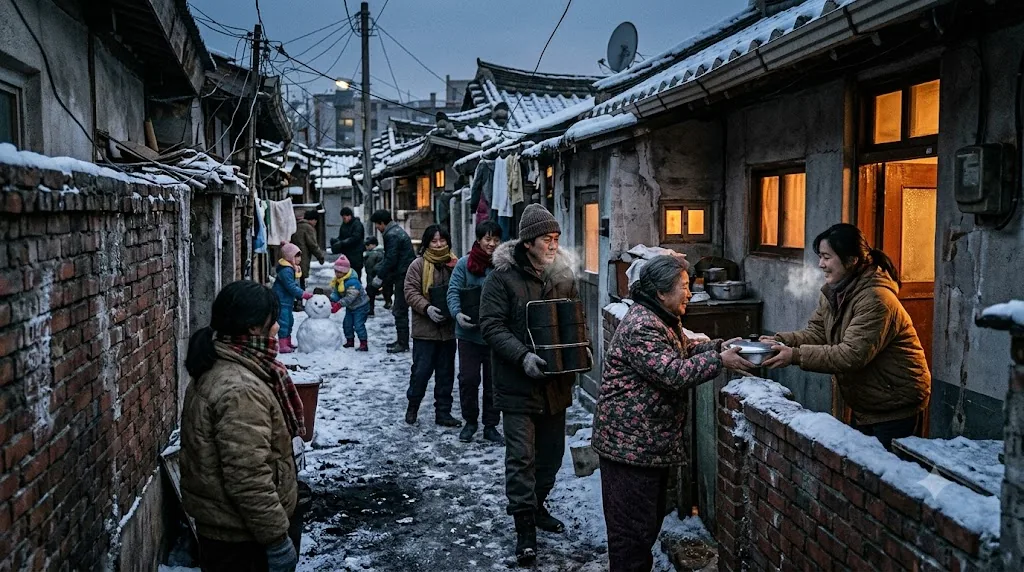
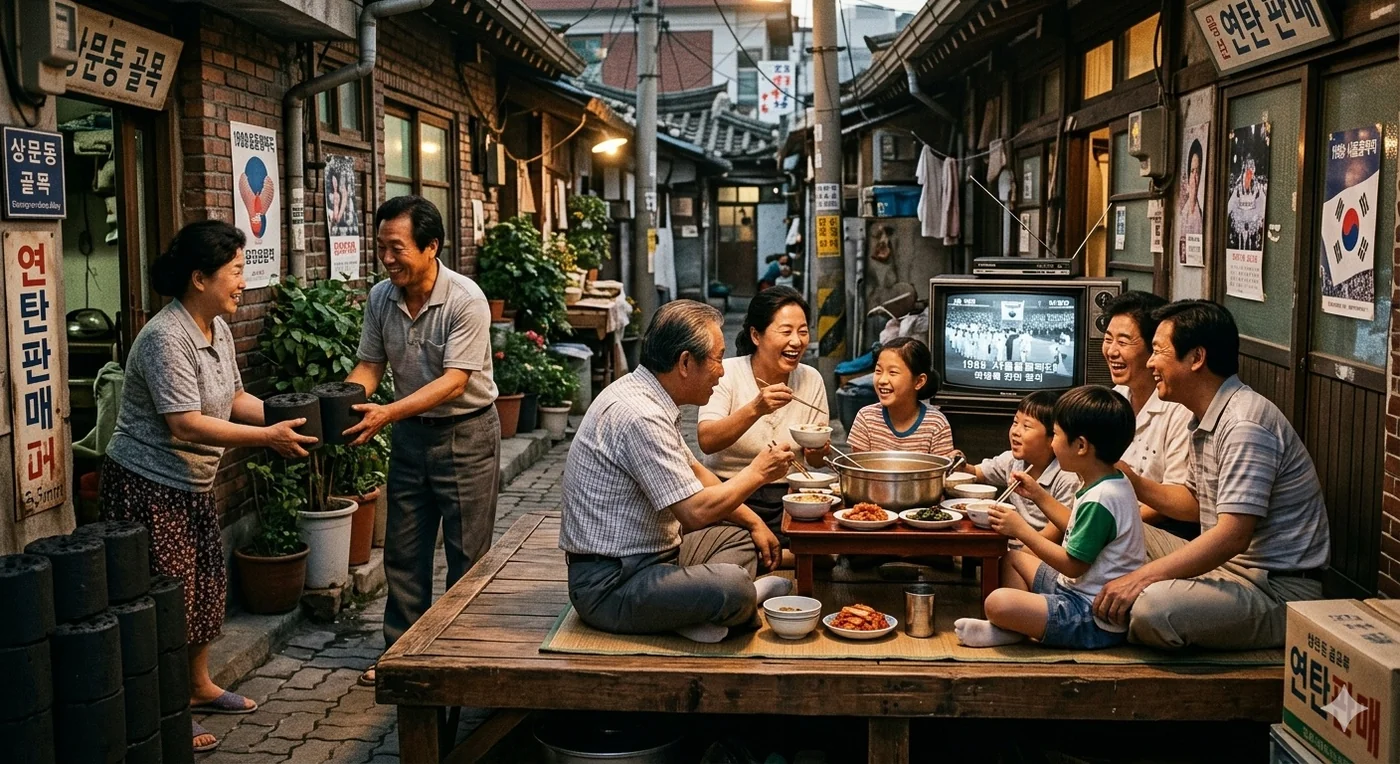
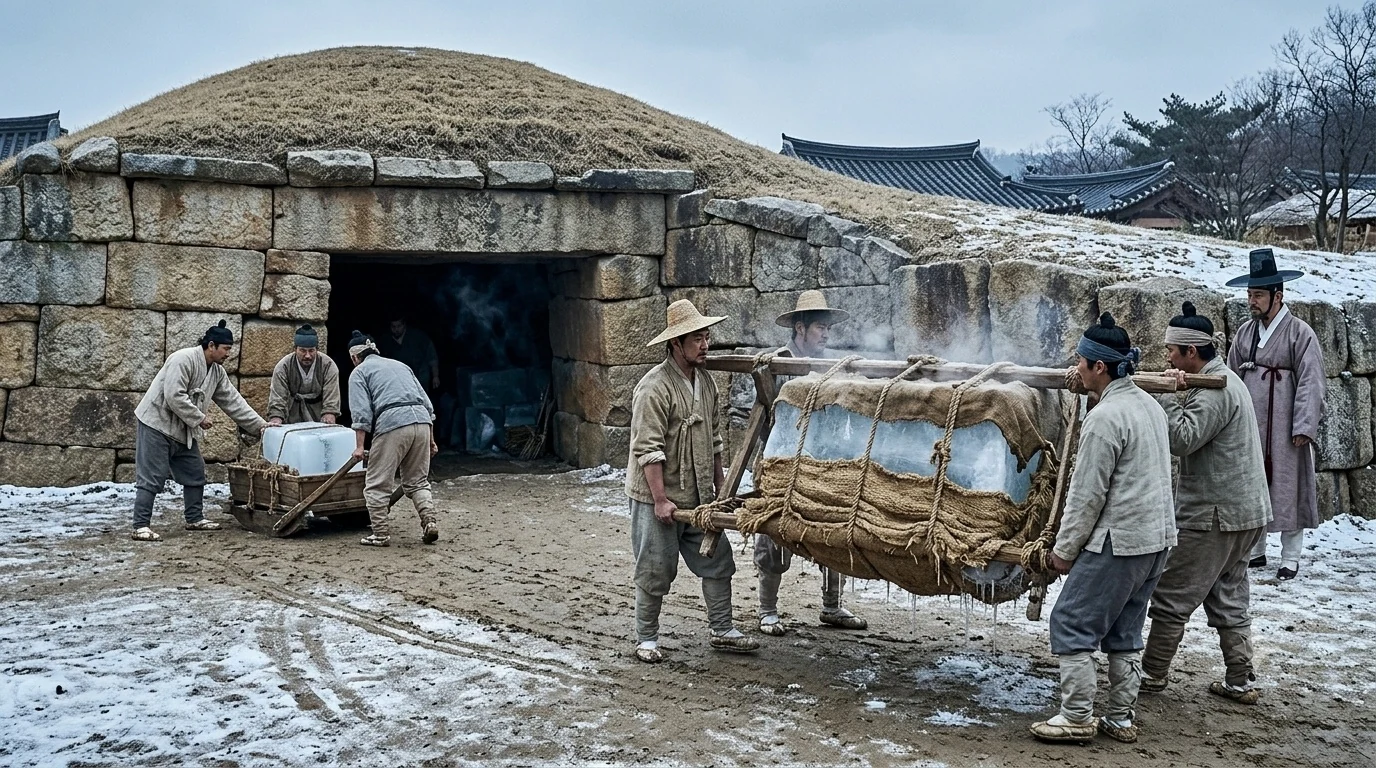
Minari, Explained: Why the Family Sleeps on the Floor — and What Ondol Has to Do With It
Theme: Knowledge & Science
From the research behind Pause the Drama.
In Minari, a Korean immigrant family arrives at a plot of land in rural Arkansas and finds a mobile home up on wheels waiting for them. It is the first night. The father, Jacob, has an idea about where everyone should sleep.
In the screenplay his line runs: “Because it’s the first night here. Let’s all sleep together on the floor. Wouldn’t that be fun?”
The children are not persuaded. One objection raised against the plan is that their father snores.
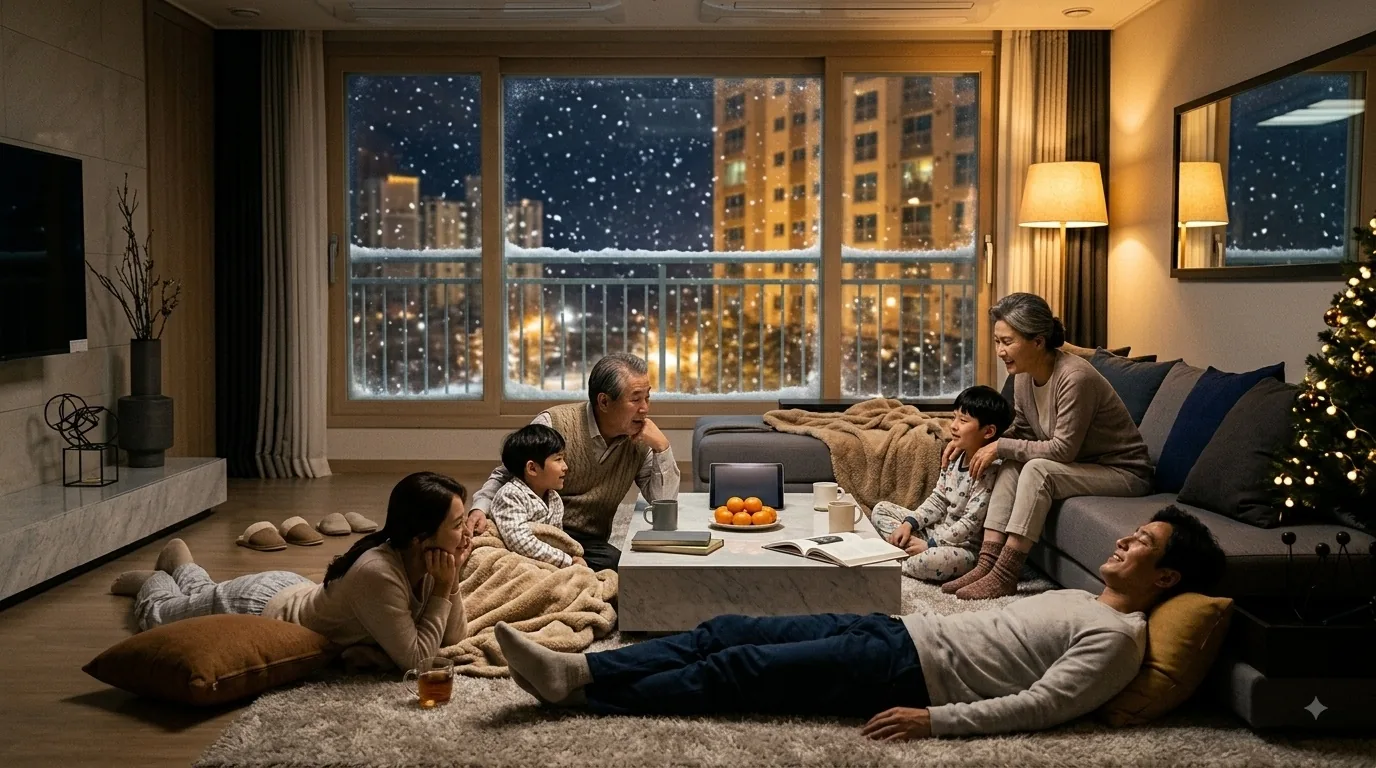 The heating is under the floor and out of sight, and the sofa is right there. People still end up on the ground. (AI illustration)
Quick answer: Minari shows no ondol. The Arkansas trailer has no firebox, no flue and no heated stone — and the family still keeps ending up on the floor, because what crossed the ocean with them was not the heating system but the habits it built: shoes off at the threshold, low furniture, life lived at floor level. Traditional ondol warmed that surface from a fire beneath it; Korean homes today still heat the floor, using hot-water piping instead of smoke flues, so the principle carried over even though the machinery did not. The history behind it is longer and less tidy than “ancient Korean heating” suggests: the Tang dynastic histories — compiled after the dynasty fell, in the tenth and eleventh centuries — attach Goguryeo’s winter trench to poor people, the fully heated room is placed only in late Goryeo — and the Encyclopedia of Korean Culture’s own gudeul entry says the question “requires further research” — while the most active period of installation was the 17th century. What Minari stages is the last stretch of that story: the habits arriving without the heat, and each generation deciding separately whether to keep them.
Let’s unpack it.
What is ondol, and how does it work?
Start with the vocabulary, because the English phrase “floor heating” hides the machine.
Ondol (온돌, 溫突) and gudeul (구들) name the same thing in two registers: ondol is written with Chinese characters and gudeul is the native word — though the split is not clean, since the Encyclopedia of Korean Culture reads the dol of 溫突 as a phonetic borrowing of the native dol, which would make both names Korean in origin. This article uses gudeul for the physical installation and ondol for the whole way of living.
The parts, following the Encyclopedia of Korean Culture’s gudeul entry: the agungi (아궁이) is the firebox where fuel goes in. The gorae (고래) are the channels built like trenches running from the firebox toward the chimney flue, so that heat and smoke travel under the floor. The goraedduk (고래둑) are the low walls stacked alongside them to carry the load. And the gudeuljang (구들장) are the broad flat stones laid across the top. Fire runs the length of the flues, the flues heat the capstones, the capstones heat the whole floor of the room, and the smoke leaves by the chimney.
The result is a room that gets warm without a heat source inside it. No fireplace, no stove, no visible flame. The warmth arrives from underneath.
The early form did not heat the whole room. A structure with one to three lines of flue laid along one side of the floor is called jjokgudeul (쪽구들) — partial-floor heating. And here is the detail worth pausing on: the encyclopaedia’s jjokgudeul entry describes its core as solving cooking at the firebox and heating through the flues at the same time.
The fire that cooks the rice and the fire that warms the room are one fire. That combination is not by itself what sets ondol apart — open hearths in Europe and North America long did both jobs too. What is structural to ondol is where the heat goes next: the fire sits outside the room, and its heat and smoke are drawn through flues under the floor, so the heated surface is the floor itself.
There are two firebox forms worth knowing, and the gudeul entry names them: the buttumak-agungi (부뚜막아궁이), built with a cooking range out front where a pot sits, and the hamsil-agungi (함실아궁이), opened directly in the wall with no range, so the flame goes straight under the capstones.
What the Chinese histories actually say — and what they do not
This is the passage everything else in the popular story tends to be hung on, and it needs handling with care.
Both Tang dynastic histories describe a winter practice among the Goguryeo people. The Old Book of Tang, in the Goguryeo chapter, reads:
其俗貧窶者多,冬月皆作長坑,下燃熅火以取暖。 In their customs the poor are many; in the winter months they all make a long trench, and burn a smouldering fire beneath it to take warmth.
The New Book of Tang is terser, and it puts the poor in the subject position outright:
窶民盛冬作長坑,煴火以取暖。 The poor people, in deep winter, make a long trench and take warmth from a smouldering fire.
Two observations follow, and they pull in different directions.
First, the social framing is unambiguous. Both histories attach this to poverty. One prefaces it by noting that the poor are many; the other makes “the poor people” the grammatical subject of the sentence. Whatever the long trench was, the Tang compilers filed it under how the badly-off got through winter — not under palace technology.
Second — and this is where the familiar story overreaches — the long trench is not simply “ondol.” The Korea Heritage Service’s own heritage magazine states that the record of ondol “begins with the janggaeng (長坑) recorded in the Goguryeo chapter of the Old Book of Tang,” and then immediately adds: “here gaeng (坑) means the kang, the Chinese bed-type heating, and is not the concept of full-floor ondol.”
The Korean sources do not speak with one voice on this. The Encyclopedia of Korean Culture’s jjokgudeul entry reads the same passage as showing that partial-floor heating was a common Goguryeo installation. Its ondol culture and gudeul entries do not cite the passage at all.
So: this article does not translate 長坑 as “ondol.” What the passage supports is that a trench-and-fire warming method existed in Goguryeo and was associated with the poor. Whether it was the ancestor of the heated floor, a partial-floor jjokgudeul, or a bed-platform of the Chinese kang type is a live question, and the institutions disagree.
That distinction matters more than it looks. A great deal of writing about ondol in English states that Chinese histories recorded Korean underfloor heating in the seventh century. The stronger and safer statement is narrower: the histories recorded a winter warming trench, and they recorded it as a poor person’s method.
When did the whole room become heated? Probably late Goryeo
Here is the fact that most surprises readers who assume ondol is primordial.
The Encyclopedia of Korean Culture’s ondol culture entry gives a sequence. In Neolithic pit dwellings, a single hearth (노, 爐) did heating, cooking and lighting together. In the Bronze Age, the heating hearth and the cooking range separated. Only in the Early Iron Age did what the entry calls the primitive form of ondol appear — flue-type gudeul with a chimney.
The Korea Heritage Service goes further and names an origin for the partial-floor form: the earliest ondol, it says, was the jjokgudeul made by the Okjeo people of southern Primorye, between the 4th century BCE and the 1st century CE. Worth noting, since Goguryeo is the name usually attached to early ondol: the encyclopaedia’s jjokgudeul entry states that jjokgudeul reached Goguryeo from Bukokjeo, rather than originating there.
And then the long wait. The ondol culture entry: “It was only upon reaching late Goryeo that the full-floor ondol structure — flues installed across the entire floor of the room, with capstones laid over them — reached completion.” The Korea Heritage Service adds that this dating is the dominant view, which answers a fair question about whether it is one study’s reading or the general one.
But the encyclopaedia is not unanimous with itself, and the disagreement is worth keeping. Its gudeul entry is more reserved: it points to excavated full-floor gudeul at the Seonwonsa temple site on Ganghwa Island and the Hoeamsa temple site in Yangju, dated to the late Goryeo to early Joseon period, and states that when full-floor gudeul began requires further research. Both readings are on the record. This article keeps both rather than picking the cleaner one.
Either way, the conclusion holds in the direction that matters: the fully heated room is late. Picture Three Kingdoms people sitting on a warm floor across a whole room and you have moved the technology forward by centuries.
Then comes the spread. The ondol culture entry names the 17th century as the period when ondol installation was carried out most actively — and it gives a two-level account that is easy to mangle. The immediate occasion, it says, was rebuilding structures destroyed by the Imjin War, the Injo coup, Yi Gwal’s revolt and the Qing invasion. But it names the underlying cause as abnormal climate — continuing summer drought and winter cold.
It is tempting to compress that into “the wars spread ondol.” The source does not say that, and it explicitly reaches past the wars for its root cause. A century of rebuilding was the occasion; a century of cold was the reason. We report both levels because dropping either one misstates what the entry actually claims.
What a warm floor built
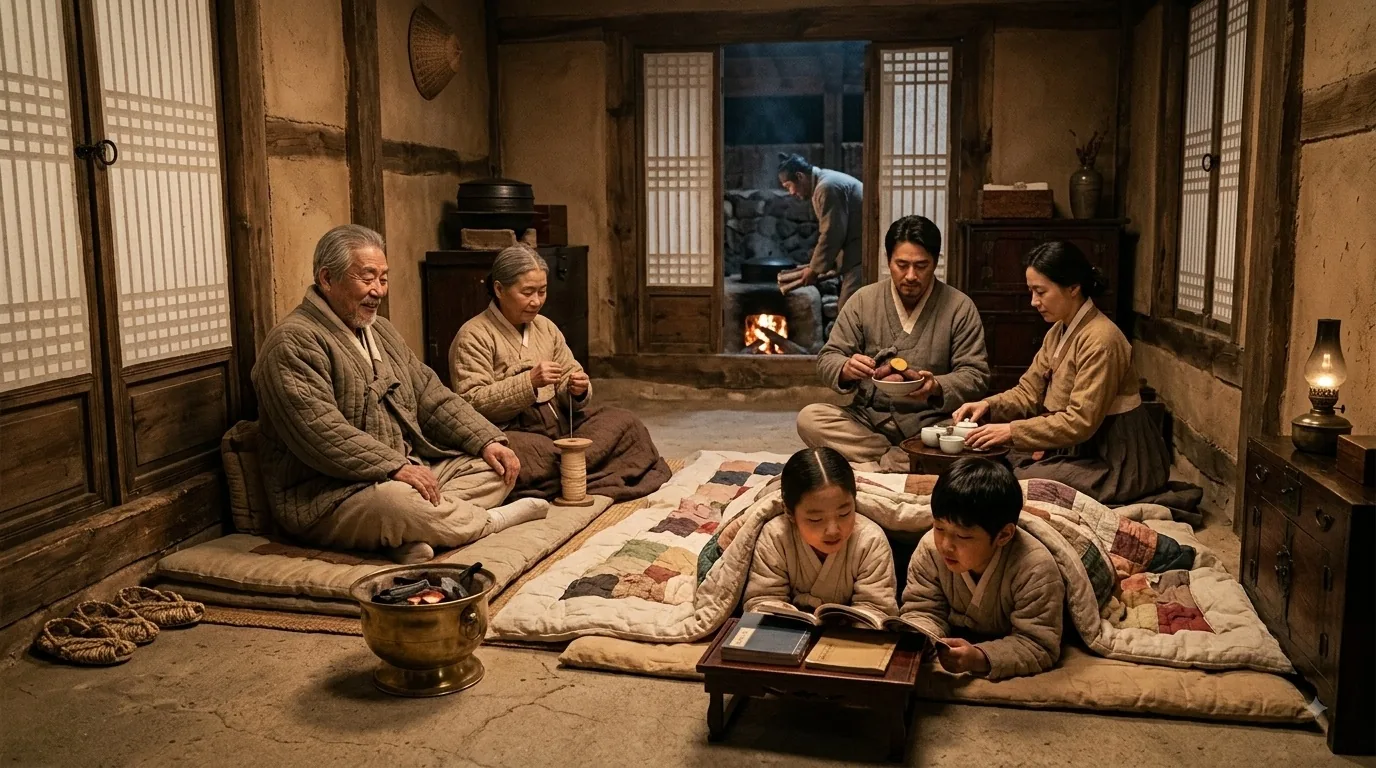 The fire is outside the room and under the floor. That arrangement is what shaped the posture. (AI illustration)
Once the floor is warm, people come down onto it. And once the floor is the surface of life, the whole house is redesigned around it.
Shoes come off. If the floor is where you sit and lie, footwear stops at the threshold.
Furniture drops. The meal table is carried in and lifted away; bedding is spread and folded up. The same room is a living room by day and a bedroom by night. One room doing several jobs is not a virtue of thrift — it is what follows from a floor you live on.
Seating acquires a rank. The areutmok (아랫목) is the stretch nearest the firebox, where the flame runs closest and the stone holds most heat. Giving it to the eldest became courtesy. The Korea Heritage Service puts it this way: “the warm areutmok becoming the seat of the senior person created a culture of courtesy that knows high from low in daily life.” The distribution of heat became the order of seating.
One caution, since the question is a fair one to ask: that source describes the custom but does not say when it is first attested. This article therefore does not date it. That it existed is documented; how far back it runs is not established here.
And the house acquires two floors, not one. This is the part most often left out of English accounts. A traditional Korean house pairs the heated ondol room with the maru (마루) — a raised wooden floor lifted off the ground so air moves beneath it. Urihistorynet, the National Institute of Korean History’s public reference, gives the pairing its own vocabulary: “in winter it was called uksil (燠室) and in summer yangcheong (凉廳) — ondol and maru coexisting.” A device for enduring cold and a device for enduring heat, under one roof. What they share is that both are floors you remove your shoes to step up onto.
That same page carries a detail that cuts directly against the picture of ondol as a technology of the powerful. In upper-class houses, it says, “an ondol room was usually built to just one or two bays, and here the elderly or the sick resided, while in the remaining space maru was laid and people slept, with folding screens and curtains set around.”
Read that slowly. In a high-status house, the heated room was for the old and the ill — and the rest of the household slept on the wooden maru behind screens.
And one more line from the same source, which unsettles the assumption underneath this whole topic: “looking at it historically, before ondol culture had fully settled, we can see that life on the maru was lived standing and seated above the floor.”
Sitting on the floor, in other words, is not the eternal Korean posture. It is something a heating technology produced.
1941: the colonial government made a film about it
There is a small, strange object in the record that shows how legible this had become from outside.
In 1941 the film unit of the Governor-General of Korea’s Document Section — a unit founded in 1920 — made a ten-minute munhwa yeonghwa (cultural film) titled simply Ondol. The Korean Movie Database entry states its purpose plainly: it was made “to introduce Korea’s ondol culture to Japan.”
The film was considered lost. It was found in 2019 in Gosfilmofond, the Russian state film archive, alongside another colonial-era title, and the Korean Film Archive released it publicly on 10 June 2021.
Two things are worth holding apart here. The first is what the film shows: by 1941 a heated floor was a thing a governing state thought needed explaining to the metropole — an ethnographic subject. The second is who was doing the explaining. A colonial administration filming the domestic habits of the colonised is not neutral documentation, and this article does not treat it as a disinterested record. What it does establish is the fact of the framing: ondol was, by then, something that could be presented as Korean culture to an outside audience.
(One caution on the details, since numbers drift: the archive listings give a running time of 10 minutes and a discovery year of 2019. Figures of “about 11 minutes” or a 2020 acquisition circulate in secondary summaries; we could not confirm either and use the archive figures.)
The Aja-bang, and how to read a number that means “a long time”
The most famous single ondol in Korea is at Chilbulsa temple in Hadong, in the south. The Aja-bang (아자방) — named for the shape of the Chinese character 亞, which its raised meditation platforms are said to form — was designated a provincial cultural heritage in 1976 and promoted to National Folklore Cultural Heritage on 22 December 2023. A 2017 excavation recovered Goryeo-period material at the site: roof-tile fragments, foundation stones, a mortar stone.
And then there is the number everyone repeats: that one firing kept it warm for a hundred days.
Here is how that number should be handled. The Digital Hadong Cultural Encyclopaedia does not present it as a measurement. It writes that once the fire was lit the room stayed warm “for a hundred days” — and then, in the same breath, gives an alternative: “or forty.” A Buddhist newspaper account frames it as “a story is told that the warmth lasts a hundred days.”
A figure that comes with a second figure attached, in a source that introduces it as something told, is a tradition, not a reading. The same applies to the temple’s founding story — a monk named Damgong building the room in the reign of King Hyogong (897–911) — which rests on the Chilbul Seonwon Sajeokgi, a temple chronicle compiled long afterwards.
None of which makes the Aja-bang less interesting. A room that people have wanted to tell that story about for centuries is telling you something real about what a heated floor meant. It is simply not telling you how long the fire lasted.
Drama vs. real history — what Minari shows and does not show
| In Minari | The record |
|---|---|
| The family’s floor is where they end up sleeping | There is no ondol in the trailer — no firebox, flues or capstones. The film shows the habit, not the installation |
| Grandmother Soon-ja sits and sleeps on the floor; the American-raised children do not | Half right, and the film itself corrects it. Soon-ja defaults to the floor and the children refuse it on the first night — but by the end the family is lying on the floor together. The split is a starting position, not a fixed trait, and the film’s framing is about this family rather than about Koreans in general |
| The floor is simply “the Korean way” | The fully heated room is late — generally late Goryeo — and full-floor heating spread most actively only in the 17th century |
| Floor life reads as timeless tradition | Urihistorynet describes life on the maru as lived above the floor before ondol culture settled |
Key terms. Ondol (온돌, 溫突) — Korean underfloor heating, and by extension the way of living it produced; designated National Intangible Cultural Heritage on 30 April 2018. Gudeul (구들) — the native Korean name for the same installation; the dol of 溫突 may itself transcribe that native word. Gorae (고래) — the flues carrying heat and smoke beneath the floor. Gudeuljang (구들장) — the flat capstones laid over the flues. Agungi (아궁이) — the firebox. Jjokgudeul (쪽구들) — early partial-floor heating warming only one side of a room. Areutmok (아랫목) — the floor nearest the firebox, hottest and by custom the senior seat. Maru (마루) — the raised, ventilated wooden floor; uksil (燠室) and yangcheong (凉廳) name the winter and summer halves of a house.
Rome heated floors too — and built a different way of living on them
Korea was not the only place that ran heat beneath a floor. Rome did it too, and the comparison is useful precisely because the two stories end differently.
The Roman hypocaust raised a floor on short pillars — pilae — leaving a cavity underneath. A furnace at one end, the praefurnium, pushed hot air and smoke through that cavity and often up through hollow wall tiles. Structurally the family resemblance to gudeul is close: a fire outside the room, a void beneath the floor, warmth arriving from below.
The differences are where it gets interesting.
Who it was for. The hypocaust is documented above all in public bath complexes and the villas of the wealthy. It was labour-intensive and expensive, and it is generally described as a luxury rather than an ordinary domestic standard. Set that against two Tang histories filing the Goguryeo long trench under what the poor did in winter. Two societies heated floors; the sources place them at opposite ends of the social scale.
What it heated it for. The hypocaust served bathing and comfort in rooms people moved through upright. It did not double as the kitchen fire, and it did not turn the floor into the surface where a household ate, slept and received guests. Ondol’s peculiarity is not that it warmed a floor. It is that in many traditional arrangements — and in the early jjokgudeul especially — the cooking fire and the heating fire could be the same fire, and that the warmed surface then became the furniture.
What became of it. In the West, hypocausts largely stopped being built into new houses as Roman power receded. Care is needed here, though, because the tidy version — “and then it was lost” — is not right: the technique continued in some monasteries, persisted in the Eastern Roman world, and was carried on in the hammam tradition. What did not continue in most of Western Europe was the everyday domestic habit of a heated floor. Heating there went on to organize itself around the hearth and the chimney, and around chairs.
Korea went the other way. The installation changed completely — today’s apartments run hot water through pipes, and the firebox, flues and chimney are gone — but the relationship to the floor stayed. The machine was replaced and the posture survived.
Which is a strange kind of durability. The most fragile-looking part of a technology, the bodily habit, turned out to be the part that lasted.
So why does the family in Minari sleep on the floor?
Now the opening scene reads differently.
There is no ondol in the Arkansas trailer. The floor is not warm. Nothing about that room rewards sitting on it.
And yet the film keeps arranging people on the floor anyway — the grandmother sleeping on it in the room she shares with her grandson while he has the bed, the two of them down at the same level in front of the television, cards between them. It is worth noticing what that shared level does. In a chair-and-sofa household, adults and children are placed on different furniture. On a floor, everyone sits on the same surface.
The film also stages the split without commentary. Soon-ja eats sitting on the floor; Jacob, the Korean American father, eats at the table. Same room, two heights, one generation apart.
Then the last stretch of the film. After the fire takes the barn and the family loses what it had been building, they lie down together on the floor, and the grandmother stays sitting, watching over them.
The reason that lands is not that they have returned to something ancestral. It is that on the first night, this exact arrangement was proposed and refused. They did not inherit the floor. They came down to it, once, after everything else had gone.
That is the honest version of what a technology leaves behind. The surviving record does not give us a tidy top-down story, or a tidy bottom-up one. The Tang histories attach the winter trench to the poor; later sources show heated rooms arriving unevenly across classes and regions, and even grand houses kept the heated room for the old and the sick while everyone else slept up on the wooden maru. It took until late Goryeo for a whole room to be warm, and a cold, war-torn 17th century for the practice to spread widely. Along the way it produced a set of habits that outlived the machine entirely.
But habits are not luggage. They do not travel by themselves. Someone has to keep choosing to sit there.
Coming up next
If the material history of ordinary Korean life interests you, two companion pieces run alongside this one. The yeontan briquette picks the story up in the 1980s, when the coal cylinder — not a wood fire — was what heated the ondol floor, and carried a lethal risk with it. The seokbinggo ice houses take the same question from the opposite direction: what a society builds, and legislates, to hold a temperature.
A separate piece will take up the comparison this article deliberately left alone — the Chinese kang, the Japanese kotatsu, and the sauna. Handled in a paragraph each, all three come out shallow; they deserve their own room.
Frequently asked questions
Is there an ondol in Minari? No. The family lives in a mobile home in rural Arkansas, and no traditional ondol installation appears in the film. That absence is the point: what the film shows is the way of living the heating produced, and what happens to it once the heat is gone.
When did ondol begin? It depends which stage you mean. The Encyclopedia of Korean Culture places the primitive flue-and-chimney form in the Early Iron Age, and the Korea Heritage Service dates the earliest partial-floor jjokgudeul to the 4th century BCE–1st century CE, attributing it to the Okjeo of southern Primorye. The fully heated room is far later — generally late Goryeo.
Do the Chinese histories record ondol? They record something, and its identity is disputed. Both Tang histories describe Goguryeo people making a winter “long trench” (長坑) with a fire beneath it, and both frame it as what the poor did. But the Korea Heritage Service states that the “gaeng” here means the Chinese kang bed-platform and “is not the concept of full-floor ondol.” This article does not translate 長坑 as “ondol.”
Was ondol a technology of kings? The record does not read that way. Both Tang histories attach the long trench to poverty, and Urihistorynet describes upper-class houses building only one or two ondol rooms — for the elderly and the sick — while the rest of the household slept on the raised wooden maru.
Why the 17th century? The Encyclopedia of Korean Culture names it as the most active period of ondol installation, giving the rebuilding after the Imjin War, the Injo coup, Yi Gwal’s revolt and the Qing invasion as the immediate occasion, but naming abnormal climate — persistent summer drought and winter cold — as the underlying cause. Quoting the wars alone would misstate it.
Why is the areutmok the seat of honor? It is the floor nearest the firebox, so it is the hottest. Giving it to the eldest became courtesy — the heat distribution became the seating order. The source describing the custom does not date it, so neither do we.
Does a traditional Korean house have a cold floor too? Yes. The heated ondol room and the raised, ventilated wooden maru coexist in one house — uksil (燠室) in winter, yangcheong (凉廳) in summer. Both are floors you take your shoes off to step up onto.
Do Korean apartments still have ondol? The principle continues, the machinery does not. Floors are heated by hot-water piping now; the firebox, flues and chimney are gone. Ondol culture was designated National Intangible Cultural Heritage on 30 April 2018 — and the designation covers the broader culture of ondol — the heating knowledge, the practices, the habits and the social norms — rather than one physical installation.
Sources & further reading
- The Tang histories on the long trench — Old Book of Tang, vol. 199a, Eastern Barbarians, Goguryeo: 其俗貧窶者多,冬月皆作長坑,下燃熅火以取暖. New Book of Tang, vol. 220, Eastern Barbarians, Goguryeo: 窶民盛冬作長坑,煴火以取暖. The Chinese text was cross-checked across two independent editions and against the National Institute of Korean History’s presentation; one widely circulated online edition carries a stray punctuation mark in the Old Book of Tang line.
- Against reading 長坑 as full-floor ondol — Korea Heritage Service, monthly heritage magazine, feature on ondol culture: the record “begins with the janggaeng recorded in the Goguryeo chapter of the Old Book of Tang,” but “here gaeng (坑) means the kang, the Chinese bed-type heating, and is not the concept of full-floor ondol.” The same feature calls the late-Goryeo dating of full-floor ondol the dominant view and attributes the earliest jjokgudeul to the Okjeo of southern Primorye, 4th century BCE–1st century CE.
- The developmental sequence, the 17th century, and the 2018 designation — Encyclopedia of Korean Culture, ‘Ondol culture’ (E0077489). Neolithic hearth → Bronze Age separation of hearth and cooking range → Early Iron Age flue-type gudeul and chimney; full-floor completion in late Goryeo; the 17th century as the most active installation period, with the wars as immediate occasion and abnormal climate as underlying cause; designation on 30 April 2018.
- A more reserved dating — Encyclopedia of Korean Culture, ‘Gudeul’ (E0005703), which places excavated full-floor gudeul at the Seonwonsa (Ganghwa) and Hoeamsa (Yangju) sites in the late Goryeo to early Joseon range and states that when full-floor gudeul began requires further research. This entry and the one above are not in agreement, and both are given here.
- Partial-floor heating — Encyclopedia of Korean Culture, ‘Jjokgudeul’ (E0068739): cooking and heating solved together; Proto-Three-Kingdoms pit dwellings at Pocheon Jajak-ri and Paju Juwol-ri; Early Iron Age pit dwellings with jjokgudeul in Jiandao and southern Primorye; and the statement that jjokgudeul reached Goguryeo from Bukokjeo rather than originating there.
- Ondol and maru in one house; the elite’s one or two heated rooms — National Institute of Korean History, Urihistorynet, ‘The maru, joining room to room’: uksil and yangcheong; upper-class houses building an ondol room to one or two bays for the elderly and the sick; and life on the maru lived above the floor before ondol culture settled.
- The areutmok as senior seat — Korea Heritage Service, monthly heritage magazine, feature on ondol and the areutmok. The feature does not date the custom.
- On “Korea’s own method” — the ondol culture entry does state that full-floor heating is Korea’s own way, and it is worth noting how narrowly it scopes that: the sentence comes immediately after acknowledging that northern China has the kang, which heats part of a floor. The gudeul entry makes a broader claim. Because a claim of global uniqueness would require checking every case worldwide, this article reports what the entries say rather than asserting it.
- The Roman hypocaust — general archaeological and encyclopaedic literature on pilae stacks, the praefurnium, and the concentration of hypocausts in bath complexes and elite villas, together with their uneven later survival in monasteries, the Eastern Roman world and the hammam tradition. Cited as general scholarship; no single monograph was collated for this article.
- Minari — Jacob’s first-night line is quoted from the published screenplay by Lee Isaac Chung as reproduced in reporting on the script. Other scene details are drawn from film-criticism and synopsis sources. The film was not re-screened shot by shot for this article, and these descriptions are presented on that basis.
This article was researched and written by K-Drama History. Source: Minari, Explained: Why the Family Sleeps on the Floor — and What Ondol Has to Do With It — K-Drama History