The Ming Commanders Who Fought From Korean Ships — Noryang, Yi Sun-sin's Last Battle, Explained
From the research behind Pause the Drama.
In Noryang: Deadly Sea (노량: 죽음의 바다), the conflict the film puts up front is stated plainly in its own synopsis: the Ming naval commander Chen Lin (陳璘, Korean reading Jin Rin), swayed by Japanese overtures, moves to open an escape route, and Yi Sun-sin (이순신) moves to close it. One commander wants the war finished. The other wants the enemy struck to the end.
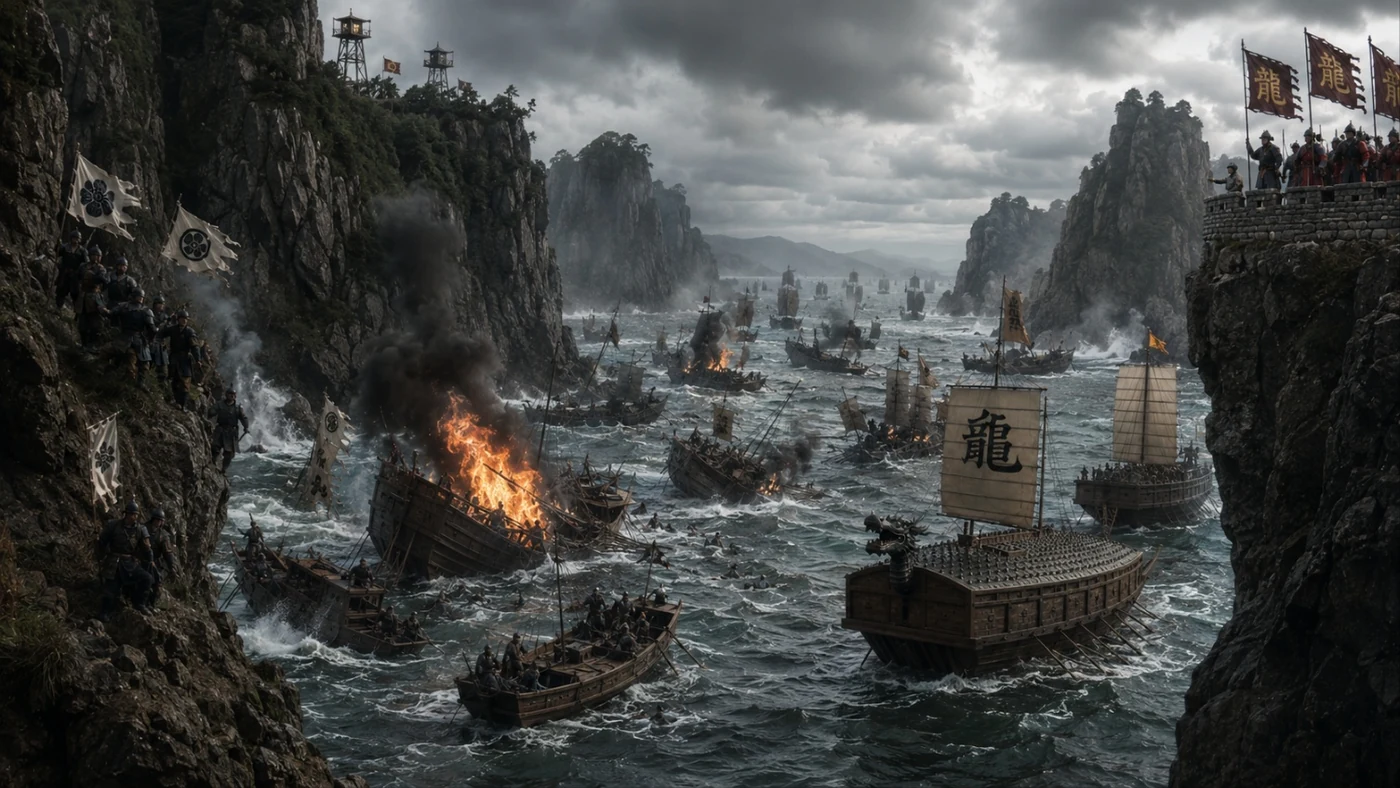
Follow the film toward Yi’s death and it is easy to miss what the fleet around him was made of. The sea at Noryang did not hold the Joseon navy alone. The Ming navy was there too — and not merely alongside.
The Ming deputy commander Deng Zilong (鄧子龍, Korean reading Deung Ja-ryong) was killed at Noryang. After the battle, a Joseon naval commander reported to the court that he had seen Chen Lin with his own eyes, fighting hard on the deck of a Joseon panokseon (판옥선, 板屋船) — the board-roofed warship, with an added deck built over the hull, that was the backbone of the Joseon fleet.
So whose battle was Yi Sun-sin’s last battle?
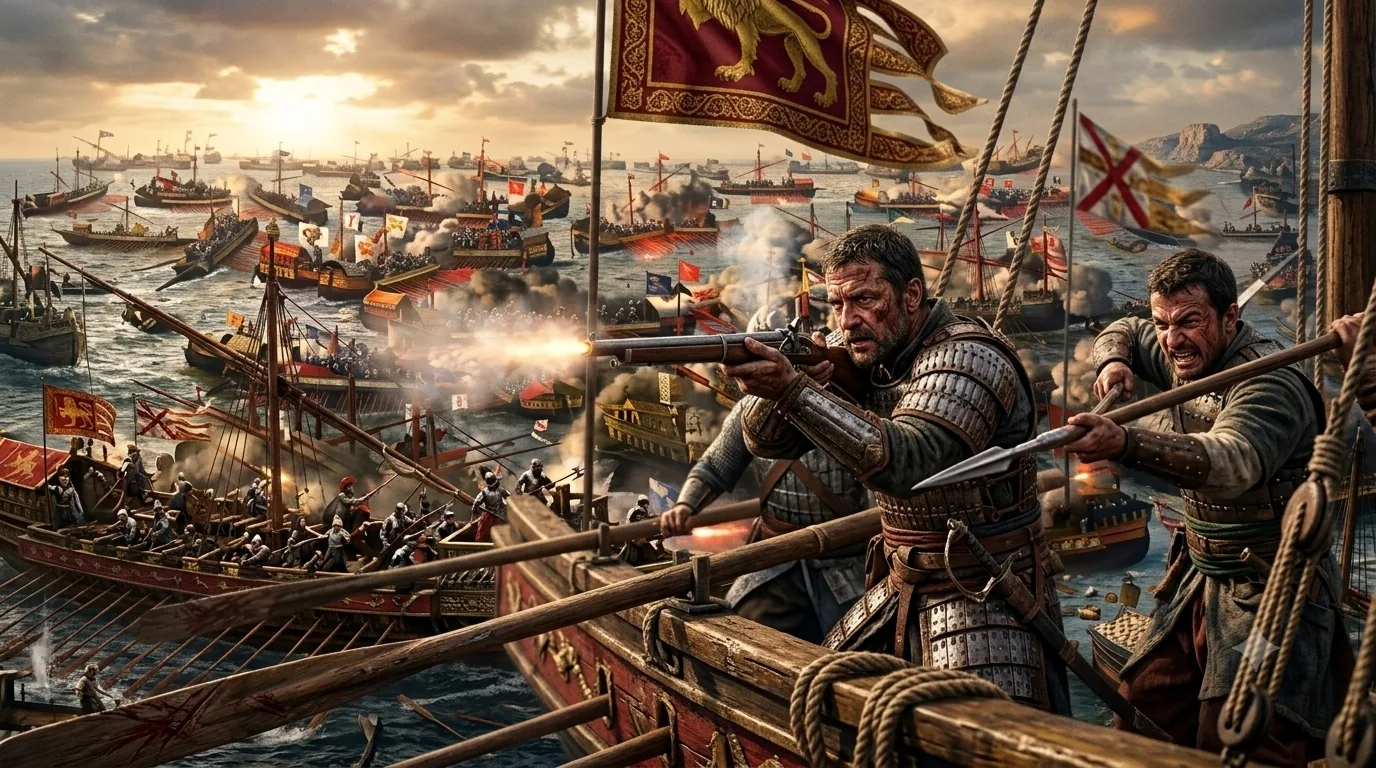
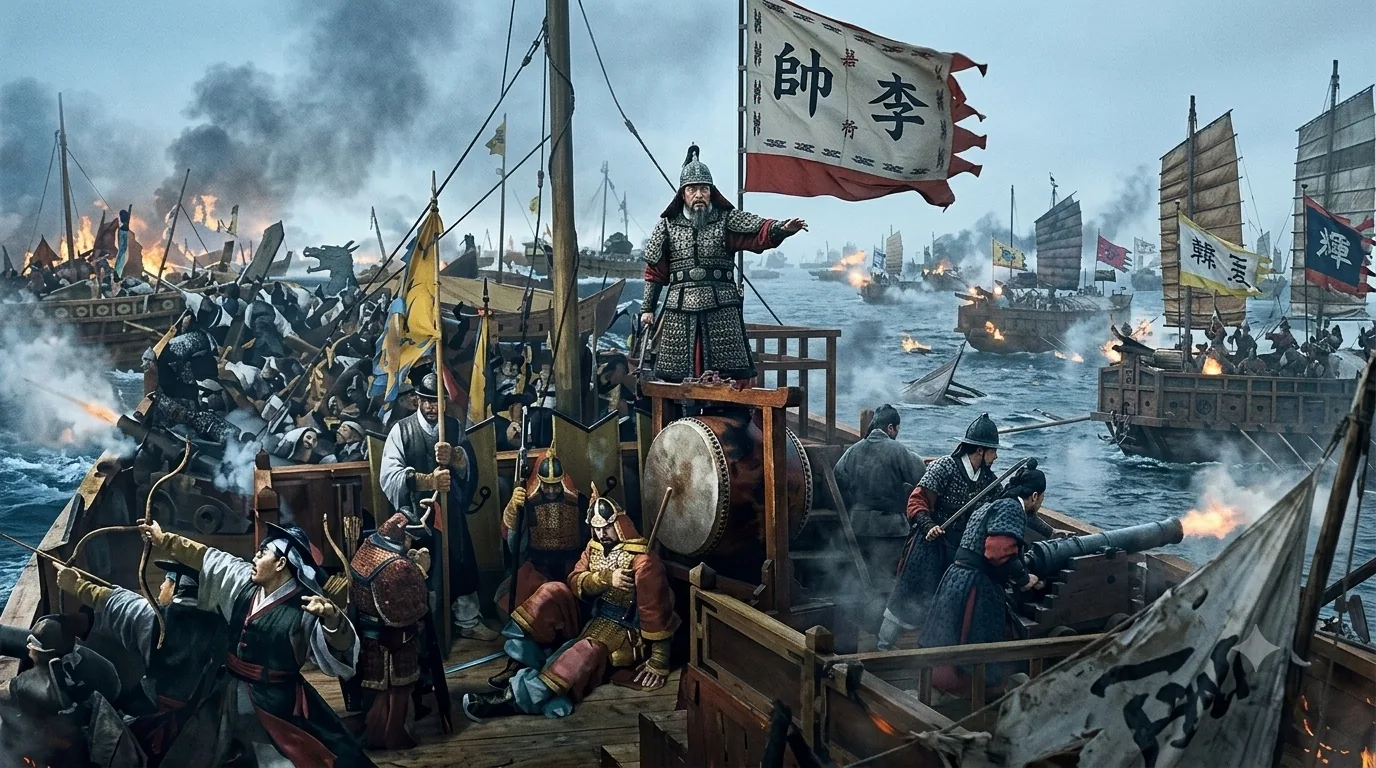 A Joseon flagship in the smoke of Noryang. Note the dragon-headed vessels in the background — the popular image of any Yi Sun-sin battle. As the records below show, a turtle ship at Noryang cannot be confirmed. (AI illustration)
Quick answer: Yes. Joseon records say Ming commanders fought aboard Korean panokseon — the board-roofed warship that was the Joseon navy’s line-of-battle vessel — at Noryang, the 19th day of the eleventh lunar month, 1598, and Yi Sun-sin’s last battle. The Seonjo Sillok (『선조실록』) names Chen Lin (陳璘), the Ming naval commander-in-chief, and his deputy Deng Zilong (鄧子龍); Shin Heum’s Sangchonjip (『상촌집』) says Chen “switched to one of our country’s ships” during the fighting and that two more Ming officers did the same. The sources collated here do not establish that Deng Zilong was still aboard a Korean hull when he was killed.
What the records disagree about: how the fleet sailed. One account says Chen consented after Yi wept and pressed him; one says Yi sailed without consent and Chen followed; one records no dispute at all. And the interception was not a seal — of some 300 Japanese ships about 200 were destroyed, roughly 100 escaped toward Namhae, and Konishi Yukinaga got away.
Let’s unpack it.
The film’s quarrel, and the fleet behind it
The publicly released synopsis of Noryang: Deadly Sea sets the axis clearly: Chen Lin, moved by Japanese bribery, would let the enemy withdraw; Yi would not (Cine21 film information). It is a clean dramatic structure — two judgments about how a war should end, colliding.
The records are less clean, and more interesting. They show the two rivals fighting in the same joint fleet — and Chen Lin doing so from a Korean deck.
That is the claim this article is built on, so it is worth stating its evidentiary weight before going further.
Speaking at court under the second day of the second lunar month of Seonjo’s 32nd year, Yi Deok-hyeong (이덕형) gave the king this account: Yi Sun-sin told Chen Lin he would go out and intercept; Chen did not permit it; Yi went anyway, blowing the horn and moving his ships, and Chen “had no choice but to follow.” Then the detail that matters here — the Chinese ships were small-hulled and in the rear, so they showed only the appearance of force, and “Deng Zilong and Chen Lin, the two of them, went aboard panokseon and fought” (Seonjo Sillok, Seonjo 32/2/2, article 3). In that telling the contrast is explicit: the smaller Ming hulls stayed to the rear and showed only the appearance of force, while Chen and Deng went forward aboard panokseon. The report does not say why they did it, and this article will not supply the reason.
A separate entry, under the 22nd day of the twelfth lunar month of Seonjo’s 31st year, carries the eyewitness statement of Yi Sun-sin (李純信), Right Naval Commander of Gyeongsang Province, who reported that he personally saw Commander Chen fighting hard aboard a Joseon panokseon (Seonjo Sillok, Seonjo 31/12/22, article 1).
And there is a third line of evidence, from outside the Sillok. Shin Heum (신흠, 1566–1628), a senior official and writer of the same generation, left an account of the Ming expeditionary forces in his collected works, the Sangchonjip (『상촌집』). Of the fighting at Gwaneumpo it says:
「賊圍李舜臣船累重。都督換乘我國舡。犯圍直入救之。… 王元周,福日昇二將亦換我舡挾都督舡。」
“The enemy encircled Yi Sun-sin’s ship many rings deep. The Commander switched to one of our country’s ships, drove into the ring and went straight in to rescue him. … Two more officers, Wang Yuanzhou and Fu Risheng, also changed to our ships and flanked the Commander’s ship.” (『상촌고』 권38, 天朝先後出兵來援志)
So for Chen Lin, two different kinds of text say the same thing: the court records, and a private literary collection. Shin Heum adds two more names doing the same. A caution on how much weight that carries: Shin Heum (1566–1628) was a serving official of the same period, so this article does not claim the two accounts are textually independent of one another — it has not traced where the Sangchonjip got its material. What it claims is narrower: the statement is not confined to a single entry in a single source.
For Deng Zilong the record is thinner, and it is worth being exact about what each source does and does not say.
The Sillok says he boarded a panokseon and fought. It does not say where he was when he was killed. The Sangchonjip, in the same passage, says: 「鄧子龍船中火起。一軍避火驚擾。賊乘之殺子龍。燒其船。」 — fire broke out in Deng Zilong’s ship; his men panicked avoiding the flames; the enemy seized the moment, killed Zilong and burned that ship. It calls the vessel simply 「his ship」 and does not say whose hull it was.
The Ming official history, in the portion collated here, is no more specific. The Ming History biography of Deng Zilong, preserved in the Korean Complete Works of Yi Chungmugong, runs, in full as that excerpt preserves it: 「朝鮮用師。詔以故官領水軍。從陳璘東征。倭將渡海遁。璘遣子龍。偕朝鮮統制使李舜臣督水軍千人。駕三巨艦爲前鋒。邀之釜山,南海。」 — Chen Lin sent Zilong, who together with the Joseon Commander-in-Chief Yi Sun-sin led a thousand marines and rode three great ships as the vanguard (『이충무공전서』 권13, 「明史鄧子龍傳」). Three great ships — the text does not say whose. That excerpt ends there, at the vanguard’s interception off Busan and Namhae; the fuller Ming History biography was not collated here, so this article says nothing about what it contains.
So this article does not assert a conflict, and it does not resolve one. It records what is there: Deng Zilong boarded a panokseon and fought, and he was killed at Noryang; the ship that burned under him is named only as his ship, and no source collated here identifies its build.
One more thing about the plural in this article’s title. It does not hang on Deng alone. The Sillok puts two men on panokseon — Deng and Chen. The Sangchonjip puts three on Korean hulls — Chen, Wang Yuanzhou and Fu Risheng. In both, more than one Ming officer is fighting from a Korean deck.
One more precision, because English-language searching will otherwise produce a collision: the officer who filed that eyewitness report, Yi Sun-sin (李純信), and the Commander-in-Chief of the Three Provinces’ Navy who died at Noryang, Yi Sun-sin (李舜臣), are two different men whose names are written identically in Korean script and differently in Chinese characters.
How big were the two fleets — and why the ship count misleads
Lee Jong-hwa and Yun Heon-sik, in a 2023 article in the Korean military-history journal Gunsa (군사), estimate the Joseon force at roughly 70 panokseon and the Ming force at roughly 300 warships (Lee & Yun, Gunsa no. 126, 2023, pp. 81–115).
On those numbers the Ming brought far more hulls. But hull counts cannot be read as shares of the fighting, because the two navies were not built the same way. The same study describes the usual complement of the Ming shachuan (사선, 沙船) and haochuan (호선, 唬船) as around 30 to 40 men, against 125 to 140 for a Joseon panokseon. These are typical figures for vessel types, not a verified muster roll of the ships present at Noryang.
The “roughly 300” is worth one more sentence of caution. It is not an independently preserved ship list. It is a reconstruction: a vessel count estimated in proportion to troop strength, adjusted with other units’ ship records and combat losses. What these numbers establish is that the two fleets differed in scale and in composition — not a ratio of contribution.
| Joseon navy | Ming navy | |
|---|---|---|
| Estimated ships | c. 70 panokseon | c. 300 warships (reconstructed from troop estimates) |
| Typical complement per ship | 125–140 (panokseon) | 30–40 (shachuan, haochuan) |
| Estimated personnel | c. 10,000 | c. 13,000 (Lee & Yun) |
In short: the Ming brought more hulls and the Joseon ships carried more men per hull, which is exactly why neither figure settles who did how much of the fighting.
From thirteen ships to seventy
To see the joint fleet at Noryang, it helps to remember what the Joseon navy had been fourteen months earlier. At Myeongnyang in 1597 it fought with thirteen warships (our companion piece on Myeongnyang works through that battle). At Noryang it sailed with roughly seventy. The rebuilding in between is part of this story.
That rebuilding included feeding the fleet. A historiographer’s commentary in the Seonjo Sillok summarizes Yi’s administration in a line of classical Chinese: 「收合餘卒, 措備器械, 廣開屯田, 販賣魚鹽, 軍餉有裕」 — he gathered up the remaining soldiers, prepared weapons and equipment, opened military colony farms (둔전, 屯田) widely, sold fish and salt (어염, 魚鹽), and made the army’s provisions ample. The commentary continues: 「不數月, 軍聲大振, 有虎豹在山之勢」 — within a few months the army’s name resounded, and it had the aspect of tigers and leopards in the mountains (Seonjo Sillok, Seonjo 31/11/27, article 5).
One caution about reading that passage as a timeline: the same commentary earlier describes Yi as having first arrived at Hansan, so it cannot be treated as a precise chronology of where he moved and rebuilt after Myeongnyang. What it does show is which activities the historiographer thought worth recording — gathering troops, repairing equipment, securing provisions.
Lee and Yun also cite the Jingbirok (『징비록』, book 2) for Yi stationing some 8,000 troops at Gogeumdo (古今島) and issuing sea-passage permits to cope with provisioning shortfalls. That detail reaches this article through their study; the original passage was not collated here.
Ming troop strength is where the studies diverge. Lee and Yun estimate the Ming naval force at Noryang at around 13,000. Park Hyeon-gyu, reviewing troop records from the earlier Waegyoseong (왜교성) campaign, concludes the scale would not have changed greatly by Noryang (Park, Gunsa no. 133, 2024, pp. 171–201). The record underlying that reading — the entry for the 12th day of the tenth lunar month of Seonjo’s 31st year — gives the Ming naval force as 19,400 men (Seonjo Sillok, Seonjo 31/10/12, article 7). That figure belongs to the Waegyoseong stage of the campaign, and cannot be carried over as the number actually present on the day at Noryang.
So the two studies’ numbers should not be merged, and neither should be used as a muster roll. Which phase of the campaign is being counted, which forces are included, and what estimating method the researcher applied all have to be read together.
Two Ming commanders who arrived by reassignment
Both Ming commanders reached Korean waters through a chain of substitutions rather than by original design.
According to Park Hyeon-gyu, Chen Lin was moving overland at the head of Guangdong land troops when Yang Wen (楊文), the officer designated as naval deputy, fell ill and could not take up the post. Chen inherited it and came to oversee the Ming naval forces dispatched to Korea. Deng Zilong took over the Zhejiang naval force from Shen Mao (沈茂), who had moved to a land command. That reassignment does not imply Deng lacked sea experience; the same study sets out his record in naval warfare.
Park’s article also cites the Imjin Pillok (『임진필록』) describing Deng as aged, unsteady in his hands and feet, and hard of hearing. That is how one text portrays an old commander, reaching this article as a citation through Park’s study; it is not a medical assessment and should not be read as one.
Park further raises the possibility of friction and mutual checking between Chen and Deng, while also reading Chen as having trusted Yi Sun-sin. Both can sit in the same study without contradiction, and the useful conclusion is the plain one: the relationships among these commanders do not reduce to a single attitude.
The sortie: wept for, or sailed without
Here the records genuinely disagree, and the disagreement is more informative than either version alone.
The historiographer’s commentary under Seonjo 31/11/27 reports that four Japanese had gone out by boat, that Yi judged they had gone to request relief forces, and that with four days elapsed a large enemy force would soon arrive — so it would succeed to sail out and meet them first. Then comes the line: 「陳璘初則不許, 舜臣涕泣固請, 璘乃許之」 — Chen at first did not permit it; Yi wept and pressed the request; Chen then permitted it. Read alone, the sortie happens because Yi begged for it.
The second account is different. In Yi Deok-hyeong’s report under Seonjo 32/2/2, Yi sailed although Chen had not given permission, and Chen followed.
And there is a third account, in which there is no dispute at all. Shin Heum’s Sangchonjip simply has: 「十九日夜。賊船見於南海。李舜臣告都督。都督與季金前行。諸將繼之。舜臣先導。」 — on the night of the 19th, enemy ships were sighted off Namhae; Yi Sun-sin informed the Commander; the Commander went ahead with Ji Jin, the other officers followed, and Yi led the way. No refusal, no weeping, no unauthorized departure.
Three accounts, then. The first two meet on the important point — Yi argued for going out to meet the enemy, and Chen initially refused — and part on what followed: consent and a joint departure, or a departure and a pursuit. The third does not record the friction at all. The tearful plea should therefore be attributed to that one commentary, and not made either the settled account of the sortie or a description of the alliance’s formal chain of command.
The same commentary contains another line worth noting: 「陸兵則觀望不進」 — the land forces looked on and would not advance. The entry does not attach a nationality to those land forces, and the siege it refers to (Waegyoseong) had Joseon troops in the line as well. But the same records point at who was deciding. In the very report quoted above, Yi Deok-hyeong says he sent word urging an attack 「請於劉提督」 — to Commander Liu Ting — and that 「劉竟不從矣」, Liu in the end would not comply. Shin Heum’s account runs parallel: 「過午陸兵不進」, 「而陸兵又不至」, and finally 「而提督已撤陸兵矣」 — the Commander had already withdrawn the land forces. So the records name Liu Ting as the commander who declined to attack and then pulled his troops out — but none of them says that the 「陸兵」 of the commentary line is his western army. That identification is this article’s reading, not the Sillok’s wording.
A joint operation, in other words, contained more than the moments when everyone attacked together. It also contained arguments about when and where to go.
What the battle did, and what it did not
The dispatch entered under Seonjo 31/11/27 gives the result. The entry opens 「左議政 李德馨 馳啓曰」 — the Left State Councillor Yi Deok-hyeong reported by express dispatch — which is where this article’s description of his office comes from. The title is exact, and the Sillok dates it: seven weeks earlier, under Seonjo 31/10/8, the appointments entry reads 「以李恒福爲右議政, 李元翼爲領議政, 李德馨爲左議政」 — Yi Hang-bok made Right State Councillor, Yi Won-ik Chief State Councillor and Yi Deok-hyeong Left State Councillor (Seonjo 31/10/8, art. 8) — and the entries of the following month go on calling him 「左議政 李德馨」 (Seonjo 31/11/2, art. 4). Some 300 enemy ships from Sacheon, Namhae and Goseong reached Noryangdo; Yi led the navy out to meet them, and 「天兵亦合勢進戰」 — the Ming troops likewise joined forces and advanced into battle. (The battle narrative below is from the dispatch itself; the historiographer’s commentary quoted earlier in this article is a separate layer appended to the same entry.)
By that report, about 200 Japanese vessels were broken. Yi Sun-sin was killed by gunshot, along with Yi Yeong-nam, Bang Deok-ryong, Go Deuk-jang and others — ten men in all. About 100 surviving enemy ships fled toward Namhae, and Konishi Yukinaga, seeing the Japanese fleet shattered, slipped away into open water.
Noryang was a heavy blow struck by a joint fleet. It was not a battle that stopped every Japanese ship, and the commander the operation was meant to trap escaped. Those two sentences belong together; either one alone is a distortion.
Where the last words came from
Any account of Yi Sun-sin’s death arrives sooner or later at the sentence about not announcing it.
It is worth being exact about where that sentence comes from. The Seonjo Sillok commentary of Seonjo 31/11/27 does not contain it. What that entry records is that Yi was shooting his bow himself when an enemy musket ball struck his chest and he fell, and that Yi Mun-uk (李文彧) — the name as that entry writes it — silenced the weeping, covered the body with a robe, and beat the drum to press the attack.
Three different records name three different people for that moment, and an English-language reader searching for this will run into all three:
| Source | Name | What it says |
|---|---|---|
| Seonjo Sillok 31/11/27, historiographer’s commentary | Yi Mun-uk (李文彧) — read by modern scholarship as the same man as the next row | stopped the weeping, covered the body, beat the drum and advanced |
| Seonjo Sillok 31/12/18, dispatch of Field Marshal Gwon Yul | Son Mun-uk (孫文彧) | “climbed onto the panokseon deck himself, surveyed the enemy and directed the fighting” |
| Seonjo Sujeong Sillok 31/11 — a revised annal compiled in 1657, decades after the events | Yi Wan (李莞), Yi’s nephew | concealed the death and pressed the attack |
The first two rows are read as one man. Modern scholarship identifies Yi Mun-uk and Son Mun-uk as the same person and accounts for the two surnames through his years as a captive in Japan; Jae Jang-myeong’s study of the circumstances of Yi Sun-sin’s death uses the Son Mun-uk form throughout (Gunsa no. 78, 2011, pp. 33–70). That identification is reported here as the scholarship’s: this article did not open the record of the name change itself, so it does not present the two spellings as a single documented act. What the Sillok does supply is the difference in weight between the two entries — 11/27 is a historiographer’s commentary appended later, while 12/18 is a field marshal’s official dispatch. The Sujeong Sillok’s Yi Wan is a separate tradition, from a revised annal compiled six decades after the battle. So the question of who covered the death and kept the fleet fighting is itself split by layer of transmission, not settled by one of them.
The famous last words come down through the Jingbirok and the Haengnok of Yi Bun, and are cited here through modern scholarship rather than from those originals, which were not collated directly (Jae Jang-myeong, Gunsa no. 78, 2011, pp. 33–70). The widely circulated Korean sentence should not be fixed as the wording spoken that day.
The end of the same commentary carries another line: 「人皆謂死舜臣破生倭」 — everyone said that the dead Sun-sin had broken the living Japanese. That sentence belongs to the historiographer’s commentary, not to the body of Yi Deok-hyeong’s dispatch. The commentary also describes people grieving the death. Perhaps it is because the death landed on contemporaries as that kind of shock that both this line and the later tradition of the last words were preserved at all.
There is also a story that Yi removed his armor and chose to die. Jae Jang-myeong examines the suicide theory and argues it is difficult to accept, and this article does not treat it as established fact. A later text’s interpretation and the actual circumstances of a death in battle are not the same object.
Multinational fleets: Noryang beside Lepanto and Surigao
One way to see what kind of battle Noryang was is to set it beside other battles where fleets of different states fought in one action. The comparison is only useful if the categories are kept apart: how an alliance was formed, how operations were commanded, and what the fighting technology was are three different questions.
 Lepanto, 1571 — a Holy League fleet drawn from several states. A formal alliance did not mean identical interests. (AI illustration)
Lepanto (1571). Fought in the Mediterranean 27 years before Noryang, with a Holy League fleet including Spain, Venice and the Papal States facing an Ottoman fleet. That several polities fought a common action is the comparable part. But a formal alliance did not make the participants’ interests identical, and the setting and geography were unlike Noryang’s (Magdalena de Pazzis Pi Corrales, “La Santa Liga y las diferentes razones para formarla,” Revista General de Marina, Aug.–Sep. 2021).
Surigao Strait (1944). Late in the Pacific War, Allied forces intercepted a Japanese fleet attempting to pass through a strait, at night. The operational shape — meeting an enemy at a chokepoint — invites comparison with Noryang. The technology does not: this was a radar-and-torpedo action, and the tactics cannot be equated (Samuel Eliot Morison, “The Battle of Surigao Strait,” Proceedings, December 1958).
Noryang (1598). Two states’ navies fought a common action — and how they coordinated the decision to sail, and the sailing itself, has to be read out of the records separately. A record of consent sought and a record of a departure followed cannot together be made into a description of a formal command structure.
The useful question across the three is not which ally was more reliable. It is how differently constituted forces moved under what command and whose judgment, and how that common action actually took shape on the day.
Drama vs. history
| In the film, and in the popular image around it | In the records |
|---|---|
| The synopsis puts Chen Lin, swayed by Japanese overtures, moving to open an escape route against Yi’s opposition | The bribery framing is the film’s dramatic premise. A related tradition exists: the Imjin Pillok, cited through Park Hyeon-gyu’s study, records Chen receiving gold, silver and silk from Konishi’s side. The Seonjo Sillok also records Chen refusing a demand from Liu Ting to open a withdrawal route (終不許之, Seonjo 32/2/2). Neither settles the other |
| The conflict of judgment between Yi and Chen is the film’s central axis | The records do show a real difference of judgment about the sortie — and they disagree with each other about how it was resolved (consent after a tearful plea, or a departure that Chen followed) |
| Yi Sun-sin’s death is the emotional center | The Veritable Records entry has Yi struck in the chest while shooting his bow, the body covered, and the drum beaten to continue the attack. The famous last words are not in that entry |
| A last battle understood as Yi’s alone — the popular image rather than the film’s own framing, which keeps Chen Lin beside him | Ming officers fought from Korean hulls — the Sillok names two of them, the Sangchonjip three, and Chen Lin appears in both. Deng Zilong boarded a panokseon and was killed at Noryang; no source collated here names the hull he fell on |
In short: the film’s quarrel is not invented, but the records that preserve that quarrel also preserve Ming officers standing on Korean decks — and they do not agree with each other about how the fleet came to sail.
Back to the film’s quarrel
Noryang: Deadly Sea leads with the opposition between Chen Lin and Yi Sun-sin, and that structure concentrates attention on Yi’s decision.
Follow the records instead and the joint action behind that quarrel comes into view. A Joseon naval commander reported seeing Chen Lin fighting hard on a Joseon panokseon, and a private account written outside the court says the same of him — that he changed ships to break a ring around Yi’s flagship, and that two more Ming officers changed ships to screen him. The Ming deputy commander Deng Zilong boarded a panokseon and lost his life at Noryang, on a ship that none of the records collated here identifies by build.
How they came to sail is told three ways, and there is no need to fuse them into one dramatic account. What can be said is narrower and, read slowly, stranger than the film’s premise: the commanders’ judgments did not always agree, and on the Korean decks of that last battle, officers of two states were standing together.
Understanding Yi Sun-sin’s end turns out to involve looking at the people who fought beside him.
Frequently asked questions
Is the film Noryang: Deadly Sea based on a true story? It is built on the Battle of Noryang of the 19th day of the eleventh lunar month, 1598. The deaths of Yi Sun-sin and Deng Zilong, the joint Joseon–Ming participation, and Konishi Yukinaga’s escape are all recorded. Individual lines and the order of events in the film are another matter; this article verified the film only at the level of its released synopsis and cast information.
Did Ming commanders really fight from Korean ships at Noryang? For Chen Lin, two different kinds of text say so - the court annals and a private collection. Shin Heum was a serving official of the same period, so this article does not claim the two are textually independent of each other; what it claims is only that the statement is not confined to a single entry in a single source. Yi Deok-hyeong told the king under Seonjo 32/2/2 that the Chinese hulls were small and in the rear and that Deng Zilong and Chen Lin went aboard panokseon and fought; the Gyeongsang Right Naval Commander Yi Sun-sin (李純信) reported seeing Chen fighting hard on a Joseon panokseon; and Shin Heum’s Sangchonjip, outside the court records entirely, says Chen “switched to one of our country’s ships” and that two more Ming officers did the same. Deng Zilong is where the record thins out — the Sillok has him boarding a panokseon and fighting but does not say where he fell, and the Sangchonjip calls the vessel that burned under him only “his ship.”
Did Chen Lin really take a bribe and try to let the Japanese go? It is a dramatic premise with a related textual tradition behind it. The Imjin Pillok, cited through Park Hyeon-gyu’s study, records Chen receiving gold, silver and silk from Konishi’s side. Separately, the Seonjo Sillok records Chen refusing a demand from Liu Ting’s side to open a withdrawal route: under Seonjo 32/2/2 Yi Deok-hyeong tells the king 「劉遣吳宗道, 請於陳璘, 開途出賊, 陳璘大責吳宗道, 終不許之云矣」 — Liu sent Wu Zongdao to ask Chen to open a route and let the enemy out; Chen rebuked Wu Zongdao severely and in the end would not allow it (Seonjo 32/2/2, art. 3). Whether a gift and a refusal belong to the same moment and the same act has to be established before either is used, so this article neither confirms nor denies the bribery.
Was Deng Zilong a real person, and how did he end up in Korean waters? He was a real Ming deputy commander. Park Hyeon-gyu’s study explains how he took over Shen Mao’s Zhejiang naval force — after Shen transferred to a land command — and joined the campaign in Korean waters, and it also sets out his earlier record at sea. That he went aboard a panokseon and fought is recorded in the Seonjo Sillok; the Sillok does not say where he fell, and no source collated here names the hull he was on when he died.
Did Yi Sun-sin need Chen Lin’s permission to sail, and did he get it? The records disagree and this article does not choose between them. The commentary under Seonjo 31/11/27 says Chen refused at first and consented after Yi wept and pressed him; Yi Deok-hyeong’s account under Seonjo 32/2/2 says Yi sailed without permission and Chen followed; Shin Heum’s Sangchonjip records no dispute at all. The first two agree that Yi pushed for the sortie and that Chen initially refused.
Did Noryang end the Imjin War, and did any Japanese ships escape? The Japanese withdrawal was already under way following Toyotomi Hideyoshi’s death, so Noryang was the last large naval battle fought in the course of that withdrawal, not the battle that created the decision to withdraw. And the interception was not complete: by Yi Deok-hyeong’s report about 100 surviving ships fled toward Namhae and Konishi Yukinaga escaped to open water.
Is “Do not announce my death” an authentic last testament? The line is transmitted through the Jingbirok and Yi Bun’s Haengnok, and is cited here through modern scholarship rather than from a direct collation of those originals. The Seonjo Sillok commentary for Seonjo 31/11/27 instead records the body being covered and the fighting continued. The sentence as known today should not be fixed as the exact wording.
Was there a turtle ship at Noryang, and did Yi choose his own death? Neither is established by the material used here. Lee and Yun reconstruct the Joseon force around roughly 70 panokseon, and not being able to confirm a turtle ship is also not a basis for asserting there was none. (On how little is securely known about the vessel itself, see our piece on the turtle ship’s missing blueprint.) On the suicide theory, a study examining it argues it is hard to accept, and a later text’s interpretation cannot determine what a man intended at the moment he was hit.
Sources & further reading. Seonjo Sillok: Seonjo 31/10/8, art. 8 (Yi Deok-hyeong appointed Left State Councillor) · Seonjo 31/11/2, art. 4 (「左議政 李德馨」 three weeks before the battle) · Seonjo 31/11/27, art. 5 (Left State Councillor Yi Deok-hyeong’s dispatch, with the historiographer’s commentary appended as a separate layer) · Seonjo 31/12/22, art. 1 (Yi Sun-sin 李純信 on Chen Lin aboard a panokseon) · Seonjo 31/10/12, art. 7 (19,400 Ming naval troops at the Waegyoseong stage) · Seonjo 32/2/2, art. 3 (the sortie; the small Chinese hulls in the rear; Chen and Deng aboard panokseon; Yi Deok-hyeong’s request to Commander Liu Ting and Liu’s refusal) · Seonjo 31/12/18, art. 4 (Gwon Yul’s dispatch naming Son Mun-uk on the panokseon deck) · Seonjo Sujeong Sillok: Seonjo 31/11 (the version naming Yi Wan). Shin Heum, Sangchongo book 38, “Record of the Ming relief expeditions” — Institute for the Translation of Korean Classics (Chen Lin switching to a Korean ship; Wang Yuanzhou and Fu Risheng doing the same; fire in Deng Zilong’s ship; no dispute over the sortie; the land forces that would not advance). Scholarship: Lee Jong-hwa & Yun Heon-sik, “The Size of the Joseon–Ming Allied Navy at the Battle of Noryang,” Gunsa 126 (2023), 81–115 · Park Hyeon-gyu, “The Ming Navy’s Participation and Commanders in the Jeongyu War,” Gunsa 133 (2024), 171–201 · Jae Jang-myeong, “A Study of the Battle of Noryang and the Circumstances of Yi Sun-sin’s Death,” Gunsa 78 (2011), 33–70. The Jingbirok, Yi Bun’s Haengnok and the Imjin Pillok are cited through these studies and were not collated from the originals. Ming official history: the Ming History biography of Deng Zilong as preserved in 『이충무공전서』 권13. Comparative material: Pi Corrales (2021) on the Holy League; Morison (1958) on Surigao Strait. Film information: Cine21.
This article was researched and written by K-Drama History. Source: The Ming Commanders Who Fought From Korean Ships — Noryang, Yi Sun-sin's Last Battle, Explained — K-Drama History