Nongae, Explained: Did a Gisaeng Really Pull a Japanese Commander to His Death at Jinju?
Theme: Women’s Lives
From the research behind Pause the Drama.
Sageuk about the Imjin War (임진왜란, the Japanese invasions of 1592–1598) return again and again to the same terrible images: a fortress wall breached, civilians fleeing, commanders fighting to the last (임진왜란 — Encyclopedia of Korean Culture). And among the most enduring of all is the fall of Jinju and the legend of Nongae (논개) — a woman who, the story goes, wrapped her arms around a Japanese commander and threw herself with him into the river.
For Koreans, she has long stood for “the woman who gave her life for her country.” But when you introduce her to a global audience, one caution matters: the Nongae story is not a fully verified war report. It’s Korea’s most powerful female-hero legend — a braid of a real event (the 1593 fall of Jinju), a tradition of her martyrdom, later writing, local mourning, and, eventually, state commemoration.
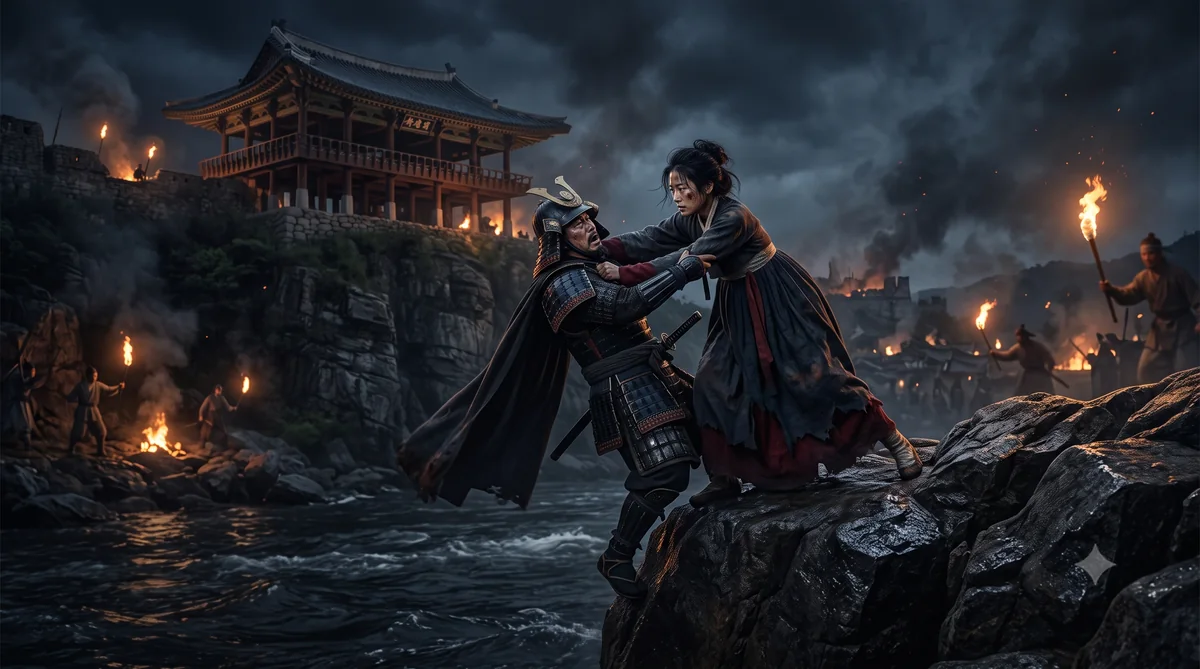 By tradition, Nongae lured a Japanese commander onto a rock beneath Chokseongnu and leapt with him into the Namgang. (AI illustration)
Quick answer: During the 1593 fall of Jinju in the Imjin War, Korean tradition holds that a woman named Nongae — remembered as a uigi (의기), a “righteous gisaeng” — lured a Japanese commander onto a rock by the Namgang river and leapt into the water clutching him, killing them both. The rock became known as Uiam (義巖), the “Righteous Rock.” But the story enters written record only from around the 1620s, chiefly through a book of tales; because she was a low-status gisaeng, the state took roughly 150 years to honor her officially. Nongae is best understood not as a documented battlefield feat but as a war memory that a community kept alive until the nation finally recognized it. Let’s unpack it.
The last night of Jinju
In 1593, during the Imjin War, the fortress city of Jinju fell to Japanese forces. Jinju was strategically vital, and its siege was one of the war’s fiercest clashes (진주전투 — Encyclopedia of Korean Culture). After the walls were taken, tradition says, Nongae went down to a celebration the Japanese held on the riverbank below Chokseongnu (촉석루), the pavilion overlooking the Namgang.
There, the story goes, she drew one Japanese commander out onto a rock at the water’s edge. To make sure he could not break free, she is said to have locked her ringed fingers around him — and then threw herself, and him, into the Namgang. Afterward the people of Jinju named that rock Uiam (義巖), the “Righteous Rock.” The tale began to appear in writing and on stone monuments roughly from the 1620s.
It is a scene built like cinema — which is exactly why it lasted. A single woman, in the wreckage of defeat, answering with the only weapon left to her. That is not just a death; it became a symbol of memory.
Was Nongae a gisaeng?
Traditionally, yes — she is remembered as a uigi (의기), a “righteous gisaeng.” The Encyclopedia of Korean Culture describes Nongae as a Jinju government entertainer, a gwan-gi (관기) — a woman attached to a local office to perform at banquets, rites, and receptions (Encyclopedia of Korean Culture — Nongae).
But her status shouldn’t be flattened into a single certainty. Later traditions added other versions — that she came from a Ju family, or was connected to the commander Choe Gyeong-hoe — and the documentary record is thin. So the careful line is this: Nongae was traditionally known as a Jinju gisaeng or uigi, though some later accounts view her origins differently. That framing holds both the tradition and the later debate at once.
When was the story first written down?
Here is the part that matters most for reading the legend honestly: the Nongae story does not appear, in detail, in the official war records made right after Jinju fell. It traveled first by word of mouth, and only began to be written down — in texts and on monuments — from roughly the 1620s.
The best-known early source is Yu Mong-in’s Eou yadam (어우야담), a collection closer to anecdote and miscellany than to official history (Encyclopedia of Korean Culture — Eou yadam). That doesn’t mean the story should be dismissed as invention. It means the story is best read as evidence of how a war’s memory was carried, recorded, and commemorated by the people who lived near it — not as a minute-by-minute military account.
Key terms. Nongae (논개) — the Joseon woman remembered as a uigi who, by tradition, died taking a Japanese commander with her at the 1593 fall of Jinju. Uigi (의기) — a “righteous gisaeng,” a low-status female entertainer honored for an act of loyalty or sacrifice. Uiam (義巖) — the “Righteous Rock” below Chokseongnu on the Namgang, named for Nongae’s leap. Eou yadam (어우야담) — Yu Mong-in’s early-17th-century collection of tales, an important early written source for the Nongae story.
Why wasn’t she honored as a national hero right away?
This is the most revealing question in the whole story — and its answer is uncomfortable. Nongae is famous now, but the state did not rush to celebrate her.
In Joseon society, a gisaeng was low-status. So even with a tradition that she had died for her country, conservative scholar-officials hesitated to hold up an entertainer as an official model of chastity and loyalty. The clearest sign: the great compendium of Imjin-War exemplars — the Dongguk Sinsok Samgang Haengsildo (동국신속삼강행실도, compiled 1617), which gathered loyal subjects, filial children, and virtuous women — left Nongae out (Encyclopedia of Korean Culture — Dongguk Sinsok Samgang Haengsildo). By the reading of later scholars, some editors steeped in Confucian propriety simply could not classify a gwan-gi as a paragon of chaste loyalty.
And yet the people of Jinju kept her memory alive, setting up an altar by the river on the anniversary of the city’s fall and pressing, for generations, for official recognition. It came slowly. In 1721 (the first year of King Gyeongjong), the regional military commander Choe Jin-han petitioned the court to reward her, and locals raised a memorial stele at Uiam. Finally, in 1739 (the 16th year of King Yeongjo), the commander Nam Deok-ha established the Uigisa (義妓祠, “Shrine of the Righteous Gisaeng”) near the rock, and a state-supported memorial rite made her recognition official — roughly 150 years after her death.
So Nongae’s story is not a simple patriotic tale. It is also a question: who is allowed to be a hero? Why did a low-status woman’s sacrifice take a century and a half to enter official memory? That question travels well beyond Korea.
Beyond Korea: is Nongae “the Korean Joan of Arc”?
For a foreign reader, invoking Joan of Arc is a natural bridge — both are women who became national symbols through war (Britannica — Joan of Arc). But the two shouldn’t be collapsed into one type.
Joan of Arc is remembered through military command and religious vision — a teenager who led armies, guided (she said) by voices. Nongae is remembered through a single act of self-sacrifice and revenge after a lost battle — no army, no campaign, one decisive moment on a rock. Different eras, different roles, different kinds of record. So rather than “Nongae is the Korean Joan of Arc,” the accurate framing is: Nongae is one of the great women that later Koreans chose to remember from a devastating war — her own kind of hero, not a copy of anyone.
Here is the legend beside what the record actually supports:
| In the drama / legend | In the historical record |
|---|---|
| Nongae lures a named Japanese commander onto the rock | A woman remembered as Nongae is traditionally credited with the act; the commander’s identity varies by source |
| The ring locking her fingers, the leap, the seduction are shown in vivid detail | These specifics are shaped by tradition and later imagination, not a contemporary report |
| Nongae is instantly a celebrated national heroine | The state omitted her in 1617 and formally honored her only in 1739, ~150 years later |
| She is “the Korean Joan of Arc” | A useful comparison, but a different figure — sacrifice-and-memory, not command-and-vision |
In short: the fall of Jinju in 1593 is real history; the vivid Nongae scene is a tradition that entered writing around the 1620s and reached official state recognition only in 1739. The most accurate way to present her is not as a proven battlefield exploit but as Korea’s most powerful remembered female-hero legend — and as a case study in how slowly a low-status woman’s sacrifice was allowed into the nation’s official memory.
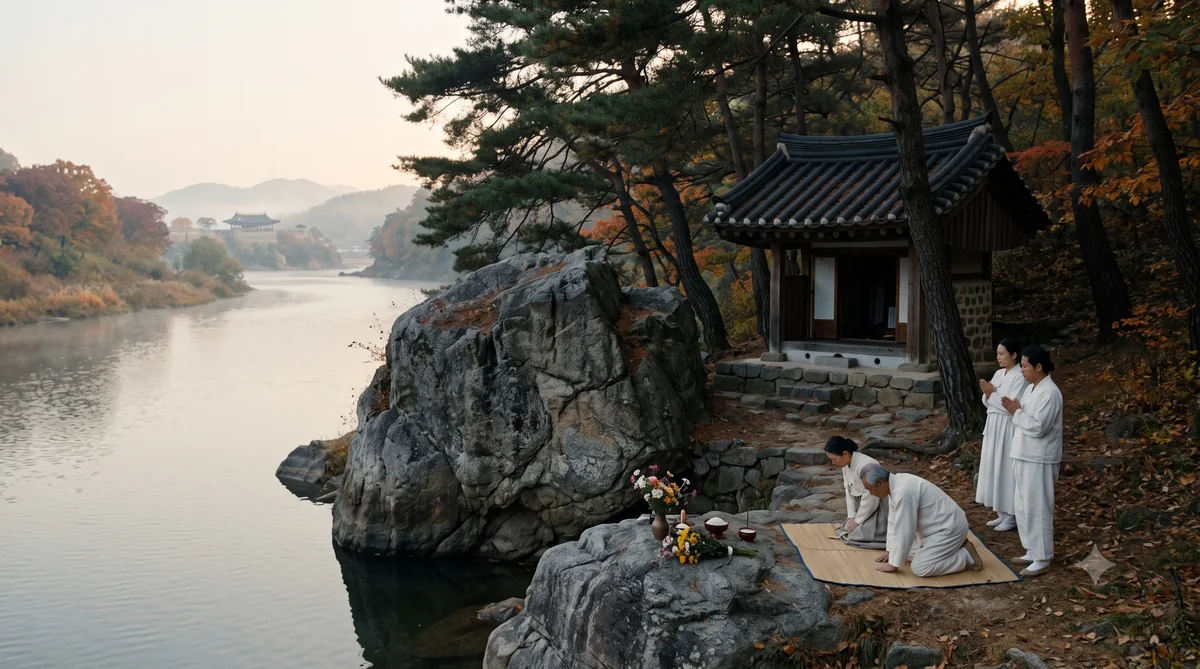 It took roughly 150 years — and the founding of the Uigisa shrine in 1739 — for the state to officially honor the gisaeng Jinju had never stopped mourning. (AI illustration)
Coming up next
A single riverside leap opens onto a whole set of questions — how a war is remembered, who records it, and whose sacrifice a society is willing to honor, and how long it makes them wait. That’s the quiet power of a legend like Nongae’s: it is never only about one night at Jinju.
In the next essay, we’ll take another K-drama scene that looks like pure spectacle — and trace the real Korean history quietly running underneath it.
Frequently asked questions
Is the Nongae story true? It’s real history braided with legend. The 1593 fall of Jinju during the Imjin War is a documented event. The specific act attributed to Nongae — luring a Japanese commander onto a riverside rock and leaping into the Namgang with him — comes down through tradition and later writing, not a detailed contemporary battle report. It’s best described not as a fully verified military record but as Korea’s most enduring female-hero legend, grown from a real war.
Was Nongae really a gisaeng? Traditionally she is remembered as a uigi (의기), a “righteous gisaeng” — a Jinju government entertainer (gwan-gi). The Encyclopedia of Korean Culture describes her that way. But later traditions added other versions — that she came from a Ju family, or was connected to the commander Choe Gyeong-hoe — and the records are thin. The safest reading is that she was traditionally known as a Jinju gisaeng or uigi, while some later accounts dispute her exact origins.
When was the Nongae story first written down? Not immediately. It spread first by word of mouth, and began appearing in writing and on stone monuments roughly from the 1620s. The best-known early text is Yu Mong-in’s Eou yadam (어우야담) — a collection of tales and anecdotes rather than an official chronicle. That doesn’t make the story fiction; it shows how a war memory was carried, recorded, and eventually commemorated by ordinary people.
Why did it take so long for Nongae to be officially honored? Because she was a gisaeng, a low-status woman. Even with a story of dying for her country, conservative Confucian officials hesitated to hold up an entertainer as a model of chastity and loyalty — the compendium of Imjin-War exemplars, the Dongguk Sinsok Samgang Haengsildo (1617), left her out. Jinju locals kept memorializing her anyway. Official recognition came only gradually: a 1721 petition for reward, and finally in 1739 the Uigisa (義妓祠) shrine and a state-supported memorial rite — about 150 years after her death.
What is the Uiam (義巖)? Uiam, the “Righteous Rock,” is the rock below Chokseongnu pavilion on the Namgang river in Jinju from which, by tradition, Nongae leapt with the Japanese commander. Jinju people named it Uiam in her honor, and it remains a memorial site tied to her story.
Is it fair to call Nongae “the Korean Joan of Arc”? It’s a useful bridge for foreign readers but shouldn’t be taken as an equation. Both became national symbols of women remembered through war. But Joan of Arc is remembered through military command and religious visions, while Nongae is remembered through a single act of self-sacrifice and revenge after a lost battle. Different eras, roles, and kinds of record — better to call Nongae one of Korea’s great remembered female heroes than a copy of Joan of Arc.
How much of the dramatic detail — the ring, the seduction — is historical? Those vivid details — luring the general, the ring locking her fingers around him, the leap — are the parts most shaped by tradition and later imagination. Dramas heighten them further. The historical core is that a woman named Nongae was remembered, after the fall of Jinju, as a righteous figure who died resisting the enemy; her exact origins, the scene’s specifics, and the commander’s identity vary by source and shouldn’t be stated as fixed fact.
Sources & further reading
This piece was written from the historical script and fact-check of 사뚱샘의 역사방 (SaDDungSam), treating the Nongae story as a documented war memory rather than a minute-by-minute battle record:
- Nongae (논개) — her status as a Jinju uigi, the martyrdom tradition, and the Uiam / Uigisa commemorations. (Encyclopedia of Korean Culture)
- Eou yadam (어우야담) — Yu Mong-in’s early-17th-century collection, a key early written source for the story. (Encyclopedia of Korean Culture)
- Dongguk Sinsok Samgang Haengsildo (동국신속삼강행실도, 1617) — the state exemplar-compendium that omitted Nongae, revealing how status shaped official honor. (Encyclopedia of Korean Culture)
- The 1593 fall of Jinju and the Imjin War. (진주전투; 임진왜란 — Encyclopedia of Korean Culture)
- Joan of Arc — for the comparison of women remembered through war. (Encyclopædia Britannica)
Thanks for reading — see you in the next one.
This article was researched and written by K-Drama History. Source: Nongae, Explained: Did a Gisaeng Really Pull a Japanese Commander to His Death at Jinju? — K-Drama History