Crash Landing on You, Explained: Are North and South Korea Still Technically at War?
Theme: War & Resistance
From the research behind Pause the Drama.
If you’ve watched tvN’s Crash Landing on You (사랑의 불시착) — the 2019–2020 mega-hit that introduced half the world to the phrase “North Korean officer romance” — you know the setup. Heiress Yoon Se-ri goes paragliding to field-test her company’s new outdoor clothing line, a freak gust swallows her, and she wakes up tangled in a tree with a North Korean officer, Captain Ri Jeong-hyeok, pointing a rifle at her. She hasn’t landed in another province. She has landed on the far side of one of the most heavily fortified frontiers in the world.
A windstorm romance across that border is fantasy, and the show knows it. But the fantasy only works because of one hard fact underneath it: between South and North there really is a line that ordinary people cannot cross — not in person, not by letter, not by phone call. So where did that line come from, and why has it stayed shut for more than seventy years?
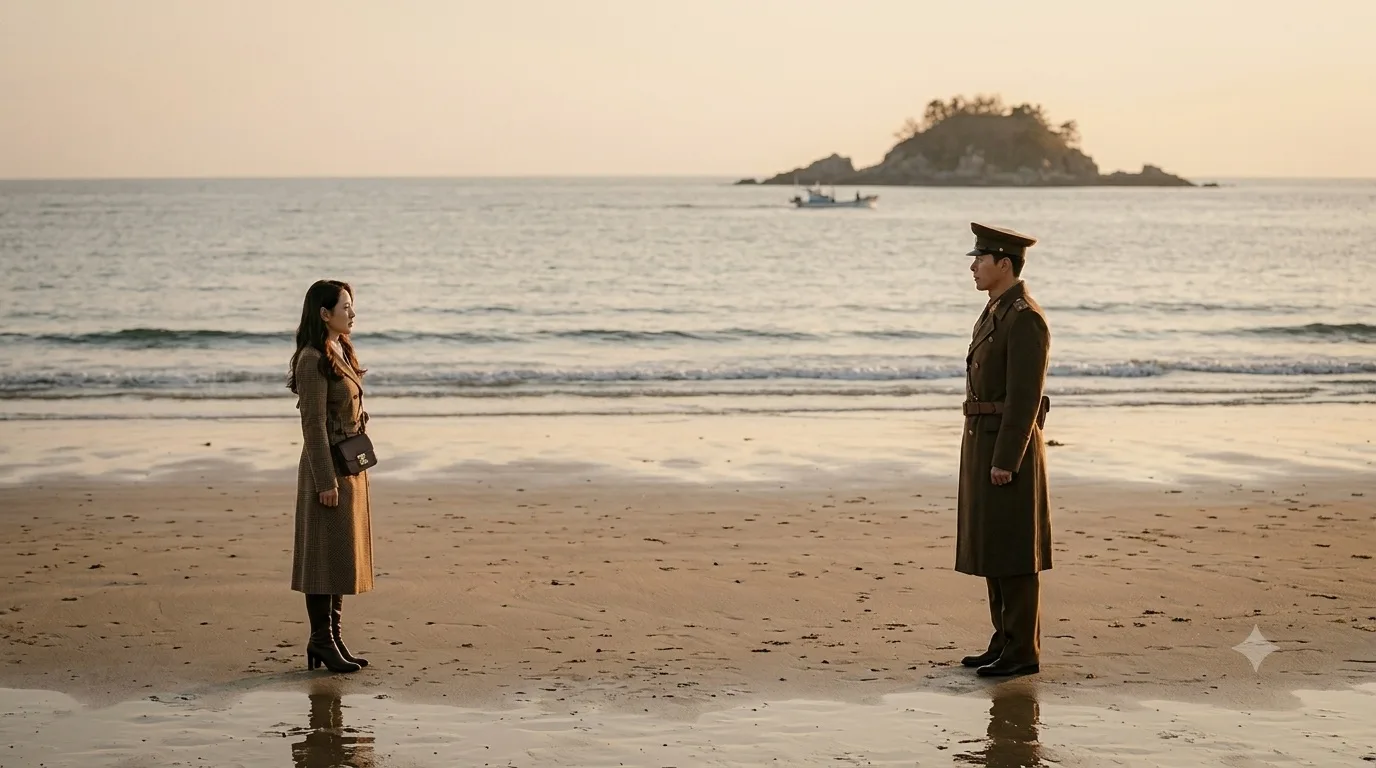 Two people, one border. The drama’s central image — love standing on either side of a line neither of them drew. (AI illustration)
Quick answer: The fighting in the Korean War stopped, but no peace treaty ever followed. What was signed at Panmunjom on 27 July 1953 was an armistice: a military agreement to cease hostilities, designed to hold until a political settlement could be reached (U.S. National Archives). That settlement never came. The peninsula therefore remains governed by an armistice regime rather than a peace treaty — a situation commonly described, though not without legal debate, as the two Koreas being “technically still at war.” The armistice drew the Military Demarcation Line and pulled both armies back two kilometers to form the Demilitarized Zone. Yoon Se-ri falls out of the sky into that frozen arrangement; everything tense, secret and heartbreaking in the drama grows out of it.
Let’s unpack the history the romance is standing on.
The fighting stopped. Peace never followed.
The Korean War began on 25 June 1950 with North Korea’s invasion of the South. Three years of fighting later — after negotiations that dragged through 158 meetings over more than two years — the armistice was signed at Panmunjom on 27 July 1953 (Prologue Magazine, U.S. National Archives).
Look closely at who signed, because the details matter. This was not a peace treaty between nations. It was a military agreement concluded between the United Nations Command on one side and the Korean People’s Army and Chinese People’s Volunteers on the other. At Panmunjom, Lieutenant General William K. Harrison Jr. signed for the UN Command delegation and General Nam Il for the North Korean–Chinese delegation; the document also bears the names of the senior commanders — Mark W. Clark for the UN Command, Kim Il Sung for the Korean People’s Army, and Peng Dehuai for the Chinese People’s Volunteers.
And here is the detail that surprises almost everyone: South Korea is not a separate signatory. President Syngman Rhee’s government bitterly opposed any armistice that would leave the peninsula divided, and the Republic of Korea did not sign the agreement in its own name — though Seoul ultimately conveyed that it would not obstruct the armistice’s implementation. The document that governs the line dividing Korea does not carry South Korea’s own signature. That does not mean the South stands outside the armistice system: its forces have operated within the security order maintained on the southern side by the UN Command and the Republic of Korea ever since.
What kind of thing is an armistice? Not a peace. The agreement was built as a temporary military measure: it halted hostilities, and it explicitly pointed forward to a political conference that was supposed to produce a final peaceful settlement of the Korean question. It contains no expiry date — it simply remains in force until superseded by such a settlement. The conference failed. Every later attempt failed. The “temporary” arrangement is now in its eighth decade.
What’s the difference between the DMZ and the Military Demarcation Line?
The armistice drew a line and then built a buffer around it, and the distinction between the two is worth keeping straight — the drama (like most people) blurs it. The line that actually divides North from South is the Military Demarcation Line (MDL). The DMZ is not the line itself but the buffer zone around it: each side pulled back roughly two kilometers, creating a strip about four kilometers wide and roughly 250 kilometers long that cuts the peninsula from coast to coast.
The name is the great irony. The “demilitarized” zone is laced with minefields, wire and guard installations, and large military forces face each other across it — which is exactly why a civilian drifting into it on a paraglider and surviving is the stuff of television.
But the DMZ has a second identity, and it’s the one that startles foreign readers. With free civilian access and development restricted for over seventy years, the area became an accidental sanctuary. A 2014–2017 survey led by Korea’s Ministry of Environment and National Institute of Ecology confirmed 5,929 wildlife species in the wider DMZ area, including 101 endangered species — red-crowned and white-naped cranes, musk deer, otters, Asiatic black bears among them (환경부·국립생태원, 2018). Not because anyone planned a nature reserve — but because a space where people cannot freely go turned out to be a space where everything else could. One of the world’s tensest borders doubles as one of its most striking ecological refuges.
Could Yoon Se-ri really paraglide across the DMZ?
Give the show its due: what it invents is the method of crossing, not the wall itself.
In reality, airspace near the DMZ is tightly controlled and the ground is mined and watched; no gust of wind delivers a civilian safely to the other side. And the human wall is higher than the physical one. There is no ordinary mail, telephone or email channel open between citizens of the two Koreas — no infrastructure for a Southerner and a Northerner to simply keep in touch. In the South, contact with North Koreans is regulated by law (the Inter-Korean Exchange and Cooperation Act works on a reporting system, not a blanket ban) — but a reporting system for exceptional contacts is a world away from being able to send a letter. The wall in Crash Landing on You is not exaggerated. The drama just borrows fantasy for one thing only: a way over it.
That’s why the romance lands so hard. Every secret meeting and coded gesture in the show dramatizes a simple, documented fact — that for most ordinary citizens, the other half of the peninsula can feel as unreachable as the far side of the moon.
The border’s cruelest ledger: separated families
The armistice’s most painful legacy has a name in Korean: isan gajok (이산가족) — separated families. War and division split parents from children, brothers from sisters, husbands from wives, and then sealed the line behind them, often without so much as confirmation of who was still alive. The scale is customarily described in Korea as “ten million separated family members” — a historic, symbolic figure rather than a current registry count, but one that conveys how deep the wound cut.
Since 1985, the two governments have intermittently arranged official reunion events, and their format is almost unbearably narrow: families who have not seen each other for half a century meet for a short, supervised program — typically a two-night, three-day event with limited face-to-face hours — and then part again, in most cases with no follow-up reunion and no way to stay in contact afterward (Ministry of Unification, Integrated Information System for Separated Families). A large share of registered applicants have died without ever getting a meeting; most survivors are now in their eighties or older.
Hold that beside the drama and the romance changes color. When Crash Landing on You imagines love finding a way across the line, the romance echoes the wish history denied to millions of separated family members: the chance to meet again.
Stranger than fiction: the flagpole war and the ghost village
The armistice regime has also produced episodes that sound invented — and aren’t.
Inside the DMZ, two villages face each other across the line: Daeseong-dong (“Freedom Village”) on the southern side and Kijong-dong on the northern side, the civilian settlements that remained in the zone after the armistice. In the 1980s the South raised a roughly 100-meter flagpole over Daeseong-dong flying the taegeukgi; the North answered with a roughly 160-meter tower over Kijong-dong flying an enormous North Korean flag. A border rivalry fought not with rifles but with flag height — the Cold War in miniature, in steel and fabric.
Kijong-dong itself is the stranger story. North Korea presents it as a thriving model village; observers from the southern side have long reported buildings that appear to be empty shells, with little sign of actual habitation — which is why the outside world calls it the “Propaganda Village.” Life in Daeseong-dong, meanwhile, is real but constrained: residents are exempt from taxes and military service, and in exchange live with nightly curfews and tight restrictions tied to residing inside an armistice zone. Two villages, seventy years, competing not with gunfire but with appearances.
And then there is Panmunjom — the Joint Security Area, the most symbolically charged spot in the DMZ. The Military Demarcation Line runs through its blue conference huts, so visitors permitted inside can physically step from one side of the line to the other — within a tightly controlled military setting, not an open border. It is the emblematic place where the two sides face each other — though not the only one where they have ever met; talks and exchanges have also been held in Seoul, Pyongyang and elsewhere.
The JSA is also where the armistice showed its teeth. In August 1976, a UN Command work detail trimming a poplar tree that blocked sightlines was attacked by North Korean soldiers; two American officers, Captain Arthur Bonifas and First Lieutenant Mark Barrett, were killed with axes. Three days later the U.S. and South Korea returned in overwhelming force — attack helicopters overhead, fighters and bombers aloft — to cut down that single tree: Operation Paul Bunyan (DVIDS, U.S. Department of Defense). A tree, two deaths, and a near-war. That is what an unfinished war means in practice: the smallest friction can escalate, because nothing was ever settled.
Two other divided places — and why Korea’s wall is the one still standing
Set Korea’s division beside two others and its particular shape gets clearer.
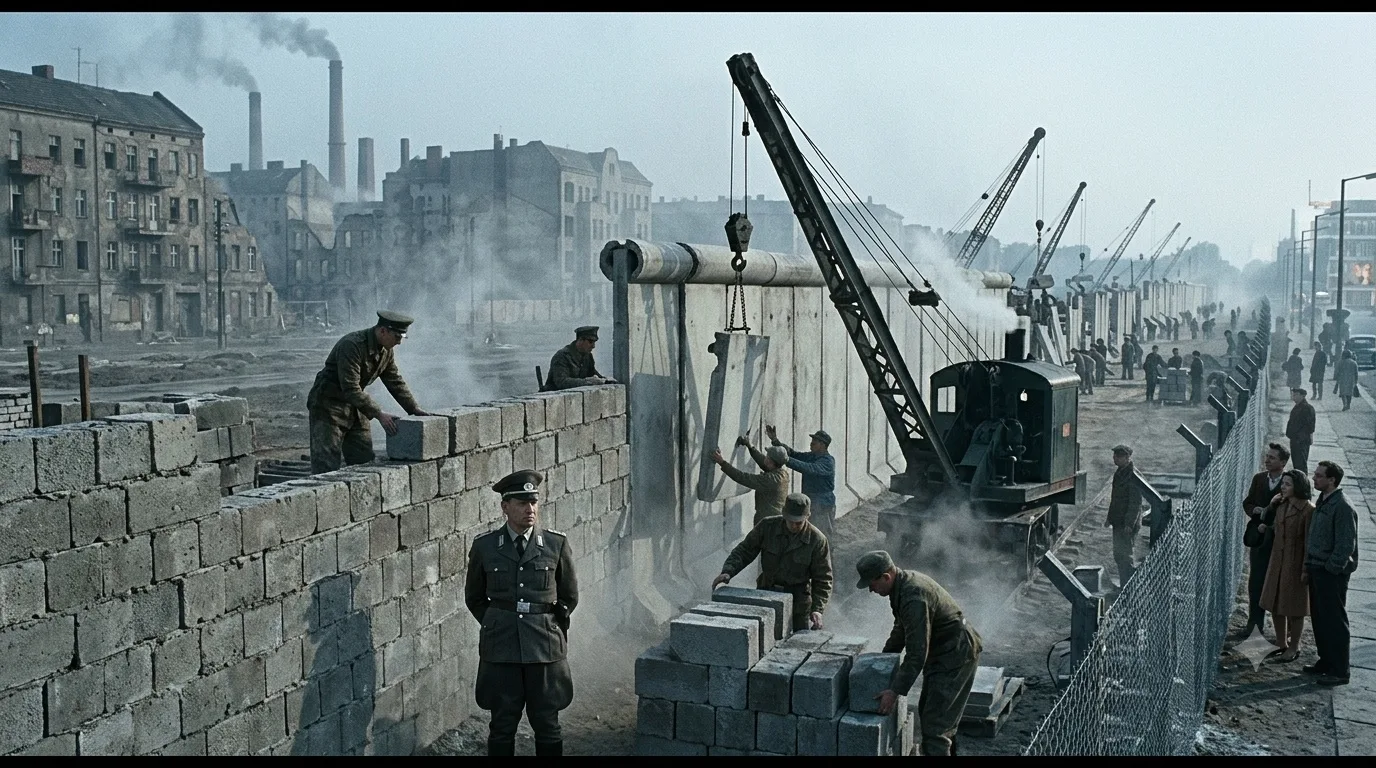 Berlin, 1961: the other great wall of the Cold War. It stood for 28 years. Korea’s has stood for more than 70. (AI illustration)
Germany — the near-twin that ended differently. Cold War Germany was, like Korea, one nation split in two by ideology, its halves divided by fortified borders and, in Berlin, a literal wall. The parallel is almost uncanny — until 1989. The Berlin Wall fell; a year later Germany reunified; the wall became a museum piece. Korea’s wall outlived the Cold War that built it, and has now stood decades longer than Berlin’s ever did. Same origin, opposite ending — so far.
Cyprus — divided, but ajar. The Mediterranean island has been split since 1974 between the south, effectively controlled by the internationally recognized Republic of Cyprus, and the north, controlled by Turkish Cypriot authorities — with a UN-supervised buffer zone, the “Green Line,” running about 180 kilometers across the island (UNFICYP). The echo of the DMZ is strong, right down to the buffer strip’s accidental rewilding. But there’s one enormous difference: since 2003, designated crossing points have allowed residents to pass between the two sides through checkpoints. Cyprus’s line is a wound, but a permeable one. Korea’s is different in kind: it has never developed a stable system of routine civilian crossings, and movement has occurred only through exceptional, state-controlled channels — reunion events, official delegations, the now-closed Kaesong industrial complex — that open and close with political conditions. Among the world’s remaining divided territories, Korea stands out for having no routine civilian crossing system and no direct private communication between the populations on either side.
Watch it again
Watch the paraglider scene again and the wind feels different. The accident is fiction; the stage is not. An unfinished war, an armistice signed without the South’s own name on it, a border that has let almost nothing through for seventy years — that is the machinery under the meet-cute. Crash Landing on You is a romance, and an unabashed one. But the reason the romance aches is historical: the fighting stopped in 1953, and the peace that was supposed to follow never arrived.
The drama’s real question isn’t whether Se-ri and Jeong-hyeok can cross the line. It’s the one it leaves with the viewer: how long does a “temporary” armistice get to last?
In the next essay, we’ll take another K-drama scene that looks like pure fiction — and trace the real Korean history hiding underneath it.
Frequently asked questions
Are North and South Korea really still at war? What’s beyond dispute: the 1953 agreement was a military armistice that halted the fighting, and the peace treaty it was meant to lead to has never been concluded. That’s why the situation is so often described as “technically still at war.” Lawyers debate how precisely to characterize the legal state between the two Koreas; the practical reality is an armistice regime, not peace.
Why was a peace treaty never signed? The armistice was designed as a stopgap: it called for a political conference to settle the Korean question and remains in force until replaced by a peaceful settlement. That conference — and every attempt since — failed to produce one, so the temporary arrangement has outlived most of its signers.
Did South Korea sign the armistice? No. The signatories were the United Nations Command on one side and the North Korean army and Chinese People’s Volunteers on the other. Syngman Rhee’s government opposed an armistice that would leave Korea divided and did not become a separate signatory — though it ultimately conveyed it would not obstruct implementation.
Is the DMZ actually demilitarized? In name only. The 4-km-wide strip is mined, fenced and watched, with large forces facing each other across it. Yet seventy years of restricted access turned the wider DMZ area — the zone plus its adjacent border region — into an ecological refuge: 5,929 wildlife species including 101 endangered ones, by the Korean government’s 2018 survey.
Could someone really be blown across the border like Yoon Se-ri? No — treat it as a fairy-tale device. Airspace near the DMZ is controlled, the ground is mined and monitored. The drama invents the crossing; it does not invent the wall.
What is the difference between the DMZ and the Military Demarcation Line? The Military Demarcation Line (MDL) is the line fixed by the 1953 armistice — the actual boundary between the two sides. The Demilitarized Zone is the buffer surrounding it: each side withdrew roughly two kilometers, creating a strip about four kilometers wide and roughly 250 kilometers long. The MDL is the dividing line; the DMZ is the controlled zone around it.
Is the Korean War legally over? No peace treaty has been concluded, and the peninsula remains under the 1953 armistice regime. The phrase “technically still at war” is widely used, but lawyers differ over the precise legal characterization of the state between the two Koreas. The safest formulation: active hostilities stopped in 1953 without a final peace settlement, and the armistice remains in force until superseded by one.
Can North and South Koreans contact each other? There is no routine private mail, telephone or internet channel between ordinary citizens of the two Koreas. Exceptional contact and travel have occurred through government-approved programs — family reunion events, official delegations, joint projects — and South Korean law regulates contact with North Koreans through a reporting system rather than a blanket ban. But an individual cannot simply call or write across the border, and that absence is the wall the drama’s romance runs into.
Sources & further reading
This piece was written from the historical script and fact-check of 사뚱샘의 역사방 (SaDDungSam). Key facts are sourced inline. Figures with source-to-source variation (DMZ dimensions, flagpole heights) are given as approximations; claims that couldn’t be pinned to a primary source (exact troop totals, the weight of the Kijong-dong flag) are omitted rather than repeated.
- The Armistice Agreement (1953) — the milestone document itself. (U.S. National Archives) · Background: “The Korean War Armistice,” Prologue Magazine
- DMZ ecology — 5,929 species, 101 endangered (2014–2017 survey). (환경부·국립생태원 press release, 2018 · korea.kr briefing)
- Separated families — reunion events and applicant statistics. (Ministry of Unification, 남북이산가족정보통합시스템)
- The 1976 axe murders and Operation Paul Bunyan. (DVIDS)
- Cyprus’s Green Line — the other buffer zone. (UNFICYP, About the buffer zone)
- The drama itself. (Crash Landing on You — Netflix)
Thanks for reading — see you in the next one.
This article was researched and written by K-Drama History. Source: Crash Landing on You, Explained: Are North and South Korea Still Technically at War? — K-Drama History