Agent Kim Reactivated, Explained: South Korea Sent Thousands of Men North — Then Denied They Existed
Theme: War & Resistance
From the research behind Pause the Drama.
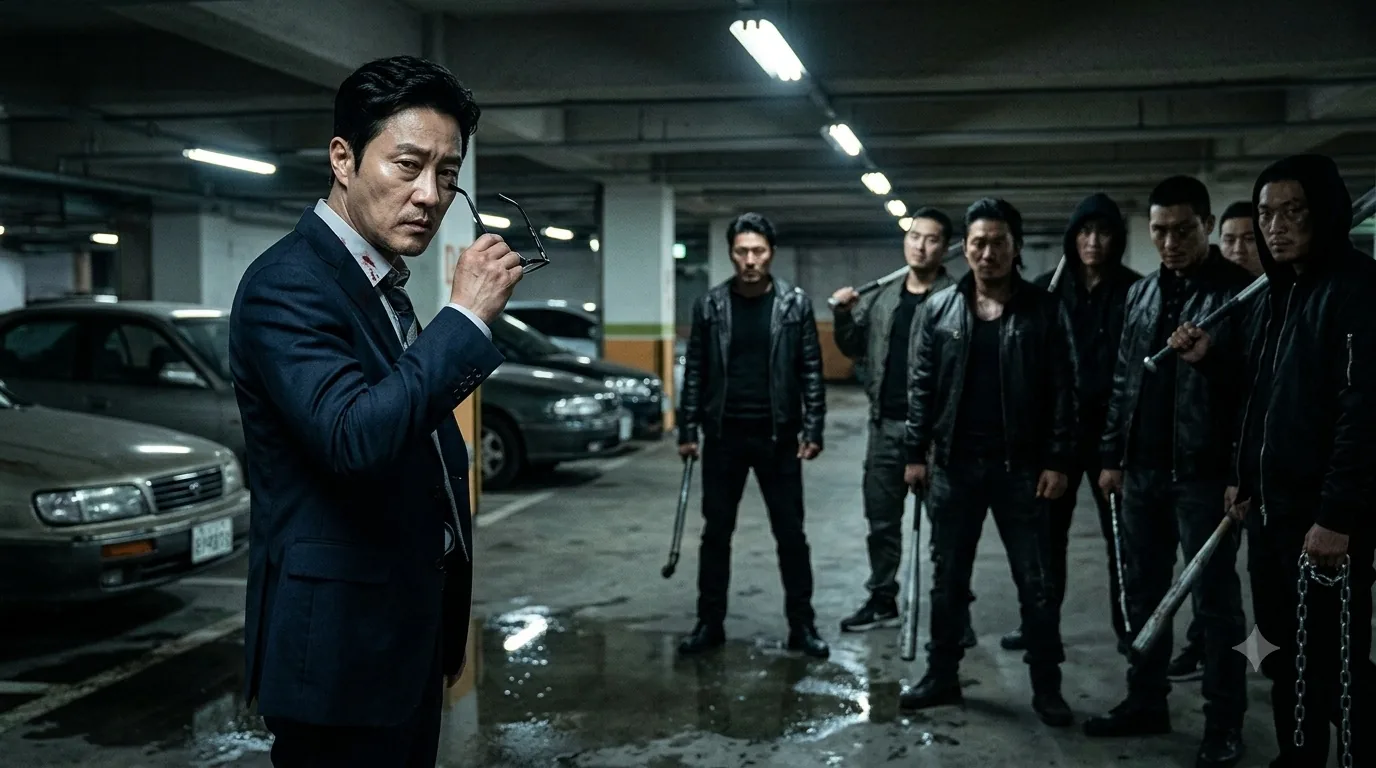
A middle-aged man in an accounting department takes off his glasses.
That is the whole trick of SBS’s Agent Kim Reactivated (김부장). Before that moment he is the most ordinary person in the room: a savings-bank section chief who absorbs a rude customer and an unreasonable boss without complaint, a single father whose whole day bends around his daughter. Then his daughter goes missing, the glasses come off, and the ordinary man is gone.
The Korea Times calls the line the series runs on “Never mess with an old man in glasses.”
There is no time travel here and no superpower. The show asks you to accept exactly one fantasy: that the harmless man next door was once an operative whose existence the state deleted.
So how much of that is invention?
The short answer
Kim himself is made up. The kind of person he stands for is not.
Men were trained in secret by their government, sent on missions across the most heavily armed border on earth, and then written out of the record by the same government that sent them. That happened, on both sides, for decades.
Kim Bujang is a fictional character. The erased agent is not a fictional category.
The drama’s Cheonsan unit, its special missions bureau, and the code name 66 are inventions. What sits underneath them — South Korean operatives sent north, North Korean units sent south — is documented history, and some of the real episodes are harder to believe than the fiction.
Let’s start with the direction the drama is quietest about.
The men the state deleted: bukpa gongjakwon
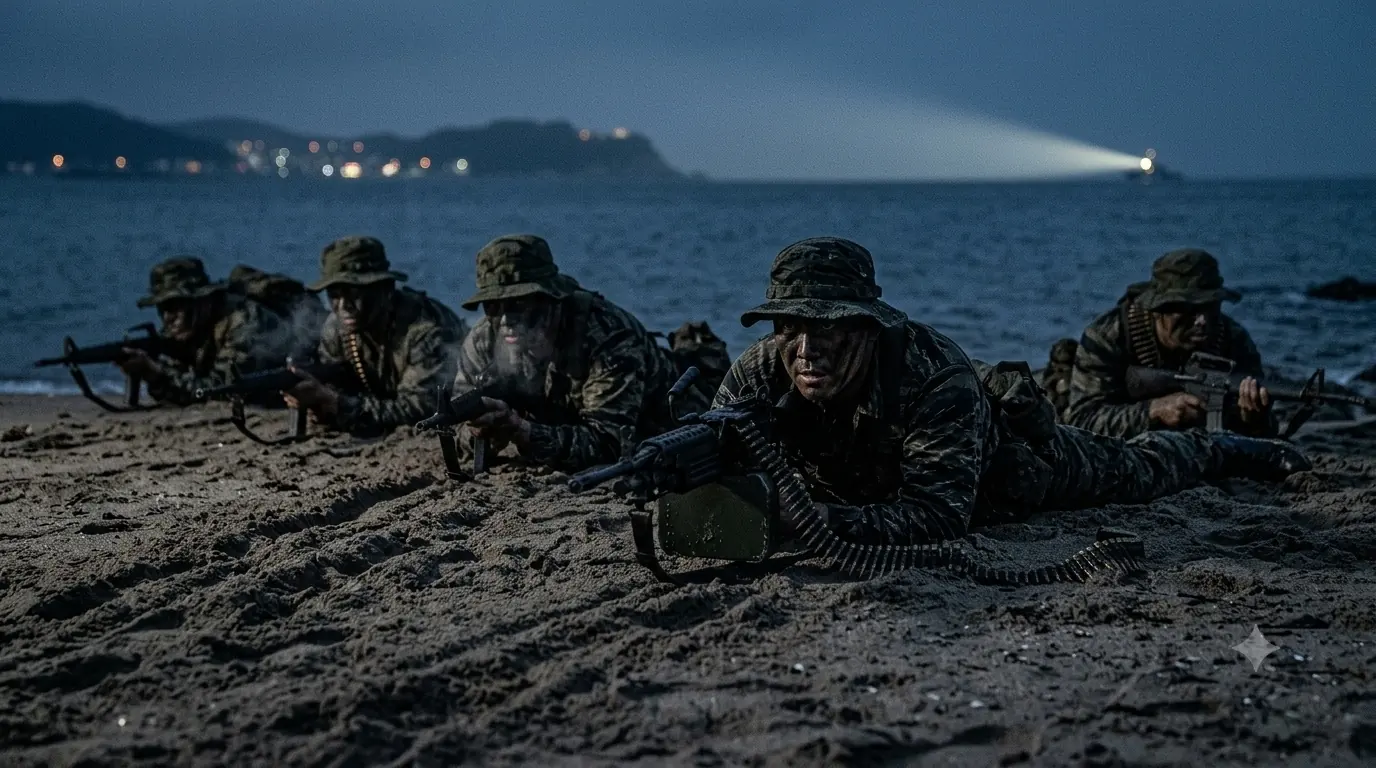
Bukpa gongjakwon (北派工作員) — “north-dispatched operatives” — is the umbrella term for South Koreans sent secretly into North Korea for reconnaissance, sabotage, and intelligence gathering.
They were not one organisation. The best known is HID, the Army’s intelligence detachment, reorganised as a dedicated intelligence unit under the Army Headquarters intelligence bureau in 1951. The Navy ran UDU and the Air Force ran OSI, both established in 1954. Different services, different units, one shared condition: officially, none of this was happening.
Here are the numbers that stop foreign readers — and they require some care, because they are not one statistic.
One frequently cited tally records 7,726 operatives as killed or missing between the creation of the postwar units and the 1972 inter-Korean détente. A later government report counted roughly 13,000 men trained or recruited as north-bound operatives between 1951 and 1994, with approximately 7,800 recorded as killed or missing.
Those two sets do not cover the same period or quite the same category, and the second figure is a count of men trained, not of men confirmed to have crossed. What they establish beyond dispute is the scale: thousands of men were recruited and trained, thousands never came back, and for decades the state would not say they had existed.
The reason for the silence was the armistice. Armed infiltration and hostile action across the Military Demarcation Line after 1953 sat badly against the armistice regime, so the missions were run at the highest level of secrecy and the men’s service records were kept out of the official account.
The survivor who is still waiting, in 2026
This is not sealed history. It is a live political question in the same month the drama is airing.
On 18 July 2026 — the day after the episode that drew a 21.9% national rating — Yonhap News published an interview with Ha Tae-jun, 67, chairman of the association of bereaved families of special mission performers, and himself a former north-bound operative. He began three years of training in 1984.
What he describes is not an action sequence.
Recruits were separated from their families without the families being told. Each operative had four handlers watching him. Training involved beatings and torture drills; some men died in training and others were permanently disabled.
And the detail that gives the Yonhap headline its weight: deaths in the family were kept from the men. No leave, no notification — not even for a parent’s funeral. The state that had made them disappear kept them from knowing who else had disappeared.
Ha also pushes back on the stigma that trailed these units for decades — the belief that they were staffed with criminals and condemned men. By his account, of roughly ten thousand operatives, about thirty-three had criminal records.
His summary of it is one sentence: the state made them risk their lives and then abandoned them.
How the record was finally corrected — and how it still isn’t
The recognition came in stages, and the stages matter.
- 2002 — a court ruling recognised a north-bound operative as a person of national merit, and limited consolation payments began.
- 2003 — government figures on the programme were formally submitted to the National Assembly, bringing its scale into the public record.
- 2004 — the Act on Compensation for Special Mission Performers (Act No. 7122) created a statutory compensation framework.
Half a century after the first missions, the men existed again on paper.
But as of July 2026 they are still excluded from the regular stipends other veterans receive, getting mostly in-kind support such as medical assistance. A bill to establish an honour stipend, filed in August 2025, was still sitting in the National Assembly when Ha gave that interview.
The drama’s emotional engine — he gave everything to the state and the state says he was never there — is not a screenwriter’s flourish. It is an unresolved item on the legislative calendar.
The war nobody called a war
To understand why either state was running these men, you have to know what the border was actually like in the years the drama’s backstory is set.
Most people outside Korea picture the DMZ after 1953 as frozen — an armistice, a line, and then silence until the present. It was not. Between 1966 and 1969 the border was the site of a sustained low-intensity conflict that some historians call the Second Korean War, and Korean and American soldiers were dying in it.
Writing in the U.S. Army’s Military Review in 1988, Major Vandon E. Jenerette put numbers on it. In the American sector of the DMZ alone, over the nine months from May 1967 to January 1968, fifteen U.S. soldiers were killed and sixty-five wounded. Across 1968 there were more than 700 hostile incidents; in 1969, just over a hundred.
That is the world Kim’s backstory lives in. Not a spy fantasy about a quiet border, but a decade in which infiltration, ambush and sabotage were routine on both sides — and in which a government could plausibly decide that men sent across it were better left off the books.
The other direction: North Korea’s Unit 124
The traffic ran both ways, and the drama’s premise depends on it.
North Korea’s Unit 124, under the Reconnaissance Bureau, was a special unit built for infiltration, reconnaissance, guerrilla action and sabotage in the South. It is the closest real-world reference point for a drama about elite operatives crossing the line — although there is no public basis for saying the production modelled Kim on it. What is fair to say is that the structures rhyme: a secret mission aimed at the top of the enemy state.
Which brings us to the night it actually happened.
21 January 1968: the raid on the Blue House
On 21 January 1968, thirty-one armed commandos from Unit 124 came within a few hundred metres of the Blue House, the South Korean presidential residence, intending to assassinate President Park Chung-hee. Note the scope: Unit 124 existed for a range of missions, and the assassination attempt was the specific task assigned to those thirty-one selected men.
The raid failed. By Jenerette’s account of the sweep that followed, twenty-eight of the commandos were killed, one was captured, and two were presumed to have escaped. The one taken alive was Kim Shin-jo. Civilians were among the dead on the South Korean side.
At his press conference, asked why they had come, Kim Shin-jo is widely reported to have replied to the effect that he had come to take President Park’s head. Accounts vary in exact wording, which is why it is better reported as substance than quoted as a line. Either way, the country heard it, and the shock was immediate: the incident led directly to the creation of South Korea’s Homeland Reserve Forces.
Two footnotes that people usually get slightly wrong. Some of the retaliatory units created in the aftermath — the Seongamdo unit, the Marine Corps MIU, the Air Force’s Unit 684 — were indeed products of 1968. But the north-bound intelligence units themselves were not: HID had existed since 1951, UDU and OSI since 1954. And the so-called “Kim Shin-jo route” that reopened after four decades is not the whole infiltration path but a stretch of trail in the Bugaksan area of Seoul, reopened in 2009, forty-one years later.
The mirror image: Unit 684 and the island
Here is where the two directions meet, and where the drama’s premise stops feeling like fiction at all.
After the Blue House raid, the Korean Central Intelligence Agency instructed each service branch to raise a retaliation unit. The Air Force stood one up in April 1968: officially the 209th Detachment of Unit 2325, better known by its cover name — Unit 684, from the year and month of its creation.
Its assignment was the raid in reverse. Where thirty-one men had come south for President Park, Unit 684 was to go north for Kim Il-sung, and it too was built around a party of thirty-one.
They were recruited from civilian life rather than assigned as regular soldiers. Contemporary accounts describe a mixture of unemployed young men and men with minor criminal histories — though later popular retellings inflated this into the claim that they were all death-row prisoners. They were taken to Silmido, a small island off Incheon, for three years of training. Seven of them died during it. The Ministry of National Defense’s own truth commission, reporting in 2006, found that after the first three months the men stopped being paid and were fed badly.
In August 1971 the mission was cancelled; relations between the two Koreas were thawing and an assassination team was now an embarrassment rather than an asset. The men had spent three years being trained for something that no longer existed, on an island, unpaid, by a state that had no record of them.
On 23 August 1971 they mutinied, killed most of their guards, crossed to the mainland and hijacked a bus toward Seoul. They were stopped short of the city. Most died there, several by grenade inside the bus. The handful who survived were tried by military tribunal and executed.
Then the file closed for thirty years.
Why 2004? When a secret history became a national story
The film did not begin the process of recognition. A court had already acknowledged a former operative in 2002, and official figures were reaching the National Assembly in 2003.
What Kang Woo-suk’s Silmido changed was the scale of public attention. Released in December 2003, it became the first Korean film to pass ten million admissions. A history previously confined to court cases, bereaved families and government files became a national conversation.
The 2004 compensation law therefore cannot be credited to the film alone. But the timing matters: legal recognition had opened the door, and popular culture pushed the buried story through it.
There is something uncomfortably close to home in that for a site like this one — which is roughly the claim Agent Kim Reactivated is making about itself when it puts an erased operative behind an accounting desk and hands him a pair of reading glasses.
18 August 1976: two officers, one poplar, and a carrier group
One more event shows how little margin that world had.
On 18 August 1976, a work party in the Joint Security Area at Panmunjom was trimming a poplar tree blocking the line of sight between two checkpoints. North Korean soldiers attacked them, and two U.S. Army officers were killed. The American response, Operation Paul Bunyan, cut the tree down with an engineer detachment on the ground while B-52s, fighter aircraft and a carrier task force including USS Midway stood behind them — and the tension that followed was serious enough that a wider military clash was a genuine fear.
Be exact about the cause, because the story is usually told as a punchline: the crisis was not caused by a tree, but by the killing of two officers during work on it. One structural change followed. The Military Demarcation Line had existed since 1953, but until 1976 both sides’ guards moved freely throughout the Joint Security Area; after the axe killings, the JSA’s own guard zones were separated along that line.
Drama vs. history
| The drama | The record |
|---|---|
| Kim served in the Cheonsan unit under a special missions bureau, as Code Name 66 | The unit names and the code number are invented. Real units — HID (1951), UDU and OSI (1954) — did exist, and operatives working under numbers and cover names was ordinary practice |
| Kim is a North Korean operative who was turned and settled in the South | Invention as a personal history. The Korea Times describes the character as a defected North Korean operative under Code Name 66; both countries really did send trained operatives across |
| He fights off many opponents at once; an ally fires a rocket launcher indoors | Genre. Real infiltration work depended on concealment, survival and information — not on winning a fight in the open |
| The state pretends he never existed | The most accurate thing in the show |
Deniability elsewhere — a difference of degree
Running agents your government will not admit to is not a Korean invention.
The CIA’s covert action is defined by that very property: operations designed so that the U.S. government’s role need not be acknowledged. Not everything an intelligence service does is covert action in that sense, but the deniable operative is a Cold War standard, not a Korean peculiarity.
Israel’s Mossad is often reached for as the opposite case, and it is a useful contrast if you don’t overstate it. A number of Mossad operations have been publicly narrated and folded into national memory in a way Korea’s were not. But many of its operations and officers remain unacknowledged as well, so “Israel makes heroes, Korea made ghosts” is too clean a line to draw.
The Korean case is distinctive in two narrower ways. The denial ran for decades, longer than most. And it ended the way it did: not through a government decision to declassify, but because the surviving operatives went public and demanded to be counted. They had to argue their way back into existence.
Watch it again
Episode 7, on 17 July 2026, drew 21.9% nationally — Nielsen Korea — and ended with Kim drugged, moved across the border, and waking in an interrogation room where a voice greets him as 66. The finale is scheduled for 25 July, so we will leave the ending where it is.
But watch the glasses again. The joke of the show is that nobody looks at a middle-aged man in an accounting department twice. That is also, precisely, what happened to the men this story is built on — and it took them fifty years and a public campaign to be looked at once.
Coming up next
A man in an office is quietly one of the most dangerous people in the country, and the state’s answer is to pretend he isn’t there. Next time we take another K-drama scene and follow it down to the Korean history sitting underneath it.
This article was researched and written by K-Drama History. Source: Agent Kim Reactivated, Explained: South Korea Sent Thousands of Men North — Then Denied They Existed — K-Drama History