Gyeongseong Creature, Explained: The Real Human Experiments Behind the Monster — Unit 731
Theme: War & Resistance
From the research behind Pause the Drama.
If you’ve watched Netflix’s Gyeongseong Creature (경성크리처) — the hit period horror set in 1945 colonial Seoul — you know that the monster is not the scariest thing in it. Pawnshop king Jang Tae-sang and missing-person searcher Yoon Chae-ok descend into the basement of Ongseong Hospital and find a creature born from a human host. But what chills the spine is upstairs: Japanese military doctors handling Korean prisoners as experimental material, faces never changing, ledgers always neat.
The creature is pure invention. The basement laboratory, the infection experiments, the vivisection of living people, the word for prisoners that means “log” — how much of that is fiction?
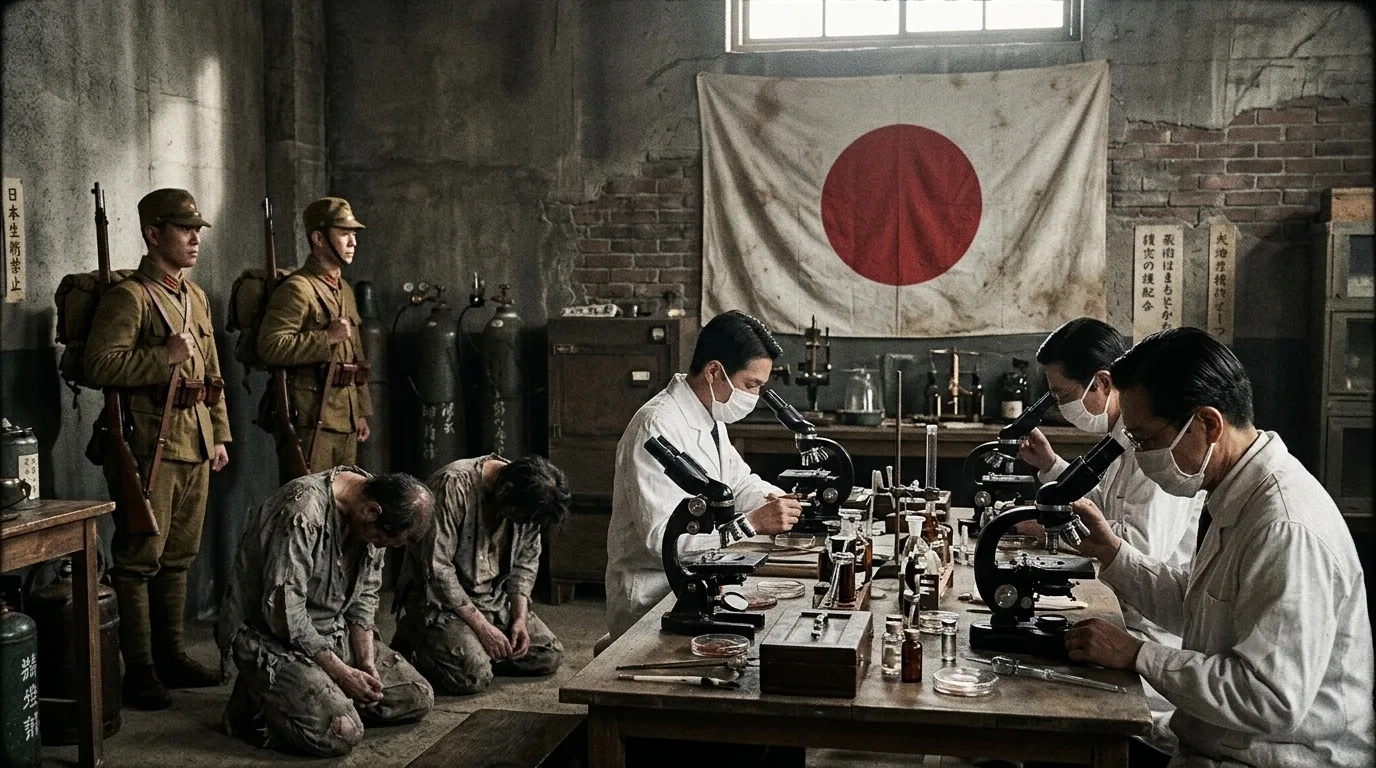 The drama’s real horror isn’t the creature — it’s the room like this one. The setting is invented; the kind of room is not. (AI illustration)
Quick answer: The monster is fiction; the history it evokes is documented. Japan’s Unit 731, a Kwantung Army organization based at Pingfang near Harbin in Manchuria and led by the army physician and microbiologist Ishii Shiro, conducted biological-warfare research through lethal experiments on prisoners and civilians. Postwar investigations and participant testimony record deliberate infection with plague, cholera and anthrax, frostbite experiments, and vivisection of living subjects; former personnel testified that the people held for experiments were called maruta, “logs.” The known victims were overwhelmingly drawn from occupied China, while surviving records and testimony also identify Koreans, Soviets and Mongolians. Unit 731’s principal experimental complex was at Pingfang — not Seoul; the drama’s Seoul facility is invention. And the reason its second season could imagine the perpetrators thriving in 2024 is historical too: Ishii and other central figures escaped Allied prosecution after U.S. authorities shielded key personnel in exchange for biological-warfare information.
Let’s separate the layers.
What was Unit 731?
Unit 731 was a Japanese Kwantung Army organization whose bland official designation — an “Epidemic Prevention and Water Purification Department” (the exact names and structure shifted over time) — covered biological-warfare research conducted through lethal experiments on prisoners and civilians (U.S. National Archives, Researching Japanese War Crimes Records).
The organization took shape under the army physician and microbiologist Ishii Shiro and was expanded and formalized within the Kwantung Army in the mid-1930s; its vast compound at Pingfang, near Harbin in Japanese-controlled Manchuria, was built and in operation by the late 1930s. There, according to postwar investigations and the testimony of former unit personnel, prisoners and civilians were deliberately infected with plague, cholera and anthrax; subjected to frostbite experiments; and vivisected while still alive — some testimony says without anesthesia. The people held for experimentation were referred to, in the testimony of unit veterans and later research, as maruta (丸太) — “logs.” Human beings, counted like timber.
How many died? Precision is impossible, partly because the unit burned most of its records in the war’s final days, and honest accounting means keeping two categories apart. For deaths inside the Pingfang facility itself, historians commonly cite an estimate of roughly 3,000 — but no complete victim list survives, and the figure should be treated as a scholarly estimate, not an audited count. The toll of Japan’s field use of biological weapons in China — plague-infected fleas over cities, contaminated wells, and the epidemics that followed — is a separate and much harder question, with estimates that vary enormously by scope and method. Adding the two into one number, as popular accounts often do, blurs what is actually known.
Was any of this in Seoul? The drama’s one big change
Here is where international viewers most easily walk away with a wrong fact. Ongseong Hospital is fiction, and so is any monster-making laboratory in colonial Seoul. Unit 731’s headquarters and its large experimental complex were at Pingfang, in Manchuria — not in Gyeongseong (colonial-era Seoul). The production itself, apart from the Manchuria-set opening, unfolds in an invented neighborhood and an invented hospital.
So the drama’s geography is a deliberate transposition: it carries Manchuria’s documented horror into the heart of the colonial capital, where its Korean protagonists live. The creature is invented; the relocation is invented; the kind of institution being depicted — a military medical facility consuming human subjects — is not.
Were Koreans really among the victims?
In the drama, the cells under Ongseong Hospital hold mostly Koreans. That is dramatic license in its proportions — but it points at something real that general audiences rarely hear.
The known victims were overwhelmingly drawn from occupied China. But the surviving documents show the net was wider. In 2014, China’s Jilin Provincial Archives made public batches of Kwantung Army documents on the “special transfer” (특별이송) procedure — the funneling of detainees to Unit 731 — and those released documents identify hundreds of people sent to the unit, among them Koreans identifiable by name and hometown, alongside Chinese, Soviet and Mongolian victims (Beijing Review on the 2014 releases; China Daily on later document releases). The number of Koreans who can be individually identified in surviving records remains limited. The unit’s destruction of its files in 1945 is a major reason — though incomplete record-keeping and gaps in what survives also stand between us and a reliable total. That Koreans were among the maruta is documented; how many, no surviving archive can say.
Why Season 2 jumps to 2024: the reckoning that never came
Gyeongseong Creature’s second season leaps to present-day Seoul, where the hospital’s experiments survive inside a gleaming modern corporation — the drama’s way of saying the hell never closed. Chae-ok’s realization that the nightmare did not end with the war is fantasy in its plot. The feeling underneath it is one of the most bitterly factual things in the series.
Because here is what actually happened after 1945: Ishii Shiro and the core researchers investigated by the U.S. never faced Allied prosecution. U.S. occupation authorities, racing the Soviet Union for biological-warfare information at the dawn of the Cold War, concluded that the information should be obtained in exchange for protecting key personnel from prosecution — a bargain documented in declassified American records (U.S. National Archives, IWG). Whether the data was even worth the price is itself disputed — some later assessments found much of it of limited scientific value — which only sharpens the point. The immunity was not total: the Soviet Union convicted a group of Japanese servicemen connected to the biological-warfare program at the Khabarovsk trial in 1949. But the men at the top never faced a courtroom. Ishii died of illness in 1959, untried. And several former unit members and associated researchers went on to postwar careers in Japanese universities, medicine and research.
The drama’s image — the experimenters not merely unpunished but prospering, decades later, behind a corporate facade — is a fantasy aimed at a documented fact.
Why is this history still argued about?
For decades after the war, Unit 731 received limited public and educational attention in Japan; from the early 1980s onward, veterans’ testimony, lawsuits, journalism and scholarship brought the subject into sustained public debate. The Cold War complicated the record from the other side too: because early disclosures came partly through Soviet and Chinese channels, Western observers long dismissed victim accounts as communist propaganda. Today, researchers do not accept or reject a document simply because it emerged from Soviet, Chinese, Japanese or American hands — provenance, internal consistency and corroboration across independent bodies of evidence are what count — but the legacy of that long silence is exactly what the numbers dispute above looks like: a crime whose scale must be reconstructed from what the perpetrators failed to burn.
The comparison that makes it sharpest: Nuremberg
Wartime medical atrocity was not uniquely Japanese. What makes Unit 731’s story distinctive is what happened afterward — and one courtroom in Germany shows the road not taken.
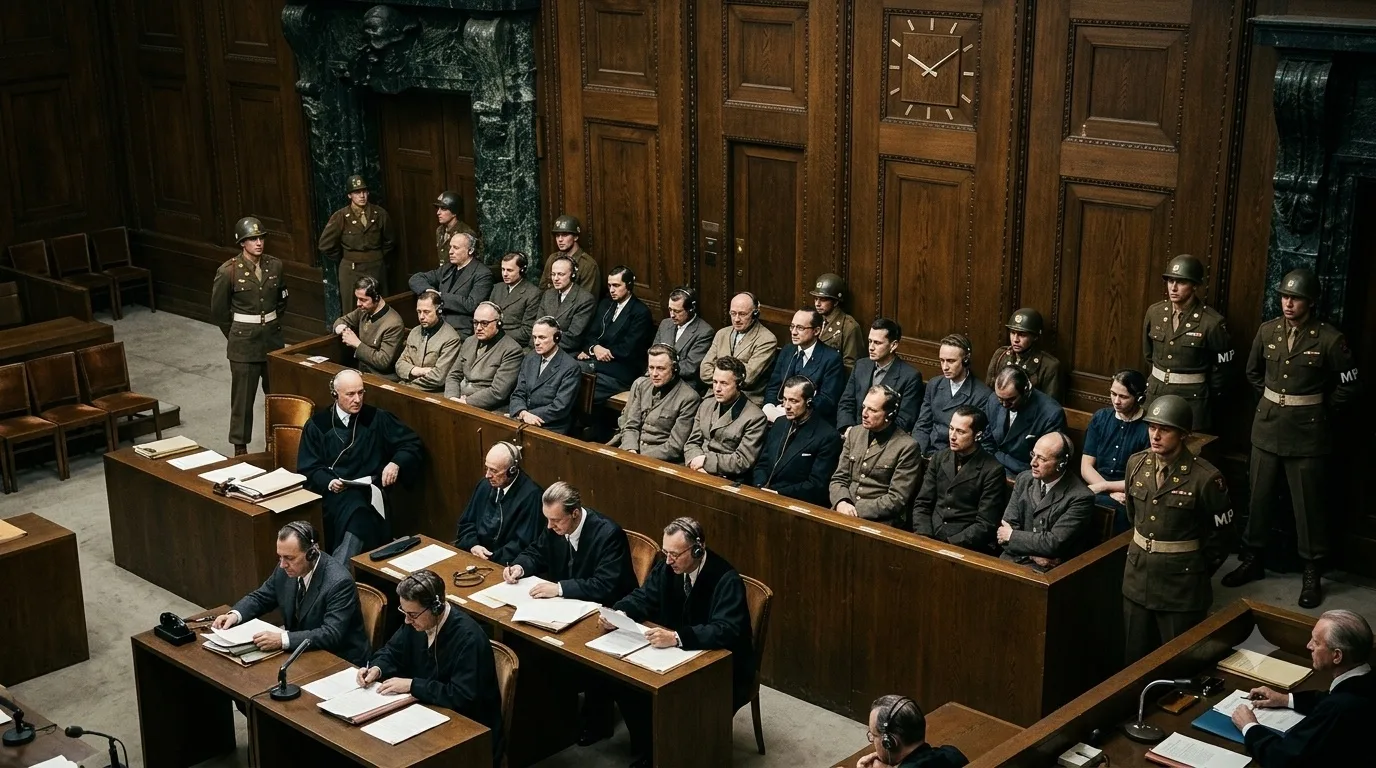 Nuremberg, 1946–47: Nazi medical crimes on trial. Unit 731 never got its courtroom. (AI illustration)
Nazi Germany’s camp doctors conducted hypothermia, infection and sterilization experiments of comparable cruelty. But in 1946–47, the United States prosecuted 23 physicians and medical administrators at the Nuremberg Doctors’ Trial; 16 were convicted, seven sentenced to death (USHMM). That was justice for a part of Nazi medicine, not all of it — but out of the verdict came the Nuremberg Code, a ten-point code that stands among the foundational documents of modern research ethics, beginning with the principle that a human subject’s voluntary consent is absolutely essential (USHMM). Comparable violations of human beings in medical research; radically different reckonings — one produced a code of ethics, the other a classified file.
And lest the lesson seem safely foreign: the U.S. Public Health Service’s untreated-syphilis study at Tuskegee (1932–1972) followed 399 Black men with syphilis and 201 without, withholding treatment to observe the disease — no wartime laboratory, no violence, just a public-health program’s face on a forty-year ethical failure (National Library of Medicine). The men were not deliberately infected, and the methods and contexts differ profoundly from wartime forced experimentation. What the two cases share is narrower and worth stating precisely: both show why vulnerability, coercion and the absence of informed consent sit at the center of research ethics — the concerns the drama, in its own genre language, digs at.
Watch it again
Here’s the drama-versus-record ledger:
| In Gyeongseong Creature | In the historical record |
|---|---|
| A monster is created in a hospital basement | Fiction — no such creature, no such experiment |
| Ongseong Hospital operates in Seoul | Fiction — Unit 731’s experimental complex was at Pingfang, Manchuria |
| Prisoners are treated as experimental material and called “logs” | Documented — postwar testimony records the term maruta for Unit 731’s human subjects |
| Koreans fill the underground cells | Koreans were among the victims, per “special transfer” records; most victims were Chinese |
| Season 2: the experimenters thrive in 2024 behind a corporation | Fantasy aimed at fact: the leadership was shielded from prosecution by U.S. authorities and never tried |
| The horror never really ends | The Nuremberg Code exists because Nazi medical crimes were tried; apart from the Soviet Khabarovsk trial of 1949, no comparable Allied prosecution of Unit 731’s central leadership ever came |
Gyeongseong Creature is a creature feature, and a stylish one. But its deepest horror is the historical one: the monster on the table was never the monster in the room. Many of the central men in white coats walked away, built careers, published, taught, and died without ever facing an Allied courtroom — and that, not the creature, is the part the drama did not have to invent.
In the next essay, we’ll take another K-drama scene that looks like pure fiction — and trace the real Korean history hiding underneath it.
Frequently asked questions
Is Gyeongseong Creature based on a true story? The monster, Ongseong Hospital, and the characters are fiction. What is real is the history the horror stands on: Japan’s Unit 731 conducted lethal human experiments — infection with plague and cholera, vivisection of living prisoners according to postwar investigations and testimony — and its victims included Koreans. The drama relocates that history into an invented Seoul hospital; it does not invent the atrocity itself.
Was there a real Ongseong Hospital in Seoul? No. Ongseong Hospital is an invented setting, and no monster-making laboratory existed in colonial Seoul. Unit 731’s headquarters and its large experimental complex were at Pingfang, near Harbin in Japanese-controlled Manchuria — the drama moves the geography, not the substance.
Did Unit 731 really exist, and what did it do? Yes. Officially named a Kwantung Army “Epidemic Prevention and Water Purification” unit, it was in reality a biological-warfare research organization led by the microbiologist Ishii Shiro. Postwar investigations and participant testimony record deliberate infection of prisoners with plague, cholera and anthrax, frostbite experiments, and vivisection of living subjects — some testimony says without anesthesia.
Were Koreans among Unit 731’s victims? Yes. Most victims were Chinese, but the unit’s “special transfer” records — batches of which were made public by China’s Jilin Provincial Archives in 2014 — include Koreans among those sent to Unit 731, several identifiable by name and hometown. The number of Koreans who can be individually confirmed is limited, in part because the unit burned most of its records at the end of the war.
Was anyone punished for Unit 731’s experiments? Largely no — and that is the history behind Season 2. Ishii Shiro and the core researchers investigated by the U.S. were never prosecuted at the Tokyo trials; American military and intelligence authorities shielded them while obtaining their experimental data. Some personnel connected to Japan’s biological-warfare program were convicted separately at the Soviet Union’s 1949 Khabarovsk trial. Ishii died of illness in 1959, untried.
What does “maruta” mean? Maruta (丸太) is Japanese for “log.” According to postwar testimony from unit personnel and later research, it was the term used inside Unit 731 for the human beings held for experimentation — people counted like timber. The term is principally known through testimony and postwar research, not through a complete surviving prisoner ledger; the drama’s use of the word is drawn from that testimony.
Did Unit 731 operate in Korea? Its principal experimental complex was at Pingfang near Harbin in Manchuria, not in Seoul. Other Japanese military medical and epidemic-prevention organizations operated across the empire, but no evidence identifies an Ongseong Hospital-type Unit 731 experimental facility in colonial Seoul. The drama deliberately relocates the historical horror to Gyeongseong.
How many people did Unit 731 kill? No complete total can be established, because the unit destroyed its records. Historians commonly cite roughly 3,000 deaths inside the Pingfang complex as an estimate, while deaths from Japan’s field use of biological weapons in China form a separate, much larger and heavily disputed category. The two figures rest on different kinds of evidence and should not be combined into one number.
Sources & further reading
This piece was written from the historical script and fact-check of 사뚱샘의 역사방 (SaDDungSam). A note on numbers: facility deaths at Pingfang and the toll of field germ warfare are kept as separate categories here, and figures that could not be tied to a specific documentary basis (a widely repeated “10,000+” total, a single fixed count for the special-transfer files) are omitted or given as ranges rather than repeated.
- The declassified American record — the IWG’s guide to Unit 731 materials in the U.S. National Archives, including the immunity-for-data bargain. (Researching Japanese War Crimes Records: Introductory Essays · IWG portal)
- The “special transfer” documents — the 2014 Jilin Provincial Archives releases and later document disclosures, recording Koreans among those sent to Unit 731. (Beijing Review · China Daily, 2023)
- The road not taken — the Nuremberg Doctors’ Trial and the Code it produced. (The Doctors Trial — USHMM · The Nuremberg Code — USHMM)
- Peacetime’s version — the U.S. Public Health Service untreated-syphilis study at Tuskegee, 1932–1972. (National Library of Medicine)
- The drama itself. (Netflix title page · About Netflix on Season 2)
Thanks for reading — see you in the next one.
This article was researched and written by K-Drama History. Source: Gyeongseong Creature, Explained: The Real Human Experiments Behind the Monster — Unit 731 — K-Drama History