Joseon Fire Service Explained: Geumhwadogam, Myeolhwagun, and the 1426 Hanyang Fire
Theme: Knowledge & Science
From the research behind Pause the Drama.
(Dates below follow the lunar calendar used in the Veritable Records.)
The capital burned, and the king was not there.
On the fifteenth day of the second month of 1426, fire broke out in a private house in the southern district of Hanyang. A strong north-westerly was blowing. The houses were thatched, timber-framed and built flush against one another, and the fire went across the city.
The Great King, Sejong (대왕 세종), KBS’s eighty-six-part 2008 series, puts this fire on screen — the disaster and Queen Soheon’s response — in an episode most viewers do not remember, because it is not the hangul or the astronomical instruments. It is the part of Sejong’s reign where the story is not really about Sejong at all. He was in Gangwon province at a gangmu (강무), the royal hunt that doubled as military training and counted as a scheduled state event, not a holiday.
So here is the question the drama sets up and history answers differently: with no fire engines and no pumps, in a city of thatch, how do you stop a fire — and who decides anything when the king is a province away?
The answer Joseon arrived at is not the one sageuk usually offers. Not a heroic king, not a martyr. An office, a set of regulations, and a flag.
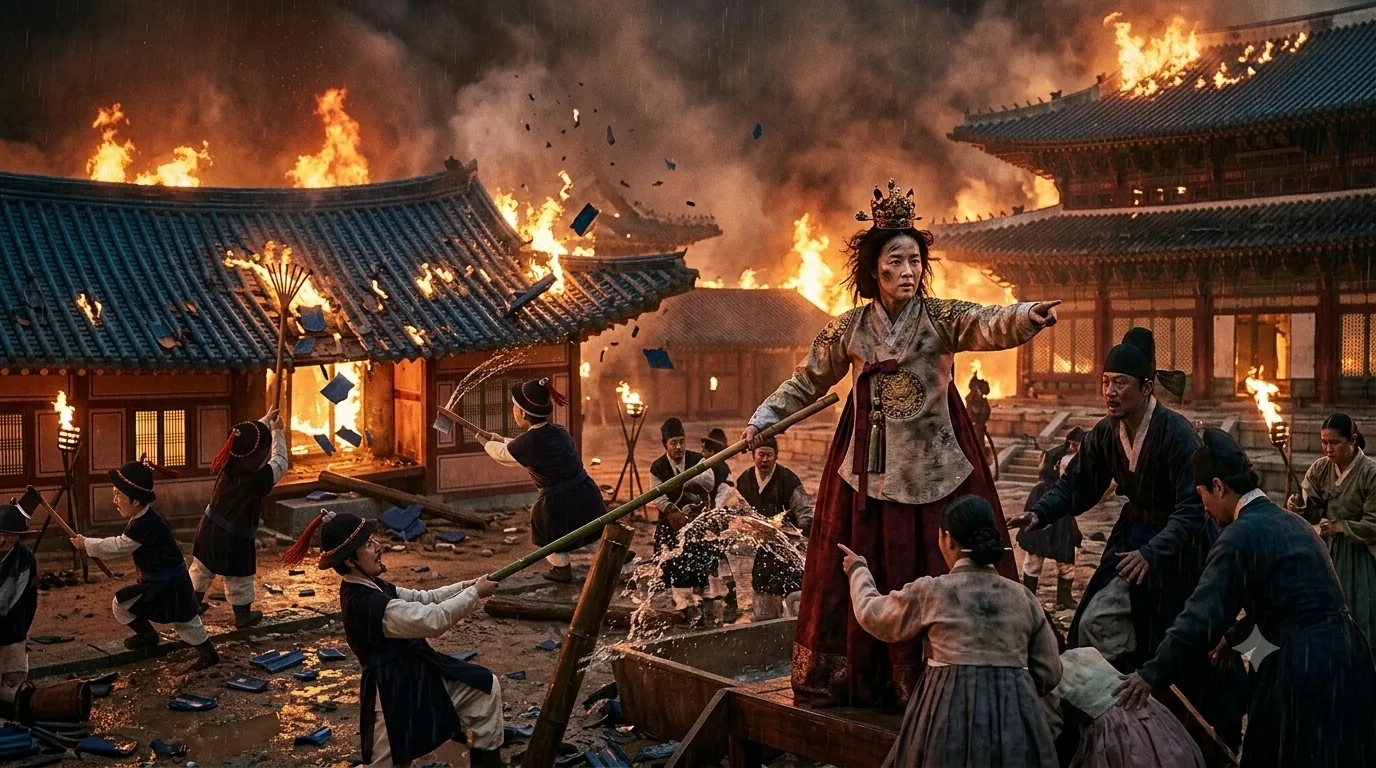 The 1426 fire reached the heart of a planned capital where the shrine, the palaces, the offices and the market stood packed together. (AI illustration)
Quick answer: After the great fire of the second month of 1426, Joseon established a dedicated fire office, the Geumhwadogam (금화도감), on the twenty-sixth day of that month. Fire measures already existed before it — patrols, palace regulations, building rules — so this was a further step of institutionalisation rather than an invention from nothing. Regulations of 1431 set out crews (geumhwagun, 금화군), unit flags, bell signals, rewards and punishments, and named the geupsu-bija (급수비자), water-drawing female slaves of the government offices, as part of the mobilisation. In 1467 the crews were reorganised as the myeolhwagun (멸화군), fifty men issued axes, iron hooks and rope. And the first order during the 1426 fire came from Queen Soheon, because the king was out of town.
What actually burned
The record for the fifteenth day of the second month is specific. 1,630 houses in the central district, 350 in the southern, 190 in the eastern — 2,170 private houses — together with 116 bays of the state row houses. The next day fire broke out again and took roughly two hundred more houses.
Thirty-two deaths were confirmed, and the record breaks them down: nine men and twenty-three women (男九、婦二十三). Then it adds the sentence that matters more than the total — infants, the elderly and the sick who burned to ash “were not included in that number” (乳兒老疾燒亡爲燼者,不在其數).
So thirty-two is what the state could count, not what the fire took. And of those it could count, roughly two in three were women.
You will see this fire described as destroying a sixth of the capital. That figure comes from setting the burned houses against a household count of around seventeen thousand — which is not a contemporaneous 1426 statistic, and which in any case yields about 12.8 per cent rather than a sixth. The safe statement is the one the record supports: 2,170 houses in a single day, and more the day after.
A note on scale, too. This was a major fire — one of the defining urban fires of early Joseon — but calling it the largest the capital suffered in five centuries would need a comparison nobody has published.
The order came from the queen
Sejong was at the hunt in Gangwon. He received the report and decided to return on the sixteenth, travelling back on a schedule; he did not appear in the burning city that night.
In the meantime Queen Soheon issued an order to the officials: even if the offices holding the state’s money and grain could not be saved, the royal ancestral shrine and Changdeok Palace were to be defended. That is a priority instruction, and a revealing one — the legitimacy of the dynasty ranked above its treasury.
It is worth being careful about how far to push this. She did not command the firefighting operation as a whole; the ministers left in charge of the capital and the assembled officials ran the response. What the episode shows is narrower and still striking: in the king’s absence a queen’s instruction carried, and the state kept functioning. Sageuk usually keeps a queen inside palace intrigue. This is a different register.
What the state built afterwards
On the twentieth day of the second month came the physical measures: firebreak walls on the state row houses, roads widened to cut the path of fire, main thoroughfares opened, wells dug at intervals. Urban planning and water supply were pressed into fire policy at once. Relief followed as well — grain and soy issued to those burned out.
On the twenty-sixth the court established the Geumhwadogam. The proposal in the Veritable Records states the reason plainly: there was no agency responsible for preventing fire inside the capital, and people were losing property and lives, so a separate office should be set up as a standing body and not abolished.
Note what this is and is not. Joseon already had fire patrols, palace fire regulations and building rules; the state had not been leaving fire to private courage. What 1426 produced was a dedicated office for it — a further step in institutionalisation, not a first step.
The office did not keep one stable name. In the sixth month of 1426 it was merged with the gate-maintenance office as the Suseong geumhwadogam (수성금화도감); that body was wound up in 1460; and after the question was reopened in 1481 the function was formalised as the Suseong geumhwasa (수성금화사). The responsibility persisted through abolition and revival — the organisation kept being reshaped around it.
The regulations of 1431 — and the women in them
Five years later, on the thirteenth day of the fifth month of 1431, the State Council, the Six Ministries, the Hanseong magistracy and the Geumhwadogam jointly submitted fire-prevention provisions. These are where the system becomes concrete.
Personnel. The Geumhwadogam set the numbers, taking account of the slaves and female servants attached to each government office: crews of soldiers to fight the fire, and separately the geupsu-bija (급수비자, 汲水婢子) — the water-drawing female slaves. The provision has them preparing water vessels in advance and being mobilised with them to the fire.
That is the detail worth stopping on. Joseon’s fire response was not only men with axes. Written into the regulation, by name, are office women carrying water.
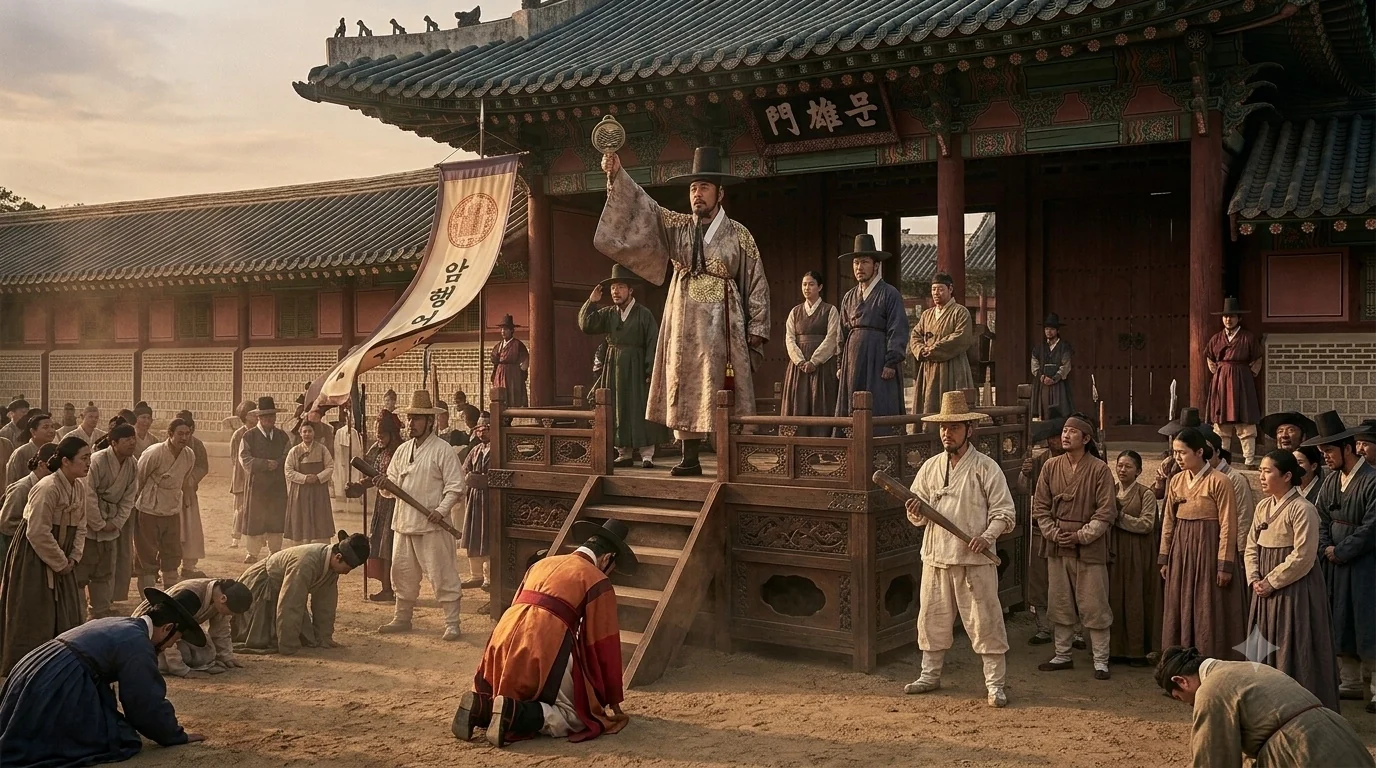
Identification. Each office made cloth banners of a common pattern, marked with the office’s own military designation and stamped with the Geumhwadogam’s seal, so crews could be told apart at the scene. Command posts were hard to find among the offices and wards, so flags were raised and drums beaten to mark position.
Speed over procedure. One provision is unusually direct. On days when the wind was wild and a fire flared, when the bell sounded, officials of the Ministry of War and of the related duty offices were to take the troops under them and go straight to where the flag stood — without going through the reporting procedure first. In a state that took memorials and royal approval very seriously, the regulation writes an exception for fire: skip the paperwork, get there.
Rewards and punishment. Those who performed were to be rewarded; the slow and negligent were held liable — including officials of offices that arrived late.
Neighbourhood mobilisation. Households were grouped in fives with a roster, and were to prepare water vessels. When a fire started, the nearest houses defended their own; the rest gathered under the ward officer. On selecting people for these units, the text says not to argue about high and low status. That is a rule for staffing fire response — not a suspension of the status order in general.
The men with axes
The name myeolhwagun (멸화군) — literally the fire-extinguishing troops — suggests men throwing water. The equipment list says something else.
In 1467, after a fire in the royal kitchen office spread to several government buildings, the existing crews were expanded and reorganised as the myeolhwagun. The entry is one line long, and it is a list: 定滅火軍五十人,授斧二十、鐵鉤十五、熟麻緪五 — fifty men appointed, issued twenty axes, fifteen iron hooks, five hemp ropes. (This was under King Sejo, four decades after the Geumhwadogam — the myeolhwagun is not something Sejong created.)
Hooks and axes are demolition tools. The core tactic was to pull a burning building apart and take away the fire’s road. The Veritable Records record the issue of the equipment rather than describing exactly how each tool was swung, so the mechanics are an inference from the kit.
It would be wrong, though, to reduce the whole system to demolition. The 1431 provisions also cover direct extinguishing: water carried by the geupsu-bija, and old cloth soaked in water and distributed to be thrown over flames. Both were in the regulations.
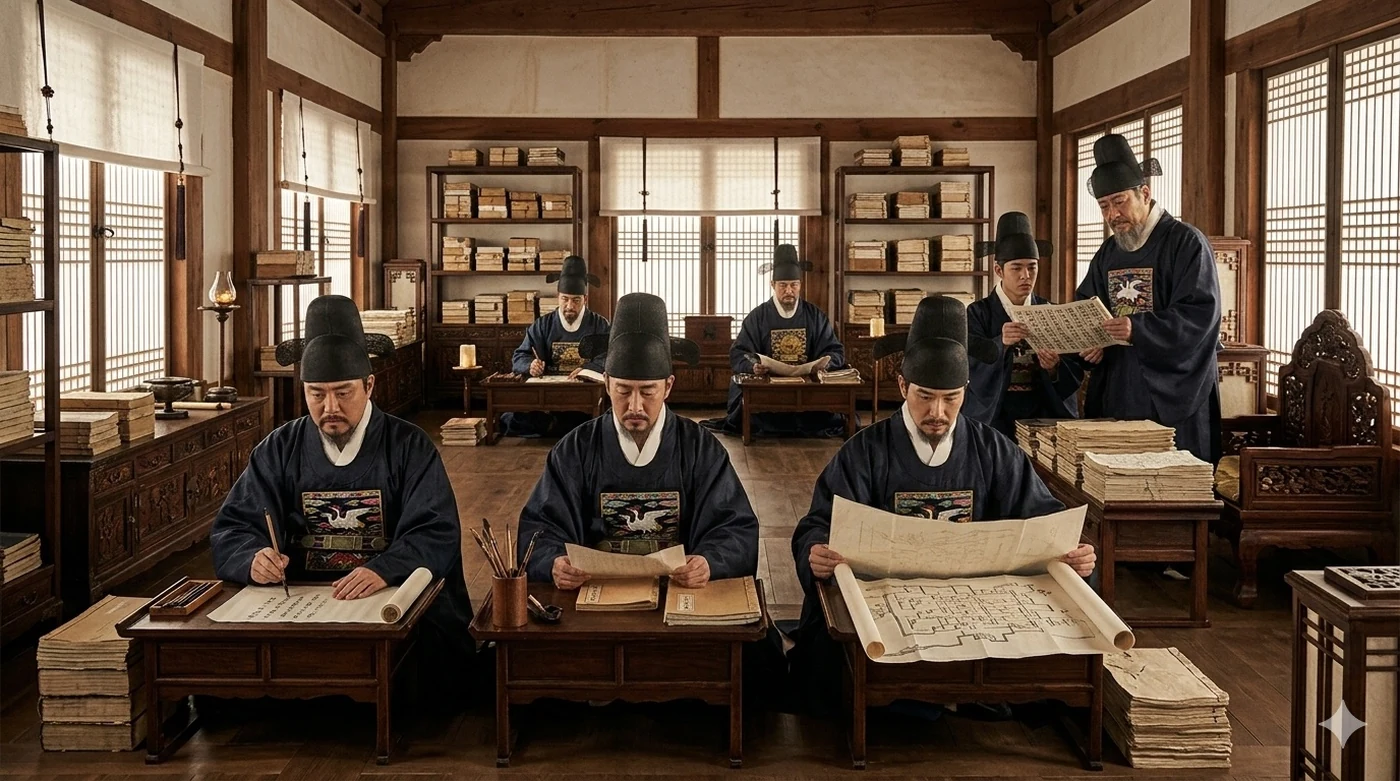
Later material describes standing watch from a bell tower, night patrols in high wind, inspection of firebreak walls and equipment. Much of that belongs to the later Suseong geumhwasa system and to duties divided among several offices, so it should not be collapsed into the daily routine of the fifty men of 1467. The establishment shrank over time — the Korea Heritage Service records thirty men by 1619 — and individual myeolhwagun barely appear in the record at all. They worked without names.
Bells, passes and the curfew
Sageuk characters who move at night dodge the patrol. Joseon’s night curfew was strictly enforced. So how did a man running to a fire get through?
He carried a pass. An entry from the third month of 1426 records sinpae (信牌) being made as tokens precisely so that people engaged in firefighting at night would not be detained. The 1431 regulations approach it from the other side: a person rushing to put out a fire is not to be blocked even without a marker — with the caveat that anyone moving suspiciously should still be stopped.
(Some accounts give the token as guhwapae (救火牌). The name that appears directly in the primary record here is sinpae, so that is the one used above.)
The bell signals were similarly staged rather than uniform. In the third month of 1426 the court limited bell-ringing for fire to government office fires; the 1431 provisions then set out signals for a large fire, and for turning out when the bell was rung differently. Two moments, two rules — not one permanent system.
Why the state took this on
Hanyang was a planned capital, and the shrine, the palaces, the offices and the market were packed into it. A fire there was not only property damage; it went at the symbolic and administrative core of the dynasty at once. Queen Soheon’s priority order says exactly that.
So the response was integrated: firebreak walls and wide roads as planning, wells as water supply, the bell tower as alarm, banners and drums as command and control, rewards and liability as accountability.
What holds it together is that it does not depend on any particular person. The king could be at a hunt; an officer could be replaced. When the bell rang, designated people went to designated places. That is a description of what the system did — not a claim that it was designed around royal absence.
One thing worth keeping in view: the people doing the most dangerous work were government slaves and low-ranking soldiers. A system that told its organisers not to weigh status when assigning fire duty was still built on a society that weighed status everywhere else.
The jars in front of the palace halls
Institutions were not the whole of it. In front of Geunjeongjeon at Gyeongbok Palace and Daejojeon at Changdeok Palace stand wide-mouthed vessels called deumeu.
The Korea Heritage Service explains that they could hold water for fire use, but that the meaning was largely symbolic: the fire demon, hwama (火魔), was said to look into the water, see its own face, and flee in fright. In winter, charcoal was burned beneath the stands so the water would not freeze. (On material: the Gyeongbok Palace deumeu have been studied as cast-iron artefacts, so describing all of them as bronze would be too broad.)
The haetae statues before Gwanghwamun are explained along the same lines — the peaks of Gwanaksan were said to have the shape of flame, and a water spirit was set up so that their fire energy would not reach the palace. That account is transmitted lore rather than a court record, and the present statues date from the Gyeongbok Palace reconstruction under Gojong.
So two orders of thinking sat in the same courtyard. A state that built firebreak walls, drew up rosters and wrote reward-and-punishment clauses also put a water jar in front of the throne hall and hoped the fire demon would startle at its own reflection. Regulation and charm were not pushing each other out.
How does this compare with Rome, Edo and London?
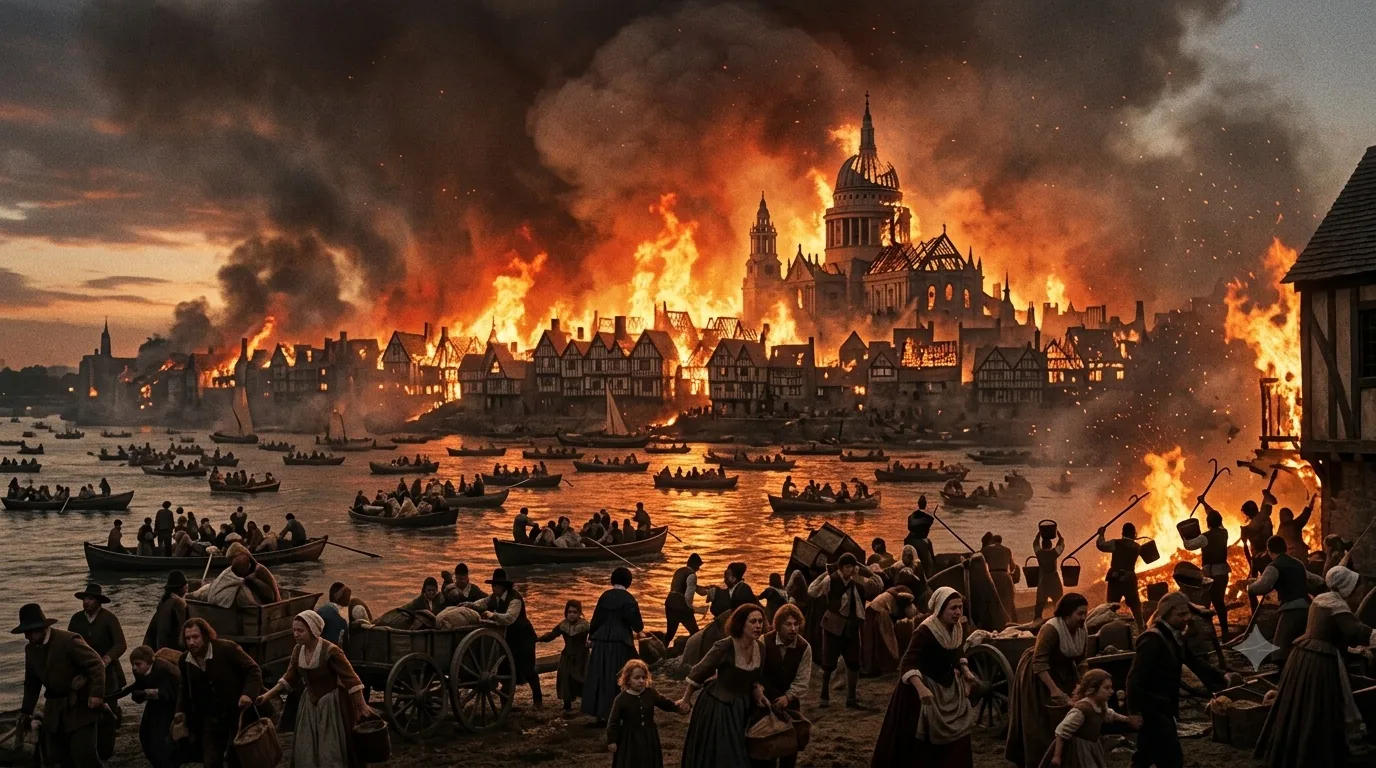 London, 1666. What followed there were insurance brigades — private companies, not a public service. (AI illustration)
Rome — far earlier. Augustus established the Vigiles, a standing fire and night-watch force, around 6 CE. That is well over a millennium before Hanyang’s fire office. Joseon’s arrangement cannot be called the world’s first, and the interesting claim is not chronological priority.
Edo — the fire capital. Edo burned so often that the phrase about fires and quarrels being its flowers is proverbial, and the shogunate maintained several kinds of fire organisation — including hōsho hikeshi and daimyo brigades before the great fire of 1657. The shogunate’s own standing brigade, the jōbikeshi (定火消), is best dated to 1658 on the fire department’s current account, with older sources giving 1650. So the honest comparison is not “great fire produced fire service” on both sides — it is that a catastrophic fire strengthened and made permanent arrangements that already existed.
London — and what the insurance brigades actually did. At the Great Fire of 1666 London had no organised fire brigade; leather buckets and hooks accomplished little. The brigades that followed were private companies formed by fire insurers, with the London Fire Brigade dating the first Fire Office to 1680.
Here a popular story needs correcting. The image of insurance crews standing by while an uninsured house burns is, on the London Fire Brigade’s own account, largely unsupported — there were rules requiring crews to turn out to fires they discovered regardless of who was insured. That insurers ran brigades to protect their own liabilities is true; that they let buildings burn by contract is not established.
The difference that survives scrutiny is one of character: London’s response after 1666 grew out of commercial insurance, while Joseon’s was carried on the state’s own books, with government offices and neighbourhood units rostered together. The gap between 1426 and 1666 is 240 years — but that is the distance between two fires, not between two fire services.
| What the drama frames | What the record shows |
|---|---|
| A disaster is resolved by the king rushing in | The king was at a hunt; he decided to return the next day and travelled back on a schedule |
| A queen belongs to palace intrigue | Queen Soheon issued the order to protect the shrine and Changdeok Palace ahead of the treasury |
| Firefighting means throwing water | Axes, iron hooks and rope for demolition — alongside carried water and soaked cloth in the regulations |
| Heroic individuals save the city | Offices, banners, drums, bell signals, rosters, rewards and liability |
| Fire duty is men’s work | The 1431 provisions name the geupsu-bija, office women mobilised with water vessels |
| 1426 created fire response from nothing | Patrols and building rules already existed; 1426 produced a dedicated office for them |
In short: Joseon’s answer to fire was not courage. It was an office, a roster and a flag — and the part of it the record names by function includes women carrying water.
Key terms. Geumhwadogam (금화도감) — the fire office established in 1426. Suseong geumhwasa (수성금화사) — the later body formed by merging it with the gate-maintenance office. Geumhwagun (금화군) — the fire crews of the 1431 regulations. Myeolhwagun (멸화군) — the fifty-man corps reorganised in 1467 with axes, hooks and rope. Geupsu-bija (급수비자 汲水婢子) — water-drawing female slaves of the government offices, mobilised to fires. Sinpae (신패 信牌) — the token that let firefighters move during the night curfew. Gangmu (강무) — the royal hunt doubling as military training, which took Sejong out of the capital. Deumeu (드므) — the wide vessel set before palace halls, water for fire and a charm against the fire demon.
Back to the drama
The Hanyang fire does not sit high on any list of Sejong’s achievements. It is not an alphabet or a rain gauge, and it happened while he was away.
What it left is easier to point at than to dramatise: one office, firebreak walls and wells, a bell in the tower, a banner for each government office, fifty men with axes — and the office women who took up water vessels and went to the fire because a regulation said they would.
A city of thatch does not survive on heroism. It survives on a roster.
Frequently asked questions
Did Joseon have a fire department? It had a dedicated state office. After the 1426 fire the court set up the Geumhwadogam for fire prevention and suppression in the capital, later staffed by the geumhwagun and myeolhwagun. It is not equivalent to a modern municipal fire department.
What was the Geumhwadogam? The fire office established on the twenty-sixth day of the second month of 1426. The recorded proposal says no agency was responsible for preventing fire in the capital, so one should be set up as a standing body. It was later merged into the Suseong geumhwasa.
How did Joseon fight fires without fire engines? Mostly by removing the fire’s path. The 1467 corps carried twenty axes, fifteen iron hooks and five hemp ropes to pull burning buildings apart, while the regulations also provided for carried water and water-soaked cloth thrown over flames — with firebreak walls, wide roads and wells as standing prevention.
Did women fight fires in Joseon? The 1431 regulations name the geupsu-bija — water-drawing female slaves attached to government offices — who prepared water vessels and were mobilised with them to fires.
Was the queen really in command during the 1426 fire? Not of the whole operation. Sejong was away at a military hunt; Queen Soheon ordered that the royal shrine and Changdeok Palace be protected even if the offices holding money and grain were lost. Ministers left in charge ran the response.
How big was the 1426 fire? 2,170 private houses — 1,630 central, 350 southern, 190 eastern — plus 116 bays of state row houses, with about two hundred more houses the following day. Thirty-two deaths were confirmed, nine men and twenty-three women; the entry states that infants, the elderly and the sick burned beyond counting were not included in that figure.
Was Joseon’s fire service the first in the world? No. Rome’s Vigiles date from around 6 CE. What distinguishes Joseon is that fire response was run as a state obligation with offices, regulations and rosters.
How did firefighters get past the night curfew? With a sinpae, a token recorded in the third month of 1426 so that night firefighting would not be treated as a curfew violation. The 1431 rules add that someone rushing to a fire should not be blocked even without a marker.
What are the large vessels in front of palace halls? Deumeu. They could hold water, but the Korea Heritage Service describes the meaning as largely symbolic — the fire demon seeing its reflection and fleeing. The Gyeongbok Palace examples have been studied as cast-iron artefacts.
Sources & further reading
This piece was written from the historical script and fact-check of 사뚱샘의 역사방 (SaDDungSam). Dates follow the lunar calendar of the Veritable Records.
- The fire and its damage; the queen’s order; the king’s return. 『세종실록』, Sejong 8th year, 2nd month, 15th–16th day
- Firebreak walls on the row houses, road widening, wells, relief grain. 『세종실록』, Sejong 8th year, 2nd month, 20th day
- Establishment of the Geumhwadogam. 『세종실록』, Sejong 8th year, 2nd month, 26th day
- Bell signals and the sinpae pass. 『세종실록』, Sejong 8th year, 3rd month, 3rd day
- The fire-prevention regulations: crews, geupsu-bija, banners, flags and drums, skipping the reporting procedure, rewards and liability, five-household units. 『세종실록』, Sejong 13th year, 5th month, 13th day
- The myeolhwagun and its equipment. 『세조실록』, Sejo 13th year, 12th month, 20th day
- Queen Soheon (소헌왕후). National Institute of Korean History, 우리역사넷
- Geumhwadogam · fire services · Suseong geumhwasa. Encyclopedia of Korean Culture
- 「불을 끄는 ‘조선의 소방관’」 · 「불과 싸우기 위해 태어난 멸화군」 · 「궁중의 화마를 쫓는 독, 드므」. Korea Heritage Service
- On the material of the Gyeongbok Palace deumeu. 문환석, 「주조철제 유물 보존처리 — 경복궁 드므 보존처리를 중심으로」, 국립문화재연구소 『보존과학연구』 19호
- The Great Fire of London; Early Insurance Brigades. London Fire Brigade
- Edo fire organisations and the jōbikeshi. 東京消防庁 「江戸の火消」; 日本消防協会 「消防の歴史」
- The Great King, Sejong (KBS, 2008) — episode 64 covers the 1426 fire and Queen Soheon’s response; the simultaneous-arson plot and investigation around it are dramatic invention
Thanks for reading — see you in the next one.
This article was researched and written by K-Drama History. Source: Joseon Fire Service Explained: Geumhwadogam, Myeolhwagun, and the 1426 Hanyang Fire — K-Drama History