Rookie Historian Goo Hae-ryung, Explained: Could Joseon's Historians Record What the King Wanted Hidden?
Theme: Knowledge & Science
From the research behind Pause the Drama.
The 45-second version — on YouTube
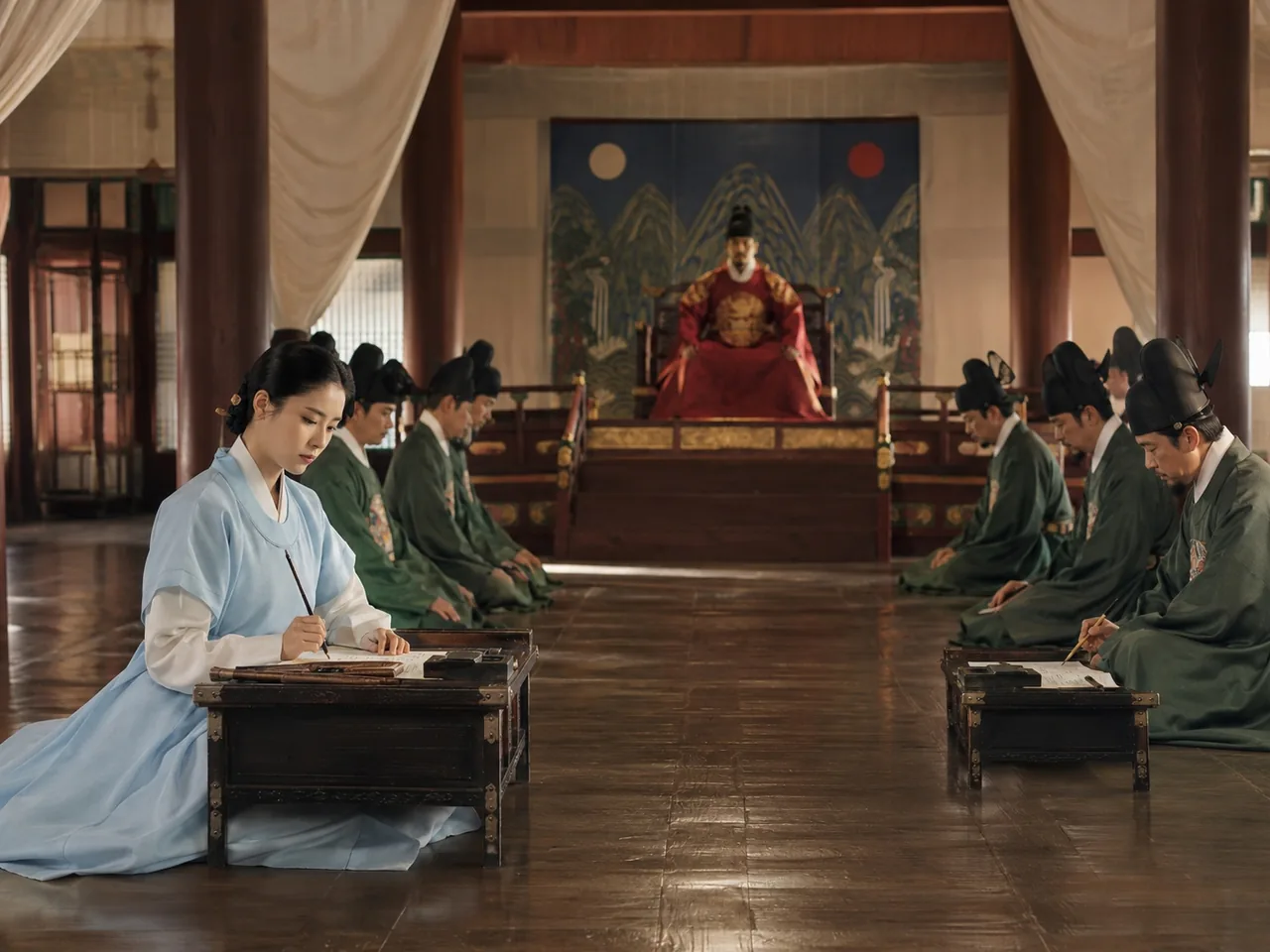
If you’ve watched the 2019 MBC drama Rookie Historian Goo Hae-ryung (신입사관 구해령), you followed a spirited young woman fighting her way into one of Joseon’s most exclusive careers: the court historian. The show’s premise — a female historian — is a romantic invention; no woman is known to have held an official sagwan post. The dynasty’s full-time court historians were a handful of junior officials in the Hall of Letters (Yemun-gwan), chosen from male literary-examination graduates through a fiercely competitive recommendation process. (For the drama’s heroine and the question of women around Joseon’s records, see our companion piece on Goo Hae-ryung and Joseon’s female historians.) But the job she was fighting to enter was very real, and it may be the most quietly astonishing office in the entire dynasty.
Because here’s what these historians could do: they could write down the things the king most wanted kept out of history — and, as a rule, the king was not allowed to stop them.
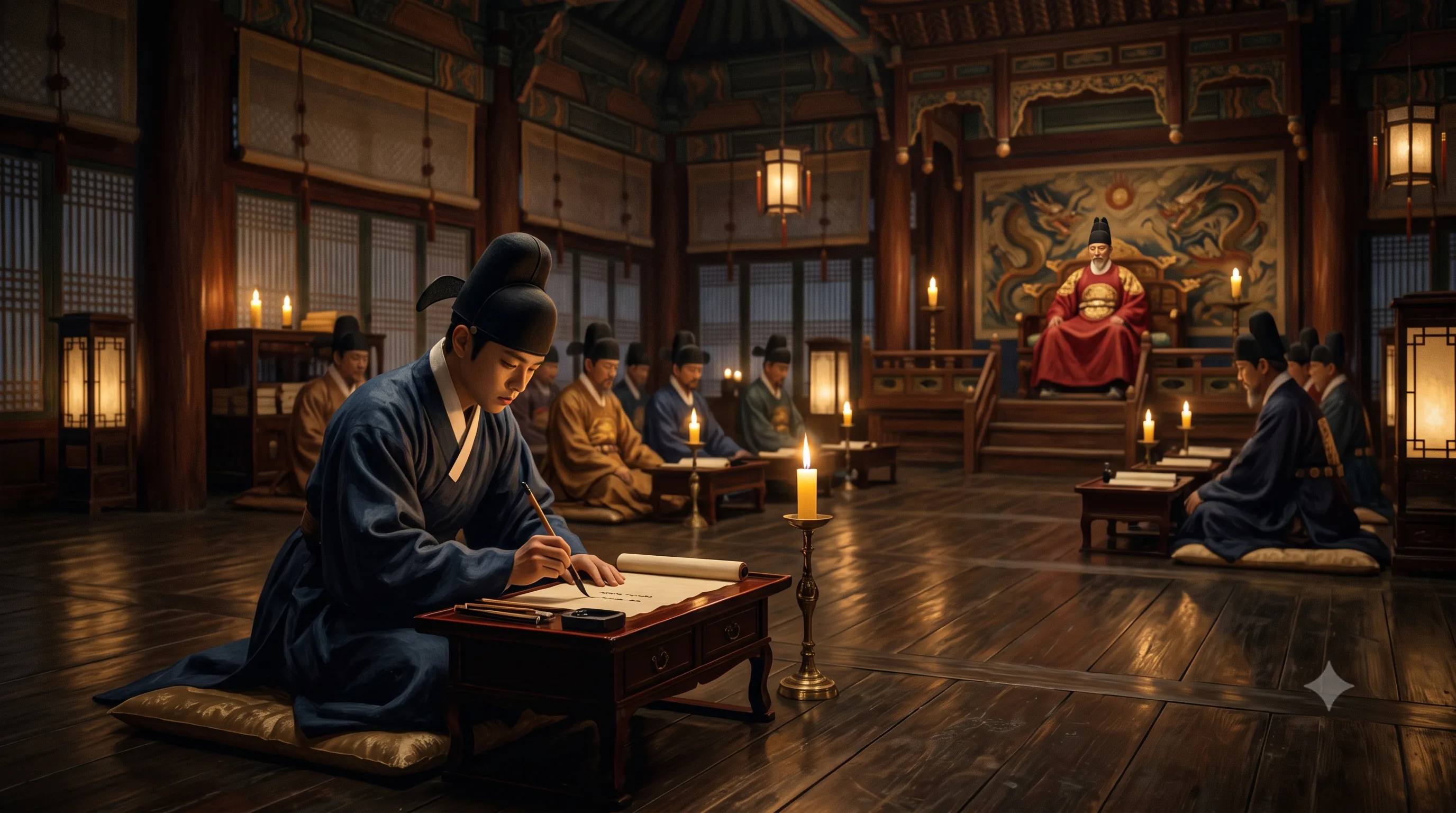 Joseon court historians attended major councils, audiences, and royal outings, recording the words and acts they witnessed — even ones the king wanted left out. (AI illustration)
Quick answer: Joseon’s court historians (sagwan) attended major audiences, councils, royal lectures, and official journeys, recording the words and actions they witnessed in draft notes called sacho. The king was normally forbidden from inspecting those drafts — a rule meant to protect honest writing. The Taejong Sillok preserves both the king’s fall from a horse and his order, “do not let the historian know.” But the system wasn’t absolute: kings sometimes excluded historians, pressured them, or breached the secrecy of their records. Joseon’s court historiography belonged to a broader East Asian tradition — but developed unusually durable procedures to protect the record.
Let’s unpack it.
Could a historian really record the king’s secrets?
Yes — and the single best illustration is a king falling off a horse.
King Taejong, the formidable third king of Joseon, was hunting when his horse threw him. He wasn’t badly hurt, but — embarrassed — he looked around and said, in effect, “don’t let the historian know about this.” The Korean phrase preserved in the record is 勿令史官知之 (“do not let the sagwan know”). And here is the punchline that captures the whole institution: the Taejong Sillok — compiled from many records after his death — preserves both the fall and the king’s order to hide it (Encyclopedia of Korean Culture — Annals of the Joseon Dynasty). The irony is genuine: even his wish to keep a humiliating moment out of history became a permanent line in the record.
That is the heart of the sagwan system. The historian sat close to the king, recorded what he said and did in the course of state affairs, and produced draft notes — the sacho (史草) — that were, as a rule, kept from the king himself. The reasoning was blunt and brilliant: if the king could preview his own record, the historian could never write the truth.
How did a court historian’s notes become the Annals?
- The sagwan attended major court proceedings and wrote draft notes called sacho.
- The Office of Annals combined court notes and government records into continuing records of state affairs.
- After a king’s death, a temporary compilation office used the sacho, official records, court diaries, and other documents to produce the final Sillok.
When the records turned deadly
If the horse story shows the charm of the system, the next one shows its danger. The historians’ notes weren’t neutral minutes — they could carry the historian’s judgments of people and power, which made them, at times, documents worth dying over.
In 1498, the sacho of the historian Kim Il-son became the spark for a political purge remembered as the Muosahwa (무오사화), the first of Joseon’s great literati purges (National Institute of Korean History / 우리역사넷 — Muosahwa). Officials reported his draft to King Yeonsangun; when the compilation office resisted the king’s demand to see the sacho, a compromise was struck — selected passages were cut out and handed over. From there it escalated: Kim Il-son and others were arrested, and an essay by his teacher Kim Jong-jik, read as a veiled attack on King Sejo, widened the affair into executions and exile. The lesson cut both ways: a historian’s record was powerful enough to shake the court — and the secrecy rule could still collapse under political pressure.
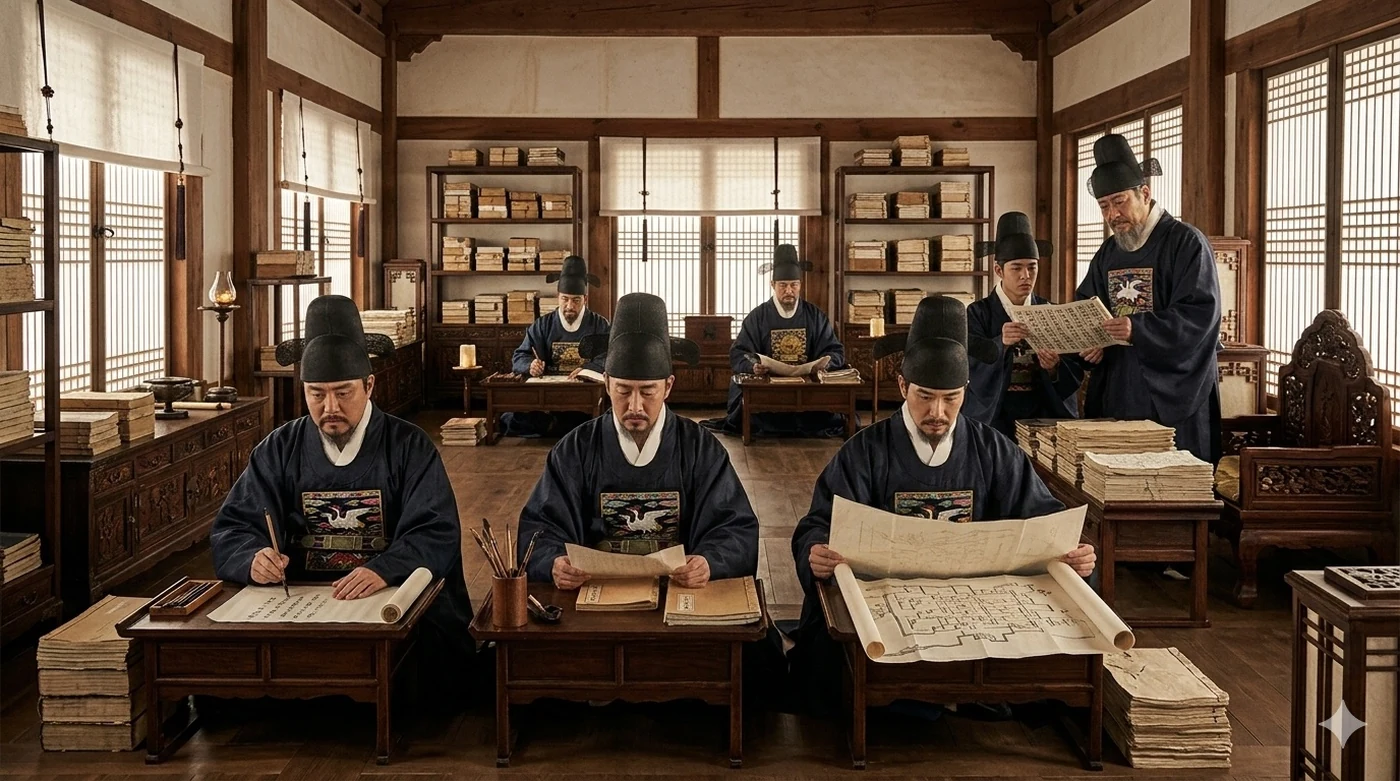
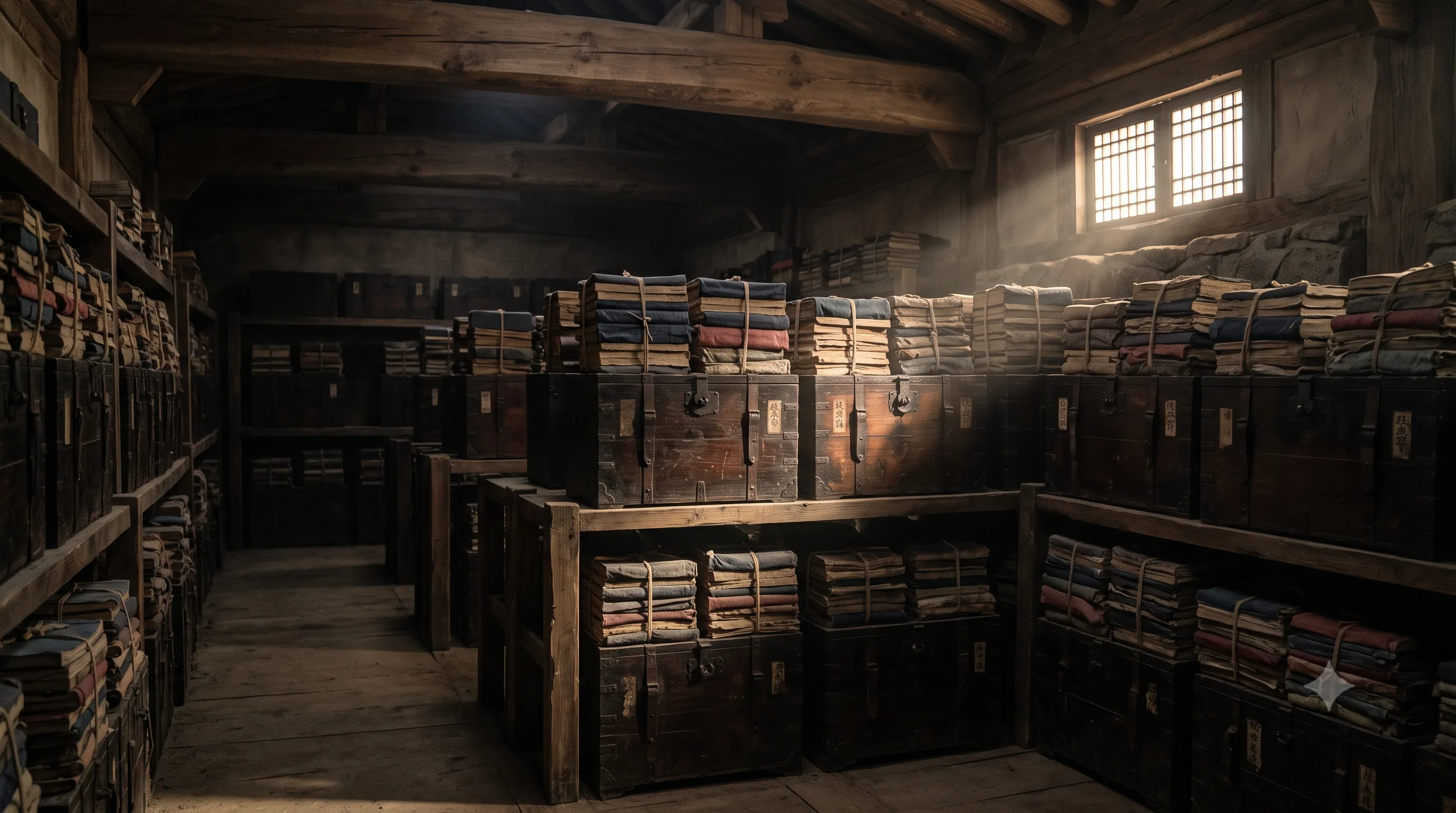 Copies of the compiled Annals were kept in several state archives; after the Imjin War, repositories were moved to remote mountain sites for safety — and remained off-limits even to the king. (AI illustration)
When a Ming officer seized the historians’ notebooks
The historians’ notes were sensitive not only in domestic politics but in diplomacy. During the Imjin War, in 1597, King Seonjo received the Ming military commissioner Yang Hao — and a flag-and-drum officer (기고관, a military aide, not a record-keeper) in Yang’s entourage seized the draft notebooks of two attending Korean record officials. Seonjo condemned the act as improper conduct by a guest in another country. But there’s a further twist: he also instructed that, in future meetings with Ming figures, the historians omit incidental details or write them down only afterward. The episode shows how charged those notes were — and that the historians’ access, though powerful, was never entirely beyond political pressure.
Put the three scenes together and the sagwan comes into focus. He was not a scribe taking dictation. He was there to record the king’s embarrassing moments, the violence of the powerful, and the tensions of a diplomatic room. That is exactly why Rookie Historian Goo Hae-ryung’s fiction is so resonant: the female historian never existed, but the question the show asks — “who gets to write the record of power?” — strikes at the true core of the Joseon system.
Key terms. Sagwan (사관, 史官) — a Joseon court historian who recorded the king’s words and acts. Sacho (사초, 史草) — the historian’s draft notes, kept from the king to protect honest writing. Sillok (실록) — the Annals of the Joseon Dynasty, compiled from the sacho after a reign ended. 勿令史官知之 — “do not let the historian know,” King Taejong’s order that the historians recorded anyway.
Here’s the drama decoded against the record:
| In the drama | In real history |
|---|---|
| A female rookie historian, Goo Hae-ryung | Female court historians are fiction; the sagwan were male exam-passers |
| Historians record the king closely | Real — they attended councils and audiences and wrote it all down |
| The record can’t simply be erased | Real — even Taejong’s “don’t let them know” was written down |
| The historian’s notes are dangerous | Real — Kim Il-son’s sacho helped ignite the 1498 purge |
| The job is coveted and powerful | Real — it was a formidable form of “record power” over the throne |
How Joseon compared to China, Japan, and the West
Joseon was not the only place that wrote down its rulers. What set it apart was how far it went to keep the king’s hands off the record.
Joseon’s court historiography belonged to a broader East Asian tradition inherited largely from China — and Chinese sources preserved the same ideal that a ruler should not inspect the record of his own conduct. But the Tang dynasty shows how two different records were involved. When Emperor Taizong of Tang asked to see the court diary (기거주, qijuzhu) — the running record of a ruler’s words and acts — the historian Chu Suiliang refused, saying he had never heard of a sovereign personally reading the histories (Old Book of Tang, Biography of Chu Suiliang — Chinese Text Project). Yet the records Taizong later did have brought to him and edited were the compiled veritable records assembled by Fang Xuanling and others; reading that the bloody Xuanwu Gate coup had been written euphemistically, he ordered the historians to “remove the empty phrasing and write it directly” (Zizhi Tongjian, vol. 197 — Chinese Text Project). The ideal of the unseen record existed in China — but it was not always kept.
What made Joseon distinctive was the durability of its procedures. It kept historians close to the king and made “the king does not see the sacho” a comparatively firm, enforced principle — precisely so a king couldn’t shape the record in advance (Encyclopedia of Korean Culture — Annals of the Joseon Dynasty (조선왕조실록)). Kings and powerful officials sometimes challenged those procedures — Yeonsangun’s breach of the sacho in 1498 is the famous case — but doing so was regarded as the behavior of a tyrant, which is how deeply the no-inspection norm had taken hold. Directly ranking Joseon, China, Japan, and Europe would take a far broader comparison than any single episode can carry; what’s fair to say is that Joseon institutionalized a shared East Asian ideal with unusual strength, producing a historian who functioned less like a royal publicist and more like a witness holding the crown accountable to history. And that is what makes Goo Hae-ryung’s dream so pointed: the seat she longed for was, in real Joseon politics, an extraordinary form of power.
Coming up next
One historian’s brush — and we’ve traveled from a king falling off his horse to a purge born of a draft note, a Ming officer grabbing for a notebook, and an emperor of Tang overruling his own historians. That’s the quiet gift of a good historical drama: a single office is a doorway.
In the next essay, we’ll take another K-drama scene that looks like pure fiction — and trace the real Korean history hiding underneath it.
Frequently asked questions
Did Joseon really have female court historians like Goo Hae-ryung? No — no woman is known to have held an official sagwan post. Joseon’s full-time court historians were junior officials in the Hall of Letters, selected from male literary-examination graduates through a highly competitive recommendation process. What the show gets right is the institution itself: the sagwan really did hold a remarkably powerful and independent role in recording the king.
Could a Joseon historian really record the king’s secrets? Yes — and the most famous proof is King Taejong. He fell from his horse while hunting and told his attendants not to let the historians find out. The historians recorded both the fall and his order to hide it (“do not let the sagwan know”) in the Annals. Even the king’s attempt to hide something became part of the record.
Was the king really not allowed to read his own records? As a strong principle, yes. The draft records (sacho) and the compiled Annals were kept from the reigning king to protect the historians’ honest writing. There were violations — Yeonsangun’s inspection of the sacho set off a purge in 1498 — but breaking the rule was seen as the act of a tyrant, which shows how firmly the principle was established.
How was Joseon’s system different from China’s? Both shared the ideal that the ruler shouldn’t read his own record. In Tang China, the historian Chu Suiliang refused to show Emperor Taizong the running court diary — but Taizong later had the compiled veritable records brought to him and ordered changes to the wording, so the ideal wasn’t always kept. Joseon institutionalized the no-inspection rule with unusual durability, treating a king who broke it as a tyrant.
Did court historians record everything the king did? No. They did not continuously observe the king’s private life. They attended major audiences, councils, lectures, ceremonies, and royal outings, recording the official words and actions they witnessed or learned through court affairs.
Sources & further reading
This piece was written from the historical script and fact-check of 사뚱샘의 역사방 (SaDDungSam). Key sources are cited inline above. For broader reading:
- The Annals of the Joseon Dynasty (조선왕조실록) — the institution of sacho, sagwan, the sillok-cheong, and the mountain archives. (Encyclopedia of Korean Culture)
- The sagwan (史官) and the ban on the king reading the record — the rule that the king could not read the sacho or the Annals, to guarantee honest writing. (Encyclopedia of Korean Culture)
- The Muosahwa purge of 1498 (무오사화) — how Kim Il-son’s sacho and Kim Jong-jik’s essay sparked the first literati purge. (National Institute of Korean History / 우리역사넷)
- Old Book of Tang, Biography of Chu Suiliang (舊唐書 卷84) — Emperor Taizong’s request to see the court diary and Chu’s refusal. (Chinese Text Project)
- Zizhi Tongjian, vol. 197 (資治通鑑) — Taizong reading the records and ordering the Xuanwu Gate coup written directly. (Chinese Text Project)
Thanks for reading — see you in the next one.
This article was researched and written by K-Drama History. Source: Rookie Historian Goo Hae-ryung, Explained: Could Joseon's Historians Record What the King Wanted Hidden? — K-Drama History