Why Was Korea's Righteous Army Called a "Mob"? The Real History Behind Mr. Sunshine
From the research behind Pause the Drama.
In the final episode of Mr. Sunshine (미스터 션샤인), a British war correspondent named McKenzie, introduced through Kyle Moore, comes looking for Eugene Choi. Eugene takes him to a Righteous Army hideout. Go Ae-sin talks her comrades round, though they fear the hideout will be exposed. Then the fighters stand before the camera with their worn-out rifles. The scene recreates a real Righteous Army photograph that appears in Korean history textbooks.
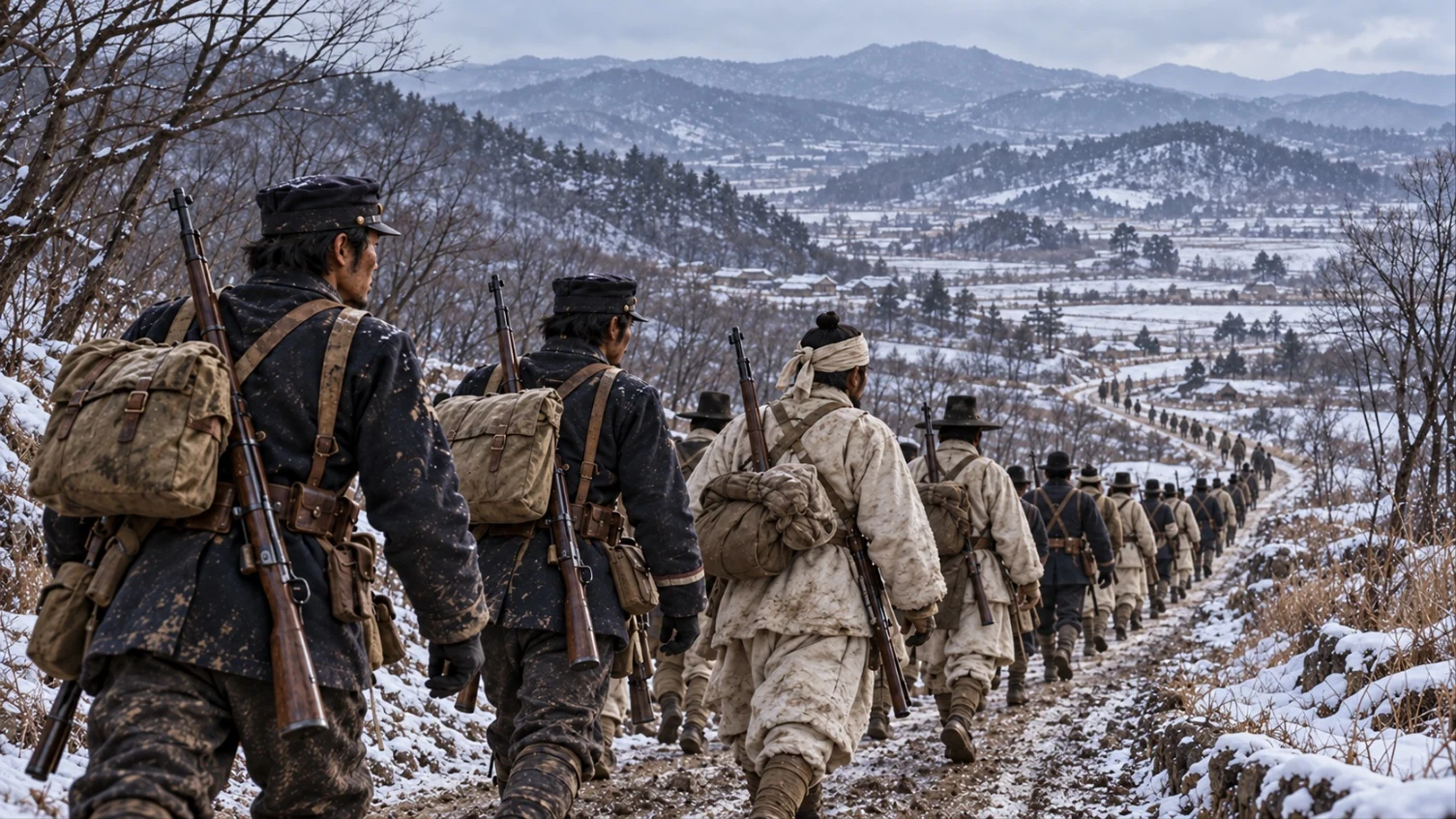 Disbanded soldiers and civilians in one column: after 1907, trained troops and their rifles flowed into local militia bands. (AI illustration)
Eugene and Ae-sin are fiction. McKenzie was real. Frederick Arthur McKenzie, a Canadian-born journalist, first came to Korea as a war correspondent for London’s Daily Mail during the Russo-Japanese War, and he returned in 1906. He wrote that he passed through Chungju and Jecheon, was pointed toward the militia at Wonju, and in 1907 met Righteous Army fighters at Yanggeun (陽根; spelled “Yan-gun” in his book).
McKenzie’s 1908 book, The Tragedy of Korea, has something odd in its table of contents. Chapter 15 is titled “A Journey to the ‘Righteous Army’”, with the name in quotation marks. Chapter 18, about his time with the fighters, is titled “With the Rebels.” Even in a book that recorded the militia with open sympathy, both names sit side by side.
Why did Japanese records call the Righteous Army “pokdo”?
Quick answer: Japanese army records called the Righteous Army pokdo (暴徒) — literally something like “violent rioters,” rendered here as “a mob.” The word even heads the title of the garrison army’s own campaign history, Chōsen Bōto Tōbatsushi (朝鮮暴徒討伐誌). That can be read as treating them not as an opponent in a war but as a band disturbing public order. Yi In-yeong, who went on to command the Thirteen-Province Righteous Army, did the opposite: in 1907 he asked foreign consulates to recognize it as a belligerent body (전쟁단체) under international law. Whether the militia legally qualified for that status is a separate question.
Japanese records called them rioters; their commander asked to be recognized as a party to a war. The fight over the name was a fight over what kind of conflict this was.
Korean history has repeated moments when ordinary people took up arms themselves as the country fell into crisis. This series goes back through three of them and asks one question: when the country was collapsing, who fought, and what did the country give back to them? This first installment covers the last few years of the Korean Empire.
Who were the Righteous Army?
In episode 23, people who had been helping the militia from behind the scenes, such as a seamstress, a nurse, and a rickshaw puller, join the organization themselves. This scene is close to the real history.
The Righteous Army (의병, 義兵, uibyeong) was a civilian army that ordinary people organized on their own when the country was in crisis. In the late Joseon and Korean Empire period, the Eulmi Righteous Army rose from late 1895 through 1896 in protest against the assassination of Empress Myeongseong and the topknot-cutting decree. After the Eulsa Treaty of 1905, militias rose again.
The peak was the Jeongmi Righteous Army (丁未義兵) from 1907 onward. 우리역사넷 (Our History Net), run by the National Institute of Korean History, summarizes its leaders as a broad mix: prominent Neo-Confucian scholars and former and serving officials, but also farmers, peddler-merchants (bobusang), disbanded soldiers, and farmhands. In Hamgyeong Province, professional hunters such as Hong Beom-do played an active role.
Women took part too. Yun Hui-sun, a daughter-in-law in a Confucian scholar family of Chuncheon, supported the Chuncheon militia in 1895–1896 and wrote a number of Righteous Army songs. In 1907 she raised funds to help make weapons and bullets, and she kept using her songs to lift the fighters’ morale.
The day soldiers became militia
In episode 22, Japan disbands the Korean Empire’s army and Major Park Seung-hwan takes his own life. Jang Seung-gu meets his end while opening an escape route for soldiers who have risen up.
The skeleton of this scene is real. In 1907, using the Hague secret envoy affair as a pretext, Japan forced Emperor Gojong to abdicate and imposed the Jeongmi Seven-Article Treaty. On August 1 it disbanded the Imperial Guard units in Seoul. When battalion commander Park Seung-hwan killed himself in protest, soldiers took up their weapons again, and street fighting with Japanese troops broke out around Namdaemun, Seoul’s South Gate.
The scattered soldiers joined militias across the country. With trained men and rifles coming in, the Righteous Army began to look more like an organized army.
”Mob” or “belligerent body”?
In 1907, Yi In-yeong, who had been chosen as Commander of the Gwandong Righteous Army, sent a manifesto to Righteous Army leaders in every province. It called on them to gather in Gyeonggi, the province surrounding Seoul. According to the National Institute of Korean History’s New History of Korea (신편 한국사), he also secretly sent Kim Se-yeong (金世榮) into Seoul to ask the foreign consulates to recognize the militia as a patriotic body, and therefore a belligerent body under international law, and to support it. An English version also survives of a manifesto issued in the name of the Commander of the Gwandong Righteous Army to Koreans abroad, titled “Manifest to all Coreans in all parts of the world.”
Militia units that answered the call gathered at Yangju in Gyeonggi Province and formed the Thirteen-Province Righteous Army (十三道倡義軍), with Yi In-yeong as commander-in-chief.
On the other side, the name was pokdo. The New History of Korea quotes a Japanese army report connected with the Great Southern Korea Suppression Campaign. In the New History’s rendering, the report explains why North and South Jeolla had failed to develop: rioters were rampant, hindering local industry and obstructing the spread of government orders. The report treats the militia as a public-order problem; it says nothing of them as an opponent in a war. The same word heads the title of the garrison army’s own campaign history, Chōsen Bōto Tōbatsushi (朝鮮暴徒討伐誌), which the New History also cites for the suppression campaign. Whether this label worked as a legal basis for denying prisoner-of-war treatment needs separate scholarly examination.
In the same year, 1907, the Second Hague Peace Conference met in the Netherlands, and Gojong’s envoys could not get into the conference hall. On October 18 the conference adopted the revised Convention respecting the Laws and Customs of War on Land. Article 1 of its annexed regulations restated four conditions, already present in the 1899 regulations, under which militia and volunteer corps count as belligerents:
- being commanded by a person responsible for their subordinates;
- having a fixed distinctive emblem recognizable at a distance;
- carrying arms openly;
- conducting operations in accordance with the laws and customs of war.
In the same year the rules on when militias and volunteer corps could claim belligerent status were reaffirmed, the Korean Empire could not take a seat at that table. This article does not judge whether those rules legally applied to the Righteous Army.
The march on Seoul, and the commander who went home
From December 1907, the allied Righteous Army of the thirteen provinces carried out a campaign to advance on Seoul. In January 1908, an advance force led by Heo Wi got within 30 ri of Dongdaemun, Seoul’s East Gate. But the main force failed to join it in time, and the advance force pulled back under Japanese attack.
On hearing of his father’s death, commander-in-chief Yi In-yeong handed command to Heo Wi and went back to his home region. The New History of Korea says he went home to observe the three-year mourning period for his father.
The order of events needs careful reading. A later compilation, Giryeo Supil (기려수필), as quoted at second hand, relates that the news of his father’s death arrived after the advance force had pulled back and the main force had been defeated. So one cannot state flatly that “the campaign failed because the commander-in-chief left.” In a Confucian society, the funeral rites for a parent were a duty as weighty as affairs of state.
A war reconstructed from the enemy’s ledgers
The New History of Korea tabulates the fighting from Japanese police statistics. In the 13 months from December 1907 to the end of December 1908, a period that included the Seoul campaign and resistance across the provinces, the Righteous Army fought Japanese troops and police about 2,000 times, and about 83,000 militia fighters took part in the clashes. For the five months from February to June 1909, the count is about 1,700 clashes and about 40,000 fighters.
Researchers regard such statistics as resting mainly on Japanese military and police tallies. People who fought in several battles may have been counted more than once, and it has also been pointed out that villagers may have been mixed in among those Japan classified as pokdo. The figure of 83,000 should be read as a gauge of how intense the war was, not as the actual number of different fighters.
The numbers that let us guess the Righteous Army’s size came, ironically, from the ledgers of the side that crushed it.
What happened next: the Great Southern Korea Suppression Campaign of 1909
The drama’s fighters scatter once their base is exposed, and in the end they leave for Manchuria.
In the real history, the Gangwon militias fought hardest in 1908, and the South Jeolla militias in 1909. On September 1, 1909, the Japanese army launched the Great Southern Korea Suppression Campaign (남한대토벌작전), aimed at the Honam (Jeolla) militias. It was planned to end on October 10 but was extended to October 30. The Encyclopedia of Korean Culture describes it as the largest military operation Japan carried out against anti-Japanese forces during the Korean Empire period. Suppression operations then continued in Hwanghae and Gangwon provinces in March 1910.
Hwang Hyeon’s Maecheon Yarok (매천야록) recorded that the suppression “searched every household as if combing through it, and killed people on the slightest suspicion” (逐戶櫛査, 少疑輒戮).
Some of the militia fighters who were captured or surrendered were forced to work on building a road from the southern coast of South Jeolla to Hadong in South Gyeongsang. At the time, the Japanese called it the “rioters’ road” (暴徒道路).
Casualty figures vary widely from source to source, so this article does not settle on a single number.
A scene handed down in later writings
Later writings preserve Yi In-yeong’s return home in more dramatic form. Giryeo Supil was compiled by Song Sang-do after 1910 from material gathered from surviving family members and acquaintances. According to it, when Yi Eun-chan and others sought to make Yi In-yeong commander of the Gwandong militia, he at first declined, citing his father’s illness (時麟榮以父病謝). Yi Eun-chan pressed him: when the nation’s survival is at stake, public duty is urgent and private obligation is light (公事急私恩輕). Later, when word came that his father had suddenly died (父病奄忽, 凶音又至), he is said to have wept aloud and gone home (遂痛哭而歸). (Quoted at second hand; not checked against the original text.)
This is a biography compiled later, not a record from the scene, so the story should be read as something that is handed down.
Across the world: same era, different names
The Philippine-American War (1899–1902): the closest parallel
The U.S. Naval History and Heritage Command still files this war under “Philippine Insurrection, 1899-1902”, while the Filipino forces led by Emilio Aguinaldo were fighting for independence. One side’s insurrection was the other side’s war — a naming dispute that resembles Korea’s.
The Boer War (1899–1902): the most different ending
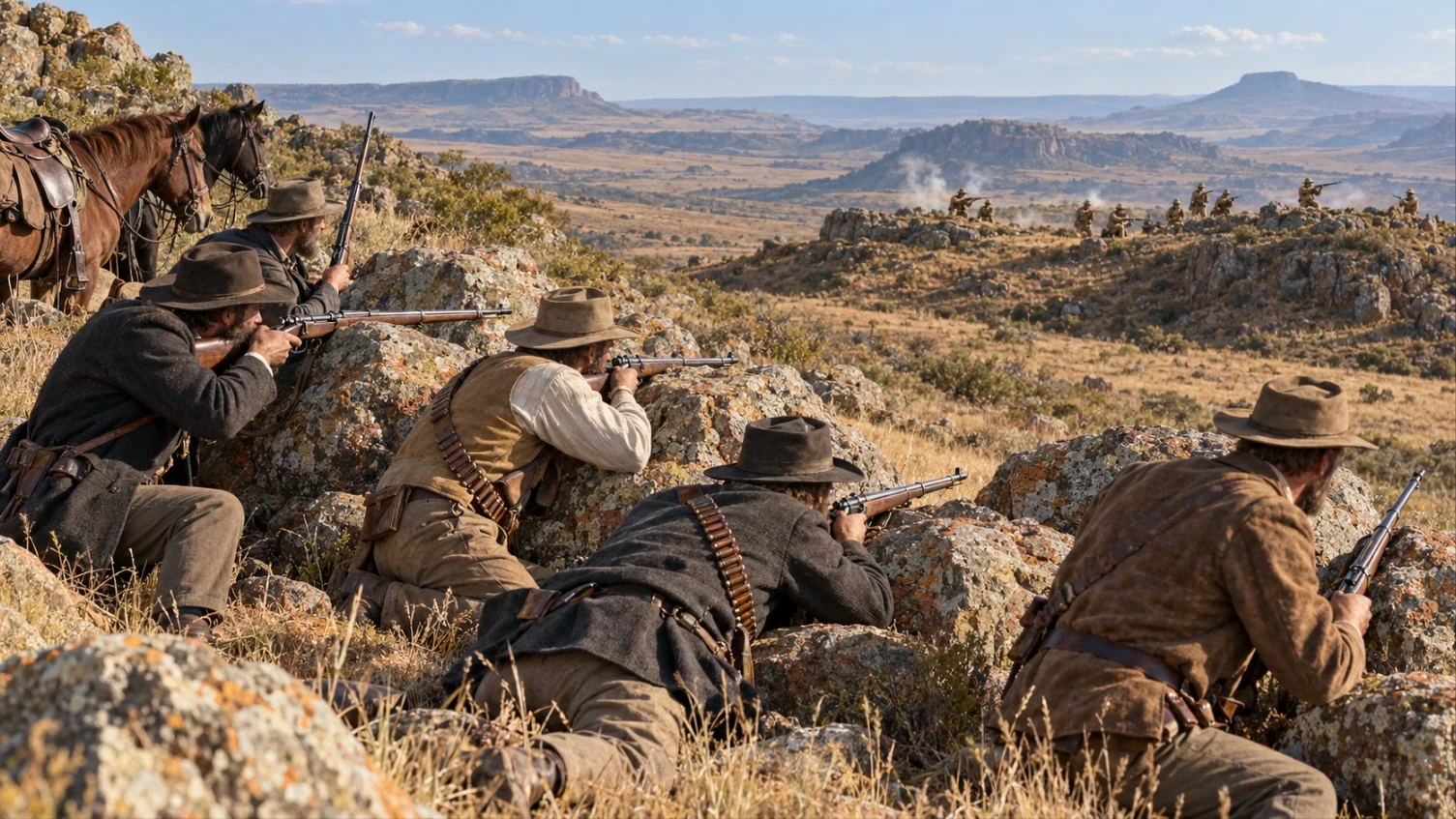 The Boers also fought a guerrilla war against a far larger empire, but they did it in the name of two republics. (AI illustration)
The Boers also waged guerrilla war against a far larger empire, but they fought in the name of two republics, the Transvaal and the Orange Free State. Even after the war turned against them, their leaders sat at the table for the Peace of Vereeniging in 1902. Korea’s Righteous Army was never given a seat at such a negotiation.
Korea: an army that had to claim for itself that it was party to a war
The Filipinos fought against the name “insurrection”; the Boers negotiated in the name of their states. In a Korean Empire that had lost first its diplomatic rights and then its army, the Righteous Army had to assert on its own that it was a party to a war. No record has been found that this claim was accepted, and in Japanese army records the militia remained pokdo.
Back to Mr. Sunshine
In the drama, the fighters in front of the camera do not say they will win. Neither did the fighter McKenzie quoted. In McKenzie’s English account:
“We may have to die,” he said. “Well, so let it be. It is much better to die as a free man than to live as the slave of Japan.”
In his book’s preface, McKenzie wrote that at the time of his journey he was “the only white man to have travelled through those districts during the fighting” in 1907. The militia photographs he left behind appear in Korean history textbooks today.
McKenzie’s camera left behind the faces of the Righteous Army, faces that the single word “mob” in the Japanese records could not erase.
The next installment goes back to the Imjin War, when the name uibyeong, “Righteous Army,” became widely known.
This article was researched and written by K-Drama History. Source: Why Was Korea's Righteous Army Called a "Mob"? The Real History Behind Mr. Sunshine — K-Drama History