Mousetrap, Explained: The Rat Knew the House Better Than the Son
From the research behind Pause the Drama.
Late in episode 2 of Mousetrap (들쥐), a children’s tale is playing on a television in somebody’s house. A young yangban is studying, and cuts his fingernails and toenails. A monk arrives and warns him not to throw away carelessly what has come out of his body. He thinks nothing of it and scatters the clippings in the woods. A few days later he comes home to his family house, and a man with his face and his voice is standing there.
The tale stops there. It does not show which of the two the family chooses, and it does not show how the fake is caught.
A little girl is sitting in front of that television. In another room, a man wearing the face of the novelist Je Mun-jae is watching the real Mun-jae set off for the police station. He tells Mun-jae to go ahead and report him — and asks how he intends to prove that he is Je Mun-jae. When the girl says she doesn’t like rat stories, the man asks whether rats are bad. She says the rat ate the yangban’s nails. He tells her to think about how badly that rat must have wanted to be a person.
The story-within-the-story summons the old tale, then cuts off before the test and the cat.
A note on what has and has not been checked. The scene evidence in this article comes in three grades. (1) Confirmed from Netflix’s official episode descriptions, its press release, and director interviews: the loss of identity in episode 1, the failure of fingerprint authentication and the failure of the people around him to recognise him, the moment in episode 6 when he asks his editor-in-chief to vouch for him, the episode 10 description, and the ending that closes on a curtain. (2) Confirmed from episode reviews and published English subtitle transcripts: the course of the episode 2 fairy-tale scene and its dialogue, the episode 1 details of the house sale, the police database and the class reunion, and the episode 6 police station scene. (3) Neither the official video nor the Korean subtitles were collated at any point. The teaser description does not specify an episode, so placing the fingerprint failure in episode 1 rests on episode reviews. Because the dialogue above was read through an English subtitle transcript, nothing in it is quoted directly here; it is described rather than cited. This article also mentions some of the series’ later developments.
The series takes its starting point from the Korean folktale of the rat that ate a man’s nails. Netflix introduces it that way, and the series itself calls the old story up on screen.
But the real terror of the old story is not the moment the rat becomes a man. It is what comes after. The family takes the fake in as one of their own, and the real man is driven out of his own house. In some transmissions the magistrate’s verdict goes to the fake as well.
The horror of this story is not that a rat becomes a man. It is that people certify the fake as real.
So the old tale and the drama face the same question and move in opposite directions — and that opposition is this article’s reading, not a claim about what the production set out to do. In the drama the loan shark No-ja says that who you are is something other people prove for you. The folktale is precisely the story of that proof collapsing.
All right. Let’s unpack it.
Is the nail-eating rat a story that was really told?
Yes. Korean scholarship calls it the jwi-dungap (쥐둔갑) tale. Korean folklore uses dungap (遁甲) for a kind of shape-shifting or transformation — in the encyclopedia’s classification, the type in which the shifter changes at will and can return to its own body. It also goes under the names true master and false master and jingajaengju (眞假爭主, the dispute over who is the true master), and it is distributed across the country. There is no single author and no fixed original. Researchers recorded it from people in many regions who had it by mouth. The encyclopedia entry and the field recordings this article collated call the animal simply a rat (쥐) — not a field mouse, which is what the drama’s Korean title, deul-jwi, means.
The representative plot as the Encyclopedia of Korean Culture sets it out runs like this. A householder throws away his fingernail and toenail clippings carelessly. A rat picks them up and eats them over a long period, and transforms into the master of the house. The whole family takes the fake for the real man, and by the magistrate’s verdict the real man is branded the impostor and driven out. Wandering, he is advised by a helper to fetch a cat; the cat kills the fake, which turns back into a rat.
In both the representative plot and the Yeongdong version below, the rat changes only after eating the clippings over a long time. Whether every transmission sets the same span of time has not been confirmed here.
Lee Hye-ran’s 2019 study summarises the tale as showing the same three-phase structure across the country — the rat’s transformation, the dispute over who is the true master, and the destruction of the rat. (Abstract only; the full text was not collated.)
How did the parents come to certify a rat as their son?
Before the tale reaches the television screen, in episode 1, Mun-jae steps outside for the first time in three years. His phone will not read his fingerprint. A broker turns up to explain the sale contract on the house he lives in. His fingerprints do not come back from the police database. He goes to a class reunion, and his old classmates do not recognise him.
The true master of the old story ran into the same wall. In October 1982, at the senior citizens’ hall in Jukjeon-ri, Hwanggeum-myeon, Yeongdong-gun, North Chungcheong Province, a 72-year-old informant named Jeon Hyeong-tae performed a version titled 「신랑으로 도습한 쥐」 — the rat that took the bridegroom’s place — collected in the Korean Oral Literature Compendium (『한국구비문학대계』) 3-4. That version keeps the scene in detail.
In it, a man has been throwing his clipped nails anywhere since he was a boy. The rat eats up every one of them, right through to the time he is married, and becomes a person.
The bridegroom goes out, comes back, and finds an identical bridegroom sitting in the room. The parents recognise as their son the one who got there first.
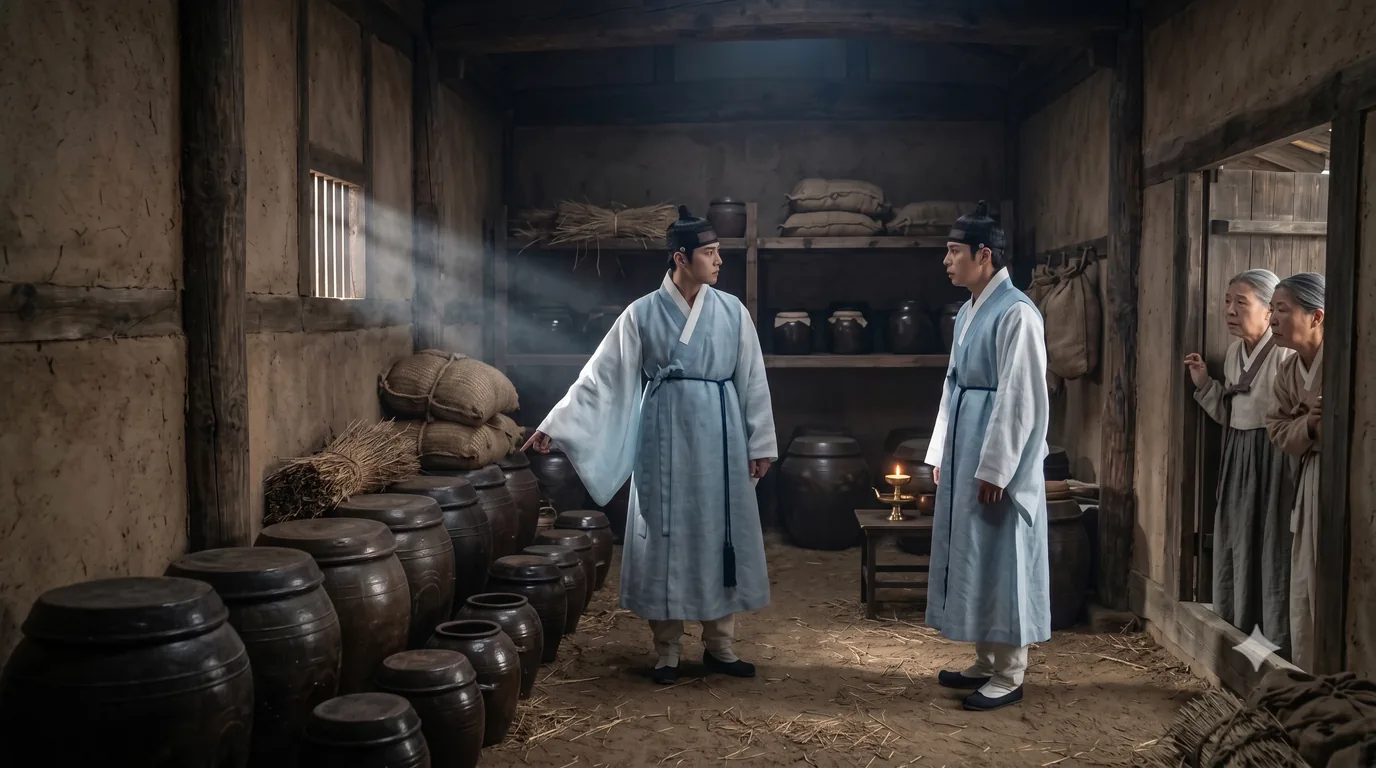 The test in the 1982 Yeongdong version: not who has the face, but who can count the crocks. (AI illustration)
The decisive test was a question about the household. The parents ask how many jars and crocks are in the storehouse, and how many dishes. The rat had spent its life going in and out among those crocks, so it knows every one of them. The real son, who had been attending the village school, mumbles something about three or four. The parents throw the real one out.
In this version at least, what settled who qualified as the son of the house was neither bloodline nor face. It was how well he knew the household’s stores.
Lee Hye-ran’s 2019 study records that the question used to separate true from false, and the ending, both vary from version to version. Deciding it by knowledge of the household is this Yeongdong version’s method, not a rule governing the tale as a whole.
There is one more thing worth noticing. The informant calls this rat “그 집에 멕이는 쥐” — readable as a rat that got its food at that house. Put that together with its always moving among the crocks in the storehouse, and the fake is less an intruder from outside than something that had been coming and going inside the house all along.
The encyclopedia entry also records a variant in which a daughter-in-law feeds the rat and that is what sets the trouble going. Lee Hye-ran’s 2019 study reads this line of the tradition as one where a woman takes the role of nurturing the rat. (Abstract only.)
So what did separate the fake from the real?
In episode 6 it is the fake who moves first. According to episode reviews, the fake goes to the police station with a lawyer and the editor-in-chief and reports that someone is impersonating him. The real one has been cast as the impostor.
Netflix’s official description for episode 6 says that Mun-jae goes to his longtime editor-in-chief and pleads with him to vouch for him. But according to the reviews, the number of times the two had actually met was not large. Even the person he had worked with longest is a difficult witness to produce.
In the folktale, human discrimination fails too. In the Yeongdong version it is the parents and the wife who fail; in the encyclopedia’s representative plot the magistrate’s trial itself hands the verdict to the fake.
So the decision passes out of speech and into the body. In the Yeongdong version the real man wanders for more than three years, and on his way home he buys a fine-looking cat and sets it on his load. Unlike the encyclopedia’s representative type, this version has no helper. The cat works its way out of the load and takes the fake by the throat, and a huge rat is revealed. Only then do the parents say they had no idea, and that they had put him through all this suffering.
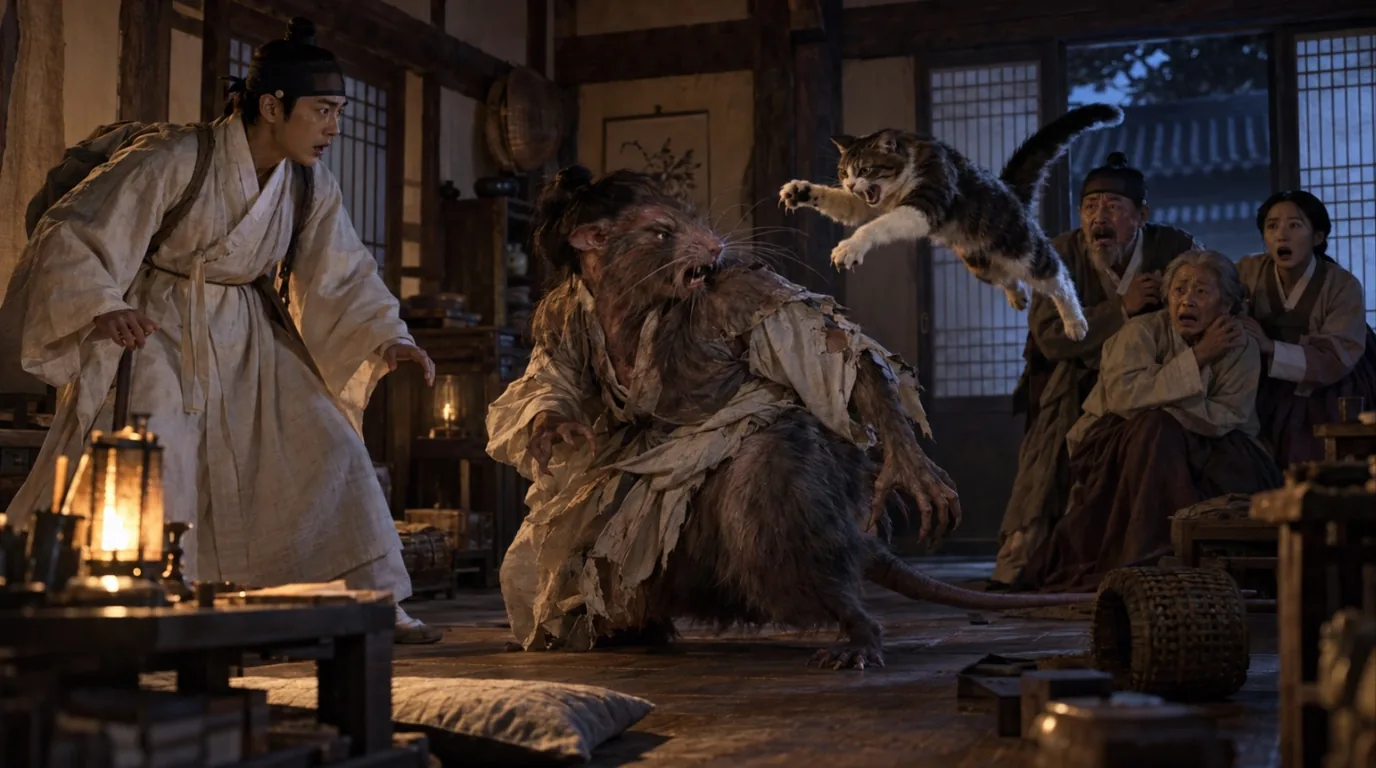 The cat does not weigh testimony. It only registers what the thing is. (AI illustration)
The cat does not look at the face, or the memory, or the verdict. It looks only at whether the thing is a rat.
What beat the fake was not better evidence. It was a test that needs no words.
That said, the representative plot does have a helper who tells the man to go and get a cat. Reading the tale as one in which human beings play no part at all goes too far.
The drama runs the other way — and that is this article’s reading
Mousetrap has no such cat. What Mun-jae needs instead is a witness.
No-ja upbraids Mun-jae for having not one person who will guarantee who he is. In this series what proves a person is neither a fingerprint nor a document but the people he has lived alongside. Mun-jae does not have them. And not only because he spent three years inside the house.
Here the series goes down a road the folktale does not take. The true masters of the encyclopedia’s representative type and of the Yeongdong version are not drawn as bad men. The whole of the fault that brings the crisis on them is carelessness in throwing away their nail clippings.
Mun-jae is not that. Director Kim Hong-sun said in an interview that viewers might root for Mun-jae at first and then want to curse him once his identity comes out. He said there is no wholly good person and no wholly bad person in this work, and that the ending is, on its surface, an open one. Netflix, for its part, introduces the final episode 10 as the episode that asks whether he is predator or prey.
The idea that the one who is driven out might not be innocent was already there in the Korean classics.
Was there a story where the real one deserved to be thrown out?
There was. Ongojipjeon (「옹고집전」) is a classical novel of unknown author and unknown date. It is said to have been one of the twelve pansori repertoires, but the sung form is not transmitted; it survives only in manuscript copies.
Ong Go-jip is a miser, and does not look after his eighty-year-old mother when she lies ill in a cold room. An eminent monk fastens a talisman to a straw effigy and sends a false Ong Go-jip to the house. Wife and children cannot tell which is which, and take the case to the county office. Before the magistrate too, the fake wins; the real man is beaten with the paddle and reduced to begging. When the real man, now repentant, is about to take his own life in the mountains, the monk appears and gives him a talisman. He throws it, and the fake reverts to a straw effigy.
The reversal that will surprise readers outside Korea is this. In this story the real man who is driven out is not a wronged victim. He is a wicked man who has punishment coming. The writer of the encyclopedia entry reads the sequence as a story of finding one’s true self: a wicked true master is cast out and comes back a good man.
The two Korean narratives this article sets side by side point in different directions. One is a story about a wronged true master who comes home. The other is a story about a wicked true master who comes home by way of punishment and reform.
As for how the two stories are related, the encyclopedia’s entry on the rat-transformation tale explains that Ongojipjeon was formed by this folktale merging with a story about abusing a monk who came begging for alms. There is also a study that re-examines this source-tale account — Kim Yeong-ho (2015), whose KCI abstract has been collated here but whose full text has not.
That Mousetrap begins with the face of the first story and moves toward the question of the second is this article’s interpretation. It is not an intention the production has stated.
Why the nails, of all things?
The encyclopedia entry explains the taboo in two ways. One is filial piety: hair and nails too are received from one’s parents, so they should be treated with care. The other is a warning against being indifferent and careless about what belongs to you, and so arriving in the end at the loss of yourself. Both of these are the entry writer’s interpretation.
The variants fit that reading. There are versions in which the cause of the rat’s transformation is not nails but clothing and headgear left lying about. On that logic it is not only what falls off the body but also what has been worn on it that carries the owner inside it.
The Yeongdong informant closes his telling by nailing the taboo down: it’s no lie, it happened, so never throw these things away. For this teller at least, the tale was not an old story but a rule still to be kept.
It is commonly known alongside the saying that you must not cut your nails at night. But in the encyclopedia’s representative plot the core of the matter is not the hour; it is the careless discarding. When the night condition attached itself to this story has not been established here.
One teller’s ending: the wife who lived three years with a rat
The Yeongdong version carries an ending that is not in the encyclopedia’s representative plot. In this version the wife lived for more than three years believing the rat was her husband, and after the rat’s death she gave birth — to rat pups, the telling says.
The collection record shows that at this point the audience all laughed together. What reads to us today as horror was also, in the storytelling session of that time, a piece of mischief.
It is possible that the premise — that the person closest to you spent years living with a fake — produced the shock and the joke at once. But the reaction at a single collection site is not enough to settle why this ending came into being.
The encyclopedia entry also attaches a proverb to this failure of recognition: it explains that the vulgar Korean saying jwi jot-do moreunda (쥐 좆도 모른다), used of someone who knows nothing at all, originates from this tale and from the wife who could not recognise the person closest to her. The phrase contains an obscenity.
Looking outward: rat trials, nail taboos, a real historical case of imposture
China — rats transform, a trial is held, and a cat ends it
One of the closest parallels checked for this article is Chinese. The Open Museum platform operated by Academia Sinica in Taiwan holds an item with a curatorial description: 『新刻五鼠鬧東京包公收妖全傳』, a printed tale of five rats making havoc in the Eastern Capital and Lord Bao subduing the demons.
According to that description, rat demons transform themselves into, respectively, the scholar Shi Jun (施俊), Chancellor Wang, Emperor Renzong of Song, the Empress Dowager, and Lord Bao. When Chancellor Wang sets out to try the true and the false Shi Jun, another rat transforms into Chancellor Wang and produces a twin-chancellor commotion; when the case goes up before the emperor, yet another rat transforms into the emperor. At each seat of judgment, in other words, one more fake appears. In the end a golden cat (金貓), which Lord Bao borrows from the World-Honoured Tathāgata, subdues the rats.
The same description explains that the Five Rats in the Eastern Capital story is already present in the Ming-dynasty Bao Gong An (『포공안』 / 『용도공안』) line, and that it continues into the Qing-dynasty Qixia Wuyi (『칠협오의』), where the golden cat is replaced by the knight-errant Zhan Zhao, the Southern Hero.
Transformation, the dispute over who is the true master, and destruction by a cat: that skeleton overlaps with the Korean rat-transformation tale. The differences are equally clear. Nail-eating is not confirmed anywhere in this Chinese story, and the cat is not a house cat the true master bought on the road but a thing borrowed from the Buddha. The fact of overlap alone cannot tell us which came from which. It should also be said that only the curatorial description was collated for this section; the two volumes of the classical text itself were not, so what is set out above is limited to what that description says about that particular held copy.
Japan — a taboo around nails, a different act and different consequences
Japan has folk beliefs in many regions against cutting one’s nails at night. As summarised in an answer supplied by Ichikawa City Central Library and posted on the National Diet Library’s Collaborative Reference Database, which cites a dictionary of proverbs and folk belief, the consequences vary by region: cut your nails at night and you will be injured (Aomori), or die young (Fukushima), or be robbed (the Kazusa region of Chiba), or fail to be present at your parent’s deathbed.
It touches Korea in being a taboo built around nails. But the act being prohibited is different. The core of the Korean representative type is throwing the clippings away carelessly; the folk beliefs gathered in this Japanese answer take issue mainly with cutting them at night. And within the range set out in that answer, no animal appears that eats nails and becomes a person.
France — a dispute over the true master that actually happened
In sixteenth-century France, in the Martin Guerre case, a peasant named Arnaud du Tilh passed himself off as Martin Guerre and took possession of his wife and his property. In 1560, when the judges of the high court at Toulouse had been very nearly persuaded by his claim, a man with a wooden leg appeared in the courtroom and declared that he was the real Martin Guerre. The impostor was executed. In an age with neither fingerprints nor photographs, the decisive turn was the real Martin’s appearance in court.
Korea — where the tale sits
Set against those three, the position of the rat-transformation tale comes into view. Its starting point, the nail taboo, touches Japan. Its skeleton — a transformed fake, and a trial — touches China. And unlike the Martin Guerre case, here the two faces are completely identical, so looking at the man does not settle it; in the Yeongdong recording the parents and the wife fail at exactly that. (The recording tells us that they failed and that a test of household knowledge followed. It does not tell us that neighbours were asked to testify, or that such a course was impossible.)
None of this structure can be called Korea’s alone. The encyclopedia entry itself notes that similar stories have long been transmitted in India as well.
Back to Mousetrap
Mun-jae, whose fingerprint authentication fails, is standing in the same spot as the son in the old story who could not say how many crocks were in the storehouse. It is not a position with no way to prove anything. It is a position with nobody to accept the proof.
The horror of this story is not that a rat becomes a man. It is that people certify the fake as real.
In the Yeongdong version what broke that deadlock was a test that needed no words — the cat. What the eyes of the parents and the wife could not do, one animal did. In the encyclopedia’s representative plot the cat comes only after even the magistrate’s trial has failed.
If the rat-transformation tale is a story about a wronged true master coming home, then Ongojipjeon was a story about a wicked true master coming home by way of punishment and reform.
Mousetrap has no cat of that kind. The drama never gives the identity dispute the folktale’s clean ending: no outside arbiter arrives to expose one body as nonhuman and settle the matter for everyone at once. That is not the same as saying nobody in the drama ever recognises anybody — it is that recognition, where it happens, stays a human judgement that other people can still dispute.
The fairy tale playing on the television in episode 2 is cut even shorter. It breaks off at the moment of meeting the double, and within that inserted story neither the test nor the cat ever arrives.
The story-within-the-story summons the old tale, then cuts off before the test and the cat.
At the end, the camera closes the story with a curtain drawing shut. Director Kim Hong-sun said in an interview that it was his idea to end by closing the curtain. A story that opened with three years of seclusion ends on the image of closing itself.
In the same interview, the director also said that he made this ending thinking of it as retribution, but that he wanted to leave it to the viewer’s imagination. The false-master business in Ongojipjeon was likewise something the monk staged in order to punish a wicked true master. Ong Go-jip, though, repents and comes back; Mousetrap draws the curtain before that point. Joining the director’s word to the classical novel is this article’s reading; the director spoke of retribution and did not mention Ongojipjeon or the punitive structure of the folktale.
Think again about what the man in episode 2 told the child. The rat ate the nails because it wanted to be a person. The question this series keeps asking to the end is which of them, in that case, was the rat.
Frequently asked questions
Is Mousetrap based on a true story? No. It is a fictional thriller adapted from Ludvico’s Kakao Webtoon of the same name. The motif behind it, however, is a real Korean oral folktale — the story of a rat that eats a man’s discarded nail clippings and takes his place. Netflix’s own press release introduces the series through that folktale, and the series stages a version of the tale on screen in episode 2.
Is the nail-eating rat really a Korean folktale? Yes. Korean scholarship calls it the jwi-dungap (쥐둔갑) tale — dungap meaning a transformation of shape — and it is also known as jingajaengju (眞假爭主), the dispute between the true and false master. It is distributed across the country and has no single author or fixed original text; researchers collected it from oral tellers. The Korean Oral Literature Compendium contains versions recorded in the field in the 1980s, and this article works from one of them.
Is the rat in the folktale a field mouse, as the drama’s Korean title suggests? The encyclopedia entry and the field recording collated for this article say only jwi (쥐), rat — not deul-jwi (들쥐), field mouse, which is the drama’s Korean title. In the 1982 Yeongdong version the informant calls it the rat that fed at that house, and says it was forever moving among the crocks in the storehouse. Within that version, then, it is a rat that lived off the household rather than one that came in from outside.
Why couldn’t the family tell the rat from their own son? In the 1982 Yeongdong version, because the faces were identical and the fake knew the household better. The parents test the two by asking how many jars and crocks and dishes were in the storehouse. The rat, which had spent its life among those crocks, answers item by item; the real son, who had been away at the village school, guesses at three or four. The parents drive out the real one. Lee Hye-ran’s 2019 study notes that the test question and the ending vary between versions, so this is that version’s method, not a rule of the tale type.
How does the fake finally get exposed? By a cat. In the Yeongdong version the real son, after more than three years of wandering, buys a handsome cat on his way home and carries it on his load; the cat gets loose, takes the fake by the throat, and a large rat is revealed. In the Encyclopedia of Korean Culture’s representative plot a helper is the one who tells him to fetch a cat, so it is not quite true that no person plays any part.
What is the relationship to the classical novel Ongojipjeon? Both are stories in which a true and a false master fight over one man’s place. The Encyclopedia of Korean Culture’s entry on the rat-transformation tale explains that Ongojipjeon was formed by this tale merging with a story about abusing a monk who came begging for alms. A 2015 study by Kim Yeong-ho re-examines that source-tale account; this article has collated its KCI abstract but not the full text, and does not adjudicate between them.
And the saying about cutting nails at night — does it come from this tale? That has not been established here. The taboo is widely known in Korea, but in the encyclopedia’s representative plot the decisive act is throwing the clippings away carelessly, not the hour at which they are cut. When the night element joined this story, this article could not determine.
Sources & further reading
Folktale and historical primary material
- 『한국구비문학대계』 3-4, 충청북도 영동군 황금면 죽전리, 「신랑으로 도습한 쥐」 (collector 김영진; informant 전형태, m., 72; 26 October 1982; classification [황금면 설화 26]). Korean Studies Integrated Platform, POKS.GUBI.GUBI.1_12928 — field transcript collated in full.
- 『新刻五鼠鬧東京包公收妖全傳』 — the classical text itself was not collated; see the curatorial description below.
State encyclopedias and public collecting institutions
- 한국민족문화대백과사전 (Encyclopedia of Korean Culture) — 쥐둔갑 설화 (E0017056, written by 최내옥) and 옹고집전 (E0038895). Both entries collated in full.
- Open Museum (openmuseum.tw, a platform developed by the Academia Sinica Center for Digital Cultures), item 「新刻五鼠鬧東京包公收妖全傳(共二卷)」, ID M0906532, held by the Taiwan Music Institute, National Center for Traditional Arts. Access was blocked automatically at the time of first drafting and the item was checked through search excerpts; the item page and its curatorial description were subsequently collated directly. The two volumes of the classical text remain uncollated.
Official drama documents
- Netflix official title page for Mousetrap / 들쥐 (netflix.com/title/81991749) — episode descriptions collated. The episode 10 description differs between language versions: predator/prey in English, the one who set the trap / the one caught in it in Korean.
- About Netflix press release, 「넷플릭스 시리즈 <들쥐> 8월 28일 공개 확정, 티저 포스터&예고편 공개!」, 31 July 2026 — folktale motif, character names, description of the teaser footage. Collated in full.
- 최송희, 「[인터뷰] ‘들쥐’ 김홍선 감독 “완전한 선인도, 악인도 없어…매 장면 집중해서 봐주길”」, Ajou Business Daily, 6 September 2026 (article 20260906162636256) — collated in full.
- 박진영, 「[조이人]② “‘들쥐’ 모두가 빌런, 응징 결말이지만 상상하길 바랐다”」, Joynews24, 2 September 2026 — source for the curtain-closing direction and for the word retribution. At the time of first drafting the page was blocked to automated access and only a search excerpt was available; the publisher’s original article has since been collated.
Supplementary drama material (English-language episode reviews)
- Episode 2 fairy-tale scene: a clip released by Netflix Korea, a work account from someone involved in producing the tale’s illustrations, episode 2 reviews at The Review Geek and masasha.net, and a published English subtitle transcript of episode 2. The existence of the scene is confirmed; the original Korean dialogue is not.
- Episode 1 details (which episode the fingerprint failure falls in, the house sale contract, the police database, the class reunion), and the episode 6 police station scene and the number of times Mun-jae had met the editor-in-chief: English-language episode reviews. These are details absent from the official episode descriptions, and the text above says so where it uses them. The episode 10 curtain is confirmed from a director interview and is listed with the official documents.
Scholarship
- 이혜란, 「「쥐좆도 모른다」의 분석심리학적 연구 — 여성 인물의 심리분석을 중심으로」, 『동아시아문화연구』 76 (2019), 57–87, Institute of East Asian Culture, Hanyang University. DOI 10.16959/jeachy..76.201902.57 (KCI ART002441175) — abstract collated, full text not collated.
- 김영호, 「〈옹고집전〉의 근원설화 再考」, 『동양학』 58 (2015), 1–21, Institute of Oriental Studies, Dankook University — KCI abstract collated, full text not collated. The study questions the established account that Ongojipjeon arose from the merging of two tales and proposes a different line of influence as a hypothesis.
Comparative material outside Korea
- National Diet Library Collaborative Reference Database, 「「夜に爪を切ってはいけない」といわれるのはなぜか」 (crd.ndl.go.jp, registration no. 1000207090; answer supplied by Ichikawa City Central Library). Access failed at the time of first drafting and the item was checked through search excerpts; the answer page was subsequently collated directly. The 『故事・俗信 ことわざ大辞典』 (Shogakukan, 1982), p. 1207 that the answer re-cites was not collated.
- Harvard University Press book page for Natalie Zemon Davis, The Return of Martin Guerre (1984 paperback, ISBN 9780674766914) — collated in full. The details of the Martin Guerre case given above follow this page.
Neither the drama’s video nor its official Korean subtitles were collated for any item on this list.
Thanks for reading — see you in the next one.
This article was researched and written by K-Drama History. Source: Mousetrap, Explained: The Rat Knew the House Better Than the Son — K-Drama History