Mr. Kim, Explained: If Your Daughter Vanished in Joseon Korea, Who Would Look for Her?
Theme: Power & Politics
From the research behind Pause the Drama.
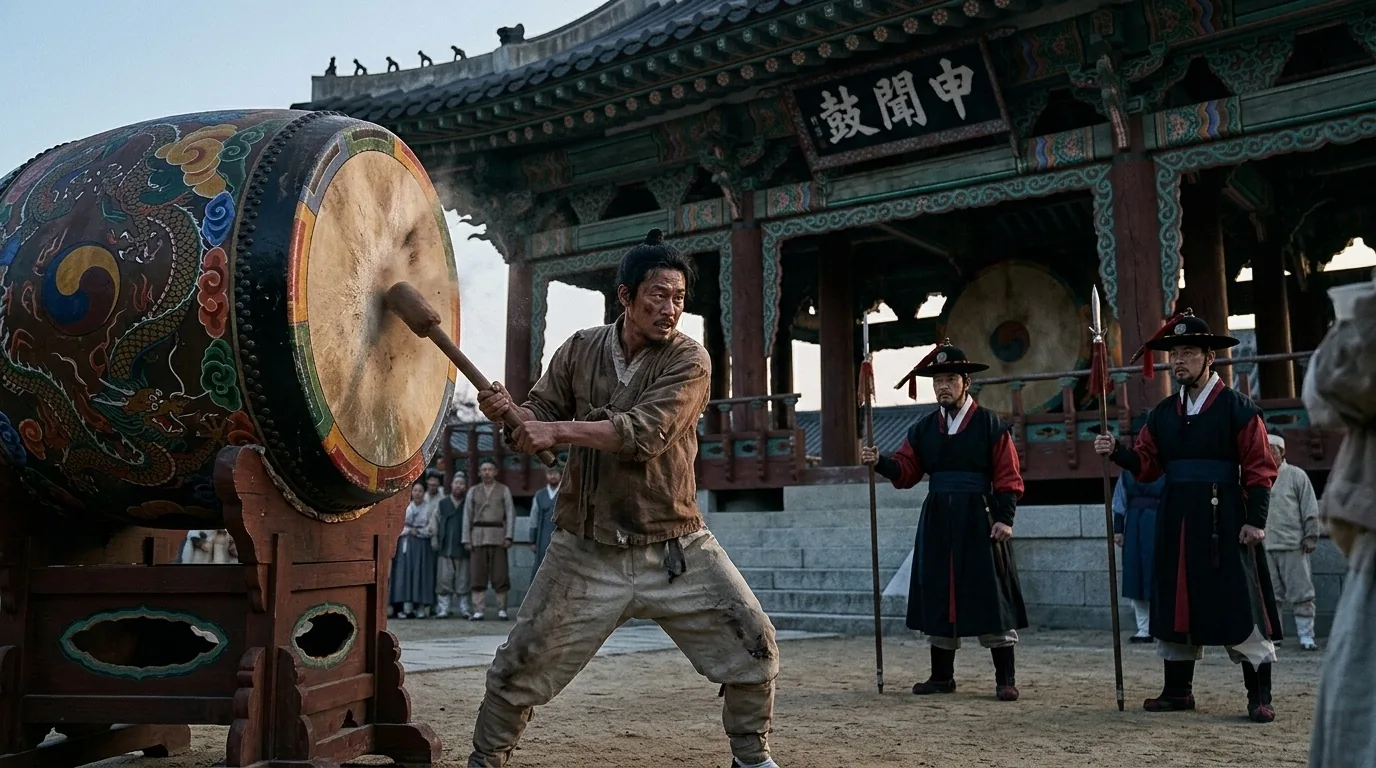 The Sinmungo: a channel for grievance that existed, and that most people could not reach. (AI illustration)
The moment that turns Mr. Kim (김부장) from a family drama into a manhunt happens inside a police station.
SBS’s 2026 series — So Ji-sub, adapted from a webtoon — spends its early episodes on an ordinary humiliation: Kim’s daughter Min-ji is bullied, the school reframes her as the aggressor, and Kim kneels before company men promising she will transfer out. Then Min-ji doesn’t come home. Kim finds blood and a hair ribbon in a derelict building behind the school. In episode 2, in a police station, a call comes in from her number — and the detectives stop him from taking it.
That is the hinge. He walks out and goes looking himself, and from then on the state is not in the story.
Set the same night four hundred years earlier and it stops being a choice: there is no equivalent institution to walk out of. One caution first: “missing person” is a modern administrative category that does not map neatly onto Joseon paperwork. A woman who left a marriage, an absconding nobi, an abducted child and a family swallowed by famine were recorded — when they were recorded at all — in different administrative languages, by different offices.
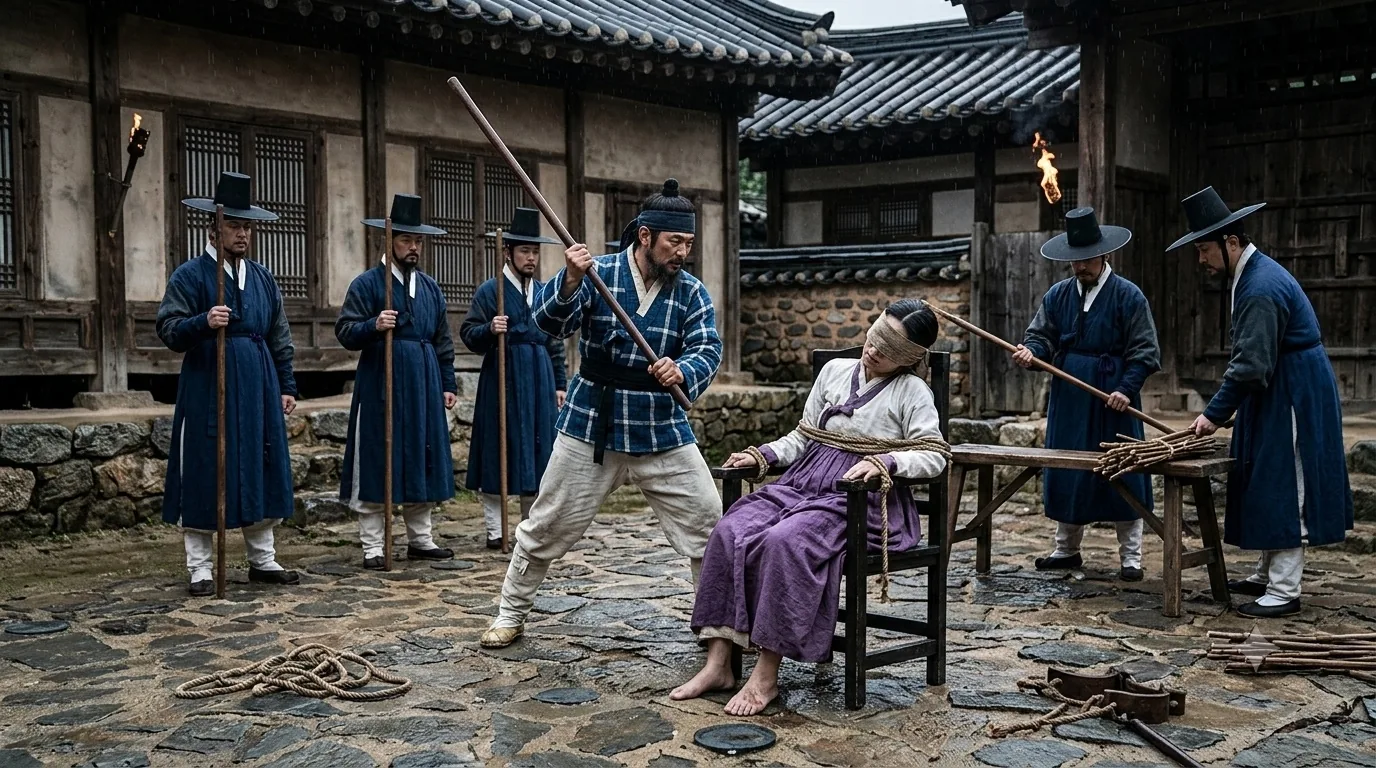 Investigation meant interrogation. The record that survives is the record the state chose to make. (AI illustration)
Quick answer: Joseon Korea had police, courts and sophisticated procedures for investigating crimes and suspicious deaths. What it does not appear to have had was a dedicated missing-person office, or a standard search triggered simply because someone failed to return home. A family would first rely on relatives, neighbours and local officials. The state was more likely to act once the disappearance could be connected to an identifiable crime, suspect, runaway case or body.
What would a Joseon father actually do on the first night?
The first move was kin and village, and this was not merely informal panic. Joseon’s local order rested on the ogajaktong (오가작통, “five households make one unit”), which arrived in stages: proposed in 1428 and not adopted; five-household joint liability for concealing bandits and thieves by 1455; a comprehensive framework, the ogatong samok (오가통사목), in 1675 under King Sukjong. Its purposes were regulatory — household registration, suppressing vagrancy, mutual surveillance and preventing the concealment of theft, backed by collective liability (Encyclopedia of Korean Culture).
Searching for missing people was never among the unit’s stated functions. What can be said is smaller, and it is my inference from the structure, not a documented duty: because neighbours were already answerable for what was hidden in their unit, a family asking them to help look was asking people with a legal reason not to shrug.
The second move was paper. The commoner’s instrument was the soji (소지, 所志), the catch-all term for petitions and written complaints submitted to a government office. The magistrate wrote his response — the jesa (제사, 題辭) — in the margin and handed it back as proof, which is why so many survive today (Encyclopedia of Korean Culture). That ruling could order an investigation, summon the people named, demand documents or authorize an arrest; records on the pursuit of runaway nobi show petitions doing exactly that (한국학자료센터).
So a petition could move officials. What I have found no evidence of is a petition of absence producing a search — men dispatched to look for someone not yet established as the victim of an offence. No automatic procedure was triggered by absence alone. The magistrate could act; nothing said he must. The third move was to go up.
Who were the Podocheong — and what did they actually police?
If you have watched sageuk you know the silhouette: officers in uniform, batons out, hauling a suspect through a market. That is the Podocheong (포도청, 捕盜廳), Joseon’s capital policing arm, and podo means “catching thieves”.
Its founding is genuinely unsettled. One account traces it to the thief-catching commands early in King Seongjong’s reign, with regulations, the podo samok (포도사목), dividing Seoul and Gyeonggi into left and right zones in 1481 (Encyclopedia of Korean Culture); 우리역사넷 fixes no founding year, noting that the name appears clearly in a record of 1540 (우리역사넷). It was abolished in the Gabo Reform of 1894.
It was two offices. The Left Podocheong (좌포도청) took the capital’s eastern, southern and central wards, the Right (우포도청) the north and west, and the city was carved into named beats and walked — fifteen or sixteen, depending on the account and the period. The work went well beyond arrest-after-report: recent scholarship describes patrol, the questioning of suspicious persons, crime prevention, arrest, interrogation and first-instance investigation, with cases passed to the Hyeongjo or the Uigeumbu (차인배, 「조선후기 포도청의 사법적 위상과 활동 변화」, 『역사민속학』 58, 2020).
So why is this still not a missing-persons capability? Because every documented trigger points at offences and suspicious presence. The sunra (순라) night patrol existed to intercept people who should not be on the street after dark — a filter for who is there. Interrogation presumes someone in hand. The institutional sources reviewed here do not identify any standard response to a father walking in to say his daughter did not come home.
Geography narrowed it further. The Podocheong was a capital institution; in the provinces, policing meant the county magistrate, his runners and officers such as the topo-sa (토포사). A pursuit could cross a county line through the governor or official correspondence (imun, gwanmun), but that meant persuading another authority to spend men — a long chain for a family with no crime to point at.
Where did the Hanseongbu and the Ministry of Punishments fit?
The Hanseongbu (한성부) administered the capital. Joseon did not separate administrative from judicial power, so it handled much we would now call legal work, but its centre of gravity was the city’s households, land, housing and registers (Encyclopedia of Korean Culture).
The Hyeongjo (형조), the Ministry of Punishments, sat at the top of the criminal system, and its four bureaus map the worldview with unusual clarity: Sangboksa (상복사) for appellate review of serious criminal cases, Goyulsa (고율사) for statutes and legal codes, Jang-geumsa (장금사) for prisons and prohibitions, and Jangnyesa (장례사) for the registers of the enslaved (Encyclopedia of Korean Culture).
Review a case, interpret the law, run the prisons, keep the register of who belongs to whom. It is tempting to read this as backwardness. It was not: the system relied less on finding people after they disappeared than on registering where subjects were supposed to belong — which is exactly where it broke.
If the state knew where everyone was, why couldn’t it find anyone?
Joseon did maintain household registers, and adult men — every male aged sixteen and over, from royals down to the enslaved — were periodically required to carry hopae (호패, 號牌) identity tags recording a name, an address, an official post, assigned duties, height and facial features. But the system was repeatedly suspended, coverage was incomplete, and women had no comparable personal tag (Encyclopedia of Korean Culture).
Women were not absent from registration as such: they could appear in the hogudanja (호구단자) submitted by households and the junhogu (준호구) issued back by the office (한국학중앙연구원 장서각). But registration was driven by taxation and military service, so it concentrated on adult males, and women and young men were frequently omitted.
Registration told officials where people were supposed to belong. It did not create a reliable mechanism for tracing someone who had disappeared.
What if someone had taken her?
Here is where Joseon law does have teeth. From the dynasty’s founding, Joseon adopted the Ming Code (대명률, 大明律) as its general penal code — King Taejo’s accession edict declared that judgements in criminal matters should apply it as a matter of principle — and it governed for roughly five centuries. The text Joseon worked from at the outset was the Daemyeongnyul Jikhae (대명률직해), an Idu-language rendering of an earlier line of the code, printed around 1395 in 30 volumes and 456 articles; the Ming dynasty’s own final code, completed in 1397, ran to 460 articles across 30 volumes (대명률직해; 대명률).
The statute can be named precisely. In the Daemyeongnyul Ganghae (대명률강해), book 18, penal section, theft and robbery, article 298, 약인약매인 — “abducting and selling persons” — punished luring or seizing a person of commoner status to make them a slave, a wife or concubine, or a descendant, or to sell them on, and punished buying the children of good families for resale (국사편찬위원회). The penalties ran up the classical five punishments (오형) — beating, heavier beating, penal servitude, exile at fixed distances up to 3,000 li, and death (Encyclopedia of Korean Culture).
Nor was the concern an import, though the older Korean rule sharpens the point. The Goryeosa penal treatise punished causing public or private nobi to abscond, or selling them to another person: gwihyang (귀향, 歸鄕), forced return to one’s place of origin, for a first offence; chungsangho (충상호, 充常戶), assignment to ordinary-household status, for a repeat (『고려사』 권85 형법지). That is a rule about the removal of somebody’s nobi, phrased as the property offence it was. It took article 298 for the statute book to speak plainly about the free person taken and sold.
Even then, criminal law does what criminal law does: it names an offence and sets a tariff. To punish an abductor you need a suspect, evidence and a court, and a suspect needs an investigation. Officials could act when a crime, suspect or suspicious death was identified. A vanished girl offers none of that — no scene, no stolen object, no witness who even knows a crime occurred. The state was a strong closing mechanism, but it had no standard opening procedure for a disappearance alone.
Could you go over the magistrate’s head?
Yes, through two channels usually described with more optimism than they can bear. The sinmun’go (신문고, 申聞鼓) was a drum established in the seventh month of 1401 under King Taejong so that grievances from below could reach the throne — a chain, not a shortcut. In the eleventh month of 1401 the route for provincial petitioners was fixed: local magistrate, then provincial governor, then the Saheonbu, and only then the drum. In the first month of 1402 the rules were refined by subject matter, with only accusations of treason or grave conspiracy allowed to go straight to it (Encyclopedia of Korean Culture). What the rules blocked was structural: accusations aimed at one’s own superior, petitions that skipped the prescribed steps (wolso, 월소), and malicious accusation. Theoretically open to every class, the drum in practice served officials and yangban resident in Seoul.
The gyeokjaeng (격쟁, 擊錚) filled the gap when the drum lapsed: a petitioner waited on the route of a royal procession and struck a gong. It too carried penalties attached to specific offences — 100 strokes and exile of 3,000 li for habitual litigation over matters with no merit, with separate provisions for malicious accusation, oeram (외람, an out-of-bounds appeal) and wolso (Encyclopedia of Korean Culture). A gyeokjaeng that simply failed did not automatically cost you a hundred strokes; one judged improper or malicious could.
Then the relationships. Handbook accounts of the Sokdaejeon tradition list four representative grounds on which a gyeokjaeng was proper — a descendant appealing for an ancestor, a wife for a husband, a younger brother for an elder brother, a servant for a master — and a parent appealing for a child is not among them. That is not impossibility: the four were representative rather than exhaustive, public harm and maladministration could be raised outside them without attracting the oeram penalty, and the Veritable Records give a counter-example, a father striking the gong in 1682 under King Sukjong in a matter concerning his sons (『숙종실록』).
What I think the list shows — and this is my reading of a legal text, not a finding I can cite — is a default direction. The enumerated appeals run upward and inward: ancestors, husbands, elder brothers, masters. A father in the road with a gong and a missing daughter would have been arguing from outside the examples rather than inside them.
And if she was found dead?
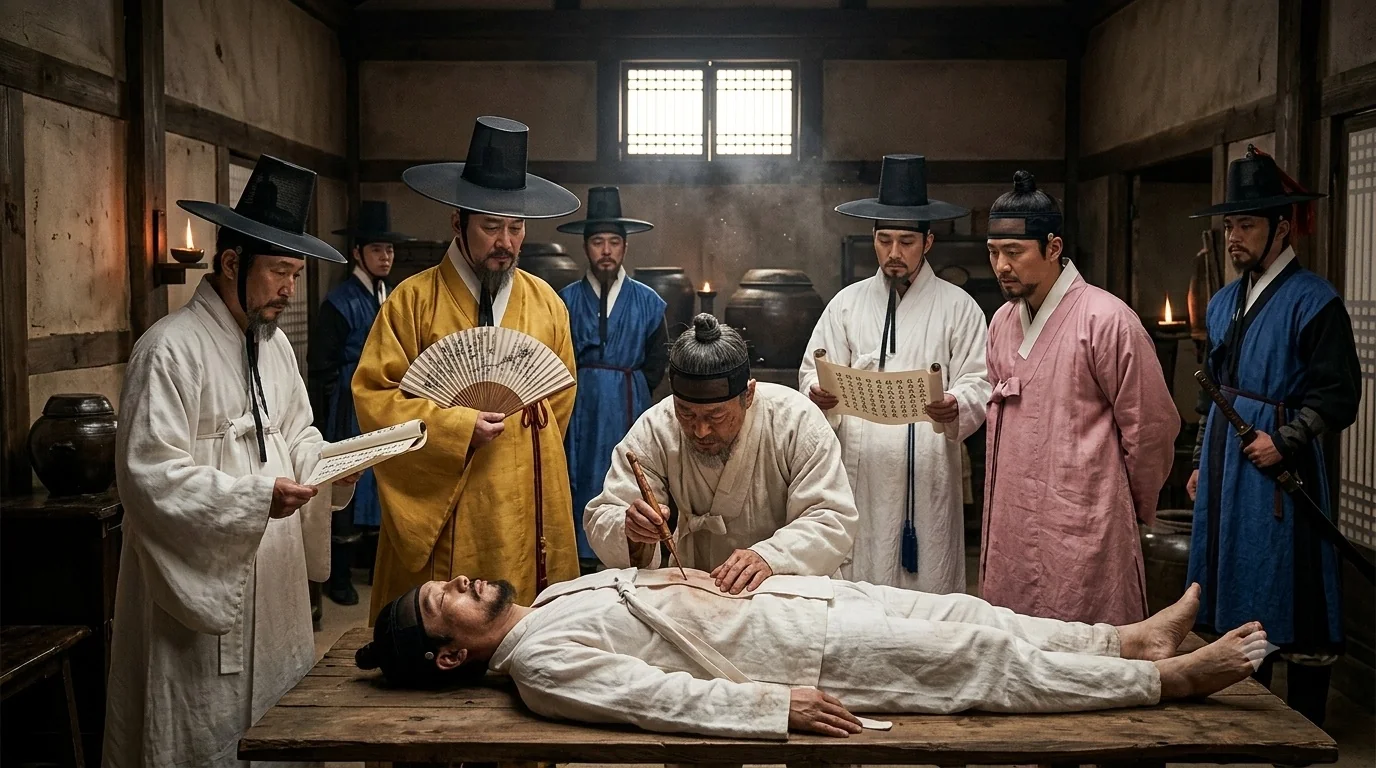
Here the state becomes suddenly and impressively present. A death in which homicide or unnatural causes were suspected — a sarok (사옥) case, not every found body — triggered geomheom (검험), the judicial inquest: an initial examination, the chogeom (초검), by the local magistrate; an independent bokgeom (복검) by a magistrate from a neighbouring jurisdiction; a third if the two disagreed; and fourth and fifth if the discrepancy persisted. In the provinces the results went up through the governor to the Ministry of Punishments, which compared the files and issued the certificate authorizing burial (Encyclopedia of Korean Culture). Behind it sat the Muwonrok manual tradition, with standardized rulers, reference tests and a fixed report template — covered in full in Why Joseon Korea Had a Forensics Manual Centuries Before Sherlock Holmes.
The asymmetry is the whole story. While she was merely missing, the record shows nothing; the moment she was a body with a suspicious cause of death, the state produced two independent investigators, an escalation ladder, a technical manual, a provincial review and a ministerial audit. The institution was built to adjudicate, and adjudication needs a fact. A body with a wound is a fact. A missing girl is a question.
Then who did chase missing people for money?
Somebody did. It just wasn’t for families. The recovery of runaway bound labourers was documented, administratively organized work, and the official term was chuswae (추쇄, 推刷) — tracking down fugitive or unregistered nobi and reconciling the registers. State-owned nobi were pursued through official channels; for privately owned nobi, the Korean Studies Data Center’s materials show owners investigating a runaway themselves, or sending other nobi and hired men, and petitioning officials for help. The term chunogaek (추노객) does appear (한국학자료센터).
What it does not support is the figure the 2010 drama Chuno made famous: a standing profession of freelance slave-hunters taking commissions (한국학자료센터). Individuals pursued runaways for someone else’s benefit, but a continuously operating tracking industry is not something the evidence establishes, and a seizure frequently needed official cooperation to stick. (Full history in Did Korea Have Slaves? Chuno & the Truth About Joseon’s 500-Year Nobi System.)
What a fugitive nobi had was not a bounty hunter but an infrastructure: an owner with a legally recognized loss, an administrative term for recovering it, registers to reconcile against, and official channels that could assist. A missing daughter had none of that — not because her family cared less, but because grief was the only thing attached to her. Grief mobilizes people. It does not mobilize offices.
How unusual was Joseon?
Not very. Premodern states generally relied on household registers, collective responsibility and crime-triggered pursuit rather than dedicated missing-person investigations. China’s baojia, Tokugawa Japan’s household registers and England’s hue and cry differed in detail, but none was a modern missing-person system. The assumption that a vanished person automatically generates an institutional search is recent.
The first crack: 1894
When the Podocheong was abolished in 1894 and replaced by the new Gyeongmucheong (경무청), its founding regulations instructed a patrolman who came across a lost child to place the child in the care of the local ward head, publicize the fact widely, and wait for the parents or relatives to come (『고종실록』 고종 31년 7월 14일).
It is not what a modern reader wants it to be. Nothing in it is set in motion by a parent arriving to say a child is gone; it is a custody, publication and hand-back procedure for a child the police have already found. Even at the end of the dynasty, the first thing the state could think to do about a person in the wrong place was to hold her, announce her and wait.
Drama vs history
| In Mr. Kim | In real Joseon |
|---|---|
| A father goes to find his daughter himself because the system is too slow | He searched himself because no dedicated missing-person office is documented — the Podocheong’s recorded work was patrol, questioning, prevention, arrest and interrogation |
| One man’s specialist skills decide whether she is found | Real tracking work existed, but in the recovery of runaway nobi — an administrative process, not the freelance profession Chuno made famous |
| The disappearance is immediately treated as a crime | Officials could act when a crime, suspect or suspicious death was identified; absence alone triggered no automatic procedure |
| The father can escalate to anyone who will listen | Escalation existed — soji, then governor, then the sinmun’go drum or a gyeokjaeng gong — but was chained and dominated by Seoul yangban |
Key terms. Podocheong (포도청) — the capital policing office. Hyeongjo (형조) — the Ministry of Punishments. Ogajaktong (오가작통) — the five-household unit of collective liability. Hopae (호패) — the identity tag for males sixteen and over. Soji (소지) — a petition to a magistrate. Sinmun’go (신문고) — the petition drum of 1401. Gyeokjaeng (격쟁) — striking a gong before the royal procession. Chuswae (추쇄) — the official recovery of fugitive nobi. Geomheom (검험) — the judicial inquest.
Coming up next
Mr. Kim grants one father the capability institutions are supposed to provide. For most of Korean history that was the most realistic plan a father had.
In the next essay, we stay with the Joseon underside and follow the people the registers were designed to catch — and what happened to those who slipped through them anyway.
Frequently asked questions
Did the Podocheong investigate missing persons? Not as a standing function anyone could trigger. The Podocheong (포도청) ran night patrols, questioned suspicious persons, prevented crime, arrested, interrogated and handled first-instance investigation. Officials could act when a crime, suspect or suspicious death was identified; an absence on its own set nothing in motion.
Could commoners report a missing family member? They could petition. A soji (소지) went to the local magistrate, who wrote his ruling — the jesa (제사) — in the margin and handed it back; it could order an investigation, summon people, demand documents or authorize an arrest. But no automatic procedure was triggered by absence alone: the magistrate could act, and nothing said he must.
Were women recorded in Joseon household registers? Yes, but indirectly. Women were not issued hopae identity tags, though they could appear in the hogudanja (호구단자) a household submitted and the junhogu (준호구) issued back. Registration was driven by taxation and military service, so it concentrated on adult males and frequently omitted women.
Was kidnapping a crime in Joseon Korea? Yes. Joseon adopted the Ming Code (대명률) as its general penal code from the dynasty’s founding, and article 298 of the penal section, 약인약매인, punished luring or seizing a commoner to make them a slave, wife, concubine or descendant, to sell them on, or to buy children of good families for resale. Punishing an abductor is a different function from finding the person taken.
Why were runaway nobi pursued more systematically? Because a fugitive nobi was a recognized loss with a procedure attached. Chuswae (추쇄) — tracking fugitive or unregistered nobi and reconciling the registers — was documented state work, and owners investigated their own runaways or sent others; the term chunogaek (추노객) appears in the sources. Nothing equivalent attached to a daughter.
What happened once a missing person was found dead? Where homicide or an unnatural death was suspected, geomheom (검험) followed: a first examination by the local magistrate, an independent second by a magistrate from a neighbouring jurisdiction, a third if they disagreed, and fourth and fifth if they still disagreed. Reports went through the provincial governor to the Ministry of Punishments, which authorized burial.
Sources & further reading
From the historical script and fact-check of 사뚱샘의 역사방 (SaDDungSam); provisions are sourced inline above.
- Capital policing. 포도청; 우리역사넷, 포도청; 국가유산진흥원, 「조선시대 경찰 포도청」; 차인배, 「조선후기 포도청의 사법적 위상과 활동 변화」, 『역사민속학』 58, 2020, 7–35쪽.
- Judicial and administrative offices. 형조; 한성부.
- Penal law. 대명률직해; 대명률; 형벌; 『대명률강해』 권18 형률 적도 제298조 「약인약매인」; 『고려사』 권85 형법지.
- Registration and collective responsibility. 오가작통; 호패; 장서각, 「호구단자」.
- Petition and appeal. 소지; 신문고; 격쟁; 『숙종실록』 숙종 8년 4월 3일.
- The inquest. 검험 — and our full treatment in the Muwonrok essay.
- The end of the Podocheong. 『고종실록』 고종 31년 7월 14일, 「경무청 관제직장」.
- Runaway nobi. 「도망간 노비를 어떻게 찾았을까?」; 「추노꾼이 정말 존재했을까?」 — and our companion piece, Did Korea Have Slaves? Chuno & the Truth About Joseon’s 500-Year Nobi System.
- Comparative systems. Harvard University Asia Center, “The Market, Social Organization, and the Military System”; The Statutes Project, 1285: 13 Edward 1: The Statute of Winchester; London Lives, “The Bow Street Officers”; Cornell & Hayami, “The Shumon Aratame Cho: Japan’s Population Registers,” Journal of Family History 11:4 (1986).
- The drama. SBS, Mr. Kim (김부장) official programme page.
Thanks for reading — see you in the next one.
This article was researched and written by K-Drama History. Source: Mr. Kim, Explained: If Your Daughter Vanished in Joseon Korea, Who Would Look for Her? — K-Drama History