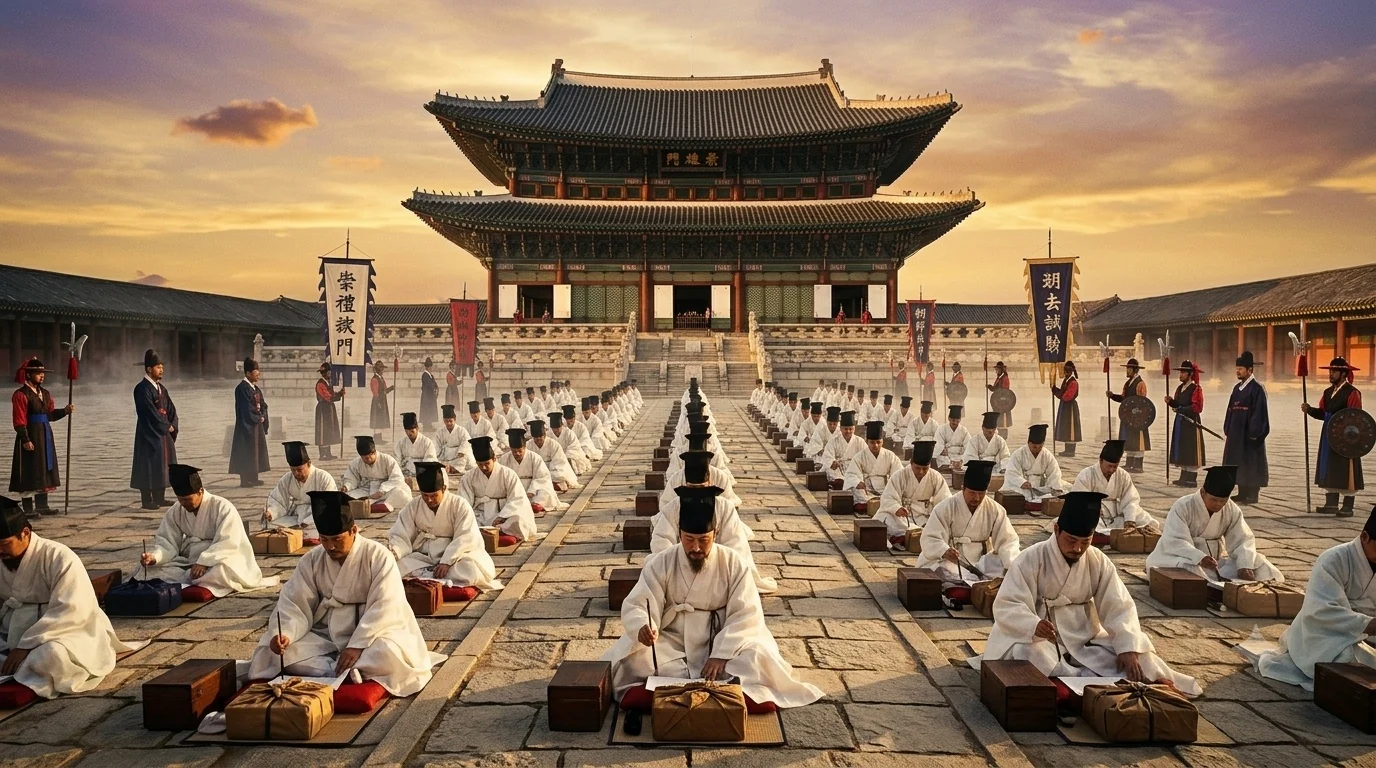
Secret Royal Inspector & Joy, Explained: What a Joseon Inspector Actually Did After Shouting 'Chuldu!'
Theme: Power & Politics
From the research behind Pause the Drama.
If you’ve started Secret Royal Inspector & Joy (어사와 조이) — tvN’s breezy 2021 sageuk, which has an official Netflix listing, though what’s actually watchable depends on where you live — you already know its best trick. Ra Ian (Ok Taec-yeon), an unambitious civil servant who’d genuinely rather run a dumpling shop, reaches into his robe and holds up a small bronze token stamped with horses. A corrupt official mid-bribe, mid-smirk, freezes. Outside, someone is pounding on a gate and shouting that the inspector has arrived. (Don’t confuse it with the 2020 KBS2 series Royal Secret Agent — 「암행어사: 조선비밀수사단」, a different show with a different cast, built on the same real institution.)
It’s a great scene, and an easy one to underestimate — mostly because the interesting part isn’t the reveal. It’s what happened next.
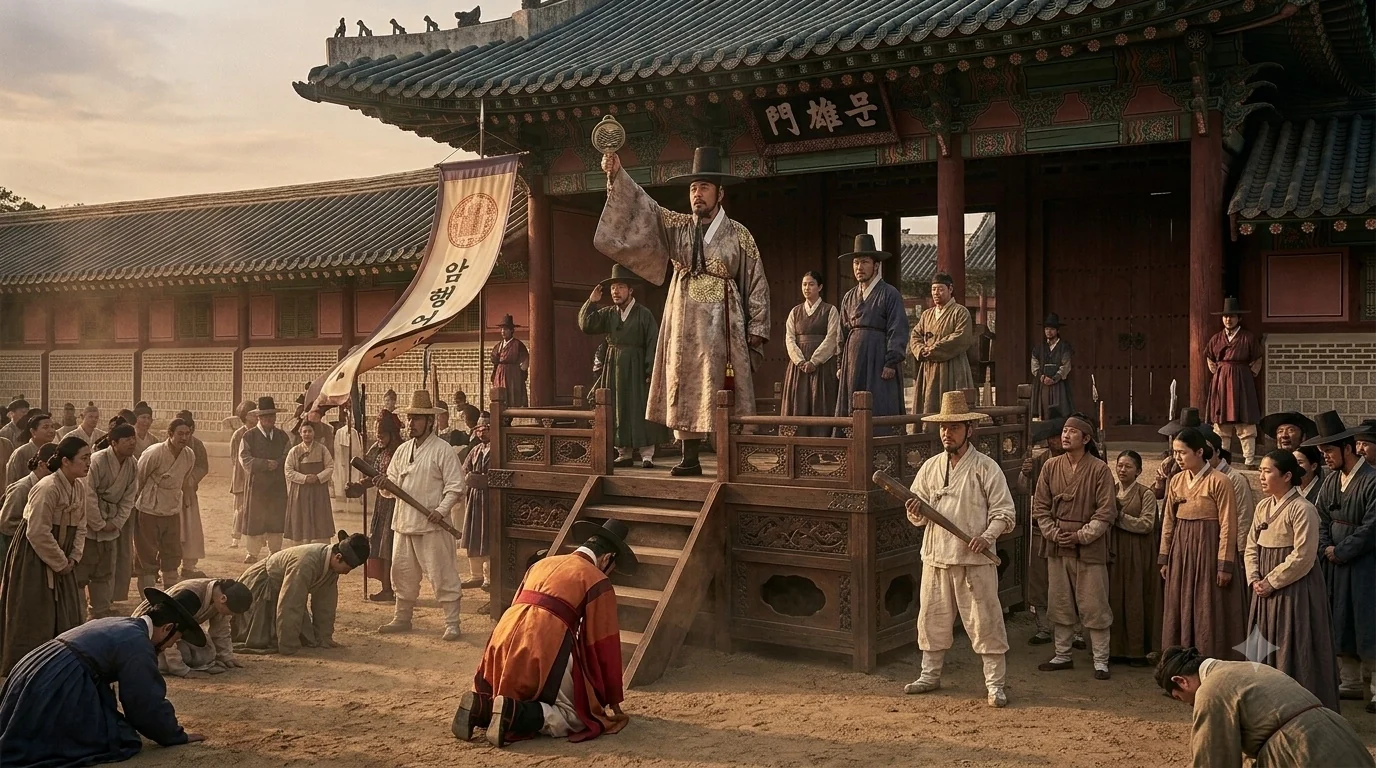 “Chuldu!” The shout was real. So were the runners at the gate. What followed was not a brawl — it was an audit. (AI illustration)
Quick answer: Secret Royal Inspector & Joy is built on a real Joseon office: the amhaengeosa (암행어사), an official secretly appointed by the king and sent to the provinces in disguise to investigate local magistrates. The chuldu (출두) — runners hammering on a magistrate’s gate and shouting — really happened. But the inspector’s actual work began after it: auditing the office’s documents (beonyeol), inspecting its granaries (beongo), sealing them shut with his mapae if he found crimes (bonggo), reviewing prisoners, re-examining the cases of the wrongly jailed, and taking petitions from the public. He came back and filed a mandatory report to the king. He was less a spy than an auditor whose inspection began in disguise.
Let’s unpack it.
What exactly was an amhaengeosa?
The word tells you the job: am — hidden — haeng — to travel — eosa, a royal envoy. An envoy who travels hidden.
What made him different from an ordinary eosa was secrecy at both ends: the king appointed him personally, and his appointment, destination and activity were all kept secret. He was drawn from the danghagwan — officials below senior third rank — men the king trusted. Once the system had matured, the king would call for nominations, the three State Councillors would pick suitable men from the roster of court attendants, and the king made the final appointment (Encyclopedia of Korean Culture, 암행어사).
Appointment practice varied by reign and circumstance — some inspectors were selected directly, or converted from other royal missions.
And one popular claim needs retiring: that inspectors were chosen young, typically in their thirties, for stamina and for having fewer local entanglements. No formal age rule is established in the sources, and surviving cases include inspectors in their forties and fifties — Hwang Hyeop was appointed inspector for Gongcheong-udo in 1833, at the age of 55. What we can say is that the king chose from among trusted danghagwan officials. What we can’t say is that he was looking for young legs.
What did an inspector actually carry?
Four items are usually listed — and it’s worth saying that “the four items” is a teaching convenience, not a term from the law codes (우리역사넷, National Institute of Korean History):
- Bongseo (봉서) — the sealed letter naming his region and mission. The outside was marked with instructions to open it only after passing beyond a specified city gate. He learned where he was going after he had already left Seoul.
- Samok (사목) — the itemized instructions: what to investigate, by what standard. In the late Joseon period, compilations like the Paldo Eosa Jaegeo Samok organized this work by province — though that text is a late compilation, from around Jeongjo’s era, so we shouldn’t imagine every inspector across five centuries working from the same manual.
- Mapae (마패) — the bronze tablet. It authorized him to use post-station horses and runners, identified him as the king’s envoy, and — importantly — worked as a seal: he stamped documents with it, including the order that shut a granary. One face showed the number of horses he could claim; the other carried the issuing office’s seal. So it isn’t quite right to say “flip it over and it becomes proof of royal authority.” The tablet was both things at once. As for its grade, the sources genuinely differ: the Encyclopedia of Korean Culture says inspectors got a two-horse tablet; the National Museum of Korea says they generally used three-horse tablets, with three under Sukjong and Yeongjo and mostly two under Gojong. The ten-horse tablet was for the royal house alone (National Museum of Korea). Different reigns, different grades — no single fixed standard.
- Yucheok (유척) — a standardized brass ruler, and the item almost every popular account gets wrong. It was not primarily a device for catching magistrates who rigged grain measures to skim taxes. Its documented uses are checking whether instruments of punishment — the flogging paddle, the cangue — had been made larger than the legal specification, and measuring bodies and wounds in death investigations. It’s a ruler against torture and for forensics, not against short-weighting.
Notice what’s missing: a sword, an army, any power to kill. An amhaengeosa’s authority was documents, a seal, and the king’s name behind them.
So was the “chuldu!” shout real, or is that just for TV?
The shout was real. What the dramas don’t show you is the paperwork that followed.
Start with what’s documented. Chuldu was the moment the covert inspector dropped the disguise, appeared in his official capacity, and entered the magistrate’s office to begin formal action. His runners and attending clerks struck the compound’s gates, shouting “Chuldu!” (Encyclopedia of Korean Culture, 암행어사). So no: the public announcement of the inspector’s arrival is not an invention of Chunhyangjeon or of television. (The drama’s episode three is literally titled “암행어사 출두요!”)
What we can’t substantiate is that every chuldu was the melee the dramas love — runners with clubs storming in, mass grapplings, a courtyard of terrified underlings. There’s no basis for treating that as standard procedure. But don’t overcorrect into “actually it was all very quiet and polite,” either, because arrests were entirely real: an inspector could issue warrants, arrest and jail the local strongmen who had been preying on the people.
Here’s what the record shows him actually doing, once seated in the hall:
- Beonyeol (反閱) — auditing the office’s documents.
- Beongo (反庫) — inspecting the granaries and storehouses.
- If the documents revealed crimes: seizing the magistrate’s seal of office and his military tally.
- Bonggo (封庫) — writing the two characters 封庫 on a sheet of paper, stamping it with his mapae, and sealing the storehouse doors shut.
- Checking the jail: prisoners, and those held without trial for too long.
- Re-examining questionable cases and ordering the release of those found to have been wrongfully held.
- Receiving petitions and complaints (soji, jeongjang) directly from the people.
- Issuing warrants for the local powerful who had abused them.
Beongo and bonggo sound nearly identical and are constantly confused: the first is the inspection of the storehouse; the second is sealing it shut. And notice which tool did which job — the mapae stamped the seal on that storehouse door. The popular idea that the yucheok did “most of the actual on-site work” while the mapae was mere theater doesn’t hold up either: they did different jobs, and there’s no basis for ranking them.
The most bureaucratic detail is the most telling one. Back in Seoul, the inspector filed a seogye (서계) — a mandatory report to the king — and could attach a byeoldan (별단), an optional supplementary memorandum. He was not a freelance spy or a secret policeman. He was a formally commissioned royal auditor who conducted the investigative stage undercover.
Did the system actually work?
Not reliably — and the hero stories never tell you that part.
Secrecy leaked. An inspector’s identity or destination could be known before he arrived, which cost him the only real advantage he had. He had no permanent staff in the province, so the quality of an investigation depended heavily on the individual man the king had picked. Punishing a handful of magistrates could expose abuses without touching the tax, relief and local-power structures that produced them. And inspectors themselves could overreach or take bribes — kings sometimes sent a second inspector to check on the first.
None of that makes the institution a sham. It makes it a real instrument of a real state: powerful in the right hands, blunt in the wrong ones, and never a substitute for fixing what was broken underneath.
Who was Korea’s most famous secret inspector — and was he really one?
Ask any Korean and the answer is Bak Mun-su (박문수, 1691–1756). And here the record is more interesting than either the legend or the debunking.
Bak Mun-su was never formally appointed to a post called amhaengeosa. His official title was Yeongnam byeolgyeoneosa (영남별견어사) — “specially dispatched inspector for Yeongnam” — and he was sent in 1727, under Yeongjo, to oversee famine relief and investigate magistrates (Encyclopedia of Korean Culture, 박문수; 우리역사넷).
But — and this is the part usually lost in the “actually, he wasn’t a real inspector” correction — his instructions explicitly told him to travel incognito, to find out from the people what was being done to them, and to dismiss magistrates who had broken the law. He did exactly that. In Cho Han-pil’s research, Bak investigated 41 magistrates and got 13 of them dismissed. So he wasn’t a title-holding amhaengeosa. He was a man who went undercover on the king’s orders and broke corrupt officials — which is why the legend stuck to him and not to someone else.
Two smaller points, both of which popular accounts garble. He was not dispatched as an inspector “four times” in the ordinary sense: some of those postings — famine-relief commissioner for Yeongnam, relief commissioner for the northern provinces, tax-equalization commissioner — were senior dangsang-rank assignments for relief, taxation and provincial oversight, not inspector missions. And the widely repeated figure of “roughly 300 Bak Mun-su folk tales” has no scholarly tally behind it that I can point to, so this piece gives no number. Many tales exist. That’s what we can say.
Key terms. Amhaengeosa (암행어사) — an inspector secretly appointed by the king to travel incognito and investigate local magistrates. Mapae (마패) — the bronze tablet: post-horse warrant, badge of royal commission, and the seal he stamped on a sealed storehouse. Yucheok (유척) — the standardized brass ruler, used to check that instruments of punishment met legal specifications and to measure bodies in death investigations. Chuldu (출두) — the inspector’s entry into the magistrate’s office, announced by runners hammering the gates. Beongo / Bonggo (反庫 / 封庫) — inspecting the storehouse / sealing it shut. Seogye (서계) — the mandatory report he filed with the king on return.
Here’s the scene, decoded:
| In the tvN drama | What the historical record shows |
|---|---|
| Ra Ian travels disguised as a commoner | Real — the secrecy of the appointment, the destination and the investigation was the whole point |
| The bronze token is revealed and the room panics | The mapae was real, and the shout of chuldu was real. But the tablet’s jobs were post-horses, royal commission and stamping the seal on a locked granary — not a magic badge |
| Clubs, a brawl, mass arrests | Arrests were real (he could issue warrants), but there’s no basis for treating the melee as standard procedure |
| The inspector’s brass ruler catches rigged grain measures | The yucheok checked that flogging paddles and cangues met legal size — and measured bodies in death investigations |
| He acts almost alone, with comic sidekicks | He worked from written instructions (samok) and filed a mandatory report (seogye) with the king |
| Bak Mun-su, the legendary amhaengeosa | He never officially held the title — he was a byeolgyeoneosa. But his orders told him to go undercover, and he investigated 41 magistrates and had 13 dismissed |
Why Secret Royal Inspector & Joy feels so Korean: four ways to watch the watchers
Every complex state eventually asks the same uncomfortable question: who checks the people the ruler already trusted to check everyone else? Joseon Korea, Ming China, Edo Japan, the Ottoman world, and Renaissance Venice all answered it — and the shape of each answer tells you something about how each society actually understood power.
Korea — delegate the disguise, keep the paperwork. The amhaengeosa did not spring from nowhere, and it did not descend in a tidy straight line either. This piece used to draw one — Saheonbu → Bundae → amhaengeosa — and that’s too neat. Joseon ran a standing watchdog office, the Saheonbu (사헌부), whose junior inspectors (gamchal) were sent to the provinces in a practice called haengdae or bundae (Encyclopedia of Korean Culture, 사헌부; the gamchal entry describes these as forerunners of the amhaengeosa). But so were the haengdae-eosa; and the bundae-eosa, under Sejo and Seongjong, who gave officials of the fifth rank and above concurrent censorial posts to police magistrates; and the gyeongchagwan, temporary commissioners sent out on royal orders; and covert inspections under Seongjong; and secret inspectors dispatched under Jungjong. Several traditions converged. And while we’re being careful: it would be wrong to call the amhaengeosa a purely Korean invention with no lineage — the whole censorial tradition is East Asian. What is distinctive is the combination: secret royal appointment, incognito investigation, a public chuldu, the bongseo–samok–mapae–yucheok kit, and a mandatory written report at the end.
China — the watchers with standing authority. Korea’s censorial tradition shares roots with China’s Censorate (yushitai 御史臺, later the duchayuan 都察院), whose touring censors — the emperor’s “eyes and ears” — investigated officials, courts and administration across the provinces (Encyclopædia Britannica, “Censor”). A claim you’ll meet often — that Ming China had no covert, disguised inspectors at all — is one this piece won’t make: you cannot establish that absence from the available sources, and the comparison doesn’t need it. The point isn’t that nobody else ever investigated covertly. It’s that Joseon developed a particularly recognizable combination: secret royal commission, incognito inquiry, public disclosure of authority on arrival, a tablet that doubled as an official seal, and mandatory written reporting afterwards.
Japan — the eyes that stayed in the shadows. Edo Japan built a standing surveillance bureaucracy: the metsuke (目付) and ōmetsuke (大目付), permanent posts overseeing political surveillance, the discipline of the shogun’s retainers, the conduct of hatamoto and gokenin, court ceremony in Edo Castle, and inspections of shogunal facilities (Encyclopædia Britannica, “Tokugawa shogunate”). Comparable to Korea’s inspectors — but not the same institution. These were permanent offices inside the shogunate’s bureaucracy, not temporary royal missions ending in a public reveal. (The covert agents often called onmitsu should be handled with care, too: the usage varies by period and source, and they shouldn’t be flattened into one fixed office nationwide.)
The Islamic and Ottoman world — the ruler in the disguise, in the stories. Here the tradition puts the sovereign himself in plain clothes — but be careful what kind of source that is. The Abbasid caliph Harun al-Rashid (786–809) is famous for walking Baghdad’s streets at night to hear what people really said about his officials. The historical caliph and the legendary figure of the Thousand and One Nights need to be kept apart: the night-walking is a literary and traditional image, not a documented administrative practice (Encyclopædia Britannica, “Harun al-Rashid”; Nabia Abbott, Two Queens of Baghdad, University of Chicago Press, 1946). Ottoman accounts likewise tell of Murad IV (r. 1623–1640) patrolling Istanbul in disguise at night to enforce his bans on wine, coffee and tobacco, punishing offenders on the spot — a story that survives in the Ottoman record and should be treated as traditional narrative rather than a regular institution of government (Avner Wishnitzer, As Night Falls: Eighteenth-Century Ottoman Cities after Dark, Cambridge University Press, 2021). Whatever their historicity, these are not delegated administrative offices. They are stories about a ruler, not a system a state could run repeatedly.
Venice — the same methods, a different target. Renaissance Venice ran one of Europe’s most elaborate intelligence systems: the Council of Ten (from 1310), and from 1539 its three State Inquisitors (Inquisitori di Stato), with informant networks, anonymous denunciations dropped into the stone “lion’s mouths,” and the power to authorize arrests without a prior court order (Encyclopædia Britannica, “Council of Ten”; Ioanna Iordanou, Venice’s Secret Service: Organizing Intelligence in the Renaissance, Oxford University Press, 2019). A striking parallel in method — secrecy, informants, sudden authority. The difference is what each was pointed at. Venice’s apparatus was built around state security: treason, espionage, political conspiracy. Joseon’s inspectors were built around provincial administration: a magistrate’s ledgers, his granaries, his jail, and his treatment of the people under him. (And a caution against a tidy contrast: Venice’s informants were not drawn only from the elite — officials, citizens, subjects and paid sources all fed the network. The distinction is in purpose, not in who did the whispering.)
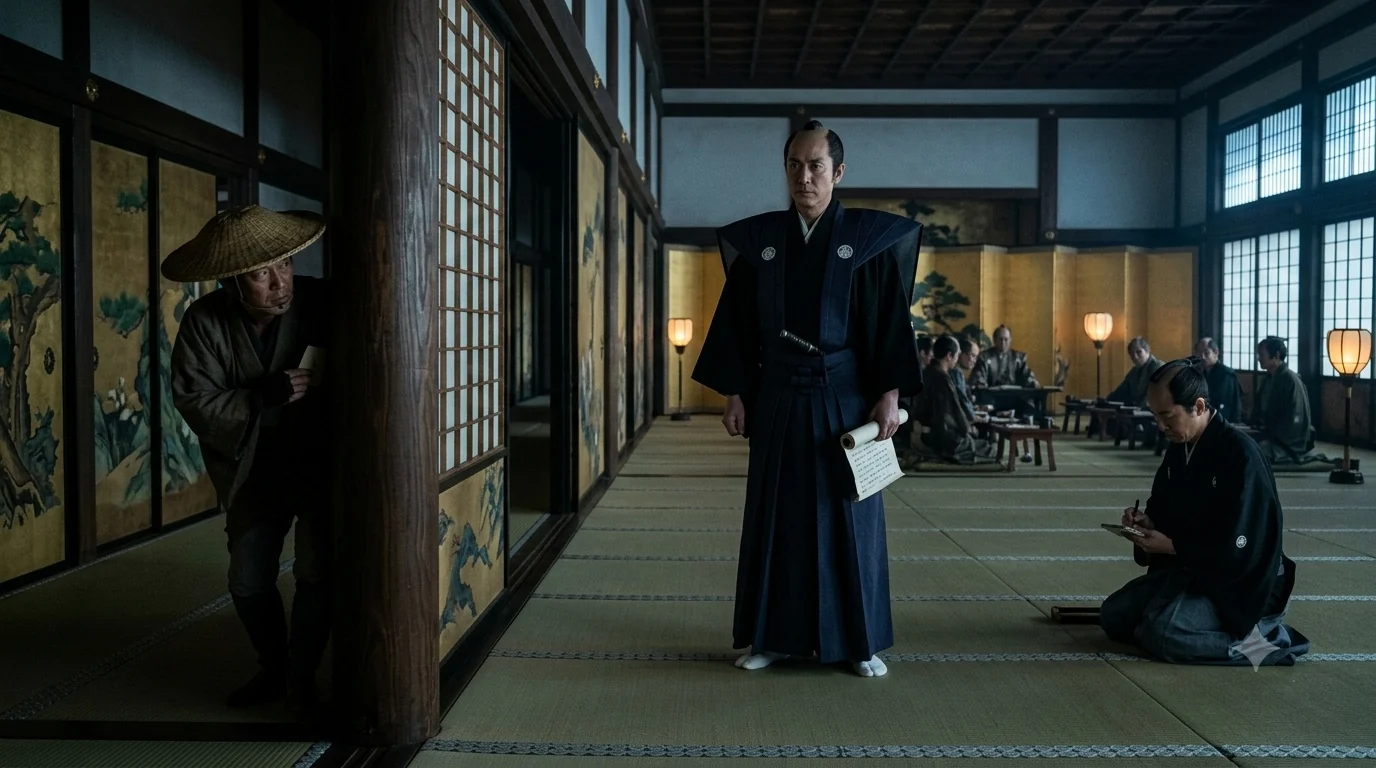 Edo Japan’s answer: permanent offices watching from inside the bureaucracy. No reveal — because the value lay in never being seen. (AI illustration)
It’s tempting to close with a neat four-box schema — China the standing and open watchdog, Japan the standing and hidden one, the Ottoman world the ruler in person, Venice the secret eye turned inward, Korea alone with the temporary disguised proxy. Resist it. Every one of these societies mixed open investigation with covert inquiry, permanent bureaus with temporary commissions, administrative audit with political and security surveillance. The boxes are too clean for the history, and “Korea alone in all the world” is a claim no one has done the comparative work to support.
What the comparison does support is narrower, and still worth having. Many states built ways for the center to watch the officials it had posted to the provinces. China had the Censorate, its investigating and touring censors. Japan had the metsuke and ōmetsuke and various covert inquiry. Venice had its Ten and its Inquisitors. The Islamic and Ottoman traditions have their stories of the disguised sovereign. And Joseon assembled a distinctive combination: a temporary royal commission, kept secret; an investigation conducted incognito under a sealed letter and written instructions; a public chuldu at the magistrate’s gate; and a mandatory written report — the seogye, with an optional byeoldan — owed to the king on return.
And its purpose was double-edged, which is the part the hero stories flatten. The amhaengeosa protected the king’s subjects from provincial abuse and gave the king an independent instrument for controlling local administration — a way to learn what was happening in a province without depending on the officials being investigated to tell him. Those two purposes were never in tension. That’s precisely why the institution lasted.
Coming up next
One bronze token — and we’ve traveled from a Joseon relay station to a 1539 Venetian tribunal, to a caliph’s nighttime walks through Baghdad, to a Tokugawa spy network that never once revealed itself. That’s the quiet gift of a good historical comedy: even its punchlines have a paper trail.
In the next essay, we’ll take another K-drama scene that looks like pure fiction — and trace the real Korean history hiding underneath it.
Frequently asked questions
Is Secret Royal Inspector & Joy based on a true story? Not literally — Ra Ian, Kim Joy and the plot are invention. But the office at its center, the amhaengeosa, was real: an official secretly appointed by the king and sent to the provinces in disguise to investigate local magistrates. (Note the drama is tvN’s 2021 series; the 2020 KBS2 show Royal Secret Agent is a different program built on the same institution.)
What was an amhaengeosa in real Joseon Korea? A temporary inspector, appointed in secret by the king from among trusted officials below senior third rank. He carried a sealed letter (bongseo) he could open only after leaving the capital, itemized instructions (samok), a bronze tablet (mapae) that requisitioned post-horses, identified him as the king’s envoy and served as his seal, and a brass ruler (yucheok). He investigated in disguise, revealed himself, audited the magistrate’s office — and filed a mandatory written report to the king on his return.
Was the dramatic “chuldu” reveal scene historically real? The shout was real: his runners hammered on the magistrate’s gates crying “Chuldu!” What we can’t substantiate is the melee — club-wielding runners storming in and mass grapplings as standard procedure. But don’t overcorrect into “it was all very quiet”: he could issue warrants and make arrests. The documented core of his work came after the entry — auditing documents, inspecting granaries, sealing them shut with his mapae, checking the jail, retrying the wrongly imprisoned, and taking petitions from the public.
What was the yucheok, the brass ruler, actually for? Not, as popular accounts have it, for catching magistrates who rigged grain measures to skim taxes. Its documented uses are checking whether instruments of punishment — the flogging paddle, the cangue — exceeded their legal dimensions, and measuring bodies and wounds in death investigations. It was a ruler against torture and for forensics.
Was Bak Mun-su a real amhaengeosa? He never officially held the title. His formal post was Yeongnam byeolgyeoneosa, specially dispatched inspector for Yeongnam, in 1727. But his orders explicitly instructed him to travel incognito and to dismiss magistrates who broke the law — and he did: research by Cho Han-pil finds he investigated 41 magistrates and had 13 dismissed. So the correction “he wasn’t really a secret inspector” overshoots. He did the work; he just didn’t hold the job title.
Was the amhaengeosa a uniquely Korean invention? The censorial tradition — inspectors sent to police officials — is shared across East Asia, and Joseon’s own inspectors grew out of several earlier practices, not one straight line of descent. What was distinctive was the combination: secret royal appointment, incognito investigation, a public reveal, a tablet that doubled as an official seal, and a mandatory written report to the king afterwards.
Sources & further reading
Written from the historical script and fact-check of 사뚱샘의 역사방 (SaDDungSam). Key sources are cited inline. For broader reading:
- Amhaengeosa (암행어사) — appointment, equipment, and the chuldu procedure: beonyeol, beongo, bonggo, the jail review, and the seogye report. (Encyclopedia of Korean Culture · 우리역사넷)
- The institutional ancestry — the Saheonbu and its gamchal, sent out as haengdae and bundae; the bundae-eosa of Sejo and Seongjong; the gyeongchagwan; covert inspections under Seongjong and Jungjong. (Encyclopedia of Korean Culture, 사헌부, and the “감찰” entry)
- The mapae — its grades, and how they varied by reign. (National Museum of Korea, curator’s pick)
- Bak Mun-su — the byeolgyeoneosa who did the inspector’s work. Cho Han-pil’s research on his Yeongnam mission (41 magistrates investigated, 13 dismissed). (Encyclopedia of Korean Culture · 우리역사넷)
- The comparative frame. For the Ming censorate: Charles O. Hucker, The Censorial System of Ming China (Stanford University Press, 1966). For the Edo ōmetsuke: Yamamoto Hideki, 『江戸幕府大目付の研究』 (Yoshikawa Kōbunkan, 2011). For Venice: Ioanna Iordanou, Venice’s Secret Service (Oxford University Press, 2019). For Murad IV’s night patrols as traditional narrative: Avner Wishnitzer, As Night Falls (Cambridge University Press, 2021). For Harun al-Rashid, history versus legend: Nabia Abbott, Two Queens of Baghdad (University of Chicago Press, 1946). (Encyclopædia Britannica, “Censor”)
- The system’s limits — leaked secrecy, no permanent provincial staff, uneven quality of individual inspectors, punishment of individuals without structural reform, and inspectors who overreached. See the scholarship on the institution’s operational results and limits (KCI).
Editor’s note, 13 July 2026. This article was substantially fact-checked before publication. Corrected draft claims included: the yucheok as a tax-fraud detector (it checked the legal size of punishment instruments and measured bodies in death investigations); “roughly 300 Bak Mun-su folk tales” (no scholarly tally); a straight-line descent from the Saheonbu to the amhaengeosa (several practices converged); the claim that Ming China had no covert inspectors at all (an absence the sources cannot establish); and an age rule for appointment (none is documented — Hwang Hyeop was 55).
Thanks for reading — see you in the next one.
This article was researched and written by K-Drama History. Source: Secret Royal Inspector & Joy, Explained: What a Joseon Inspector Actually Did After Shouting 'Chuldu!' — K-Drama History