Joseon Divorce Law: Seven Grounds, Three Exceptions
From the research behind Pause the Drama.
In MBC’s Joseon Attorney: A Morality (2023, 16 episodes), Kang Han-su is an oejibu, a kind of Joseon-era lawyer, who digs into the lawsuits of wronged commoners. Property, murder, false accusations: every kind of case reaches the courtroom. That raises a question. What happened when a married couple split up? Was there even such a thing as divorce in Joseon?
There was. But it worked quite differently from what we’d expect today.
Quick answer: In Joseon, the formal ending of a yangban marriage was not a matter for the couple alone; the state intervened. When a nobleman’s expulsion of his wife came under official investigation, the king made the final judgment on whether it would stand. That is not the same as saying every yangban had to petition the king in advance under one uniform procedure. A study of early-Joseon policy on wife-abandonment notes both that no reporting-and-permission procedure had been established and that cases brought to investigation went to the king for final decision (Park Kyung, 2010; Encyclopedia of Korean Culture — Divorce). Divorce was handled as a public matter, not a purely private one. That is the thread running through this whole piece.
(The trials and characters of Joseon Attorney are fiction. This piece connects only the show’s backdrop, the oejibu and Joseon’s culture of litigation, to history.)
Where to watch: at the time of release, the show is offered on wavve (Korea), Kocowa, Viki, and others. Availability varies by country and region and changes often, so check before you look for it.
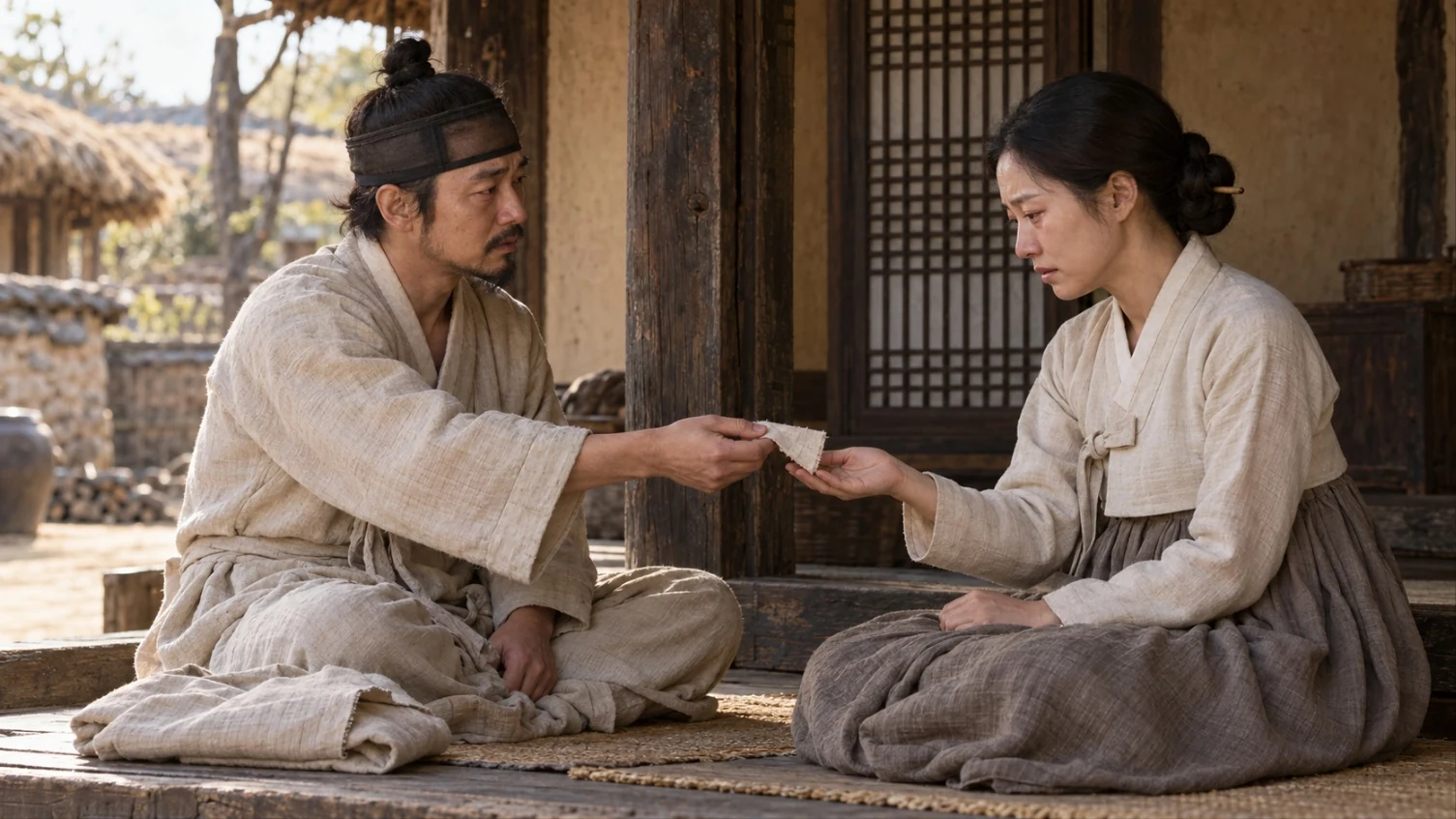 Halgeup-hyuseo: among commoners, a piece cut from the jeogori collar could serve as a token of divorce. (AI illustration)
Divorce in Joseon law: the seven grounds (chilgeo) for sending a wife away
Just as the trials in the drama are always argued over “the law,” divorce in Joseon had its own governing norms. The most famous was chilgeojiak (七去之惡), the seven grounds on which a husband could send his wife away (Encyclopedia of Korean Culture — Chilgeojiak):
- Failing to serve her parents-in-law well (bulsun bumo)
- Bearing no son (muja)
- Adultery (eumnan)
- Jealousy (jiltu)
- A serious illness of the kind then counted as grounds for ending a marriage (akjil)
- Talking too much (daeon)
- Theft (jeoljeol)
By today’s standards, every one of them is startling. Not bearing a son, being jealous, talking too much: each was enough to get a wife thrown out. A note on terms: these seven were grounds for expelling a wife, not crimes in the state’s penal sense. The list grew out of a Confucian idea of the family in which a wife served not so much her husband as the household she married into. Both the seven grounds and the three exceptions are of Chinese origin (Confucian ritual texts, then the Chinese legal codes). Joseon took them in through the Great Ming Code, so how strictly they applied in practice varied by period and by social status.
The chilgeo were harsh on women. But Joseon also had a second mechanism that checked that harshness: the sambulgeo.
The three exceptions (sambulgeo) that blocked expulsion
For readers outside Korea, this is often the “I never knew that” moment. The seven grounds are widely known, but the sambulgeo (三不去), the “three conditions for not sending away” that restrained them, are hardly known at all (Encyclopedia of Korean Culture — Sambulgeo).
Even if a wife fell under one of the seven grounds, she could not be sent away in three cases:
- She had carried out the three-year mourning for her parents-in-law with her husband (經持舅姑之喪).
- They had married when he was poor and lowly, and he later became rich and honored (娶時賤後貴).
- She had a family to marry from, but no family left to return to (有所娶無所歸).
The second is especially striking. A wife who had shared the hard years could not be discarded because her husband had since grown rich. It is striking that a clause like this stood in written law in 15th-century Joseon.
The Great Ming Code (Daemyeongnyul, 大明律), the Ming Chinese penal code that Joseon applied as its basic reference for criminal law, put penalties behind these rules. (It was a criminal code, not Joseon’s own comprehensive code of government.) The relevant article provides that (Daemyeongnyul jikhae / ganghae, vol. 6, Household Statutes, Marriage, Art. 123, “Expelling a wife”; the article text was checked against the Da Ming lü, vol. 6, Marriage, “Expelling a wife” (出妻) on Chinese Wikisource):
- A husband who expelled his wife without any of the grounds received 80 strokes of the heavy stick (杖八十).
- A husband who expelled a wife who fell under the seven grounds but also under a sambulgeo condition was punished two degrees less, which the Daemyeongnyul ganghae glosses as 60 strokes, and the couple were ordered to reunite (追還完聚).
- A husband who failed to divorce when the marriage fell under uijeol (義絶, a grave breach that the state treated as grounds for compulsory dissolution) also received 80 strokes.
- When husband and wife were at odds and both wished to part, there was no punishment.
So the sambulgeo were more than moral advice; they were law with penalties attached. Two cautions apply. First, the legal order to reunite is not the same as proof that the couple actually went back to living together. Second, the sambulgeo were not an absolute rule keeping every marriage intact. Compulsory dissolution for uijeol existed separately. And the Daemyeongnyul ganghae commentary, as distinct from the statute itself, explains that a wife guilty of adultery or afflicted with akjil could be sent away even when a sambulgeo condition applied.
The sambulgeo Sejong upheld: even for a wife who had killed
A real case in the Veritable Records shows the sambulgeo were more than words. Like a courtroom battle in Joseon Attorney, it was fiercely argued at court.
According to the Sejong sillok, entries for the 17th and 19th days of the 6th lunar month of Sejong’s 22nd year (1440), Lady Yi was the wife of Yi Maeng-gyun (李孟畇), who had risen to the high post of Left Associate State Councilor (jwachanseong). Out of jealousy, she killed a household slave woman who had been her husband’s concubine (Sejong sillok, 1440.6.17; Sejong sillok, 1440.6.19).
Two separate bodies pressed the case against her:
- The Office of the Inspector-General (Saheonbu) went after the killing and Yi Maeng-gyun’s responsibility for covering it up. He had concealed signs that his wife killed the woman deliberately and reported the matter differently. The office demanded that Lady Yi be divorced and expelled.
- On the 19th, the State Council (Uijeongbu), through its official Yi In-son, made the argument from the seven grounds. Lady Yi was guilty of jealousy and had no son, which made two of the seven.
Sejong refused the divorce. The Sejong sillok entry for the 19th has him say: “有此二不去之義, 未可遽以此而離異也” (“Since there are these two grounds against sending her away, she cannot be divorced hastily on this account”; Sejong sillok, 1440.6.19). He cited two of the sambulgeo: Lady Yi had carried out the three-year mourning with her husband, and they had married in poverty and later shared wealth and honor. He also cited her advanced age and her status as the wife of a high minister.
Refusing the divorce did not mean everyone walked away untouched:
- Lady Yi had her patent of rank revoked on the 17th.
- Yi Maeng-gyun was dismissed from office on the 17th and banished on the 19th to Ubong-hyeon in Hwanghae Province.
- Sejong also faulted him, as head of the household, for failing to control his wife.
Even a wife who had caused a death could not simply be cast out once the sambulgeo applied. This case is still hard to recast in today’s terms as “protection of women.” The two sambulgeo were not the only grounds Sejong gave, and family standing and rank were also in play. But at the very least, the case shows the common belief that “a husband could dump his wife whenever one of the seven grounds applied” doesn’t match the record.
The yangban answered to the state; commoners had a scrap of jacket
Another striking part of Joseon divorce is how much the process differed by social status.
For the yangban, the formal dissolution of a marriage drew the state in. Divorce cases in official families were debated at court, and when a case of wife-expulsion was investigated, the king made the final decision. That is why the Yi Maeng-gyun affair played out between the censorate, the State Council, and the king. Yangban were reluctant to divorce at all, and the law laid out no detailed divorce procedure for them. As noted above, the state’s involvement fell on cases that came to light and were investigated. It was not a standard advance-permission process that every couple passed through.
Commoners had considerably more room. A commoner couple could part through sajeong-paui (事情罷議): husband and wife sat down together, talked through the circumstances that left them no choice but to separate, and agreed to it. It was a kind of consent divorce (Encyclopedia of Korean Culture — Divorce).
At that point the husband might give his wife a token of the divorce: he cut off part of his jeogori collar and handed her the piece. This was called halgeup-hyuseo (割給休書). The scrap was something like a “remarriage permit” in today’s terms; a woman who held it could remarry. It was not, of course, an official certificate issued by the state.
Within the same Joseon, then, divorce for the yangban was a public matter the state stepped into. For commoners it was a matter of ordinary life that could end with a scrap of jacket. Status shaped even the way a marriage ended.
Still, sajeong-paui shouldn’t be romanticized. When a husband asked for one and the wife refused, she was in effect simply abandoned. Accounts say that in many cases the outcome differed little from a husband casting his wife out on his own. The difference between yangban and commoners was relative. It does not mean commoner wives had an equal say in divorce, or that ending a marriage was as simple as handing over a piece of cloth.
Where did divorced women go? Constraints changed over time
Here is a twist that may surprise readers outside Korea. It’s easy to picture Joseon as uniformly oppressive to women from start to finish. In reality, the constraints varied considerably over time.
Joseon was patriarchal from the beginning. Wife-expulsion centered on the husband, and the seven grounds applied in the early period too. What changed over time was the content and the strength of those constraints. Several distinct changes happened at different times, and they shouldn’t be lumped into one “late-Joseon turning point.”
Inheritance and women’s property. In early Joseon, equal inheritance between sons and daughters was the principle. Women held property separately after marriage, and a woman without heirs could give her property to her natal kin. That equal-inheritance practice weakened in substance mainly from the 17th century onward (Yoon Jin-sook, 2013, abstract).
The legal restriction on remarriage came earlier, in the 15th century. The Gyeongguk daejeon (經國大典, 1485), Joseon’s great law code of the early period, included this clause: “The descendants of women who have remarried or lost their virtue may not sit the civil service examination or the saengwon and jinsa licentiate examinations” (再嫁失行婦女之子孫勿許赴文科生員進士試) (the clause text itself was not rechecked against the original for this draft; the Encyclopedia of Korean Culture entry on the code confirms only that the revised code took effect in 1485). The clause did not void a remarriage. It targeted the woman’s descendants, blocking them from these particular examinations, and so acted as a powerful deterrent against remarriage by yangban women. It should not be read as a bar on every examination or every path into office.
The clause did not come about smoothly. In 1477, when King Seongjong had the matter of remarriage debated, only a small group of officials argued for a total ban. The entry records no vote count. About 46 named officials give opinions in groups, and only one group, the last (four officials), proposes banning all remarriage. The others did not speak with one voice. Some wanted to keep the existing rule restricting only women who married a third time (samga, 三嫁). Others proposed conditions based on whether parents or elders had ordered the remarriage, whether the woman had children, or whether she had anyone to depend on (Seongjong sillok, 1477.7.17). Most of the officials in the debate opposed a total ban, but they differed on the conditions for allowing remarriage. The restriction nonetheless went into the Gyeongguk daejeon. The Veritable Records entry for the following day, which would show Seongjong’s final decision and his stated reasons, has not been checked against the original text for this article, so his reasoning is not quoted here.
This episode does not explain the whole change in women’s status. It shows something narrower: a particular restriction went through political debate and became law. Joseon’s constraints on women were not a finished, fixed tradition from the start. They were strengthened over time through law and social practice.
That is also why the sambulgeo clause “she cannot be sent away if she has nowhere to return to” carried different weight in different periods. As remarriage was blocked and women’s economic footing eroded, a divorced woman had a much harder time finding somewhere to go. Commoner women had relatively more freedom to remarry, and tokens like halgeup-hyuseo backed up that remarriage.
Could a wife initiate a divorce?
In principle, divorce overwhelmingly took the form of a husband sending his wife away. That’s why so many of the old words for it, like gicheo (棄妻) and chulcheo (出妻), carry the sense of “discarding a wife.”
The legal picture has a few pieces that shouldn’t be blurred together:
- Uijeol (義絶) was a rule under which the state compelled the dissolution of a marriage when a grave cause arose, for example when the husband did serious harm to his wife or her family. It was not the same as a wife’s free, independent right to sue for divorce.
- The Daemyeongnyul jikhae article on expelling a wife does contain provisions on a husband who has run away, involving a three-year period and reporting to the authorities. Those provisions apply to a husband who absconded, not to any husband who simply fell out of touch. They should not be read as saying a wife could automatically divorce and remarry after three years. How the permission procedure worked in practice has not been confirmed here.
There was some legal room for a marriage to end from the wife’s side. Still, the system was clearly and heavily weighted toward men.
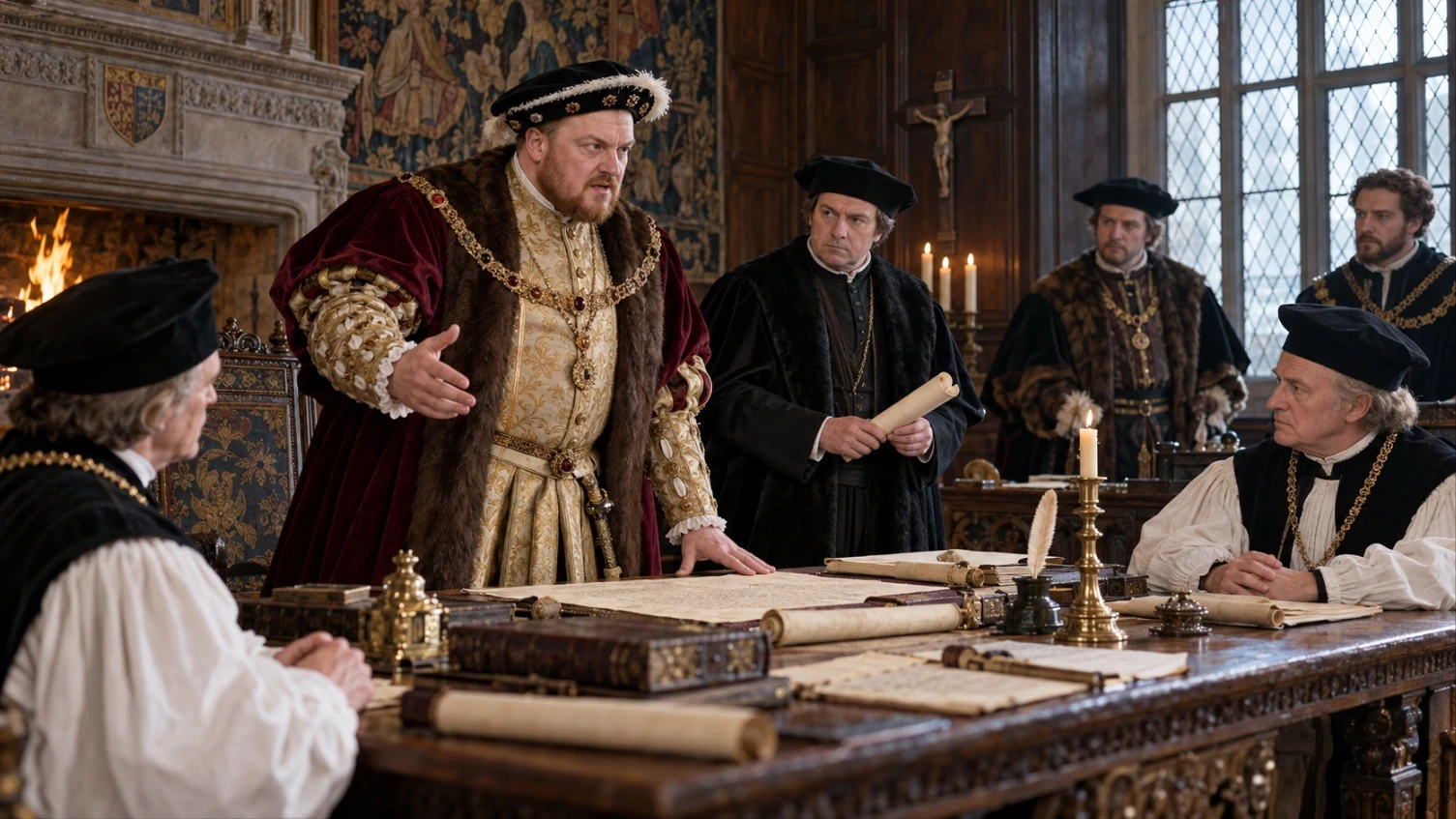 Henry VIII sought from the pope an annulment of his marriage to Catherine of Aragon. (AI illustration)
A comparison: three ways of handling the end of a marriage
In every civilization, ending a marriage was a serious matter tangled up with religion, power, and family. The answers differed from place to place. Each case below is framed within its own scope.
Catholic canon law: a valid marriage cannot be dissolved (the contrast). In Catholic teaching, a valid, consummated sacramental marriage cannot be dissolved by any human power. An annulment is a different thing: a declaration that no valid marriage existed in the first place. It is not a way of dissolving a valid marriage. Separation is recognized, but it leaves the marriage bond intact, so it is not another route to ending a marriage (Catechism of the Catholic Church §§1629, 1649; Code of Canon Law, cann. 1141–1143, 1151–1155). These are present-day Church documents. They describe the concepts and are not direct evidence of how the rules operated across the whole medieval and early modern period.
England: the king and the break with Rome (the extreme case). Henry VIII asked the pope to annul his marriage to Catherine of Aragon. The marriage question was a central trigger for the break with Rome, which ended with the king made head of the English church under the 1534 Act of Supremacy. But succession to the throne, papal jurisdiction, and the power of the crown and Parliament were bound up in it too (The Royal Family — Henry VIII; UK Parliament — The Reformation). The story is not as simple as “a king founded a new church just to get a divorce.” It does show what a wall the end of a marriage could be, even for a king. A system for divorce through the courts was created in England only much later, by the Matrimonial Causes Act of 1857. Before then, a very small number of wealthy people could obtain a divorce that allowed remarriage through a private Act of Parliament (UK Parliament — Obtaining a divorce; Curran, 2024).
Joseon: divorce was possible, but the state limited and policed it (the final axis). Joseon differed from both. Divorce was not impossible there. The seven grounds existed, and commoners actually separated through sajeong-paui. What marks Joseon is less a ban on divorce than restrictions set by law and the state’s intervention. Formal dissolutions among the yangban drew the state in, cases that came to investigation went to the king for final judgment, and the sambulgeo, backed by penalties, limited a husband’s power to throw his wife out. Each system has to be compared within its own scope: Catholic canon law’s principle of indissolubility, England’s annulments and later secular divorce, and Joseon’s chilgeo, sambulgeo, and state intervention. And Joseon was not the only society in which the state exercised control over divorce.
Back to Joseon Attorney
Like the many lawsuits Kang Han-su fights in court, ending a Joseon marriage was a matter of law and procedure. It didn’t end with feelings alone. It was a public affair tangled up with norms, status, and the state.
Look only at the seven grounds and Joseon divorce seems one-sidedly harsh on women. Put the sambulgeo next to them, and Joseon also turns out to be a society that barred husbands from discarding their wives at will, at least on paper and backed by penalties, within an order that remained thoroughly patriarchal. Joseon law set out not only the grounds on which a marriage could end, but also the conditions under which it could not.
This article was researched and written by K-Drama History. Source: Joseon Divorce Law: Seven Grounds, Three Exceptions — K-Drama History