Battle of Jinpo 1380: How Choe Museon Gave Goryeo Its Own Gunpowder — The History Behind Six Flying Dragons
Theme: War & Resistance
From the research behind Pause the Drama.
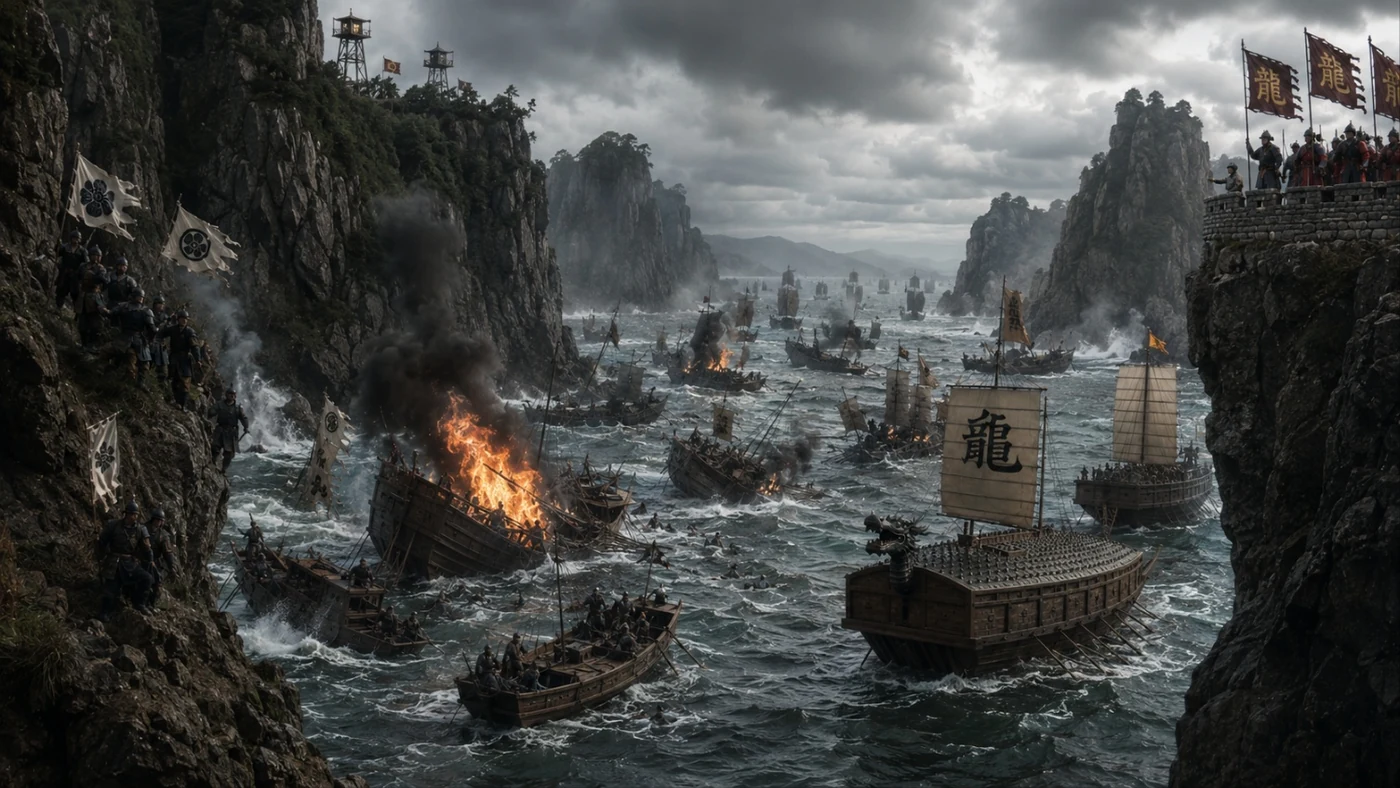
In the autumn of 1380 — the eighth lunar month, by the sources — a Japanese pirate fleet lay at Jinpo, on the estuary of the Geum River in Jeolla province. The ships had been roped to one another. Part of the force had gone ashore and scattered through the surrounding districts, and grain taken from the countryside was being carried down to the boats. One record notes that rice spilled in the loading lay a ja deep on the ground — a foot, more or less, though a Goryeo foot and a modern one are not quite the same thing.
A Goryeo fleet came up the estuary. The sources put it at a hundred ships. Against three hundred, or five hundred, depending on which record you read, that is a small number.
But the hundred ships were carrying something that had not been carried into a Korean battle before: gunpowder weapons that Goryeo had made itself.
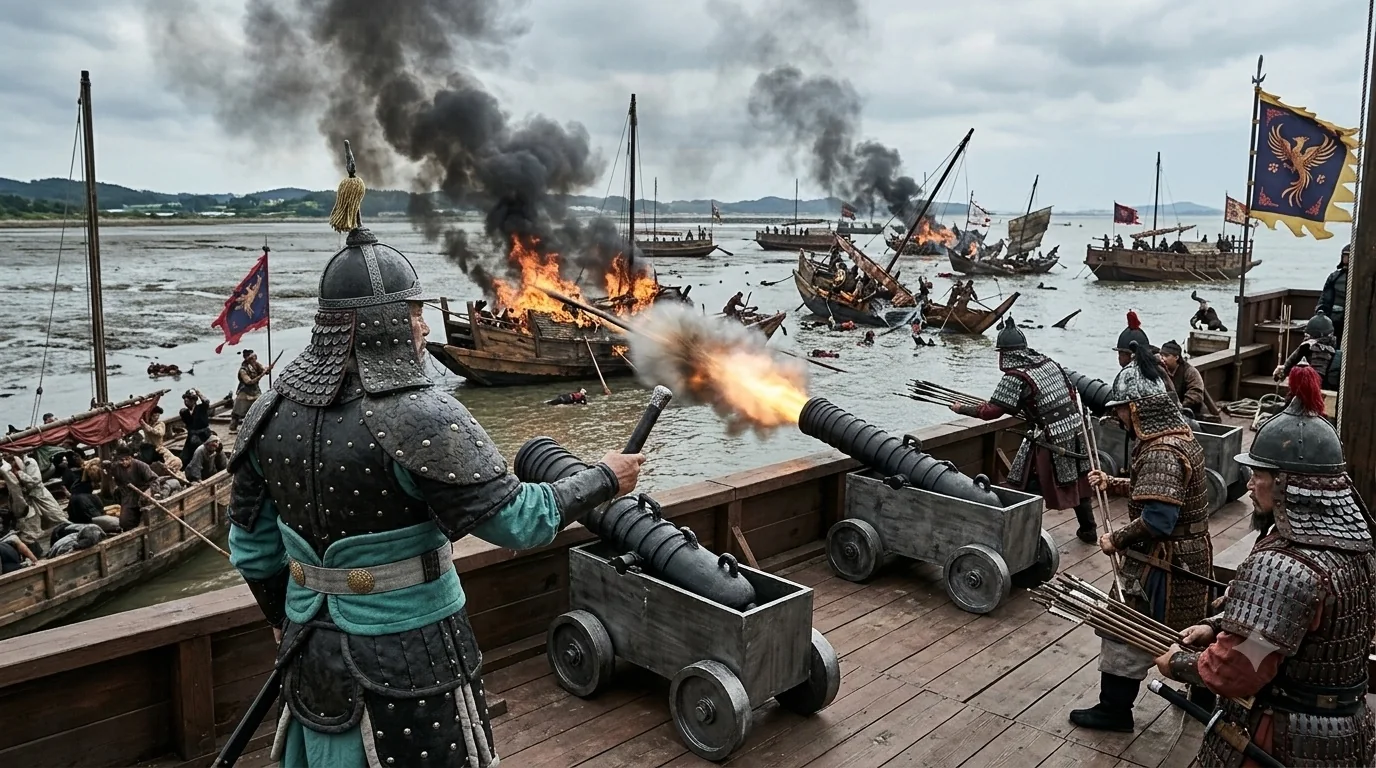
Jinpo, 1380, as an illustrator imagines it. No object that can be attributed to Choe Museon survives, and the sources do not say which of his devices were fired that day or from what distance — the guns here are a modern reconstruction, not a record. (AI illustration)
Quick answer: Goryeo had known about gunpowder for decades before 1380 and had even fired a chongtong in 1356. What it could not do was make the stuff reliably, because it lacked the process for producing saltpetre. A single official, Choe Museon, obtained that process privately — the sources differ on exactly how: one describes an unnamed merchant from Jiangnan, another a Yuan saltpetre craftsman named Yi Won — tested it at home, and pressed the court for years until it founded a gunpowder office in 1377. Less than three years later, at Jinpo, the new weapons burned a pirate fleet at anchor. Six Flying Dragons, set in the years that follow, is about the politics of ending Goryeo and does not show any of this.
The drama, and the years it skips
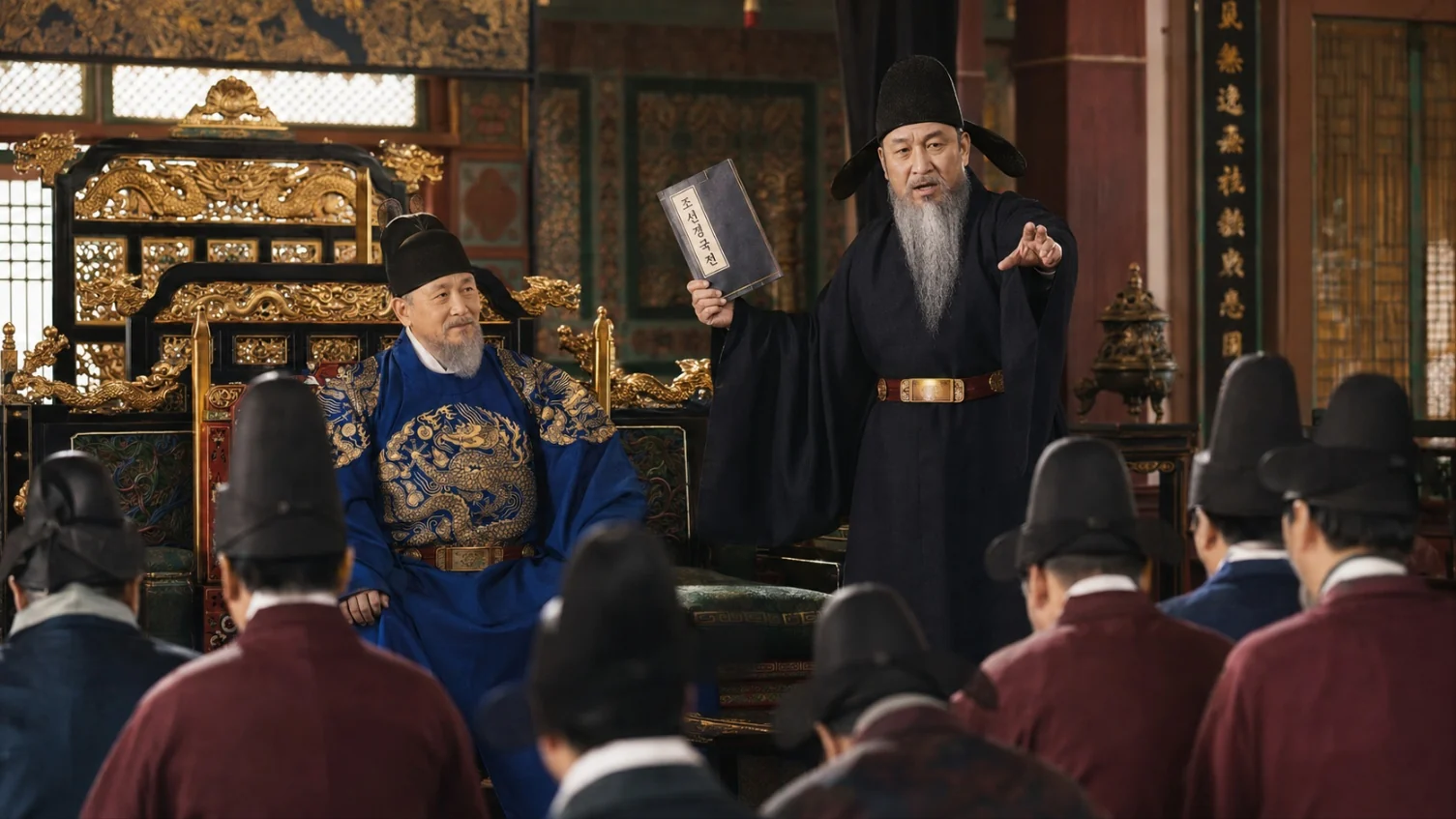
Six Flying Dragons runs for fifty episodes and is, for a drama set at the end of a dynasty, remarkably light on battlefields. Its stage is the council chamber. People argue about how an old state should be dismantled and a new one designed, and the arguments — Jeong Do-jeon’s, Yi Bang-won’s — are the plot. Yi Seong-gye, played by Chun Ho-jin, is the sword the designers reach for.
In the range we checked, the drama does not put Jinpo, Choe Museon, or the Hwatong Dogam — the gunpowder office — on screen. That is not a fault. It is a drama about power, not ordnance. But it does mean that the background against which its Yi Seong-gye is already a famous general, and against which its reformers can afford to spend years on constitutional argument, is off camera.
The period the drama’s story opens in — the early 1380s — is the period in which that background was made.
The recipe, not the cannon
The point that popular accounts most often blur is this: Goryeo’s problem was not that it had never seen gunpowder. It was that it could not make it.
The History of Goryeo records a chongtong being fired in the ninth month of 1356, the arrow flying as far as the south side of Suncheon-sa temple and lodging up to its fletching. The record does not say where the device came from or what it was made of; some modern reference works infer a metal firearm brought in from Yuan China, and that inference should be labelled as one. In the eleventh month of 1373 Goryeo asked Ming China for weapons, gunpowder, sulphur and saltpetre to use against the pirates. According to the National Institute of Korean History’s account of that exchange, the Ming reply was that if Goryeo could procure 500,000 geun of saltpetre and 100,000 geun of sulphur, Ming would mix in the other ingredients and send finished powder — but it would not teach the method.
Gunpowder has three ingredients: charcoal, sulphur and saltpetre (potassium nitrate, 염초). Charcoal was no problem. Sulphur was a mineral to be procured and refined. The hard part, and every official Korean history treats it as the hard part, was saltpetre: leaching it from nitrogen-rich soil and ash with water, clearing the impurities, and boiling the liquor down to crystals. That process — yeomcho jachwibeop, “the method of boiling out saltpetre” — was what Goryeo did not have. A kingdom that has to ask a neighbour for powder can be refused, and a supply that arrives by request can stop.
So the protagonist of this story is not a cannon. It is a manufacturing process. That is the sentence to hold on to, because the drama of Jinpo tends to swallow it.
The man who kept asking merchants
Choe Museon (崔茂宣) was the son of Choe Dong-sun, superintendent of the Gwangheungchang, the granary that paid official salaries. His birth year is given variously — 1325, 1326 and 1328 all appear in institutional references — and his death in 1395 is fixed by the Veritable Records of Taejo, which carry his obituary. That obituary is the best single source we have on him, and it is worth quoting rather than paraphrasing.
嘗曰: “制倭寇莫若火藥, 國人未有知者。” 茂宣每見商客自江南來者, 便問火藥之法。有一商以粗知對, 請置其家, 給養衣食, 累旬諮問, 頗得要領。
He once said: “For checking the Japanese pirates there is nothing like gunpowder, but no one in our country knows it.” Whenever Museon met a merchant arriving from Jiangnan he would at once ask about the method of making gunpowder. One merchant answered that he knew it roughly. Museon had him lodge at his own house, gave him clothing and food, and questioned him for tens of days, until he had grasped the essentials.
He then proposed a trial to the State Council. The obituary is candid about the reception:
言於都堂欲試之, 皆不信, 至有欺詆。茂宣積以歲月, 獻計不已, 卒以誠意感之, 乃許立局。
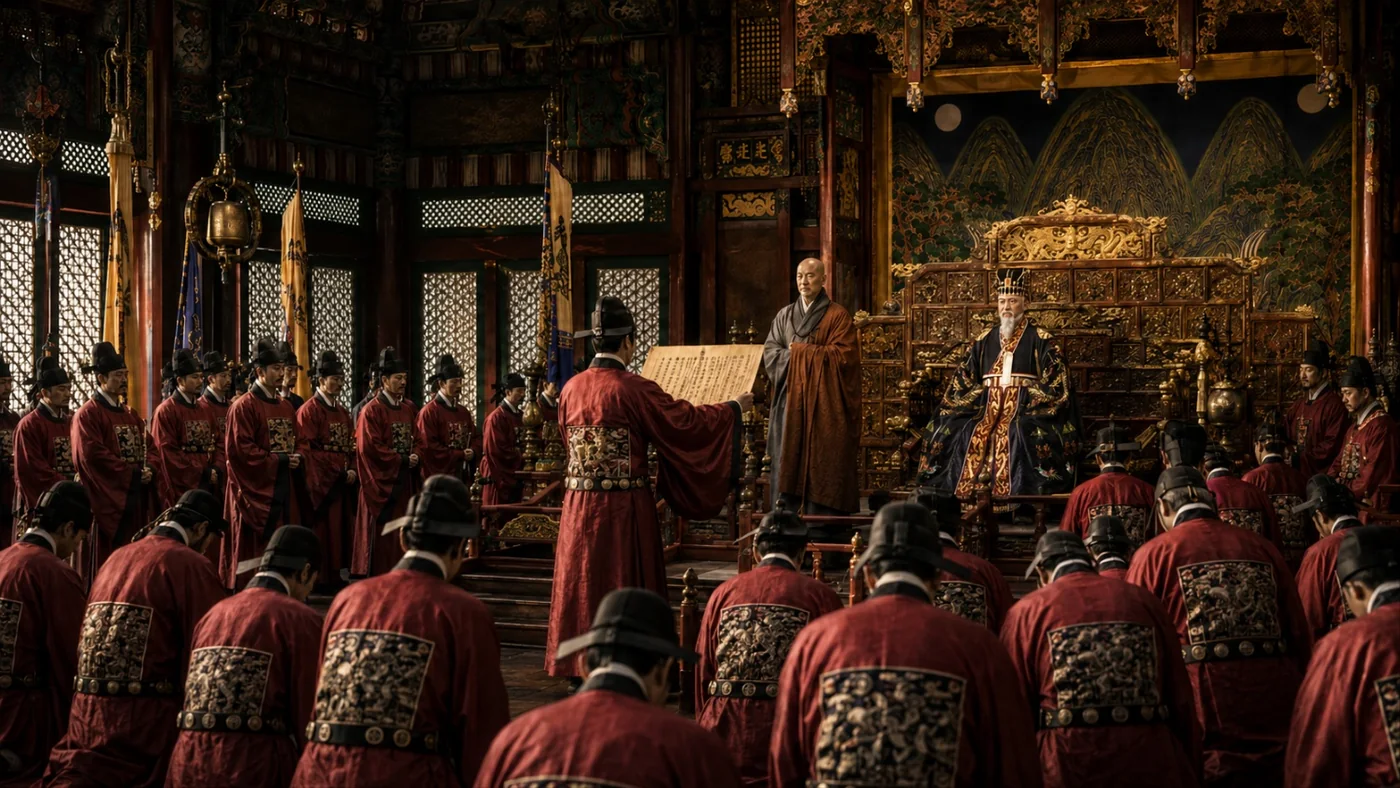
He told the Council he wished to test it; none believed him, and some even called him a fraud. Museon went on submitting his proposals year after year, until at last his sincerity moved them and they permitted an office to be set up.
Two things follow from the text. First, the acquisition was personal and informal — a private household, a lodger, weeks of questions, and years of being disbelieved. Second, it preceded the institution. The New Edition of Korean History puts his mastery of the saltpetre process “several years” before the office was founded in 1377; the exact year is not recorded, but the sequence — private success first, state adoption afterwards — is what the sources show.
There is a second tradition about where the knowledge came from, and it should be kept separate rather than merged. The History of Goryeo and its Essentials, in their entry on the founding of the office, say that Choe Museon lived in the same neighbourhood as a Yuan saltpetre craftsman named Yi Won (李元), treated him well, quietly asked him about the process, and had several of his own household servants learn it. The Veritable Records name no one and describe a merchant from Jiangnan. These may be the same man seen through two chroniclers; they may not. Nothing in the texts settles it, so this article does not.
One more thing the texts do not say: that Choe learned the precise proportions of the three ingredients. What they say is that he obtained the essentials of the method, saltpetre foremost. “The recipe” in our title is shorthand for that.
An office, and a garrison in the temples
The History of Goryeo records that in the tenth month of 1377 (King U, year 3) the Hwatong Dogam (火㷁都監) was established “for the first time”, on Choe Museon’s proposal. A dogam was a temporary commission set up for a specific task — the Goryeo and Joseon way of standing up a project without creating a permanent ministry. The characters for hwatong appear in the sources as 火㷁, 火筒 and 火桶; we follow the Veritable Records form.
What the office produced is listed in the obituary:
其具有大將軍、二將軍、三將軍、六花石砲、火砲、信砲、火㷁、火箭、鐵翎箭、皮翎箭、蒺藜砲、鐵彈子、穿山五龍箭、流火、走火、觸天火等名。旣成, 觀者莫不驚嘆。
Its devices bore the names Great General, Second General, Third General, Six-Flower Stone Cannon, fire cannon, signal cannon, fire tube, fire arrow, iron-fletched arrow, leather-fletched arrow, caltrop cannon, iron shot, Mountain-Piercing Five-Dragon Arrow, Flowing Fire, Running Fire and Heaven-Touching Fire. When they were finished, none who saw them failed to marvel.
How many types that is depends on where you put the commas. The current Korean translation reads sixteen items; some studies count eighteen; the New Edition of Korean History says “some twenty”. The names are secure; the count is a matter of punctuation, and the article says so rather than choosing. So is the classification. The caltrop cannon is interpreted as an explosive device, and Running Fire and Heaven-Touching Fire are classified as rocket-type weapons, on the strength of the names and of later Joseon material — no object and no manual survives to confirm the reading.
Then, about six months later, in the fourth month of 1378, the court assigned a dedicated force of gunpowder-weapon troops — the hwatong bangsagun — to the Buddhist temples of the capital and the provinces: three men to a large temple, two to a middling one, one to a small one. The figures are in the History of Goryeo. Why temples, where the weapons were kept, how the men trained: the entry does not say, and we do not guess. It is simply one of the more striking details in the record that a kingdom’s first gunpowder corps was distributed by monastery size.
Jinpo, eighth month of 1380
The numbers first, because they cannot be reconciled. The History of Goryeo tradition — the biographies of Byeon Allyeol and Na Se, as summarised in the New Edition of Korean History — gives 500 pirate ships. The obituary of Choe Museon gives 三百餘艘, three hundred and some. The National Institute of Korean History notes the discrepancy and declines to resolve it. So do we. Estimates of pirate manpower in the tens of thousands, derived from the ship counts, are calculations rather than records, and the article does not use them.
What the sources describe is a fleet at anchor, its ships tied together, with part of the force ashore. The obituary is specific about why the ships were tied — and it is not the reason popular accounts give:
寇不意有火藥, 聚船相維, 欲盡力拒戰, 茂宣發火具盡燒其船。
The pirates, not expecting gunpowder, gathered their ships and lashed them together, meaning to resist with all their strength. Museon fired the fire-devices and burned every one of their ships.
The familiar telling says the ships were roped together to make loading grain easier, and that the rope became the fatal weakness when fire spread from hull to hull. The Essentials do record both the lashed ships and the loading of plundered grain, but as separate facts; they do not connect them. And the Veritable Records say the ships were lashed to fight. The picturesque version — rope as the pirates’ undoing — is a modern reconstruction. What the records support is smaller: the ships were connected, and they burned.
The Goryeo force is given as a hundred ships. By the obituary’s account the court appointed Sim Deok-bu as dowonsu (commander-in-chief), Na Se as sangwonsu (senior marshal) and Choe Museon as buwonsu (deputy marshal) — the History of Goryeo entry for the month groups the three as sea commanders without ranking them — and sent them down with the fire-devices aboard. Choe was there as deputy marshal; that he was, in effect, the officer responsible for the new weapons is a reasonable understanding of his role, not something any source states as his commission.
What the sources do not give: the range at which the Goryeo ships fired, which of the sixteen-or-eighteen devices were used, whether any boarding took place at all, and how the fire actually spread. They say hwagu — fire-devices, a general term — were discharged and the ships burned. The temptation to write “cannon, fire-tubes and fire-arrows rained down” should be resisted; the record does not itemise. Nor does it say the pirates were relaxed at the sight of a smaller fleet, a detail that appears in some retellings; the obituary says the opposite.
Ship for ship, Goryeo was heavily outnumbered. Ship for ship is the only comparison the sources allow — nothing is recorded about the size of the vessels, the ratio of warships to transports, or how the pirate force was divided between the ships and the shore.
Before gunpowder, war at sea in this region used bows, crossbows, thrown stones, fire, ramming and boarding — several methods, not one. What is new at Jinpo is that a Goryeo fleet defeated an enemy primarily by setting its ships alight with gunpowder weapons rather than by fighting across the gunwales. The Essentials of Goryeo History mark it as the first combat use of the cannon Choe had built. That is a precise claim, and it is the one the article makes.
What Jinpo did, and did not, make possible
Having lost their ships, the pirates went inland. The obituary says they raided through Jeolla and into Gyeongsang and regrouped at Unbong. There, Yi Seong-gye — Taejo in the obituary’s language, since it was written under his dynasty — as commander-in-chief of the field armies, “with the other generals, destroyed them without remainder”. That is the Battle of Hwangsan, the engagement that raised Yi Seong-gye’s already considerable military reputation to something like national fame.
It is easy to draw a straight line from the burning ships to the founding of Joseon, and the obituary itself, written for a Joseon court, invites it. The line should be drawn more carefully. Some survivors of Jinpo joined other pirate forces already inland; forces connected with those groups were met at Hwangsan; Yi Seong-gye’s standing rose further; twelve years later he became king. Each of those is a separate fact. Jinpo created one of the conditions under which Hwangsan was fought. It did not cause a dynasty.
The obituary’s own summary of the aftermath is more modest, and more useful: after this “the pirates gradually subsided, those seeking to surrender came one after another, and the people of the coasts recovered their livelihoods”. Suppressing pirate activity at sea mattered to the grain-transport system on which the capital depended and to the treasury that depended on it. That is the strongest claim about consequences the sources will bear.
”The world’s first naval battle with cannon”
Korean popular sources often call Jinpo the world’s first naval battle fought with ship-borne cannon. The usual reasoning is that the first European sea battle in which guns sank ships is taken to be Lepanto in 1571, so Jinpo, 191 years earlier, must have priority.
The arithmetic is fine. The premise is not. The Battle of Arnemuiden in 1338 is commonly cited as an early European naval battle involving guns — although the documentary evidence for their actual use in that battle has itself been questioned by specialist studies, which note that no contemporary record confirms it and that, guns or not, the fighting was still conducted by missiles and boarding. Either way, guns were carried and used at sea in Europe well before 1571. Lepanto cannot serve as the baseline. Beyond Europe, earlier Chinese use of gunpowder-based weapons at sea in the twelfth century is discussed in the naval-history literature, though what exactly was thrown or fired in those engagements — tube weapons, or incendiary bombs hurled by catapult — is a separate question this article has not resolved from specialist sources and does not lean on.
The honest formulation, then, is not “Jinpo was not the first” but “there is not enough evidence to call Jinpo the world’s first” — and that the definitions of cannon, gunpowder weapon and naval battle vary so much between studies that a single “first” may not be a well-formed question.
Nor should the Korean claim be widened into “the first use of gunpowder weapons at sea in Korean history” without a definition. Goryeo ships and crews took part in the Mongol invasions of Japan a century earlier, campaigns in which explosive weapons were used. What the Essentials record is narrower and firmer: Jinpo was the first combat use of the cannon Choe Museon had made. Jinpo’s weight does not depend on a world record. It depends on a kingdom having made the weapon itself.
A related question the article leaves open: whether to call Jinpo a naval battle at all. The Goryeo force sailed to the estuary and attacked from its ships, so the conventional name — Jinpo haejeon, the sea battle of Jinpo — is defensible. But the enemy was anchored and lashed together, not manoeuvring, and this was not two fleets fighting a gun duel under way. The History of Goryeo describes a different kind of engagement three years later at Gwaneumpo in 1383, when 120 pirate ships advanced to encircle a Goryeo squadron and Jeong Ji met them with 47; that reads much more like fleet action. Which of the two better deserves the name is a matter of definition. It is not a matter on which the sources record a scholarly consensus, and we do not claim one.
The office that closed, and the book that did not
The Hwatong Dogam did not survive the fall of King U. After the coup at Wihwa Island in 1388 and the accession of the boy king Chang, the reformer Jo Jun submitted a memorial proposing that temporary commissions be wound up and their functions folded into the regular ministries, to tidy the administration and lighten the burden on the people. The History of Goryeo’s treatise on offices records that under Chang the Hwatong Dogam was abolished and its functions attached to the Gungisi, the arms office. A proposal and a recorded change are two events, not one, and the treatise does not give a precise date for the second.
Popular accounts often say the office was closed because pirate raids had declined and weapons were no longer needed. That is not the rationale in Jo Jun’s memorial, which is about administrative consolidation, and we could find no reliable study attributing the closure to the pirate situation. So the article does not say it.
It is also worth being clear about what was and was not lost. An organisation was dissolved; a capability was transferred. Gunpowder did not leave Korea with the dogam.
Choe Museon himself lived into the new dynasty. The obituary says that after the founding of Joseon he was too old to be employed, but that the king, mindful of his service, granted him the honorary rank of geomgyo chamchan. Some institutional references add a date of 1392 and a concurrent post at the Gungisi, and some popular accounts credit the appointment to Yi Bang-won’s recommendation; none of that is in the obituary, and the last point we could not source at all, so it is left out. He died in 1395, in his late sixties or close to seventy — the uncertainty is the uncertainty about his birth year.
And then the detail that is often told as legend and turns out to be in the record:
茂宣臨卒, 以一卷書屬其夫人曰: “待兒長, 以此與之。” 夫人藏之甚密, 及海山年十五稍識字, 出而與之, 乃火藥修鍊之法。海山學其法見用, 今爲軍器少監。
As Museon lay dying he entrusted a single volume to his wife, saying: “When the boy is grown, give him this.” She kept it well hidden, and when Haesan was fifteen and could read a little, she brought it out and gave it to him. It was the method of refining gunpowder. Haesan learned the method, was taken into service, and is now Deputy Director of the Arms Office.
The book has no title in the record; later names given to it are later names. But the transmission is not folklore. It is in the Veritable Records, written within a generation.
The son’s career is also better documented than “he became an arms official” suggests. The Veritable Records of Taejong for the eighteenth day of the tenth month of 1409 record that the king went out to the Haeon Pavilion to watch a hwacha — a “fire cart” — being fired, and rewarded Yi Do, Deputy Director of the Arms Office, and Choe Haesan, Assistant Director, with a horse each, and the gunpowder troops with fifty bolts of cloth. The entry describes the machine: dozens of iron-fletched arrows packed into a copper tube, mounted on a small cart, and discharged with gunpowder, “fierce enough to check the enemy”. So Choe Haesan can be placed at a hwacha in 1409. He should not be made the sole inventor of the Joseon hwacha, and the 1409 device should not be confused with the famous hwacha of King Munjong’s reign four decades later.
Nothing that can be confirmed as made by Choe Museon himself is known to survive. What survives is a list of names, a son in the arms office, and a book handed over at fifteen.
How gunpowder crossed borders — four cases
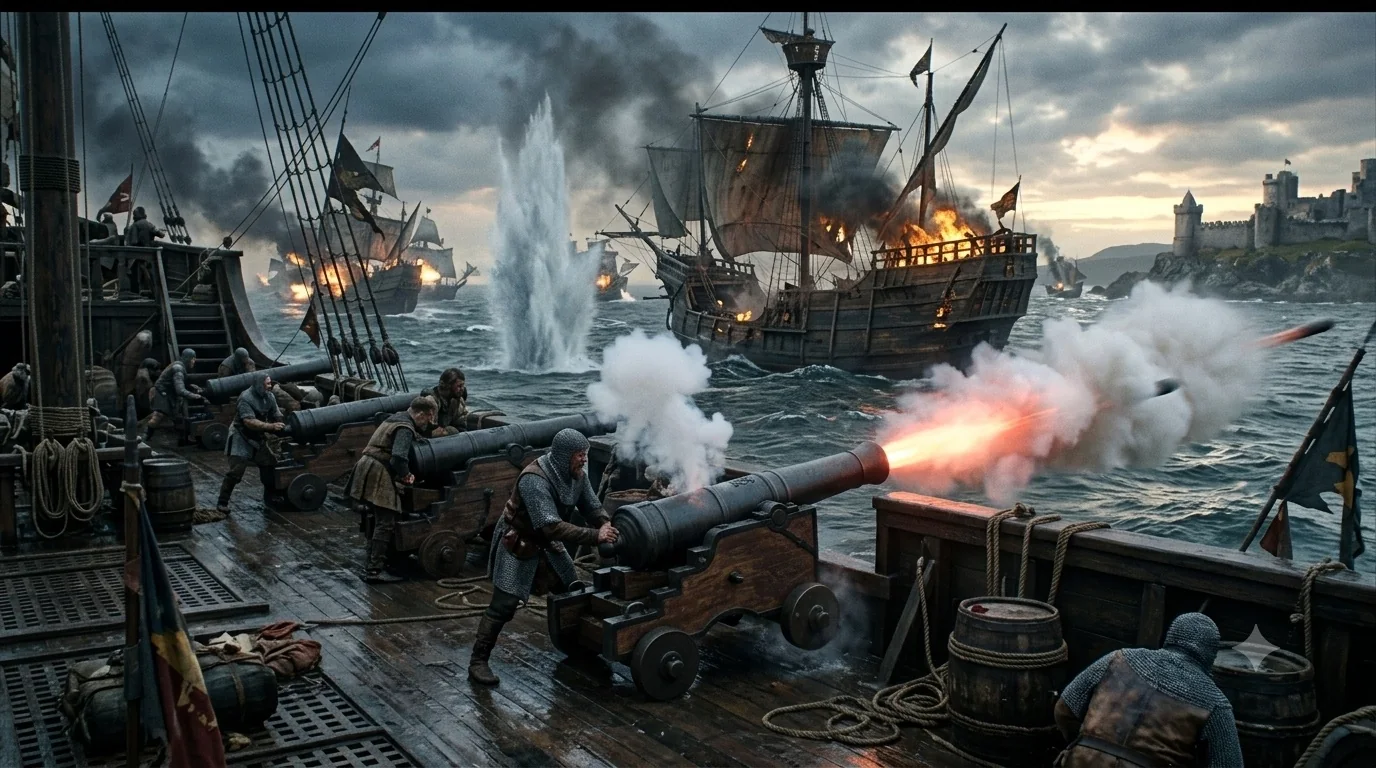
Guns went to sea in European waters in the fourteenth century — the Battle of Arnemuiden in 1338 is the case usually cited, though the evidence for guns in that particular fight is debated — which is why Lepanto cannot serve as the baseline for “the world’s first”. The scene here is a general impression of late-medieval naval gunnery, not a specific battle. (AI illustration)
Comparing how different states came by gunpowder is useful, provided the comparison stays modest. These are four sketches, not four matched cases.
China — the source. Gunpowder was developed in China under the Tang and Northern Song; the Wujing zongyao, compiled in 1044, already records formulae and gunpowder weapons. The Southern Song inherited that accumulated technology and applied it to river and coastal warfare. This is what it looks like to hold a technology rather than to acquire one.
Ming — one negotiation. In 1373 Goryeo asked Ming for gunpowder and its ingredients, and Ming offered finished powder in exchange for raw materials while withholding the method. That is one recorded exchange. It shows that in this instance the manufacturing process did not travel through official channels; it does not show a Ming-wide policy of technological embargo across all periods and partners, and the article does not generalise it into one.
Europe — contested routes. How gunpowder reached Europe is debated: through the Mongol empire, through the Islamic world, by land and by sea, with independent European improvement on top. Whatever the route, guns were in use in fourteenth-century Europe and were being carried in ships by the 1330s. Craftsmen, founders and gunners moved between employers, and that movement mattered to how the technology spread.
Goryeo — a household first, then a state. Goryeo’s case is not a fourth category so much as a particular shape. Technology acquired through personal contact with a foreign craftsman or merchant is, in the broad sense, informal diffusion by the movement of people — the same thing that happened in Europe. What is distinctive in the Korean record is the sequence: a private acquisition and a private trial, years of rejected proposals, and then, once the state was persuaded, rapid institutionalisation — an office within the year, a garrison allotment within six months of that, and combat use less than three years after the office opened.
Back to the drama
Six Flying Dragons is about people who spend their days deciding what a state should be. It is entitled to leave the estuary out.
But the argument it dramatises was conducted by men who had, by the 1380s, one less thing to worry about. The coasts had been raided for decades, the grain fleets on which the capital’s supply and the treasury’s income depended had sailed through pirate waters, and in one autumn month of 1380 a hundred Goryeo ships carrying home-made weapons had burned an anchored pirate fleet. Suppressing the raids mattered to the stability of the state those reformers were arguing over. That is as far as the evidence goes, and it is far enough.
What made Jinpo possible was not Choe Museon’s generalship — though he was there, as deputy marshal. It was the manufacturing capability he had spent years trying to build: an official who kept asking merchants the same question until one of them answered, and who then spent years being called a fraud by the council he was trying to arm. What Goryeo obtained from him was not a cannon. It was the ability to keep making them.
What this article could not confirm
- Whether Six Flying Dragons omits Jinpo, Choe Museon and Hwangsan entirely. We checked the drama’s scope and principal storylines; we did not compare all fifty episodes against a script, and we say “not prominently” rather than “never”. The drama’s exact opening year is likewise not fixed by an on-screen caption we could cite.
- Whether the Yuan craftsman Yi Won of the History of Goryeo and the unnamed Jiangnan merchant of the Veritable Records are the same person.
- Choe Museon’s birth year (1325, 1326 and 1328 all appear in institutional sources) and the rank his father held at the time, which changed with reforms of the office.
- The precise date and stated rationale of the Hwatong Dogam’s absorption into the Gungisi beyond the treatise’s statement that it happened under King Chang.
- The nature of the gunpowder weapons used at sea in twelfth-century China, which is why they are not used here as a counter-example.
- The current streaming availability of the drama. As of 8 August 2026 it was available in the United States on Rakuten Viki, free with advertising; availability differs by region and changes over time.
Primary records used
| Source | What it supplies | Link |
|---|---|---|
| Taejo sillok, vol. 7, 19th day, 4th month, Taejo 4 (1395) — obituary of Choe Museon | The Jiangnan merchant; “tens of days” of questioning; years of disbelief; the office; the list of sixteen device names; “three hundred and some” ships; the pirates lashing their ships to fight; the three commanders; Unbong; geomgyo chamchan; the book left to his wife; Choe Haesan at fifteen | Veritable Records DB |
| Taejong sillok, vol. 18, 18th day, 10th month, Taejong 9 (1409) | The king watches a hwacha fired; Yi Do and Choe Haesan rewarded; description of the device | Veritable Records DB |
| Goryeosa jeoryo, U 6 (1380), 8th month — “Na Se and others use cannon to drive off the pirates at Jinpo” | 500 ships; the ships lashed together with great ropes and a guard left aboard; rice spilled a ja deep; “for the first time” Choe’s cannon used to burn the ships; survivors flee to Okju and join pirates ashore | Korean History DB |
| Goryeosa jeoryo, U 3 (1377), 10th month — “The Hwatong Dogam is established” | Founded on Choe’s proposal; the Yuan saltpetre craftsman Yi Won living in the same neighbourhood; household servants trained and the method tested privately before the court was petitioned | Korean History DB |
| Goryeosa, Gongmin 5 (1356), 9th month | A chongtong fired at Namgang; the arrow reaching the south side of Suncheon-sa and burying its fletching in the ground | Korean History DB |
| Goryeosa, U 4 (1378), 4th month; Goryeosa treatise on offices | Temple allotment of 3/2/1 for the hwatong bangsagun; the office’s absorption into the Gungisi under Chang | Cited via the National Institute of Korean History pages below |
| National Institute of Korean History, Urihistorynet — “Choe Museon’s manufacture of gunpowder weapons” | The 1373 request to Ming and the reply; the 1377 founding; Jinpo | Urihistorynet |
| National Institute of Korean History, Urihistorynet — “Gunpowder weapons made with our own hands” | The History of Goryeo passage on Yi Won; Choe’s birth given as 1328 | Urihistorynet |
| National Institute of Korean History, New Edition of Korean History, vol. 27 — “The manufacture of gunpowder” | Saltpetre as the technical bottleneck; the process obtained “several years” before 1377; 500 ships per the biographies of Byeon Allyeol and Na Se; “some twenty” types of weapon | Urihistorynet |
| Gwon Geun, Yangchonjip, vol. 4 — 賀崔元帥茂先破鎭浦倭船 | A contemporary poem congratulating Marshal Choe on Jinpo; the full title includes his name, and the text is not quoted here | Collection title only |
A note on the illustrations
Both images are AI illustrations and neither should be read as a reconstruction. No weapon attributable to Choe Museon survives, so the guns on the Goryeo deck are an artist’s guess informed by later Joseon pieces; the sources for Jinpo do not name the devices fired or the range. The European scene is a general impression of late-medieval naval gunnery and does not depict Arnemuiden or any other named engagement. The Korean image keeps the site’s usual watermark.
This article was researched and written by K-Drama History. Source: Battle of Jinpo 1380: How Choe Museon Gave Goryeo Its Own Gunpowder — The History Behind Six Flying Dragons — K-Drama History