Itaewon Class, Explained: Sweet, Then Bitter — Soju's Old Name, Modern Method
From the research behind Pause the Drama.
In the first episode of the 2020 JTBC K-drama Itaewon Class (이태원 클라쓰, streaming on Netflix in many regions; availability varies by country), Park Sae-ro-yi has just been expelled from school. His father pours him a glass of soju and asks how it tastes. “It’s sweet,” Sae-ro-yi says. His father explains what that means: today must have been a day that left a mark on him. Scene descriptions say the bottle on the table is dark-green glass.
In episode 2, Sae-ro-yi has lost his father and served time in prison. He pours a glass for the empty seat across from him and drinks alone. “It’s bitter.”
(These lines come from JTBC’s official clips and script reading. They have not been checked against the broadcast footage.)
The drama never shows us the history of what is inside that green bottle. This article starts from that gap.
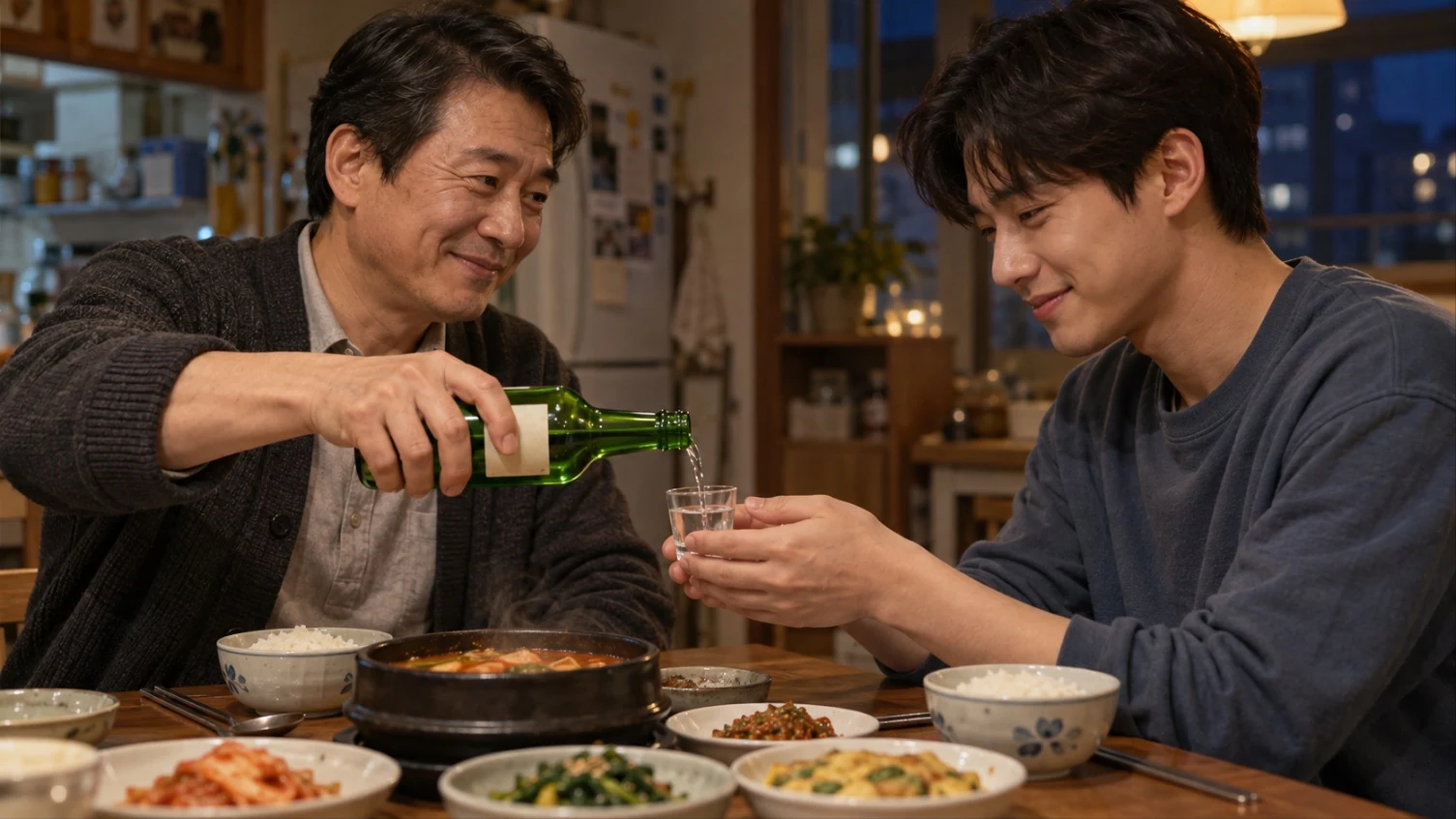 A father and son over a glass of soju: the scene that frames Itaewon Class. (AI illustration)
Quick answer: The green-bottle soju in Sae-ro-yi’s glass carries a name that is more than 650 years old. But a limit on grain around 1965 pushed most producers toward today’s common diluted soju, according to a 2010 government report. Soju (燒酒) means “burned liquor,” that is, distilled liquor. In Korea it first appears clearly in records from late Goryeo, in the late 14th century, after a long period of close contact with the Mongol Empire. In 1375 Goryeo banned it as a luxury, alongside embroidered silk and gold and jade vessels. Today’s most common green-bottle soju is made by diluting high-proof ethanol with water. That puts it in a different lineage from distilled soju, which is made by running a fermented grain mash through a still.
| Question | Answer |
|---|---|
| How old is the name? | One of the earliest sure records is a Goryeo ban of 1375, about 651 years ago |
| What do the early records show? | Soju stands out in elite drinking and in a ban on luxuries |
| What changed around 1965? | A 2010 government report says distilled soju could no longer be made from grain and most producers switched to diluted soju |
| When did distilled soju come back? | In stages, from the late 1980s to the early 1990s |
| Parallels abroad | Japan’s two-track shochu law; England’s 1690 grain-distilling act |
Korean soju’s story runs through more than one change, and state limits on luxury and grain are part of it.
Where did soju come from?
The leading scholarly explanation is that distillation know-how developed in West Asia, along with names related to ʿaraq, the word for distilled liquor there. Both then spread east through the exchange networks of the Mongol Empire.
The Yuan court’s dietary manual Yinshan zhengyao (飮膳正要, c. 1330) has an entry for “alaji liquor” (阿剌吉酒) in its third volume. The entry describes steaming good liquor and collecting what condenses like dew (用好酒蒸熬,取露成). Only part of this was checked, against an electronic transcription. The printed edition was not consulted. The Ming-era pharmacopoeia Bencao gangmu is quoted in a study by Angela Schottenhammer as saying that shaojiu is not an ancient method and was first devised in the Yuan period (燒酒非古法也,自元時始創其法). That passage has not been checked against an edition of the Bencao itself.
Yuan distilled liquor wasn’t simply a copy of West Asian technique, though. Research on the subject argues that it mixed with existing Chinese distilling apparatus and with the nomads’ culture of fermented milk. For Goryeo, historian Hyunhee Park describes a localized form: Koreans likely made distilled liquor using local grains such as rice and barley and their existing brewing traditions. She also notes that the early soju records say little about ingredients, so this is a scholar’s reconstruction, not a recipe recorded at the time.
Goryeo writers used the foreign name too. A poem by the scholar Yi Saek is quoted in Park’s 2016 study. In it, someone from the “western neighborhood” (西隣) brings him alaji (阿剌吉). After barely forcing down half a cup, he writes, its warmth seeped into his bones (强吸半杯熏到骨). Secondary accounts date the poem to 1382 and identify the giver as the official Jo Un-heul. The poem’s exact title, its volume in Yi Saek’s collected works, the date and the giver’s identity have not been checked against the original. And no contemporary record shows who brought distillation to Goryeo, or when.
Why did Goryeo ban soju?
The section on prohibitions in the Goryeosa (History of Goryeo) records an edict from the 2nd month of 1375, the first year of King U’s reign. Complaining that people no longer knew thrift and were wasting their wealth, the king banned soju together with embroidered silks and vessels of gold and jade (如燒酒·錦繡叚匹·金玉器皿等物, 一皆禁斷).
This wasn’t a law against alcohol. It was a frugality decree that classed soju as a luxury good. The ban is one of the earliest sure records of soju in Korea.
The Goryeosa’s biography of Choe Yeong also tells the story of Kim Jin. In 1376 Kim Jin became military commander of Gyeongsang province. He gathered famous gisaeng (courtesans) and drank with his officers day and night. He was so fond of soju that his troops called his circle the “soju gang” (燒酒徒) (縝嗜燒酒, 軍中號曰燒酒徒).
When Japanese raiders burned the Happo garrison, the soldiers refused to fight: “Let the soju gang fight the enemy. How could the likes of us fight?” (可使燒酒徒擊賊, 我輩焉能戰). Kim Jin was badly defeated and fled alone. The Goryeosa jeolyo records that defeat under the 12th lunar month of the same year, 1376, and introduces the drinking story with “before this” (先是). The exact date of the drinking itself is not fixed.
So in the early records that survive, soju stands out in two settings: the drinking of powerful men, and the state’s efforts to curb luxury. Those records are about elites, though, so they can’t tell us whether ordinary people drank it. The Goryeo ban shows that soju counted as a luxury in the 1370s. A separate study of early Joseon, by Kim Jun-hyeok (2014; abstract consulted), describes soju as having been seen as an expensive, high-end drink that used up a great deal of grain.
What kind of drink was soju in early Joseon?
Yi Bang-u, Prince Jinan, was the eldest son of the dynasty’s founder, Taejo (Yi Seong-gye). He loved drink and drank heavily every day. According to the Annals of King Taejo, he fell ill after drinking soju and died in the 12th lunar month of 1393, the second year of Taejo’s reign (飮燒酒病作而卒). A year after Joseon was founded, the death of the king’s eldest son went into the Veritable Records alongside soju.
In 1417, Park Gang-saeng, the magistrate of Suwon, and Kim Mun, the magistrate of Geumcheon, along with others, held a farewell for Yun Don at Anyang Temple as he left his post as magistrate of Gwacheon. Kim Mun was harmed by the soju and died suddenly (汶傷燒酒暴死). The Office of the Inspector-General asked for punishment. King Taejong replied that pressing drink on someone was never meant to kill (勸酒本非欲致人於死), and that farewells for officials from neighboring districts were common. Setting other matters aside, he ordered Park Gang-saeng and Yun Don dismissed from office (命除他事罷職). Dismissal was still a punishment. The king did not let them off.
Together, the two records show that people already knew soju could be dangerous in early Joseon.
Tradition: did Mongol troops bring soju to Andong and Gaeseong?
A widely told story says soju reached the places where Mongol troops were stationed while preparing to invade Japan. The Encyclopedia of Korean Culture’s entry on sul (alcoholic drinks) explains that the Yuan set up supply bases at Gaeseong and Andong, and that these areas became famous for soju as a result. It also points out that the Yuan name aragilju sounds like Gaeseong’s arakju.
However, no contemporary record has been confirmed saying that a particular unit brought the recipe to a particular place. No direct source has been found for a Yuan supply base at Andong either. Park also presents this account while noting the lack of direct evidence for it. So it is best read as local tradition and common lore. A missing record doesn’t prove that the bases or the troop activity never existed.
This next part is only our own guess: the presence of foreign troops may have been a great shock to people at the time, and the memory of a new liquor may have become bound up with that experience.
When was the drink in Sae-ro-yi’s glass born?
The drink Sae-ro-yi tips back alone in episode 2 also comes from a dark-green bottle, according to scene descriptions. If it is the common diluted kind, as most green-bottle soju is, the way it is made doesn’t go back to Goryeo. That method took shape in the 20th century.
During the Japanese colonial period, continuous distillation arrived from Japan, and factory production of ethanol and diluted soju took hold.
A major turn came in the 1960s. The Liquor Industry and Competition Policy, a 2010 report by the Korea Fair Trade Commission, says on page 25 that from January 1965 distilled soju could no longer be made with grain, and that most producers switched to diluted soju. That date is the report’s later account. The original administrative order has not been located, so its exact date and start of enforcement remain unconfirmed. Diluted soju and factory-made ethanol already existed before 1965. The year marks the point where the market turned toward diluted soju, not the invention of the method.
Diluted soju is not synthetic alcohol. Korea’s Liquor Tax Act defines its base spirit, jujeong (주정), as alcohol made by fermenting starchy or sugary materials and distilling them to at least 85%. Both kinds of soju involve fermenting and distilling. The difference lies in the process: diluted soju cuts that high-proof spirit with water, while distilled soju comes straight from a still running a fermented grain mash.
Makgeolli, Korea’s milky rice wine, was caught up in the same rice policy. According to the National Archives of Korea, the use of white rice in makgeolli was restricted in 1963 and banned outright from 28 August 1966. Rice makgeolli was allowed again on 1 December 1977, after 14 years. Distilled soju had to wait much longer.
All of this concerns the drink and how it is made. It says nothing about when the green bottle itself first appeared.
When did the old soju come back?
In episode 4, Sae-ro-yi is asked why he named his bar DanBam (단밤, roughly “sweet night”). Going by JTBC’s official clip descriptions, his answer is that his life has been bitter, and he wanted his bitter nights, his life, to be a little sweet. Who asks the question, and its exact wording, have not been checked.
Distilled soju came back in stages:
| Date | Change |
|---|---|
| 13 May 1987 | Andong soju-making designated an intangible cultural property of Gyeongsangbuk-do |
| 1988 | Limits on distilled methods lifted for folk-liquor manufacturing licences (folk liquors only, not all distilled soju) |
| 31 December 1990 | Liquor Tax Act amendment, including permission to use white rice, promulgated |
| 1 July 1991 | The amendment takes effect |
| September 1991 | Manufacturing licences opened, a separate step from the earlier folk-liquor exception |
A 2017 paper by Choi Han-seok and colleagues states that distilled soju began to be produced again once rice was allowed in 1990.
The drama versus history
The shift in how the soju tastes is a dramatic device that shows the character’s loss and resolve. Park Sae-ro-yi, his father and DanBam are all invented.
Still, it would be a mistake to read the green-bottle soju on screen as Joseon’s traditional liquor. The name carried over, and both kinds are still fermented and distilled, but the way most green-bottle soju is made today took shape in the 20th century.
Abroad: grain, the state and distilled spirits
Japan: shochu split in two
According to the Japan Sake and Shochu Makers Association (JSS), distillation reached the Ryukyu kingdom (Okinawa) around the 15th century through trade with neighboring regions. For mainland Japan, the JSS gives several possible routes: via Okinawa, via China and via the Korean peninsula.
Japan’s Liquor Tax Act today separates two kinds of shochu. One is made in continuous stills and is under 36% alcohol. The other is single-distilled in other stills and is 45% or less. Like Korea, Japan draws a legal line between industrial continuous-still shochu and traditional single-distilled shochu.
England: a country that told people to distill grain
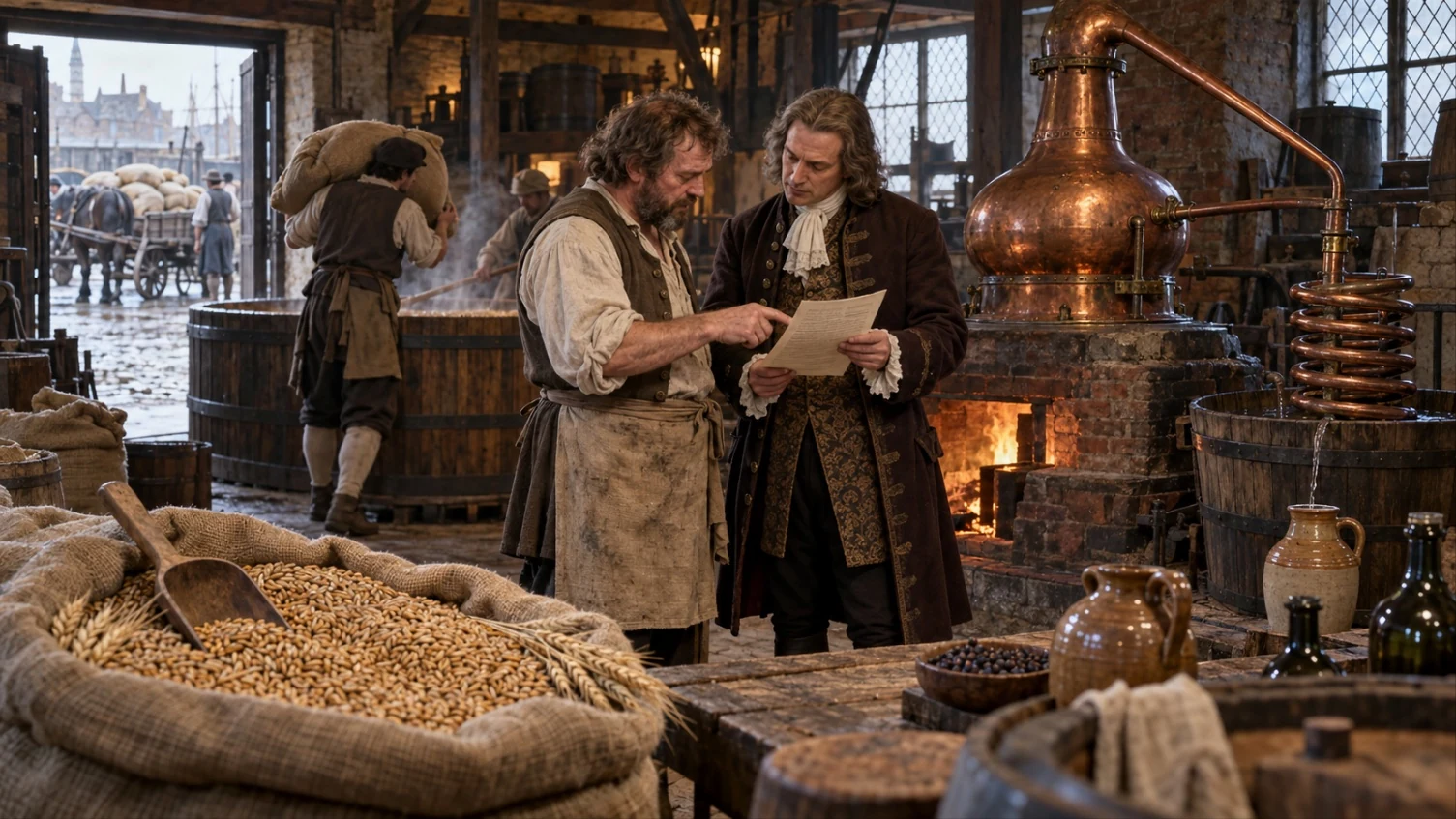 A grain distillery in late-17th-century England, when Parliament encouraged distilling from grain. (AI illustration)
In 1690 the English Parliament passed an act to encourage distilling spirits from grain. It stated its purpose plainly: “for the greater consumption of Corne and the advantage of Tillage.” (In the English of the act, “Corne” means grain generally, not maize.) Gin, a grain spirit, then spread rapidly in what became known as the Gin Craze (1690–1760, as dated by The Oxford Companion to Spirits and Cocktails).
England, wanting to use up more grain, encouraged grain distilling. Korea in the 1960s, under rice and grain controls, barred it. The policies pointed in opposite directions, but in both countries the grain supply shaped what distilled liquor looked like.
Korea: a drink shaken by rice
Korea’s traditional soju settled into a method of distilling liquor brewed from grain and nuruk (a fermentation starter), and that tied it closely to grain policy. Goryeo restricted soju as a luxury. Korea in the 1960s restricted grain-distilled soju under its rice and grain controls.
Back to Itaewon Class
In episode 10, Sae-ro-yi visits his father’s grave and pours him a drink. Remembering the voice that used to ask how the drink tasted, he answers: “Still… bitter.”
That word “still” leaves room for the drink to turn sweet someday. Korean soju’s history has the same shape. It entered the records as a luxury. It lost its old method through 20th-century factory production and the grain limits of the 1960s. Then, after revival efforts in the late 1980s, more of the legal limits came off in the early 1990s.
The green-bottle soju in Sae-ro-yi’s glass carries a name that is more than 650 years old, but a limit on grain around 1965 pushed most producers toward today’s common diluted soju, according to a 2010 government report.
This article was researched and written by K-Drama History. Source: Itaewon Class, Explained: Sweet, Then Bitter — Soju's Old Name, Modern Method — K-Drama History