Queen Inhyeon and Catherine of Aragon, Explained: Why a Queen's Fall Could Shake an Entire Kingdom
Theme: Women’s Lives
From the research behind Pause the Drama.
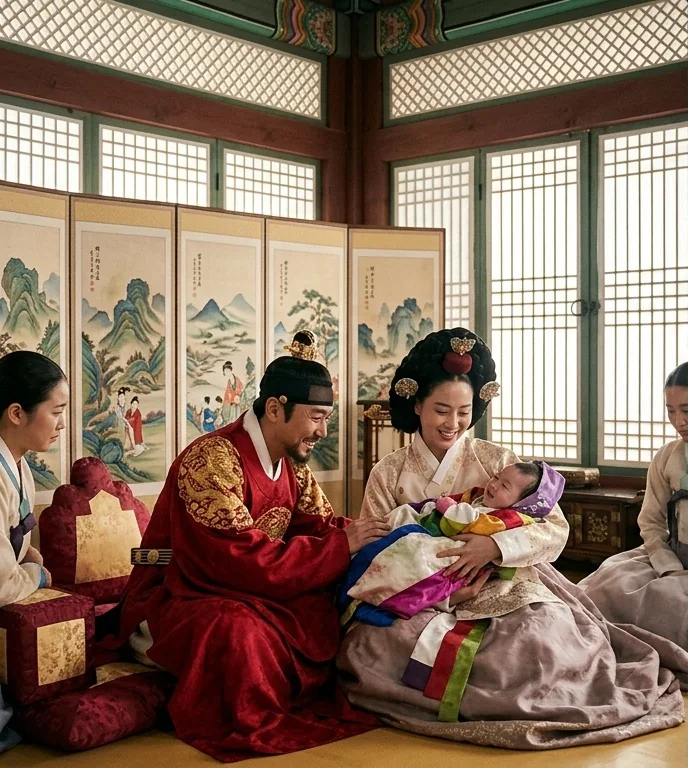
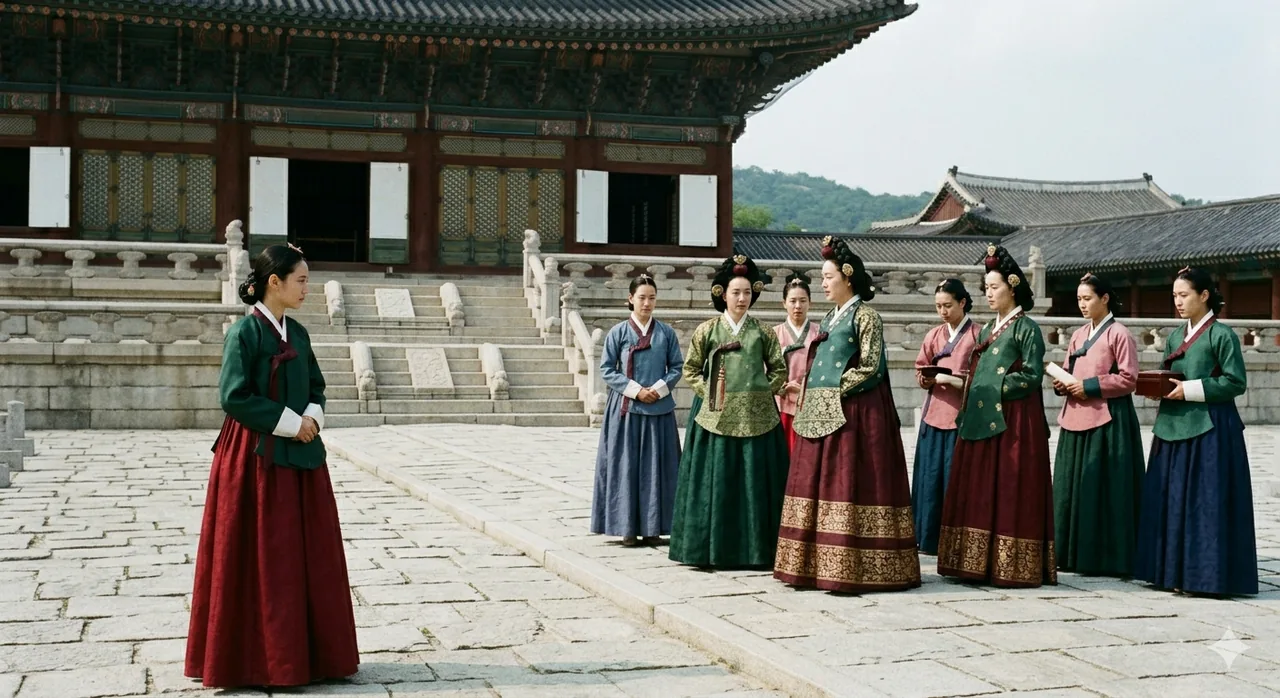
If you’ve watched Jang Ok-jung, Living in Love (장옥정, 사랑에 살다), one scene sits at the heart of it: Queen Inhyeon being led out of the palace, stripped of her rank, while the king’s favorite rises to take her place. On screen it looks like love, jealousy, and palace intrigue — a private heartbreak.
It was nothing of the kind. In a monarchy, a queen was not simply the king’s wife. She was the living symbol of the dynasty’s legitimacy, the mother-question of the succession, and the fixed point around which factions arranged themselves. So when a queen fell, the ground moved under the whole state.
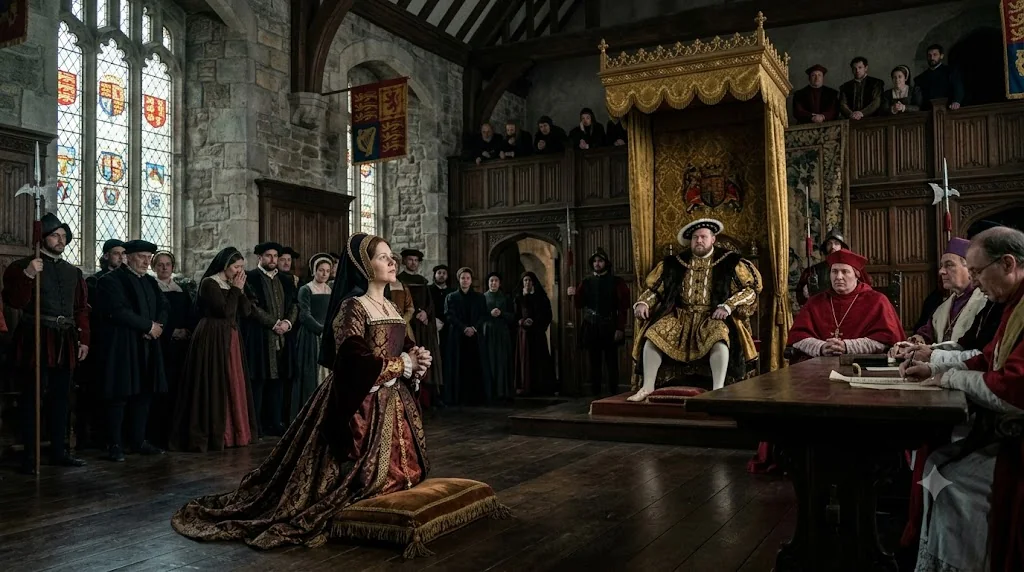 Catherine of Aragon kneels before Henry VIII to defend her marriage — a private appeal that would help pull England out of the Roman Church. (AI illustration)
And this is not only a Korean story. More than a century and a half earlier, on the other side of the world, Tudor England had lived through its own version: Catherine of Aragon, Henry VIII’s first wife, set aside so the king could remarry — a fall that helped pull England away from Roman Catholic authority.
Quick answer: Queen Inhyeon of Joseon and Catherine of Aragon of England were both queens pushed aside in royal-marriage and succession politics — but their falls ran in opposite directions. Catherine’s set-aside (an annulment declared in 1533) helped trigger the English Reformation and the 1534 Act of Supremacy that made Henry VIII head of the Church of England. Inhyeon’s deposition (1689) instead set off Joseon’s hwanguk — factional purges through which King Sukjong reshuffled power. Same shock — a fallen queen — two completely different political worlds. Let’s unpack it.
Why was losing a queen never a private matter?
Because a queen consort anchored three things at once: the dynasty’s legitimacy, the succession, and the balance of political power around the throne. Remove her, and all three wobble.
That was true in Joseon, where the queen’s status was governed by Neo-Confucian ritual law and the succession ran through questions of legitimate birth. It was equally true in Tudor England, where a queen who bore no surviving son put an entire young dynasty at risk. In both courts, the woman at the king’s side was a public institution as much as a private spouse — which is exactly why removing her detonated a crisis far larger than one marriage.
Two queens, then, in two civilizations, both set aside — and two very different explosions.
Catherine of Aragon: how a queen’s marriage became a Reformation
Catherine of Aragon was a Spanish princess — daughter of Ferdinand of Aragon and Isabella of Castile — and Henry VIII’s first wife. For years she was England’s queen, and she bore Henry a daughter, Mary, the future Mary I (Encyclopaedia Britannica — Catherine of Aragon).
But Henry wanted a male heir. The Tudor dynasty was still young and not yet secure, so the succession was not a private wish but a matter of the realm’s stability. When Catherine did not produce a surviving son, Henry moved to have their marriage annulled.
Here is the crucial part: in 16th-century Catholic Europe, a king could not simply dissolve his own marriage. A marriage’s validity was a matter of canon law, and the final word belonged to the Pope in Rome. When Rome would not give Henry the annulment he demanded, he forced the question through England instead. In May 1533, the Archbishop of Canterbury, Thomas Cranmer, declared Henry’s marriage to Catherine void (Encyclopaedia Britannica — Thomas Cranmer). Henry had already secretly married Anne Boleyn that January, and she was crowned queen that June.
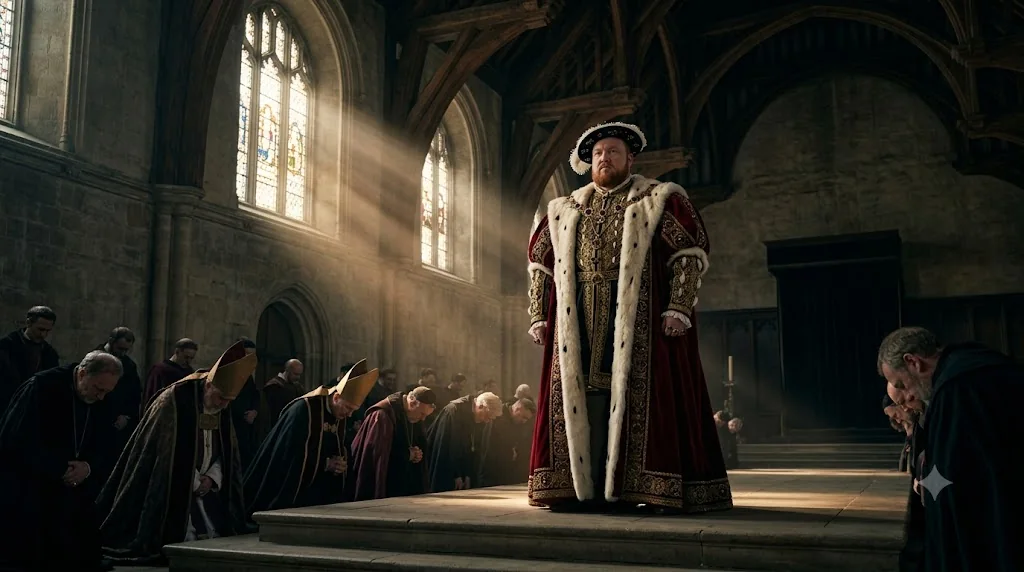 The 1534 Act of Supremacy made Henry VIII Supreme Head of the Church of England — a queen’s annulment turned into a national break with Rome. (AI illustration)
And it did not stop at a new wife. In 1534, the English Parliament passed the Act of Supremacy, declaring Henry VIII the Supreme Head of the Church of England (UK Parliament — Act of Supremacy 1534). This was a claim that the King of England — not the Pope in Rome — held ultimate authority over the English Church. Catherine’s removal, in other words, was never just “the king took a new queen.” It was a hinge on which England swung away from Roman authority and toward an independent religious and political order. Catherine herself never accepted the ruling: to her last day she maintained she was Henry’s true and lawful wife.
Queen Inhyeon: how a queen’s deposition became a factional purge
Queen Inhyeon was the second queen consort of King Sukjong. Like Catherine, she bore the king no son — and, as in England, that absence became a crisis of succession. When Sukjong’s consort Lady Jang bore him a son in 1688 — the future King Gyeongjong — the king moved to designate that infant his heir (원자, wonja) (Encyclopedia of Korean Culture — 기사환국).
That was explosive, because the wonja status was traditionally tied to a son born of the queen. Naming a consort’s son to it, while a reigning queen might still bear a legitimate heir, raised a storm over ritual propriety and the legitimacy of the succession. The ruling Seoin faction, including the senior scholar-official Song Si-yeol, urged caution. Sukjong took the caution as defiance.
In 1689, Sukjong purged the Seoin, installed the rival Namin faction, and deposed Queen Inhyeon — reducing her to commoner status and sending her out of the palace (Encyclopedia of Korean Culture — 인현왕후). This was the Gisa Hwanguk. Lady Jang rose to the top consort rank of Huibin and, after her son’s formal investiture as crown prince in 1690, was raised to queen herself that October.
The order did not hold. In 1694, the Gapsul Hwanguk reversed everything: the Namin were purged in turn, Queen Inhyeon was restored, and Lady Jang was demoted back to Huibin (Encyclopedia of Korean Culture — 갑술환국). Inhyeon died of illness in 1701. (For the full mechanics of these two reversals, see the companion piece on the Gisa and Gapsul Hwanguk.)
Notice what Inhyeon’s fall did not touch: religion, the church, any question of who ruled the faith. It erupted entirely inside the world of royal authority, Confucian ritual propriety, and factional politics.
Key terms. Annulment — a ruling that a marriage was never validly formed in the first place; the mechanism used against Catherine of Aragon in 1533 (distinct from a Joseon-style deposition). Deposition (폐위, pyewi) — the formal stripping of a queen’s rank in Joseon; Queen Inhyeon was deposed to commoner status in 1689 and restored in 1694. Act of Supremacy (1534) — the English law that made Henry VIII Supreme Head of the Church of England, breaking from Rome. Neo-Confucianism (성리학, Seongnihak) — Joseon’s core governing ideology and ritual-ethical order (not a church with a pope) that framed ritual, succession, and the duties of ruler and subject.
Two queens, two mechanisms
Here is the drama’s version beside the historical reality:
| In Jang Ok-jung (and Tudor legend) | In real history |
|---|---|
| A queen falls because the king’s heart moves to another woman | A queen falls because a sonless royal marriage threatens the succession of a whole dynasty |
| Catherine and Inhyeon look like wronged wives in a love triangle | Both were public institutions — symbols of legitimacy whose removal shook the state |
| “The king simply replaced one queen with another” | Catherine’s annulment ran toward the English Reformation; Inhyeon’s deposition ran toward Joseon’s hwanguk purges |
| The stories look interchangeable (“the Korean Catherine”) | The legal routes differed: annulment (marriage void) versus formal deposition (rank stripped, then restored) |
In short: Inhyeon and Catherine were both queens set aside amid marriage-and-succession politics, but the machinery around them was different — Catherine’s fall helped remake England’s church and sovereignty, while Inhyeon’s fed a cycle of factional reversals in Joseon. Same human shock, two different state systems answering it.
Why did England get a Reformation and Joseon a hwanguk?
The difference comes down to what each society’s order was built on.
In 16th-century Western Europe, a royal marriage sat inside the reach of the Catholic Church and canon law, with Rome at the top. So when Henry VIII collided with that system, the collision had to become a church-versus-crown question — and England resolved it by pulling the church under the king (the 1534 Act of Supremacy).
Joseon was not inside that order at all. Its official governing ideology was Neo-Confucianism (성리학) (Encyclopedia of Korean Culture — 성리학) — and this is the single most important thing for a foreign viewer to grasp. Neo-Confucianism was not a church with a pope, canon law, or an independent priestly hierarchy. In Joseon it functioned as the state’s governing ideology and its ritual-ethical framework — explaining how a king should rule, how officials should remonstrate, how children should serve parents, how rites and mourning should be ordered — and, crucially, who could legitimately be queen and whose son could be heir. (Joseon had Buddhism, shamanism, and folk belief too, but the state’s organizing ideology was Confucian.)
So in Joseon, a queen’s deposition could never become a church-state rupture, because there was no papal authority to rupture from. Instead it flowed into the channels that Confucian court politics actually ran through: ritual legitimacy, the succession, and the endless contest between scholar-official factions mediated by the king. A marriage crisis in England pushed toward Rome; the same crisis in Joseon pushed toward the hwanguk.
Queen Inhyeon vs Catherine of Aragon — the key difference. Catherine of Aragon’s fall became a church-state crisis, because Tudor England’s royal-marriage law was bound to Catholic canon law and papal authority. Queen Inhyeon’s fall became a factional crisis, because Joseon’s marriage and succession politics ran through Confucian ritual legitimacy, court remonstrance, and factional struggle. In short: Catherine’s case moved toward the Reformation; Inhyeon’s moved toward hwanguk.
Was Queen Inhyeon “the Korean Catherine of Aragon”?
It’s a tempting line — and as a hook it’s fair enough. Both were queens pushed off the throne in the tangle of royal marriage and succession, and both became political symbols larger than themselves.
But taken literally it misleads, and the differences are the whole point. Catherine’s marriage was declared annulled — void from the start — and she refused to the end to accept the new church, the new queen, or her demotion; her defiance became a symbol in Europe’s Catholic-versus-crown struggle. Inhyeon was formally deposed under Joseon’s Confucian court order and then, five years later, restored — her rise and fall were products of internal factional politics and royal recalibration, later sharpened by court fiction into a simpler tale of a virtuous queen wronged by a villainess.
So the honest framing isn’t “Inhyeon was the Korean Catherine.” It’s this: two queens, in two different worlds, each caught where a royal marriage met the machinery of the state — one world answering with a Reformation, the other with a factional purge.
Coming up next
Two fallen queens, two courts, two completely different aftermaths — a Reformation on one side of the world, a cycle of factional reversals on the other. That’s the quiet power of a palace drama: a single scene of a queen walking out a gate opens onto the deepest structures of an entire civilization.
In the next essay, we’ll take another K-drama scene that looks like pure fiction — and trace the real Korean history hiding underneath it.
Frequently asked questions
What is Jang Ok-jung, Living in Love about? Jang Ok-jung, Living in Love (장옥정, 사랑에 살다, 2013 SBS) is a 24-episode drama starring Kim Tae-hee as the historical Royal Noble Consort Huibin Jang. It follows her rise from a talented designer to royal consort, mother of the future King Gyeongjong, and briefly queen — set against the deposition of Queen Inhyeon during the 1689 Gisa Hwanguk and her restoration in the 1694 Gapsul Hwanguk.
Who was Queen Inhyeon? Queen Inhyeon (인현왕후, 1667–1701) was the second queen consort of King Sukjong of Joseon. Childless after years of marriage, she was formally deposed in 1689 when Sukjong made his consort Lady Jang’s son his heir and turned on the ruling Seoin faction. Reduced to commoner status, she was restored to the throne in 1694 and died of illness in 1701.
Who was Catherine of Aragon? Catherine of Aragon (1485–1536) was a Spanish princess, daughter of Ferdinand of Aragon and Isabella of Castile, and the first wife of King Henry VIII of England. Their daughter became Mary I. When Catherine did not produce a surviving male heir, Henry sought to have the marriage annulled — a demand that, when Rome refused, helped drive England’s break from the Catholic Church.
Why did Catherine of Aragon’s marriage lead to the English Reformation? Because in 16th-century Catholic Europe a royal marriage’s validity was tied to canon law and ultimately to the Pope. When Rome would not grant Henry VIII an annulment, he pushed the matter through England instead: Archbishop Thomas Cranmer declared the marriage void in 1533, and the 1534 Act of Supremacy made Henry the Supreme Head of the Church of England — severing the country from papal authority. A marriage dispute became a question of national sovereignty.
Why didn’t Queen Inhyeon’s deposition cause a religious change like Catherine’s? Because Joseon was not inside the Catholic order of popes and canon law. Its official governing ideology was Neo-Confucianism (성리학), which structured ritual propriety, succession legitimacy, and the relationship between king and officials. So Inhyeon’s deposition erupted not as a church-state conflict but as a factional one — the hwanguk purges through which King Sukjong reshuffled the Seoin and Namin factions to strengthen royal power.
Was Queen Inhyeon “the Korean Catherine of Aragon”? It’s a useful hook but shouldn’t be taken literally. Both were queens pushed aside amid royal-marriage and succession politics, and both became political symbols. But the mechanisms differed: Inhyeon was formally deposed and reduced to commoner status under Joseon’s Confucian court order, then restored in 1694; Catherine was set aside by an annulment declaring her marriage void, and never accepted the ruling. One story ran toward factional purges, the other toward a national Reformation.
Was Jang Huibin the “Korean Anne Boleyn”? The parallel is tempting — a royal favorite rising as the sitting queen falls — but it flattens two very different stories. Anne Boleyn’s rise was bound up with England’s break from Rome; Jang Huibin’s was bound up with Joseon factional politics and the hwanguk mechanism. Both women also fell hard afterward, but the forces around them were not the same, and calling one the other obscures more than it reveals.
What is Neo-Confucianism (성리학) and why does it matter here? Neo-Confucianism (성리학, Seongnihak) is a Confucian philosophical system codified in Song-dynasty China that Joseon adopted as its core governing ideology. It was not a church with a pope or canon law but a comprehensive framework explaining state institutions, ritual propriety, family ethics, and the duties between ruler and subject. It is why questions like who could be queen, whose son could be heir, and whether a rite was “proper” were matters of national principle, not private feeling.
Sources & further reading
This piece was written from the historical script and fact-check of 사뚱샘의 역사방 (SaDDungSam), cross-checked against Korea’s primary and official records and reputable histories of Tudor England:
- Queen Inhyeon (인현왕후) — her deposition in 1689, restoration in 1694, and death in 1701. (Encyclopedia of Korean Culture)
- Gisa Hwanguk (기사환국, 1689) and Gapsul Hwanguk (갑술환국, 1694) — the two factional reversals that deposed and restored Queen Inhyeon. (기사환국; 갑술환국)
- Catherine of Aragon, the annulment, and the English Reformation — Henry VIII’s first marriage, its 1533 annulment under Archbishop Thomas Cranmer, and the 1534 Act of Supremacy that broke England from Rome. (Britannica — Catherine of Aragon; Britannica — Thomas Cranmer; UK Parliament — Act of Supremacy 1534)
- Neo-Confucianism (성리학) — the Song-dynasty Confucian system Joseon adopted as its core governing ideology (not a religion). (Encyclopedia of Korean Culture)
Thanks for reading — see you in the next one.
This article was researched and written by K-Drama History. Source: Queen Inhyeon and Catherine of Aragon, Explained: Why a Queen's Fall Could Shake an Entire Kingdom — K-Drama History