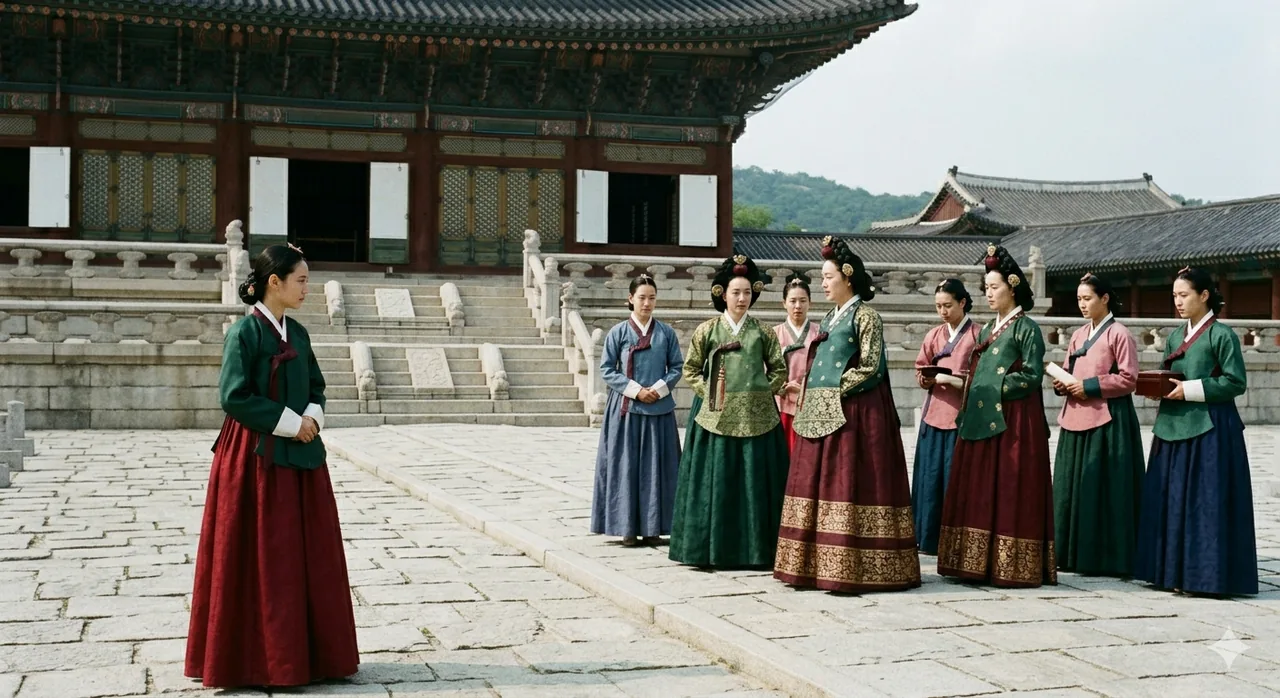
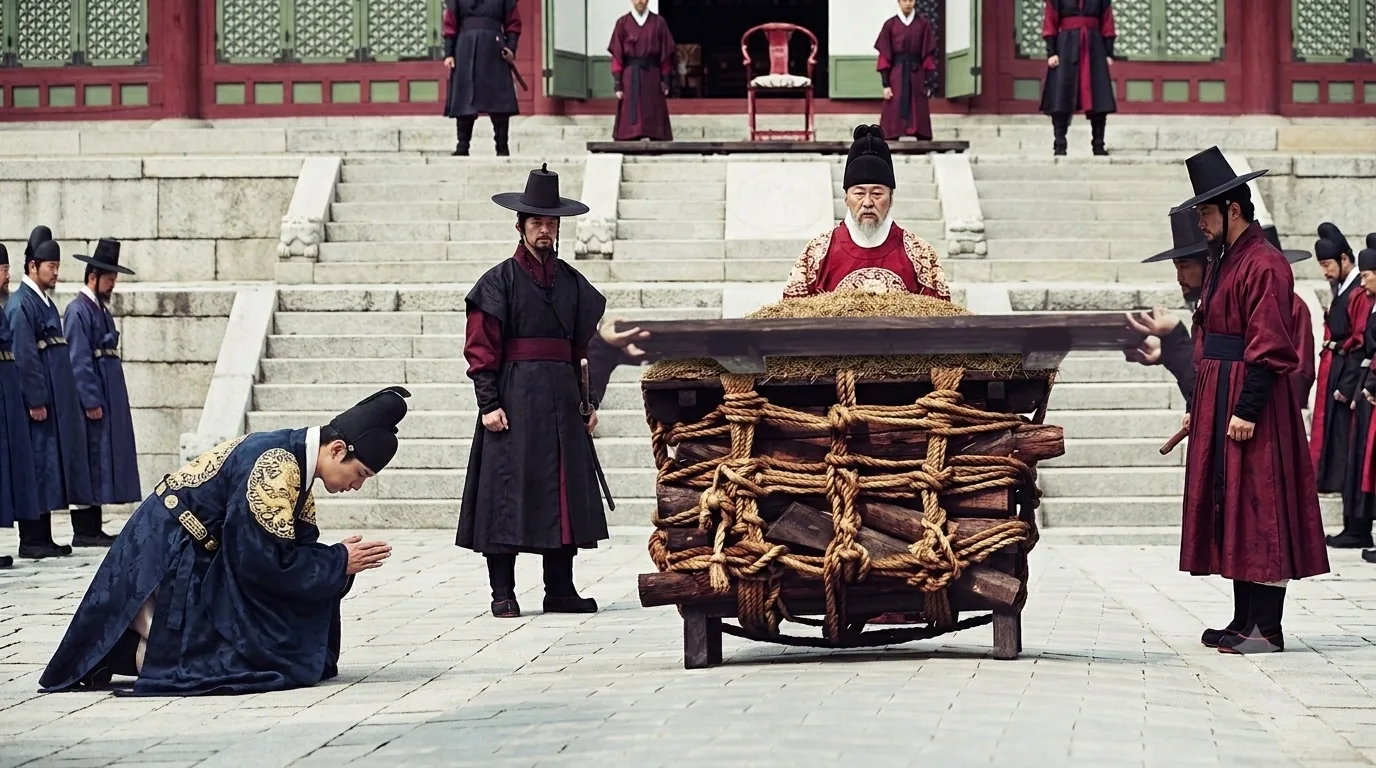
Jang Ok-jung, Explained: Why Could a King Flip an Entire Government Overnight?
Theme: Power & Politics
From the research behind Pause the Drama.
If you’ve watched Jang Ok-jung, Living in Love (장옥정, 사랑에 살다), the whiplash is the point. A palace seamstress becomes the king’s favorite. The king’s favorite becomes a royal consort. The royal consort’s newborn son becomes the reason a sitting queen is removed from the palace in disgrace. And five years later, the whole thing runs in reverse — the deposed queen comes back through the front gate, and the woman who replaced her is stripped back down to where she started.
It plays like soap opera. It is also, almost beat for beat, real Joseon history — and it happened not because of one woman’s ambition, but because of a political mechanism the Joseon court had a name for: hwanguk (환국), “a change of the political situation.” This wasn’t palace drama for its own sake — it was one of the most extreme demonstrations in Korean history of how completely a single royal decision could flip an entire faction’s fortunes — promoting large numbers of one faction while dismissing, exiling, or executing many of the other, with a queen deposed and restored in the span of five years.
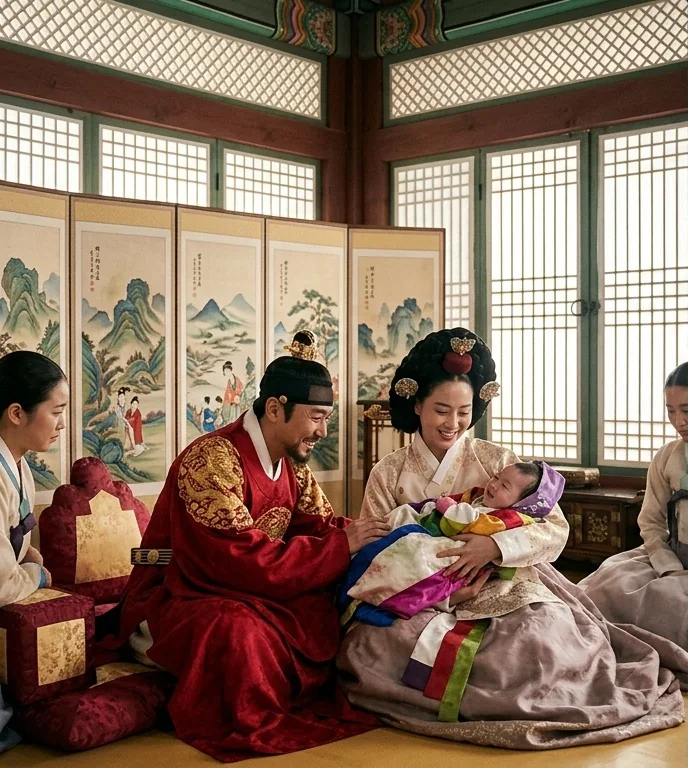 1688: the consort Lady Jang bears the king a son. In a court with no queen-born heir, that single birth was enough to set an entire government reversal in motion. (AI illustration)
Quick answer: In 1689, King Sukjong’s Gisa Hwanguk purged the ruling Seoin faction, deposed Queen Inhyeon, and elevated his consort Lady Jang — mother of his infant heir — who was made queen the following year (1690), with Namin officials taking over the government. In 1694, the Gapsul Hwanguk reversed all of it: the Namin were purged in turn, Queen Inhyeon was restored, and Lady Jang was demoted back to the consort rank of Huibin. Both events were driven by one king’s personal, decree-level power over faction and family — a political style historians call hwanguk. Let’s unpack it.
Timeline — the making and unmaking of a queen:
- 1680 — Gyeongsin Hwanguk: the Seoin faction returns to power.
- 1688 — Lady Jang bears King Sukjong a son, the future King Gyeongjong.
- 1689 — Gisa Hwanguk: the Seoin are purged, Queen Inhyeon is deposed, and the Namin take power.
- 1690 — Lady Jang is formally elevated to queen (October 22).
- 1694 — Gapsul Hwanguk: the Namin are purged, Queen Inhyeon is restored, and Lady Jang is demoted to Huibin.
- 1701 — Queen Inhyeon dies of illness; Huibin Jang is ordered to end her own life after the Mugo Incident.
Why did a queen get deposed over a court dispute?
The spark was dynastic, not personal scandal: Sukjong had no son with Queen Inhyeon after eight years of marriage. When his consort, Lady Jang, bore a son in 1688 — the future King Gyeongjong — Sukjong moved quickly to fix the succession by naming the infant his wonja (원자, 元子) — the designated “principal royal son,” a preliminary heir status short of the formal crown-prince investiture — locking in the line before the queen could bear a legitimate son of her own (Encyclopedia of Korean Culture — 기사환국).
The problem was factional as much as personal. The Seoin (“Westerners”) faction, which had controlled the government since an earlier reversal in 1680 (the Gyeongsin Hwanguk), argued the move was premature — the queen was still young enough to bear a legitimate heir (우리역사넷 — 기사환국 1689). Song Si-yeol, the country’s most senior Seoin scholar-official, submitted a memorial urging Sukjong to wait.
Sukjong did not take it as principled caution. He took it as defiance — and reacted with a purge.
What actually happened in 1689 — the Gisa Hwanguk
On January 15, 1689, Sukjong formally designated Lady Jang’s infant son as his wonja (원자) — not yet crown prince, but the officially recognized heir, a status the Seoin thought dangerously premature. (The boy’s formal investiture as crown prince, 왕세자 wangseja, would come only in June 1690.) When Song Si-yeol’s memorial arrived criticizing the timing, the king’s response was immediate and total: Song was stripped of office and exiled to Jeju Island, and the Seoin faction was purged wholesale from the government, replaced by the rival Namin (“Southerners”) faction (Encyclopedia of Korean Culture — 기사환국).
The purge did not stop with dismissals. Under continued pressure from Namin officials now back in power, Sukjong ordered Song Si-yeol to take his own life by poison (sasa, 賜死, a royal command to end one’s own life) — not on Jeju, but on the road: he was being escorted back toward the capital when the order reached him at Jeongeup in June 1689. He was 83 by the traditional Korean count (born 1607) (우리역사넷 — 송시열). Other senior Seoin figures, including Yi Ui-myeong and Kim Man-jung, were exiled or executed alongside him. Just before the deposition, on April 25, 1689, some eighty-six officials and scholars — led by the former minister O Du-in (오두인), the memorial itself drafted by Bak Tae-bo (박태보) — petitioned against the move to remove the queen, and were interrogated under torture that same night. The petition did not save her (Encyclopedia of Korean Culture — 기사환국).
Queen Inhyeon herself was deposed on May 2, 1689. To justify it, Sukjong reached for a royal precedent — the deposed-queen “cases of two earlier reigns,” pointing above all to King Seongjong’s deposition of his own consort, Lady Yun — and accused Inhyeon of jealousy (우리역사넷 — 기사환국 1689). This is better read as political cover than as settled fact: the same Veritable Records entry preserves court historians’ own note that the queen had done no real wrong. She was sent from the palace to live as a commoner. Lady Jang was elevated first to the highest consort rank of Huibin (禧嬪, “Consort of Joy”) on the same day her son was made wonja; then, after the boy’s formal investiture as crown prince in June 1690, she was raised to queen consort herself that October (October 22, 1690) (우리역사넷 — 기사환국 1689).
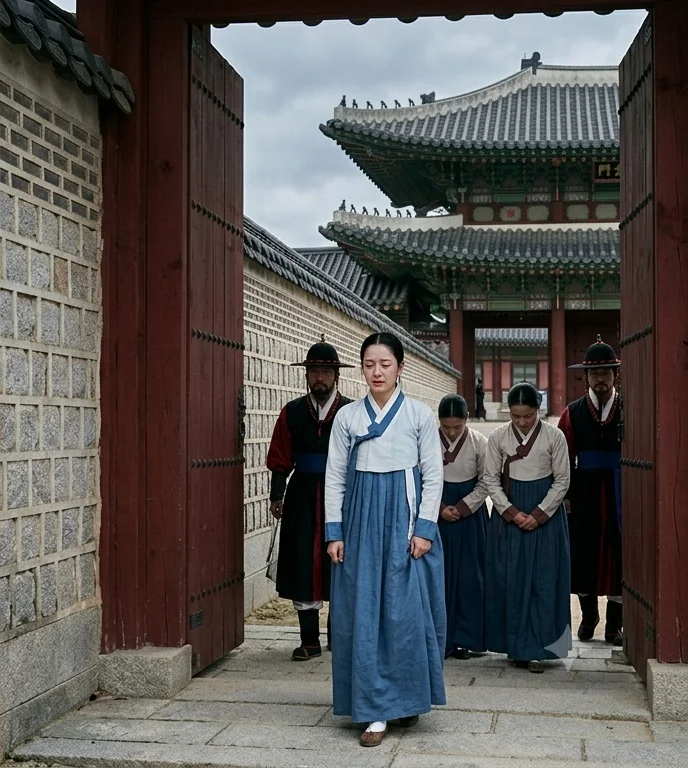 Queen Inhyeon leaves the palace as a commoner in 1689 — removed by the same royal will that had raised her rival. (AI illustration)
In a few months, an entire government had changed hands, a sitting queen had lost her position, and a former concubine sat on the throne beside the king.
A common misconception: was this just one woman’s ambition?
It’s tempting — and the 19th-century court novel tradition that shaped later folklore about Jang Ok-jung leaned hard into this — to read 1689 as one scheming concubine manipulating her way to the top and destroying a virtuous queen. The 2013 drama pushes back, spending its early episodes on Jang Ok-jung’s life as a talented designer before she ever caught the king’s eye.
The record supports a more structural reading. The crisis was a succession problem — no son with his queen after eight years — that any consort bearing a royal heir would have destabilized, regardless of her character. The purge ran through existing factional machinery: the Namin didn’t need Lady Jang to invent a conspiracy; they already existed as an out-of-power faction waiting for a royal opening. Hwanguk was a recognized mechanism of Joseon court politics, not an improvised mood swing — Sukjong had already used the same tool once, in the 1680 Gyeongsin Hwanguk that first put the Seoin in power (우리역사넷 — 환국). Reading 1689 as “one ambitious woman’s plot” erases the larger machine she became part of — a machine that, as 1694 would show, used her just as thoroughly as it seemed to serve her.
What flipped in 1694 — the Gapsul Hwanguk
By 1694, Sukjong had grown visibly regretful about deposing Queen Inhyeon. Sensing the shift, Noron official Kim Chun-taek and Soron official Han Jung-hyeok launched a movement to restore her. The ruling Namin, led by Min Am, tried to treat this as a prosecutable conspiracy and moved to interrogate and report the plotters to the king (Encyclopedia of Korean Culture — 갑술환국).
It backfired completely. Sukjong turned on the Namin instead. Min Am and Yi Ui-jing, who had led the crackdown, were ordered to take their own lives (sasa); other senior Namin figures, including Kwon Dae-un and Mok Nae-seon, were exiled or dismissed (Encyclopedia of Korean Culture — 갑술환국). The Soron and Noron — heirs to the purged Seoin of 1689 — were restored to government, with figures like Sin Yeo-cheol and Yun Ji-wan installed in key military posts.
The order to restore Queen Inhyeon came on April 12, 1694 — the same day the royal seals (璽綬) marking Queen Jang’s rank were withdrawn and she was demoted back to her earlier title of Huibin; Inhyeon’s formal re-investiture ceremony followed that June (Encyclopedia of Korean Culture — 인현왕후). The Namin faction, historians note, never recovered the political dominance it had held under the Gisa Hwanguk (Encyclopedia of Korean Culture — 갑술환국).
The coda came seven years later. Queen Inhyeon died of illness in August 1701. That same year, Huibin Jang was accused in the Mugo Incident (무고의 옥) of cursing the queen through shamanic ritual, and Sukjong ordered her to end her own life — the Veritable Records register her death as a self-dispatch (자진), though later popular retellings describe a cup of poison. Her brother Jang Hui-jae was executed alongside her (우리역사넷 — 장희빈). It closed a fifteen-year arc that had begun with her son’s birth in 1688.
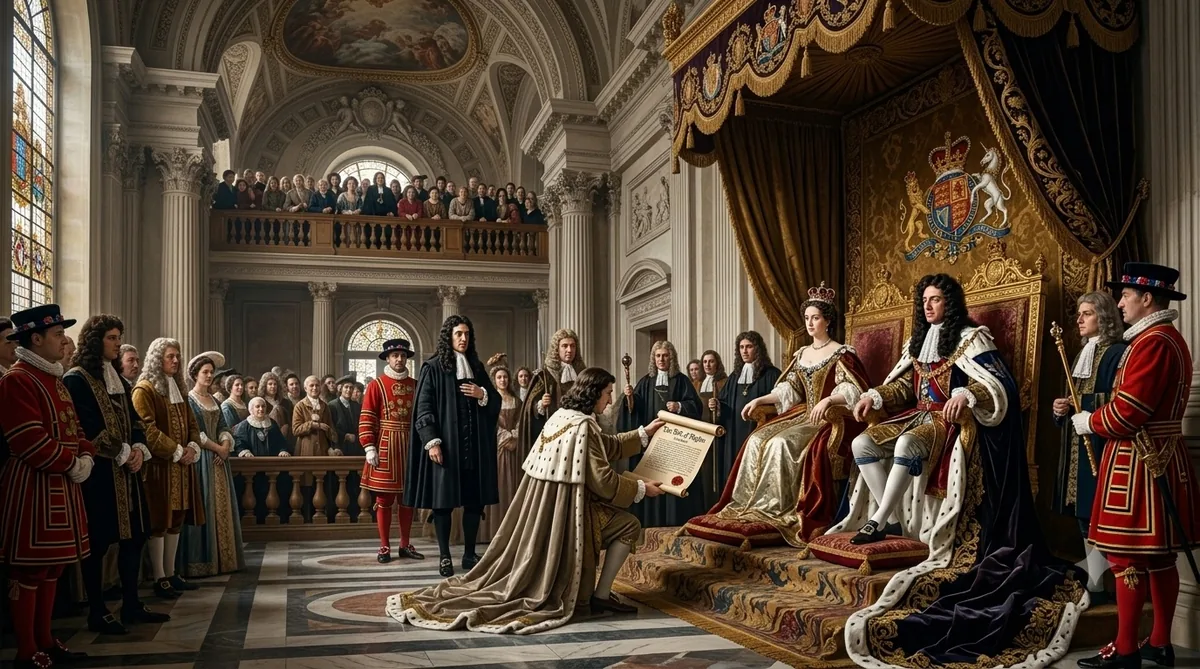 England’s answer in the very same decade: William and Mary accept the crown — and, with the Bill of Rights (1689), new limits on it. Power moving away from one ruler, not toward. (AI illustration)
Why this resonates beyond Korea: two “regime flips,” one decade, two completely different mechanisms
It’s a strange historical coincidence that Joseon’s most extreme run of hwanguk politics — 1680, 1689, 1694 — overlaps almost exactly with England’s own constitutional upheaval: the Glorious Revolution of 1688–89, in which Parliament and a Dutch invasion force replaced the Catholic King James II with the Protestant William III and Mary II (EH.net — The Glorious Revolution of 1688).
Both reshuffled who held power within the same rough window, and produced winners and losers along factional lines — England’s Whigs, who favored parliamentary supremacy and had pushed to exclude James over his Catholicism, versus the Tories, who resisted exclusion but largely united against James once he packed the army and Parliament with loyalists. But the mechanism of change could not have been more different.
| In Jang Ok-jung | In real history |
|---|---|
| A king’s personal favor for one woman seems to drive the entire plot | The real trigger was a succession crisis: no queen-born heir after eight years |
| Palace politics look like a closed, two-person rivalry (queen vs. consort) | The real machinery was factional — Seoin/Noron/Soron vs. Namin, contesting through the king |
| Reversal happens simply because the king’s heart changes | 1694 also involved a failed Namin prosecution overreach, giving Sukjong a pretext as well as a motive |
| The struggle looks unique to Joseon court intrigue | England saw its own “regime flip” in nearly the same decade — via Parliament and invasion, not one monarch’s decree |
| The story centers on individual blame (a “villainess,” a “wronged queen”) | Both women were instruments and casualties of a repeatable mechanism the court itself called hwanguk |
In short: Joseon and England each saw dramatic reversals of power in almost the same window, but by opposite logics. In Joseon, hwanguk concentrated the power to flip an entire government in one man — Sukjong could purge, exile, execute, depose, and restore by decree, twice within five years. In England, the Glorious Revolution bound the monarchy to Parliament’s consent for taxation and law, setting up a Whig-Tory rivalry that alternated in and out of power through election and coalition rather than one ruler’s reversal of favor. Two courts, two “flips,” two very different answers to where ultimate power should sit.
Coming up next
Between 1689 and 1694, an entire government changed hands twice, one queen was deposed and restored, another woman rose from consort to queen and back to consort, and the country’s most senior scholar-official was ordered to end his own life over a memo about timing. That is the reality standing behind the plot twists of Jang Ok-jung, Living in Love — and it is also the clearest illustration in Joseon history of just how personally, and how totally, one king’s shifting favor could remake the entire court.
In the next essay, we’ll take another K-drama scene that looks like pure fiction — and trace the real Korean history hiding underneath it.
Frequently asked questions
What is Jang Ok-jung, Living in Love about? Jang Ok-jung, Living in Love (장옥정, 사랑에 살다, 2013 SBS) is a 24-episode SBS drama starring Kim Tae-hee as Jang Ok-jung, later Royal Noble Consort Huibin Jang. Rather than the scheming villainess of older adaptations, it reimagines her early years as a fashion and cosmetics designer, then follows her rise to consort, mother of the future King Gyeongjong, and briefly queen — against the real 1689 Gisa Hwanguk and 1694 Gapsul Hwanguk.
What was the Gisa Hwanguk of 1689? The Gisa Hwanguk (己巳換局) was a 1689 purge in Sukjong’s 15th year. When Sukjong moved to name the infant son of his consort Lady Jang (the future King Gyeongjong) his principal royal heir (원자, wonja) — the step before a formal crown-prince investiture — the ruling Seoin, led by Song Si-yeol, objected as premature since Queen Inhyeon was still young enough to bear an heir. Sukjong purged the Seoin, installed the rival Namin, deposed Queen Inhyeon, and eventually made Lady Jang queen.
What was the Gapsul Hwanguk of 1694? The Gapsul Hwanguk (甲戌換局) reversed the Gisa Hwanguk five years later. After Namin officials tried to prosecute a Noron-Soron movement to restore the deposed Queen Inhyeon, a regretful King Sukjong turned on the Namin instead, exiling or executing their leaders, restoring Queen Inhyeon, and demoting Queen Jang back to her earlier rank of Huibin.
What does hwanguk (환국) mean? Hwanguk (換局) means “change of the political situation” — a rapid, top-down realignment of factional power at the king’s initiative, not gradual negotiation. It defined Sukjong’s 46-year reign (1674–1720), which saw at least three hwanguk events (1680, 1689, 1694), each replacing the ruling faction overnight with mass promotions for the winners and purges, exile, or execution for the losers.
Was the Gisa Hwanguk a coup? Not exactly. It was neither a military coup nor a popular revolution. It was a court-centered political reversal initiated by King Sukjong himself, who used royal authority to replace one ruling faction with another. The army did not seize power — the king redistributed it.
Why was Song Si-yeol executed? Song Si-yeol (1607–1689), the senior Seoin scholar-official, submitted a memorial arguing the heir (원자) designation was premature. Sukjong treated it as defiance, exiling him to Jeju Island. Under pressure from the newly powerful Namin, Sukjong then ordered Song to take poison (sasa) as he was brought back toward the capital; the order reached him at Jeongeup in 1689, where he died — aged 83 by the traditional Korean count (born 1607).
Did Queen Inhyeon and Jang Huibin actually hate each other like in the drama? The record supports real hostility, though not the simplified rivalry folklore later attached to it. Sukjong deposed Queen Inhyeon in 1689 partly by accusing her of jealousy, citing a precedent from King Seongjong’s reign. After her 1694 restoration, their fates split permanently: Inhyeon died of illness in 1701, and that same year Jang Huibin was ordered to end her own life, accused in the Mugo Incident of cursing the queen. Later court fiction sharpened this into a simpler heroine-versus-villainess story than the sources support.
Is it fair to call Jang Ok-jung simply a villain? Most historians, and this 2013 drama, resist that flattening. Lady Jang rose from a modest background to mother of a crown prince and, briefly, a queen — an extraordinary ascent in a rigid court. She was also a casualty of hwanguk politics: raised by one royal reversal in 1689, destroyed by the next in 1701. Reading her only as a temptress ignores how much the deposing and restoring of queens was driven by Sukjong’s shifting alliances, not one woman’s ambition.
How does this compare to England’s Glorious Revolution of the same era? Both reshuffled a governing faction within a few years of each other, through very different mechanisms. Joseon’s hwanguk let one king personally reverse an entire faction’s fortunes by decree. England’s Glorious Revolution of 1688–89 replaced King James II with William and Mary through a parliamentary and military process that increasingly bound the monarchy to Parliament’s consent for revenue and law — moving power away from any one ruler’s whim rather than concentrating it further in the throne.
Sources & further reading
This piece was written from the historical script and fact-check of 사뚱샘의 역사방 (SaDDungSam), cross-checked against Korea’s own primary records and official cultural-heritage databases:
- Gisa Hwanguk (기사환국, 1689) — the 1689 purge, crown prince designation, and deposition of Queen Inhyeon. (Encyclopedia of Korean Culture; 우리역사넷)
- Gapsul Hwanguk (갑술환국, 1694) — the 1694 reversal, Namin purge, and restoration of Queen Inhyeon. (Encyclopedia of Korean Culture)
- Queen Inhyeon (인현왕후) — her installation in 1681, deposition in 1689, restoration in 1694, and death in 1701. (Encyclopedia of Korean Culture)
- Royal Noble Consort Huibin Jang (희빈 장씨) — her rise to queen consort, demotion in 1694, and death by royal order in 1701 following the Mugo Incident. (Encyclopedia of Korean Culture; 우리역사넷)
- 환국 (Hwanguk) as a political mechanism — the teaching-glossary explanation of hwanguk politics under Sukjong. (우리역사넷, National Institute of Korean History)
- Song Si-yeol (송시열) — his opposition memorial, exile, and 1689 death by royal order. (우리역사넷)
- The Veritable Records of the Joseon Dynasty (조선왕조실록) — the official primary chronicle of Sukjong’s reign. (National Institute of Korean History)
- The Glorious Revolution of 1688–89 and Whig-Tory politics — the parliamentary replacement of James II with William and Mary, and the constitutional settlement that followed. (EH.net, Economic History Association)
Thanks for reading — see you in the next one.
This article was researched and written by K-Drama History. Source: Jang Ok-jung, Explained: Why Could a King Flip an Entire Government Overnight? — K-Drama History