Taejo Wang Geon, Explained: Why Did King Gungye Claim He Could Read Your Mind?
From the research behind Pause the Drama.
If you’ve watched the KBS epic Taejo Wang Geon (2000–2002, 200 episodes), you know the scene. In episode 116 (aired May 6, 2001), King Gungye (played by Kim Yeong-cheol) calls in his general Wang Geon and asks whether he has been plotting treason. Wang Geon denies it. Gungye says he will look with gwansimbeop, the mind-reading method, and closes his eyes. At that moment the official Choe Eung drops his brush. Pretending to pick it up, he passes by Wang Geon and whispers that he should admit his guilt. Wang Geon confesses to a treason he never committed, and he survives.
In this drama, gwansimbeop became a sort of national meme. In episode 80 (Dec 31, 2000), Gungye is using it when he demands, “Who is it? Who just coughed?” The line is still widely parodied.
So here’s the question: was gwansimbeop a superpower invented for TV? And if a real king really claimed he could read people’s minds, what was he trying to do with that claim?
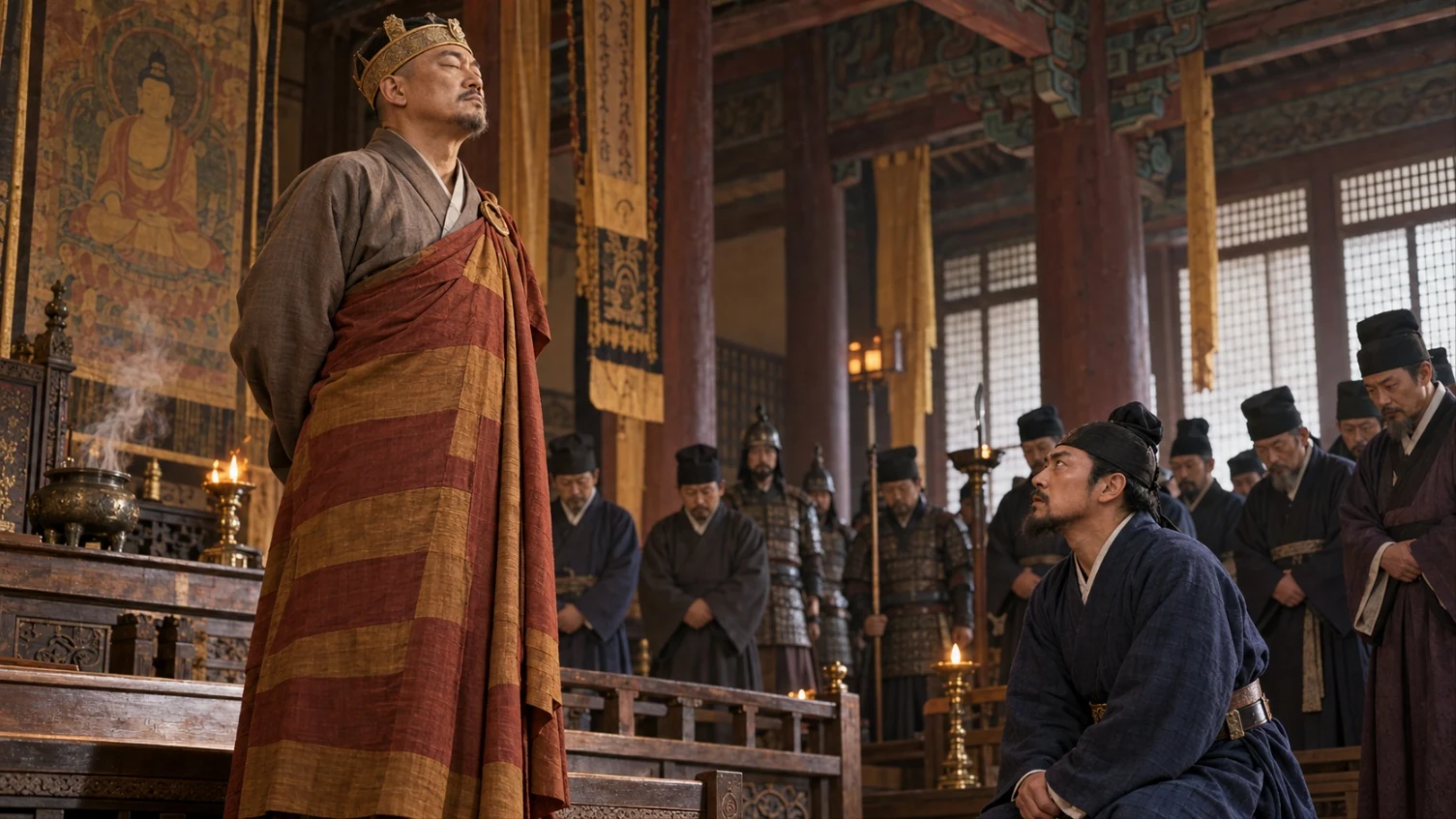 Gungye “looking into” a kneeling general’s heart. The Goryeosa describes him closing his eyes and gazing upward as if entering meditation. (AI illustration)
Quick answer: Gwansimbeop was not invented by the drama. It is Gungye’s own claim, as the sources record it. The Goryeosa reports him saying he had obtained the “Maitreya mind-reading method” (彌勒觀心法). It was part of a kingship built on his claim to be Maitreya, the Buddha of the future. In this article’s reading, an accusation backed by the inner sight of the future Buddha needed no evidence, which made it an accusation that could not be refuted, whether it was aimed at a general or (in a claim the Samguk sagi calls “divine power”) at the king’s own wife. And there is a twist. When Wang Geon overthrew Gungye in 918, he revived the state name Goryeo, which Gungye had proclaimed in 901 before renaming his state in 904, kept Gungye’s top state office, the Gwangpyeongseong, and continued Gungye’s Palgwanhoe festival. He removed Gungye, but he selectively inherited important parts of Gungye’s state.
| Question | What the sources say |
|---|---|
| Is “gwansimbeop” in the sources? | Yes. The Goryeosa quotes Gungye: “I have obtained the Maitreya mind-reading method.” The Samguk sagi uses sintong (divine power); the NIKH annotation equates it with gwansimbeop |
| What does the Goryeosa say it revealed? | ”The hidden affairs of women” (婦人陰私), i.e. adultery; the same entry then turns it on treason |
| Who was accused by it? | The best-known named cases: Wang Geon (914) and Gungye’s wife, Lady Kang (915) |
| Did Lady Kang commit adultery? | The sources don’t say so. She remonstrated with the king first, the accusation came after, and she denied it |
| How did Gungye die? | Killed by the people of Buyang while fleeing. The Goryeosa says he was caught cutting ears of barley. The drama’s ending is an adaptation (Myeongseongsan follows local legend; Eunbu’s sword is the drama’s) |
| Was “Goryeo” Wang Geon’s new name? | No. Gungye used it in 901 (Samguk yusa), and Goguryeo had used it before him |
(A note on the drama: we could not confirm any official overseas streaming service for Taejo Wang Geon. KBS runs its own replay service, and the KBS Drama Classic YouTube channel has carried the series. Check KBS’s official replay and YouTube listings for current access and subtitle options; we could not confirm availability by country or English subtitles.)
Is gwansimbeop really in the sources?
The Goryeosa (History of Goryeo), in the Taejo prologue of its first volume, has an entry for 914 in which Gungye is said to have often declared:
“I have obtained the Maitreya mind-reading method and can know the hidden affairs of women. If anyone runs afoul of my mind-reading, I will at once apply severe law against him.” (我得彌勒觀心法, 能知婦人陰私. 若有干我觀心者, 便行峻法.)
This is where overseas readers may be surprised. In this sentence, the power Gungye claims for himself is not uncovering treason. It is knowing “the hidden affairs of women” (婦人陰私), in other words, detecting adultery. In the same entry, that power then shifts to the interrogation of Wang Geon for treason.
The scene in episode 116 follows this entry almost exactly. In the Goryeosa, Gungye says he will enter ipjeong (入定, a meditative state), closes his eyes, and looks up toward the sky. Choe Eung, holding the post of jangju (掌奏, an official title), deliberately drops his brush, pretends to pick it up, and whispers, “If you do not submit, you will be in danger.” The drama follows the same sequence: meditation, brush, whisper, confession, pardon. The source goes on a little further. After Wang Geon confesses, Gungye laughs loudly, says “You are honest,” and gives him a saddle and bridle decorated with gold and silver. One of the drama’s most famous scenes is an almost direct transfer of a historical source.
The terminology differs between sources. The Samguk sagi (History of the Three Kingdoms) records the same power not as gwansimbeop but with Gungye saying, “I saw it through divine power” (神通). The National Institute of Korean History’s annotation treats this divine power as equivalent to the Maitreya mind-reading method. It reads it as a device that pushed the king’s surveillance into the daily lives of the ruling class. That is the annotator’s interpretation.
The same Goryeosa entry says Gungye wildly fabricated treason charges and “killed a hundred or more in a single day” (日殺百數). That figure comes from records written by the side that overthrew him and may be an exaggerated expression, so we don’t treat it as a statistic.
Did Gungye really claim to be Maitreya?
The drama makes Gungye a Maitreya figure. In episode 68 a line says that Maitreya reads minds through gwansimbeop, and in episode 69 Gungye “awakens” to gwansimbeop.
The sources speak of Maitreya too. According to the Samguk sagi’s biography of Gungye, he called himself the Maitreya Buddha (自稱彌勒佛). He wore a golden headcloth (金幘) on his head and a monk’s square-cut robe (方袍). He called his eldest son the Bodhisattva Cheonggwang (靑光菩薩) and his youngest son the Bodhisattva Singwang (神光菩薩). When he went out, boys and girls led the way carrying banners and incense, and monks followed chanting beompae (梵唄, Buddhist hymns). He is said to have written more than twenty volumes of scripture himself, but none survive. As king, when he sat lecturing on those scriptures, the monk Seokchong (釋聰) criticized his teaching as heretical (邪說), and Gungye beat him to death with an iron club (鐵椎).
The timing is different, though. In the Samguk sagi, the entry about his calling himself Maitreya appears after the entry on the 911 renaming of the state as Taebong. But that placement alone does not let us conclude that his claim to be Maitreya began in 911, and the entry itself gives no year for when it started. Nothing in the record says that, as in the drama, he raised his army under the banner of Maitreya from the very beginning.
Maitreya (彌勒) is the future Buddha, who is to come into this world after Shakyamuni and save all beings. In the chaos of late Silla, for people waiting for salvation, this was a powerful political language. Urinyeoksanet, run by the National Institute of Korean History, explains that Gungye deified himself by claiming to be Maitreya and used that authority to drive his rule, but that this also reveals how unstable his power was.
Gungye had been a monk. At around ten years old he left home to enter the monastery of Sedalsa, taking the Buddhist name Seonjong (善宗).
Who was gwansimbeop aimed at?
In the sources, the best-known cases in which Gungye used gwansimbeop or “divine power” to accuse someone are those of Wang Geon and Lady Kang. They are not the only uses the sources describe. The Goryeosa’s 914 entry also says, in general terms, that Gungye invoked gwansimbeop and inflicted harsh punishments on those he wanted to kill. But these two are the cases in which a specific person is named. We take them in chronological order.
The general: Wang Geon (914). Wang Geon rose to sijung (侍中, the top administrative post) in 913. But the Samguk sagi records that the following year, 914, Gungye made him Baekseon janggun (百船將軍), “General of a Hundred Ships.” In other words, he was sent back to command the navy. (The classical text writes 百舡將軍; the textual note explains that 船 and 舡 are interchangeable.) The Goryeosa’s official Korean translation likewise records that in 914 Wang Geon stepped down as sijung and again took charge of the navy. We have not checked that passage against its classical Chinese text. The mind-reading interrogation took place that same year. A general who had been leading campaigns in the Naju region nearly became a traitor on the strength of the king’s inner sight alone.
The wife: Lady Kang (915). In episode 116, Gungye interrogates his queen, “Yeonhwa,” and has her executed with a heated iron club. The deaths of her two sons are not written in KBS’s official synopsis. They are confirmed by the funeral procession scene at the end of episode 116. The Samguk sagi’s account is this. In 915, the first year of Zhenming (貞明, an era name of the Later Liang), his wife, Lady Kang (康氏), earnestly remonstrated with the king over his wrongdoing. The king came to hate her and said, “You have committed adultery with another man. How do you explain it?” When Lady Kang denied it, he said, “I saw it through divine power,” killed her with a heated iron pestle, and killed their two children (兩兒) as well. (The NIKH edition notes that some early printed editions write 神迪 where the Samguk sagi jeolyo has 神通.)
The order matters. The remonstrance comes first, and the adultery charge comes after. Writing that “Lady Kang was executed for adultery” turns an accusation into a fact. Lady Kang’s personal name and origins are not recorded. “Yeonhwa” is a name the drama gave her.
The two sources also place the iron pestle differently. The Goryeosa, in its 914 entry, describes the heated iron pestle as the method Gungye routinely used on anyone he wanted to kill. The Samguk sagi ties it to Lady Kang’s execution in 915. For Lady Kang’s case, we follow the Samguk sagi alone.
The two cases have something in common. In each, the only basis for the accusation is the king’s inner sight. There is no way to produce evidence against it, so the only choices left are confession or denial. Wang Geon confessed and lived. Lady Kang denied and died.
Calling gwansimbeop “an accusation that could not be refuted” is this article’s interpretation, not a sentence the sources state directly. It rests on the Goryeosa’s 914 entry, the Samguk sagi’s 915 entry, and the National Institute of Korean History annotation that reads the power as a surveillance device. We have not surveyed the full range of scholarly views, so this should not be taken as an academic consensus.
A purge from the same period: the monk Hyeongmi (917). In episode 118 (May 13, 2001), the Great Master Hyeongmi is publicly beheaded in the street on the Buddha’s Birthday. To be clear, there is no record that gwansimbeop was used in Hyeongmi’s death. But his death matters for another reason. It survives in a source earlier than the official histories. The stele of Master Seongak (先覺大師碑) at Muwisa temple in Gangjin, South Jeolla, was erected in 946, about two hundred years before the Samguk sagi (1145). The stele records that Hyeongmi (864–917) was killed under Gungye’s rule. Scholars disagree, however, about who the “Great King” (大王) was who summoned Hyeongmi in the inscription. Ha Il-sik (2025) reads him as Wang Geon. Jo Gyeong-cheol (2025), supporting the view of Choe Yeon-sik, reads him as Gungye. The identity of the “Great King” is disputed, but that dispute does not by itself decide whether the stele describes violence under Gungye. Even Ha Il-sik, who reads the “Great King” as Wang Geon, still identifies a passage about Gungye’s interrogation of the monk; according to his abstract, Gungye is generally called the “former ruler” (前主) in the inscription, but in that passage he is called the “sovereign” (主上), which Ha attributes to wording taken from an account written by the monk’s disciples before Gungye was deposed. Either way, the stele is a 946 source about Hyeongmi’s death under Gungye, and either way it was erected by Wang Geon’s Goryeo.
Recently, Ha Il-sik re-read the inscription and suggested that Hyeongmi may have faced charges of secret dealings with Later Baekje and conspiring with a prince (2025; cited secondhand from research materials, at the level of the paper’s abstract). This is an inference from interpreting the inscription, not evidence of an actual plot.
Where the drama departs from the record
It changes the order. In the Goryeosa, Wang Geon’s false confession dates to 914, and in the Samguk sagi, Lady Kang’s execution dates to 915. The drama puts both the queen’s execution and Wang Geon’s interrogation in a single episode, 116, and KBS’s official synopsis lists the execution first and the interrogation second. This looks like a rearrangement for dramatic tension.
The ending is completely different. In episode 120 (May 20, 2001), Gungye shares a last drink with Wang Geon, who has come to find him at Myeongseongsan. He then has Eunbu, to whom he had already entrusted the royal sword, cut him down. Eunbu follows by taking his own life. The episode’s closing narration says directly that Gungye’s death in the histories differs from his death in the drama.
The ending in the sources is the opposite. The Samguk sagi records that Gungye hid in the mountains in commoner’s clothes and was killed by the people of Buyang (斧壤, modern Pyeonggang). The Goryeosa is even more wretched. He hid in a mountain valley for two nights, and while he was secretly cutting off ears of barley to eat because he was starving, the local people killed him. In the Goryeosa’s telling, the king who had called himself Maitreya ended as a starving fugitive taking ears of barley.
The portrayal of madness. The drama traces Gungye’s madness as it deepens. The sources do describe him as becoming increasingly suspicious (多疑). But there is no basis for attaching a modern psychiatric diagnosis to a person who lived 1,100 years ago.
What did Wang Geon keep from Gungye’s state?
KBS’s official synopsis for episode 121 (May 26, 2001) says Wang Geon “changed the name of the country to Goryeo.” In the drama, Wang Geon renames Taebong with the new name Goryeo. But the name was not new.
The state name “Goryeo.” When Gungye proclaimed himself king in 901, the state name he used was Goryeo. This appears in the royal chronology (Wangnyeok) of the Samguk yusa (Memorabilia of the Three Kingdoms). We confirmed this in the official translation but did not read the classical Chinese passage directly. The Samguk sagi’s biography of Gungye, by contrast, says only that “Seonjong proclaimed himself king” in its 901 entry and gives no state name. The National Institute of Korean History annotation interprets this as the Samguk sagi’s compilers apparently choosing not to show the name because they were aware of Wang Geon’s state name, Goryeo. This is an interpretation.
One caution: “Goryeo” was not a name Gungye coined. Goguryeo had already used Goryeo as its state name in its later period. More precisely, Gungye revived the name to claim Goguryeo’s legacy, dropped it in 904 in favor of Majin, and Wang Geon took it back in 918. The Goryeosa jeoryo records that on the byeongjin day of the 6th month of 918, Wang Geon took the throne in the Pojeong Hall, named the state Goryeo, and adopted the era name Cheonsu (天授).
The top office, Gwangpyeongseong. In 904, when Gungye renamed his state Majin, he set up central offices including the Gwangpyeongseong (廣評省). According to the Goryeosa, in the very month he took the throne, Wang Geon appointed Gim Haeng-do as Gwangpyeong sijung (廣評侍中) and Im Jeok-yeo as Gwangpyeong sirang. The National Institute of Korean History annotation holds that early Goryeo inherited Taebong’s bureaucratic system and kept the Gwangpyeongseong.
The Palgwanhoe. In the 11th month of 898, Gungye held a Palgwanhoe (八關會, a state festival honoring both the Buddha and native deities) for the first time. In the 11th month of 918, five months after Wang Geon took the throne, the responsible office proposed: “The former ruler (Gungye) held the Palgwanhoe on a grand scale every midwinter; let us follow that practice.” The text records that the king followed this (王從之). The same entry also mentions elements of old Silla observances, so there is no need to claim that every meaning and component of the rite continued unchanged. Wang Geon took up Gungye’s Palgwanhoe as a state rite of the new dynasty, and it went on to become one of Goryeo’s signature state rites. Its continuity was not unbroken, though. The Goryeosa records that the Palgwanhoe in the two capitals was halted in the 6th year of King Seongjong (987) and revived in the 1st year of King Hyeonjong (1010).
The inheritance had limits. On the 27th day of the 6th lunar month of 918, Wang Geon ordered that the Silla ranks, official titles, and county names Gungye had changed be returned to the Silla system, while allowing new names whose meaning was easy to understand to stay in use. Continuity and change went together.
Why did Gungye claim to read minds?
Gungye’s state was built by bringing together several regional military groups. In a coalition like that, a king needs some authority other than the sword to stand above the rest. What Gungye chose was Maitreya. Maitreya binds people not through status but through salvation.
The problem was that this authority did not allow itself to be checked. Maitreya’s eye could not be wrong, so questioning a gwansimbeop verdict amounted to disbelief. The authority meant to raise the king up ended up driving away the people closest to him. (This is this article’s interpretation.) The coup of 918 was not launched by an outside enemy but by Hong Yu, Bae Hyeon-gyeong, Sin Sung-gyeom, and Bok Ji-gyeom, Gungye’s own generals.
Folklore, legend, and later tradition
The character 王 carried by a crow. The Samguk sagi’s biography of Gungye contains this story. When Gungye was still a monk, on his way to a Buddhist rite, a crow dropped something into his alms bowl. Looking at it, he found a slip of ivory (牙籤) with the character 王, “king,” written on it. It appears in an official history, but it is in the nature of an omen tale foretelling that he would become king. A story of the same lineage is said to appear in the Jewang ungi by Yi Seung-hyu of late Goryeo, but we have not checked the original text.
Cheorwon’s other memory. In the Cheorwon, Pocheon, and Pyeonggang area, there are folktales that Gungye fought a final battle against Wang Geon. There is also a legend that Gungye died at Myeongseongsan (鳴聲山), between Pocheon and Cheorwon. Place-name legends such as Gullyanggok and Cheonhwangji are also linked to Gungye. In the official histories he is a tyrant who died stealing ears of barley, but in local memory he is a defeated hero. When episode 120 set his last stand at Myeongseongsan, it was in line with this local tradition rather than the official histories. Eunbu’s sword and the final drinking scene appear to be the drama’s own invention.
Whether any of this actually happened has not been confirmed. These local traditions preserve a different image of Gungye; their origins and transmission would need separate study.
Comparisons abroad: religious authority and political power
A parallel: Hong Xiuquan (1814–1864, the Taiping Heavenly Kingdom, China). Hong Xiuquan failed the civil service examinations repeatedly. After experiencing visions, he claimed to be the younger brother of Jesus. In 1851 he launched the Taiping uprising and took the title Heavenly King (天王), founding the Taiping Heavenly Kingdom. A man who claimed to be a savior and used that authority to found a new state: in that respect he resembles Gungye most closely. The endings were different. The Taiping Heavenly Kingdom fell in 1864 after a war involving Qing government forces and Western powers. Gungye fell to a coup by his own generals.
A case that sharpens the theme: al-Hakim (r. 996–1021, Fatimid Egypt). During his reign, around 1017, some da’is (preachers of the Ismaili doctrine) spread a teaching that attributed divinity to him, and this became the origin of the Druze faith. Whether al-Hakim himself encouraged it is disputed. Britannica writes that Hamza, leader of the movement proclaiming his divinity, appears to have enjoyed al-Hakim’s favor. Farhad Daftary writes that there is no evidence al-Hakim himself encouraged it. This is where the contrast with Gungye becomes clear. Divinity was attributed to al-Hakim by others, while in the sources Gungye called himself (自稱) Maitreya. In 1021 al-Hakim went out beyond Cairo and never returned, and memories of his disappearance are divided as well.
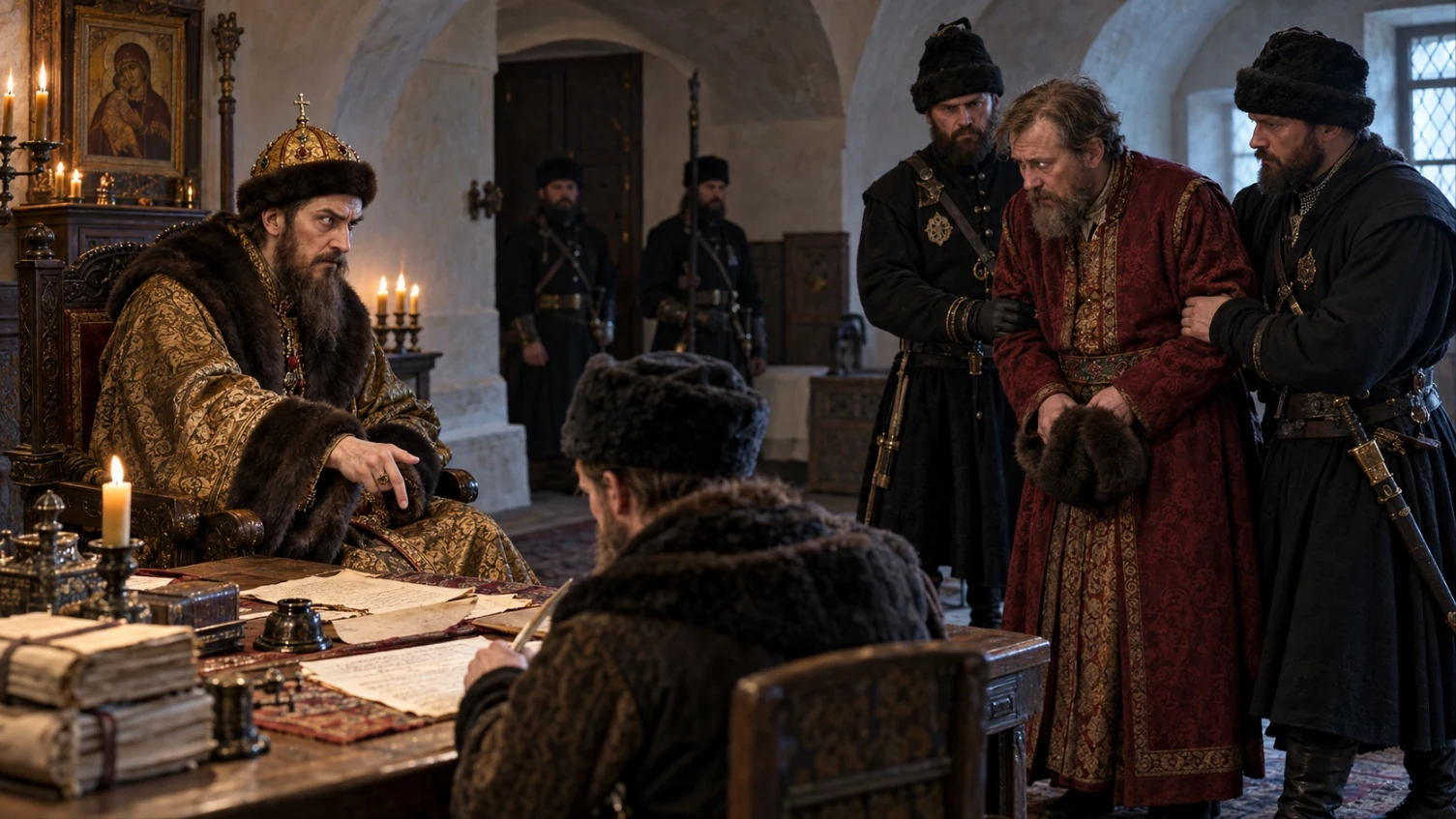 Ivan IV’s purges ran through an institution, the oprichnina and its guard, rather than a claim to read minds. (AI illustration)
A contrast: Ivan IV (r. 1533–1584, Russia). In 1565, Ivan created the oprichnina, a special territory under his direct rule, and set up a personal guard to purge the nobility. According to Britannica, he sent lists of more than 3,000 victims to monasteries. Like Gungye, he was a ruler who strengthened the state and also ruled through terror. But Ivan was a hereditary monarch, and he never claimed to be a buddha or a god. There was an ideology that stressed the sacredness of royal power, but his purges were driven not by a king’s divine sight but by an institution: a separate territory and a personal guard. The death of his son Ivan in 1581 is described differently by different sources. Britannica describes it as a killing in a fit of rage. Sergei Bogatyrev, in The Cambridge History of Russia, describes it as an unintended fatal incident.
Korea: Gungye. Like Hong Xiuquan, he claimed to be a savior. Like Ivan, he purged those close to him. But in the episodes discussed here, the sources present the justification not as an institution’s verdict but as a single claim: I can see into your heart. And the man who drove him out took up again his state’s former name, his top office, and his festival.
Back to episode 116
In episode 116, Wang Geon confesses to a treason he never committed, and he survives. What makes the scene frightening is that the truth is useless. As the sources tell it, there was no evidence to answer, only the king’s inner sight. Confession or denial were the only choices left.
Gwansimbeop was not invented by the drama. It is Gungye’s own claim, as the sources record it. That claim rested on his self-proclaimed Maitreya status, and a power of the same kind was turned on the general Wang Geon and, in the Samguk sagi’s words, on the king’s own wife. Four years later, the man who drove Gungye out was the very general who had survived that day by confessing falsely. And he raised again the name Gungye had once used: Goryeo. Wang Geon drove out Gungye, but he selectively kept important parts of Gungye’s state: its name, some of its offices, and its state rites.
This article was researched and written by K-Drama History. Source: Taejo Wang Geon, Explained: Why Did King Gungye Claim He Could Read Your Mind? — K-Drama History