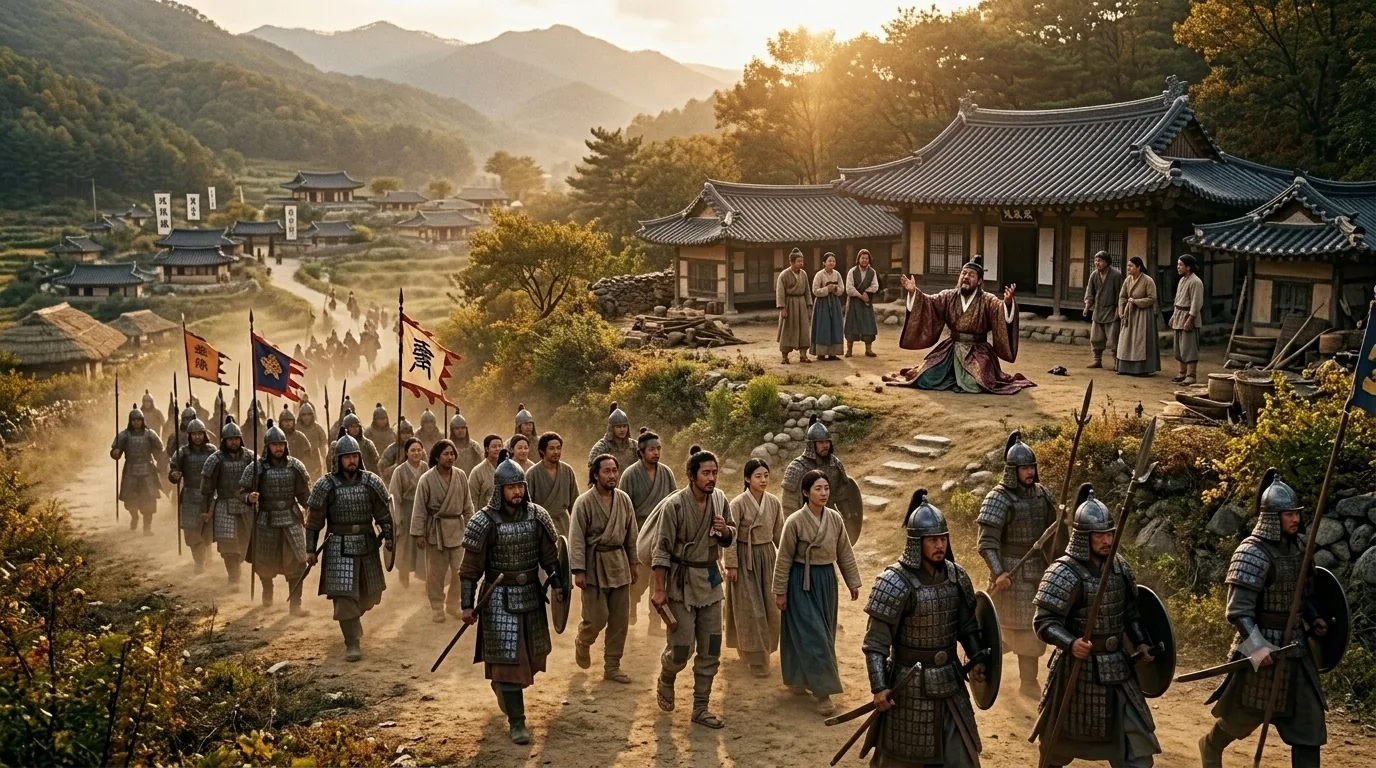
Nine Daughters, One Outside Son-in-Law — and He Had Already Surrendered His Kingdom
Theme: Power & Politics
From the research behind Pause the Drama.
The first thing a new viewer of Moon Lovers: Scarlet Heart Ryeo has to cope with is the arithmetic. Third Prince, Fourth Prince, Eighth Prince, Ninth Prince, Tenth Prince, Thirteenth Prince, Fourteenth Prince. They are brothers, and they behave like rivals, because most of them have different mothers — and a different mother meant a different family standing behind you.
Watch a little longer and something else stands out. There are almost no daughters on screen.
In the record there were nine. The Goryeosa opens its section on Taejo’s daughters with a single line: 太祖九女 — Taejo had nine daughters. So where did they go?
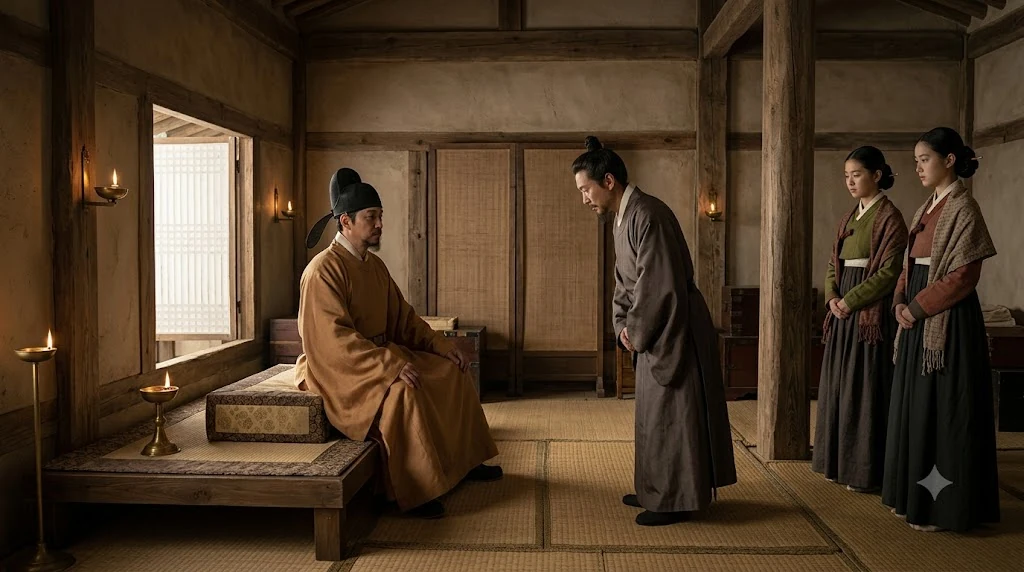
The short answer: The Goryeosa names a husband for eight of the nine. Six of those marriages were inside the royal house, including to half-brothers. Two were not — and both of those daughters married the same man: Kim Bu, the last king of Silla. The record places that marriage after he had already come over to the Goryeo court. The door outward opened once, and behind it there was no longer a rival kingdom.
Twenty-nine consorts, and what that number is not
Taejo took twenty-nine consorts. That figure comes from the Goryeosa’s biographies of royal consorts and is the number the National Institute of Korean History uses.
It is worth being careful about two things.
First, “twenty-nine marriages” overstates it. The Goryeosa cases include relationships that were not formal weddings — some were a single night’s attendance rather than a ceremony. Twenty-nine consorts is accurate; twenty-nine weddings is not.
Second — and this is the correction that matters for the politics — twenty-nine consorts does not mean twenty-nine houses. The record is explicit where it doubles up. Of the Lady of Gwangju Won and the Lesser Lady of Gwangju Won, the text says of the second simply 亦規之女 — also a daughter of Wang Gyu. Of the Lady of Daeseowon and the Lady of Soseowon, likewise: 亦行波之女 — also a daughter of Kim Haengpa. Two men supplied two consorts each.
So the correct statement is that Taejo drew twenty-nine consorts from a number of powerful houses across the peninsula, not that he tied twenty-nine separate families to the throne. Where a house mattered, he took more than one daughter from it.
A single night could become a political tie
The Goryeosa’s cases fall into recognisable patterns, and the National Institute of Korean History sorts them into types — formal political matches, unions of choice, and sichim (侍寢), attendance for a night rather than a wedding. The sorting is a modern scholarly convenience; the Goryeosa does not label its own cases that way.
For readers outside Korea, sichim is the strange one, and the Kim Haengpa entry shows exactly how it worked. Kim Haengpa was a fine archer and rider, and Taejo granted him the surname Kim. When Taejo passed through the western capital, Haengpa met him on the road with his hunting party, invited him to his house, kept him two nights, and — in the text’s own words — 以二女, 各侍一夜: had his two daughters each attend one night.
It is hard to read that simply as romance; politically it also worked as a bid for connection. A local strongman put his household in the path of a rising commander and came away with a tie to him. Both daughters appear afterwards in the list of consorts.
The record also carries a colder line. Where a woman bore no child, or bore only daughters, she is sometimes said to have married someone else afterwards. The basis for reading it that way is arithmetic — the twenty-nine consorts produced a strikingly lopsided ratio of sons to daughters — and it should be held as inference. The Goryeosa does not state the reason.
The two who married out married the same man
Now the daughters.
The Goryeosa names a husband for eight of the nine. Six of those are men of the royal house, and the pattern is close-in: Heungbanggungju to Prince Wonjang; Queen Munhye to Wang Jeong; Queen Seonui to Wang Uk; two daughters whose titles are lost to a royal prince and to the crown prince Wang Tae. Queen Daemok’s entry gives no husband but refers the reader to the consorts’ section — she married Gwangjong, her half-brother.
One daughter is left blank. The entry for Sunan reads in full: 順安王大妃, 貞穆夫人王氏所生 — Sunan, born of Lady Jeongmok of the Wang house. No husband, no further line. We do not know whom, or whether, she married.
Two daughters did marry outside. The Goryeosa records them plainly:
安貞淑儀公主, 神明王太后劉氏所生, 新羅王金傅入朝, 以公主歸之. Princess Anjeong Sugui, born of Queen Sinmyeongsunseong of the Yu house — when Kim Bu, king of Silla, came to court, he gave the princess to him. She was called Princess Nangnang.
公主, 史失其號, 聖茂夫人朴氏所生, 適金傅. A princess whose title the history has lost, born of Lady Seongmu of the Pak house, married Kim Bu.
Both to Kim Bu — the same man. Kim Bu is King Gyeongsun, the last ruler of Silla.
And note the clause the text puts first: 入朝, came to court. The marriage follows the surrender. By the time Taejo’s daughters went out, the house they went to no longer commanded a kingdom; it had handed one over.
So the flat claim that Wang Geon never sent a daughter out is wrong. What the record supports is narrower and, read carefully, sharper: the royal house opened outward to exactly one son-in-law — and only after that man had stopped being a rival. The exception has the shape of the rule.
Why keep them in
The usual explanation is that marrying a daughter outward would create in-laws with a claim on the succession. That is roughly right in spirit and loose in its terms, so it is worth getting the mechanics straight.
A consort’s own family was already, by definition, the maternal kin of the son she bore. That is where the leverage sat: a prince with a strong maternal house behind him had a political and sometimes military base for a succession fight. A princess’s husband, by contrast, became a royal in-law — a son-in-law of the dynasty — which is not the same relationship to the reigning king.
Seen that way, keeping daughters inside was not a device for abolishing maternal kin, which was impossible; every prince had them. It looks more like a limit on expansion: every princess married outward would have opened one more external house into the royal family, at a time when the house already contained many princes with many different mothers. Marrying daughters inward bound those maternal lines to each other instead of adding new claimants.
This is one of the standard political readings offered by historians, and it should be labelled as such. No surviving source has Taejo state a motive. Royal consolidation, the sacral standing of the royal house, and a kinship logic in which a different mother made you a genuinely separate lineage are all part of the discussion.
The map complicates the tidy story
There is a well-known reading in which Taejo’s marriages knit together the whole peninsula. The National Institute of Korean History records a scholarly objection to it, and the objection is worth reading.
Of the twenty-nine consorts, the origins of twenty-six can be identified. They cluster: eighteen from the Goryeo region, two from the former Later Baekje region, six from the Silla region.
Two, from the kingdom he spent his career fighting.
That distribution makes a simple “he absorbed his enemies by marriage” account hard to sustain, which is the scholars’ point. This article takes it a step further — that the marriages were used most heavily to bind houses already inside the tent rather than to convert houses outside it — and that further step is an interpretation of the distribution, not a finding of the cited research.
Held that way, the inward marriages of the daughters stop looking like an exotic custom and start looking like the same instinct applied twice: keep the allied houses close, and don’t let any one of them acquire a route to the throne.
The woman who ran the network after he died
Lady Hwangbo of Hwangju is one of twenty-nine in the drama’s crowd scenes and easy to miss. Taejo’s court gave her no exceptional standing in his lifetime.
What happened after his death is the interesting part. She lived on for some forty years, and the royal marriages of the next two generations ran through her line: her daughter married Gwangjong; two granddaughters married Gyeongjong; her grandson Seongjong married a granddaughter on the other side. A 2015 study by Shin Su-jeong argues that she was actively involved in arranging this, and that her eventual title of grand queen dowager is better explained by that activity than by simple maternity — she was not the mother of a king.
That reading belongs to the study, and the plain fact in the Goryeosa is narrower: Seongjong conferred the title on her. But the study’s suggestion is worth carrying, because the raw number twenty-nine invites a reading in which women are only instruments. At least in this case, the person deciding who married whom, for four decades after the founder’s death, was one of the women that number is usually taken to describe.
The sleeping mat
Wang Mu — the crown prince, later Hyejong — is written in the drama as a legitimate heir who is never safe, because his mother’s family is weak. The record around his birth is one of the strangest passages in the Goryeosa.
His mother, Queen Janghwa of the Oh house of Naju, is said to have dreamt of a dragon entering her belly. Taejo, campaigning in Naju, saw a five-coloured cloud over the stream; he went to it and found her washing cloth. Because her family was humble he did not wish to father a child, and — the text is blunt — she took what he spilled onto the sleeping mat. She bore a son. That son was Hyejong.
Then: 面有席紋, 世謂之襵主. His face bore the pattern of a sleeping mat, and the world called him 襵主 — rendered by the National Institute of Korean History as the wrinkled king.
Two things follow. The nickname is not folklore invented later; it is in the official history. But it sits inside a chain of omens, and the passage has the character of a dynastic birth legend rather than a straightforward factual report — the kind of story that accumulates around a king whose mother’s house was too low for the throne he took. Some scholarship reads it as shaped by later succession politics; that reading needs a specific citation to be asserted, and we are not asserting it here.
One story often attached to this queen — that she floated a willow leaf on water she offered him, so he would not drink too fast — is not in this passage. It may be a later regional tradition, but it is not in the Goryeosa’s account of her.
Drama and record
| What a viewer may assume | What the record shows |
|---|---|
| The half-sibling marriage is invented for shock | Gwangjong and Queen Daemok were half-siblings, and such marriages are documented repeatedly in Taejo’s children’s generation |
| The princes’ hostility is personal | Brothers by different mothers had different maternal houses behind them, which could mean different political bases |
| ”Imperial” titles reflect a fully imperial system | Goryeo did use imperial-style terms and rituals at times; whether the early period amounts to a consistent imperial system is debated |
| Wang Geon never let a daughter marry outward | Two daughters married Kim Bu of Silla — after he had come over to the Goryeo court |
The time-travelling protagonist, the personalities, the dialogue: invention. The structure the show is built on — many sons, many maternal houses, marriages inside the family — is not.
Elsewhere, other answers
Every dynasty faced a version of the same problem: how do you deal with the powerful families outside the palace? Marry them and you gain allies who then have a claim. The comparisons are worth a glance, though the political structures differ enough that these are parallels rather than four answers to one exam question.
The Habsburgs are remembered by a Latin tag about letting others wage war while Austria marries — a later saying that came to stand for the policy rather than a family motto. Their marriages ran outward, across borders, to other royal houses. Close-kin marriage followed there too.
The Ottomans moved the other way. Over the fourteenth and fifteenth centuries, succession came to run through slave-origin concubines rather than through wives from established houses, which limited the formation of a hereditary noble family as the sultan’s in-laws. Leslie Peirce’s work is the standard corrective to the idea that this left palace women without power: royal women could and did exercise considerable political influence, particularly as mothers of sultans. What was constrained was the outside family, not the woman.
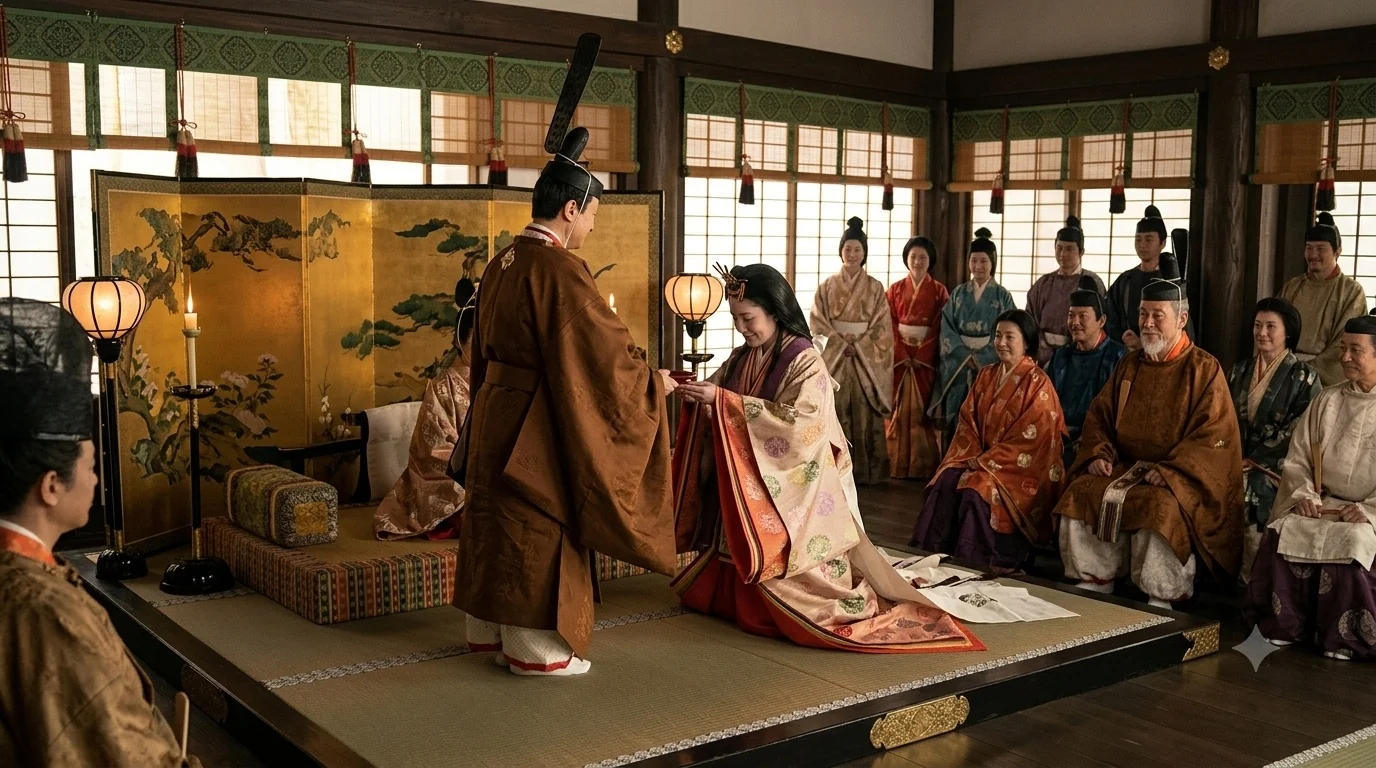
The Fujiwara in Japan show the outcome a ruler might want to avoid. The family married daughters to emperors and then governed through the grandsons those marriages produced, holding regental office across generations. Whether Wang Geon knew of this is not something we can claim — the record does not say — but it is the clearest case of an outside family expanding its power through royal marriage.
Against those, Goryeo’s arrangement was its own: consorts drawn from many houses, daughters kept largely inside.
The bill came later
There is a line the drama gives Lady Hwangbo — that if marriage is to be used to bind her, she will use marriage to become the master of Goryeo. It is written dialogue, not a quotation from any record, and it reads the situation correctly. In the early Goryeo court marriage was not a matter of feeling. Which house a woman came from set her son’s odds of surviving; who her children married set her own standing in old age.
And the arrangement solved Taejo’s problem at his successors’ expense. Many sons, many maternal houses, all of them inside one palace, and very few daughters spent on building new alliances outside it. The next generation inherited that room.
That is where Gwangjong comes in — and what he did to the men in it is a separate story.
This article was researched and written by K-Drama History. Source: Nine Daughters, One Outside Son-in-Law — and He Had Already Surrendered His Kingdom — K-Drama History